
1. Overview and background
The transitional process of student veterans from military to civilian life is fraught with unique stressors that can adversely affect their learning and academic outcomes. For the transition to occur well, student veterans need a support system outside the military (Vacchi & Berger, 2014). The Forever GI Bill has no end date, which should perpetuate a stable population of student veterans in higher education.
There is limited research regarding factors conducive to the academic success of student veterans, particularly those who have suffered cognitive injuries. This article outlines this problem with recommendations and suggestions for faculty, ancillary staff, and administrative staff at universities to increase retention, learning outcomes, and positive contributions to student veterans. This article also discusses the issue of student veterans in higher education against the background of the institutional, relational, and internal factors that serve to support this nontraditional student demographic.
A historical perspective describes the reason for the recent influx of student veterans in higher education. The signing into law of the Servicemen’s Readjustment Act (also known as the GI Bill) in 1944 and the end of World War II gave rise to an increase in the student veteran population on college campuses in the United States. Later, the signing into law of the Post-9/11 GI Bill in 2008 further increased the ranks of student veterans in higher education (U.S. Department of Veterans’ Affairs, 2012). Through these bills, the Department of Veterans Affairs has provided educational benefits to veterans and their families by equipping them to learn and develop professional skills in preparation for civilian life. Governmental provision of educational benefits for veterans is a way of compensating American veterans for military service (Altschuler & Blumin, 2009). The Servicemen’s Readjustment Act of 1944, which was the original GI Bill, put into place the programs and benefits that focus on helping veterans transition from the military into civilian life. These benefits included unemployment benefits, business loans, home loans, and educational opportunities. It was the educational benefit, and a vital part of the GI Bill (Olson, 1974). The GI Bill has provided educational assistance to service members, veterans, and their dependents through stipends for tuition and other expenses for college or trade schools. Initially, more than 2.2 million veterans pursued a college education between 1946 and 1950 (Clark, 1998; Serow, 2004; Thelin, 2004). This increased access to higher education for veterans and their families resulted in 5.2 million veterans, or 28% of all veterans, completing a postsecondary degree or credential between 1992 and 2017 (Postsecondary National Policy Institute, 2019). By 2025, this has increased to over 44% of student veterans receiving some form of federal Title IV financial aid other than GI Bill or Department of Defense (DOD) benefits in the 2019–2020 academic year (NCES, 2023). By the 2022–2023 academic year, 429,704 students received Post-9/11 GI Bill Financial Benefits while 229,103 received DOD Tuition Assistance Program benefits (NCES, 2025).
The social context from this study outlines financial and political themes surrounding student veterans. The years after WWII marked an increase in the societal, financial, and governmental support of student veterans. However, after the Korean and Vietnam Wars, the focus and attention on student veterans waned, and there was a lull in the scholarly inquiry into this student demographic. For political reasons, veterans from the Vietnam War era faced a societal stigma, and student retention literature in the 1970s began to focus on traditional students rather than nontraditional students. According to Olson (1974), the negative perceptions toward Vietnam War veterans were revealed in federal policy and reduced GI Bill benefits. The GI Bill of the Vietnam era was insufficient, and the Vietnam Education Assistance Program (VEAP) was developed to better the GI Bill of the Vietnam era (U.S. Department of Veterans’ Affairs, 2013). The VEAP evolved into the Veterans Education Assistance Program, offering a $2 to $1 government-match for education benefits. To further improve on the VEAP, the Montgomery GI Bill was established in 1985. It was planned and implemented by the US military as a tool to recruit for an all-volunteer force. Eventually, the Post 9/11 GI Bill benefits were developed as an improvement to the Montgomery GI Bill (Vacchi & Berger, 2014).
The generous contemporary financial benefits afforded to veterans by the US Government are an expression of gratitude for serving in the nation’s military (Shinseki, 2013). However, this financial benefit is not a guarantee of educational success. For student veterans to succeed in college, there must be a good understanding of the unique stressors and needs of this student population, and universities need to invest in strategies and frameworks that support student veterans as they adapt from the military to the higher education academic environment (Vacchi & Berger, 2014). By learning more about student veterans and what contributes to their success, the stage can be set to ensure educational success for this immense group of nontraditional students.
The theoretical context of this study focuses on theories used in student veteran literature. Some literature on student veterans leans on Schlossberg’s 4S model (1981) as a theoretical framework (DiRamio et al., 2008; Livingston et al., 2011; Rumann & Hamrick, 2010; Van Dusen, 2012). However, this is a flawed approach as Schlossberg’s 4S Model is a counseling strategy, not a theory. Using Schlossberg’s Theory (1981) would have been more appropriate, as exemplified in the scholarship of Diamond (2012) and Young (2012). Further, while there may be some overlap between adults in mid-career transition and student veterans in higher education, the complexity and nuances of experiences of student veterans in college cannot be fully explained with a model that does not allow for a comprehensive approach (Vacchi & Berger, 2014). Not only do the transition experiences of student veterans potentially include identity shifts as they leave the military and enter college as adults, but student veterans between the ages of 17 and 25 are in the process of maturing as adults mentally, emotionally, and neurologically (Piaget, 1970/1972; Steinberg, 2007; Vacchi, 2011).
Although DiRamio’s model focuses on student veterans, it does so through the lens of Tinto’s theory of student attrition (1975, 1993), which was developed for traditional college students within the highly social context of the college campus. This inadequate approach renders the model ineffective in assessing the unique experiences of student veterans. This study offers a strengths-based perspective on how student veterans succeed in college.
With the influx of student veterans in higher education, institutions of higher education are exploring ways to integrate this student demographic. As an alternative to taking a deficit model and seeking to either fill in the blanks or fix what is wrong, this qualitative study explored the perspectives of combat student veterans on the factors that facilitated their success in college.
2. Problem and purpose of study
The unique stressors that student veterans face can adversely affect their learning and education, and there is limited understanding regarding what comprises the success of student veterans and especially of those who have suffered cognitive injuries. The transition from military to civilian life is challenging and can be a culture shock for student veterans (Kato et al., 2016). These aspiring students need a support system outside the military. Student veterans face stereotypical perceptions from other students regarding the military, veterans, and PTSD.
There has been an increased number of student veterans on college campuses as they seek higher education to prepare for a purposeful career and financial stability in civilian life. This demographic has unique challenges in the transition from the combat-related military environments to the college campus environment, heightening the need for colleges to have the right kind of support systems to ensure their academic success. There has been a need for policies and programs tailored to address their unique needs (Borsari et al., 2017; Mobley et al., 2019) that have been unevenly met by college institutions.
The purpose of this case study was to gain a deeper understanding of the factors that support the success of combat student veterans in higher education. The central phenomenon was the experiences of student veterans in college that led to successful outcomes, such as graduation or job attainment. To specify the inclusive population, I use Vacchi’s definition for student veterans, “A student veteran is a student who is a current or former member of the Active Duty Military, the National Guard, or Reserves, regardless of deployment status, combat experience, or legal status as a veteran” (Vacchi, 2012, p. 17).
3. Theoretical framework
This study was framed by Astin’s developmental theory of student involvement for higher education (Astin, 1984, 1991). Astin’s inputs–environment–outcome (I–E–O) model (1984, 1991) is a diagrammatic representation of the theory, showing that student outcomes are a function of their personal characteristics as they interact with experiences in the higher education environment. In this model, inputs are the demographic characteristics, family backgrounds, and academic and social experiences that students bring to the environment of higher education, whether on or off-campus, and outcomes, which are students’ characteristics, knowledge, skills, attitudes, values, beliefs, and behaviors as they exist after college (Pascarella & Terenzini, 2005).
The conceptual model for this study was Vacchi’s model for student veteran support (Vacchi & Berger, 2014). Appropriately, this model situates within the environment of Astin’s I–E–O theory and focuses directly on the individual student veteran. The four tenets, or cornerstones, of the model support the successful degree completion of veterans. In this model, the vertical axis is aligned with the effectiveness of services for student veterans, and the horizontal axis is aligned with peer support, external campus support, and interactions with faculty and students in and out of the classroom. Based on the empirical work of Bean and Metzner (1985) and Weidman (1989), Vacchi’s model is the most grounded and empirically sound model developed to explore the experiences of veterans in college since 2008.
The theoretical significance and contribution of this study to the theoretical framework is the validation of Astin’s theory of student involvement (Astin, 1975, 1991; Pascarella & Terenzini, 2005). This study also supported newer models of student veteran support that focus on the student veteran experience in college from a strengths perspective. Specifically, Diamond’s (2012) Adaptive Military Transition Theory renders a cohesive explanation of the individuality of each student veteran in the larger context of their transitional journey to and through a new environment.
4. Empirical and practical significance of the study
This study has practical and empirical implications and builds upon prior work by scholars in veteran studies. Results of this study, when implemented, can improve the experience of student veterans in higher education, faculty and staff characteristics, and true veteran-friendliness of universities. This data can be used not only to improve the experiences of student veterans but also to assist staff and higher education administrators in effect change and interact more meaningfully with students.
The yielded data can help universities create environments conducive to student veterans’ success. Faculty, staff, and students can use this information to relate to student veterans with more emotional intelligence (Love et al., 2015). Additionally, policies, procedures, and operations at various support service offices can be improved so that student veterans are more likely to use these services. In addition, this study provided answers and evidence to guide programs and policies in higher education for student veterans, particularly related to what they need to succeed. This study also provided information to develop substantial direction and support for student veterans. The core inquiry of this study was the exploration of the factors that are supportive of combat student veterans at a private institution of higher education.
5. Methodology
This qualitative study was a single case design with multiple embedded units of analysis to explore institutional factors, relational factors, peer factors, and internal factors supporting student veterans at a private Christian institution of higher education. An embedded case study design was considered as embedded multiple units of analysis demonstrated different perspectives within one case (Yin, 2018). The selection of the case was related to the theoretical assertions of Astin’s I–E–O model. This single case design authenticates and confirms Astin’s I–E–O model while involving multiple units of analysis, including data not only from combat student veterans, but also from faculty and staff of support services at the institution. The embedded case study design also served to maintain the focus of the study on the factors contributing to the success of combat student veterans in higher education, while examining perspectives from those who interact with combat student veterans. All subthemes and subunits were connected to the larger unit of analysis, in this case, the university.
The participants in this study were eight staff members, as well as eight combat student veterans in residential or online programs, undergraduate or graduate programs, who were 18 years old or older. One of the features of a case study is that it is bounded, being defined within parameters (Creswell & Poth, 2018). In this case, the parameters are the private institution of higher education, and combat student veterans 18 years of age and above, in any residential or online undergraduate and graduate programs from 2011 to 2021. According to Yin (2018), the choice of methodology in qualitative inquiry depends largely on the research questions, to the extent that the research questions aim to explain a circumstance, and to the extent that the research questions require a comprehensive explanation and description of a social phenomenon. Additionally, Yin explained the bent toward a case study method if the main research questions are exploratory, if the researcher has none to scant control over the behavioral events, and if the focus of the study is contemporary rather than historical. The purpose of the research, the problem, and the questions all espoused the above three characteristics, lending further strength to this choice of qualitative inquiry. Moreover, this was about group behavior, organizational processes, and school performance, all of which are stated by Yin as a “distinctive need for case studies” (2018, p. 5). Case studies are also the preferred method when the intent is to study contemporary events, and the reliance on direct observation and interviews as techniques is heavy (Yin, 2018).
6. Results
Each theme below is presented from the vantage point of the combat student veteran first, with the intention that the voices of the students remain uppermost as the data are presented (Figure 1).
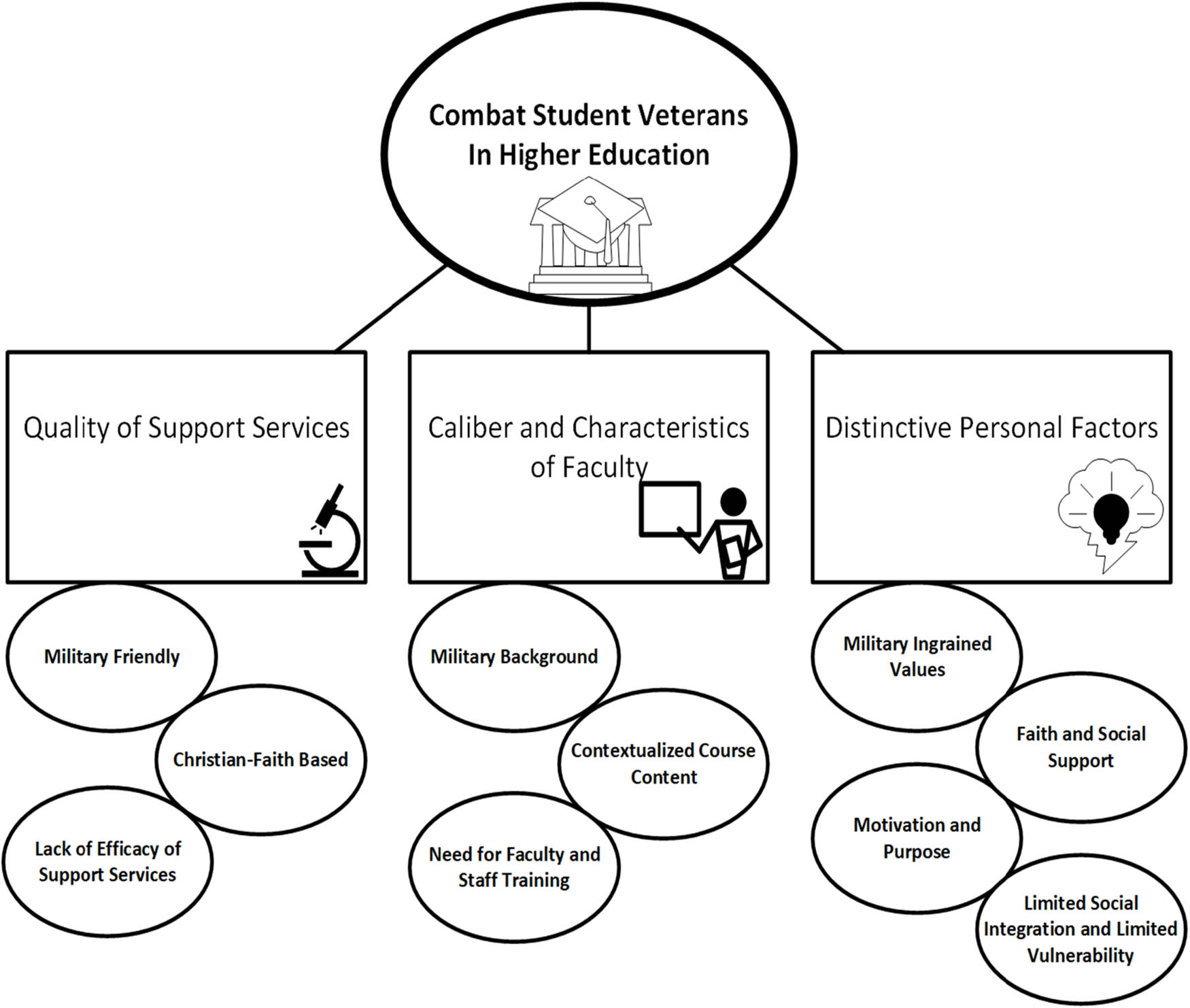
Figure 1
Model for student veteran support: The environment in higher education. A diagrammatic representation of themes and subthemes.
Source: Author’s contribution.
6.1. Quality of support services
Efficacious services offered by well-informed departments are what student veterans find supportive. Services designed to attend to needs promptly, while undergirded by a Christian worldview, made a positive difference for this nontraditional student population at this university (Figure 2). The Veterans Support Services Center was affirmed by undergraduate residential students as a positive contribution and source of assistance, as well as a sense of camaraderie and community with their peers. Services related to academic performance were mentioned with recommendations for improvement, and services for health-related concerns were mentioned sparsely, only when specifically prompted.
A mixed methods study (Benbow & Lee, 2025) of 531 student veterans showed that it is not merely the awareness of but the actual utilization of support services that has the potential to lead to success; underutilization of support services is a potential detractor. Higher levels of engagement with services are associated positively and significantly with a sense of belonging and institutional satisfaction, which in turn are strong predictors of academic persistence and success. When student veterans do not use readily available support services, they are more apt to experience academic challenges, disengagement, and even attrition.
6.2. Military-friendly
The extent of the military-friendliness of the university differed according to individual perspectives. Unsurprisingly, the undergraduate students adopted a linear perspective tied directly to their experience on campus, while the graduate and online students favored the financial and accessibility aspects of the benefits. Supporting student veterans in the current socio-economic climate is what makes the difference. While the financial considerations for student veterans were significant and evident, they are not the ultimate yardstick of military-friendliness. Any social and peer support within a social media group for students, including university library resources for research and writing, lent to positive experiences of support services for online and residential students.
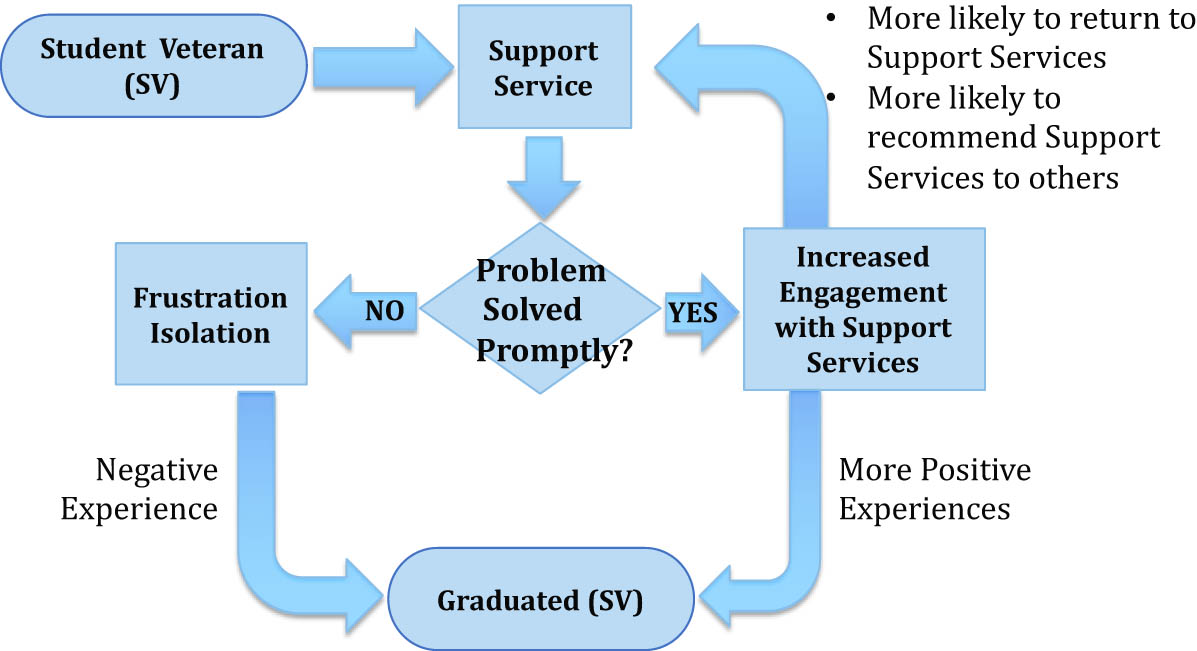
Figure 2
Path to engagement with support services.
Source: Author’s contribution.
The path to increased engagement with support services is straightforward but not linear. It requires additional effort and a demonstration of true caring by professors and staff, by going the extra mile for students: those who did not do so contributed inadvertently to student frustration.
While good leadership at the university included those who served in the military and patriotic leadership, and those who understand the value of military training and background and what veterans bring to institutions of higher education, ultimately, leadership qualities are channeled in higher education to support other veterans. This strategy should be harnessed and embraced by senior leadership. There is further empirical evidence of the efficacy of university efforts toward developing military-focused student support services (Benbow & Lee, 2025). This can be implemented via administrative expertise and social support targeted specifically to nontraditional students.
How students utilize support services is the student’s responsibility and can vary widely between residential and online students. Educating student veterans on available resources and guiding them to understand how using support services can contribute to successful academic performance. Overcoming veterans’ general reluctance to use support services is a lynchpin to the success of getting veterans to engage with support services (Vacchi & Berger, 2014). Assisting student veterans and providing faculty training to understand veterans better is part of this strategy. A study underlining the need for faculty and staff to develop a better understanding of the unique and specific needs of this student demographic (Rolland et al., 2023) further corroborates this finding and interpretation.
6.3. Christian faith-based
Military friendliness was tied to a Christian worldview by more than one participant. Some chose this university to further their education not only because of its military friendliness but also due to the faith-based education, staff, and faculty. While a faith-based world-view assuredly helped the success of veterans in this study, we acknowledge this may not be universally necessary for student veteran success.
6.4. Limited efficacy of support services
While the combat student veteran participants had suffered invisible injuries in combat, the prevailing mindset was that this was a relatively minor problem in the larger context of accomplishing the mission of degree completion in higher education. Some participants admitted that veterans struggling with severe, real psychological problems who are not seeking help can be problematic academically, but that was part of their internal stance. If faculty understand that combat student veterans may have underlying problems that could impact success, and if they are trained to recognize and sensitively approach a struggling student, this can make a positive difference. This is clearly a situation where staff at the university have difficulty assisting the student veteran, partly because of the student veteran’s reluctance to reveal a known need. The role of grit as a means and mediator indicative of the relationship between student-veteran status and not seeking mental health (Cody, 2021; Wilson et al., 2023) further corroborates this finding.
6.5. Use of disability services
All the steps that support services could offer are galvanized into action only once the student has asked for help; 75% of the student participants had not pursued any specific treatment for invisible injuries, and none had approached Disability Support Services for accommodations. The two student veterans who were seeking medical treatment were doing so in parallel with their studies while considering degree attainment a primary goal and their health concerns a distant secondary goal. An inherent problem is that invisible injuries are sometimes brought to light by the student’s choice which first requires admission of a perceived flaw, which goes against the grain of all that military training inculcates (Soeters et al., 2007; Vacchi & Berger, 2014). One key is that faculty and staff must send the message that there are no negative effects to admitting a need for assistance.
6.6. Timeliness of support services
A detractor from the quality of support services was the timeliness of support services. The more timely, the better received and helpful. Accessing support for online students adds to the complexity of juggling academic work with work and family commitments (Figure 2).
6.7. Characteristics of faculty and staff
The qualities of faculty were judged as strong contributors to the student experience of combat student veterans. This included the personal characteristics of faculty, their military background, and their skill in teaching. Student veterans highly regarded the faculty who chose to take the initiative in interacting with students, fostering a sense of belonging, and providing thoughtful feedback on assignments. Faculty who set high, rigorous academic standards were respected by student veterans.
6.7.1. Military background
This was deemed a significant contributor to a positive student experience, although participants recognized that even faculty with non-military backgrounds contribute powerfully to the positive experience of combat student veterans. Approachability was important, and the discerning approach of the professors made the academic experience outstanding. While faculty with a military background gained near-immediate credibility with the students, other faculty easily gained credibility by being student-focused in their role as professors.
6.7.2. Contextualized course content
A minor theme with important implications was revealed by some participants as lending academic rigor to coursework and credibility to faculty: the ability to contextualize coursework to real life. Not contextualizing course content with real-life examples and experiences struck a discordant note for combat student veterans in their otherwise neutral or pleasant experience in higher education.
6.7.3. Need for faculty and staff training
Specific deterrents to success were identified in some faculty who might benefit from additional training, especially if faculty treated students as a homogenous group. Any lack of engagement by adjunct faculty was identified as another area that would benefit from additional training. The bar could be set higher for expectations and accountability for students and faculty. Any reduced accountability structure afforded by online methods of instruction and learning worked against students who had the desire to give their best.
6.8. Distinctive personal factors
Personal factors with which combat student veterans come to higher education served to drive them to academic success and degree completion. Their military training, deeply ingrained values, faith, and a strong sense of purpose and independence served as synergistic forces in the higher education environment. Many of the participants took rightful pride in serving their country and being identified as veterans. They had developed a sense of responsibility, a strong work ethic, and matured because of their military background.
6.8.1. Military-ingrained values
Participants shared traits learned in training: resiliency, adaptability, mental agility, discipline, and a strong work ethic combine to help facilitate success in higher education. A common theme for combat student veterans was the extent to which they had been given responsibilities when in the military. The reality and conviction that they were responsible for issues directly and indirectly pertaining to life and death bore heavily on them. They could not let the team down, and they had to succeed. The mindset of persistence, endurance, and never giving up, all applied to academics and helped them toward success in higher education, whether measured by grades or degree completion.
6.8.2. Faith and social support
Most participants attributed some aspect of their success in higher education to the invisible and sure presence of God, and their faith as Christians, in addition to the support and encouragement they received from a spouse, parents, or immediate family members. Their humble acknowledgment of these factors was sincerely and gratefully stated. Some participants considered this important enough to make it one of the primary reasons for selecting a faith-based university.
6.8.3. Motivation and purpose
Combat student veterans approached their role as students with a strong desire to have the mission accomplished, along with their value system, and a supportive family. Participants took ownership of their professional and academic journey and had a strong desire to excel. Their motivation, drive to excel, desire to serve others, and a well-thought-out strategy to reach their goals encapsulated their honorable motivations not only in the military but also in academia.
6.8.4. Limited social integration and limited vulnerability
The identity of combat student veterans as a factor of military socialization was evident in the responses of combat student veterans to questions related to their interactions with others in college. The harsh and hardening experience of being a combat student veteran was life-altering and enforced personal change. Injuries that civilians would consider an emergency were often downplayed by combat student veterans as an obstacle to face and a challenge to rise above. Participants who sustained invisible injuries reported having dealt with symptoms by sheer force of doggedness and the awareness that they were part of a team and did not want to be the weak link. They had deprioritized the issue of invisible injuries to prioritize their education. For the few participants who did pursue medical treatment for their injuries, that was a pursuit secondary to their academic work and family life. Staff and faculty who worked closely with student veterans stated their biggest challenge was having the student self-identify when they needed assistance.
7. Outlier data and findings
These nontraditional students are not a homogeneous group. The participants in this study were in online programs, residential programs, undergraduate and graduate students, and had varied military backgrounds. The uniqueness of each participant inevitably yielded outlier data. Some non-military faculty were seen as better faculty members for these nontraditional students. The rationale being that the faculty member would be more inclined to offer an unbiased approach while also ensuring consistency of expectations for all students. These students did not want to be treated as special or different and did not want to take unfair advantage of their protected veteran status.
Some lack of awareness about disability support services was suggestive of the disconnect in communication between a military-friendly university and the student veteran who could have known about Disability Support Services. There were instances in which a student who could have benefited from Disability Support Services on campus did not, due to a lack of awareness. This could be a compelling reason to make a faculty orientation course, or at least materials, mandatory for all student veterans.
One misguided prerogative was that while social integration can be problematic for nontraditional students, and the university, faculty, and staff have their role in bridging the gap, student veterans also have a responsibility to recognize the norms on a college campus and seek to integrate socially. Faculty, too, could benefit from training in how best to communicate the importance of community, assignments and to encourage inclusion. However, feelings that result from a combat student veteran feeling out of place need to be addressed not only by faculty but also by the student. A misguided sense of privilege and entitlement creates a tension for the student veteran who resists academic integration. Such a student would be disadvantaged because academic integration is conducive to academic success, even when social integration is disregarded.
8. Limitations
Vacchi’s conceptual model for student veteran support was conceived for undergraduate residential student veterans but was used for both graduate and undergraduate students and online and residential students. However, the graduate combat student veterans were able to reflect on their undergraduate experience and compare their undergraduate experience with their graduate experience at the university. Atlantic State University.
The propensity of combat student veterans to avoid disclosing injuries may have been a factor that caused them to downplay the seriousness of their injuries. This study focused on combat student veterans and is susceptible to a lack of transferability to all student veterans or to all nontraditional students. Still, there is the possibility that the findings of this study to be transferable to other injured or disabled students and broader veteran and nontraditional student populations. The COVID-19 pandemic caused all interviews to be held virtually and resulted in residential students taking most of their classes online; this may have altered their perceptions of support services.
This study focused on combat student veterans who had invisible injuries and mTBI of a severity that did not deter them from active learning in the classroom or from pursuing a higher education degree. This delimitation was chosen to demonstrate that while combat student veterans may have had invisible injuries such as blast-induced concussions or vestibular injuries, they may have residual symptoms, but by sheer force of true grit, these invisible injuries were not considered as deterrents to their pursuit of a higher education degree. As the results demonstrated, these types of invisible injuries were perceived by combat student veterans to be relatively minor and not problematic. This single-site study was conducted at a private university with a significant student veteran population. The university was selected for its military-friendliness, which was an influential factor mentioned by all combat student veterans without exception. The rationale for selecting a single site for this study was to define the study’s scope and sharpen the researcher’s understanding of factors in the environment of combat student veterans, all of whom attended this same university. In addition, using a single site for this study enabled the researcher to access staff who had interdepartmental access and interactions, which was valuable to an understanding of the complexity of combat student veteran success in higher education. Both graduate and undergraduate students in online and residential programs were participants in this study. This yielded valuable insight because the graduate students reflected on their undergraduate experience and compared it to their graduate experience at this university. The study was conducted at a Christian University. The faith-based nature of the university was mentioned as influential in their college choice.
9. Recommendations for future research
A study focusing solely on undergraduate students may help determine more accurately the challenges that combat student veterans have as they transition to higher education, because graduate students have often developed strategies to overcome similar challenges. A study on combat student veterans with increased severity of invisible injuries may yield valuable data on their needs and tendency to use disability services in college. Moreover, including details of the medical problems that combat student veterans have had, and which may easily affect their executive function, may be useful in a study designed to explore the use of Disability Services by students with a medical history of concussions or other forms of TBI. The findings of a multi-site study may be generalizable to larger populations. A study involving public universities may capture student veterans from more varied socio-economic and faith backgrounds, thereby increasing generalizability and reducing bias. Another possible study would be a quantitative analysis to quantify the relative strength of the inputs in Astin’s I–E–O with combat student veterans over traditional students to understand the relative impact of inputs and the environment on the output. A phenomenological study may be helpful in capturing the essence of the distinctive factors of combat student veterans in higher education while yielding information on the uniqueness of combat student veterans in higher education. A life-history narrative of a single participant, with multiple types of data collected longitudinally and with a narrative approach, would yield data that could be viewed as a video versus a snapshot in time. This collaborative approach may yield a rich understanding of the subject within a larger social and institutional dimension. A study in which staff at integral departments, such as the Veterans Office, can participate in a face-to-face interview and focus group would help create a multi-dimensional understanding of the research problem, rather than a two-dimensional perspective allowed by written responses, which does not allow for conversational follow-up.
10. Conclusions
Combat student veterans in higher education espouse core values contributing to their success as students in higher education. These military-ingrained and foundational values serve as a taproot from which they thrive in college. While support services can be helpful, if they are found to be neutral or detractors, combat veterans have the resiliency to overcome detracting factors and meet their goal of pursuing a college degree. This is not to suggest that colleges should ignore serving veterans because they will succeed anyway, quite the contrary, as valued services were regarded by participants as helpful in their success as students. Whether their student experience is positive or not, they will likely emerge with their mission accomplished. Universities that take the initiative and make changes to enhance their services for this population may find that their military-friendliness rises more than the success of student veterans, which may be independent of the university’s support services available to them. While this may not be true for all student veterans, this was reportedly true in the representative sample of combat student veterans with invisible injuries. As evident in Astin’s I–E–O model (1984), the student combat veteran who enters college with a solid “input” has within them the force multipliers for success in the higher education “environment,” and can emerge with the “output” of successful degree completion.
This case study brought to light a deeper understanding of the factors that support combat student veterans in a private institution of higher education, especially for those who have suffered invisible injuries. Institutional factors, internal factors, peers, academic interactions, campus services, transitional courses, orientations, and social connections with the military all serve student veterans in a way that elicits their involvement and gives them a richer academic experience.
Institutions of higher education can support student veterans in meaningful ways that contribute to their success. Institutional support systems focused on student veterans’ specific needs and concerns, strategies to facilitate access to these services, and military-friendly policies and procedures are all helpful in creating a thriving environment. Learning about military culture, positioning to serve this student population, and being approachable go a long way toward creating a welcoming and supportive atmosphere.
Acknowledgments
My sincere thanks to Dr. David Vacchi and Dr. Lisa Foster who were instrumental in the successful completion of this study. Above all to God: “That the communication of thy faith may become effectual by the acknowledging of every good thing which is in you in Christ Jesus.” Philemon v.6, The Holy Bible.
Funding information
This research received no specific grant from any funding agency in the public, commercial, or not-for-profit sectors.
Author contributions
Mona Fazzina served as the primary author and was responsible for the conceptualization, design, and execution of the study. She conducted the research, analyzed the data, and prepared the initial manuscript draft. Dr. David Vacchi provided oversight, guidance, and critical feedback and recommended throughout the research process and manuscript development.
Conflict of interest statement
Authors state no conflict of interest.