
1. Exploring the effects of positive and negative normative information on an exercise endurance task
Social norms, or the perceptions that individuals have regarding what others do, can be a powerful influence on behavioral choices. Field-based studies have provided evidence that interventions disseminating information about social norms can increase positive health-related behaviors and decrease undesirable behaviors (Mollen et al., 2013). Few researchers, however, have tested social norm interventions in field settings designed to increase physical activity (PA). Though scant, evidence supporting the use of social norms to increase PA does exist. Generally, field-based research into social norm and PA interventions has used a pre-posttest design that relies on self-reported PA as the outcome variable (Priebe & Spink, 2012, 2015). However, recent investigations have begun to utilize an experimental design for furthering norm and PA research.
The focus theory of normative conduct (FTNC) has been used to guide research exploring how social norms affect behavioral choices. In the FTNC (Cialdini et al., 1990), norms are delineated as either descriptive or injunctive. Descriptive norms are defined as the perception of what the majority of one’s peers are participating in (i.e., what I think most of my friends are doing). Injunctive norms are distinct from descriptive norms in that they convey a perception of the approval or disapproval of the target behavior. The FTNC also characterizes norms as proximal (close peer group) or distal (larger population), recognizing that proximal norms are more influential than distal norms (Yun & Silk, 2011). Norm perceptions are often the byproduct of a “trigger.” A trigger is something that draws an individual’s attention to the social norms in their environment. With many conflicting triggers vying for an individual’s attention, it is those messages that are most salient or most focused on that are most likely to influence behavior (Cialdini et al., 1990).
Triggers are used in field base studies and experimental designs to present normative information and investigate how norms affect behavior. For example, Priebe and Spink (2014) tested the effect of positive verbal normative triggers on effort exerted in a muscular endurance task. When controlling for initial performance, the intervention group performed significantly better than the control group on the second trial. Additionally, the normative information was associated with increased task self-efficacy for the second trial.
Properly activated norm triggers can produce increases in exercise effort and task self-efficacy (Crozier & Spink, 2017; Priebe & Spink, 2014). Self-efficacy (Bandura, 1977), defined as the belief that an individual can successfully execute a task in a specific situation, is a strong predictor of participatory behavior. Researchers have hypothesized that self-efficacy is influenced by social norms through the vehicle of vicarious experience, one of the four sources of information influencing self-efficacy as outlined in Bandura (1977). In the study by Priebe and Spink (2014), vicarious experience was invoked when researchers informed participants of the performance of other similar participants. Individuals provided with a descriptive norm message reported a higher post-manipulation self-efficacy score than those in the control group. To date, the Priebe and Spink (2014) study is the only one of its kind to test self-efficacy, social norms, and exercise behavior. This initial work makes a significant contribution to the literature regarding how normative information can be used to promote effort, and provides a basis for extending this work to more closely examine how normative information affects behavior. It is clear that insight into how normative information affects self-efficacy is valuable, especially when considered in light of strong evidence that self-efficacy predicts exercise behavior (McAuley, 1993).
Another aspect of the influence of normative information that has not been explored is the effect of negative normative information. This is especially important in light of the preponderance of information presented in the media about high rates of physical inactivity. The effect of normative information that highlights the majority of the population does not meet recommended levels of PA has not been explored. It seems plausible, however, that this information may actually lead to higher levels of physical inactivity. A study by Cialdini et al. (2006) provides some insight into how descriptive norms about the prevalence of negative actions can affect behavior. Cialdini et al. (1990) introduced norm triggers in the form of signs posted around a park with the goal of decreasing petrified wood theft. Their descriptive norm trigger emphasized the fact that many past visitors had removed petrified wood from the park. Instead of reducing theft, the message highlighting the high frequency of theft resulted in an increase in wood theft in areas where those particular signs were posted. Rather than decreasing the target behavior, the trigger activated the normative perception that the majority of people who visit the park are stealing wood, so stealing wood was not a big deal.
In terms of norms and PA, attempts to motivate individuals to increase their PA by increasing their awareness that a large percentage of their peers are sedentary is providing negative normative information. While the goal of this approach is commendable, this message could actually be emphasizing that being sedentary is acceptable and characteristic of the majority. Consequently, individuals may be less likely to be ostracized for being sedentary because it is the norm. The study by Cialdini et al. (2006) suggests that negative normative information may reinforce a negative behavior, but the effect of negative normative cues has not been explored in PA. The purpose of this study was to further explore the effects of normative triggers on exercise, extending the Priebe and Spink (2014) study by investigating the effect that messages about low performance have on decisions to exert effort on an endurance task.
The utility of this study is three-fold. First, findings add to the literature on social norms and exercise providing valuable insight into the influence social norms exert on exercise effort. Second, findings from this study provide seminal data on the effects of descriptive negative norms on single bouts of exercise, providing direction for future interventions containing a normative trigger component. Third, the design provides a basis for a more thorough investigation of the effect of normative information on self-efficacy by including a baseline measure for comparison.
Based on normative principles outlined in FTNC and previous research by Liddelow et al. (2025), Lin et al. (2023), and Priebe and Spink (2014), the following hypotheses were tested:
H1: Provision of positive normative information would increase performance on an exercise endurance task while provision of negative normative information would result in a performance decrement, as compared to the absence of normative information.
H2: Provision of positive normative information would increase self-efficacy on an exercise endurance task while provision of negative normative information would result in a decrease in self-efficacy, as compared to the absence of normative information.
2. Methods
2.1. Participants
The participants for this study were 102 undergraduate students (50% males and 50% females, M age = 22.06 years) recruited from various Kinesiology classes at a large university in the Southeastern United States. The racial make-up of participants was 17% (17) African American, 3% (3) Asian, 74% (74) Caucasian, 1% (1) Pacific Islander, 5% (5) other/unreported; ethnicity 4% (4) Hispanic, 63% (63) non-Hispanic; 33% (33) unreported; with 93% (93) reporting they had performed a plank in the last year. This sample size yielded an acceptable level of observed power (Power = 0.95). Participants were told that the purpose of the study was to establish norms for college students’ performance on the abdominal endurance plank. They were randomly assigned to one of the three groups: positive normative information, negative normative information, and control (no information). Thirty-four (17 males and 17 females) participants were assigned to each condition.
2.2. Instrumentation
2.2.1. PA readiness questionnaire (PAR-Q)
The PAR-Q was used to screen participants before they participated in the study to eliminate participants who were at an increased risk of health problems during exercise (CSEP, 2002). This questionnaire consists of seven dichotomous statements about recent health. Example items are “Do you feel pain in your chest when you are physically active?” and “Do you lose your balance because of dizziness or do you ever lose consciousness?” Individuals were required to answer “no” to all questions to participate in the study.
2.2.2. Plank self-efficacy
This measure was developed by Priebe and Spink (2014) to assess an individual’s level of confidence in their ability to hold a second abdominal plank. The plank self-efficacy tool consists of five items on an 11-point Likert scale measuring task self-efficacy for completing a second plank (0% = I definitely cannot; 100% = I definitely can) with sample questions such as “Rate your confidence in your ability to hold the second abdominal plank for 20% more time than you held the first plank.” Modifications in the scale were made to address the inclusion of negative normative information in this study. The modifications were tested during a pilot study and were found to be psychometrically appropriate. Additionally, the items were modified to provide an assessment of the participants’ general level of efficacy to perform a plank. Again, five items were used with the 11-point Likert response scale, but the items were stated in terms of how confident participants were in their ability to hold an abdominal plank for a percentage of time (i.e., at least 80% of the average, 90% of the average, the average, 10% longer than the average, and 20% longer than the average) as peers of the same age and sex.
2.2.3. Plank peer norms
This measure was created by Priebe and Spink (2014) to asses an individual’s perception of the amount of time a peer of the same age, sex, and fitness level could hold an abdominal plank. The plank peer norm tool consisted of one item on a seven-point Likert (decreased 40%; increased 40%) scale measuring normative perceptions with the question “What do you think happened when others like you (i.e., same age range, sex, and fitness level) performed their second timed plank hold?” (Priebe & Spink, 2014).
2.2.4. Manipulation check
This measure was developed by Priebe and Spink (2012) to assess the quality of the trigger used in the experimental group. The norm trigger manipulation consisted of four items on a seven-point Likert scale (1 = strongly disagree; 7 = strongly agree) measuring message quality with questions such as “The information about others performance was … believable, relevant, easy to understand, persuasive” (Priebe & Spink, 2012, 2014).
2.3. Procedures
We tested participants individually. First, we asked each participant to complete a PAR-Q, consent form, and the pre-test survey, including demographic questions, experience with the abdominal plank, and initial self-efficacy. Next we read each participant the instructions verbatim by the researcher to ensure reliability of instruction quality. Following the instructions, we showed each participant a sex appropriate video of an individual performing an abdominal plank using proper form, and also demonstrating errors and improper form for clarity. Following the conclusion of the video, each participant performed an abdominal plank and was asked to exert maximal effort (i.e., hold the plank as long as possible). Once the plank timer started, we gave each participant a warning if his/her torso and legs were no longer horizontally aligned (i.e., bending of the knees, raising the hips, or arching the back). We stopped the timer when either the participant said they were done, the participant displayed improper form after being warned once, or after 5 min was reached to protect against unnecessary strain on the participants’ shoulders or lower back. Participants who could hold a plank for 5 min were to have been excluded from the study, but this did not occur. The timer was not visible to the participants during either plank attempt and the researcher gave no feedback related to time until the second plank was completed. The only performance feedback we provided was a single warning of improper form (if necessary) during each plank attempt.
Immediately following the first plank we gave participants a 3 min rest period. As the rest period began, participants completed a brief survey measuring their self-efficacy in terms of how long they believed they could hold a second plank and their perception of how long they believed their peers could hold a second plank. Information provided during the rest period varied according to group assignment. We simply reminded the control group that at the end of the 3-min rest period they would be asked to perform a second maximal effort plank. We informed the positive norm test group that peers of the same age, gender, and similar skill level typically held their second plank for “at least 20% longer than they held their first plank.” We told the negative norm group that their peers of the same age, gender, and similar skill level typically held the second plank for “less than 80% as long as they held their first plank.” With 30 s left in the rest period, the participants completed a second self-efficacy assessment identical to the efficacy assessment they completed at the start of the rest period. Immediately following the 3 min rest period all participants completed a second maximal effort plank. After the completion of the second plank, participants in the normative message groups completed a manipulation check to determine if participants found the normative information to be believable. Participants also completed a second survey measuring future plank self-efficacy. The steps in data collection are outlined in Table 1.
Table 1
Data collection steps.
| Preparation | Recruitment and screening |
|---|---|
| Completion of informed consent and PAR-Q | |
| General instructions | |
| Demographic and pre-efficacy questionnaire | |
| Video of plank demonstration | |
| Trial one | Completion of first plank |
| 3 min rest period | Efficacy for second plank |
| Perceptions of peer norms for second plank | |
| Normative information prompt according to group assignment | |
| Repeat efficacy for second plank | |
| Trail two | Completion of second plank |
| Post-efficacy for plank | |
| Post surveys | Manipulation check for groups who received feedback |
Source: Created by the author.
2.4. Data analysis
Data were analyzed using SPSS statistical software. First data were checked for missing data and outliers. H1 was tested using an analysis of covariance (ANCOVA). The time on the initial plank was the covariate, the independent variable was the group assignment, and the dependent variable was the time on the second plank. H2 was tested using two 3 (group) × 2 (time) repeated measures analysis of variance (RMANOVA). The dependent variables in the first RMANOVA were self-efficacy for the second plank prior to and after presenting the normative information. For the second RMANOVA, initial efficacy for the plank and final efficacy were the dependent variables.
3. Results
Prior to the presentation of normative information, participants were asked to report their perceptions of how they expected their peers would perform on their second plank attempt to provide a reference point for the normative information that was to be provided. The frequency count of those responses is presented in Table 2.
Table 2
Perceptions of peer’s second plank performance.
| What do you think happened when others like you performed the second plank? | Number of responses |
|---|---|
| Decreased by 40% | 6 (5.9%) |
| Decreased by 20% | 40 (39.2%) |
| Decreased by 10% | 42 (41.2%) |
| Same amount | 8 (7.8%) |
| Increased by 10% | 5 (4.9%) |
| Increased by 20% | 1 (1%) |
| Increased by 40% | 0 (0%) |
Source: Created by the author.
The majority of participants indicated that they had expected their peers to have experienced a decrement in performance on the second attempt, with only 13.7% indicating that they expected either the same performance or an increase. This provides verification that the positive normative information provided was information that was incongruent with their prior expectations, and that the negative normative information (that most individuals decreased by 20%) tended to be either comparable to or lower than participants’ expectations. Descriptive data including mean values and standard deviations for experimental conditions are presented in Table 3.
Table 3
Mean values and standard deviations for study variables.
| Variable | Positive norm condition mean values (SD) | Negative norm condition mean values (SD) | Control condition mean values (SD) | Grand mean values (SD) |
|---|---|---|---|---|
| Initial plank (s) | 106.04 (53.90) | 114.50 (42.21) | 98.89 (32.55) | 106.48 (43.80) |
| Second plank (s) | 101.29 (44.17) | 89.22 (31.98) | 83.95 (27.47) | 91.488 (35.66) |
| Pre-manipulation plank self-efficacy | 62.29 (23.64) | 67.47 (20.26) | 59.47 (26.03) | 63.08 (23.50) |
| Post-manipulation plank self-efficacy | 59.88 (19.23) | 56.41 (20.92) | 52.82 (24.72) | 56.37 (21.72) |
| Pre-manipulation plank two self-efficacy | 48.71 (20.13) | 50.82 (16.42) | 47.06 (19.62) | 48.86 (18.67) |
| Post-manipulation plank two self-efficacy | 57.71 (18.72) | 49.70 (17.71) | 47.47 (19.24) | 51.63 (18.91) |
Source: Created by the author.
3.1. Abdominal plank performance
H1 was tested using an ANCOVA, with the initial plank time as the covariate and the time on the second plank as the dependent variable. Assumptions of the ANCOVA (e.g., normality, linearity, homogeneity of variance) were checked and found to be tenable (Tabachnick & Fidell, 2007). The covariate effect was significant (F(1, 98) = 234.64, p < 0.001), so it was retained in the model. The group effect was significant (F(2, 98) = 7.66, p < 0.001, η 2 p = 0.14) indicating a large effect size (Cohen, 1969). After controlling for plank hold one time, the positive norm group (estimated marginal M = 101.59 s, 95% CI [95.04, 108.13]) held their plank significantly longer than the negative norm group (estimated marginal M = 83.79 s, 95% CI [77.21, 90.38]) and the control group (estimated marginal M = 89.08 s, 95% CI [82.50, 95.66]). The negative norm group and the control group did not differ significantly.
3.2. Self-efficacy
H2 was tested using two RMANOVAs. In the first analysis, changes in self-efficacy for the second plank were examined to determine whether the provision of normative information affected perceptions of efficacy. The 3 (group) × 2 (pre-post efficacy for the second plank) revealed a significant group by time interaction (F(2, 99) = 10.22, p < 0.001, η 2 p = 0.17) indicating a large effect size (Cohen, 1969). The interaction is illustrated in Figure 1.
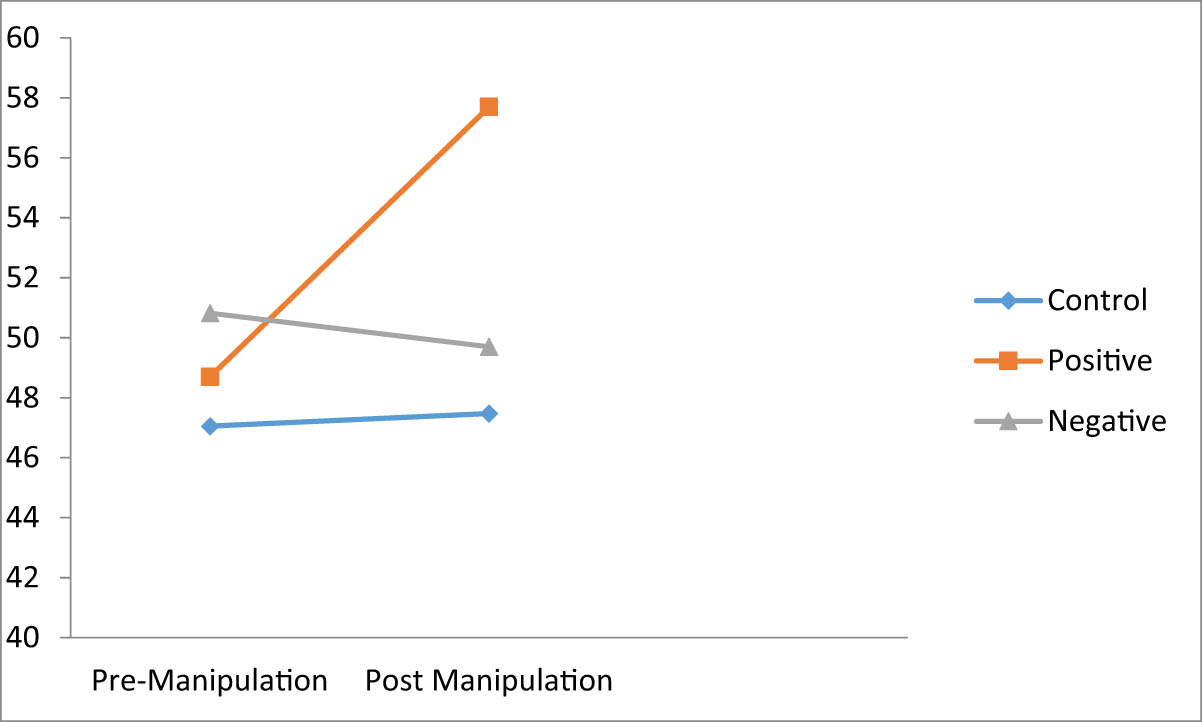
Figure 1
Changes in second plank efficacy.
Source: Author's contribution.
The group by time interaction indicates that the presentation of positive normative information about peers’ performance on the second plank produced an increase in self-efficacy. Efficacy levels did not change for the control group or the negative norm group.
The second RMANOVA examined change over time from the initial efficacy to perform a plank and the final efficacy after both trials had been completed with the normative information presented during the rest period. The 3 (group) × 2 (pre-post efficacy) RMANOVA revealed a significant time effect (F(1, 99) = 13.80, p > 0.001, η 2 p = 0.12) indicating a large effect size (Cohen, 1969), but the group by time interaction was not significant (F(2, 99) = 1.91, p = 0.153, η 2 p = 0.04). The trend across time is illustrated in Figure 2. Self-efficacy to perform a plank at the level of peers of same age and sex decreased from pre to post test, but the rate of decline did not vary based on the treatment.
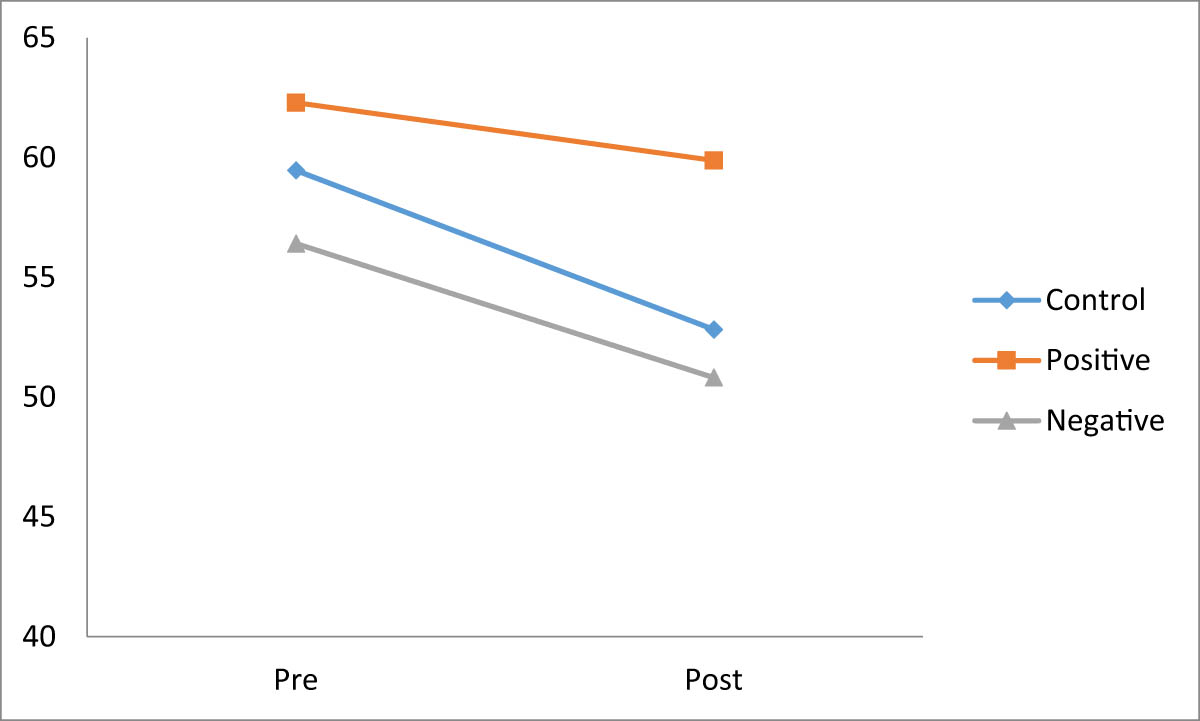
Figure 2
Changes in total plank efficacy.
Source: Author's contribution.
3.3. Manipulation check
At the conclusion of the testing session, participants in the groups that received normative feedback were asked to indicate their level of agreement with statements that the information they were given about others’ performance was believable, relevant, easy to understand, and persuasive. The responses on a scale of 1 (strongly disagree) to 7 (strongly agree) indicated that both the positive (M = 5.70 SD = 0.88) and negative (M = 6.12, SD = 0.83) norm groups found the information provided to be credible.
4. Discussion
Using a muscular endurance task, the purpose of study 2 was two-fold: to examine the effect of positive and negative normative triggers on an individual’s performance and to examine the effect of normative information on task self-efficacy. Findings support the conclusion that normative triggers affect individuals’ performance on a muscular endurance task where performance is largely dependent on willingness to exert effort.
The first hypothesis of the study, that positive information would produce improved performance while negative information would produce a decrement as compared to the control condition, was partially supported. Individuals who were presented with a positive trigger (i.e., a majority of the peers were able to maintain the abdominal plank position longer on the second attempt than they did on the first) outperformed those who received no normative information as well as those who were presented with a negative trigger (i.e., a majority of the peers were able to maintain the abdominal plank position for less time than they held the first). These results suggest that the presence of a positive norm trigger prompts a greater level of effort in single bout of an abdominal endurance exercise than a negative trigger or no trigger. These findings mirror the results reported by Priebe and Spink (2014) who also found that individuals who received positive norm information outperformed those who received no information on the second trial of a muscular endurance task. This supports the theoretical assertion from the FTNC (Cialdini et al., 1990) that by providing a reference point for appropriate behavior in a specific situation, social norms serve as a decisional cue to exert a high level of effort on the second attempt, in light of the information that a majority of peers performed better on the second attempt. A strength of this study is that norm perceptions about performance on the second trial were measured prior to providing the normative triggers, and only a very small percentage of participants expressed the belief that performance of their peers would improve (6%). This verifies that the positive norm information (that a majority of participants had been able to hold the plank longer on the second attempt) was not congruous with the preconceived notions the participants held and demonstrates that providing credible information can elicit increased effort and performance on a task.
A unique contribution of this study is the inclusion of negative normative information in the research design. Individuals who received information that, on the average, their peers decreased performance on the second attempt, exerted less effort and performed worse than those who received the positive information, which provides partial support for the first hypothesis. Their performance, however, did not differ from the control group who received no normative information. A possible explanation of this may be that the negative trigger basically confirmed their existing perception (i.e., the norm perceptions the control group already held), so the negative information did not have a significant effect.
One potential explanation for the effect of a normative trigger on the performance of the second plank attempt is that the norm trigger operated by affecting the individual’s self-efficacy which then in turn affected their performance. The second hypothesis tested was related to task self-efficacy. As in the first hypothesis, it was theorized that the positive trigger would increase task self-efficacy and the negative trigger would decrease self-efficacy as compared to the control condition. Consistent with the findings relevant to the first hypothesis, the results provide partial support for the predictions. The positive norm trigger produced an increase in self-efficacy for the second attempt, while the task self-efficacy levels for the individuals who received negative normative information and no normative information remained constant. It was expected that the negative information would decrease self-efficacy, but again, it seems that the negative trigger essentially confirmed existing expectations so participants reacted in a similar way to the group that received no information.
These findings suggest that information on the ability of similar peers can affect an individual’s perception of their own ability and ultimately the level of performance on a task. The increase in task self-efficacy associated with the provision of positive information is consistent with Priebe and Spink (2014) who reported similar findings. A likely mechanism for the effect of positive norms on efficacy is found in the concept of vicarious experience, one of four sources of self-efficacy (Bandura, 1977). That is, if the participant believes a peer of similar ability performed a task at a given level, then they believe they too can perform a task at that level. Lu et al. (2014) identified self-efficacy as a mediator in the relationship between peer norms and levels of PA, and the findings from this study add support for the assertion that self-efficacy is an important mechanism through which norms affect behavior.
Another point of interest regarding self-efficacy was whether overall task efficacy would be affected by the presentation of normative information. The general measure of task self-efficacy assessed efficacy beliefs about the ability to hold a plank relative to the average performance of peers of the same age and sex, in contrast to the self-referent ability relative to holding the second plank. There was a general decline in overall task self-efficacy across all groups, but the decrease was similar across groups. The provision of a positive normative trigger, although powerful enough to increase efficacy for the second attempt, did not affect overall efficacy. One explanation for this can be found in the reference point for the efficacy level (other vs self). It is also important to point out that efficacy beliefs are very specific, so a positive trigger about relative performance on a second attempt may not be viewed as applicable to the overall ability to perform the task. It should also be noted that individuals received no feedback concerning their performance, so there was no information relative to mastery performance, the most influential source of information for self-efficacy.
Several implications are supported by the results of this study. It is clear that providing a positive norm trigger that communicates high expectations can increase self-efficacy and facilitate a willingness to exert effort that can lead to improved performance. So, practitioners in PA settings would be well advised to ensure that program participants are provided with triggers that facilitate the belief that they can meet a high but realistic expectation. Additionally, the results reinforce the notion that self-efficacy is a very specific construct and that information that is effective in increasing efficacy for a specific task (i.e., the second abdominal plank) may not extend to a more global self-efficacy belief (ability to perform the plank relative to peers). When the goal of a normative trigger is to bolster self-efficacy, it is seemingly important to make sure that the information provided extends to the broader context of performing a behavior.
Although the results of this study are promising, some questions remain unanswered and further study is warranted. First, the negative information provided in the study seemingly confirmed the normative beliefs that participants already held, but they did not lower the expectation, which was the intent. To more clearly understand the effect of negative normative information, it would be important to design a study where the negative information is lower than the conceptions that are already held. There is evidence that normative triggers can result in unintended consequences (Cialdini et al., 2006), and one goal of this study was to examine the effect of negative normative information as a first step in investigating the consequences of the proliferation of information provided to the general population that the social norm is to be physically inactive. The results of this study suggest that confirming low expectations can result in decreasing effort and maintaining a low level of self-efficacy, but this issue needs further study.
Understanding the mechanisms through which social norms affect behavior is an important research avenue. The results of this study, consistent with the work of Lu et al. (2014), suggest that, as the investigation of these mechanisms moves forward, it is important to explore the role self-efficacy plays in the process through which norms affect behavior.
5. Conclusion
Social norms literature is moving from an attempt to better define social norms to a more applied exploration into how social norm perceptions are influenced. Normative triggers have been used to successfully address public health initiatives such as decreasing binge drinking among college students and increasing healthy food choices in both children and adults. These studies provide valuable blueprints for creating effective normative interventions. Unfortunately, there are currently few examples of normative triggers being used to positively affect exercise behavior. This study provided such an example. It gave a clear illustration of how normative triggers can be used to positively affect an exercise behavior and did so in such a way that can be both easily and inexpensively replicated. Findings from this study make a valuable contribution to the literature on best practices for effective normative interventions.
Also, this study was the first of its kind to explore the effect of negatively worded normative triggers on exercise effort. The findings that when a person perceives their peers’ performance decreased their performance is more likely to decrease should serve as a reminder of the potential impact practitioners’ statements can have on student’s behavior. Telling a student “most students don’t get enough daily physical activity” can be interpreted by the student as it is okay if they are not physically active since most of their peers are not active. Statements such as this can negatively impact perceptions and ultimately behavior.
Funding information
Author states no funding involved.
Author contribution
The author confirms the sole responsibility for the conception of the study, presented results and manuscript preparation.
Conflict of interest statement
Author states no conflict of interest.