Introduction
In Mexico, the most significant gastrointestinal nematodes (GINs) affecting sheep and goats belong to the order Strongyloidea, which includes species such as Haemonchus contortus, Cooperia spp., Oesophagostomum spp., Bunostomum spp., Strongyloides papillosus, Trichostrongylus colubriformis, Teladorsagia circumcincta, and Trichuris ovis (López-Ruvalcava et al., 2013; Mondragón-Ancelmo et al., 2019). These nematodes colonize the gastrointestinal tract of their hosts, causing a wide range of clinical manifestations. The severity of infection is influenced by several factors, including the host's age and nutritional status (Schallig, 2000; Reyes-Guerrero et al., 2020). Among these parasites, H. contortus, commonly known as the “barber’s pole worm” or “wire worm”, is considered one of the most pathogenic nematodes globally, particularly in small ruminants. During its endogenous phase, which encompasses the pre-adult and adult larval stages, this blood-feeding parasite causes significant blood loss. This results in anemia and low protein levels and, in severe cases, can lead to sudden death, particularly in young animals. Such outcomes can result in considerable production and economic losses (Zarlenga et al., 2016). Several control and prevention strategies exist for ovine haemonchosis, the most widely used of which is the administration of synthetic chemical anthelmintics (Adduci et al., 2022). However, their therapeutic efficacy is now being questioned due to frequent and indiscriminate use, which has led to the serious problem of anthelmintic resistance (AR). Moreover, H. contortus has raised global concern owing to its high adaptability to diverse ecosystems, driven by parasite variability and the impacts of climate change (Munguía-Xóchihua et al., 2018; Sánchez-Mendoza et al., 2020). For centuries, animals, including humans, have utilized plants as a source of food and as remedies for various ailments across different cultures worldwide (Chifa, 2010). In this context, many plant families are known to possess therapeutic properties. For instance, Luffa aegyptiaca Mill., a member of the Cucurbitaceae family, contains several secondary compounds, including triterpenes, polyphenols, anthocyanidins, coumarins, saponins, and glycosides, which have been used in the treatment of cellulitis and as antioxidants and antimicrobial agents (de la Paz et al., 2012; Arias-Cedeño et al., 2018). Similarly, the Fabaceae species Prosopis laevigata (Humb. et Bonpl. ex Willd.) M.C. Johnst., commonly known as Mesquite, is traditionally used in folk medicine to treat various ailments. This genus exhibits multiple pharmacological properties, including wound-healing, antioxidant, antipyretic, anti-inflammatory, anticancer, antimicrobial, and anthelmintic activities. In addition, P. leavigata is a valuable source of nutrients, minerals, and a wide variety of secondary metabolites with potential applications for human and animal health (García-Andrade et al., 2013; Delgado-Altamirano et al., 2017; Sharifi et al., 2019; García-Azpeitia et al., 2022; Delgado-Núñez et al., 2020). In summary, the objective of the present study was to evaluate the in vitro anthelmintic activity of organic extracts from the fruits of L. aegyptiaca and P. laevigata against infective larvae of the small ruminant parasite H. contortus.
Materials and Methods
Location
The extraction of phytochemicals and their profiling were conducted at the National Center for Disciplinary Research in Animal Health and Safety (CENID-SAI) of the National Institute of Forestry, Agricultural and Livestock Research (INIFAP), located in the municipality of Jiutepec, Morelos, Mexico. The in vitro mortality assays were conducted at the Faculty of Agricultural and Environmental Sciences (FCAA-UAGro) of the Autonomous University of Guerrero in the municipality of Iguala de la Independencia, Guerrero, Mexico.
Plant material and geolocation
Mature fruits (pulp and seeds) of L. aegyptiaca and P. laevigata were used in this study. The fruits of L. aegyptiaca (468.6 g) were collected in August 2019 in Iguala de la Independencia, Guerrero, Mexico, and the fruits (pulp and seeds) of P. laevigata (172.3 g) were collected in May 2017 in the community of Huixastla, State of Morelos, Mexico (Fig. 1). The specimens were taxonomically identified and deposited in the Herbarium of the Autonomous University of the State of Morelos (UAEM), with voucher numbers 39804 and 34873 for L. aegyptiaca and for P. laevigata, respectively.
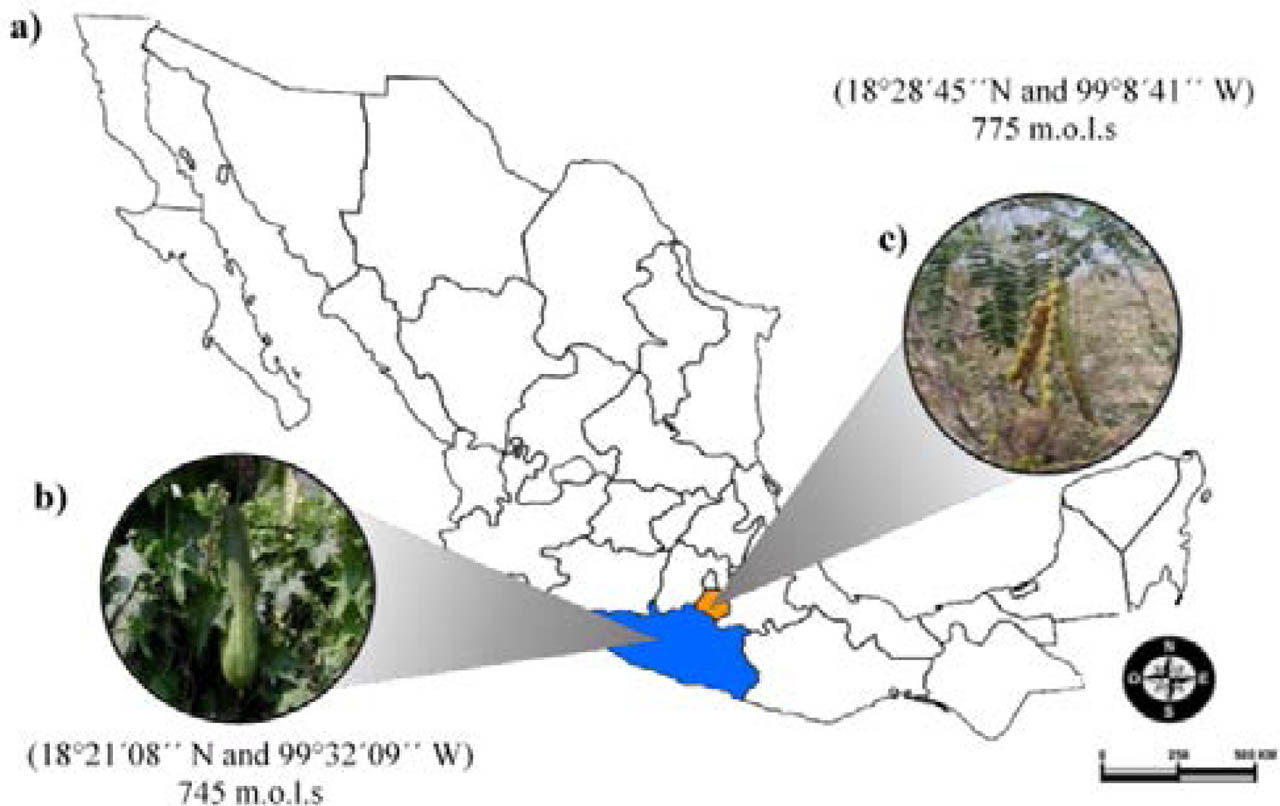
Fig. 1.
a) Map of the Mexican Republic; b) map of the state of Guerrero, collection site of Luffa aegyptiaca in Iguala, Guerrero, Mexico; and c) collection of Prosopis laevigata in Huixastla, municipality of Tlaquiltenango, Morelos, Mexico
Obtainment of hydroalcoholic extracts
The plant material was shade-dried for three weeks, yielding a final dry weight of 191.3 g for L. aegyptiaca and 108.4 g for P. laevigata. Dried fruits were cut into ~ 1 cm pieces and macerated in a 70:30 % (v/v) mixture of distilled water and methanol at a 1:10 (w/v) ratio for 48 h in the absence of light. Subsequently, the extracts were filtered using gauze and cotton to remove residual plant material. The solvents were eliminated using a Büchi R-300 rotary evaporator. The extracts were then lyophilized and stored at 4°C until further use.
Qualitative analysis of secondary compounds of the extracts
The chemical profiles of the HA extracts of L. aegyptiaca and P. laevigata were determined using several phytochemical testing procedures with different standard compounds and methods. The Dragendorff, Mayer, and Wagner tests were used to detect alkaloids (Wagner et al., 1996). The Bornträger test was used to determine coumarin content, and the Mg2+ and HCl tests were used for flavonoids (Domínguez, 1973; Rivas-Morales et al., 2016). The ferric chloride test and the gelatin and saline solution tests were used to confirm the presence of tannins (Ringuelet and Vina, 2013; Kuklinski, 2000). The Liebermann-Burchard and Salkowski tests were used to detect triterpenes, and the foam formation test was used to detect saponins (Rivas-Morales et al., 2016).
Biological material
Haemonchus contortus infective larvae (L3) were obtained from a healthy three-month-old goat previously orally inoculated with 350 H. contortus L3 larvae per kilogram of body weight. After a 21-day prepatent period, feces were collected to perform coprocultures. The L3 larvae were recovered using the Baermann funnel tech-nique and subsequently exsheathed (Sancho et al., 2009).
Experimental design
Anthelmintic activity of the organic extracts was evaluated using 96-well microtiter plates (n=12). Treatments were assigned as follows: Hydroalcoholic extracts (HA-E) 12.5, 25, 50, and 100 mg/mL.
Distilled water was used as a negative control, and ivermectin at 5 mg/mL was used as a positive control. Into each well, 50 μL of each concentration and 50 μL of an aqueous suspension containing ≈100 exsheathed H. contortus L3 larvae were added, achieving a final volume of 100 μL. Plates were incubated for 72 h at room temperature (25 – 35 °C). Subsequently, the total number of live and dead larvae in each well of every treatment was counted individually. The mortality rate was determined by counting live and dead larvae and expressed as a percentage of mortality according to the following formula:
Statistical analysis
Larval mortality percentages were analyzed using ANOVA. Differences among treatments were determined using Tukey’s test (P<0.05) at a 95 % confidence level. For treatments with a concentration-dependent effect, the lethal concentrations at 50 and 90 (LC50 and LC90) were estimated using the PROBIT PROC procedure in the SAS statistical package (SAS, 2006).
Ethical Approval and/or Informed Consent
The lamb used as a parasitic egg donor was maintained under controlled conditions, in accordance with the principles of animal welfare and the minimization of unnecessary suffering, in accordance with Norma Oficial. Mexicana (official rule number) NOM-052-ZOO-1995 (https://www.gob.mx/senasica, accessed on 10 December 2024) as well as the Ley Federal de Sanidad Animal (Federal Law for Animal Health) DOF 07-06-2012 (http://www.diputados.gob.mx/LeyesBiblio/ref/lfsa.htm, accessed on 10 December 2024).
Results and Discussion
The extract of L. aegyptiaca yielded 15.72 g with an 8.21 % extraction yield, while that of P. laevigata yielded 7.89 g with a 7.27 % extraction yield. Furthermore, qualitative phytochemical analysis revealed that the fruits of P. laevigata contained the full range of secondary metabolite groups. In contrast, L. aegyptiaca exhibited the presence of alkaloids, coumarins, tannins, and saponins (Table 1).
Table 1.
Phytochemical screening results of selected hydroalcoholic extracts.
| Metabolite | Reagent chemical | Luffa aegyptiaca | Prosopis leavigata |
|---|---|---|---|
| Alkaloids | Dragendorff | ++ | ++ |
| Mayer | ++ | + | |
| Wagner | + | + | |
| Coumarins | Bornträger | + | ++ |
| Flavonoids | Mg2+ and HCL | − | ++ |
| Tannins | Ferric chloride (FeCl3) | + | ++ |
| Triterpenes | Liebermann-Buchard | − | + |
| Sterols | Salkowski | − | + |
| Saponins | Water | + | + |
The mortality percentage of H. contortus attributed to the hydroalcoholic extract (E-HOH) from fruits of L. aegyptiaca and P. laevigata is shown in Table 2. The results reveal that at 100 mg/mL, L. aegyptiaca achieved an 81.98 % mortality rate, while P. laevigata showed 79.0 % mortality. At 50 mg/mL, the values were 57.94 ± 2.37 % for L. aegyptiaca and 63.72 ± 2.77 % for P. laevigata. From 25 mg/mL onward (40.12 ± 3.24 % and 14.61 ± 2.44 %, respectively), a clear concentration-dependent effect (P<0.05) was observed for both species. The minimum and maximum lethal concentrations (LC50 and LC90) are shown in Table 2. The LC50 values for L. aegyptiaca and P. laevigata were 30.78 and 33.96 mg/mL, respectively. The use and abuse of synthetic anthelmintics not only generate anthelmintic resistance but also severely impact livestock farmers’ economies. Furthermore, these products persist as residues in meat and milk and contaminate soil and water, adversely affecting beneficial organisms (López-Villacís et al., 2017; Machado-Pereira-Da-Silva et al., 2020). The use and knowledge of herbal medicine constitute a medicinal alternative, owing to the action of secondary metabolites against gastrointestinal parasites in small ruminants (Rodríguez-Zúñiga et al., 2023; Hernández et al., 2023). Furthermore, reports indicate that certain Fabaceae species exhibit anthelmintic activity against H. contortus, notably Lysiloma acapulcensis and Caesalpinia coriaria. Both belong to the same family as P. laevigata, and, consistent with our results, hydroalcoholic extractions showed similar anthelmintic activity against H. contortus under in vitro conditions (Hernández et al., 2023; González-Cortazar et al., 2018).
Table 2.
Mortality percentage and lethal concentrations (LC) of Haemonchus contortus infective larvae (L3) exposed to a hydroalcoholic extract (HA-E) derived from fruits of Luffa aegyptiaca and Prosopis laevigata at 72 h.
| LC50/CI | LC90/CI | ||
|---|---|---|---|
| Distilled water | 0.00 e | -- | -- |
| Ivermectin (5 mg/mL) | 100.00 a | -- | -- |
| L. aegyptiaca (HA-E, mg/mL) | |||
| 100 | 91.98 ± 3.99 b | 30.78/28.41–33.26 | 92.09/82.97–103.60 |
| 50 | 57.94 ± 2.37 c | ||
| 25 | 40.12 ± 3.24 e | ||
| 12.5 | 1.42 ± 0.53 e | ||
| P. laevigata (HA-E, mg/mL) | 33.96/29.73–38.66 | -- | |
| 100 | 79.00 ± 1.88 b | ||
| 50 | 63.72 ± 2.77 c | ||
| 25 | 14.61 ± 2.44 d | ||
| 12.5 | 1.19 ± 0.90 e | ||
| VC | 4.02 | ||
| R2 | 0.99 |
Notably, hydroalcoholic extracts derived from forage tree legumes have yielded promising results in vitro evaluations against the nematode H. contortus. In this regard, findings on the use of Acacia farnesiana reported mortality rates approaching 80 % at 50 mg/mL (Zarza-Albarrán et al., 2020). Furthermore, the phytochemical profile of A. farnesiana revealed the presence of phenolic compounds and flavonoids, to which the anthelmintic effect is attributed. Similarly, a study found that hydroalcoholic extracts of Leucaena leucocephala leaves contain bioactive compounds (phenolics, terpenes, and flavonoids) that exhibit ovicidal activity against H. contortus (López-Rodríguez et al., 2022). Consequently, it is hypothesized that hydroalcoholic extracts from leaves and fruits of legumes, including P. laevigata contain elevated levels of phenolic compounds with antiparasitic properties effective against the ovine parasite H. contortus (García-Hernández et al., 2022). This reference supports a rational, integrated approach to the use of natural products in the management of haemonchosis in small ruminants. A comparison of medicinal plants from different families that have been assessed and shown promising results is presented in Table 3. This establishes a phytotherapeutic foundation for controlling H. contortus.
Table 3.
Medicinal plants used in the control of ovine haemonchosis.
| Scientific name | Family | Extraction suystem | Assay type | Results | Reference |
|---|---|---|---|---|---|
| Prosopis laevigata | Fabaceae | Ac-E | In vitro (LM) | 20 mg/mL= 100% | Delgado-Núñez et al., 2025 |
| Chamaecrista nictitans | Fabaceae | EtOAc-E | In vitro (EHI) | 5000 μg/mL 88.45% | Cortes-Morales et al., 2024 |
| Arceuthobium vaginatum | Santalaceae | EtOAc-E | In vitro (EHI) | 0.25 mg/mL= 97.5 % | Becerril-Gil et al., 2023 |
| Cyrtocarpa procera fruits | Anacardiaceae | HA-E | In vitro EHI/LM | 3 mg/mL= 100% / 150 mg/mL=96% | De Jesús-Martínez et al., 2024 |
| Aq-F | 3 mg/mL= 92.57% / 50 mg/mL= 30.19% | ||||
| EtOAc-F | 1 mg/mL= 100% / 50 mg/mL= 78.97% | ||||
| Ipomoea pauciflora | Convolvulaceae | HA-E | In vitro (LM) | 50 mg/mL= 85.75 % | Delgado-Núñez et al., 2023a |
| Carica papaya | Caricaceae | Aq-E | In vitro (LM) | 12 μg/mL 97.67 % | Delgado-Núñez et al., 2023b |
| Caesalpinia coriaria | Fabaceae | HA-E | In vitro (LM) | 100 mg/mL= 45.72% | García-Hernández et al., 2022 |
| Aq-E | 50 mg/mL= 23.48% | ||||
| EtOAc-F | 50 mg/mL= 98.36% | ||||
| Leucaena leucocephala | Fabaceae | HA-E | In vitro (EHI) | 100 mg/mL= 71% | López-Rodríguez et al., 2022 |
| Lippia graveolens (Lg) | Verbenaceae | HA-E | In vitro EHI/LM | 12.5 mg/mL= 100% / 100 mg/mL=78.94% | Olmedo-Juárez et al., 2022a |
| Aq-F | 25 mg/mL= 4.50% / 50 mg/mL= 71.62% | ||||
| EtOAc-F | 1.56 mg/mL= 100% / 25 mg/mL=99.72% | ||||
| Delonix regia (Dr) | Fabaceae | HA-E | 25 mg/mL= 63.72% / 200 mg/mL=97.68% | ||
| Aq-F | 25 mg/mL= 67.00% / 50 mg/mL= 86.82% | ||||
| EtOAc-F | 1.56 mg/mL= 100% / 50 mg/mL=97.83% | ||||
| Pithecellobium dulce | Fabaceae | HA-E | In vitro (EHI) | 5 mg/mL= 98.57 % | Olmedo-Juárez et al., 2022b |
| Aq-F | 5 mg/mL= 96.87 % | ||||
| EtOAc-F | 0.62 mg/mL= 99.94% | ||||
| Prosopis laevigata | Fabaceae | EtOAc-F | In vitro (LM) | 50 mg/mL= 96.01 % | Delgado Núñez et al., 2020 |
| Acacia farnesiana | Fabaceae | HA-E | In vitro EHI/LM | 50 mg/mL= 100% / 50 mg/mL=72.50% | Zarza-Albarrán et al., 2020 |
| Aq-F | 50 mg/mL= 10.30% / 50 mg/mL= 0.0% | ||||
| EtOAc-F | 1.56 mg/mL= 99.79% / 25 mg/mL=100% | ||||
| Chenopodium ambrosioides (Ca) | Amaranthaceae | n-hexane | In vitro (LM) | Ca: 40 mg/mL= 96.3 % | Zamilpa et al., 2019 |
| Ct: 40 mg/mL= 76 % | |||||
| Castela tortuosa (Ct) | Simaroubaceae | In vivo (gerbils) | Ca: 40 mg/mL= 45.86 % | ||
| Ct: 40 mg/mL= 27.15 % | |||||
| Thymus vulgaris (thyme) | Lamiaceae | EO | In vitro | Ferreira et al., 2016 | |
| EHI | 25 mg/mL = 99.8% | ||||
| LM | 12.5 mg/mL= 98.4% | ||||
| LD | 0.062 mg/mL= 99.4% | ||||
| Cymbopogon schoenanthus | Poaceae | EO | In vitro | Katiki et al., 2011 | |
| EHI | LC50 = 0.04 mg/mL | ||||
| LD | LC50 = 0.06 mg/mL | ||||
| LFIA | LC50 = 0.009 mg/mL |
[i] Nomenclature: EHI= egg hatching inhibition, LM= larval mortality, LD= larval development, LFIA= larval feeding inhibition, LEA= larval exsheath assay, Ac-E= acetone extract, EtOAc-E= ethyl acetate extract, HA-E= hydroalcoholic extract, Aq-F= aqueous fraction, EtOAc-F= ethyl acetate fraction, EO= Essential oils.
Regarding L. aegyptiaca, an exhaustive literature review reveals that this species has been scarcely investigated for its medicinal properties, especially its anthelmintic potential. However, other species within this genus, such as fruits and leaves of L. cylindrica and L. operculata, used as infusions or hydroalcoholic extracts, are employed as vermifuges in folk medicine (Roig-Mesa, 1993). In contrast, an aqueous extract of Cucurbita maxima has been reported to inhibit the egg hatching of the nematode Ascaris suum by 88 % and 79.83 % (Bejarano-Pichen, 2019). Ultimately, this work would represent the first scientific report on the nematicidal properties of L. aegyptiaca worldwide. The results of the present study reveal that the hydroalcoholic extracts of L. aegyptiaca and P. laevigata possess allelochemicals with in vitro larvicidal activity against the ovine parasite H. contortus. Nevertheless, targeted phytochemical studies are recommended to identify the metabolites responsible for this activity and to evaluate other stages of this parasite’s biological cycle.
Acknowledgements
The authors gratefully acknowledge the Autonomous University of Guerrero and INIFAP for providing the facilities, reagents, consumables and equipment necessary to conduct this study.