Supplementary Table S1.
BLASTn comparison and phylogenetic dataset of Dipylidium caninum COX1 sequences
| No. | Accession | Isolate / description | Host | Country | Identity (%) | Query cover | Sequence length (bp) |
|---|---|---|---|---|---|---|---|
| 1 | PZ299077.1 | D. caninum isolate Igdir_Dog1 | Shepherd dog / Canis lupus familiaris | Türkiye | 100 | 100 % | 396 |
| 2 | PX765914.1 | D. caninum isolate Hp03 | Dog | Ghana | 92.12 | 93 % | 373 |
| 3 | OR251824.1 | D. caninum isolate Sv_PS_Amz_22 | Speothos venaticus / bush dog | Colombia | 91.92 | 100 % | 1602 |
| 4 | OR251823.1 | D. caninum isolate Sv_PS_Amz_21 | Speothos venaticus / bush dog | Colombia | 91.92 | 100 % | 1602 |
| 5 | OK523384.1 | D. caninum isolate Dcan_canine_FL1, complete mitogenome | Canis lupus familiaris | USA | 91.92 | 100 % | 14296 |
| 6 | PZ165824.1 | D. caninum isolate DICAA | Canis lupus familiaris | Croatia | 91.92 | 100 % | 396 |
| 7 | PX765913.1 | D. caninum isolate Hp02 | Dog | Ghana | 91.85 | 93 % | 373 |
| 8 | PX765912.1 | D. caninum isolate Hp01 | Dog | Ghana | 91.85 | 93 % | 373 |
| 10 | MN099047.1 | D. caninum complete mitogenome | Stray dog | China | 91.67 | 100 % | 14226 |
| 11 | PP842203.1 | D. caninum isolate DogSRTDc2 | Dog | Türkiye | 91.27 | 95 % | 383 |
| 12 | PP842202.1 | D. caninum isolate DogSRTDc1 | Dog | Türkiye | 91.27 | 95 % | 383 |
| 13 | MG587892.1 | D. caninum isolate R166, complete mitogenome | Feline | South Africa | 89.8 | 99 % | 13598 |
| 14 | OQ281679.1 | D. caninum isolate VCG6 | Felis catus | Mexico | 89.8 | 99 % | 416 |
| 15 | OK523385.1 | D. caninum isolate Dcan_feline_KS1, complete mitogenome | Felis catus | USA | 89.8 | 99 % | 13598 |
| 16 | MT806359.1 | D. caninum voucher 4245P18 | Vulpes vulpes / red fox | Italy | 89.8 | 99 % | 411 |
| 17 | PX765915.1 | D. caninum isolate Hp04 | Dog | Ghana | 89.67 | 93 % | 373 |
| 18 | OR511473.1 | D. caninum isolate Alex-2 | Stray cat | Egypt | 89.53 | 92 % | 363 |
| 19 | PZ165825.1 | D. caninum isolate DICAB.1 | Felis catus | Croatia | 89.39 | 90 % | 358 |
| 20 | ON506044.1 | D. caninum isolate Isb1 | Cat | Pakistan | 89.34 | 92 % | 384 |
| 21 | PP054312.1 | D. caninum haplotype A | Felis catus familiaris | Ethiopia | 89.27 | 96 % | 963 |
| 22 | OR511472.1 | D. caninum isolate Alex-1 | Stray cat | Egypt | 88.71 | 92 % | 363 |
| 23 | ON954760.1 | D. caninum isolate dog1 | Dog | Iraq | 88.01 | 92 % | 384 |
| 24 | ON954628.1 | D. caninum isolate cat1 | Cat | Iraq | 88.01 | 92 % | 384 |
| 25 | ON514129.1 | D. caninum isolate Isb2 | Cat | Pakistan | 88.01 | 92 % | 384 |
| 26 | ON954763.1 | D. caninum isolate cat1 | Cat | Iraq | 87.91 | 92 % | 383 |
| 27 | ON954761.1 | D. caninum isolate dog2 | Dog | Iraq | 86.58 | 92 % | 384 |
| 28 | PP054311.1 | Dipylidium sp. 01-SA haplotype A | Proteles cristata / aardwolf | South Africa | 85.86 | 100 % | 1647 |
| 29 | PZ165826.1 | D. caninum isolate DICAB.2 | Canis lupus familiaris | Croatia | — | — | 358 |
| 30 | ON954762.1 | D. caninum isolate dog3 | Dog | Iraq | — | — | 384 |
| 31 | ON954764.1 | D. caninum isolate cat2 | Cat | Iraq | — | — | 384 |
| 32 | ON954765.1 | D. caninum isolate cat3 | Cat | Iraq | — | — | 384 |
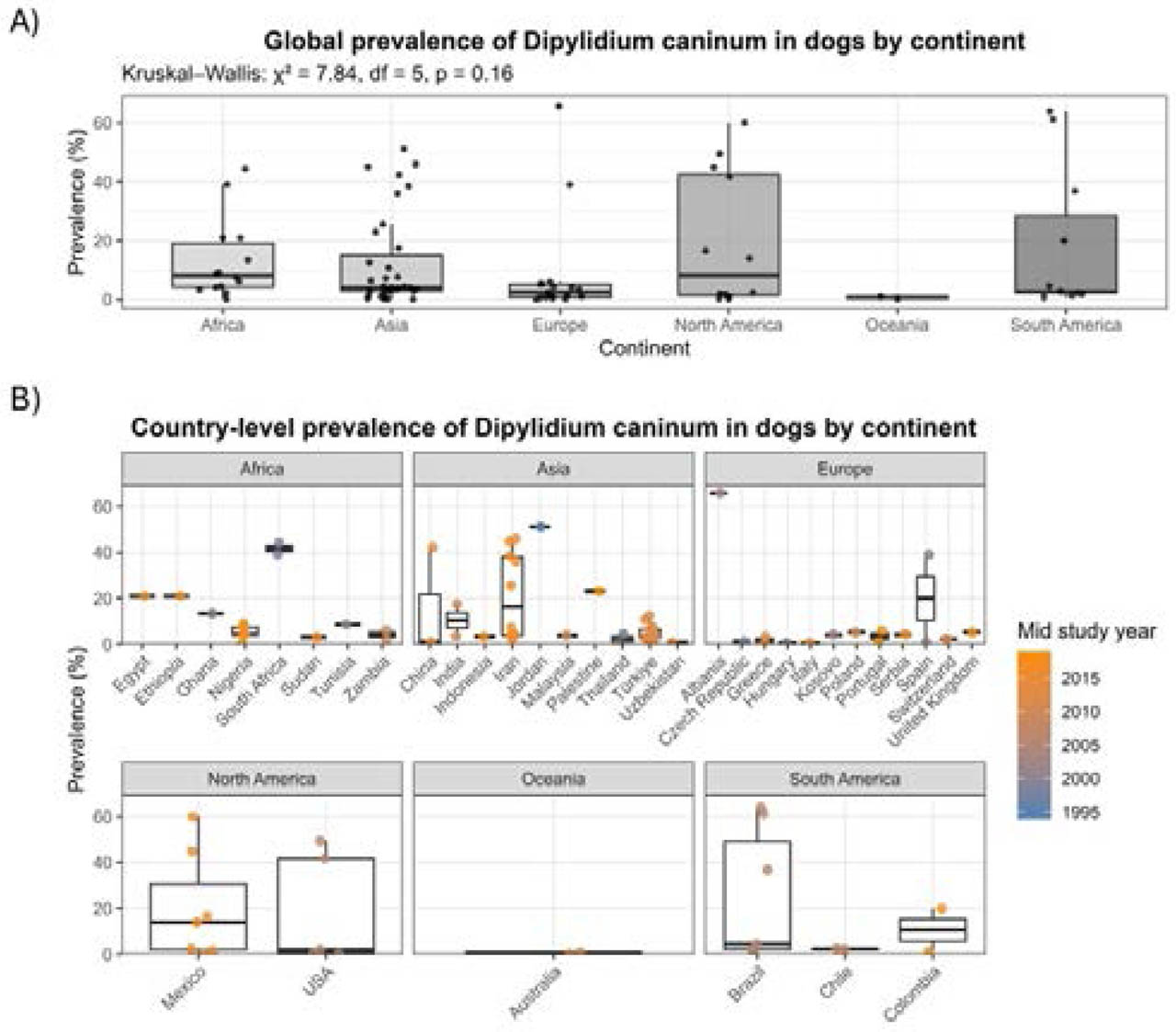
Supplementary Fig. S1.
Global prevalence of Dipylidium caninum in dogs.
Reported canine D. caninum prevalence data from previously published studies were descriptively summarized by continent and country to provide broad epidemiological context. (A) Prevalence values across continents. Box plots show the median, interquartile range, and individual study points. (B) Country-level prevalence grouped by continent. Colored points represent individual studies according to approximate mid-study year. No molecular sequence data were included in this overview. Because the included studies differed in sampling design, dog population, geographic setting, and diagnostic method, this figure should be interpreted only as descriptive context and not as a formal quantitative comparison among regions.
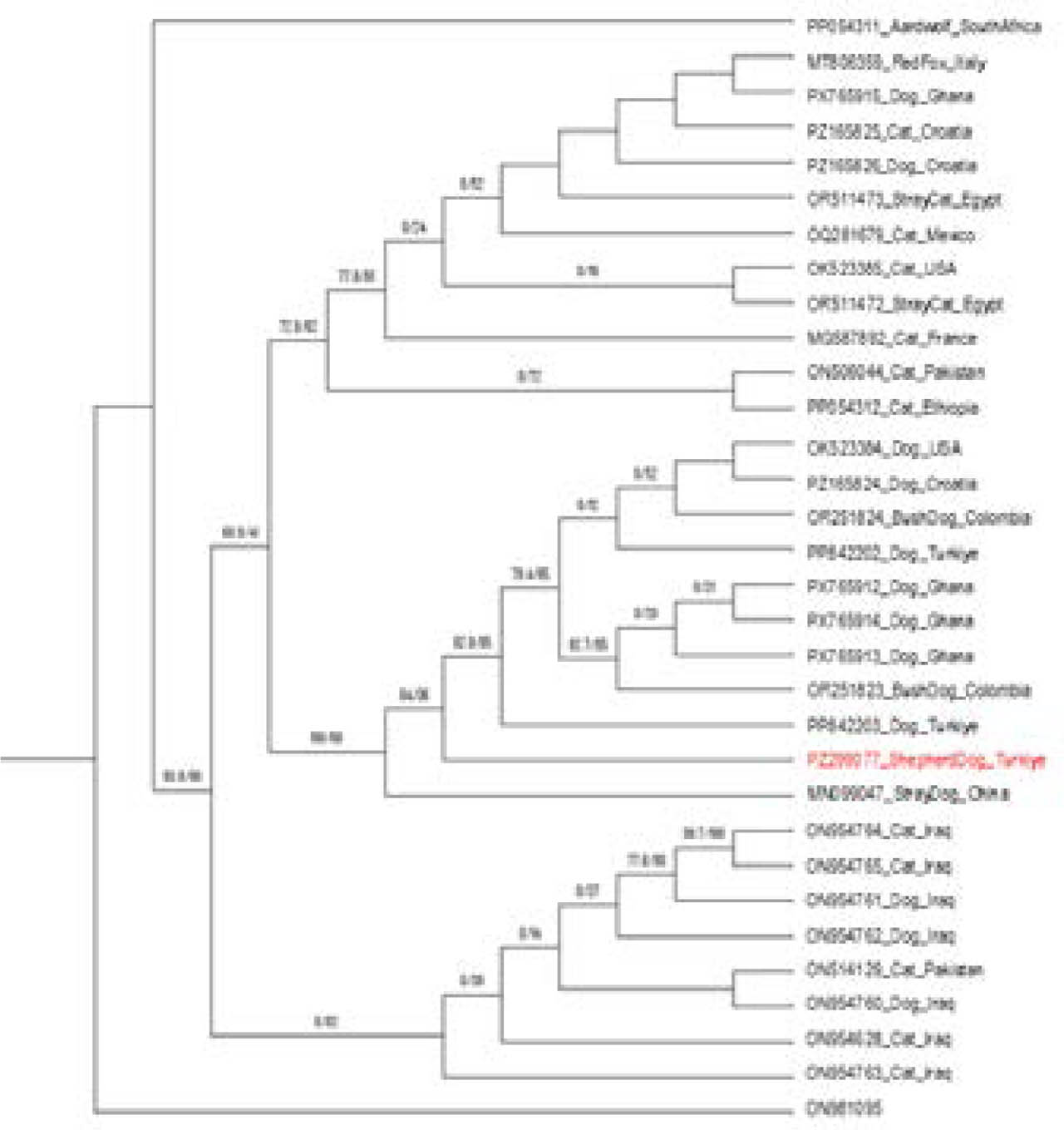
Fig. 1.
Maximum Likelihood phylogenetic tree based on a 363-bp COX1 alignment of Dipylidium caninum and related Dipylidiidae sequences.
The tree was reconstructed in IQ-TREE v3 using the GTR+I+G substitution model and rooted with Joyeuxiella pasqualei ON981095 as the outgroup. Branch values are shown as SH-aLRT support (%) / ultrafast bootstrap support (%) based on 1,000 replicates. The Turkish isolate generated in this study, PZ299077.1, is highlighted in red.
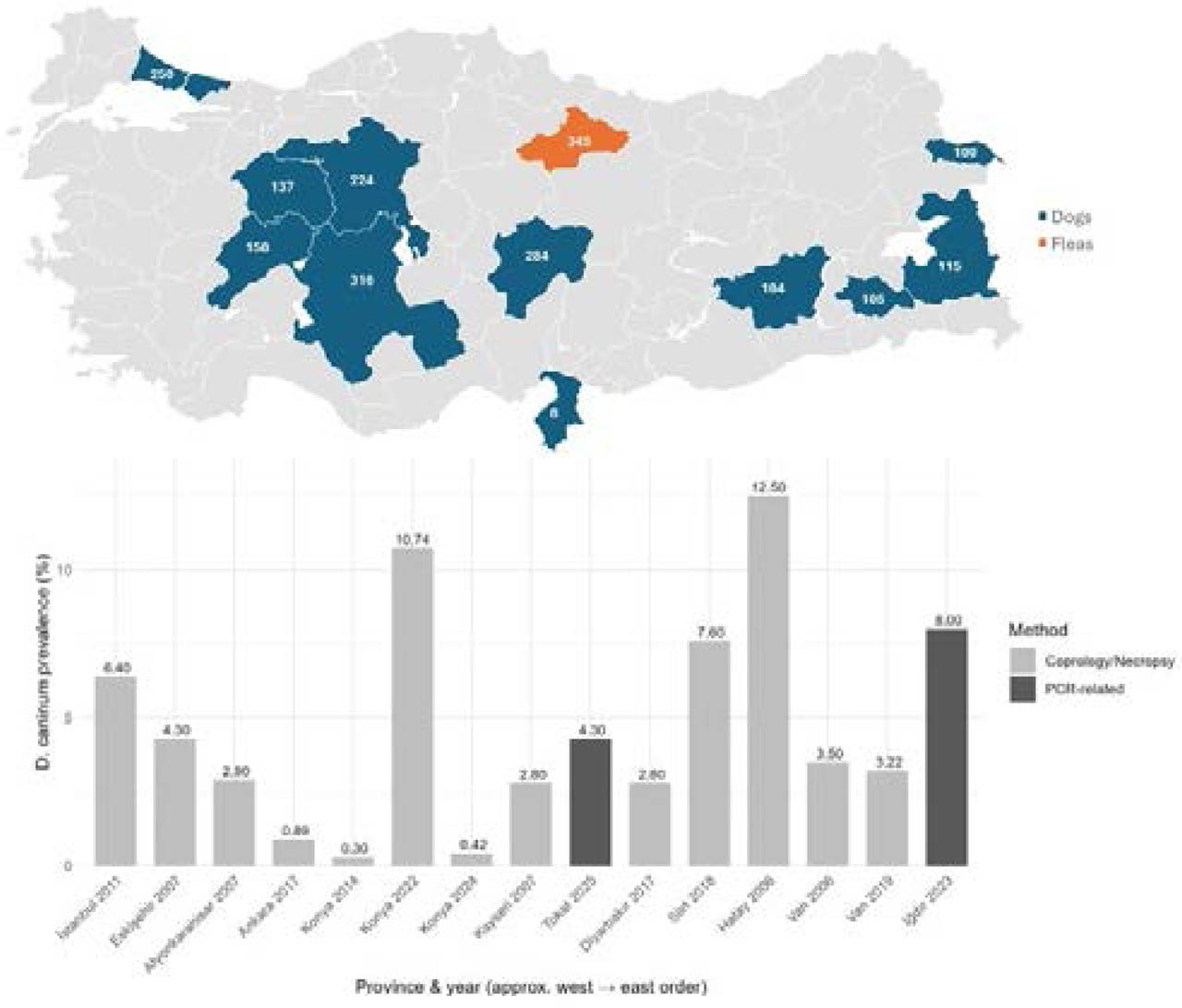
Fig. 2.
Geographic and temporal distribution of Dipylidium caninum in Türkiye.
The map and accompanying bar plot summarize published prevalence data from 2006 to 2025 across different provinces of Türkiye. Coprological and necropsy-based surveys are shown in light shading, whereas PCR-based studies are shown in dark shading. The figure illustrates the long-term and widespread circulation of D. caninum in both western and eastern regions of the country.