Introduction
Corn (Zea mays L.) is one of the main commodities in Brazilian agribusiness. It is cultivated nationwide, and the 2021/2022 crop season production was 113.1 million tons, with a projected increase of 10.4 % for the 2022/2023 crop season. In Brazil, corn is cultivated intensively, allowing for up to three harvests a year: the first in spring/summer, the second in summer/fall/winter, and a third in certain Northeastern states (Conab, 2023; Von Pinho et al., 2017). However, intensive cultivation can increase pest populations and cause greater damage.
Pest attacks are a primary limitation to high yields. The corn leafhopper, Dalbulus maidis (DeLong & Wolcott) (Hemiptera: Cicadellidae), previously considered a secondary pest that caused sporadic damage, has been causing significant financial losses over the last few years. This pest is present throughout all phenological stages of the crop. However, the initial stages are most critical (Oliveira & Frizzas, 2022; Ramos et al., 2020; Waquil et al., 1998). The corn leafhopper can cause direct damage by sucking the photoassimilates and indirectly by transmitting the fine stripe virus and mollicutes responsible for pale and red wilt diseases (Oliveira & Frizzas, 2022). Mollicutes colonize the plant’s phloem, and the corn leafhopper can transmit them collectively or individually. The young and adult stages can acquire pathogens by feeding on sick plants, but only the adults transmit them to other plants (Bedendo, 2018). Infected females do not transmit the pathogens to their offspring but prefer laying eggs on infected plants. Both types of damage reduce the photosynthetic area (Ramos et al., 2020; Waquil et al., 1998).
Entomopathogenic nematodes of the Heterorhabditis and Steinernema genera are successful biological control agents that contain symbiotic bacteria from the Photorhabdus and Xenorhabdus genera, respectively. The life cycle of EPNs is divided into eggs, 1st stage (J1) and 2nd stage (J2) juveniles, infective juveniles (IJ), 4th stage juveniles (J4), females, and males. The IJ enters the insect’s body through natural openings in the skin, such as spiracles, anus, and oral cavity. As soon as it enters the insect, it releases symbiotic bacteria into the hemolymph, causing the insect’s death from septicemia between 24 and 48 hours (Dolinski et al., 2017; Lacey & Georgis, 2012).
Many studies report the effectiveness of EPNs in controlling hemipterans, such as the brown stink bug, Euschistus heros (Fabricius) (Hemiptera: Pentatomidae) (Borges et al., 2023), and the green-belly stink bug, Dichelops melacanthus (Dallas) (Hemiptera: Pentatomidae) (Guide et al., 2019) and the spittlebug, Mahanarva spectabilis (Distant) (Hemiptera: Cercopidae) (Batista et al., 2014). This study aimed to assess the pathogenicity, virulence, and life cycles of Heterorhabditis and Steinernema species on D. maidis adults, and their compatibility with insecticides and herbicides used in corn cultivation.
Materials and Methods
The corn leafhoppers were collected using a recyclable suction device in cornfields located in Monte Carmelo, MG, with the geographical coordinates 18°43’31.75”S, 47°31’ 32.06”W, at an altitude of 890 m. The breeding was maintained in a greenhouse using corn plants, SHS4070 hybrid from Santa Helena company, planted in pots with a five-liter capacity, and the plants were kept in pots until the V5. stage.
Thirty corn leafhoppers were added per plant and were covered with voile fabric. The pots received 15 grams of NPK fertilizer in the 04-14-08 formula and were watered every day as recommended for the crop.
Selection of entomopathogenic nematodes
The nematodes were multiplied using Tenebrio molitor L. (Coleoptera: Tenebrionidae) larvae. The breeding of T. molitorfollowed the methodology of Potrich et al. (2007).
The experiment was carried out in gerbox containers measuring 11 x 11 x 3.5 cm, containing a piece of corn leaf measuring 10 x 11 cm and 1 % agar to keep the corn leaf turgid, allowing the corn leafhopper to feed. Ten adult corn leafhoppers were placed in each gerbox, with 6 repetitions per isolate, for a total of 60 insects per isolate. Isolates of Heterorhabditis amazonensis Andaló, Nguyen & Moino, represented by the isolates GL, MC01, UENP2 and UENP6, were used, as well as Steinernema brazilense Nguyen, Ginarte, Leite, dos Santos & Harakava (isolate IBCB06), Steinernema carpocapsae (Weiser) (isolate IBCB02), and Steinernema feltiae (Filipjev) (isolate IBCB47). These isolates were included to allow comparison of their ability to induce mortality in D. maidis under the same concentration conditions. Each isolate was tested separately, and distilled water served as the control, resulting in eight treatments. The isolates were inoculated onto adult D. maidis using an automatic pipette, with a concentration of 200 infective juveniles per insect in a volume of 0.5 ml in the gerbox type containers. Afterward, the gerboxs were sealed with cling film and kept under laboratory conditions. Insect mortality was observed to verify pathogenicity after 120 hours.
The adults were taken out of the gerboxs, kept in a dry room for 48 hours, and then dissected with a 1 % NaCl solution to confirm mortality brought on by the nematode. The presence of nematodes was observed under a stereoscopic microscope.
The collected data were subjected to variance analysis and were compared using the Scott-Knott test (p<0.05) with the assistance of the Exp.Des package in the R statistical software (Ferreira et al., 2021).
Lethal concentration (LC50) of Heterorhabditis amazonensis MC01 and Steinernema feltiae IBCB47 isolates
To assess the lethal concentration caused by infective juveniles to D. maidis adults, isolates H. amazonensis MC01 and S. feltiae IBCB47 were used, selected based on the results of the previous test. The experiments were carried out under the same conditions as the previous test.
The tested concentrations were 50, 100, 150, and 200 adult IJs per unit, and the control group only received distilled water. After 72 hours, insect mortality was assessed. The obtained data were analyzed using Probit in the R statistical software.
Compatibility of H. amazonensis MC01 and S. feltiae IBCB47 with chemicals
The H. amazonensis MC01 and S. feltiae isolates were used to evaluate compatibility with registered phytosanitary products for corn cultivation. insecticides were tested: clorfluazuron, methomyl, chlorpyrifos, profenofos, and lufenuron, and four herbicides: atrazine, 2,4-D, glyphosate, and tembotrione. All the mentioned products are registered for corn cultivation by the Ministry of Agriculture, Livestock, and Supply (Agrofit, 2025).
The experiment followed the IOBC/WPRS protocol (Vainio, 1992) and involved nine treatments (products) and a control (distilled water). Each treatment was replicated five times. Double the recommended dose was used for the solution preparation, diluted with the nematode suspension. The volumes used to prepare 50 ml of each product solution were 0.06 ml of clorfluazuron, 1.25 ml of atrazine, 0.198 ml of methomyl, 0.60 ml of chlorpyrifos, 0.8 ml of profenofos + lufenuron, 0.2 ml of deltamethrin, 2 ml of glyphosate, 0.120 ml of tembotrione, and 0.35 ml of 2,4-D. The parameters evaluated were viability, infectivity, and production.
In a glass tube, 1 ml of the chemical solution and 1 ml of suspension containing 2,000 IJs were added, making a total volume of 2 ml with 1,000 IJs per mL, and the product was at the manufacturer-recommended dose. For the control, 1 ml of distilled water was added to 1 ml of the nematode suspension. The tubes were sealed with aluminum foil and kept under laboratory conditions.
Due to the pigmentation of some products, to ease the viewing of IJs under a stereo microscope, after the incubation phase (48 h), the tubes were cleaned to remove all chemical residues. The suspension was poured through a 500-mesh sieve to retain the nematodes and remove products. Subsequently, the retained nematodes were collected, and the volume was adjusted to 2 ml with distilled water.
Later, viability was assessed by taking 0.1 ml from each replication and counting live and dead juveniles. The count was done by adding the aliquot to the wells of an Elisa plate.
For infectivity, 3 ml of distilled water was added to the suspension. The tubes were kept in the fridge for 30 minutes. This procedure was performed three times to ensure complete removal of the chemical products. Subsequently, 1 ml of the suspension was taken and applied to T. molitor larvae placed on Petri dishes (9 cm in diameter) with two filter papers. The experiment was conducted under the described conditions and lasted five days. After this period, dead larvae were counted using symptom-based criteria specific to each tested species.
Dead larvae were transferred to White traps for production determination. The nematodes produced over five days were counted. The viability data of IJ and insect mortality were subjected to variance analysis, and nematode mortality values were adjusted using Abbott’s formula (1925).
The effect of chemical products on nematode infectivity (E) was calculated, classifying products as proposed by the International Organization for Biological and Integrated Control of Harmful Animals and Plants (IOBC): harmless (E <30 %), slightly harmful (E: 30 % – 79 %), moderately harmful (E: 80 % – 99 %), and harmful (E: >99 %).
Life cycle of entomopathogenic nematodes in D. maidis
To assess the life cycle dynamics and reproductive output of Heterorhabditis amazonensis MC01 and Steinernema feltiae IBCB47 in D. maidis adults, we used concentrations of 5 IJ per adult (long cycle) and 100 IJ per adult (short cycle). Distilled water served as the control. Each treatment comprised 40 replicates, with one Petri dish (5 cm diameter) considered one replicate. Suspensions (0.5 ml per dish) were applied onto a corn leaf fragment (7 × 5 cm) placed on 1 % agar. One D. maidis adult was introduced per dish, totaling 40 insects per treatment.
Post-exposure, mortality was monitored, and evaluations of nematode penetration began 72 h after insect death. For penetration assessment, ten dead insects per treatment were randomly selected, transferred to a clean Petri dish (5 cm diameter) lined with dry filter paper, and held in the dark for 24 h. After this period, insects were washed with distilled water to remove IJs adhered to the cuticle and then dissected in 1 % NaCl. The number of IJs inside each insect and their developmental stage were recorded under a stereoscopic microscope. The remaining insects in each treatment continued to be observed to characterize the temporal progression of nematode development; the experiment lasted 264 h for H. amazonensis MC01 and 288 h for S. feltiae IBCB47.
Results
Selection of isolates of entomopathogenic nematodes
All tested isolates caused a mortality rate of over 50 % in D. maidis (Fig 1). There were no significant differences in the mortality percentages among the isolates (Table 1), indicating that all isolates are pathogenic to adult D. maidis.
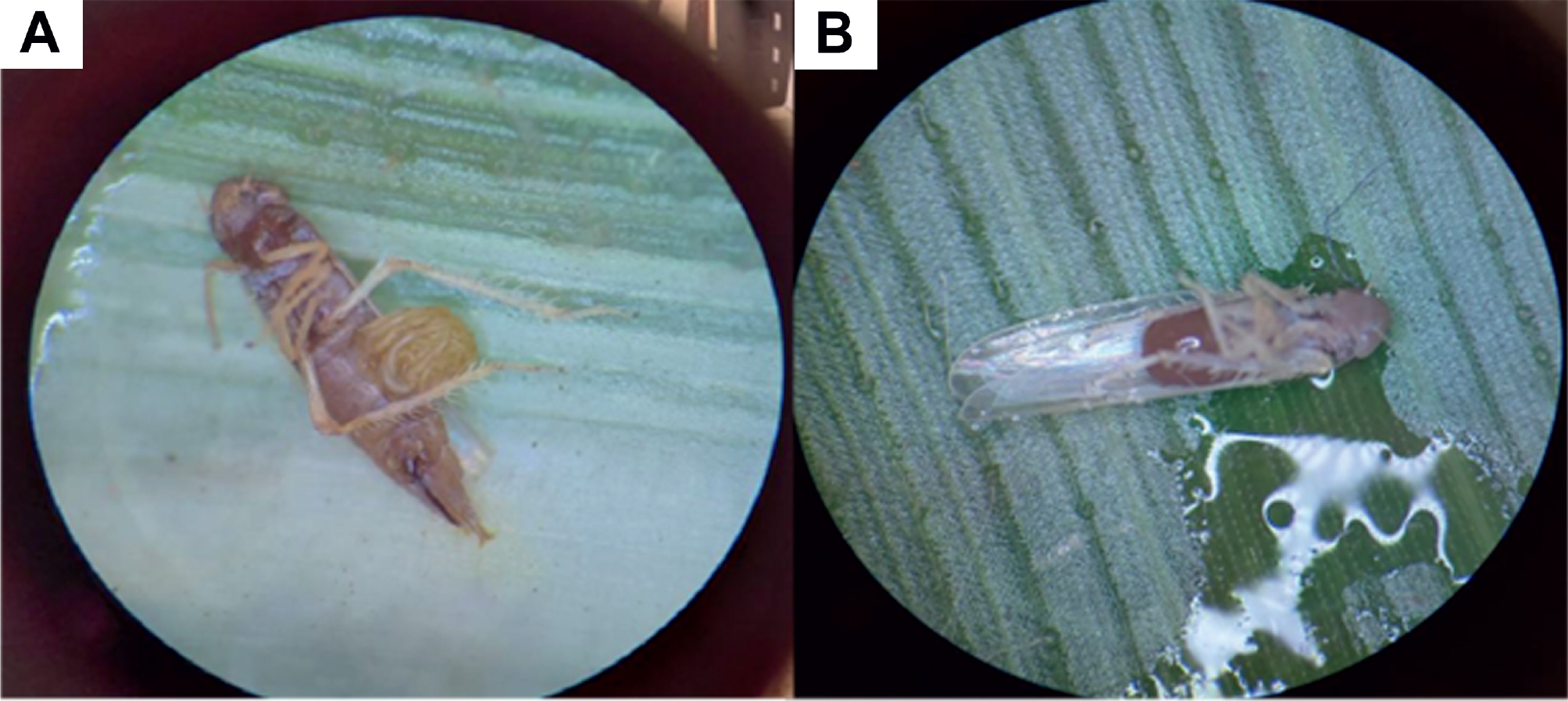
Fig 1.
Adult Dalbulus maidis killed by entomopathogenic nematodes under laboratory conditions. A. Heterorhabditis amazonensis MC01. B. Steinernema feltiae IBCB47.
Table 1.
Mortality (%) of Dalbulus maidis adults caused by different isolates of entomopathogenic nematodes under laboratory conditions.
| Treatment | Mortality (%)* |
|---|---|
| Heterorhabditis amazonensis GL | 66.48 ± 4.20 a |
| Heterorhabditis amazonensis MC01 | 62.61 ± 13.71 a |
| Heterorhabditis amazonensis UENP2 | 78.68 ± 6.16 a |
| Heterorhabditis amazonensis UENP6 | 65.53 ± 7.29 a |
| Steinernema brazilense IBCB 06 | 52.85 ± 9.07 a |
| Steinernema carpocapsae IBCB 02 | 51.48 ± 6.64 a |
| Steinernema feltiae IBCB 47 | 77.62 ± 5.31 a |
| CV (%) | 10.83 |
In subsequent steps, the S. feltiae IBCB47 isolates were selected as representatives of the Steinernema genus, and H. amazonensis MC01, a native isolate from the study region in Monte Carmelo, Minas Gerais, Brazil.
Lethal concentration (LC50) of Heterorhabditis amazonensis MC01 and Steinernema feltiae IBCB47 isolates
The exponential curve obtained by correlating different concentrations of the two isolates with the mortality of D. maidis was significant. The LC50 that results in adult mortality of D. maidis due to H. amazonensis MC01 was 75 IJ per adult and 173 IJ per adult for CL75 (Fig. 2A).
The LC50 causing adult mortality of D. maidis due to S. feltiae IBCB47 was 25 IJ per adult and 77 IJ per adult for CL75. However, even at higher concentrations, there was no increase in adult mortality (Fig. 2B).
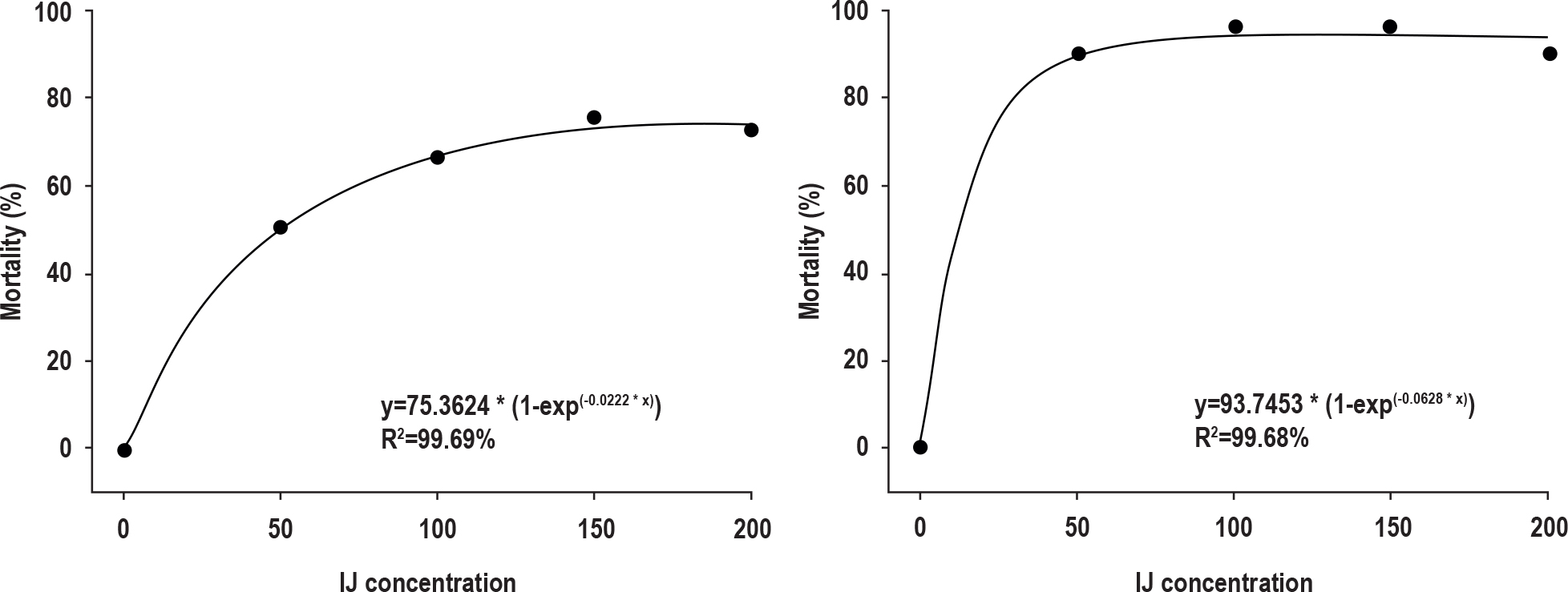
Fig. 2.
Lethal concentration of entomopathogenic required to kill Dalbulus maidis adults under laboratory conditions. A. Heterorhabditis amazonensis MC01. B. Steinernema feltiae IBCB47.
Compatibility of Heterorhabditis amazonensis MC01 and Steinernema feltiae IBCB47 isolates with phytosanitary products
All tested products affected viability and differed from the control treatment (Table 2). The infectivity potential of H. amazonensis MC01 to T. molitor larvae decreased after exposure to all products; the lowest infection rate was observed after exposure to the insecticide chlorpyrifos and the herbicide glyphosate. Insecticides methomyl and deltamethrin and the herbicide tembotrione did not significantly differ from the control treatment.
According to the IOBC protocol, none of the tested insecticides and herbicides were harmless to H. amazonensis MC01; only the insecticides chlorpyrifos and profenofos + lufenuron were classified as harmful. Herbicides atrazine, glyphosate, and tembotrione were classified as slightly harmful, and the herbicide 2,4-D as moderately harmful (Table 2).
Table 2.
Compatibility of Heterorhabditis amazonensis MC01 with phytosanitary products after 48 hours of contact.
| Treatment | Viability (%)* | Infectivity (%)* | MC | Rfin (%) | Rfec (%) | E (%) | IOBC Classification |
|---|---|---|---|---|---|---|---|
| Chlorfluazuron | 68.85 ± 2.62c | 35.00 ± 7.29b | 24.28 | 51.07 | 2.33 | 77.68 | Slightly Harmful |
| Atrazine | 77.75 ± 2.03b | 62.50 ± 12.50 a | 14.53 | 30.36 | 0.00 | 44.88 | Slightly Harmful |
| Methomyl | 69.90 ± 1.87c | 72.50 ± 9.18 a | 23.16 | 13.92 | 19.56 | 56.64 | Slightly Harmful |
| Chlorpyrifos | 66.17 ± 3.63c | 30.00 ± 8.48b | 27.28 | 63.57 | 42.65 | 133.51 | Harmful |
| Profenofos + Lufenuron | 60.50 ± 3.27c | 49.00 ± 9.00 b | 33.52 | 50.00 | 13.36 | 130.59 | Harmful |
| Deltamethrin | 62.10 ± 4.53c | 62.50 ± 12.50 a | 31.73 | 24.52 | 37.30 | 93.55 | Moderately Harmful |
| Glyphosate | 77.54 ± 3.50 b | 30.00 ± 10.23b | 14.81 | 58.09 | 5.14 | 78.04 | Slightly Harmful |
| Tembotrione | 79.47 ± 2.71 b | 70.00 ± 14.49 a | 12.60 | 25.83 | 14.56 | 52.60 | Slightly Harmful |
| 2.4D | 80.85 ± 2.90b | 32.50 ± 12.25 b | 11.12 | 57.62 | 11.09 | 79.83 | Moderately Harmful |
| Control | 90.97 ± 0.42 a | 77.50 ± 8.29 a | 0.00 | 0.00 | 0.00 | 0.00 | Harmless |
| CV (%) | 14.76 | 17.69 |
Regarding the S. feltiae isolate, the insecticides chlorfluazuron, chlorpyrifos, methomyl, and the herbicides 2,4-D, glyphosate, and tembotrione did not differ significantly from the control treatment (Table 3). The insecticide deltamethrin and the herbicide atrazine had the lowest viability rates. On the other hand, infectivity was reduced across all treatments, with the herbicide 2,4-D showing the lowest infectivity (60 %). Only the insecticide deltamethrin and the herbicide tembotrione did not significantly differ from the control treatment. Only the herbicide tembotrione was classified as harmless to S. feltiae IBCB47. The insecticides chlorfluazuron and chlorpyrifos, and the herbicide glyphosate, were classified as moderately harmful. However, the insecticides methomyl, profenofos + lufenuron, and deltamethrin, and the herbicides 2,4-D and atrazine, were classified as slightly harmful. None of the tested phytosanitary products were harmful to S. feltiae IBCB47.
Table 3.
Compatibility of Steinernema feltiae IBCB 47 with phytosanitary products after 48 hours of contact.
| Treatment | Viability (%)* | Infectivity (%)* | MC (%) | Rfin (%) | Rfec (%) | E (%) | IOBC Classification |
|---|---|---|---|---|---|---|---|
| Chlorfluazuron | 92.71 ± 0.95 a | 72.50 ± 9.18b | 80.24 | 2.48 | 53.20 | 83.18 | Moderately Harmful |
| Atrazine | 88.43 ± 1.80c | 72.50 ± 7.29b | 6.88 | 27.50 | 0.00 | 34.38 | Slightly Harmful |
| Methomyl | 97.18 ± 0.72 a | 65.00 ± 13.92b | 0.00 | 35.00 | 43.17 | 75.93 | Slightly Harmful |
| Chlorpyrifos | 95.46± 0.67 a | 80.00 ± 7.29b | 0.00 | 20.00 | 67.55 | 87.07 | Moderately Harmful |
| Profenofos + Lufenuron | 91.74 ± 1.19b | 65.00 ± 2.45b | 3.48 | 35.00 | 0.20 | 38.67 | Slightly Harmful |
| Deltamethrin | 86.15 ± 2.81c | 97.50 ± 2.50 a | 9.42 | 2.50 | 37.81 | 49.73 | Slightly Harmful |
| Glyphosate | 96.44 ± 1.06 a | 70.00 ± 10.89b | 0.00 | 30.00 | 11.71 | 40.24 | Moderately Harmful |
| Tembotrione | 97.11 ± 1.26 a | 87.50 ± 9.68 a | 0.00 | 12.50 | 8.37 | 18.67 | Harmless |
| 2,4D | 95.79 ± 1.39 a | 60.00 ± 7.29b | 0.00 | 40.00 | 7.82 | 47.04 | Slightly Harmful |
| Control | 95.07 ± 0.97 a | 100.00 ± 0.00a | 0.00 | 0.00 | 0.00 | 0.00 | Harmless |
| CV (%) | 3.38 | 24.24 |
Life cycle of the Heterorhabditis amazonensis MC01 and Steinernema feltiae IBCB47 isolates in Dalbulus maidis
All development stages of the H. amazonensis MC01 isolate were observed in the short cycle (Table 4). In the long cycle, only the 2nd stage juvenile was not observed (Table 5).
Table 4.
Duration of developmental stages of Heterorhabditis amazonensis MC01 in Dalbulus maidis at a concentration of 100 infective juveniles per insect (short cycle).
| Developmental stage | Assessment time (h) | |||||||
|---|---|---|---|---|---|---|---|---|
| 72 | 96 | 120 | 144 | 192 | 216 | 240 | 264 | |
| J4 | 0 - 10 | 10 | 18 | 3 | 10 | |||
| Hermaphrodites + eggs/J1 | 56 | |||||||
| Hermaphrodites + J2 | 18 | |||||||
| J3 and J4 | 50 | |||||||
| Females and Males | 1 | 31 | ||||||
| Females + eggs/J1 | 279 | 755 | ||||||
| Females + J2 | ||||||||
| J3/JI | 2 | |||||||
| J4 (2nd Generation) | ||||||||
Table 5.
Duration of developmental stages of Heterorhabditis amazonensis MC01 in Dalbulus maidis at a concentration of 5 infective juveniles per insect (long cycle).
| Developmental stage | Assessment time (h) | ||||
|---|---|---|---|---|---|
| 72 | 144 | 168 | 216 | 264 | |
| J4 | 0 - 10 | 10 | 6 | ||
| Hermaphrodites + eggs/J1 | 3 | ||||
| Hermaphrodites + J2 | |||||
| J3 and J4 | |||||
| Females and Males | 1 | 31 | |||
| Females + eggs/J1 | 50 | 300 | |||
| Females + J2 | |||||
| J3/JI | 2 | ||||
| J4 (2nd Generation) | |||||
In both periods, the S. feltiae IBCB47 isolate lasted longer compared to the H. amazonensis MC01 isolate (Tables 6 and 7). In the short cycle, the juvenile stage was observed 96 hours after application, while in the long cycle, it was 72 hours after application.
Table 6.
Duration of developmental stages of Steinernema feltiae IBCB 47 in Dalbulus maidis at a concentration of 100 infective juveniles per insect (short cycle).
| Developmental stage | Assessment time (h) | |||||||
|---|---|---|---|---|---|---|---|---|
| 96 | 120 | 144 | 192 | 216 | 240 | 264 | 288 | |
| J4 | 92 | 68 | 137 | 4 | ||||
| Hermaphrodites + eggs/J1 | 0 - 10 | 4 | 8 | 4 | ||||
| Hermaphrodites + J2 | 17 | |||||||
| J3 and J4 | 15 | 6 | ||||||
| Females and Males | 15 | 4 | ||||||
| Females + eggs/J1 | ||||||||
| Females + J2 | 31 | |||||||
| J3/JI | 13 | 16 | ||||||
| J4 (2nd Generation) | 8 | |||||||
Table 7.
Duration of developmental stages of Steinernema feltiae IBCB 47 in Dalbulus maidis at a concentration of 5 infective juveniles per insect (long cycle).
| Developmental stage | Assessment time (h) | ||||||
|---|---|---|---|---|---|---|---|
| 72 | 144 | 168 | 216 | 240 | 264 | 288 | |
| J4 | 0 - 10 | 3 | |||||
| Hermaphrodites + eggs/J1 | 0 - 5 | 2 | 3 | ||||
| Hermaphrodites + J2 | 3 | 3 | |||||
| J3 and J4 | 1 | ||||||
| Females and Males | 7 | ||||||
| Females + eggs/J1 | 8 | ||||||
| Females + J2 | |||||||
| J3/JI | 9 | ||||||
| J4 (2nd Generation) | 2 | 4 | |||||
Discussion
All isolates in our screening caused mortality >50 % in D. maidis adults (Fig. 1), which supports the use of entomopathogenic nematodes against this pest and justified advancing Heterorhabditis amazonensis MC01 (native to Monte Carmelo, MG, Brazil) and Steinernema feltiae IBCB47 to subsequent assays (Table 1). High susceptibility of hemipterans to these agents is well documented: in D. melachanthus nymphs, Guide et al. (2019) reported >80 % mortality within 24 h for H. amazonensis GL (80.0 %), RSC05 (88.0 %), and Steinernema sp. IBCB-n27 (82.0 %). Consistently, Alves et al. (2009) found higher pathogenicity of Heterorhabditis spp. than Steinernema spp. against Dysmicoccus texensis (Tinsley) (Hemiptera: Pseudococcidae), and Zart et al. (2021) reported strong performance of Heterorhabditis on D. brevipes. Beyond the laboratory, Leite et al. (2005) documented ~70 % field efficacy of Heterorhabditis sp. CB-n5 against Mahanarva fimbriolata (Fabricius) (Hemiptera: Cercopidae), while Cecconello et al. (2022) showed high adult mortality of E. heros using Heterorhabditis IB-CB-n46 and NEPET 11 under laboratory and greenhouse conditions, together reinforcing that isolate identity shapes performance across Hemiptera and that certain Heterorhabditis isolates can perform under operational settings.
Dose–response analyses further characterized performance. For H. amazonensis MC01, LC50 = 75 IJ/adult and LC75 = 173 IJ/adult (Fig. 2A). For S. feltiae IBCB47, LC50 = 25 IJ/adult and LC75 = 77 IJ/adult (Fig. 2B). Increasing IBCB47 dose did not yield proportional mortality gains, suggesting a threshold response aligned with Batista et al. (2014), who reported that higher IJ densities did not improve performance of H. amazonensis RSC1 on M. spectabilis. Differences from Guide et al. (2019) using IBCB-n27 and from Nanzer et al. (2021) with Steinernema diaprepesi Nguyen & Duncan underscore host-isolate specificity and context dependence. Compatibility testing revealed distinct sensitivity profiles. For H. amazonensis MC01, all tested products reduced viability versus water (Table 2), with the lowest infection after the insecticide chlorpyrifos and the herbicide glyphosate; methomyl, deltamethrin, and tembotrione did not differ from the control for viability. Under IOBC categories, none of the products were harmless to MC01; chlorpyrifos and profenofos + lufenuron were harmful; atrazine, glyphosate, and tembotrione were slightly harmful; 2,4-D was moderately harmful. These patterns are consistent with Borges et al. (2023), who reported incompatibility of MC01 with chlorpyrifos, methomyl, and profenofos. For S. feltiae IBCB47 (Table 3), chlorfluazuron, chlorpyrifos, methomyl, 2,4-D, glyphosate, and tembotrione did not reduce viability relative to the control, whereas deltamethrin and atrazine produced the lowest viability. Infectivity declined under all products, with 2,4-D yielding the lowest infectivity (60 %); deltamethrin and tembotrione did not differ from the control for this endpoint. In broader context, Ozdemir et al. (2021) observed that diamide and spinosyn insecticides were not harmful to S. feltiae, while Amizadeh et al. (2019) reported high IJ mortality after exposure to abamectin and azadirachtin, highlighting that compatibility hinges on both isolate identity and active ingredient/formulation. Life-cycle observations aligned with these efficacy and compatibility patterns. H. amazonensis MC01 displayed all developmental stages in the short cycle (Table 4) and all except the second-stage juvenile in the long cycle (Table 5), indicating faster within-host progression. For S. feltiae IBCB47, juveniles were first recorded at 96 h (short cycle) and 72 h (long cycle) (Tables 6 and 7), indicating slower development. The influence of IJ density and host traits on cycle duration is consistent with foundational syntheses by Adams & Nguyen (2002), and with Grewal et al. (1994), who emphasized that developmental rate and recycling are determined by isolate pathogenicity, host size/quality, and environmental conditions. Moreover, reports of multiple generations of H. amazonensis RSC5 in Galleria mellonella L. (Lepidoptera: Pyralidae) (Andaló et al., 2009) corroborate our observation of robust within-host development for Heterorhabditis under favorable conditions.
Taken together, these results, anchored by our mortality screening (>50 % for all isolates), dose–response estimates for MC01 and IBCB47, compatibility profiles, and life-cycle timelines, indicate that careful matching of isolate, dose, and compatible chemistries is essential for integrating entomopathogenic nematodes into IPM against D. maidis. Future work should validate field performance across environments, refine dos–timing recommendations alongside compatible products, and quantify persistence and recycling in maize systems.
Conclusion
All isolates tested were pathogenic to D. maidis adults. Under our conditions, the estimated lethal doses were LC50 = 22 IJ adult−1 for S. feltiae IBCB47 and LC50 = 75 IJ adult−1 for H. amazonensis MC01. Compatibility assays showed that the insecticides chlorpyrifos and profenofos + lufenuron were harmful to H. amazonensis MC01, whereas the herbicide tembotrione was harmless to S. feltiae IBCB47; nevertheless, both isolates exhibited reduced infectivity after exposure to several phytosanitary products, highlighting the need to manage product choice and application timing in IPM programs. Life-cycle assessments documented, for H. amazonensis MC01, the presence of all developmental stages in the short cycle and of all stages except the second-stage juvenile in the long cycle. For S. feltiae IBCB47, juveniles were first recorded at 96 h in the short cycle and at 72 h in the long cycle, and the developmental pace in both isolates depended on the number of infective juveniles applied.
Acknowledgement
The authors would like to thank the Federal University of Uber-lândia, the Graduate Program in Agriculture and Geospatial Information, and the Research and Support Foundation of the State of Minas Gerais (FAPEMIG) for the master’s scholarship to the first author.
Notes
[7] Conflicts of interest Conflict of Interest
The authors state no conflict of interest.