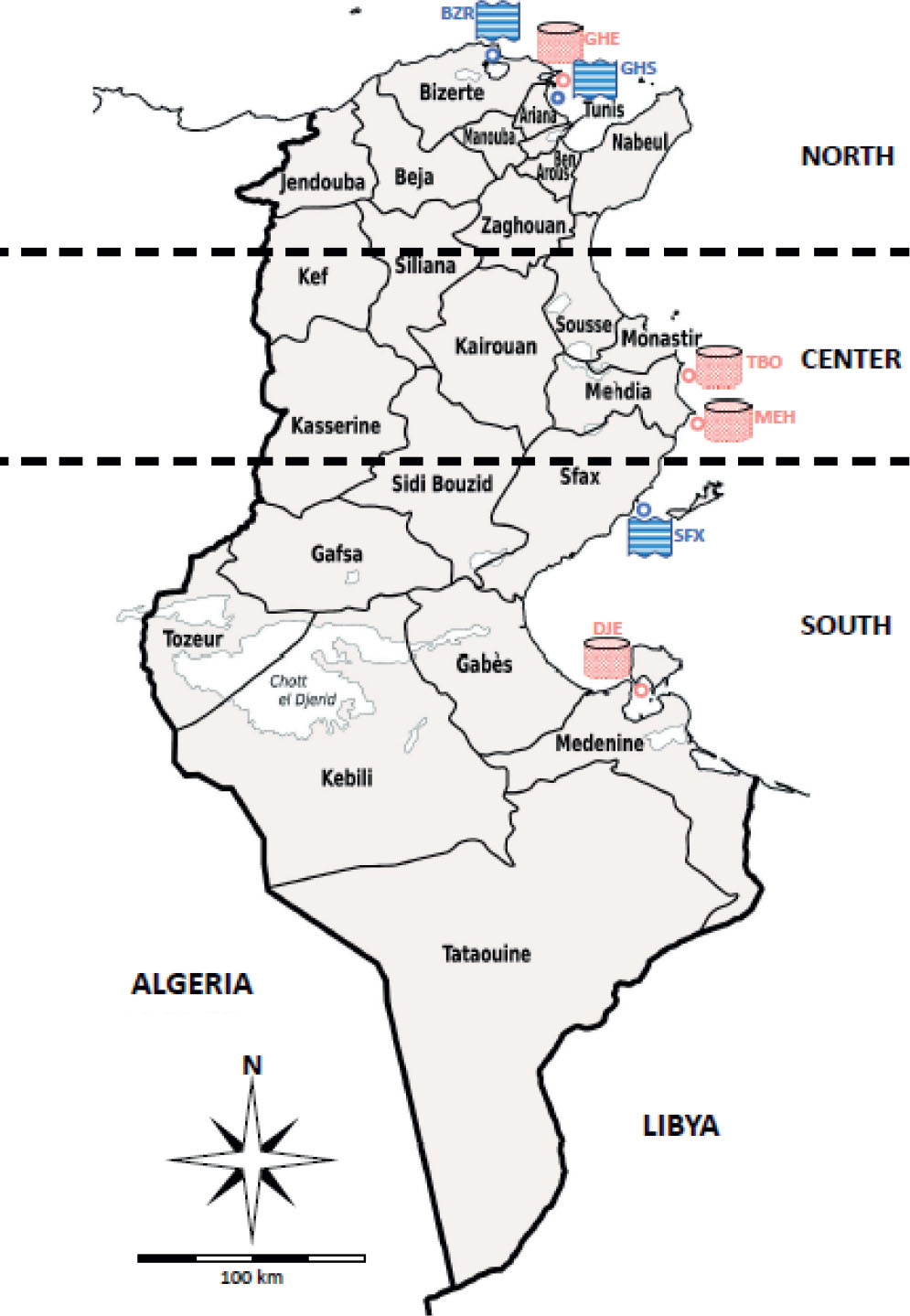
Fig. 1.
Sampling sites of Sparicotyle chrysophrii from wild (blue waves) and farmed (Red cages) Sparus aurata in Tunisia: North (Bizerte (BZR), Ghar El Melh (GHE/GHS)), Centre (Tboulba (TBO), Mehdia (MEH)), South (Djerba (DJE), Sfax (SFX)).
Table 1.
List of Sparicotyle chrysophrii specimens collected from the gills of wild and farmed Sparus aurata in Tunisia.
| S. aurata | Locality (Code) | NHE | NHP | P (MI) | n-28S | n-COI |
|---|---|---|---|---|---|---|
| Wild | Bizerte (BZR) NORTH | 11 | 7 | 63.6 % (1.7) | 1 | 11 |
| Ghar El Meleh (GHS) NORTH | 13 | 5 | 38.5 % (2.0) | 1 | 9 | |
| Sfax (SFX) SOUTH | 16 | 6 | 37.5 % (1.7) | 1 | 10 | |
| Cage-reared | Ghar El Melh (GHE) NORTH | 10 | 9 | 90.0 % (2.4) | 1 | 20 |
| Tboulba (TBO) CENTER | 17 | 5 | 29.4 % (2.8) | 1 | 10 | |
| Mehdia (MEH) CENTER | 15 | 7 | 46.7 % (1.6) | 1 | 11 | |
| Djerba (DJE) SOUTH | 15 | 5 | 33.4 % (3.4) | 1 | 17 |
Table 2.
Diversity indices and neutrality tests values of S. chrysophrii samples collected from Tunisian sites based on COI marker.
| Population | n | S | h | k | Pi | Hd | Tajima's D | Fu's Fs |
|---|---|---|---|---|---|---|---|---|
| Ghar El Melh (C) NORTH | 20 | 5 | 8 | 1.336 | 0.00440 | 0.815 | −0.15742 | −3.745 |
| Tboulba CENTER | 10 | 5 | 6 | 1.466 | 0.00482 | 0.888 | −0.68235 | −2.691 |
| Mehdia CENTER | 11 | 4 | 5 | 0.981 | 0.00323 | 0.709 | −1.02918 | −2.111 |
| Bizerte NORTH | 11 | 11 | 5 | 2.836 | 0.00933 | 0.781 | −1.05320 | 0.425 |
| Djerba SOUTH | 17 | 4 | 7 | 1.308 | 0.00431 | 0.830 | 0.32498 | −2.954 |
| Sfax SOUTH | 10 | 3 | 5 | 1.177 | 0.00387 | 0.755 | 0.39804 | −1.849 |
| Ghar El Melh (W) NORTH | 9 | 4 | 5 | 1.777 | 0.00585 | 0.861 | 0.84519 | −1.113 |
Table 3.
Genetic diversity indices and neutrality tests values of S. chrysophrii populations from the Mediterranean Sea based on COI marker.
| Population | n | S | h | k | Pi | Hd | Tajima's D | Fu's Fs |
|---|---|---|---|---|---|---|---|---|
| Tunisia | 88 | 12 | 15 | 1.56818 | 0.00519 | 0.82941 | −0.91998 | −6.945 |
| Adriatic Sea | 9 | 16 | 5 | 3.88889 | 0.01288 | 0.80556 | −1.64543 | 0.624 |
| Algeria | 5 | 13 | 5 | 5.40000 | 0.01788 | 1.00000 | −0.97762 | −1.223 |
| Spain | 22 | 16 | 15 | 4.61039 | 0.01527 | 0.96104 | 0.18310 | −6.121 |
| Italy | 23 | 16 | 11 | 3.81028 | 0.01262 | 0.85771 | −0.43524 | −2.204 |
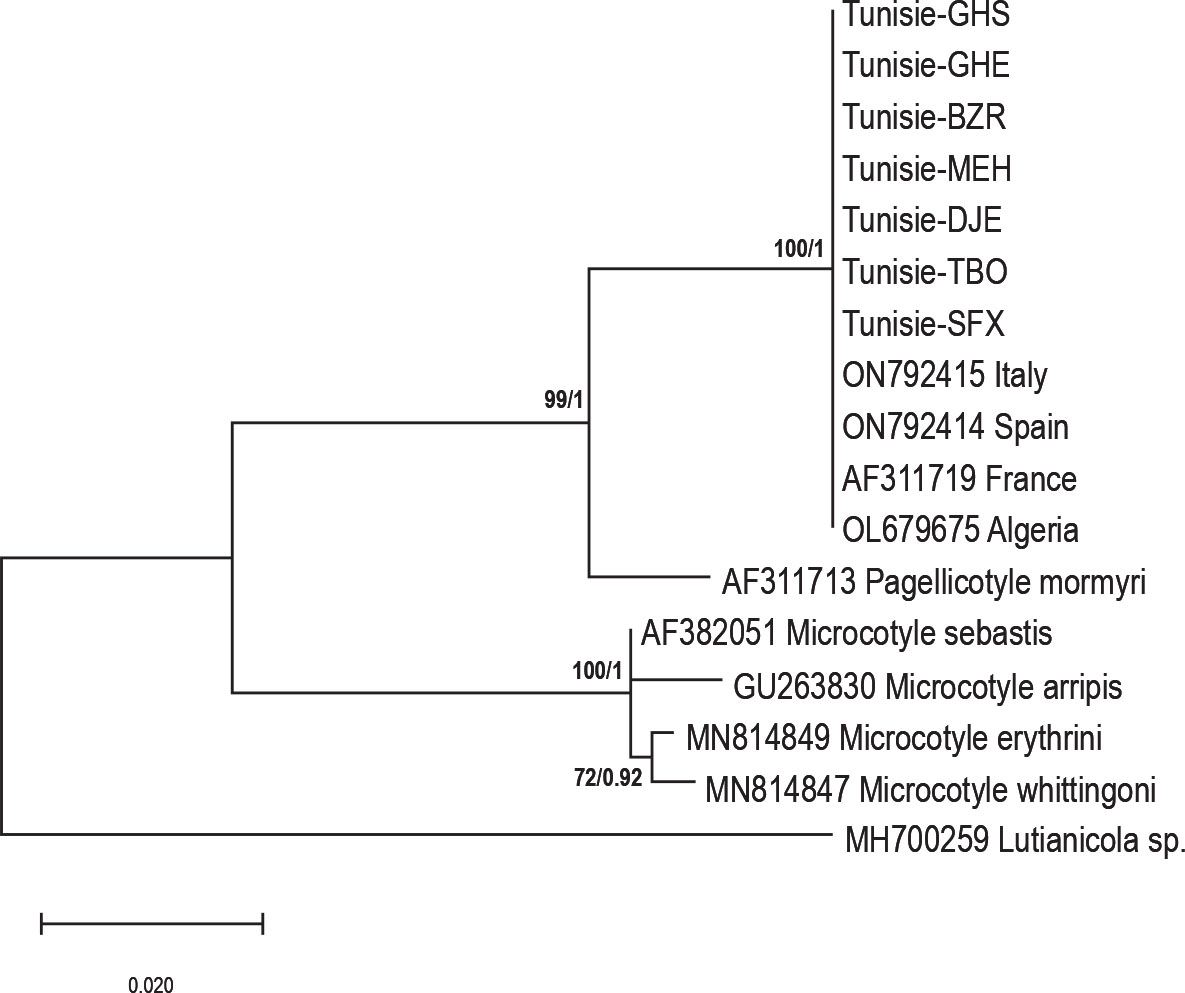
Fig. 2.
ML and BI phylogenetic tree of Sparicotyle chrysophrii from the Mediterranean Sea based on partial 28S rDNA (872 bp). Tunisian samples (GHS/GHE: Ghar El Melh; BZR: Bizerte; MEH: Mahdia; DJE: Djerba; TBO: Téboulba; SFX: Sfax) and Mediterranean references (Italy, Spain, France, Algeria) are included. Lutianicola sp. used as outgroup. Only nodal support values >75% are shown (ML bootstrap right; BI posterior probability left).

Fig. 3.
ML and BI phylogenetic tree of Sparicotyle chrysophrii from the Mediterranean Sea based on COI sequences (300 bp). Locality codes indicate Tunisian samples (GHS/GHE: Ghar El Melh; BZR: Bizerte; MEH: Mahdia; DJE: Djerba; TBO: Tboulba; SFX: Sfax), and Mediterranean references from Italy, Spain, France, and Algeria are included. Only nodal support values >50% are shown (ML right; BI left).
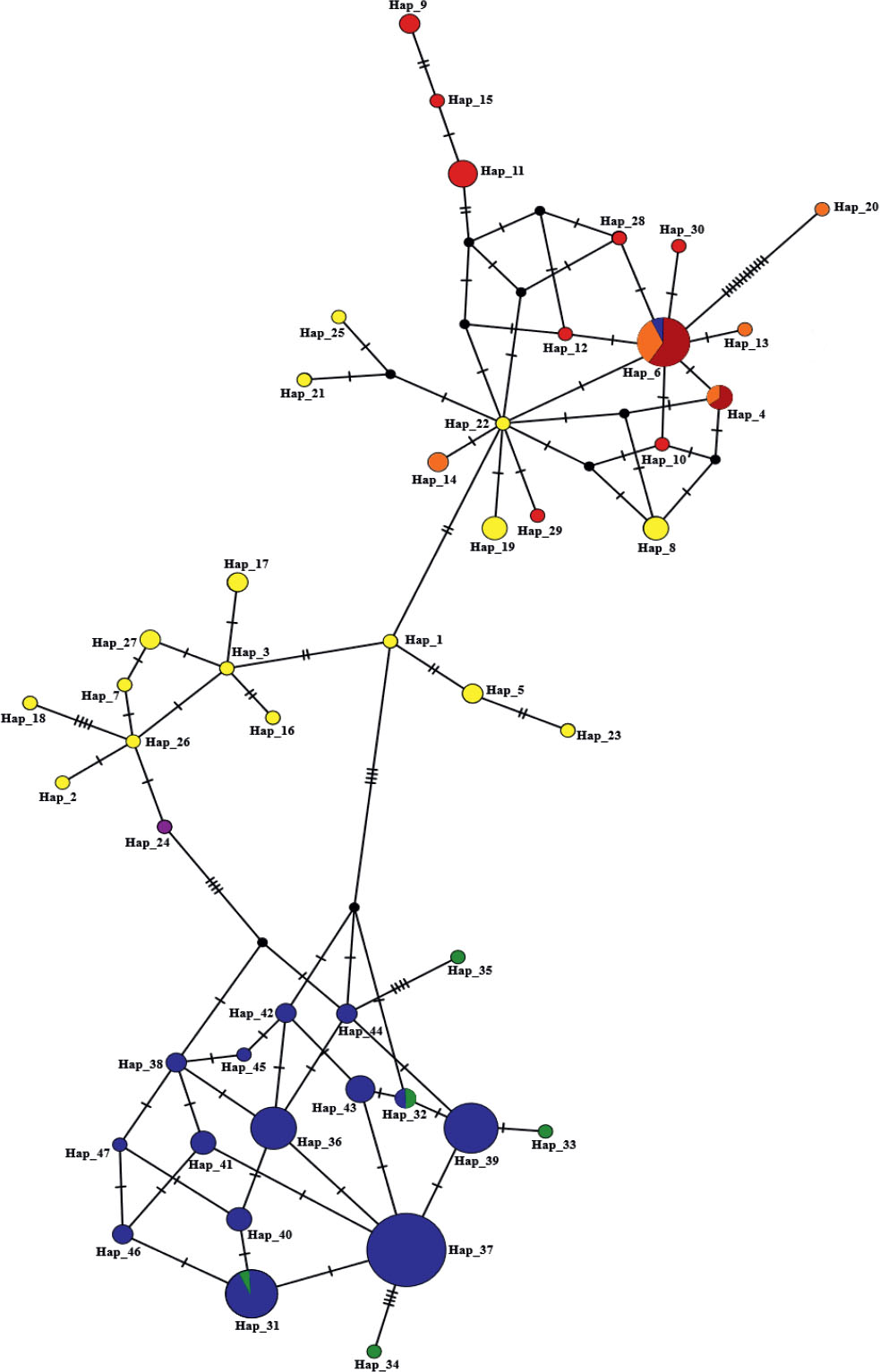
Fig. 4.
Median-joining haplotype network for Sparicotyle chrysophrii from the gills of Sparus aurata from the Mediterranean Sea based on 300bp COI sequences. Different colors indicate the locations of origin for the distinct haplotypes. Blue: Tunisia; Green: Algeria; Yellow: Spain; Purple: France; Red: Sardinia, Italy; Orange: The Adriatic Sea. Abbreviations: H1–H47, haplotype IDs. Circle sizes are proportional to the frequency of each haplotype.
Table 4.
Analysis of Molecular Variance (AMOVA) of Sparicotyle chrysophrii samples from Tunisia, divided into three groups (North, Central and South).
Table 5.
Analysis of Molecular Variance (AMOVA) of Sparicotyle chrysophrii samples based on their hosts origin, grouped into two groups (wild versus cage-reared Tunisian hosts).
Table 6.
Analysis of Molecular Variance (AMOVA) of Sparicotyle chrysophrii samples from the North and the South Mediterranean Sea (North versus South Mediterranean Sea).
Table 7.
Analysis of the genetic diversity of Sparicotyle chrysophrii populations from the Mediterranean Sea (Pairwise FST between populations (lower diagonal), nucleotide divergence (Dxy)/the net genetic distance (Da) between populations).
| Tunisia | Algeria | Spain | Italy | Adriatic Sea | |
|---|---|---|---|---|---|
| Tunisia | - | 0.01148/-0.00006 | 0.02961/0.01938 | 0.03171/0.02281 | 0.03639/0.02735 |
| Algeria | −0.00525 | - | 0.03188/0.0153 | 0.0334/0.01815 | 0.03797/0.02259 |
| Spain | 0.65457 | 0.4801 | - | 0.01935/0.00541 | 0.01945/0.00538 |
| Italy | 0.71922 | 0.54346 | 0.27953 | - | 0.01416/0.00141 |
| Adriatic Sea | 0.75169 | 0.59496 | 0.2765 | 0.09959 | - |
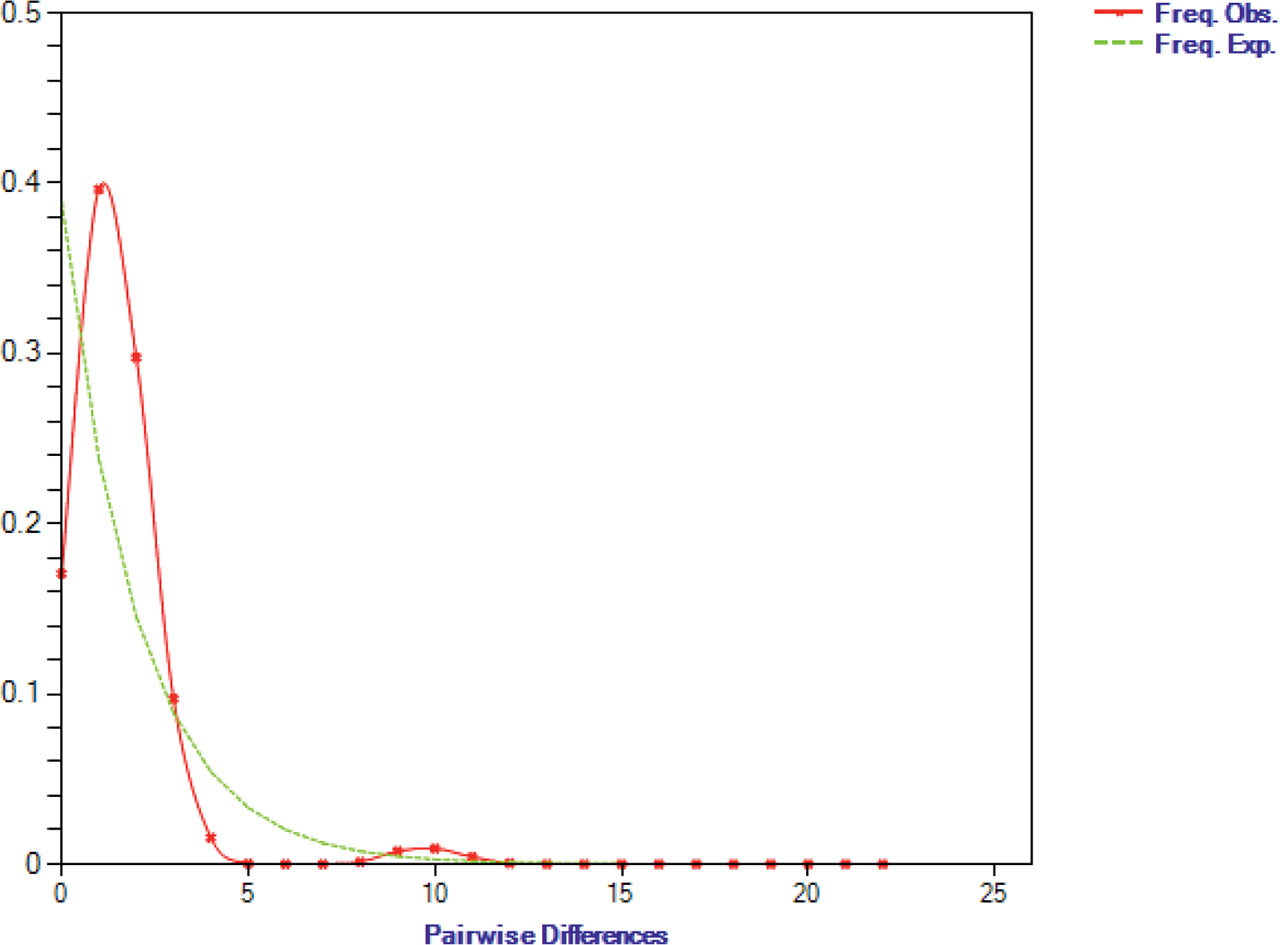
Fig. 5.
Mismatch distribution graph for Sparicotyle chrysophrii from Tunisia. The x-axis displays the number of pairwise differences, and the y-axis displays the frequency of the pairwise comparisons. The red dotted line indicates the observed frequencies. The continuous green line shows the frequency expected under the population expansion model.