Introduction
As wild fish stocks decline and seafood demand rises, the Tunisian aquaculture industry has expanded significantly. It currently accounts for 16 % of the country’s aquatic products and provides over 1,000 direct, permanent jobs in aquaculture. This sector produces approximately 26,000 tonnes of fish and seafood annually and has considerable growth potential to meet increasing demand in the Middle East and North Africa (FAO, 2025). Among key species, the gilthead seabream (GSB), Sparus aurata Linnaeus, 1758, accounts for a substantial share of aquaculture production. Despite this expansion, the industry faces mounting challenges from parasitic infections, particularly polyopisthocotylan ectoparasites, which severely impact farmed fish populations (Sitja-Bobadilla & Álvarez-Pellitero, 2009; Villar-Torres et al., 2019; Riera-Ferrer et al., 2022). One of the most concerning parasites for GSB farming is Sparicotyle chrysophrii (Van Beneden & Hesse, 1863) Mamaev, 1984, which threatens farm productivity and can induce severe epizootic outbreaks, leading to notable mortality rates in sea-cage systems (Sitjà-Bobadilla et al., 2006; Antonelli et al., 2010; Mladineo et al., 2024). Effective control of this parasite requires integrated management practices that encompass regular health monitoring, appropriate stocking densities, treatment strategies, and molecular diagnostics. However, the limited efficacy of available treatments, combined with the parasite’s capacity for rapid reinfection, frequently results in recurrent outbreaks, with reported mortality rates reaching up to 15 % in farmed seabream (GSB) populations (Sitjà-Bobadilla et al., 2006). Survivors often exhibit stunted growth and other symptoms, including lethargy, severe anaemia, weight loss, and histopathological changes such as lamellar synechiae, clubbing, and shortening of gill filaments, and epithelial hyperplasia (Piazzon et al., 2019; Merella et al., 2021; Riera-Ferrer et al., 2022). Recently, Merella et al. (2024) demonstrated that dietary administration of fenbendazole is an effective strategy for the prevention and control of sparicotylosis in aquaculture, significantly reducing S. chrysophrii infection levels in farmed S. aurata.
The bidirectional transmission of S. chrysophrii between wild and farmed fish poses a significant risk, exacerbated by farm-escaped fish that act as vectors for pathogen spread (Farjallah et al., 2023). The parasite’s life cycle, characterised by limited egg dispersal and favoured by net biofouling and high fish densities, promotes reinfection within and between adjacent cages, leading to a high prevalence of sparicotylosis (Stella et al., 2023).
In this context, molecular tools play a crucial role in advancing our understanding of fish parasite epidemiology, pathogenicity, evolutionary history, and host adaptation (Perkins et al., 2011; Froeschke et al., 2014; Pascual et al., 2016). Misidentification of parasitic taxa can severely hinder epidemiological studies, compromise diagnostic accuracy, and reduce the effectiveness of control measures (Bell & Sommerville, 2002; Lavikainen et al., 2010; Schulte et al., 2011). In Tunisia, although the presence of S. chrysophrii has been confirmed in both wild and farmed seabream (GSB), previous studies have relied predominantly on morphological identification (Chaari et al., 2019; Derbel et al., 2022), the need for molecular investigations focusing on population structure and genetic diversity.
Genetic markers, including nuclear ribosomal regions (28S rDNA), and mitochondrial DNA sequences, have proven helpful in molecular systematics, species differentiation, phylogenetic analysis, and understanding intraspecific variation within monogenean families such as Diplectanidae, Gyrodactylidae and Microcotylidae (Ayadi et al., 2017, 2022; Villar-Torres et al., 2019; Hossen et al., 2022; Farjallah et al., 2024). A multilocus approach has yielded robust, consistent phylogenetic insights that are essential for understanding parasite biology and developing management strategies (Rosell et al., 2010; Allio et al., 2017; Sereno-Uribe et al., 2019). Specifically, combining the 28S ribosomal DNA region with the mitochondrial cytochrome c oxidase subunit I (COI) gene has been effective for species differentiation in monogeneans (Hansen et al., 2007; Locke et al., 2010; Tambireddy et al., 2016; Bouguerche et al., 2021; Ayadi et al., 2022; Geraerts et al., 2023).
This study addresses a critical gap in the monitoring of S. chrysophrii in Tunisia, where comprehensive epidemiological and molecular data are still scarce. Building on previous research exploring the genetic diversity of S. chrysophrii in Italy (Sardinia) and Spain (Farjallah et al., 2023), this study adopts an integrated approach to identify the parasite in wild and farmed GSB populations off the Tunisian coast. Using nuclear (28S rDNA) and mitochondrial (COI) markers, it aims to examine population genetic variation and phylogenetic relationships through a multilocus molecular approach, incorporating both new and existing haplotype data from various Mediterranean localities.
Materials and Methods
Sample collection and parasitological infection parameters
Ninety-seven specimens of wild (40) and cage-reared (57) GSB were collected from February 2023 to May 2024. Specimens were sampled from seven localities in Tunisia (Fig. 1, Table 1). The marine farms included in the study were anonymized and identified by their respective localities. Gills and opercula from each fish were carefully removed and examined fresh. The eight holobranchs (four on each side) were isolated, placed in Petri dishes with seawater, and examined individually under a stereomicroscope for the presence of S. chrysophrii. The morpho-anatomical characteristics of the collected parasites were observed using an Olympus BX41 optical microscope. All S. chrysophrii specimens collected from each host were counted and stored in 70 % ethanol; infection levels (prevalence and mean intensity) were calculated according to Bush et al. (1997) (Table 1).
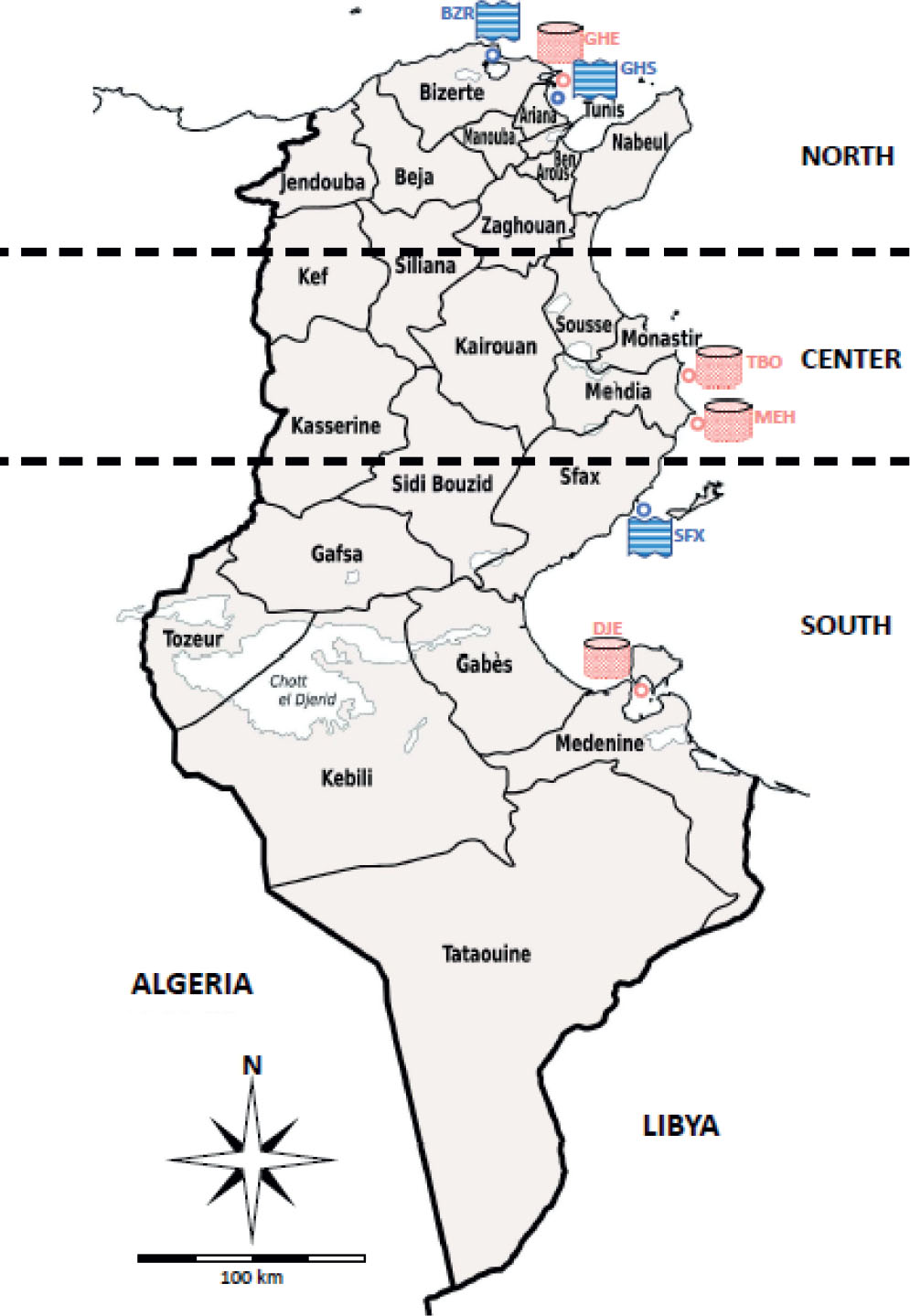
Fig. 1.
Sampling sites of Sparicotyle chrysophrii from wild (blue waves) and farmed (Red cages) Sparus aurata in Tunisia: North (Bizerte (BZR), Ghar El Melh (GHE/GHS)), Centre (Tboulba (TBO), Mehdia (MEH)), South (Djerba (DJE), Sfax (SFX)).
Table 1.
List of Sparicotyle chrysophrii specimens collected from the gills of wild and farmed Sparus aurata in Tunisia.
| S. aurata | Locality (Code) | NHE | NHP | P (MI) | n-28S | n-COI |
|---|---|---|---|---|---|---|
| Wild | Bizerte (BZR) NORTH | 11 | 7 | 63.6 % (1.7) | 1 | 11 |
| Ghar El Meleh (GHS) NORTH | 13 | 5 | 38.5 % (2.0) | 1 | 9 | |
| Sfax (SFX) SOUTH | 16 | 6 | 37.5 % (1.7) | 1 | 10 | |
| Cage-reared | Ghar El Melh (GHE) NORTH | 10 | 9 | 90.0 % (2.4) | 1 | 20 |
| Tboulba (TBO) CENTER | 17 | 5 | 29.4 % (2.8) | 1 | 10 | |
| Mehdia (MEH) CENTER | 15 | 7 | 46.7 % (1.6) | 1 | 11 | |
| Djerba (DJE) SOUTH | 15 | 5 | 33.4 % (3.4) | 1 | 17 |
DNA Extraction, amplification, and sequencing of 28S and COI molecular markers
Genomic DNA was extracted using a modified SDS-based method (Farjallah et al., 2023). Samples were mixed with 300 μl phosphate-buffered saline (PBS), homogenised using a tissue homogeniser (Biospec Tissue Tearor-985370), and digested with SDS–proteinase K at 55 °C for 30 minutes. Proteinase K was inactivated by thermal shock (70 °C for 5 minutes, then chilled for 5 minutes). Proteins were precipitated by centrifugation at 13,000 rpm for 6 min, and the supernatant was transferred to a new 1.5-ml tube. DNA was then precipitated with 100 % ethanol, air-dried, resuspended in 100 μl TE buffer, and stored at −4 °C.
A partial fragment of the 28S ribosomal DNA gene was amplified using the primers C1 (5′-ACC CGC TGA ATT TAA GCA T-3′) and D2 (5′-TCC GTG TTT CAA GACGG-3′) (Hassouna et al., 1984).
PCR amplifications were performed as described by Jovelin and Justine (2001). To investigate the population genetic variation, a second set of primers, SparicoF (5′-GTG CTA ATA CTA CCA GC-3′)/SparicoR (5′ GCT ACA CGA CCA TCT ATC3′), was used for the amplification of 370-bp fragments of the cytochrome oxidase I (COI) (Mladineo et al., 2009). Amplifications were performed according to the procedure described by Mladineo et al. (2009). Negative controls (sterile water) were added to detect potential contamination.
Amplification products were visualised by gel electrophoresis on a 1 % agarose gel using the HyperLadder 100 bp molecular weight marker (Bioline Reagents Ltd., London, UK). Sequencing of PCR products was performed by Macrogen (Amsterdam, Netherlands). The sequences were manually checked and aligned using ClustalW, implemented in Mega X version 10.2.5 (Bandelt et al., 1999). Sequence alignments were constructed using available sequences from the GenBank database, retrieved with the BLAST algorithm (Altschul et al., 1990). Comparative sequence analyses utilised nuclear and mitochondrial marker sequences from studies conducted by Lablack et al. (2022) in Algeria, Farjallah et al. (2023) in Italy (Sardinia) and Spain, Mladineo et al. (2009) in the Adriatic Sea (Croatia), and Jovelin and Justine (2001) in France (Supplementary Materials, Table S1).
Phylogenetic analyses
The optimal evolutionary model and partitioning scheme were determined using PartitionFinder 2.1 (Lanfear et al., 2017). For the 28S dataset, the GTR + G substitution model was used for both Maximum Likelihood (ML) and Bayesian analyses. For the COI dataset, the GTR + I + G model was applied.
Phylogenetic trees were constructed using Maximum Likelihood (ML) for both nuclear and mitochondrial markers using Mega X version 10.2.5 and RAXML version 8 (Stamatakis, 2006), with bootstrap values calculated from 2000 pseudoreplicates. Bayesian Inference (BI) analyses were performed using MrBayes version 3.2.6 (Huelsenbeck & Ronquist, 2001), with two independent runs of 1 × 10⁸ generations, sampling every 1000 generations.
For the COI dataset, the outgroup consisted of sequences from Microcotyle sebastis (MW730640), M. erythrini (MW730640), Kuhnia scombri (KU380211), Pauciconfibula trachini (MW484935), and Mormyrocotyle mormyri (AY009160). At the same time, the 28S tree was rooted using sequence of Lutianicola sp. (MH700259).
Population genetic analyses
DnaSP v.5.10.01 (Librado & Rozas, 2009) was used to estimate various genetic diversity metrics, including the number of haplotypes (h), haplotype diversity (Hd), nucleotide diversity (Pi), the average number of nucleotide differences (k), the number of polymorphisms and insertions/deletions (S), neutrality test statistics (Fu’s Fs and Tajima’s D). Additionally, nucleotide divergence (Dxy), net genetic distance (Da) between populations, and pairwise FST values were calculated.
The haplotype network was constructed using PopArt version 1 (Bandelt et al., 1999) to illustrate relationships among S. chrysophrii populations from different geographical regions. The median-joining (MJ) network algorithm was applied with default parameters (equal character weight = 10, transitions/transversions weight = 1:1, and connection cost as the criterion).
Pairwise genetic distances (p-distance) between localities were calculated using Mega X version 10.2.5 (Bandelt et al., 1999). Population differentiation was assessed using the FST index, and analysis of molecular variance (AMOVA) was performed using Arlequin 3.5 (Excoffier & Lischer, 2010).
For AMOVA, S. chrysophrii samples were grouped by geographic origin into three groups from Tunisia: North (Bizerte and Ghar el Meleh), Center (Tboulba and Mehdia), and South (Djerba and Sfax). A second AMOVA was performed on Tunisian samples by host origin (wild vs. cage-reared). A final AMOVA compared samples from the North (Tunisia and Algeria) and the South Mediterranean localities (Spain, Italy, France, and the Adriatic Sea).
To evaluate potential population expansion, the mismatch distribution pattern of pairwise nucleotide site differences between sequences was analyzed using DnaSP v.5.10.01 (Librado & Rozas, 2009).
Ethical Approval and/or Informed Consent
Ethics approval and consent to participate do not apply to this study. No official or institutional ethical approval was required because the research used fish intended for human consumption.
Results
A total of 96 specimens of S. chrysophrii were collected in the 97 fish examined (Table 1). Total prevalence was 45.4 % (ranging 37.5 % – 63.6 % in wild, and 29.4 % – 90.0 % in cage reared fish), and total mean intensity was 2.2 (ranging 1.7 – 2.0 in wild, and 1.6 – 3.4 in cage reared fish) (Table 1). The specimens used for molecular analysis, their collection sites, and the associated infection parameters are presented in Table 1.
Visual inspection of the chromatogram data revealed no double peaks, ensuring that each chromatogram consistently displayed a single, unambiguous peak. No instances of double peaks or stop codons were observed, confirming the accuracy and integrity of the sequence data. Both the COI and 28S sequences were submitted to GenBank under accession numbers PV052485-PV052572 and PV052573-PV052579, respectively. A BLAST comparison of the S. chrysophrii 28S rDNA region revealed high similarity scores with published sequences, showing 100 % genetic similarity with specimens from Italy (ON792415), Spain (ON792414) and Algeria (OL679674–OL679675), and 99 % similarity with specimens from France (AF311719).
Haplotype diversity and distribution
Sequence analysis of the Tunisian samples revealed 12 variable sites (3.947 %) and defined 15 haplotypes (Supplementary Materials, Table S1). The mitochondrial COI gene exhibited low nucleotide diversity (Pi = 0.00516 ± 0.00069 S.D.) and nucleotide diversity across Tunisian populations, ranging from 0.00323 (Mehdia, cage-reared) to 0.00585 (Ghar El Melh, wild). Despite this, haplotype diversity was high (Hd = 0.829 ± 0.027 S.D.), with values for each S. chrysophrii population in Tunisia ranging from 0.709 to 0.888 (Table 2). Neutrality testing was performed to assess population variation. Fu’s Fs value was negative for all Tunisian samples except Bizerte (Fu’s Fs=0.425) (p > 0.05). Similarly, Tajima’s D test yielded a negative result for the Ghar El Melh (C), Tboulba, Mehdia and Bizerte populations (p > 0.05) (Table 2).
Table 2.
Diversity indices and neutrality tests values of S. chrysophrii samples collected from Tunisian sites based on COI marker.
| Population | n | S | h | k | Pi | Hd | Tajima's D | Fu's Fs |
|---|---|---|---|---|---|---|---|---|
| Ghar El Melh (C) NORTH | 20 | 5 | 8 | 1.336 | 0.00440 | 0.815 | −0.15742 | −3.745 |
| Tboulba CENTER | 10 | 5 | 6 | 1.466 | 0.00482 | 0.888 | −0.68235 | −2.691 |
| Mehdia CENTER | 11 | 4 | 5 | 0.981 | 0.00323 | 0.709 | −1.02918 | −2.111 |
| Bizerte NORTH | 11 | 11 | 5 | 2.836 | 0.00933 | 0.781 | −1.05320 | 0.425 |
| Djerba SOUTH | 17 | 4 | 7 | 1.308 | 0.00431 | 0.830 | 0.32498 | −2.954 |
| Sfax SOUTH | 10 | 3 | 5 | 1.177 | 0.00387 | 0.755 | 0.39804 | −1.849 |
| Ghar El Melh (W) NORTH | 9 | 4 | 5 | 1.777 | 0.00585 | 0.861 | 0.84519 | −1.113 |
Genetic diversity indices from the analysis, integrating reference sequences from various Mediterranean regions, are shown in Table 3. The Algerian population exhibited the highest haplotype diversity (Hd = 1 ± 0.126 S.D.), while populations from the Adriatic Sea showed the lowest (Hd = 0.80556 ± 0.120 S.D.) for the COI marker. The nucleotide diversity was higher in the Algerian population (Pi = 0.01788 ± 0.01133 S.D.) compared to other populations. The average number of nucleotide differences (k) ranged from 1.568 in Tunisia to 5.400 in Algeria (Table 3). For Mediterranean localities, Tajima’s D test for the COI gene produced negative values for all populations except Spain (Tajima’s D= 0.18310). At the same time, Fu’s Fs values were also negative except for the Adriatic Sea (Fu’s Fs = 0.624) (Table 3). The number of haplotypes, nucleotide diversity, haplotype diversity, and results of neutrality tests for each population are detailed in Tables 2 and 3.
Table 3.
Genetic diversity indices and neutrality tests values of S. chrysophrii populations from the Mediterranean Sea based on COI marker.
| Population | n | S | h | k | Pi | Hd | Tajima's D | Fu's Fs |
|---|---|---|---|---|---|---|---|---|
| Tunisia | 88 | 12 | 15 | 1.56818 | 0.00519 | 0.82941 | −0.91998 | −6.945 |
| Adriatic Sea | 9 | 16 | 5 | 3.88889 | 0.01288 | 0.80556 | −1.64543 | 0.624 |
| Algeria | 5 | 13 | 5 | 5.40000 | 0.01788 | 1.00000 | −0.97762 | −1.223 |
| Spain | 22 | 16 | 15 | 4.61039 | 0.01527 | 0.96104 | 0.18310 | −6.121 |
| Italy | 23 | 16 | 11 | 3.81028 | 0.01262 | 0.85771 | −0.43524 | −2.204 |
Phylogenetic relationships
The most appropriate substitution model for the 28S dataset was GTR + I + G. An 872-bp fragment of the 28S ribosomal DNA region was sequenced from S. chrysophrii specimens collected at seven Tunisian localities, as well as from both wild and cage-reared S. aurata. Phylogenetic analyses revealed consistent topologies. The 28S sequences were conserved across both wild and cage-reared specimens, forming a unique clade closely related to the genus Microcotyle (Fig. 2). The genetic distance, based on the 28S ribosomal DNA region, ranged from 6.726 % between S. chrysophrii samples and M. sebastis to 7.785 % between S. chrysophrii and M. arripis. The resulting tree topology was supported by bootstrap values (Bootstrap Support [BS] = 100) and a high posterior probability (Posterior Probability [PP] =1). Within this clade, the 28S sequences formed a well-supported monophyletic group, clustering with S. chrysophrii sequences from Itay (ON792415), Spain (ON792414), France (AF311719) and Algeria (OL679675).
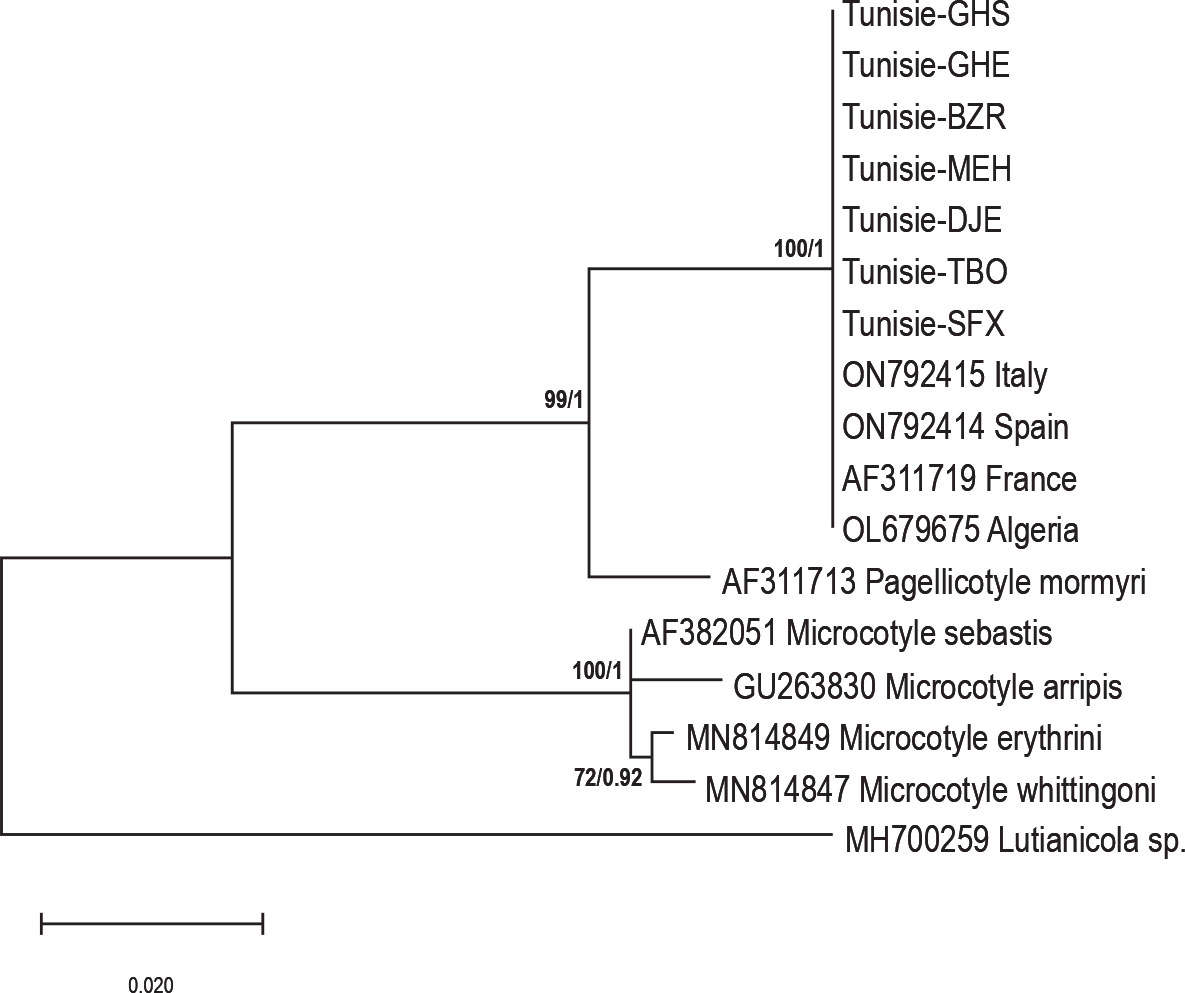
Fig. 2.
ML and BI phylogenetic tree of Sparicotyle chrysophrii from the Mediterranean Sea based on partial 28S rDNA (872 bp). Tunisian samples (GHS/GHE: Ghar El Melh; BZR: Bizerte; MEH: Mahdia; DJE: Djerba; TBO: Téboulba; SFX: Sfax) and Mediterranean references (Italy, Spain, France, Algeria) are included. Lutianicola sp. used as outgroup. Only nodal support values >75% are shown (ML bootstrap right; BI posterior probability left).
The best substitution model for the COI dataset was also GTR + I + G. The resulting phylogenetic trees, constructed using ML and BI methods, showed similar topologies. All COI sequences (300 bp) were grouped into a single, highly supported clade that included sequences from various Mediterranean localities, including the Adriatic Sea, France, Spain, Italy (Sardinia), and Algeria. This clade was robustly supported by bootstrap value ([BS]=95) and a posterior probability of 0.76 (Fig. 3).

Fig. 3.
ML and BI phylogenetic tree of Sparicotyle chrysophrii from the Mediterranean Sea based on COI sequences (300 bp). Locality codes indicate Tunisian samples (GHS/GHE: Ghar El Melh; BZR: Bizerte; MEH: Mahdia; DJE: Djerba; TBO: Tboulba; SFX: Sfax), and Mediterranean references from Italy, Spain, France, and Algeria are included. Only nodal support values >50% are shown (ML right; BI left).
The COI haplotype network displayed a star-like pattern, with the predominant haplotype, Hap_37 (30 individuals, 20.27 % of total haplotypes), originating from Tunisia and found in both cage-reared and wild GSB. This haplotype was widespread in all Tunisian localities. From Hap_37, a cluster of common Tunisian haplotypes separated by a single mutation step radiated: Hap_31 (8.783 %), Hap_36 (6.756 %), Hap_39 (9.459 %), and Hap_43 (Fig. 2). Hap_39 was closely associated with Hap_33 from Algeria. Hap_31 and Hap_32 also contained sequences from wild GSB from Algeria, with one sequence for each haplotype. Another common haplotype, Hap_6 (8.783 %), included 13 sequences from both wild and cage-reared GSB in the Adriatic Sea (4 sequences), Italy (Sardinia) (8 sequences), and Tunisia (1 sequence) (Fig. 4) (Supplementary Materials, Table S1).
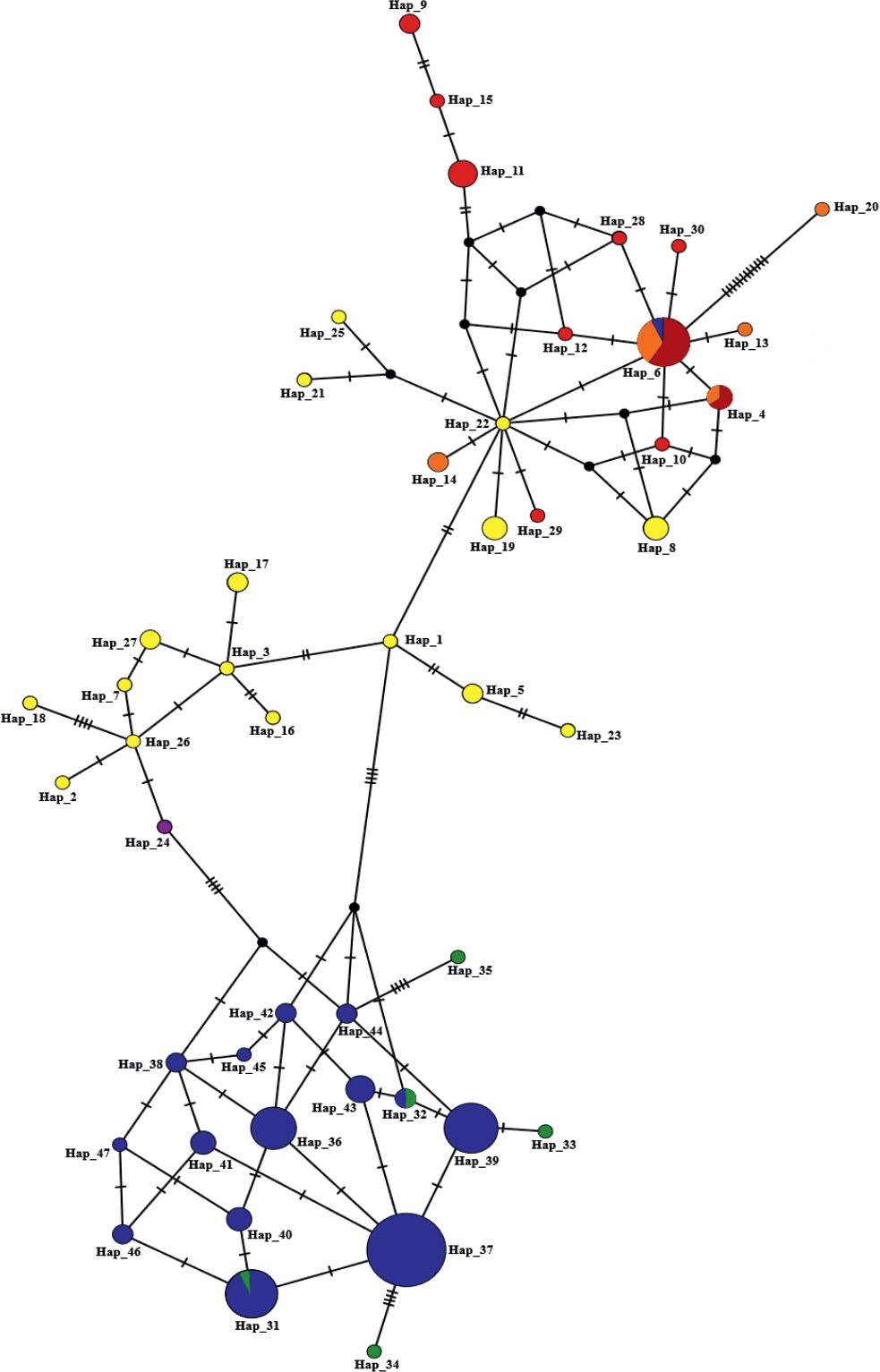
Fig. 4.
Median-joining haplotype network for Sparicotyle chrysophrii from the gills of Sparus aurata from the Mediterranean Sea based on 300bp COI sequences. Different colors indicate the locations of origin for the distinct haplotypes. Blue: Tunisia; Green: Algeria; Yellow: Spain; Purple: France; Red: Sardinia, Italy; Orange: The Adriatic Sea. Abbreviations: H1–H47, haplotype IDs. Circle sizes are proportional to the frequency of each haplotype.
Hap_6 clustered with other haplotypes, including one from Spain (Hap_22), four from Italy (Sardinia) (Hap_10, Hap_12, Hap_28, and Hap_30), one from the Adriatic Sea (Hap_13), and Hap_4, which included one sequence from the Adriatic Sea and two from Italy (Sardinia). Hap_20, relative to parasites of Boops boops from the Adriatic Sea, was separated from Hap_6 by twelve mutation steps (Fig. 4). Hap_24 from France was closely associated with the Spanish haplotype Hap_26, showing a distinct separation of four mutation steps from the Tunisian-Algerian cluster. A total of 16.891 % of haplotypes were singletons, represented by a single individual (Fig. 4). Genetic distance within groups was 1.15 % between Tunisian and Algerian samples, increasing to 3.81 % between the Tunisian samples and those from the Adriatic Sea (B. boops), and 3.97 % between the Algerian samples and the Adriatic Sea (B. boops).
Population genetic structure and demographic expansion
The AMOVA, grouping the Tunisian samples by origin into three regions (North, Central, and South), revealed that 92.77 % of the variance was attributed to differences among individuals. In contrast, 0.39 % to differences among groups (Table 4). The genetic diversity was moderate (FST = 0.07227, p < 0.00001). Classifying Tunisian samples by host origin (wild vs. cage-reared), the AMOVA analysis attributed 89.12 %, 5.96 %, and 4.92 % of the total variation to differences within populations, among populations within groups, and among groups, respectively (Table 5). The fixation index exhibited a moderate value (FST = 0.10879, p < 0.00001). The final AMOVA, which included S. chrysophrii samples from North and South Mediterranean localities attributed 37.52 %, 6.93 %, and 55.54 % of the total variation to differences within populations, among populations within groups, and among groups, respectively (Table 6). The fixation index was significant, with an FST value of 0.62478, which was higher than in previous analyses (Table 6). Pairwise FST values between Mediterranean populations were all significant (Table 7). For S. chrysophrii populations isolated from GSB, the highest FST value was observed between the Adriatic Sea and Tunisia populations (FST = 0.75169). In contrast, the lowest value was found between Tunisian and Algerian populations (FST = −0.00525). Nucleotide divergence (Dxy) among Mediterranean populations ranged from 1.148 % between Tunisian and Algerian populations to 3.797 % between Adriatic Sea and Algerian populations. The net genetic distance (Da) ranged from −0.00006 % between the Tunisian and Algerian populations to 2.735 % between the Adriatic Sea and Tunisian populations (Table 7).
Table 4.
Analysis of Molecular Variance (AMOVA) of Sparicotyle chrysophrii samples from Tunisia, divided into three groups (North, Central and South).
| Source of variation | df | Sum of squares | Variance components | % variation | P-value |
|---|---|---|---|---|---|
| Among groups | 2 | 2.479 | −0.00269 Va | −0.39 | *** |
| Among populations within groups | 4 | 5.034 | 0.05206 Vb | 7.62 | *** |
| Within populations | 81 | 51.327 | 0.63367 Vc | 92.77 | *** |
| Total | 87 | 58.841 | 0.68303 |
Table 5.
Analysis of Molecular Variance (AMOVA) of Sparicotyle chrysophrii samples based on their hosts origin, grouped into two groups (wild versus cage-reared Tunisian hosts).
| Source of variation | df | Sum of squares | Variance components | % variation | P-value |
|---|---|---|---|---|---|
| Among groups | 1 | 1.603 | 0.03496 Va | 4.92 | *** |
| Among populations within groups | 5 | 5.911 | 0.04239 Vb | 5.96 | *** |
| Within populations | 81 | 51.327 | 0.63367 Vc | 89.12 | *** |
| Total | 87 | 58.841 | 0.71102 |
Table 6.
Analysis of Molecular Variance (AMOVA) of Sparicotyle chrysophrii samples from the North and the South Mediterranean Sea (North versus South Mediterranean Sea).
| Source of variation | df | Sum of squares | Variance components | % variation | P-value |
|---|---|---|---|---|---|
| Among groups | 1 | 192.471 | 2.39800 Va | 55.54 | *** |
| Among populations within groups | 2 | 10.640 | 0.29939 Va | 6.93 | *** |
| Within populations | 148 | 239.751 | 1.61994 Va | 37.52 | *** |
| Total | 151 | 442.862 | 4.31733 |
Table 7.
Analysis of the genetic diversity of Sparicotyle chrysophrii populations from the Mediterranean Sea (Pairwise FST between populations (lower diagonal), nucleotide divergence (Dxy)/the net genetic distance (Da) between populations).
| Tunisia | Algeria | Spain | Italy | Adriatic Sea | |
|---|---|---|---|---|---|
| Tunisia | - | 0.01148/-0.00006 | 0.02961/0.01938 | 0.03171/0.02281 | 0.03639/0.02735 |
| Algeria | −0.00525 | - | 0.03188/0.0153 | 0.0334/0.01815 | 0.03797/0.02259 |
| Spain | 0.65457 | 0.4801 | - | 0.01935/0.00541 | 0.01945/0.00538 |
| Italy | 0.71922 | 0.54346 | 0.27953 | - | 0.01416/0.00141 |
| Adriatic Sea | 0.75169 | 0.59496 | 0.2765 | 0.09959 | - |
Historical demographic expansions were evaluated by analysing the frequency distributions of pairwise sequence differences. The mismatch distribution for all Tunisian samples showed a unimodal pattern, which is typically associated with recent population expansion or bottleneck (Fig. 5).
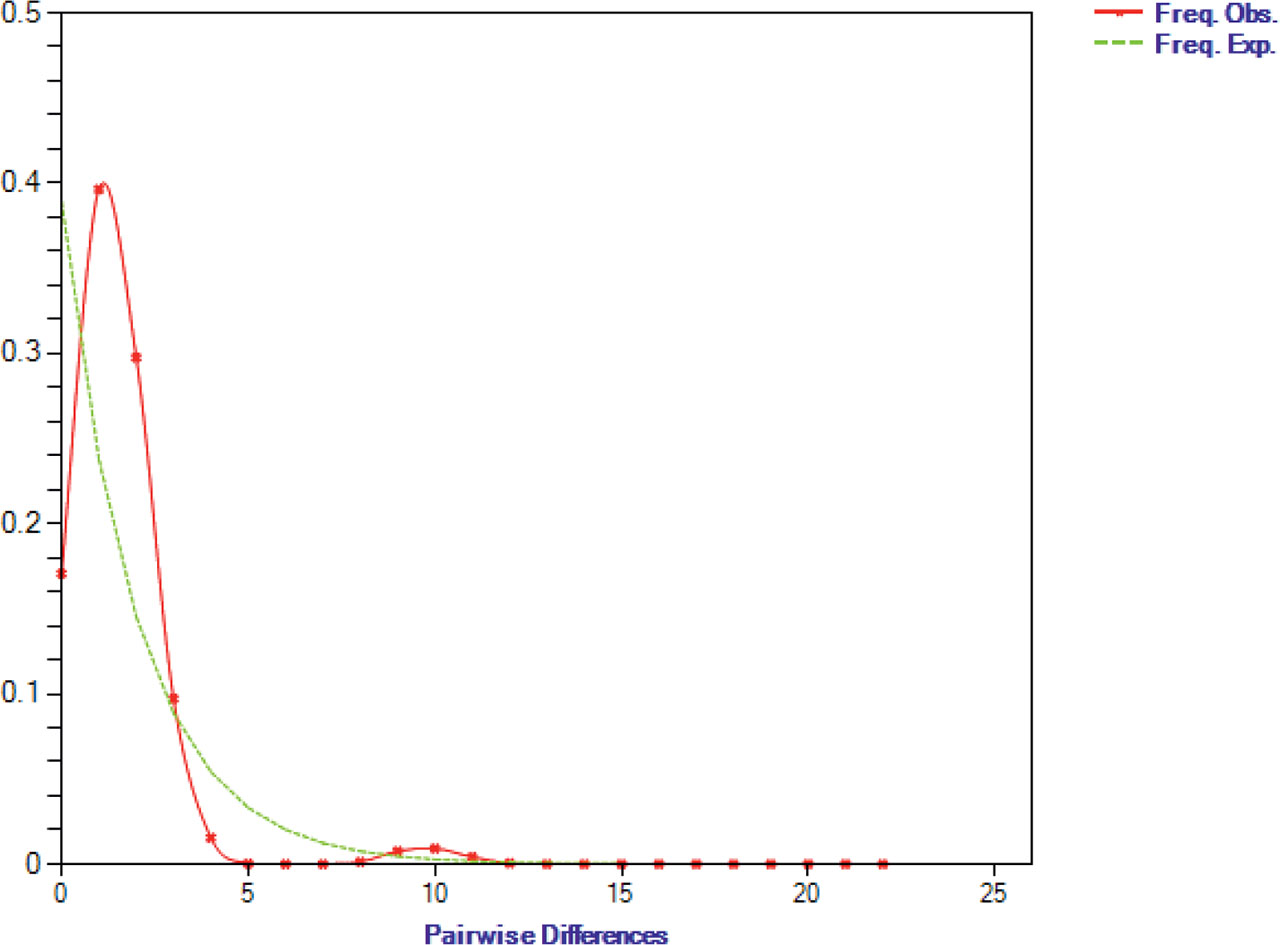
Fig. 5.
Mismatch distribution graph for Sparicotyle chrysophrii from Tunisia. The x-axis displays the number of pairwise differences, and the y-axis displays the frequency of the pairwise comparisons. The red dotted line indicates the observed frequencies. The continuous green line shows the frequency expected under the population expansion model.
Discussion
This study provides new data on the presence and genetic structure of S. chrysophrii in wild and cage-reared GSB from Tunisian coastal waters. Prevalence ranged 37.5 % – 63.6 % in wild GSB and 29.4 % – 90.0 % in cage-reared ones, and mean intensity ranged 1.7 – 2.4 in wild GSB and 1.6 – 3.4 in cage-reared fish, confirming that this parasite is widespread in wild and farmed hosts across the Mediterranean Sea (Mladineo et al., 2024). The genetic structure of S. chrysophrii was investigated for the first time from different localities of Tunisia. Population genetic variation and phylogenetic relationships were inferred by incorporating novel and existing haplotype data from various Mediterranean localities in Italy (Sardinia) and Spain (Farjallah et al., 2023), Algeria (Lablack et al., 2022), France (Jovelin & Justine, 2001) and the Adriatic Sea (Mladineo et al., 2009).
Analysis of the S. chrysophrii 28S rDNA region revealed BLAST scores ranging from 99 % to 100 % when compared to sequences from Italy (Sardinia), Spain, Algeria, and France (Jovelin & Justine, 2001; Lablack et al., 2022; Farjallah et al., 2023). The 28S sequences, from Tunisian and other Mediterranean populations, formed a monophyletic group. Phylogenetic analysis of 28S rDNA sequences confirmed previous studies, showing a distinct clade closely related to Microcotyle, with genetic distances of 6.726 % – 7.785 % (M. sebastis and M. arripis, respectively) (Lablack et al., 2022; Farjallah et al., 2023). The utility of 28S rDNA in resolving phylogenetic relationships in Microcotylidae has been well established (Mollaret et al., 2000; Jovelin & Justine, 2001; Víllora-Montero et al., 2020; Lablack et al., 2022).
Genetic diversity indices, derived from sequence analyses of Tunisia and integrated with reference sequences from various Mediterranean regions, showed low nucleotide diversity and high haplotype diversity, suggesting a recent population expansion of S. chrysophrii. The haplotype network exhibited a star-like pattern, further supporting evidence of recent demographic expansion across the Mediterranean Sea (Avise, 2000).
Climate changes, such as the Pleistocene glaciations, led to the contraction of the Mediterranean Sea, creating refugia where populations survived before subsequent expansion. Populations from these refuge areas, which experienced postglacial demographic expansion, exhibit genetic signatures characteristic of these demographic fluctuations (Hewitt, 2000; Lessa et al., 2003). These phenomena can be detected through specific analyses, such as neutrality tests (Tajima, 1989; Fu, 1997). The negative values obtained from the neutrality test also suggested recent population expansion, as indicated by an excess of rare alleles (Hartl & Clark, 2007). This expansion signature is further supported by the analysis of S. chrysophrii discordances in Tunisia, which revealed a unimodal pattern, confirming recent population expansion. These results also indicate that although there is haplotypic diversity, the haplotypes differ by only one or a few nucleotide substitutions. This pattern is consistent with a rapid expansion from a small effective population size (Avise, 2000), a phenomenon previously observed in M. gonialosae (Li et al., 2011), Aspidodera raillieti (Varella et al., 2022), and Kapentagyrus spp. (Kmentová et al., 2020), Gotocotyla sawara (Shi et al., 2014), L. echeneis (Farjallah et al., 2024) and other monogenean species.
Genetic distances based on COI sequence revealed 1.15 % divergence between Tunisian and Algerian samples, with the lowest pairwise FST value (FST = −0.00525). Populations of S. chrysophrii from Tunisian coasts, which are closely related to those from Algeria, suggest a shared evolutionary history, as supported by the haplotype network. The most common haplotype, Hap_37, which is associated with other frequent haplotypes (Hap_31, Hap_36, and Hap_39), all originating in Tunisia, forms a haplogroup linked to Algerian haplotypes (Hap_31–Hap_35). This result is consistent with the observation that ancient haplotypes often have high frequencies and exhibit widespread geographic distributions (Posada & Crandall, 2001).
The low intraspecific variability observed in this study is consistent with findings from other studies on Polyopisthocotylea monogeneans, including Paradiplozoon bliccae (0.0 – 0.8 % COI) (Nejat et al., 2023), Plectanocotyle lastovizae, P. major (0 – 1 % COI) (Cappelletti & Bouguerche, 2024) and Eudiplozoon kamegaii (2.6 – 6.1 % COI) (Benovics et al., 2021), suggesting limited genetic differentiation across geographic regions when assessed using mitochondrial markers.
Shared haplotypes between wild and farmed hosts confirmed potential cross-infection, providing evidence of pathogen transfer, as previously documented for this species in Spanish waters (Farjallah et al., 2023), and also other monogenean species, such as Gyrodactylus salaris (Olstad et al., 2006), Kapentagyrus limnotrissae, and K. tanganicanus (Kmentová et al., 2020), L. echeneis (Mladineo et al., 2013; Farjallah et al., 2024). It is crucial to emphasize the role of anthropogenic factors, particularly given that Tunisia currently hosts 20 marine aquaculture farms (Agúndez et al., 2024), which facilitate gene flow between parasites in wild and farmed S. aurata populations along the Tunisian coast. The AMOVA analysis of Tunisian samples, grouped by region (North, Central, and South), attributed 92.77 % of the variance to individual differences, with a moderate FST value (0.07227), indicating the absence of genetic structuring within the S. chrysophrii population in this region. Furthermore, Mladineo et al. (2025) demonstrated, through SNP analysis, the absence of clear genetic structure in S. chrysophrii populations from Spain, Italy, Croatia, and Greece in the northern Mediterranean basin. The most striking similarity was observed between wild and farmed populations of S. chrysophrii in Greece, which could be attributed to the long history of intensive aquaculture practices in this region (Mladineo et al., 2025). This prolonged association between wild and farmed GSB populations has likely facilitated gene flow between them, thereby blurring genetic divergence (Papoutsoglou et al., 1996).
Fish escapes from cages are frequent, and because cages attract nearby schools of fish (Dempster et al., 2002; Valle et al., 2007; Johansen et al., 2011), these events likely increase the risk of pathogen transfer between wild and farmed populations (and vice versa), which may help explain the observed shared haplotypes. Supporting this, AMOVA, classifying Tunisian samples by host origin (wild vs. farmed), attributed 89.12 % of the total variation to within-population differences. Furthermore, the fixation index indicated moderate differentiation (FST = 0.10879).
Phylogenetic analysis of the COI sequences revealed the absence of significant phylogenetic ramifications, with samples from different Mediterranean regions clustering into a monophyletic clade. Regarding the role of parasite-specific biological parameters in explaining gene flow, this was ruled out, as S. chrysophrii shares the same biological characteristics as another GSB gill parasite, L. echeneis (Farjallah et al., 2024), including the presence of filamentous appendages on the eggs and a limited dispersal capacity of the oncomiracidia, which have a short lifespan. On average, S. chrysophrii oncomiracidia survive only 12 hours (Repullés-Albelda et al., 2012) and are capable of vertical swimming (their most efficient swimming direction) for just 6 – 8 hours (Villar-Torres et al., 2018). The genetic processes shaping monogenean populations are, consistently, once, influenced by the biological characteristics of the hosts, particularly the hosts’ dispersal potential (Criscione & Blouin, 2004; Huyse et al., 2005; Poulin, 2007; Froeschke et al., 2014; Mazè-Guilmo et al., 2016; Farjallah et al., 2024). No significant genetic differentiation has been observed within S. aurata in the Mediterranean (Villanueva et al., 2022; Mhalhel et al., 2023). The AMOVA, performed by grouping samples by origin (North and South of the Mediterranean), revealed that 37.52 % of the genetic variation was attributed to intra-population differences, while 55.54 % was due to differences between groups. A high genetic differentiation was observed, as evidenced by a high fixation index (FST = 0.62478). These results suggest genetic heterogeneity within S. chrysophrii in the Mediterranean Sea. However, these conclusions should be interpreted with caution due to the heterogeneity of sequences from the Adriatic Sea, some of which are associated with S. aurata but others with B. boops (see Mladineo et al., 2009). Parasites isolated from B. boops showed significant divergence from those of S. aurata, as previously demonstrated by Mladineo et al. (2009) and Farjallah et al. (2023). For a more accurate assessment, future sampling along the Ionian-Adriatic coast would be required, as the genetic diversity of S. chrysophrii in the Mediterranean might be overestimated.
Notes
Notes
Supplementary material associated with this article can be found, in the online version, at https://doi.org/10.2478/helm-2025-0039.