Introduction
Poultry farming related to domestic chicken is known to be one of the most important sectors of agriculture (Nanda et al., 2022). According to the Food and Agriculture Organisation (FAO), the global poultry population is around 14 billion, approximately 75 % situated in the developing world (Ara et al., 2021). Traditional free-range poultry farming plays a vital role in the rural economies of poor communities (Berhe et al., 2019). It provides a crucial source of protein (El-Debakhy et al., 2024). Additionally, it is a source of income for poor communities (da Silva et al., 2022). Chicken meat and eggs are vital for nutrition in poor families (Ameji et al., 2022). Sales in local markets provide cash income (Islam et al., 2020). Scavenging chickens are hindered by malnutrition practices. Poor body condition and inadequate management systems. In the backyard production system (Idika et al., 2016). Free-range chickens are at higher risk of infection by a wide variety of parasites (Malik et al., 2022), lice, mites, fleas, ticks, and helminths (Saemi Soudkolaei et al., 2021). Coprological feeding of chickens is a routine practice that leads to infection of the chicken with a large number of helminth parasite species (Tay et al., 2017). Common chicken nematodes include Ascaridia galli, Heterakis gallinarum, Capillaria spp., and Trichuris spp., targeting different parts of the gastrointestinal tract (Ara et al., 2021).
A. galli has a direct life cycle; eggs develop into second-stage larvae (L2) in 8 – 21 days, depending on temperature (Hoglund et al., 2023). Chickens ingest embryonated Ascaridia eggs; L3 larvae hatch, migrate into and out of the mucosa, then mature in the intestinal lumen (Shohana et al., 2023). H. gallinarum adults inhabit the cecum; eggs passed in faeces become infective and are ingested directly or via earthworms, which transport them. The prepatent period is 5 – 6 weeks (Rahimian et al., 2016). Once ingested, larvae hatch, migrate to the cecum, and mature into adults, completing the cycle (Thomas et al., 2024). Capillaria species, also called hairworms, are thin gastrointestinal parasites of poultry, affecting either the upper (crop, oesophagus) or lower (intestine, ceca) digestive tract (Yousaf et al., 2019). They have direct or indirect life-cycles (Bajoi et al., 2024). In the direct life cycle, chickens ingest Capillaria embryonated (infective) eggs, which develop into adults in the intestine without tissue migration (Sarba et al., 2020). Indirect-cycle species like C. caudinflata, C. bursata, and C. anuulata require earthworms; chickens ingest them, with a period of about three weeks, causing gut damage (Jilo et al., 2022). In chickens, Trichuris infection occurs from ingesting embryonated eggs, causing intestinal damage, inflammation, and ulceration, leading to diarrhoea, anaemia, weight loss, and possible death (Filbey et al., 2019). Gastrointestinal nematode parasites in backyard chickens result in reduced egg production (Sadeghi et al., 2024). It also causes diarrhoea, intestinal obstruction, morbidity hemoglobin depression, and heightened mortality rates. High death rate, especially among the young, if remains untreated (Shifaw et al., 2021). Anthelmintic vaccines for poultry helminths are not yet developed (Shirin et al., 2025).
Control mainly relies on prophylactic drug therapy with albendazole, fenbendazole, Mebendazole, piperazine, levamisole, and Ivermectin. Benzimidazole and piperazine resistance in Ascaridia galli was recently detected by Ritu et al. (2024). There is limited data on the efficacy of commercial anthelmintic against nematodes, and the worm's pathological impact remains understudied. This study aims to assess infection prevalence, characterize induced pathologies, and evaluate the efficacy of Mebendazole and its derivative against nematode infection.
Materials and Method
Study Area
The present study was conducted in three districts of the Malakand region, namely District Lower Dir (34.9161°N, 71.8097°E), District Swat (35.2220°N, 72.4258°E), and District Malakand (34.5656°N, 71.9304°E) are located in northern Khyber Pakhtunkhwa, Pakistan (Fig. 1). The region experiences a temperate climate characterised by cold winters and hot, humid summers due to monsoon rains in warm months of the year (June – September). The humid climate, with high rainfall, favourable conditions for the transmission of parasitic infections in domestic livestock and poultry.
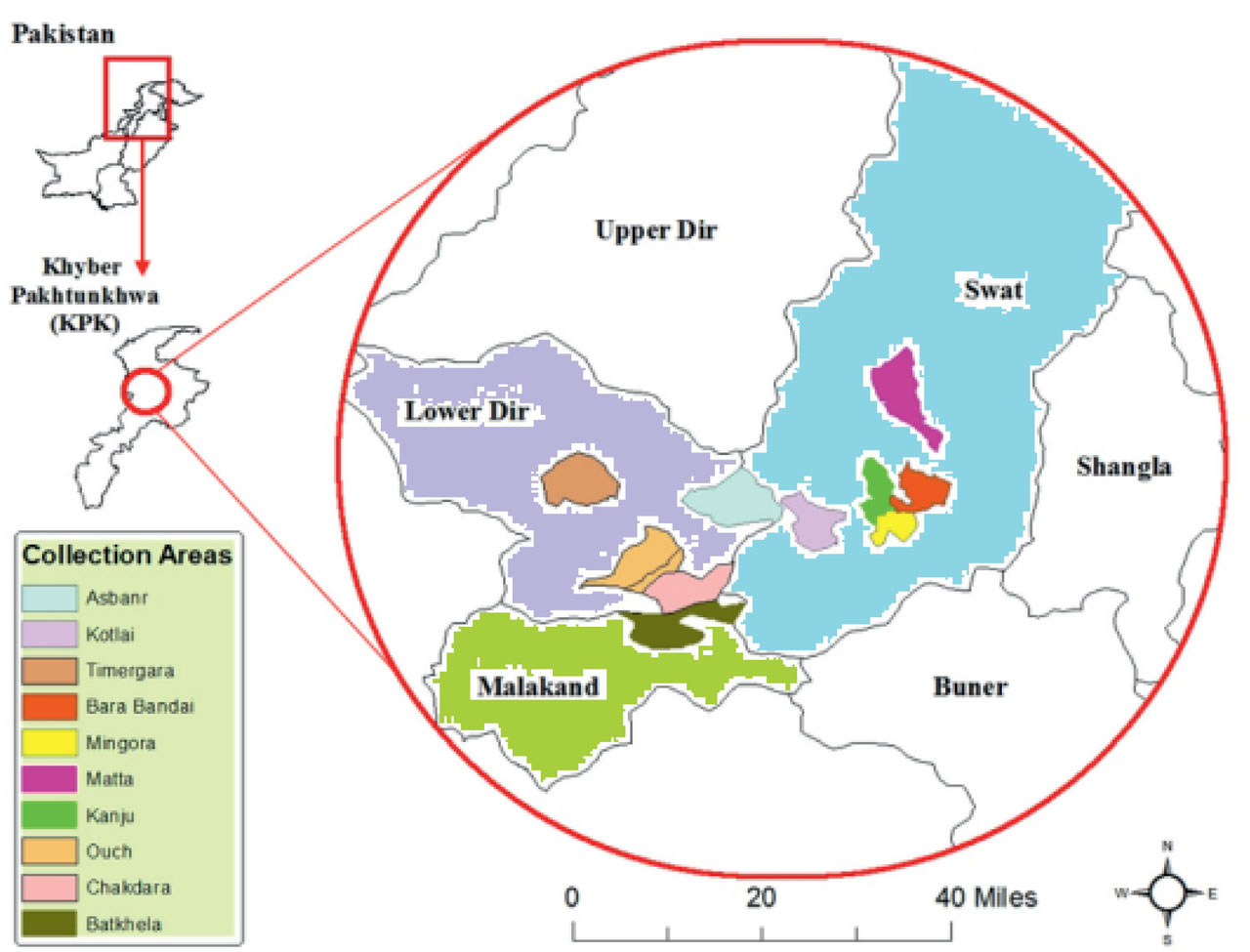
Fig. 1.
Map of Malakand Division showing sample collection areas (self-generated via ArcGIS)
Sample Size
The sample size was computed from the formula (Daniel & Cross, 2019), n = Z2P(1 − P) / d2 with the confidence at 95 % and expected prevalence at 50 % and precision at 0.05, which we used to produce 385. We actually conducted the survey in 456 domestic chickens.
Duration of Study
The present work was conducted from January through December 2023. In the meanwhile, faecal samples were collected and chickens were obtained for chemotherapy and histopathological studies. Data pertaining to potential risk factors including age, gender, health status, and management practices were also obtained from the caretaker owners via a structured questionnaire.
Study season
The seasonal differences were determined from the year's partitioning into two parts with respect to rainfall: the dry season (from March till mid-June and mid-September till February), covering the spring, summer preceding the monsoon, autumn, and winter; and the rainy season (from late June till mid-September), i.e., the monsoon season.
Sample collection and preservation
3 – 5 g fresh faeces were collected immediately from the birds' cloaca in labeled bottles with 2.5 % potassium dichromate. Kept in sealed sterile containers at 4 – 8°C in insulated ice-packs from the field site and then stored at 4°C in the laboratory of University of Malakand for further analysis.
Laboratory Analysis
Direct wet smear and concentration techniques were used to detect nematode eggs in fecal material. Briefly, one gram of faeces was mixed with 20 ml of sodium chloride (NaCl) solution and thoroughly filtered. The resulting filtrate was transferred into a test tube until a meniscus was formed at the top. A coverslip was gently placed over and left for 12 to 20 minutes. After that, the coverslip was carefully removed and examined under a light microscope for the presence of nematode eggs.
Determination of changes in the intestine
During post-mortem, parasitically damaged suspected tissues were collected and preserved in Carnoy's solution (3:1 ethanol to acetic acid) for 48 hours with shaking. Samples were washed with PBS (phosphate buffer solution), dehydrated, cleared, and embedded in paraffin. Thin 5 μm sections were stained with H&E and examined under the light microscope (10x and 40x, Olympus DP71). Three sections and three foci per sample were analysed.
Effect of the Anthelmintic Drugs
Sixty domestic 30-week-old chickens already naturally infected with nematode parasites, tagged, housed separately, and provided with clean water and grain ad libitum for seven days without parasitic treatment. Based on their EPG (eggs per gram) values, domestic chickens were randomly allocated into groups X, Y, and Z, each with three replicates of five chickens, following the experimental design. Group X was the untreated control, Group Y received Mebendazole at 10 mg per 1.5 kg body weight, and Group Z was administered an oral Mebendazole derivative at the same dosage for three consecutive days. Faecal samples were collected on days 7, 14, and 21 post-treatments for egg reduction analysis. Drug efficacy was calculated using the formula of Soulsby (1982)
Statistical Analysis
The obtained data were put in Microsoft Excel to determine the statistical variation in different factors. The computations were conducted with the using of R software for multivariate regression test. Anthelmintic efficacy was evaluated using one-way ANOVA, followed by Tukey's post-hoc test.
Ethical Approval and/or Informed Consent
The study protocol was approved by the Institutional Bioethics Committee University of Malakand (Ref: No: UOM/Admin/2025/1325).
Results
Prevalence, Species Distribution, and Seasonal Variation
Overall, an infection rate was detected in 72 % (n=330/456) of the examined chickens found to be infected with one or more species of nematode (Fig. 2A). Regarding species, A. galli was the most prevalent parasite found in 38.5 % (n=127/330) (Fig. 2B). Infection types showed a high prevalence of single infections, accounting for 70.3 % (n=232/330), followed by double infections 24.5 % (n=81/330), and triple infections 5.2 % (n=17/330) (Fig. 2C). The chickens screened in the wet season were noted with the highest prevalence 65 % (n=215/330) cases, as compared to the dry season, 34 % (n=115/330) (Fig. 2D).
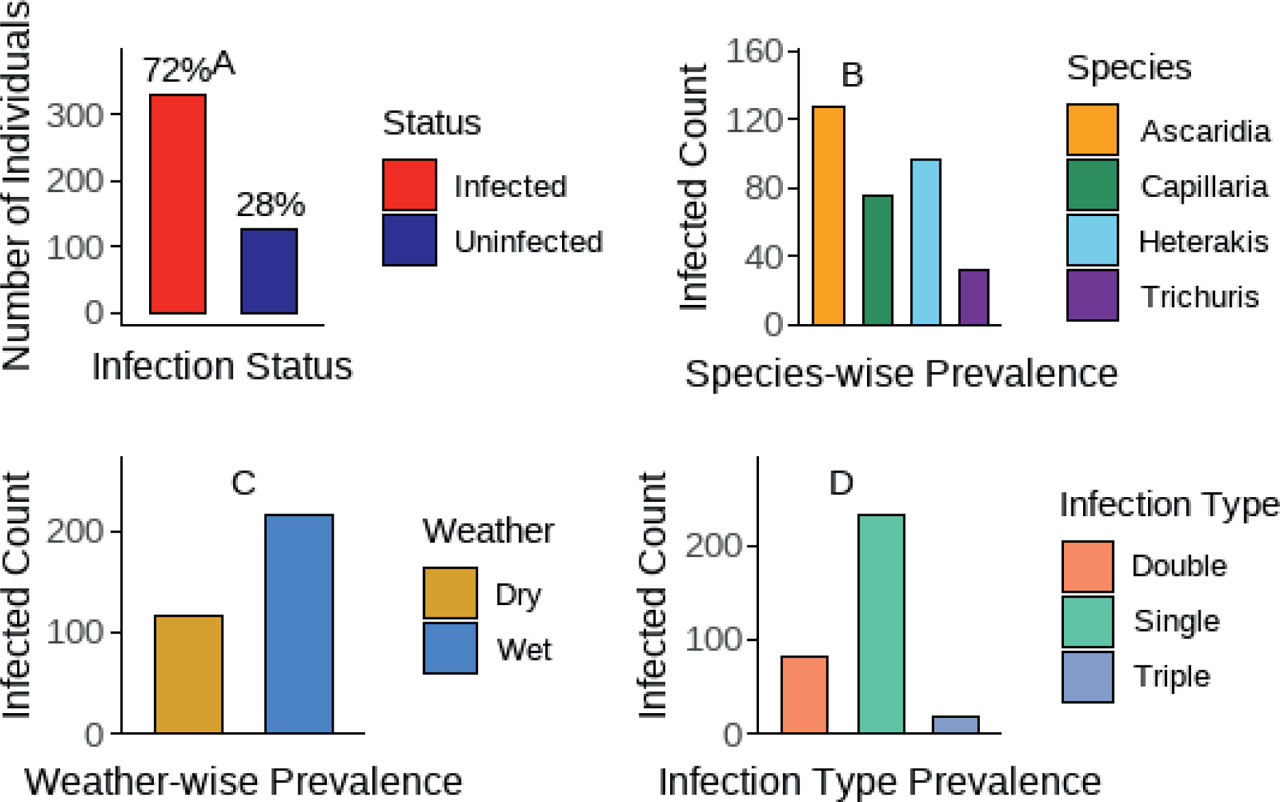
Fig. 2.
Prevalence of nematode infection in chickens: Overall infection (A). species-wise prevalence (B); infection types (C); weather-wise infection (D).
Multivariate Logistic Regression Analysis of Associated Risk Factors in Chickens
Table 1. presents the results of the multivariate logistic regression analysis conducted to evaluate the association between various host and management-related risk factors and the prevalence of gastrointestinal nematode infections in domestic chickens. The highest prevalence of gastrointestinal nematodes was recorded in female chickens (74.6 %) compared to males (68.8 %), statistically significant with (OR = 1.47, 95 % CI = 1.01 – 2.17, P = 0.044). Young chickens showed a particularly high prevalence at 85 % as compared to adults 53 % statistically significant with (OR = 0.25, 95 % CI = 0.16 – 0.41, P = 0.001). Weak chickens had the highest prevalence rate (90.6 %) compared to healthy 64.4 % statistically significant with (OR = 3.85, 95 % CI = 2.23 – 6.63, P = 0.001). Free-range rearing also showed a higher prevalence (74.3 %) compared to semi-scavenging systems (71.8 %), statistically significant with (OR = 1.54, 95 % CI = 1.02 – 2.32, P = 0.039). Regarding feeding, both scavenging (74.8 %) and additional feeding (71 .1 %) were observed (OR = 1.41, 95 % CI = 1.00 – 2.29, P = 0.047). Non-dewormed chickens had a higher prevalence (73.3 %) compared to dewormed (69 %), with statistically significant (OR = 1.61, 95 % CI = 1.03 – 2.63, P = 0.036). Locality-wise, infection was highest in Malakand (75.5 %), followed by district Lower Dir (72 %)and district Swat (69.1 %). The odds of infection were significantly higher in Malakand (OR = 1.49, 95 % CI = 1.02 – 2.18, P = 0.041), while the difference in Lower Dir was not statistically significant (OR = 1.32, 95 % CI = 0.87 – 1.99, P = 0.18).
Table 1.
Multivariate Logistic Regression Analysis of Associated Risk Factors in Chickens (n= 456).
| Variable | Category | Examined (n) | Infected (n) | Prevalence (%) | OR | 95% CI | P-value |
|---|---|---|---|---|---|---|---|
| Gender | Male | 189 | 130 | 68.6 | Ref | — | — |
| Female | 267 | 200 | 74.8 | 1.47 | 1.01 – 2.17 | 0.044* | |
| Age | Young | 274 | 233 | 85 | Ref | — | — |
| Old | 182 | 97 | 53.3 | 0.25 | 0.16 – 0.41 | 0.001*** | |
| Body condition | Healthy | 317 | 204 | 64.4 | Ref | — | — |
| Weak | 139 | 126 | 90.6 | 3.85 | 2.23 – 6.63 | 0.001*** | |
| Rearing System | Semi-intensive | 101 | 75 | 71.8 | Ref | — | — |
| Free range | 355 | 255 | 74.3 | 1.54 | 1.02 – 2.32 | 0.039* | |
| Feeding Type | Additional feed | 112 | 83 | 71.1 | Ref | — | — |
| Scavenging | 344 | 247 | 74.8 | 1.41 | 1.00 – 2.29 | 0.047* | |
| Deworming Status | Yes | 100 | 69 | 69 | Ref | — | — |
| No | 356 | 261 | 73.3 | 1.61 | 1.03 – 2.63 | 0.036* | |
| Locality | Swat | 152 | 105 | 69.1 | Ref | — | — |
| Malakand | 151 | 114 | 75.5 | 1.49 | 1.02 – 2.18 | 0.041* | |
| Lower Dir | 153 | 111 | 72.5 | 1.32 | 0.87 – 1.99 | 0.18 |
Intestinal Alteration Caused by Nematodes in Chickens
Pathological changes revealed inflammation, reddish hemorrhagic spots on the intestinal wall, acute fibrous enteritis with clotted blood, necrotic patches, and consolidation of intestinal contents, mainly in savior infected birds. A thorough visual examination was conducted on both infected and uninfected small intestines (Fig. 3a). Pathological changes observed in the intestine of domestic chickens revealed submucosal oedema with minimal cellular infiltration, accompanied by hyperplasia of the elongated submucosal glands. There is a focal accumulation of inflammatory cells (FACI) due to dead necrotic debris from adjacent glandular tissue in the submucosa layer in the small intestine (Fig. 3b).
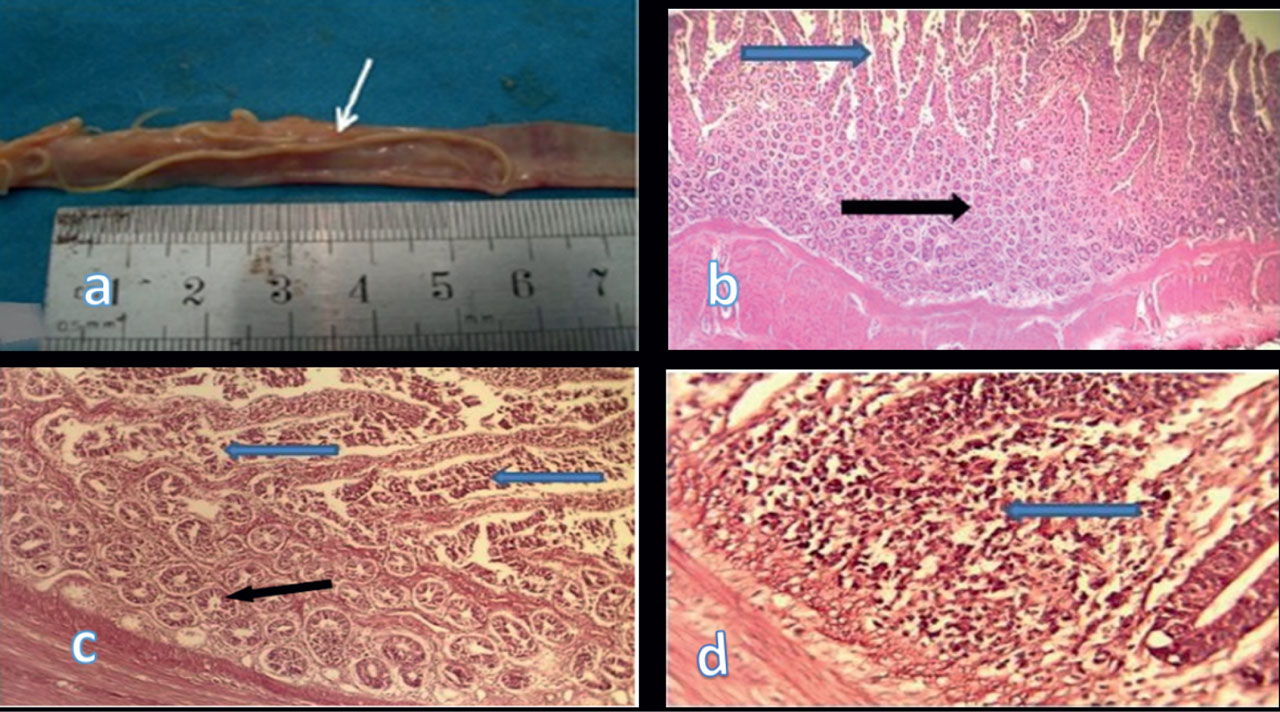
Fig. 3.
Histopathological changes in small intestine: Gross pathology of small intestine
a - Focal pro-inflammatory cell aggregation with predominant submucosal mononuclear cells
b - Submucosal glandular hyperplasia (black arrow) with atrophic microvilli (blue arrow)
c - Villous necrosis (blue arrow) and epithelial sloughing with crypt hyperplasia (black arrow) d; 100X
The submucosal glands of the small intestine in domestic chicken exhibited marked proliferation along with some degree of atrophy of the intestinal villi (Fig. 3c).
Severe necrosis of the intestinal villous cells, along with the shedding of epithelial cells and hyperplastic crypt structures, was noticed (Fig. 3d).
Mebendazole and its derivatives in the control of nematode infection
The mean EPG (eggs per gram) counts for A. galli, H. gallinarum, Capillaria spp., and Trichuris spp. were evaluated across the treatment groups: Control, Mebendazole, and a Derivative compound. EPG counts in the Control group rose with time, with the maximum in A. galli at 370, confirming the continuance of infection. Mebendazole was moderately effective in decreasing EPGs by 70 – 78 % with post-treatment EPGs in the range 55 – 75 % in all species. Derivative compound proved the most efficacious with EPG reductions of 88 – 92 % and with EPGs decreasing lowest at the level of 17.6 in Trichuris spp. and 28 – 30 % in other groups at day 21. Statistics verified the result that the derivative compound treatment proved more efficacious against the nematode (P < 0.0001) in comparison with the mebendazole-treated group. The present result suggests that while Mebendazole does possess moderate anthelmintic activity, the Derivative compound is substantially more effective in reducing gastrointestinal nematode burdens in chickens (Table 2).
Table 2.
Mebendazole and its derivative in control of nematode infection.
| Parasite | Group | Drug | Pre Treatment (Mean ± SD) | Post treatment (Mean ± SD) | Reduction % | P-value |
|---|---|---|---|---|---|---|
| Ascaridia galli | X | Control | 340 ± 40 | 370 ± 40 | 0 | 0.18 |
| Y | Derivative | 340 ± 50 | 30.6 ± 50 | 91 | 0.0001*** | |
| Z | Mebendazole | 340 ± 60 | 74.8 ± 60 | 78 | 0.0001*** | |
| Capillaria spp. | X | Control | 250 ± 35 | 265 ± 35 | 0 | 0.3 |
| Y | Derivative | 250 ± 45 | 30 ± 45 | 88 | 0.0001*** | |
| Z | Mebendazole | 250 ± 55 | 75 ± 55 | 70 | 0.0001*** | |
| H. gallinarum | X | Control | 280 ± 38 | 310 ± 38 | 0 | 0.13 |
| Y | Derivative | 280 ± 48 | 28 ± 48 | 90 | 0.0001*** | |
| Z | Mebendazole | 280 ± 50 | 72.8 ± 50 | 74 | 0.0001*** | |
| Trichuris spp. | X | Control | 220 ± 32 | 235 ± 32 | 0 | 0.23 |
| Y | Derivative | 220 ± 42 | 17.6 ± 42 | 92 | 0.0001*** | |
| Z | Mebendazole | 220 ± 53 | 55 ± 53 | 75 | 0.0001*** |
Egg reduction rate
The egg per gram (EPG) count reduction after treatment was calculated. A higher egg negative rate (%ENR) was observed with the Derivative treatment compared to Mebendazole across all tested nematode infections. Derivatives achieved ENR values ranging from 87.5 % to 92.2 %, with the highest efficacy observed against Trichuris spp. (92.2 %), followed by A. galli (90 %), Capillaria spp. (90.6 %), and H. gallinarum (87.5 %), as compared to Mebendazole, with %ENR values ranging from 70.3 % to 78.1 %. Chi-square analysis showed that the derivative had a consistently higher egg reduction rate than mebendazole; the differences were not statistically significant (p > 0.05) (Table 3).
Discussion
Current investigation highlights the risk factors associated with pathological alterations and control of nematode infections in domestic chickens. The current findings show 72 % prevalence, which is in accordance with the findings reported by Atique et al. (2025) from Gujranwala, Punjab, Pakistan, Hasan et al. (2025) from Bangladesh and Ara et al. (2021) from Kashmir, India. Even higher rates have been reported in free-roaming chickens in Africa (Asumang et al., 2019). The variations of these findings highlight the significant risk of nematode infection in low-input, rural poultry systems.
In the present study, A. galli was the most prevalent parasite, which was consistent with the findings of Atique et al. (2025) from Punjab, Pakistan; Ara et al. (2021) from India; Hasan et al. (2025) from Bangladesh and Temesgen et al. (2024) from Ethiopia, revealing a steadily high prevalence in several regions of the globe is linked to poor sanitation, irregular deworming, contaminated feed and water, and resilient parasite eggs. The current research indicated a high rate of single infections, then double and triple infections, in turn. To date, the result is in agreement with Raza et al. (2017) in their research in Tabriz, Iran. Previous studies have documented similarly reported that, even in populations where mixed parasitic infections occur in domestic chickens, single type infections are generally more common. The observed patterns of single infection may be attributed to several factors, including inadequate sanitation practices, contaminated feed or water sources. Irregular deworming procedures, as well as the resilience of nematode eggs within the environment, for a long time.
In the present study weather wise, prevalence was higher during the wet season and hot weather, compared to the dry season, which aligns with the study of Anggrahini et al. (2025) from Indonesia. Tsegaye et al. (2024), and Thomas et al. (2024), who found that the moist and warm conditions enhance parasite egg survival, larval development. Among associated factors, gender-based prevalence rate was more in female chickens as compared to males, which aligns with findings of Saemi Soudkolaei et al. (2021) from Iran, who documented the high infection rate in females due to their voracious and unselective feeding nature at egg-laying stage. Further Refisa and Rebuma (2024) and Sarba et al. (2020) also reported similar tendencies, associating that females are prone to high parasitic infection due to foraging habits. Subedi et al. (2018) also documented the role of gender-related behaviour in influencing parasite burden. Age-based prevalence revealed a higher prevalence rate in adult chickens (> 6 months) as compared to young, which might be due to prolonged exposure to contaminated litter. Which is align with the studies of Shifaw et al. (2021), Tay et al. (2017), and Raza et al. (2014) who found a higher prevalence in adult chickens, possibly due to prolonged exposure to contaminated environment for feeding and drinking. Health-based result shows a higher prevalence rate was noted in weak chickens compared to healthy ones, which aligns with the findings of Wondimu et al. (2019), who reported high worm burdens in chickens with weak health, poor immunity, and reduced weight gain. A similar pattern of prevalence was also documented by Jaiswal et al. (2020) and Temesgen et al. (2024) observed a high prevalence rate in weak chickens with weak immunity and poor hygiene. From a management perspective, nematode infection rates were significantly higher in free-range systems than in semi-free-range systems consistent with the findings of Tsegaye and Miretie (2021) who find out that Scavenging chickens showed a higher prevalence than those provided with supplementary feed, likely due to exposure to contaminated soil containing faeces, and intermediate hosts (Sharma et al., 2017; Ara et al., 2021). The higher risk in free-range systems is mainly due to uncontrolled feeding, dirty living conditions, and close contact with infectious stages.
Based on Deworming, the prevalence of nematode was higher in non-dewormed chickens compared to in dewormed chickens, which aligns with findings of Velkers et al. (2021), Subedi et al. (2018), and Berhe et al. (2019). He also documented that the infection rate was more common in untreated chickens as compared to treated ones. Regular deworming lowers the internal parasite load, prevents egg shedding, and reduces environmental contamination, thereby breaking the transmission of infection. The multivariate logistic model revealed that gender, age, body condition, weather, and a number of management-related risk factors significantly co-varied with parasitism by gastrointestinal nematodes amongst domestic chickens. Higher risk is most likely connected to increased exposure to filthy environments, lower levels of deworming, and inadequate nutritional supplements in less regulated systems. Histopathological alterations induced by nematode infection revealed the most important pathological changes, including petechial bleeding, mucosal thickening, and intestinal obstruction, which are consistent with findings of Shifaw et al. (2021) and Tsegaye and Miretie (2021), who reported that mild parasitic infections may not induce overt pathological changes in the intestinal tissue. Our results suggest that moderate to heavy nematode burdens damage the intestinal wall, reducing feed efficiency, slowing growth, and increasing mortality.
The severity of lesions appears proportionate to the parasite load, as also highlighted by Wuthijaree et al. (2019). These pathological changes are mainly caused by mechanical damage from parasite attachment, abrasion of intestinal mucosa, and the release of toxic metabolic by-products, which provoke chronic inflammation and disrupt normal gut function.
The present study showed that Mebendazole and its derivative significantly reduced roundworm burden in chickens over 21 days. The derivative was slightly more effective as compared to mebendazole, as reported that mebendazole disrupts microtubules, blocking glucose uptake and killing parasites (Lassen, 2017). Worm counts dropped by day 14 and further by day 21, similar to Permin (2021), who reported an over 90 % egg reduction rate, revealing 78.6 % efficacy with 50 mg/kg Mebendazole for six days against nematode infection. Despite using a lower dose, our results suggest room for optimized treatment. Fenbendazole, another benzimidazole, achieved over 90 % efficacy with minimal effects on egg production and good pharmacokinetics. In many developing countries, nematode infections in chickens are commonly treated without proper diagnostic evaluation. Resistance has emerged as a consequence of the irregular and intermittent use of anthelmintic drugs (Mitraet et al., 2023). Studies conducted by Ritu et al. (2024 evidenced that helminths show resistance to anthelminthic drugs, with special reference to Ascaridia species often occur alongside other parasites.
Conclusions
The current study investigated that Ascaridia galli and Heterakis gallinarum were found to be the most prevalent nematode infections in female chickens, sub-adults, week-old body conditions, wet season. Among the free-range, scavenging, non-dewormed animals, there were mostly infected with these nematode infections. Hemorrhagic enteritis, necrotic patches, intestinal inflammation, submucosal oedema, glandular hyperplasia and villous atrophy were noted as pathological changes in the intestinal tissues. Mean number of eggs per gram of faeces A.galli was the highest, followed by H.gallinarum, Capillaria spp., and Trichuris spp., respectively. Mebendazole derivative was noted as most effective against nematode infection, significantly reducing the number of eggs per gram of faecal samples (EPG) of roundworm infection.
Notes
Acknowledgment
The authors extend their gratitude to chicken owners in the study area for their provision of facilities and cooperation in conducting the research