Introduction
Sheep farming has traditionally been one of the leading livestock sectors in the southern part of the Odessa region (Bessarabia) and plays an important role in shaping the agri-industrial complex of the region. This branch has a zonal distribution structure, formed under the influence of natural conditions and farming practices (Vdovychenko, 2013; Adamenko, 2014).
According to Bogach (2020, 2022), the southern Odessa region has experienced an increase in the duration of moderate and severe droughts (HTC 0.4–0.8) and a reduction in periods of sufficient moisture (HTC 1.0–1.5). Such climatic fluctuations directly affect the spread of parasitic and infectious diseases in animals and poultry. Global climate change and land-use transformation significantly affect parasite transmission mechanisms, their life cycles, and the epizootic situation (Rose, 2014).
Environmental factors, including temperature, humidity, and seasonality, determine the development and survival of parasites on pastures as well as the availability of forage resources for animals (Navarre, 2020). Climate change can influence parasites, their hosts, and related diseases in complex ways, particularly in ecosystems with intricate transmission chains involving multiple host species or vectors. Populations located at the edges of species ranges are especially sensitive to changes in temperature and humidity, which may disrupt the stability of parasite and host life cycles (Rohr, 2011; Altizer, 2013).
Many parasites have free-living developmental stages or utilize ectothermic intermediate hosts; therefore, their life cycle, survival, and transmission dynamics depend on environmental conditions (O’Connor, 2006).
Rising average annual temperatures and changes in precipitation patterns enhance the survival and reproductive potential of many soil-borne and gastrointestinal parasites (Kumar, 2024). At the same time, Lafferty (2009) emphasizes that disease dynamics are influenced not only by climatic conditions but also by other factors, such as land use, noting that “the existence of seasonality in disease does not necessarily imply a climatic effect on disease.” Moniezia expansa is the most widespread tapeworm of sheep, with significant infections usually observed in lambs. At moderate levels, monieziasis often proceeds without pronounced clinical signs; however, heavy infections may cause abdominal distension, diarrhea, anemia, stunted growth, emaciation, reduced wool quality, intestinal lesions, and even host mortality (Dever, 2015). The prevalence and intensity of infection depend on a complex of factors, including climatic conditions, management systems, age, sex, and breed of animals (Diop, 2015; Belina, 2017; Mpofu, 2022). Socio-demographic factors, animal management, and habitat transformation also influence parasite population density and infection levels in livestock (Randolph, 2009; Walsh, 2013; Estrada-Peña, 2014). While global warming contributes to the spread of vector-borne diseases, climate alone is not a decisive factor: agricultural practices, land-use changes, and human–animal contact with infected vectors also play a critical role (Nuttall, 2022).
Thus, a deep understanding of the ecology of oribatid mites, as intermediate hosts of Moniezia spp., as well as the factors affecting their abundance and seasonal dynamics, is an important prerequisite for the quantitative assessment of the risks of infection in animals. This, in turn, enables the development of scientifically sound strategies for preventing moniezia in sheep farming, taking into account both climatic changes and the spatial features of the pasture environment.
The objective of this research was to evaluate how hydrometeorological variability influences the abundance of oribatid mites and the prevalence of sheep monieziasis in Bessarabia (2014 – 2024).
Materials and Methods
Agroclimatic study
The territory of the Odessa region extends from north to south, spanning a latitude of 45° – 48° north, and covers both the forest-steppe and steppe natural-climatic zones. The north is characterized by the forest-steppe, while the central and southern parts are dominated by the steppe, particularly the historical region of Bessarabia, Ukraine.
Information on precipitation and average air temperature was obtained from the Bolgrad meteorological station (Bolgrad, Odesa region). To assess the moisture conditions during the active vegetation period, when the average daily temperature exceeds 10°C, the hydrothermal coefficient (HTC) was used according to the Selyaninov method. In months when the temperature did not reach this threshold, the calculation of the HTC was not performed.
The HTC indicator was determined by the formula:
where ΣR is the sum of precipitation (mm) for the period with temperatures above 10°C, and Σt>10 is the sum of active temperatures for the same period.If HTC < 0.4 – very severe drought, from 0.4 to 0.5 – severe drought, from 0.6 to 0.7 – moderate drought, from 0.8 to 0.9 – weak drought, from 1.0 to 1.5 – sufficiently moist, > 1.5 – excessively moist (Selyaninov, 1937).
Soil zoological studies
Collection of oribatid mites was carried out monthly throughout the year, and samples were combined by season: spring (March – May), summer (June – August), autumn (September – November) and winter (December – February). To study soil mesofauna, particularly oribatid mites, soil samples were manually collected from natural and cultivated meadows, as well as from forest belts, using a 5 cm diameter metal cylinder to a depth of 10 cm. The total volume of each sample was approximately 200 cm3. Sampling was conducted at 3 – 5 locations on each site, after which the samples were combined into an integrated sample (Balogh, 1992). To isolate oribatid mites from the soil, a Berlese-Thülgren extractor was used (Fig. 1).
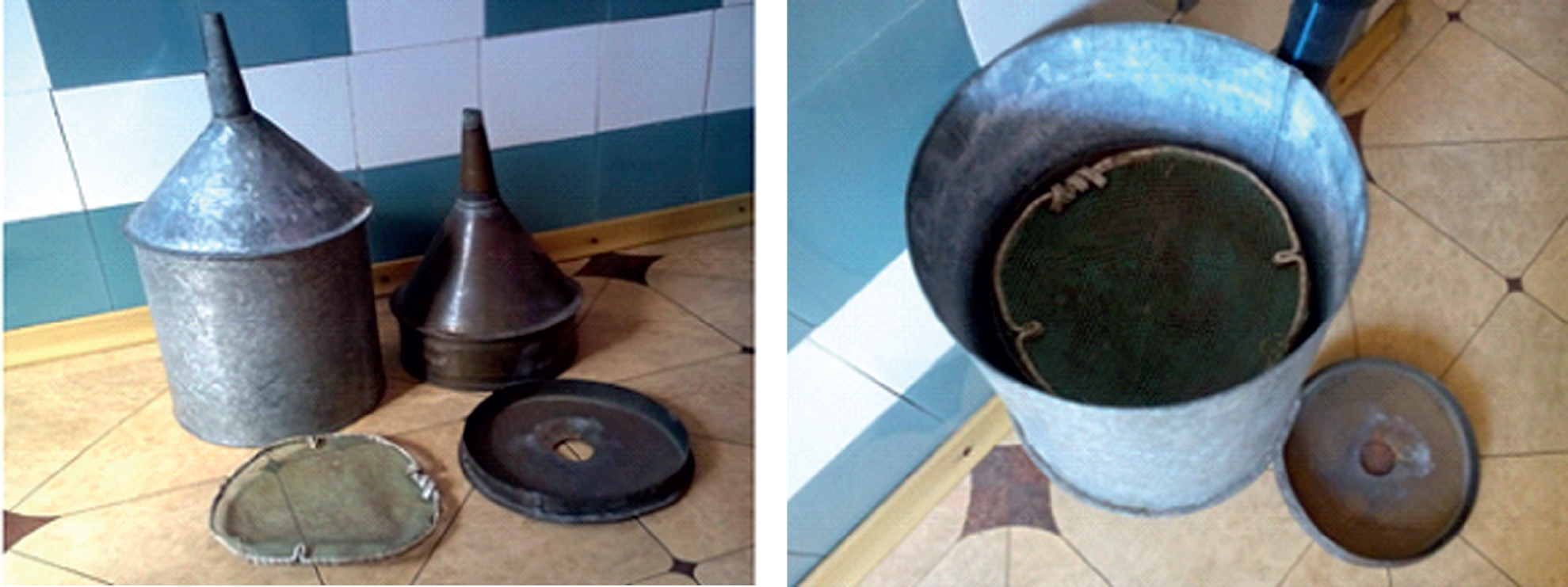
Fig. 1
Berlese-Thülgren extractor in disassembled and working condition.
Soil samples were placed in funnel-shaped containers, under which were bottles of 70 % ethyl alcohol. A light source (40 – 60 W lamp) was placed above the sample, which gradually increased the temperature, causing the invertebrates to move downwards; they then fell into the preserving liquid. Extraction was carried out for 5 – 7 days at a controlled temperature of not more than 30°C. For further identification of mites, preparations were prepared in Goyer’s medium or lactic acid. If necessary, mites were placed on a glass slide under a coverslip in temporary or permanent preparations. Oribatid mites were extracted and counted; taxonomic identification was not carried out, as the study focused on population density in relation to hydrometeorological conditions.
Sampling time and study locations
From January 2014 to December 2024, a total of 9,809 Tsigai sheep (Ovis aries), aged 1 – 2 years, were examined from farms in the southern part of the Odesa region (Bessarabia, Ukraine). The study was conducted in 14 farms located in three districts: Bolgrad (7 farms, n = 4,005), Izmail (3 farms, n = 2,010), and Bilhorod-Dnistrovskyi (4 farms, n = 2,914). According to anamnestic data, preventive measures against parasitic diseases were carried out irregularly.
Parasitological studies
Fecal samples from sheep were collected individually from the rectum into sterile containers and delivered to the parasitology laboratory of the Odessa Research Station of the National Scientific Center «Institute of Experimental and Clinical Veterinary Medicine». The Fulleborn flotation method was used to detect Moniezia spp. eggs, which provides sufficient sensitivity even when the number of eggs in the samples is low. The intensity of the invasion was assessed using the McMaster method modified by Raynaud (1970), which allows determining the number of eggs (or oocysts) per gram of feces (OPG). The analysis was performed at a magnification of ×100, and in cases of doubtful results, at a magnification of ×400.
Determination of the prevalence of monieziasis (invasion extensiveness)
The prevalence of monieziasis was determined by the indicator of the extensiveness of invasion (EI, %) and was calculated using the formula:
where n is the number of infected animals; N is the number of studied animals.Statistical analysis
of the study results was conducted to assess the relationship between hydrothermal conditions (HTC), the number of oribatid mites in different types of pastures, and the level of infestation of sheep with Moniezia pathogens (Moniezia spp.). To calculate parasitological indicators, particularly the extent and intensity of invasion, the online platform Quantitative Parasitology on the Web (Rózsa, 2000) was utilized.
Pearson’s correlation coefficient (r) was used to determine the strength of the relationship between the hydrothermal coefficient (HTC) and the extensiveness of invasion (EI) in selected years with contrasting climatic conditions (2021 – a wet year, 2024 – a dry year). For detailed analysis, contrasting climatic conditions were selected for the years 2021 (wet, HTC 1.0) and 2024 (severe drought, HTC 0.5).
A p-value of < 0.05 was considered statistically significant. Additionally, seasonal dynamics of tick abundance by pasture type were visualized, and the impact of climatic conditions on their population activity was assessed.
Ethical Approval and/or Informed Consent
The research program was reviewed and approved by the Bioethics Commission of the National Scientific Center “Institute of Experimental and Clinical Veterinary Medicine” (protocol No. 17 dated 04.24.2025). The entire experimental part was conducted in accordance with the international principles of the European Convention “For the Protection of Vertebrate Animals Used for Experimental and Other Scientific Purposes” (Strasbourg, 1985) (Festing & Wilkinson, 2007; Simmonds, 2018; Kabene & Baadel, 2019).
Results
Climatic variability, especially the instability of precipitation, significantly affects the epizootic situation, in particular the spread of sheep moniesiosis. According to the Bolgrad meteorological station, in the period from 2014 to 2024, only two years had a sufficient level of moisture (HTC at 1.0), while the remaining nine years, with an HTC ranging from 0.5 to 0.9, were classified as years of severe, moderate, or mild drought (Graph 1).
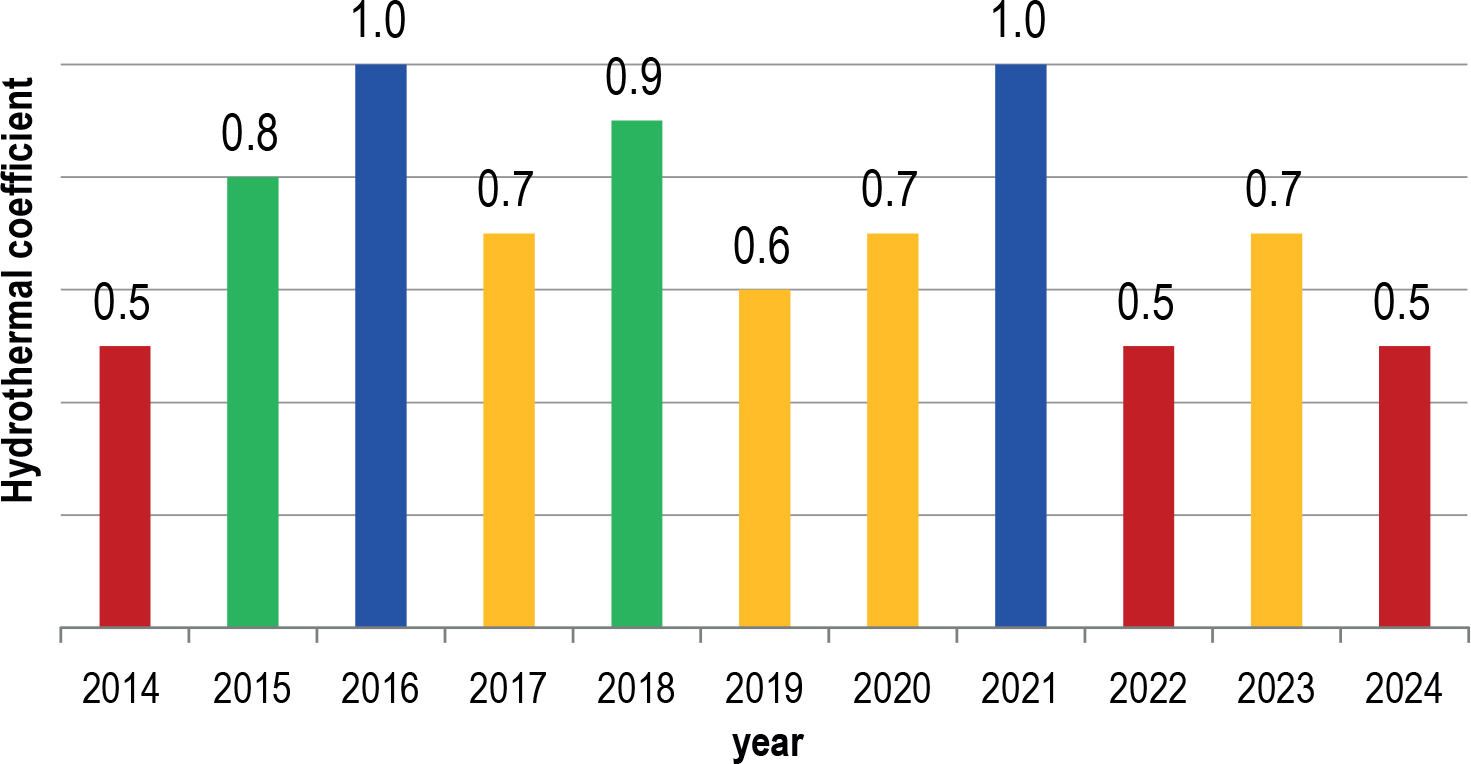
Graph 1.
Parameters of the hydrothermal coefficient from 2014 to 2024 in Bessarabia, Ukraine
Due to the presence of significant interannual fluctuations in the hydrothermal coefficient during 2014 – 2024, two representative years with opposite climatic characteristics were selected for indepth analysis. Thus, 2021 represents conditions of sufficient moisture (HTC–1.0), while 2024 is a year with prolonged and intense atmospheric drought (HTC–0.5).
During the three months of 2021 – January, February and December, the calculation of the hydrothermal coefficient was not carried out due to the fact that the average daily air temperature during the specified periods did not exceed the threshold value of +10°C, which is the lower limit for such calculations according to the regulatory methodology (Table 1).
Table 1.
Characteristics of hydrometeorological conditions in Bessarabia, Ukraine for 2021 (sufficiently moist).
| Months | Precipitation, mm | Average temperature, °C | Sum of active temperatures (tact > 10), °C | HTC |
|---|---|---|---|---|
| January | 22.4 | 0.6 | 0.0 | – |
| February | 31.6 | 2.2 | 0.0 | – |
| March | 44.1 | 11.5 | 357 | 1.2 |
| April | 50.3 | 13.1 | 393 | 1.3 |
| May | 65.5 | 19.9 | 616 | 1.0 |
| June | 45.8 | 23.1 | 693 | 0.7 |
| July | 48.9 | 26.4 | 818 | 0.6 |
| August | 39.7 | 27.1 | 840 | 0.5 |
| September | 49.9 | 20.5 | 615 | 0.8 |
| October | 52.1 | 13.7 | 425 | 1.2 |
| November | 45.2 | 10.1 | 303 | 1.5 |
| December | 53.2 | 2.9 | 0.0 | – |
During four months of the year, the HTC values were observed to be within 0.5 – 0.8, which, according to the agroclimatic classification, indicates the development of medium to severe atmospheric drought. At the same time, during the five months, the moisture supply coefficient fluctuated within the range of 1.0 – 1.5, indicating a sufficient level of moisture.
For comparison, in 2024, the HTC was not calculated for four months: January, February, November, and December (Table 2). During seven months of the year, HTC indicators were recorded that correspond to the conditions of medium and severe atmospheric drought, and in one additional month, weak drought.
Table 2.
Characteristics of hydrometeorological conditions in Bessarabia, Ukraine for 2024 (severe drought).
| Months | Precipitation, mm | Average temperature, °C | Sum of active temperatures (tact > 10), °C | HTC |
|---|---|---|---|---|
| January | 30.1 | 1.0 | 0.0 | – |
| February | 43.8 | 3.6 | 0.0 | – |
| March | 25.9 | 10.6 | 329 | 0.8 |
| April | 21.7 | 11.2 | 336 | 0.6 |
| May | 28.9 | 18.5 | 575 | 0.5 |
| June | 25.9 | 23.0 | 689 | 0.4 |
| July | 30.1 | 24.9 | 772 | 0.4 |
| August | 29.5 | 25.1 | 788 | 0.4 |
| September | 28.2 | 19.8 | 594 | 0.5 |
| October | 31.5 | 13.9 | 431 | 0.7 |
| November | 41.2 | 9.5 | 0.0 | – |
| December | 40.7 | 3.4 | 0.0 | – |
Thus, the analysis of hydrometeorological indicators indicates that the southern part of the Odessa region, particularly Bessarabia, Ukraine, is predominantly characterized by pronounced aridity.
For an in-depth analysis of the impact of hydrothermal conditions on the number of oribatid mites and the prevalence of monieziasis, two representative years were selected - 2021 and 2024, which reflect the polar climate scenarios of the region.
In 2021, under conditions of sufficient moisture, a clear seasonal dynamics of the number of oribatid mites was observed in the soils of different types of pastures of Bessarabia (Table 3).
Table 3.
Seasonal dynamics of the number of oribatid mites in the soils of Bessarabia, Ukraine in 2021 (sufficiently moist).
| Season | HTC | Specimens per 100 cm2 of pasture area | ||
|---|---|---|---|---|
| Natural meadows | Cultural meadows | Forest strips | ||
| Spring | 1.2 | 118.4±5.1 | 45.5±4.2 | 121.6±5.5 |
| Summer | 0.6 | 129.5±6.6 | 47.2±3.2 | 199.2±7.1 |
| Autumn | 1.2 | 142.1±4.8 | 52.6±4.1 | 134.6±6.9 |
| Winter | – | 35.5±2.7 | 21.4±2.9 | 98.1±5.4 |
Oribatid mites reached their highest population density during the spring–autumn period, peaking in the summer months. The highest concentration of oribatid mites was observed in natural meadows (142.1 ± 4.8 individuals/100 cm2) and in forest belts (199.2 ± 7.1 individuals/100 cm2), indicating more favorable microecological conditions for the development of saprophytic fauna in these biotopes. Significantly lower numbers were noted in cultivated meadows, regardless of the season, which is attributed to the agrotechnical features of their management.
During the winter period, the number of oribatid mites significantly decreased in all types of land, primarily due to a decrease in temperature and the suppression of mite biological activity in the soil environment.
In 2024, under conditions of prolonged severe drought, the seasonal dynamics of oribatid mite abundance in soils showed a trend towards a general decrease in population density across all types of pastures (Table 4).
Table 4.
Seasonal dynamics of the number of oribatid mites in the soils of Bessarabia, Ukraine in 2024 (severe drought).
| Season | HTC | Specimens per 100 cm2 of pasture area | ||
|---|---|---|---|---|
| Natural meadows | Natural meadows | Natural meadows | ||
| Spring | 0.6 | 62.9±6.6 | 39.4±2.7 | 115.2±6.5 |
| Summer | 0.4 | 74.5±7.5 | 28.5±1.9 | 135.8±7.2 |
| Autumn | 0.4 | 60.8±4.9 | 32.6±2.8 | 114.3±5.1 |
| Winter | — | 23.5±1.8 | 19.8±2.2 | 31.6±2.8 |
Despite seasonal fluctuations, the total number of mites was significantly lower compared to the indicators in wet years. The highest values were observed mainly in summer and spring, but even in these periods, population activity remained suppressed. As in previous years, forest belts provided more stable conditions for the existence of mites, resulting in a higher number compared to natural and, especially, cultivated meadows. The lowest numbers of oribatid mites were recorded in winter, which is associated with low soil temperatures and extremely unfavorable conditions for mite life.
Oribatid mites are sensitive to low humidity and prone to drying out; therefore, an increase in the frequency of atmospheric droughts during the growing season can significantly limit their numbers in the natural environment. Instead, a high level of soil moisture, together with favorable temperatures, contributes to the expansion of the tick range, increasing their population density and reproductive activity, which, in turn, leads to an increase in the level of infestation of animals.
The established relationship between climatic conditions and the number of oribatid mites allows us to assess potential risks for pasture ecosystems in different years. In particular, variations in temperature and humidity levels significantly affect the population density of mites, and therefore the biological availability of invasive stages of the parasite. According to the results of our research, these factors determine the level of sheep infection by Moniezia spp. in different years. The summarized data of epizootological monitoring for 2014 – 2024 are given in Table 5.
Table 5.
Dynamics of Moniezia spp. and Thysaniezia giardi in sheep in Bessarabia, Ukraine over an 11-year period.
| Indicators | Year | ||||||||||
|---|---|---|---|---|---|---|---|---|---|---|---|
| 2014 | 2015 | 2016 | 2017 | 2018 | 2019 | 2020 | 2021 | 2022 | 2023 | 2024 | |
| Number of tested animals | 1002 | 994 | 946 | 545 | 850 | 914 | 880 | 974 | 890 | 805 | 1009 |
| Number of infested animals Moniezia spp. | 198 | 310 | 356 | 129 | 269 | 185 | 193 | 367 | 170 | 179 | 203 |
| Prevalence, % | 19.8 | 31.2 | 37.6 | 23.7 | 31.6 | 20.2 | 21.9 | 37.7 | 19.1 | 22.2 | 20.1 |
| Number of infested animals Thisaniezia giardi | 17 | 22 | 39 | 13 | 24 | 17 | 15 | 32 | 18 | 15 | 16 |
| Prevalence, % | 1.7 | 2.2 | 4.1 | 2.4 | 2.8 | 1.9 | 1.7 | 3.3 | 2.0 | 1.9 | 1.6 |
In years with pronounced aridity (HTC 0.4–0.5), the average prevalence of Moniezia spp. infection in sheep was 19.7 %, while Thysaniezia giardi accounted for 1.8 %. Under conditions moderate drought (HTC 0.6–0.7), these values increased to 22.0 % and 2.0 %, respectively. In years of mild drought (HTC 0.8–0.9), the prevalence of Moniezia spp. reached 31.4 %, and T. giardi – 2.5 %. Under sufficient moisture (HTC 1.0–1.5), the infection rates rose further to 37.7 % and 3.7 %, respectively, indicating a clear dependence of Moniezia spp. and T. giardi prevalence on hydrothermal conditions.
In the sufficiently wet years of 2016 and 2021, a study was conducted on 1920 sheep from farms in Bessarabia, Ukraine. According to the survey results, 37.7 % of animals were found to be infested with Moniezia spp. (Fig. 2), indicating high pathogen activity in conditions of increased soil moisture and favorable temperatures (Table 6).
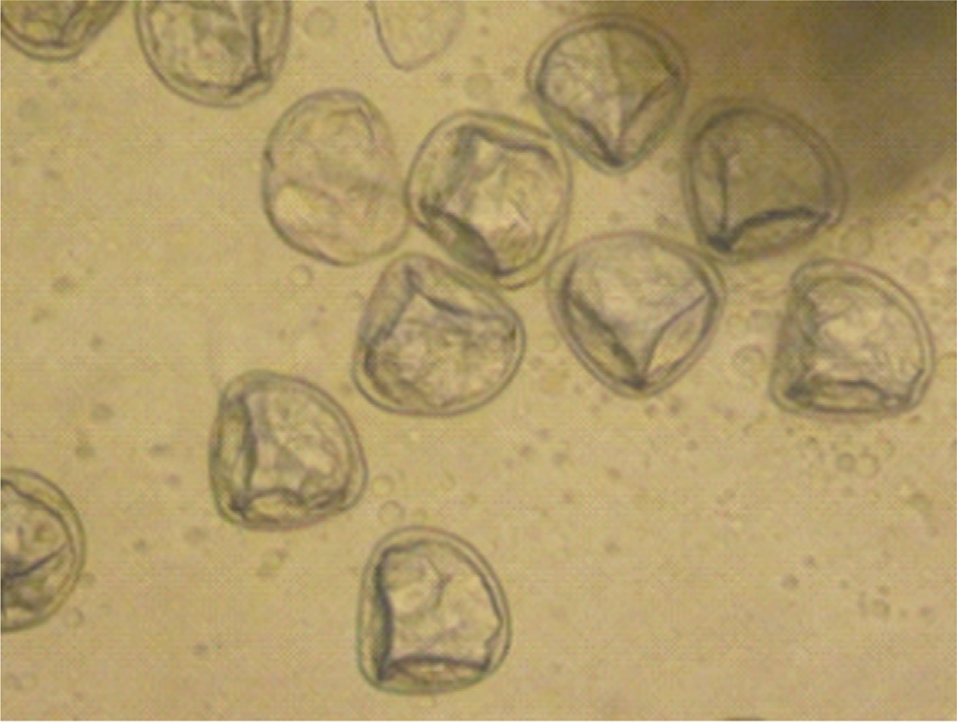
Fig. 2
Eggs of Moniezia spp.
Table 6
Dynamics of monieziasis in sheep in sufficiently wet years in farms of Bessarabia, Ukraine.
| Months | HTC | Number of tested animals | Number of infested animals | Prevalence, % | Intensity of infestation, EPG |
|---|---|---|---|---|---|
| January | – | 79 | 21 | 26.6 | 52.3±0.5 |
| February | – | 87 | 23 | 26.4 | 54.7±0.8 |
| March | 1.2 | 175 | 60 | 34.3 | 72.4±0.3 |
| April | 1.3 | 220 | 107 | 48.6 | 120.8±1.2 |
| May | 1.0 | 176 | 87 | 49.4 | 135.1±0.9 |
| June | 0.7 | 155 | 51 | 32.9 | 140.5±1.0 |
| July | 0.6 | 110 | 31 | 28.2 | 102.9±1.4 |
| August | 0.5 | 108 | 28 | 25.9 | 96.8±0.5 |
| September | 0.8 | 157 | 46 | 29.3 | 88.4±0.8 |
| October | 1.2 | 245 | 121 | 49.4 | 101.2±1.1 |
| November | 1.5 | 215 | 104 | 48.4 | 95.2±0.3 |
| December | – | 193 | 44 | 22,8 | 62.7±0.5 |
| Total | – | 1920 | 723 | 37.7 | 93.6±8.0 |
During the winter period, when the average daily air temperature dropped below +10°C and the HTC was not calculated, the average level of infestation of sheep with Moniezia pathogens was 25.3 %, with an average invasion intensity of 56.6 ± 0.4 EPG. During the dry months (HTC 0.5–0.8), the average infestation rate was 29.1 %, with an average invasion intensity of 107.2 ± 0.5 EPG. Under conditions of sufficient moisture (HTC 1.0–1.5), the level of infestation of sheep with Moniezia spp. Increased to 46.0 %, with an average invasion intensity of 97.4±0.4 EPG.
The prevalence of Moniezia spp. in sheep showed clear age-related differences (Graph 2). One-year-old lambs consistently exhibited higher infection rates (from 10.9 % in December to 32.2 % in October) compared with two-year-old animals (6.7 – 17.1 %). Peaks of infection were observed in spring (April – May) and autumn (October – November), with a marked decline during the summer months (June – August). This pattern indicates that younger animals are more susceptible to monieziasis, whereas older sheep show lower prevalence due to partial age-related resistance. In wet years, when the level of environmental moisture is sufficient for the mass development of intermediate hosts (oribatid mites), monieziasis in sheep acquires a pronounced seasonal and sexual character; against the background of the general increase in invasion, an uneven distribution of morbidity between females and males sheep is clearly visible (Table 7).
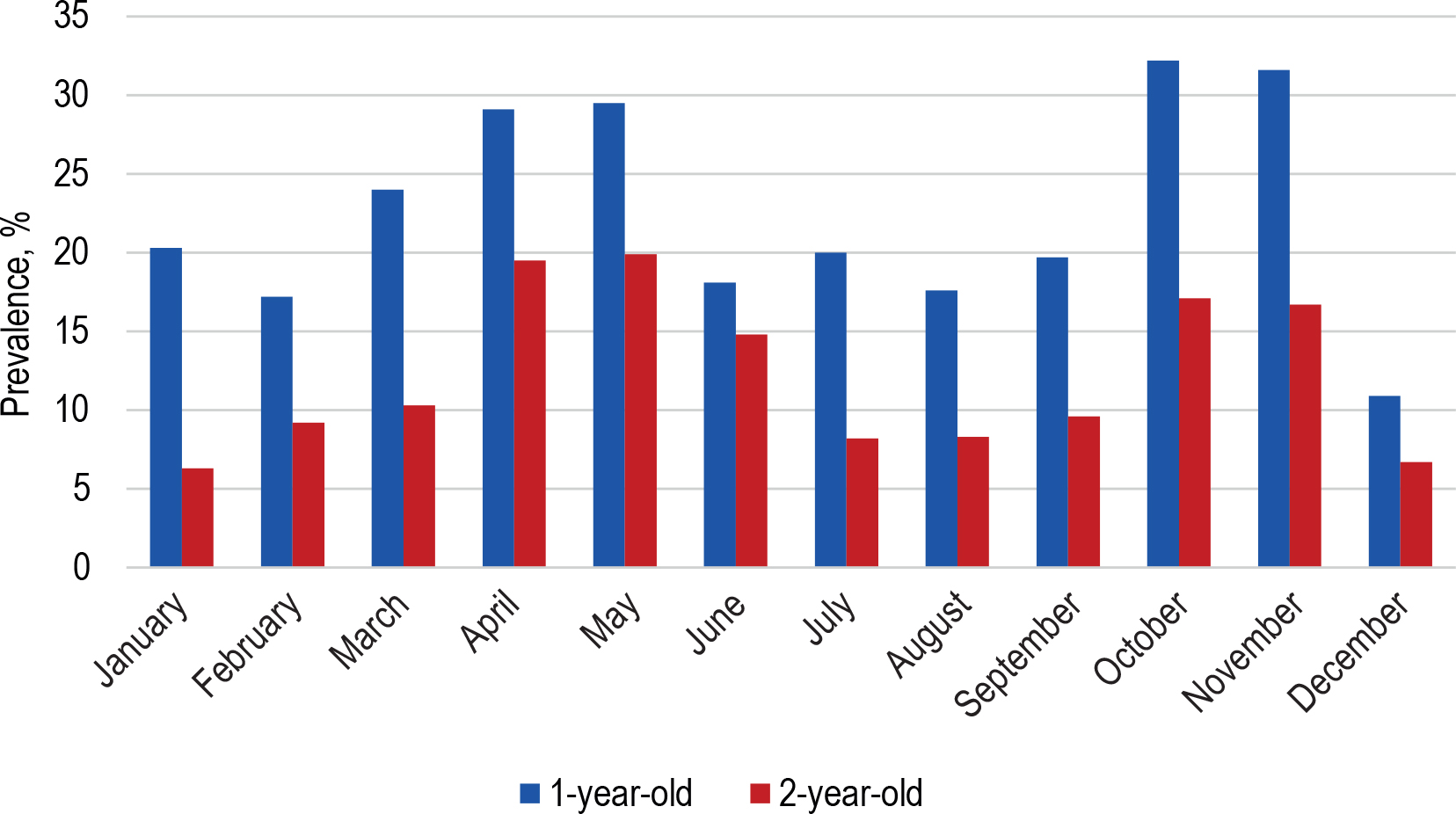
Graph 2.
Dynamics of Moniezia spp. infestation of sheep in sufficiently wet years in farms in Bessarabia (Ukraine) by age groups (1-year-old and 2-year-old).
Table 7.
Prevalence of monieziasis among females and males sheep in wet years in farms in Bessarabia, Ukraine.
| Season | HTC | Infested animals | Females | Prevalence, % | Males | Prevalence, % |
|---|---|---|---|---|---|---|
| Spring | 1.2 | 254 | 168 | 66.1 | 86 | 33.9 |
| Summer | 0.6 | 110 | 63 | 57.3 | 47 | 42.7 |
| Autumn | 1.2 | 271 | 179 | 66.1 | 92 | 33.9 |
| Winter | – | 88 | 45 | 51.1 | 43 | 48.9 |
| Total | 0.8 | 723 | 455 | 62.9 | 268 | 37.1 |
The prevalence of infection among females is particularly noticeable during the spring and autumn periods (66.1 %), when climatic conditions favor tick activity and grazing reaches its peak. At this time, females are often in physiologically stressed states (pregnancy, lactation), which weakens immunity and increases the risk of invasion. Additionally, they spend more time on pasture, which increases their exposure to sources of infection. In the summer, sex differences in sheep infection levels are minimal, with the most minor difference observed in winter, which is associated with a decrease in tick activity and limited grazing opportunities.
In 2014, 2022 and 2024, when severe drought was recorded, 19.7% of the 2901 sheep examined were infected with Moniezia spp. (Table 8). In contrast to wet years, during periods of severe drought, the average daily air temperature remained below +10°C for four months. Under these conditions, the average level of sheep infestation with Moniezia spp. was only 16.4 %, with an average intensity of infestation of 14.6±0.1 EPG. In dry months (HTC 0.4–0.8), the average level of sheep infestation was 19.0 %, with an average intensity of infestation of 38.9±0.1 EPG.
Table 8.
Dynamics of monieziasis in sheep in years of severe drought in farms of Bessarabia, Ukraine.
| Months | HTC | Number of tested animals | Number of infested animals | Prevalence, % | Intensity of infestation, EPG |
|---|---|---|---|---|---|
| January | – | 78 | 12 | 16.0 | 7.2±0.2 |
| February | – | 147 | 26 | 17.7 | 8.1±0.1 |
| March | 0.8 | 266 | 64 | 24.1 | 25.9±0.5 |
| April | 0.6 | 345 | 86 | 24.9 | 45.8±0.4 |
| May | 0.5 | 272 | 56 | 20.6 | 56.6±0.3 |
| June | 0.4 | 231 | 45 | 19.5 | 50.1±0.2 |
| July | 0.4 | 169 | 22 | 13.0 | 32.5±0.2 |
| August | 0.4 | 211 | 34 | 16.1 | 30.4±0.6 |
| September | 0.5 | 307 | 77 | 15.1 | 27.5±0.1 |
| October | 0.7 | 369 | 68 | 18.4 | 42.1±0.2 |
| November | – | 250 | 43 | 17.2 | 36.2±0.3 |
| December | – | 259 | 38 | 14.7 | 6.8±0.1 |
| Total | – | 2901 | 571 | 19.7 | 30.8±0.1 |
In years of severe drought, the level of Moniezia spp. infestation in lambs fluctuated throughout the year with pronounced seasonal peaks (Graph 3). One-year-old animals consistently showed a higher prevalence of infection (8.5 – 16.5 %) compared with two-year-old sheep (3.5 – 9.8 %). The highest rates were recorded in spring (March – April) and autumn (September), whereas a decline was observed during the summer months (July – August).
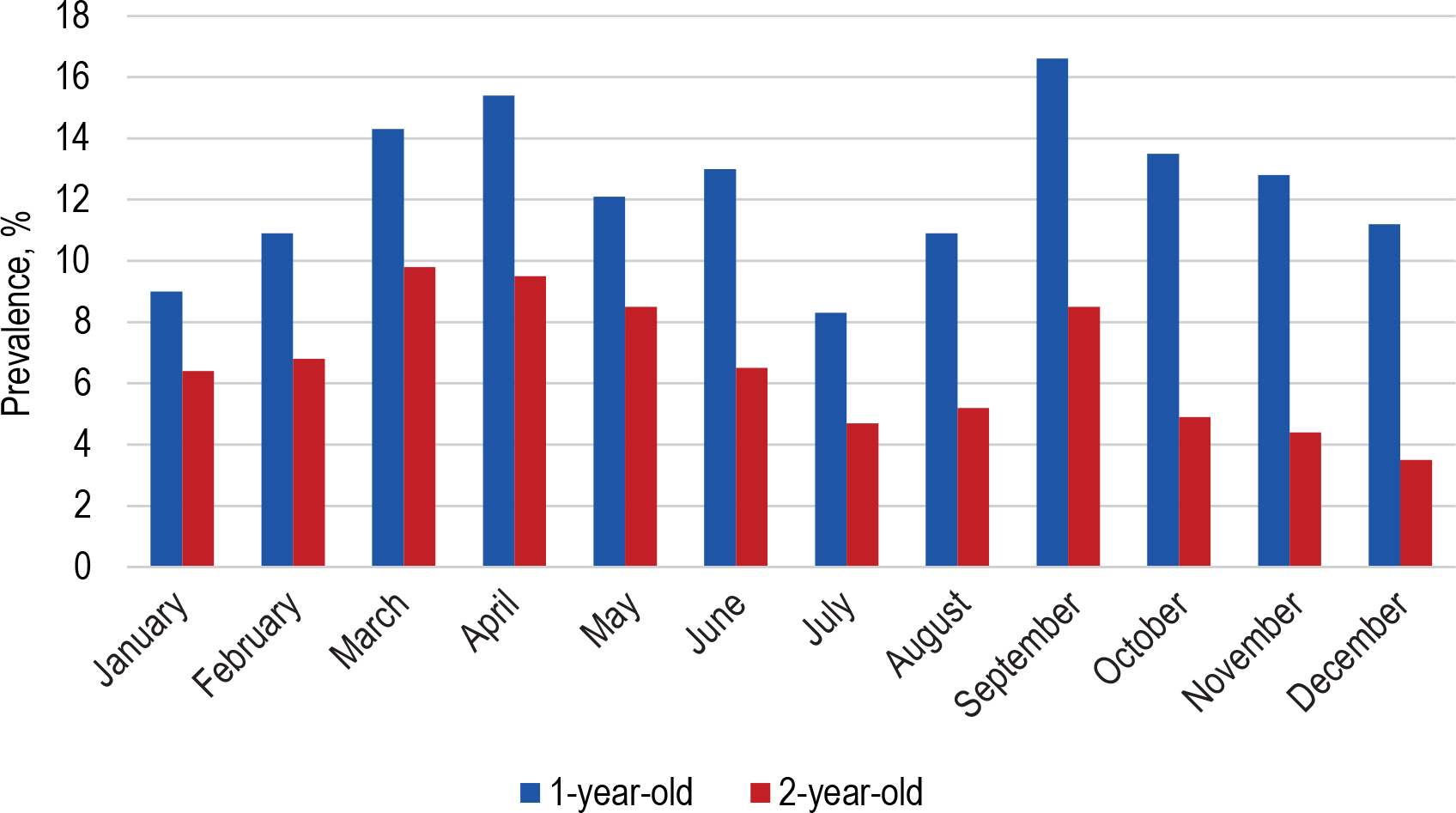
Graph 3.
Dynamics of Moniezia spp. infestation of sheep during years of severe drought in farms in Bessarabia (Ukraine) by age groups (1-year-old and 2-year-old)
In years of severe drought, the overall level of infection with Moniezia spp. was lower, and the distribution between females and males was not significant (Table 9).
Table 9.
Prevalence of monieziasis among females and males sheep during years of severe drought in farms in Bessarabia, Ukraine.
| Season | HTC | Infested animals | Females | Prevalence, % | Males | Prevalence, % |
|---|---|---|---|---|---|---|
| Spring | 0.7 | 206 | 125 | 60.7 | 81 | 39.3 |
| Summer | 0.4 | 101 | 53 | 52.5 | 48 | 47.5 |
| Autumn | 0.6 | 188 | 102 | 54.3 | 86 | 45.7 |
| Winter | – | 76 | 38 | 50.0 | 38 | 50.0 |
| Total | 0.4 | 571 | 318 | 55.7 | 253 | 44.3 |
The highest proportion of infected females was recorded in spring (60.7 %); however, compared to wet years (where it reached 66.1 %), the advantage of females is less pronounced. In summer, autumn and winter, the difference between the sexes was minimal, and in winter it was completely absent (50/50).
Thus, in dry years, the spread of Moniezia among male and female sheep did not differ significantly due to lower tick activity and a general decrease in the level of invasion.
The results obtained confirm that dry climatic conditions significantly limit the biological activity of oribatid mites - intermediate hosts of Moniezia spp., which, in turn, reduces the level of infection of sheep with cestodes. The seasonal dynamics of the number of oribatid mites closely correlate with periods of the highest risk of invasion. The peak activity of these saprophytes coincides with an increased probability of infection in animals. The intensity of infection with Moniezia spp. can serve as a sensitive indicator of biocenotic changes associated with climatic fluctuations.
According to the data obtained, there is a clear connection between hydrothermal environmental conditions and the epizootology of sheep monieziasis. In particular, high temperature in combination with sufficient humidity (HTC > 1.0) creates favorable conditions for the development of populations of oribatid mites, which are intermediate hosts of Moniezia spp. This, in turn, leads to an increase in the level of infection of animals due to an increase in the density of mites and the availability of invasive forms of the parasite. On the other hand, in dry years, when the hydrothermal coefficient decreases to 0.7 and below, the number of mites decreases markedly. This is due to unfavorable conditions for the survival and development of free-living stages of saprophytic fauna in the soil. As a result, the number of infected mites in the environment decreases, which leads to a decrease in the level of infestation of sheep with Moniezia spp.
Thus, weather factors, in particular air temperature, soil moisture, and hydrothermal coefficient, are key determinants of tick population dynamics and, accordingly, determine the level of monieziasis and the prevalence in sheep.
Discussion
Parasitic invasions remain a major obstacle to sheep farming, with anoplocephalid cestodes—particularly the causative agents of monieziasis—representing the greatest threat (Bashtar, 2011; Barry, 2002). Since oribatid mites function as intermediate hosts, their abundance and population dynamics directly influence the epidemiology of these cestodes (Denegri, 2003; Tihaya, 2024). The results confirm previous observations that climatic factors, especially temperature and humidity, are decisive in the spread of gastrointestinal helminths (Denegri, 1992; Schuster, 2000; Seeber, 2020; Modabbernia, 2021). In the present study, oribatid mites densities were higher under warm and humid conditions and markedly reduced during drought stress. Maximum numbers were recorded in natural meadows (142.1 ± 4.8 individuals/100 cm2) and forest belts (199.2 ± 7.1 individuals/100 cm2) during sufficiently moist years, while in drought years their abundance declined substantially, which is consistent with the findings of Pfingstl (2021) on the susceptibility of oribatid mites to desiccation.
Seasonal dynamics of Moniezia spp. prevalence also aligned with earlier reports, showing higher infection levels in wet seasons compared to dry ones (Nwosu, 1996; Al-Qureishy, 2008; Bogach et al., 2024; Kumar et al., 2024). In sufficiently humid years, prevalence in sheep reached 37.7 % with an average intensity of 93.6 ± 8.0 EPG, whereas in severe drought years prevalence fell to 19.7 % with an intensity of 30.8 ± 0.1 EPG. This pattern corresponds to findings from Ethiopia, where climatic conditions strongly influenced prevalence (Ibrahim, 2014), and from Brazil, where the rate was 20.39 % (Martins, 2022), but differs from Grenada, where prevalence was only 4 % (Chikweto, 2018), and from Romania, where infection levels were considerably higher, reaching 56.1 % for M. expansa and 43.9 % for M. benedeni (Iacob, 2020). The results also corroborate the observations of Al-Qureishy (2008), who reported distinct seasonal peaks of Moniezia spp. in autumn and spring with declines in summer. Prevalence in wet years peaked in April – May (48.6 – 49.4 %) and October – November (31.6 %), while in drought years the values were lower (March – April: 24.1 – 24.9 %), indicating that the general seasonal pattern is preserved but the magnitude of fluctuations is strongly dependent on hydrometeorological conditions.
At the same time, some discrepancies were noted when compared to data from Iraq, where the highest infection rates were observed in summer (up to 57.1 % in August) (Sray, 2022), and Senegal, where no significant seasonal differences were detected (Ndom, 2016). Such variation may be explained by differences in local climate, grazing management practices, and vegetation type, which shape the microclimatic conditions for oribatid mites. Age-related patterns were also evident: one-year-old animals consistently showed higher prevalence (up to 31.6 % in wet years, compared to 8.3 – 16.6 % in drought years), whereas two-year-olds had lower infection rates (19.9 % vs. 3.5 – 9.8 %). These findings are in line with host–parasite interaction theories emphasizing partial age resistance and the role of acquired immunity (Altizer, 2006; Cornell, 2008).
Overall, the data confirm that climatic and seasonal factors play a decisive role in shaping the epidemiology of Moniezia spp., while regional differences are largely attributable to variations in hydrometeorological conditions, the density of intermediate hosts, and local grazing systems.
Conclusion
Increased humidity levels, combined with optimal temperature indicators, contribute to the expansion of the oribatid mites range, an increase in their number, activation of population dynamics and, as a result, an increase in the level of infestation of sheep with monieziasis.
Notes
[3] Conflicts of interest Conflicts of Interest
The authors declare no conflict of interest in conducting this study. The authors have no conflict of interest when submitting an article to Helminthologia.