Introduction
The results of the EDXA of hooks of Corynosoma pseudohamanni Zdzitowiecki, 1984 (Polymorphidae) show the predominance of calcium (11.5 – 47.0 %) and, to some extent, phosphorus (2.0 – 19.6 %) in all analyzed hooks followed by lower levels of sulfur (0.0 – 7.1 %) (Amin et al., 2025a). Calcium levels reached the highest levels in the roots of the anterior (50.6 %), middle (67.9 %), and posterior (51.9 %) hooks. Sulfur reached higher levels at the edges of all hooks; however, we only detected the highest concentration of this element at the tip of the middle hook (7.1 %). Magnesium exhibited the lowest levels or was mostly undetectable (0.0 – 1.2 %). Magnesium was detected only in the anterior hook’s root (1.5 %). These levels of elements characterize the species of acanthocephalan being studied and evaluates the relative contribution of each element in providing strength and flexibility for attachment and retention of infection. EDXA studied cystacanths and juveniles of five other species of acanthocephalans for elemental composition. These are (1) Southwellina hispida (Van Cleave, 1925) Witenberg, 1932 (Polymorphidae) from the long jaw mudsucker Gillichthys mirabilis Cooper (Gobiidae) off the California coast (Amin et al., 2022); (2) cystacanths of Profilicollis rancoensis Amin, Rodríguez, Farrer, Fierro, Garcés, Rivera, D’Elía, 2023 (Polymorphidae) from the freshwater crab Aegla abtao Schmitt (Crustacea: Decapoda) in Ranchi Lake, North Patagonia, Chile (Amin et al., 2023); (3) cystacanths of Neoandracantha peruensis Amin, Heckmann, 2017 from the ghost crab Ocypode guadichaudi Milne-Edwards and Lucas in Peru (Amin and Heckmann, 2017); (4) cystacanths of Sphaerirostris picae (Rudolphi, 1819) Golvan, 1956 from lizards and hedgehogs in Ukraine (Amin et al., 2022); and (5) Cystacanths of Moniliformis kalahariensis Meyer, 1931 from Blatella germanica Linn. in India (Amin et al., 2022).
This study aims to characterize, for the first time, the elemental composition and spatial distribution of mineral elements—specifically calcium, phosphorus, sulfur, and magnesium—in the proboscis hooks of Corynosoma pseudohamanni cystacanths using Energy Dispersive X-ray Analysis (EDXA). By integrating morphological, molecular, and elemental data, we evaluate the taxonomic, biological, and structural significance of mineral localization patterns across anterior, middle, and posterior hooks and hook roots. Comparative analyses with related acanthocephalan species are included to assess the diagnostic and systematic value of hook mineralization profiles
Materials and Methods
Collections
A total of 594 cystacanths of C. pseudohamanni were collected from cysts in the body cavity of 5 individuals of the Atlantic black rockcod Notothenia coriiceps Richardson between November 2022 and March 2023 off Galindez Island, Argentine Islands, West Antarctica (65°15' S, 64°15' W). This collection was part of the long-term parasitological monitoring studies carried out from 2014 to 2015 by the Ukrainian Antarctic expeditions at the Ukrainian Antarctic station (UAS) “Akademik Vernadsky” on Galindez Island, West Antarctica. Acanthocephalan cysts were collected manually from fish body cavity sites, washed in saline after excystation, and kept for a few hours for proboscis evagination before fixing in 70 % ethanol. We have processed 10 specimens of each sex for SEM and energy-dispersive X-ray analysis (EDXA).
Deposits
Voucher specimens were submitted to the Harold W. Manter Laboratory for deposition. (HWML) The collection of the University of Nebraska State Museum in Lincoln, Nebraska, USA; collection no. HWML 217883. Additional specimens are kept in the OMA collection in 70 % ethanol.
Energy Dispersive X-ray analysis (EDXA)
EDXA is an analytical technique associated with electron microscopy used for the elemental analysis or chemical characterization of a sample. It relies on the interaction between an X-ray excitation source and the sample. Its characterization capabilities are mainly according to the fundamental principle that each element possesses a distinct atomic structure, leading to different peaks in its electromagnetic emission spectrum (Goldstein, 2003; Scimeca et al., 2018), which is the main principle of spectroscopy. A similar methodology to study the hooks Moniliformis kalahariensis Meyer, 1931 (Moniliformidae Van Cleave, 1924) was combined with TEAM (Texture and Elemental Analytical Microscopy) which is a technique that combines both crystallographic texture analysis (using Electron Backscatter Diffraction - EBSD) and elemental analysis conducted using Energy Dispersive X-ray Spectroscopy (EDS) on a single electron microscope platform (Tan, 2024). This technique allowed us to simultaneously study the microstructure and chemical composition of the M. kalahariensis material at the micro-scale (Amin et al., 2025b).
The fixed samples were dehydrated through an ascending ethanol series, which was applied, followed by critical point drying using a Tousimis Autosamdri-815 (Tousimis Research Corporation, Rockville, United States). They were mounted on stubs and coated with carbon using a sputter coater Balzers MED 010 (Balzers Union limited, Balzers, Liechtenstein.), establishing an approximate thickness of 20 nm. The specimens were examined and positioned using the LYRA3 FIB-SEM (TESCAN, Brno – Kohoutovice, Czech Republic), equipped with a Phoenix energy-dispersive X-ray analyzer (Oxford Instruments, Abingdon, England). X-ray spot analysis and live scan analysis were performed at 15 kV with a spot size of 2, and the results were recorded on charts and stored using digital imaging software attached to a computer. The AZtec version 4.3 software system (Oxford Instruments, Abingdon, England) was used. A dual-beam scanning electron microscope (SEM) equipped with a gallium (Ga) ion source was used for the LIMS (Liquid Ion Metal Source) part. The hooks of the acanthocephalans were positioned at the center of the SEM stage and sectioned longitudinally. The cut was then analyzed with X-rays at the hooks’ tip, middle, and base for chemical ions using an electron beam (FEG Schottky) to obtain an X-ray spectrum.
SEM data maps were created, marking spectra from the edge and middle of hook tips, middle, and roots. These were followed by color-coded spectra showing magnesium, calcium, phosphorous, and sulfur element overlays. Then, graphs and tables were created for each spectrum of anterior hooks (Figs. 1–11), middle hooks (Figs.12–23), and posterior hooks (Figs. 24–34).
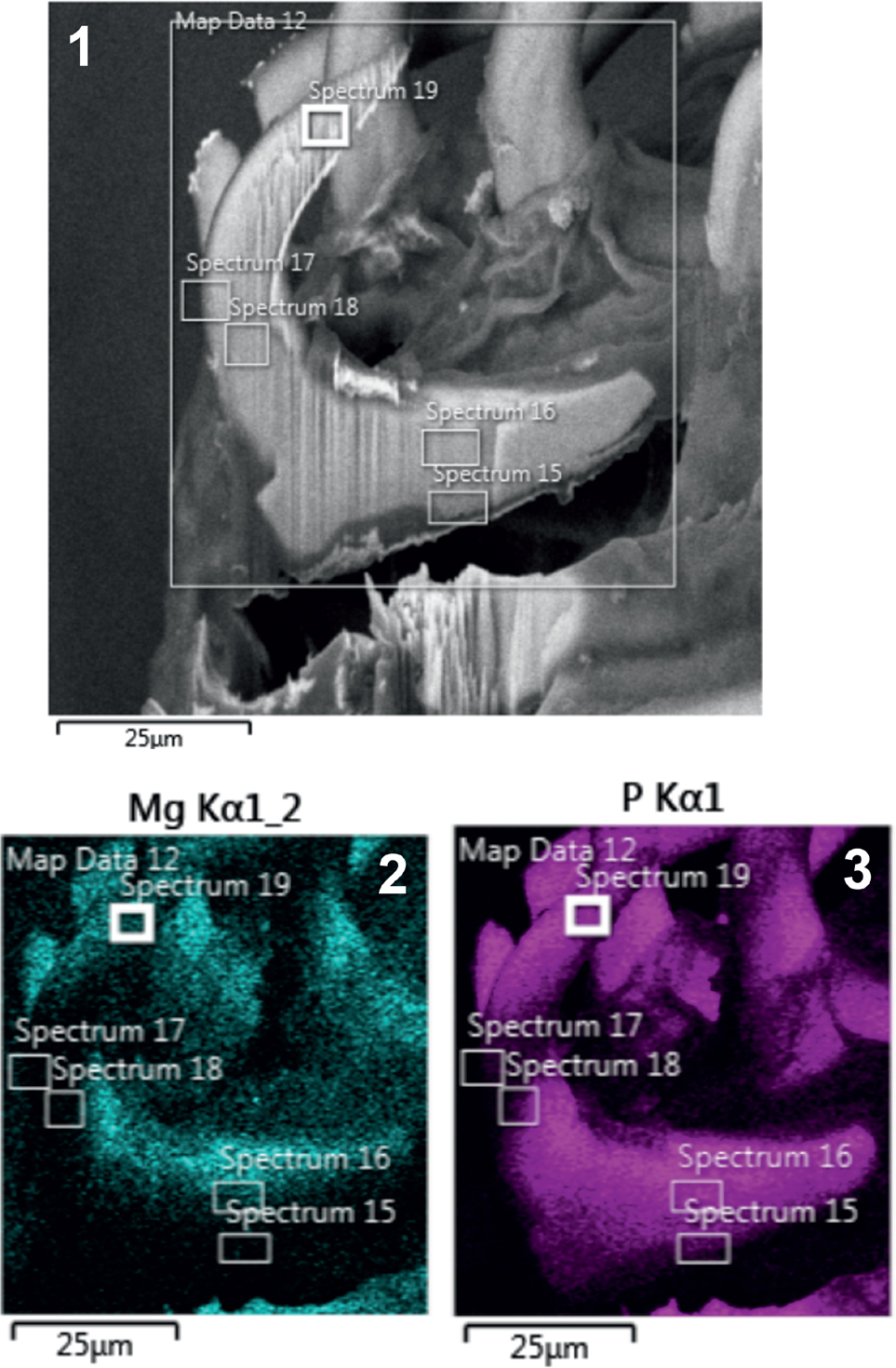
Figs. 1-3.
Elemental analysis of anterior proboscis hooks of Corynosoma pseudohamanni collected from Notothenia coriiceps off Galindez Island Argentine Islands West Antarctica. 1. A Gallium-cut lateral section of an anterior hook showing spectra at which elemental analysis was performed. 2. Phase map of magnesium. 3. Phase map of phosphorous.
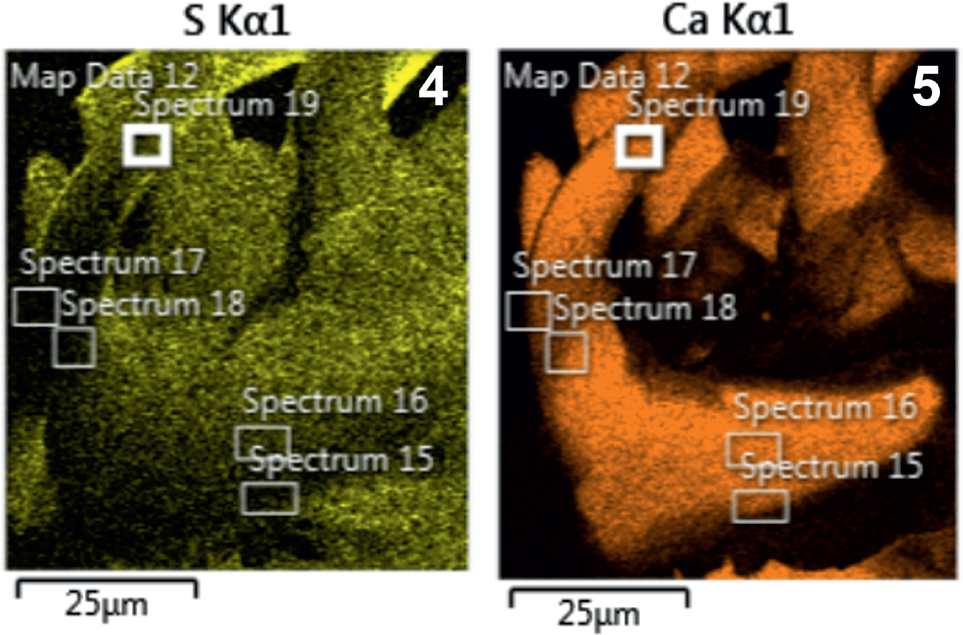
Figs. 4-5.
Elemental analysis of anterior proboscis hooks of Corynosoma pseudohamanni collected from Notothenia coriiceps off Galindez Island, Argentine Islands, West Antarctica. 4. Phase map of sulfur 5. Phase map of calcium.
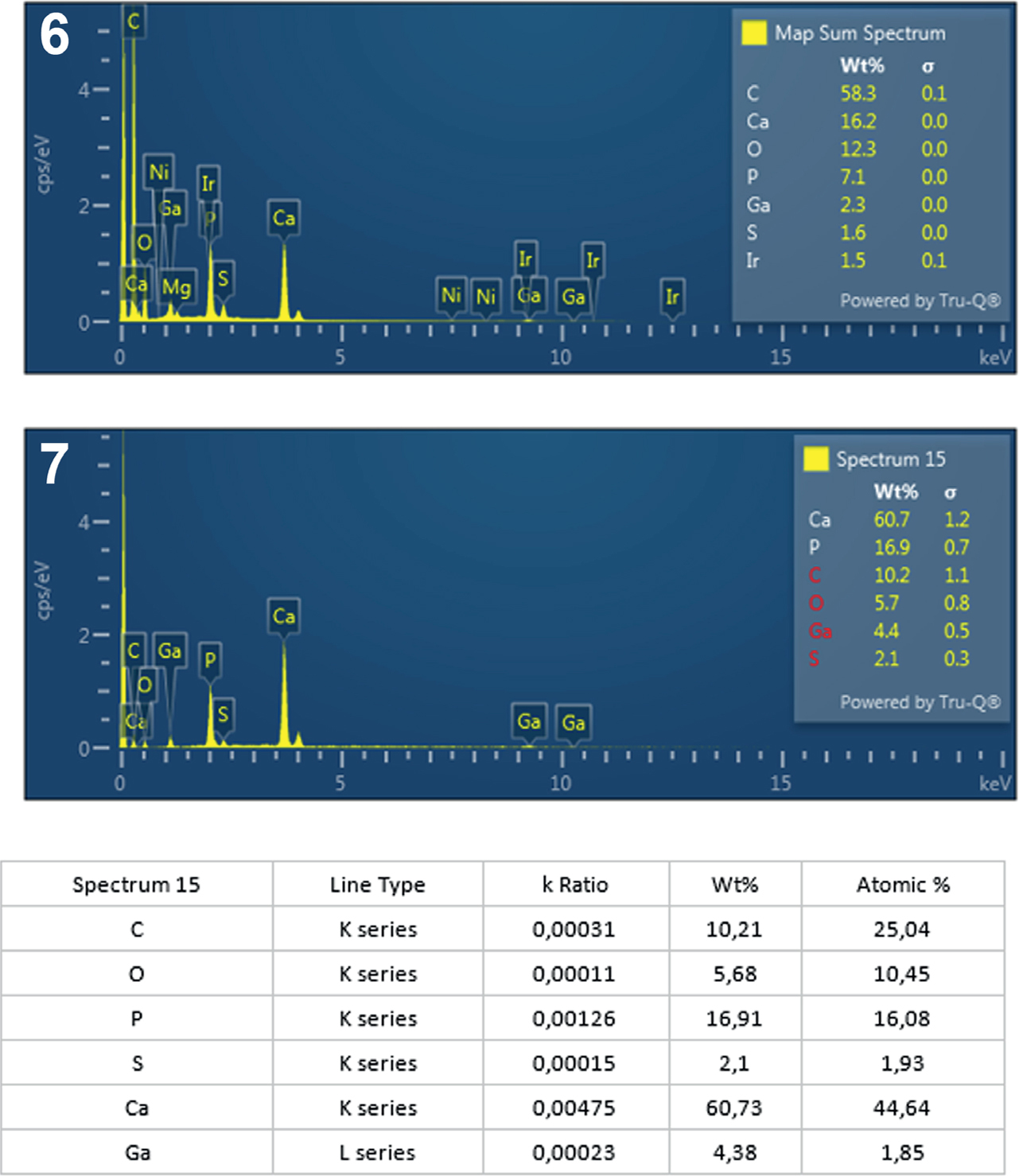
Figs. 6-7.
Elemental analysis of anterior proboscis hooks of Corynosoma pseudohamanni collected from Notothenia coriiceps off Galindez Island, Argentine Islands, West Antarctica. 6. Map of sum spectra with the inset showing the numerical analysis of the spectra. 7. Graphic and tabulated levels of elements analyzed from the edge of the root (spectrum 15).
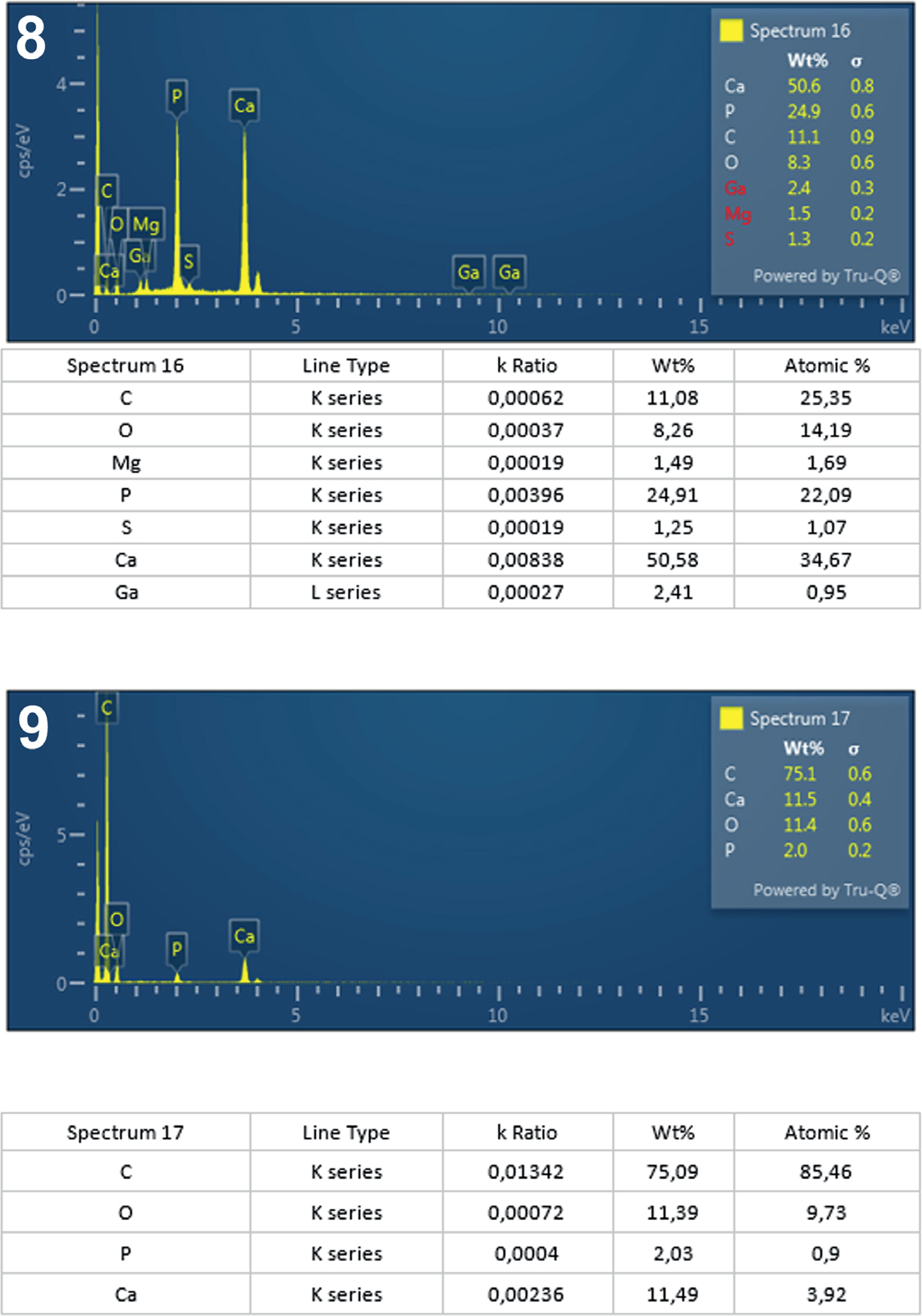
Figs. 8-9.
Elemental analysis of anterior proboscis hooks of Corynosoma pseudohamanni collected from Notothenia coriiceps off Galindez Island, Argentine Islands, West Antarctica. 8. Graphic and tabulated levels of elements analyzed from the center of the root (spectrum 16). 9. Graphic and tabulated levels of elements analyzed from the edge of the hook middle (spectrum 17).
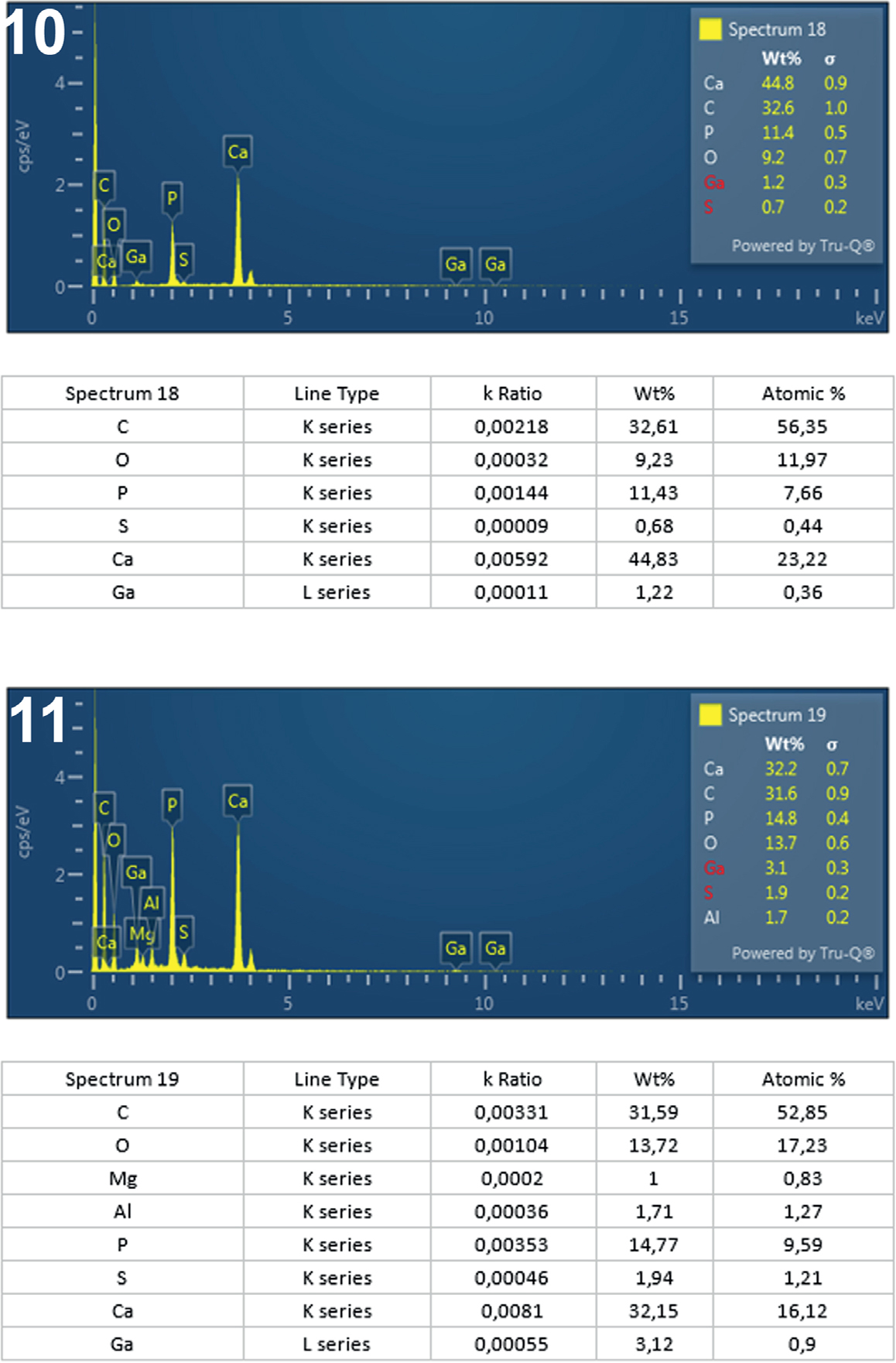
Figs. 10-11.
Elemental analysis of anterior proboscis hooks of Corynosoma pseudohamanni collected from Notothenia coriiceps off Galindez Island, Argentine Islands, West Antarctica. 10. Graphic and tabulated levels of elements analyzed from the center of the hook middle (spectrum 18). 11. Graphic and tabulated levels of elements analyzed from the hook tip (spectrum 19).
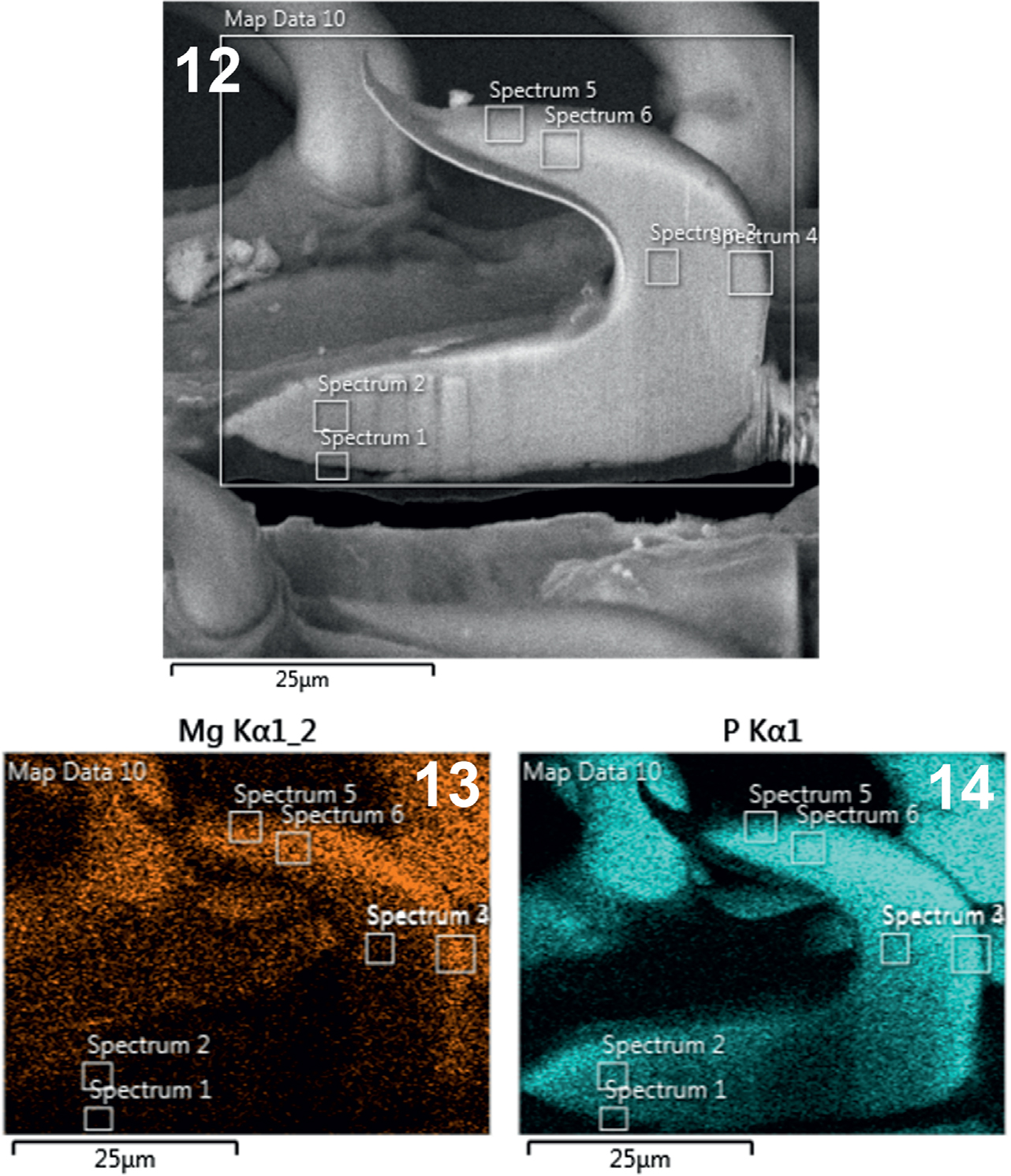
Figs. 12-14.
Elemental analysis of middle proboscis hooks of Corynosoma pseudohamanni collected from Notothenia coriiceps off Galindez Island, Argentine Islands, West Antarctica. 12. A Gallium-cut lateral section of a middle hook showing spectra at which elemental analysis was performed. 13. Phase map of magnesium. 14. Phase map of phosphorous.
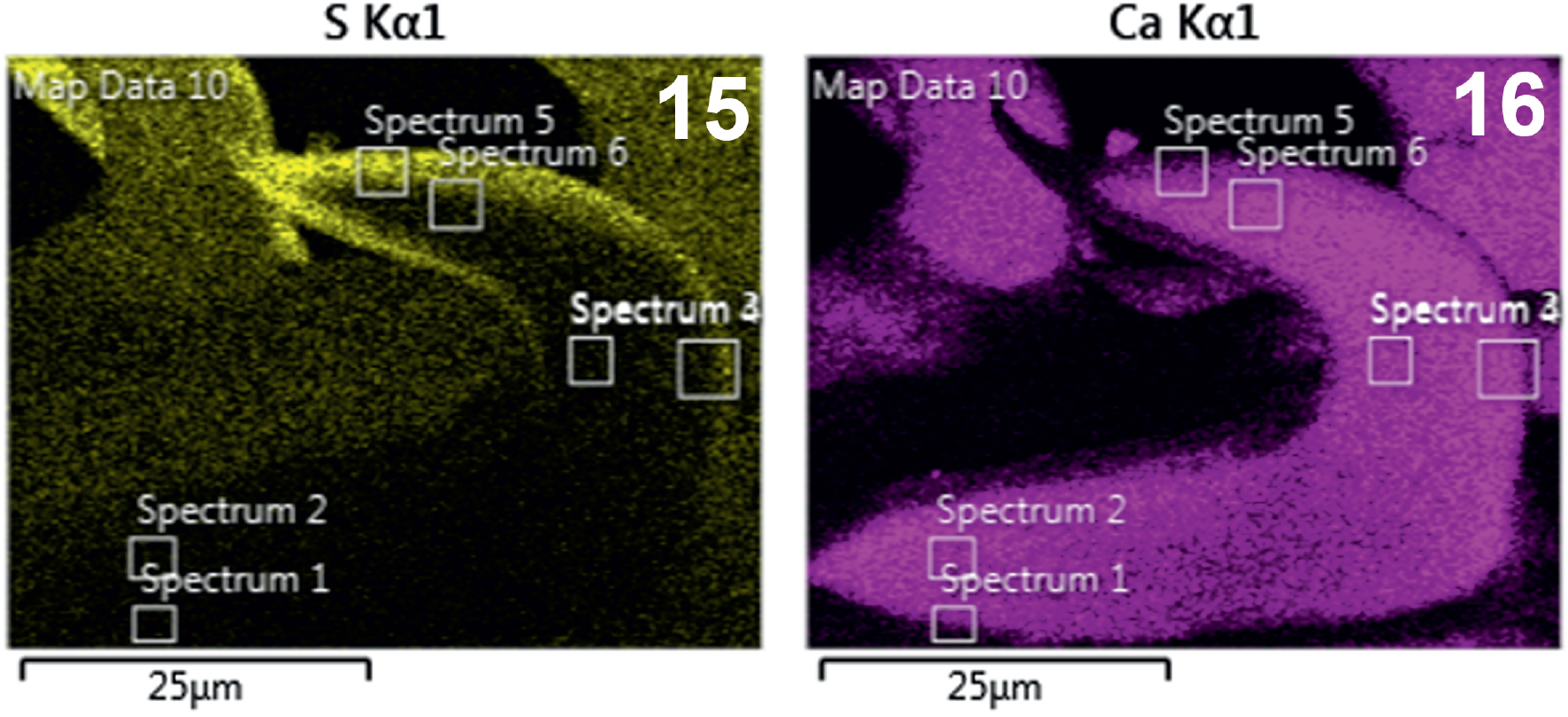
Figs. 15-16.
Elemental analysis of middle proboscis hooks of Corynosoma pseudohamanni collected from Notothenia coriiceps off Galindez Island, Argentine Islands, West Antarctica. 15. Phase map of sulfur 16. Phase map of calcium.
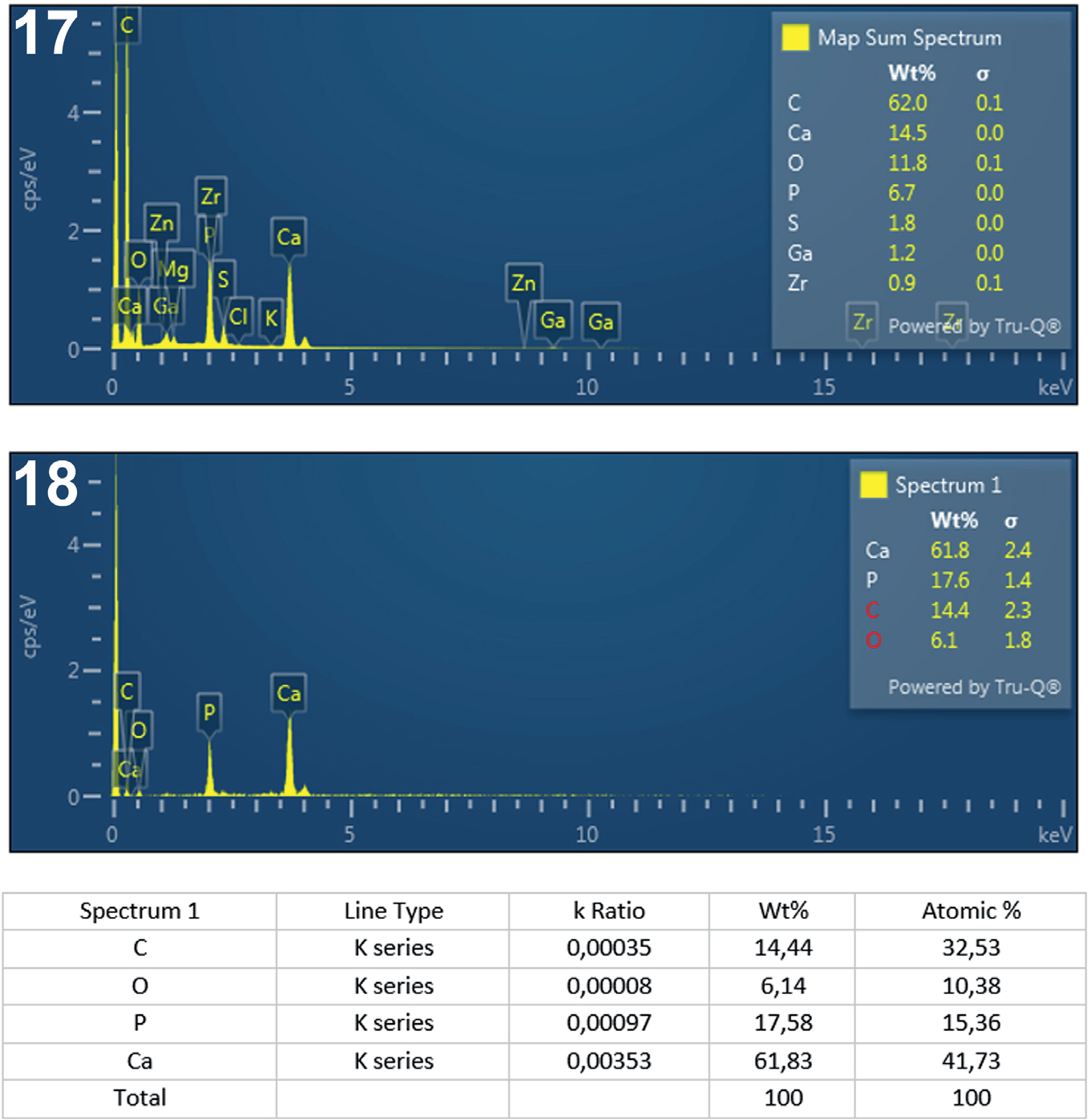
Figs. 17-18.
Elemental analysis of middle proboscis hooks of Corynosoma pseudohamanni collected from Notothenia coriiceps off Galindez Island, Argentine Islands, West Antarctica. 17. Map of sum spectra with the inset showing the numerical analysis of the spectra. 18. Graphic and tabulated levels of elements analyzed from the edge of the root (spectrum 1).
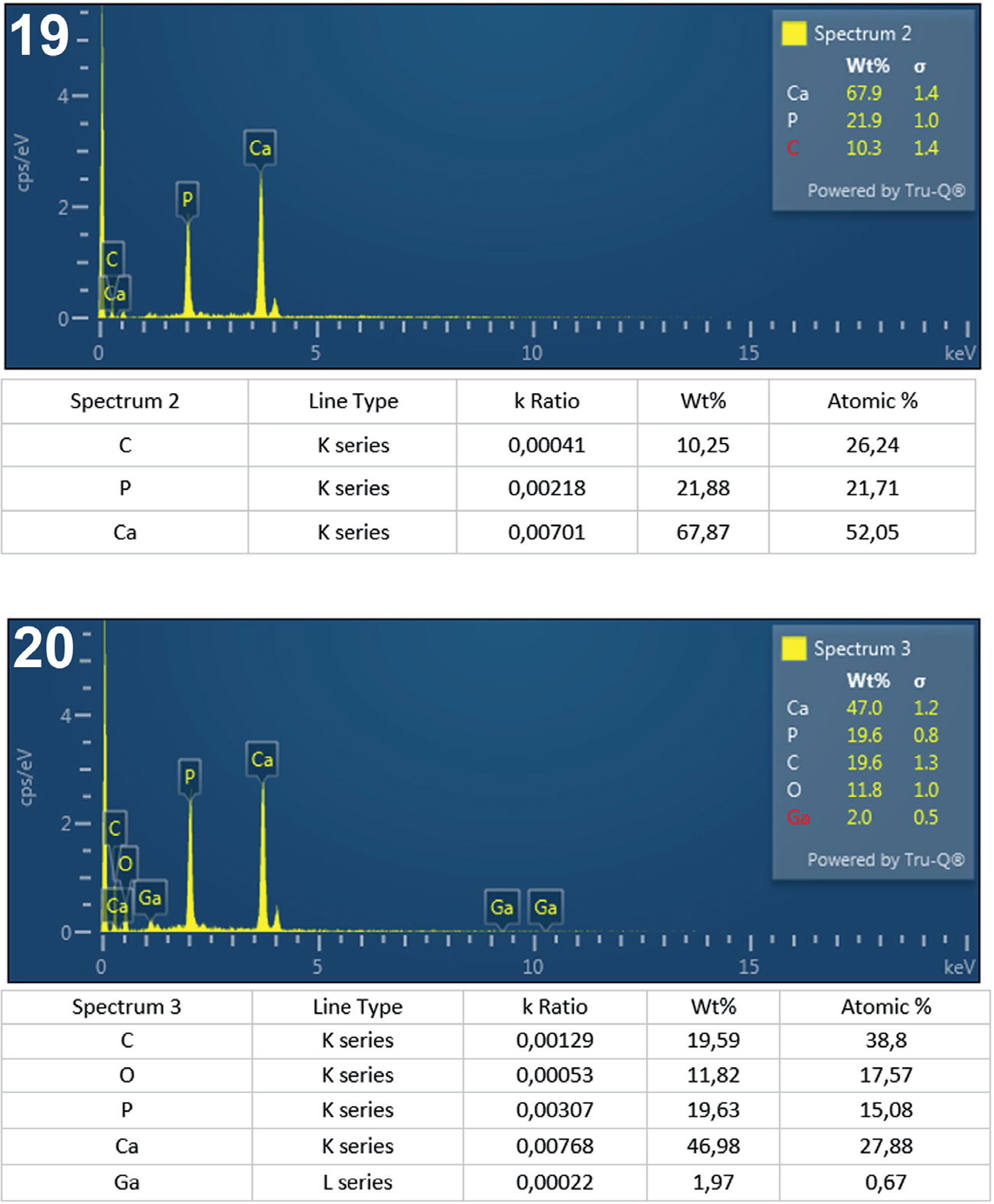
Figs. 19-20.
Elemental analysis of middle proboscis hooks of Corynosoma pseudohamanni collected from Notothenia coriiceps off Galindez Island, Argentine Islands, West Antarctica. 19. Graphic and tabulated levels of elements analyzed from the center of the root (spectrum 2). 20. Graphic and tabulated levels of elements analyzed from the center of the hook middle (spectrum 3).
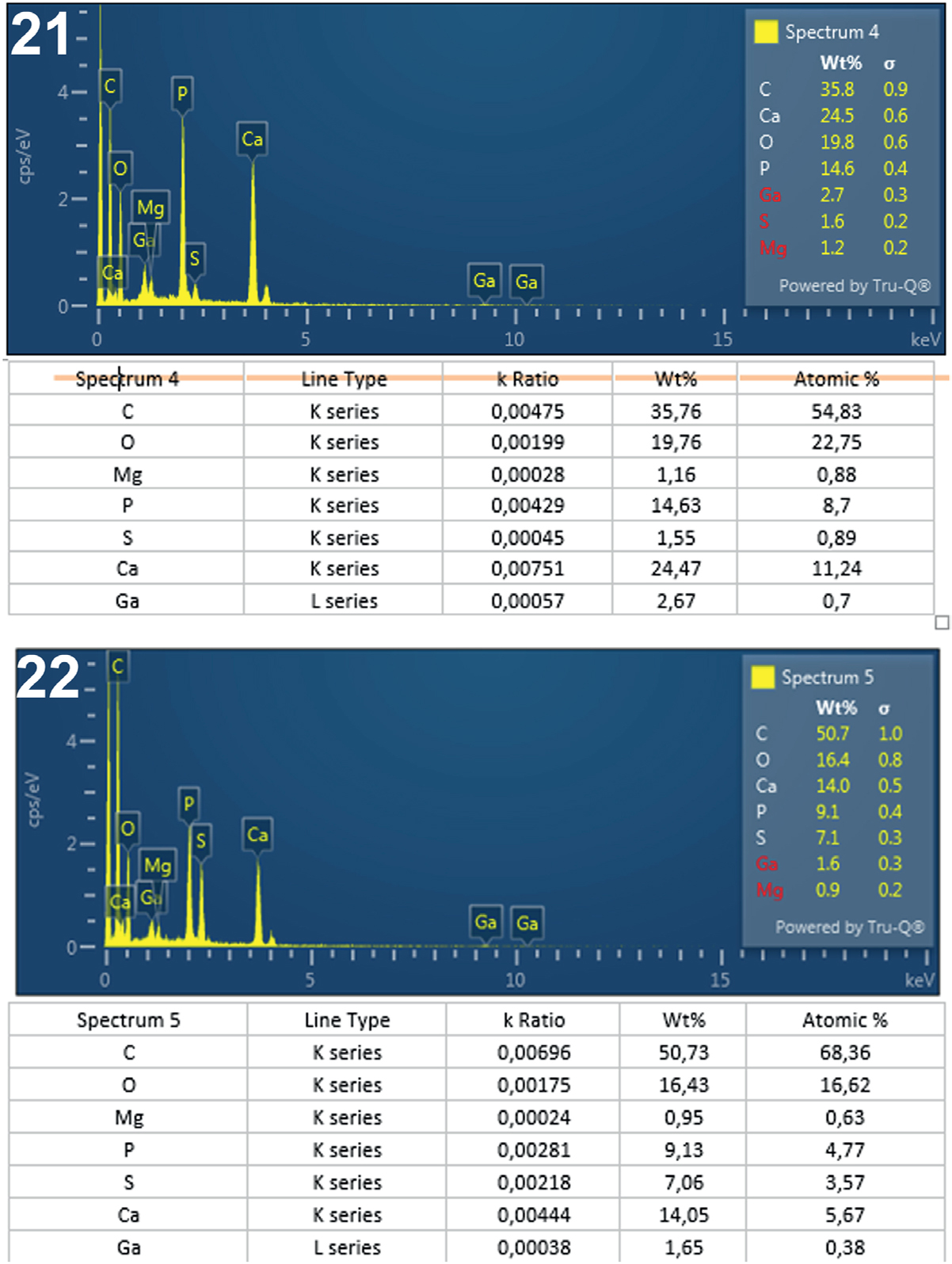
Figs. 21-22.
Elemental analysis of middle proboscis hooks of Corynosoma pseudohamanni collected from Notothenia coriiceps off Galindez Island, Argentine Islands, West Antarctica. 21. Graphic and tabulated levels of elements analyzed from the edge of the hook middle (spectrum 4). 22. Graphic and tabulated levels of elements analyzed from the edge of the hook tip (spectrum 5).
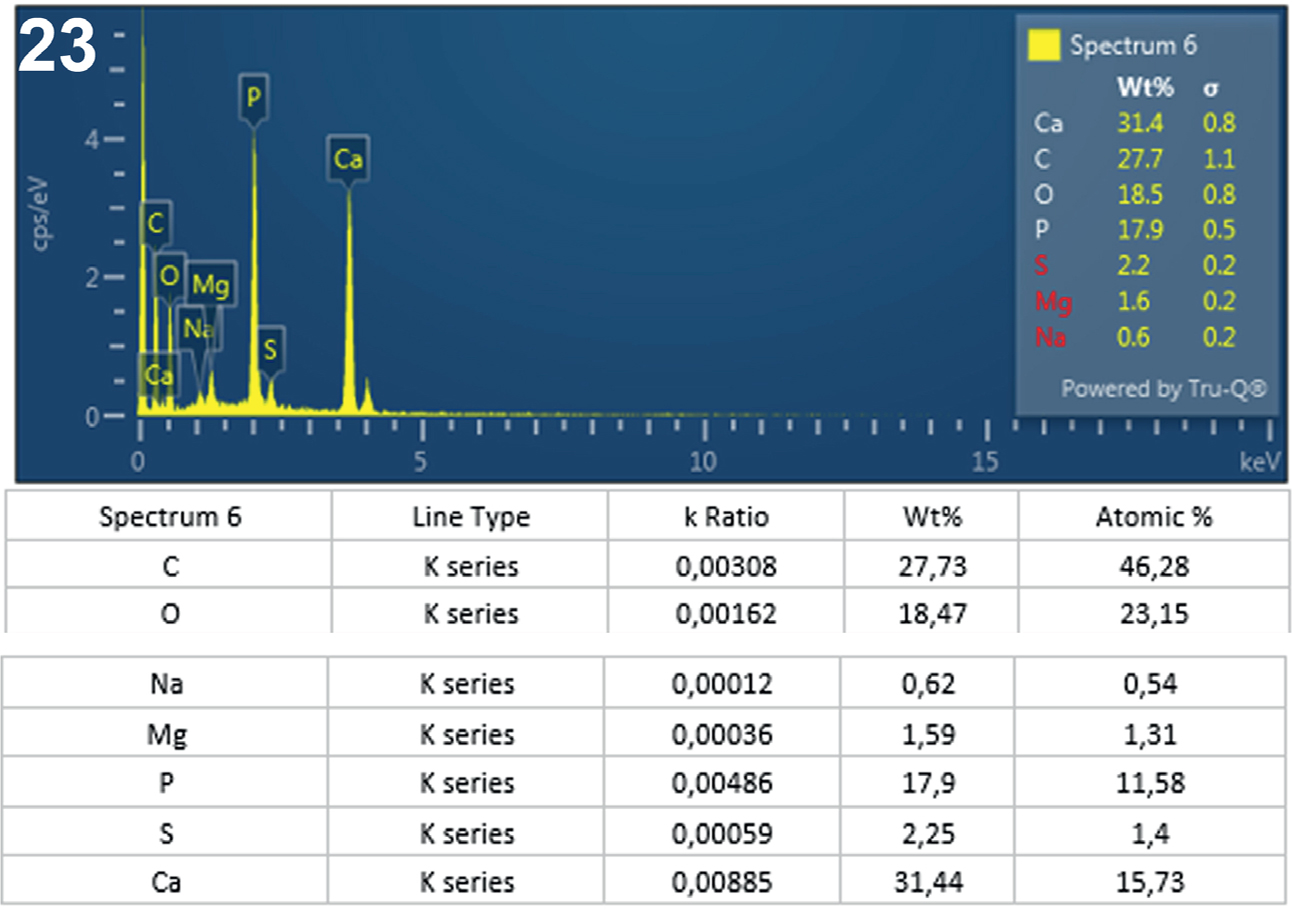
Fig. 23.
Elemental analysis of middle proboscis hooks of Corynosoma pseudohamanni collected from Notothenia coriiceps off Galindez Island, Argentine Islands, West Antarctica. 23. Graphic and tabulated levels of elements analyzed from the center of the hook tip (spectrum 6).
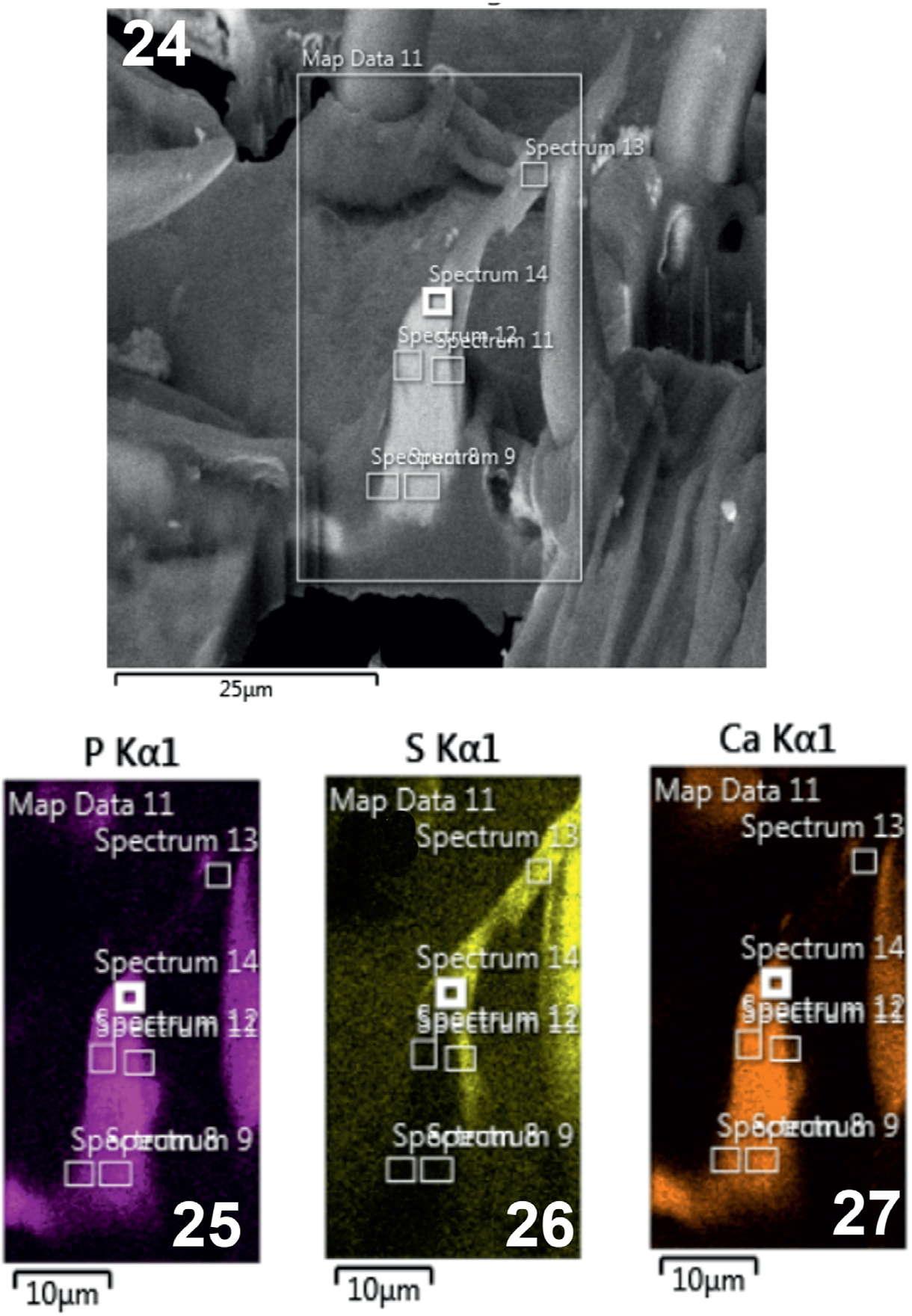
Figs. 24-27.
Elemental analysis of posterior proboscis hooks of Corynosoma pseudohamanni collected from Notothenia coriiceps off Galindez Island, Argentine Islands, West Antarctica. 24. A Gallium-cut lateral section of a posterior hook showing spectra at which elemental analysis was performed. 25. Phase map of phosphorous. 26. Phase map of sulfur. 27. Phase map of calcium.
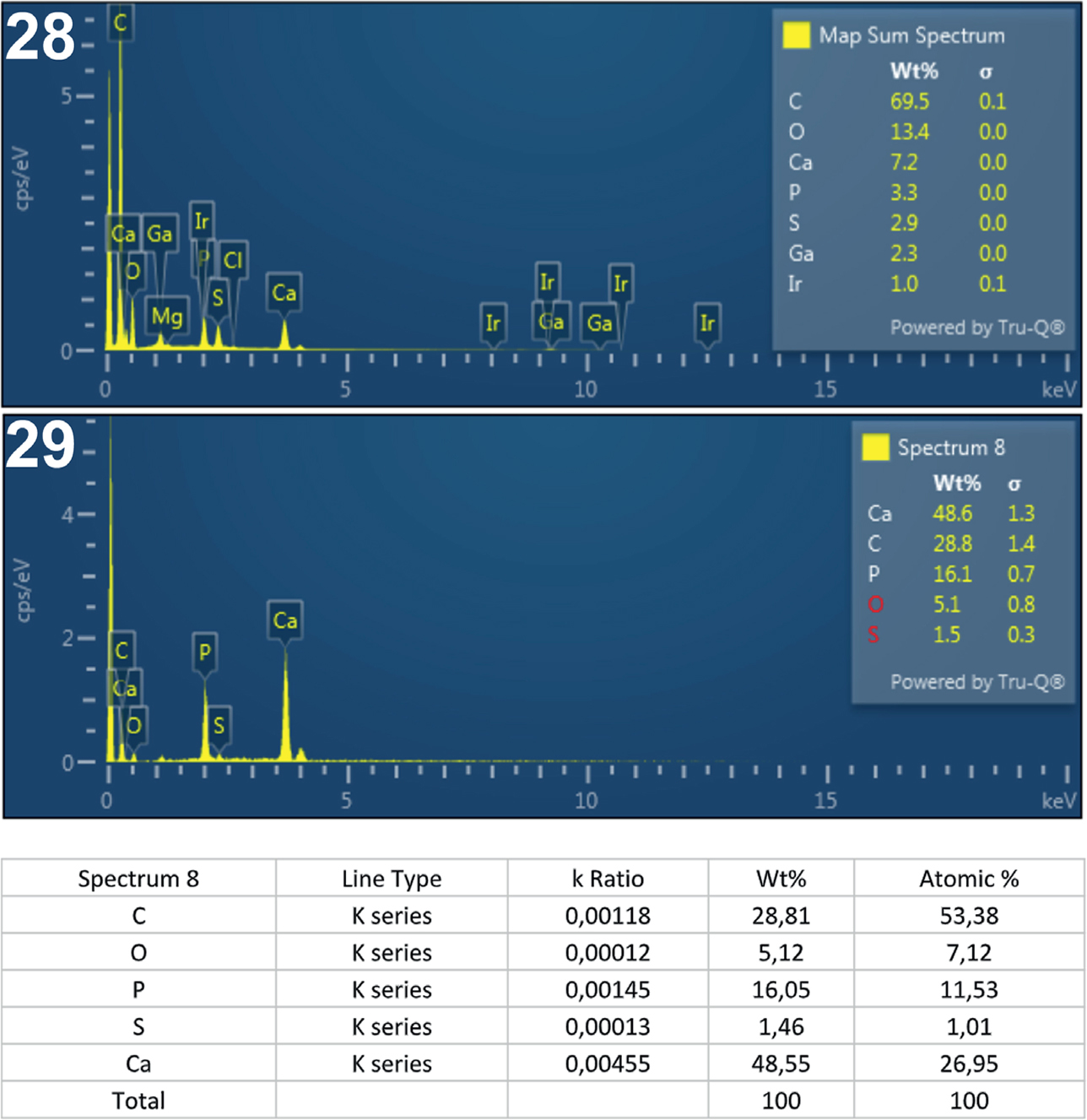
Figs. 28-29.
Elemental analysis of posterior proboscis hooks of Corynosoma pseudohamanni collected from Notothenia coriiceps off Galindez Island, Argentine Islands, West Antarctica. 28. Map of sum spectra with the inset showing the numerical analysis of the spectra. 29. Graphic and tabulated levels of elements analyzed from the edge of the root (spectrum 8).
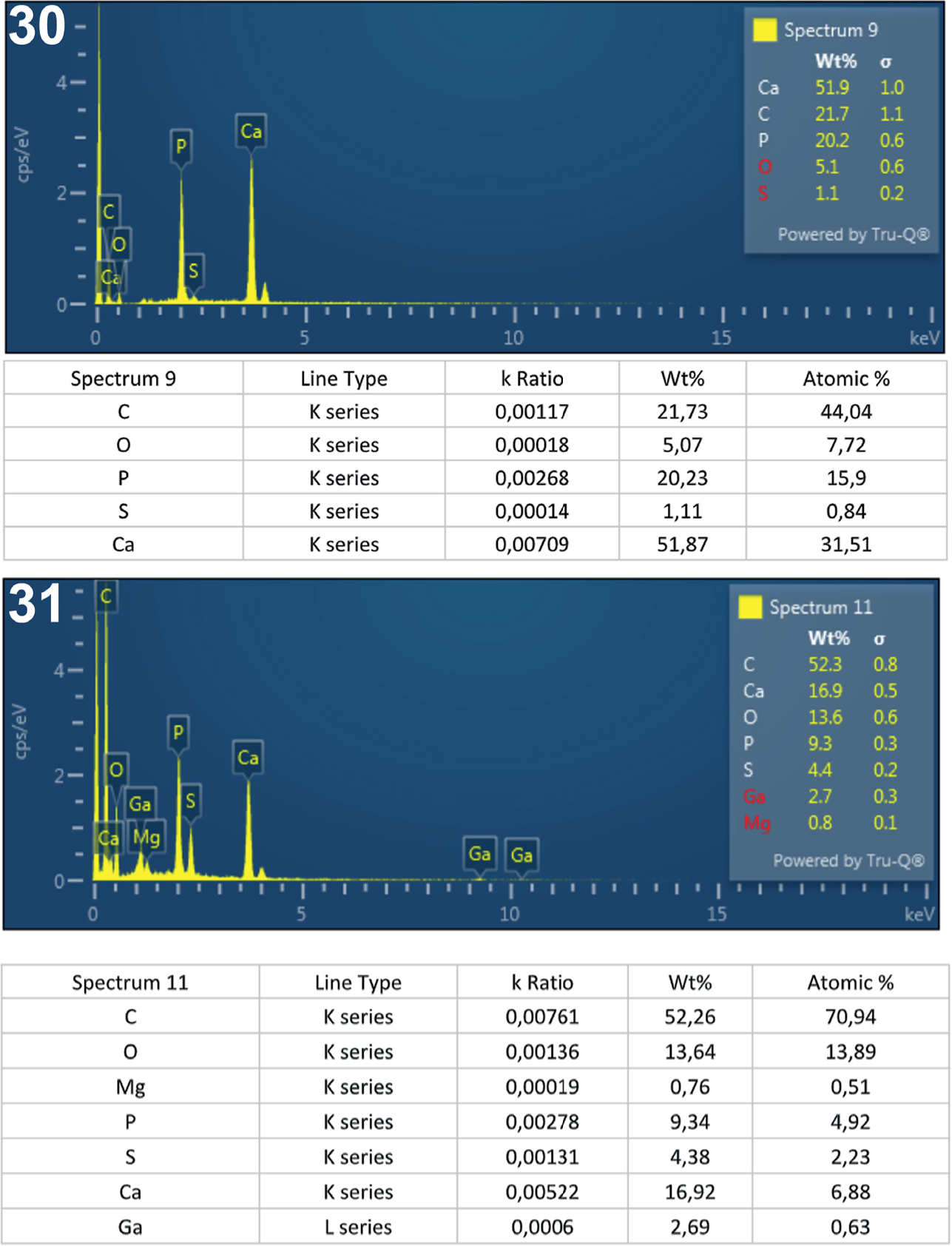
Figs. 30-31.
Elemental analysis of posterior proboscis hooks of Corynosoma pseudohamanni collected from Notothenia coriiceps off Galindez Island, Argentine Islands, West Antarctica. 30. Graphic and tabulated elements analyzed from the center of the root (spectrum 9). 31. Graphic and tabulated elements analyzed from the edge of the hook middle (spectrum 11).
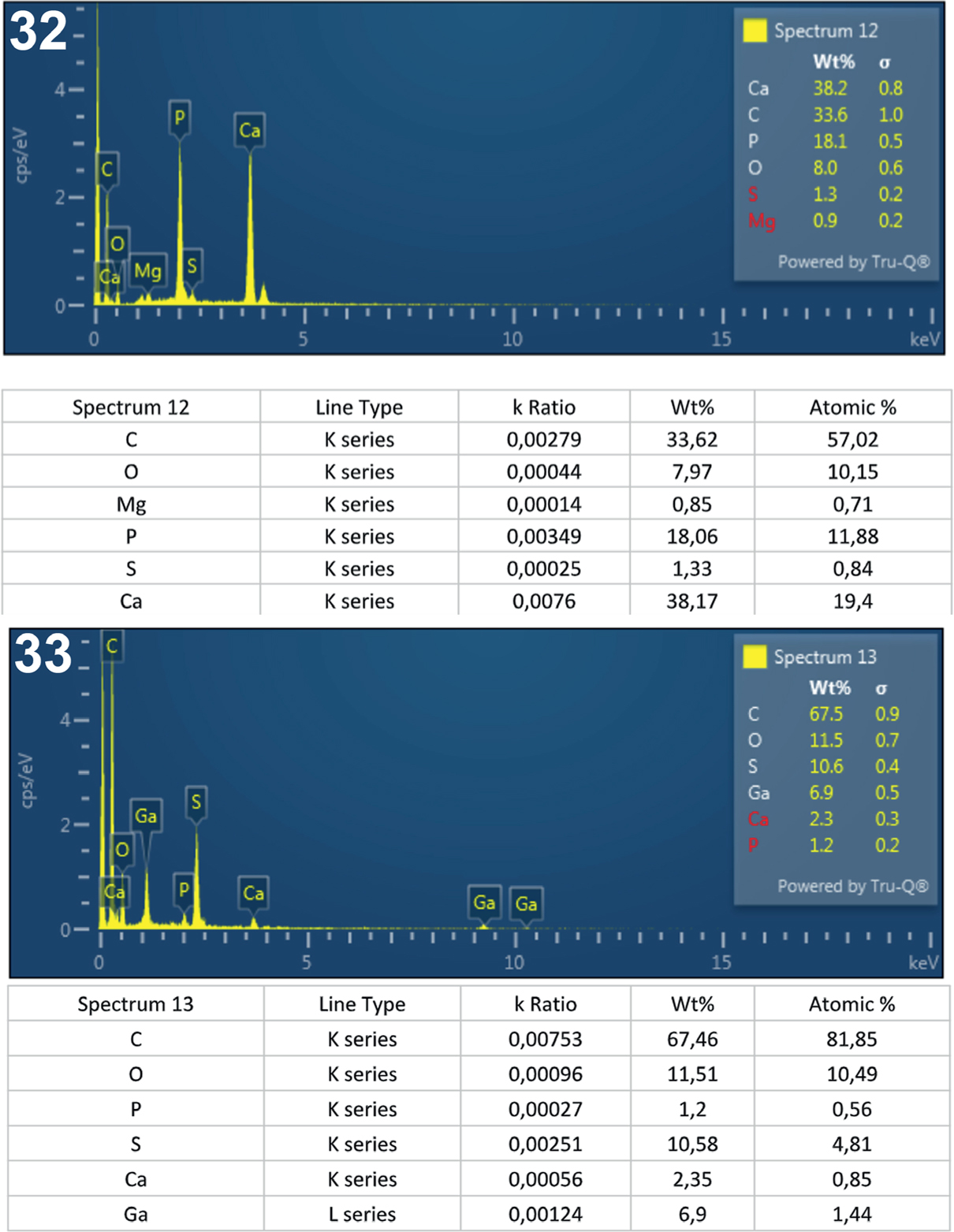
Figs. 32-33.
Elemental analysis of posterior proboscis hooks of Corynosoma pseudohamanni collected from Notothenia coriiceps off Galindez Island, Argentine Islands, West Antarctica. 32. Graphic and tabulated levels of elements analyzed from the center of the hook middle (spectrum 12). 33. Graphic and tabulated levels of elements analyzed from the hook tip (spectrum 13).
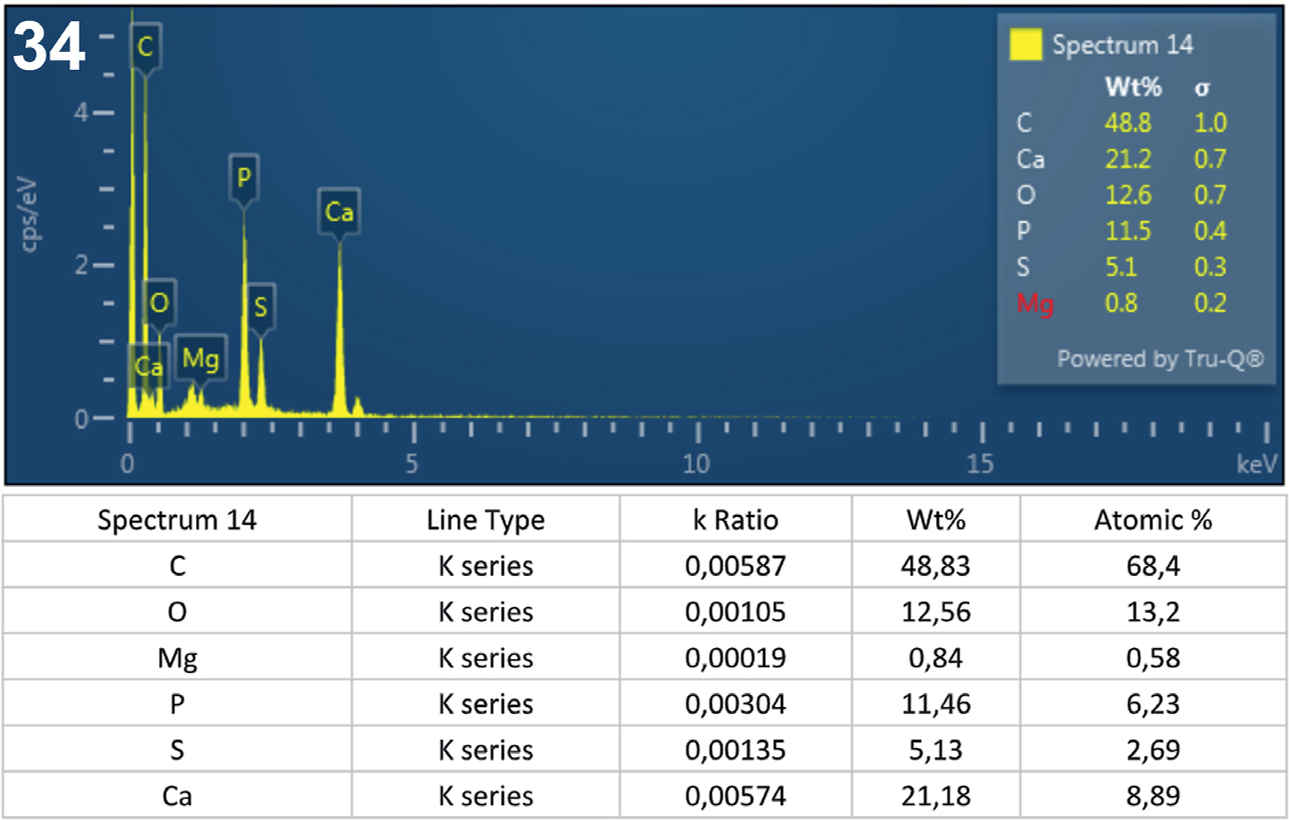
Fig. 34.
Elemental analysis of posterior proboscis hooks of Corynosoma pseudohamanni collected from Notothenia coriiceps off Galindez Island, Argentine Islands, West Antarctica. 34. Graphic and tabulated levels of elements analyzed from below the hook tip (spectrum 14).
Ethical Approval and/or Informed Consent
The authors declare that they have observed all applicable ethical standards.
Results
Our results are reported as weight % for calcium, phosphorous, sulfur, and magnesium. Atomic % and K Ratios are also reported in all tables. Common elements in living cells (H, O, N) and cutting elements (Ga) are also listed in all tables and spectra but not discussed. A comparison of the levels of the primary elements (Ca, P, S) in all positions of anterior, middle and posterior hooks and roots is given in Table 1. Calcium was the most prevalent element in roots (root edge and root middle) and the middle of all hooks, (Figs. 6–11), in middle hooks (Figs. 17–23), and in posterior hooks (Figs. 30–34). Phosphorous was equally common but not as prevalent as calcium and was highest in the middle of the roots and also the middle of all hooks in anterior hooks, in middle hooks and in posterior hooks. Interestingly, phosphorous was consistent in all hook roots but was markedly lower in anterior hooks compared to middle and posterior hooks. Sulfur was negligible or absent in the roots and middle of all hooks but highest at hook tips, especially the middle hook and posterior hook as well as the edge of the middle hook. The differential distribution of these elements in certain hooks and hook regions reflects which of these attachment structures is more heavily involved in their strength and flexibility.
Table 1.
Weight % of primary elements in different parts of hooks and hook roots of Corynosoma pseudohamanni collected from Notothenia coriiceps in West Antarctica.
| Site | Anterior hooks | Middle hooks | Posterior hooks |
|---|---|---|---|
| Calcium | |||
| Root edge | 60.73 | 61.83 | 48.55 |
| Root center | 50.58 | 67.87 | 51.87 |
| Middle hook | 11.48 | 46.98 | 16.92 |
| Middle hook edge & center | 44.83 | 14.05-24.47 | 38.17 |
| Hook tip | 32.15 | 31.44 | 2.35 |
| Phosphorus | |||
| Root edge | 16.91 | 17.58 | 16.05 |
| Root center | 24.91 | 21.88 | 20.23 |
| Middle hook | 2.03 | 19.63 | 9.34 |
| Middle hook edge & center | 11.43 | 9.13-14.63 | 18.06 |
| Hook tip | 14.77 | 17.90 | 1.20 |
| Sulfur | |||
| Root edge | 2.10 | 0 | 1.46 |
| Root center | 1.25 | 0 | 1.11 |
| Middle hook | 0 | 0 | 4.38 |
| Middle hook edge & center | 0.68 | 1.55-7.06 | 1.33 |
| Hook tip | 1.94 | 2.25 | 10.58 |
Discussion
Energy Dispersive X-ray Analysis (EDXA)
We describe the mineral distribution in the margins and center of the anterior, middle, and posterior proboscis hooks of cystacanths of Corynosoma pseudohamanni for the first time. We studied X-ray scans (EDXA) of FIB-sectioned hooks and spines of these acanthocephalan worms. The chemical composition of the hooks is characteristic of acanthocephalans. Hooks were evaluated for chemical ions, with sulfur (S), calcium (Ca), and phosphorus (P) being the prominent elements. Calcium and phosphorus are significant ions at the base and middle of the hooks that play a prominent role in host tissue attachment (Heckmann et al., 2007, 2012; Standing and Heckmann, 2014; Amin and Heckmann, 2017). Sulfur is usually high, especially at the outer edge of large hooks and hook tips. These elements play a crucial role in the mineralization of the hook, forming a hardened outer layer composed of apatite, similar to the tooth enamel of mammals. Our results support these findings and are close to those of the closely related Corynosoma paraevae Amin, Chaudhary, Caracciola, Rubtsova, Wendt, Lisitsyna, Kuzmina, de Souza, Singh 2025 collected from N. coriiceps in Galindez Island, West Antarctica with 0 – 4.15 % S, 15.11 – 50.55 % Ca, 6.55 – 23.69 % P and 0 – 1.87 % Mg (Amin et al., 2025c). Magnesium probably plays a role in the mineralization of hooks, similar to the disulfide bonds formed by sulfur in the protein apatite (Amin & Heckmann, 2017). Sodium, a rarely prominent metal, was found in scans of whole hooks of some other acanthocephalans.
EDXA, as a diagnostic tool, supports the observation that populations of an acanthocephalan species will consistently have similar EDXA spectra irrespective of host species or geography. The taxonomic identity of species is deep-seated at the genetic level, manifesting the organism’s morphology and biochemistry as revealed, in part, by its elemental spectra (Amin et al., 2022).
The results of large and small gallium (Ga) cut hooks are given in Figs. 6–11, 17–23 and 28–34. The elements necessary for the mineralization and hardening of the hooks, especially calcium and phosphorus, are present with sulfur in minimum amounts. In contrast, the percent of sulfur was highest in hook tips and hook edges of Cavisoma magnum (Southwell, 1927) Van Cleave, 1931 from Mugil cephalus in the Arabian Sea, reaching 43.51 wt. % and 27.46 wt. %, respectively (Amin et al., 2018).
Metal analysis of hooks has become a diagnostic standard since hooks have the highest level of elements compared to the mid-and posterior trunk regions of the acanthocephalan body (Heckmann et al., 2012). Specifically, the sulfur content in the proboscis is paramount in the composition of disulfide bonds in the thiol groups for cysteine and cystine of the polymerized protein molecules. In C. pseudohamanni, sulfur levels were highest at 10.58 % at the tip of posterior hooks (Table 1). Protein synthesis occurs in transcription and translation (Stegman, 2005). The formed disulfide bonds are direct by-products of the DNA-based protein synthesis process, which makes up a biological species’ identity. Accordingly, the level of sulfur in our EDXA profiles will indicate the number of sulfur bonds that, along with the levels of calcium phosphates, will characterize the identity of a species based on its nuclear DNA personality (Amin et al., 2022). Diversity in the species-specific EDXA profiles will further substantiate its taxonomic relevance in the cystacanth and adult stages when such information becomes available.
Acknowledgements
An institutional grant from the Parasitology Center, Scottsdale, Arizona, supported this work. Tetiana Kuzmina, Institute of Zoology NAS of Ukraine, Kyiv, Ukraine and Institute of Parasitology SAS, Košice, Slovak Republic, gratefully provided the research specimens used in this study. The authors also wish to express their gratitude to LABNANO/CBPF for their assistance with FIB SEM analysis, to the Laboratório de Helmintologia Romero Lascasas Porto / UERJ, NANOFAB/UERJ, and Plataforma de Microscopia Eletrônica Rudolf Barth/FIOCRUZ for their support during the SEM analysis, and to FAPERJ for the postdoctoral grant (number E-26/204.620/2024).
Notes
[1] Contributed by Author Contributions
Makoto Enoki Caracciolo managed the project and coordinated its activities. Omar Amin conducted the research, confirmed it, and wrote the manuscript. Camila Wendt processed and analyzed the FIB-SEM and EDSX images. Nataliya Rubtsova refined and organized all images. Wanderley de Souza provided the microscopy laboratory facilities and scientific support.
[2] Conflicts of interest Conflicts of Interest
None.