Introduction
Loggerhead (Caretta caretta) and green sea turtles (Chelonia mydas) use Turkey's Mediterranean coastline for nesting and foraging. On the one hand, Ch. mydas is globally categorised as Endangered and the Mediterranean subpopulation is listed as Near Threatened (IUCN, 2025). Nesting in the Mediterranean is confined to Turkey, Cyprus, Syria, Lebanon, Israel and Egypt (Kasparek et al., 2001; Rees et al., 2008; Yılmaz et al., 2015) with foraging areas in Greece and Libya (Casale & Margaritoulis, 2010). However, almost 95 % of Mediterranean nesting activity occurs in Turkey and Cyprus (Kasparek et al., 2001).
On the other hand, C. careta is also categorised as Vulnerable globally (IUCN, 2025) with the largest Mediterranean nesting rookeries occurring in Greece, Turkey, Cyprus and Libya (Yılmaz et al., 2015). These countries also hold the most important foraging areas in the Mediterranean (Casale & Margaritoulis, 2010). This Mediterranean subpopulation is classified as Least Concern (IUCN, 2025). Eastern Turkey represents one management unit, and appears to have been a key source populaion enabling the re-colonisaion of the Mediterranean during glacial luctuaions of the Pleistocene (Clusa et al., 2013). Loggerhead sea turtles have been isolated from the Atlantic population and colonized in the Mediterranean and their nesting population appears to be only around 2000 females (Başkale et al., 2015) (Fig. 1). In Turkey, seasonal stranding numbers are 50 injured and 100 dead turtles found on the Mediterranean coast in recent years (Y. Kaska, per. observ.). In an effort to protect the declining numbers of turtles, it is most important to ensure both the survival of as many offspring as possible and reduce these mortalities and cause of injuries (Kaska et al., 2011).
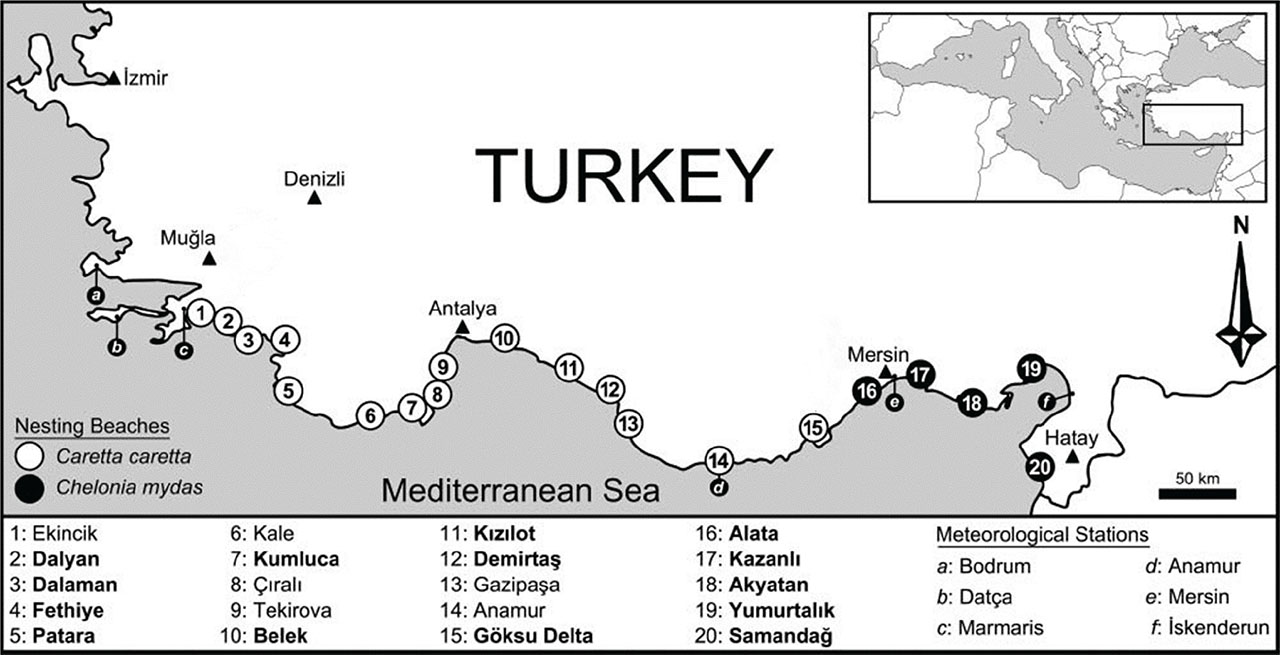
Fig. 1.
Nesting beaches of loggerhead and green sea turtles in Turkey, bolds indicate main nesting beaches (modified from Sarı and Kaska, 2015).
Numerous papers have been published on both endoparasites and epibionts of sea turtles (Looss, 1901; Luhman, 1935, Manter & Larson, 1950; Raj & Penner, 1962; Chattopadhyaya, 1970, 1972; Davies & Chapman, 1974; Schwartz, 1974; Groschaft et al., 1977; Threlfall, 1979; Lester & Blair, 1980; Berry & Cannon, 1981; Blair & Limpus, 1982; Geldiay et al., 1982; Hays-Brown & Brown, 1982; Wolke et al., 1982; Blair, 1984; Glazebrook et al., 1981, 1989; Glazebrook & Campbell, 1990 a, b), Badillo & Raga, 1995; Dyer et al., 1995; Manfredi et al., 1996; Aznar et al., 1998; Gordon et al., 1998; Cribb & Gordon, 1998; Manfredi et al., 1998; Piccolo & Manfredi, 2001; Badillo et al., 2003; Scaravelli et al., 2003; Cordero-Tapia et al., 2004; Greenblatt et al., 2004; Inohuye-Rivera et al., 2004; Orós et al., 2005; Bursey & Manire, 2006; Bursey et al., 2006; Pereira et al., 2006; Santoro et al., 2006, 2007; Werneck et al., 2006; Amador, 2007; Bunkley-Williams et al, 2008; Hayashi & Tsuji, 2008; Pfaller et al, 2008; Manire et al., 2008; Kučinić et al., 2008; Werneck et al., 2008a, b, c; Mifsud et al., 2009; Muniz-Pereira et al., 2009; Santoro & Mattiucci, 2009; Sezgin et al., 2009; Valente et al., 2009; Innis et al., 2010. Santoro et al., 2009, 2010; Stacy et al., 2010; Xavier, 2011; Chen et al., 2012; Gračan, et al., 2012; Nájera-Hillman et al., 2012; Rodenbusch et al., 2012; Frick & Pfaller, 2013; Greiner, 2013; Hayashi, 2013, Hayashi, et al., 2013; Werneck & Silva, 2013, 2015; Wyneken et al., 2013; Truong, 2014; Domènech et al., 2015; Werneck et al., 2015; Jerdy, et al., 2016; Binoti et al., 2016; Werneck & Da Silva, 2016; Werneck et al., 2014, 2015a, b, 2016; Marchiori et al., 2017; Pace et al., 2019; Karaa et al., 2019: Marangi et al., 2020; Marcer et al., 2020; Santoro et al., 2020; Cavaco et al., 2021; Gentile et al., 2021; Robinson & Pfaller, 2022).
The first preliminary report on internal parasites of sea turtles (C. caretta and Ch. mydas) in Turkey published as a conference paper by Altuğ et al. (2012) and focused on the Hatay coast in the Eastern Mediterranean. Following this study, several separate conference papers were published on epibionts and internal parasites in C. caretta. The first of these focused on Ozobranchus margoi (İşler et al., 2015), while in the second, an ecological study, the author reported epibiont taxa at the family level (Lepadidae, Gammaridae, Caprellidae and Tanaidacea) (Özaydınlı, 2022). Finally, a conference paper on some internal parasites infecting C. caretta was published by Zerek et al., 2022.
This is the first detailed study of both epibionts and internal parasites of loggerhead and green sea turtles (C. caretta and Ch. mydas) from Turkey.
Materials and Methods
In this study 22 C. caretta (6 males, 12 females, and 4 juveniles) and 12 Ch. mydas (3 males, 8 females and 1 juvenile) were examined for symbiotic groups between 2009 – 2012 in the Sea Turtle Research, Rescue and Rehabilitation Center (DEKAMER) Muğla Ortaca-Dalyan (Turkey). All these turtles died during the treatment period, the body cavity was opened by a standard necroscopy procedure. Standard measurements of each dead turtle specimen were taken for SCL (Straight Carapace Length), SCW (Straight Carapace Width), CCL (Curved Carapace Length), and CCW (Curved Carapace Width) to the nearest 0.1 cm using a soft tape measure. The external structures of the turtles (carapace, plastron, head and extremities) were carefully examined for the symbiotic groups, the observed specimens were recorded and stored. The digestive tract was excised and separated into stomach, small intestine, large intestine and rectum. The contents of each part and other organs (lungs, liver, gall bladder, kidneys and urinary bladder) were kept each mixed with 70 % ethyl alcohol or 10 % formaldehyde solution. The tissues and separated organs were poured into petri dishes for examination under a stereomicroscope for internal parasites. Samples of trematodes and epibionts were preserved in 70 % ethanol, whereas nematodes were stored in 70 % ethanol with 5 % glycerol. For light microscopy, trematodes were stained with acetocarmine, then dehydrated, cleared in cedar oil or xylol and mounted in Canada balsam; nematodes were cleared in glycerol. Some epibionts (e.g. Ozobranchus margoi and Lepas hillii) and unidentified helminth cysts (observed in Ch. mydas) were too numerous to be counted. Intesities are given as mean value followed by the range. Helminth and epibiont specimens were deposited at Pamukkale University, Faculty of Science, Department of Biology, Denizli, Turkey (PAU-HELM-8-16/2015).
Ethical Approval and/or Informed Consent
In this study, turtles that died in the Sea Turtle Research, Rescue and Rehabilitation Center during treatment were examined. Formal consent was not required as the Research and Rescue Centre routinely collects such body and necropsy samples. All applicable national and institutional guidelines for the care and use of animals were followed.
Results
The body measurements of the examined sea turtles can be found in Table 1, while all records and quantitative data of endoparasites and epibionts are presented in Table 2.
Table 1.
The measurements of loggerhead and green sea turtles (C. caretta and Ch. mydas, respectively) samples (cm).
| Caretta caretta | Chelonia mydas | |
|---|---|---|
| (6♂♂, 12♀♀, 4 Juv.) | (3♂♂, 8♀♀, 1 Juv.) | |
| SCL | 61.33 (25.5–74.5) | 64.35 (36–81) |
| SCW | 51.71 (22.5–70.5) | 55.56 (29–75) |
| CCL | 63.31 (28–75) | 64.08 (41–78) |
| CCW | 56 (26–70) | 54.33 (43–62) |
Table 2.
Prevalence, mean abundance, and infection intensity of endoparasites and epibionts of loggerhead and green sea turtles (C. caretta and Ch. mydas, respectively) from Turkey.
| SYMBIOTIC SPECIES | Host | Microhabitat | Total number of symbionts | Number of infected hosts | Prevalence (%) | Abundance | Mean intensity |
|---|---|---|---|---|---|---|---|
| DIGENEA | |||||||
| Pyelosomum renicapite | C. caretta | E | 51 | 1 | 4.54 | 2.31 | 51 |
| Ch. mydas | I | 2 | 1 | 8.33 | 0.16 | 2 | |
| Learedius learedi | Ch. mydas | H | 39 | 4 | 33.33 | 3.25±9.22 | 9.75±16.84 |
| Deuterobaris proteus | Ch. mydas | LU | 7 | 1 | 8.33 | 0.58 | 7 |
| NEMATODA | |||||||
| Kathlania sp. | C. caretta | E | 123 | 1 | 4.54 | 5.59 | 123 |
| Sulcascaris sulcata | C. caretta | E | 300 | 1 | 4.54 | 13.63 | 300 |
| Anisakis simplex | C. caretta | LIV | 2 | 1 | 4.54 | 0.09 | 2 |
| ANNELIDA | |||||||
| Ozobranchus margoi | C. caretta | SR, F | Uncount. 2 | 9.09 | - | - | |
| CIRRIPEDIA | |||||||
| Chelonibia testudinaria | Ch. mydas | C | 27 | 1 | 8.33 | 2.25 | 27 |
| Lepas hillii | Ch. mydas | C, F | Uncount. | 1 | 8.33 | - | - |
| CYST | |||||||
| Cysts from an unidentified helmith (encapsulated in submucosa of organs) | C. caretta | LU, LIV | 5 | 3 | 13.63 | 0.23±0.64 | 1.67±0.35 |
| Ch. mydas | LU, I, R, S | Uncount. | 1 | 8.33 | - | - |
In this study, one digenean (Pyelosomum renicapite (Leidy, 1856) Ruiz, 1946) and one unidentified helminth cyst (encapsulated in submucosa of organs) samples were observed in both turtle species.
The two digenean (Learedius learedi Price, 1934 and Deuterobaris proteus (Brandes, 1891) Looss, 1902) and two epibiotic cirriped species (Chelonibia testudinaria (Linnaeus, 1758) and Lepas hillii (Leach, 1818)) were only observed in Ch. mydas.
The three nematode species (Sulcascaris sulcata (Rudolphi, 1819) Hartwich, 1957, Anisakis simplex (Rudolphi, 1809) Dujardin, 1845, and Kathlania sp. Lane, 1914) and one ectoparasitic annelid species (Ozobranchus margoi (Apáthy, 1890)) were observed on C. caretta (Table 2).
The site of infection in the sea turtles and the data on infection parameters for each host and species, are presented in Table 2. In summary, 524 individuals of six helminth species and three epibionts were collected from the 34 sea turtles samples examined. Nematodes were observed in esophagus and liver; digeneans were also observed in esophagus, heart, lungs and intestines. As demonstrated by the data obtained, the mean helminth population size was found to be 15.41±2.80 individuals per infected host. The presence of epibionts was observed on the carapace, fins and skin regions of the hosts (due to the large number of epibionts (e.g. Ozobranchus margoi and Lepas hillii) observed, accurate counting was not possible).
Discussion
In this study, three species of epibionts (Chelonibia testudinaria, Lepas hillii and Ozobranchus margoi), and six species of internal helminth species (Pyelosomum renicapite, Learedius learedi, Deuterobaris proteus, Sulcascaris sulcata, Anisakis simplex, and Kathlania sp.), and cysts from an unidentified helmith were observed in two sea turtle species found in Turkey.
All existing sea turtle species, with the exception of the flatback sea turtle (Natator depressus) use pelagic and oceanic habitats during their juvenile stages (Bolten, 2003). Some species continue to inhabit these environments into adulthood (Frick & Pfaller, 2013). During their time in pelagic and oceanic stages, sea turtles can host various communities of pelagic organisms on their body surfaces, including the carapace, plastron, and flippers (Frick & Pfaller, 2013). Some epibionts in particular can be a problem for host turtles as they negatively affect the health of the host turtles (Frick & Pfaller, 2013). In particular, some epibiont species of sea turtles (e.g. platyhelminth worms, annelid worms and mussels) are thought to cause or be associated with infections of sea turtles (George, 1997; Alfaro, 2008). According to George (1997), tissue damage caused by some epibionts settling on the turtle may increase the vulnerability of host turtles to pathogens. Some coronuloid barnacles (e.g. Chelolepas cheloniae, Stephanolepas muricata, and Cylindrolepas darwiniana) burrow into the hard and soft tissues of host turtles, causing deep tissue injuries and sometimes leaving scars on the underlying bone (Hendrickson, 1958; Green, 1998; Frick & Zardus, 2010; Frick et al., 2010a). Some parasitic sea turtle leeches, such as Ozobranchus, are thought to not only consume host tissue but also act as disease vectors for the spread of fibropapilloma-associated herpes virus (secondary infection), which is found in latent tumors that often infect, deform and debilitate host turtles (Greenblatt et al., 2004; Rittenburg et al., 2021). Furthermore, some commensal gastropods of sea turtles can act as intermediate hosts for spirorchiid blood flukes, which can have devastating effects on host turtles (Frazier et al., 1985; George, 1997).
Loggerhead and green sea turtles have not been studied in detail in terms of parasitological and epizootic organisms in Turkey. In this study, the observed helminths and epibiont species had previously reported in these two sea turtle species in other geographic areas by some researchers. Threlfall (1979) is reported Pyelosomum renicapite in leatherback turtle (Dermochelys coriacea) from coast of Newfoundland and Labrador. Inohuye-Rivera et al. (2004) reported the Learedius learedi in green sea turtle (Ch. mydas agassizii) hearts from Magdalena Bay, Baja California Sur, Mexico. Bursey et al. (2006) are reported the first North American Record of a Kathlania species in Ch. mydas from Georgia USA. Santoro et al. (2006) are reported Learedius learedi, and Deuterobaris intestinalis in Ch. mydas from Tortuguero National Park, Costa Rica. Amador (2007) is reported a Kathlania species and Anisakis sp in C. caretta from West mediterranean coasts of Valencia, Spain. Muniz-Pereira et al. (2009) recorded the Anisakis sp. (Larval) in Ch. mydas's conjuctive tissue from Brazil, also they reported Sulcascaris sulcata in Ch. mydas's stomach from Rio de Janeiro, and they reported the Learedius learedi in Ch. mydas's, heart, liver, spleen, lungs, kidneys, mesenterium. Werneck et al. (2006) are observed Learedius learedi in Ch. mydas in Brazil. Werneck et al. (2008b) are observed Twelve juvenile specimens of C. caretta were parasitized by Sulcascaris sulcata, Learedius learedi and Pyelosomum renicapite in Brazil. Valente et al. (2009) are reported Anisakis simplex (larvae), and Pyelosomum renicapite in C. caretta from Madeira Archipelago, Portugal. Santoro et al. (2010) observed an Anisakis species (Anisakis pegreffii) in the C. caretta. Mifsud et al. (2009) reported preliminary data on the epibionts of C. caretta from Maltese waters. These epibionts were identified as Chelonibia testudinaria and Ozobranchus margoi species from Cirripedia and Hirudinea, respectively. Sterioti et al. (2017) published a study on Ozobranchus margoi infection on C. caretta in Greece and potential treatment options. İşler et al. (2015) reported a severe O. margoi infection and treatment on C. caretta from Turkey. Nájera-Hillman et al. (2012) are recorded Chelonibia testudinaria on on juvenile green turtles (Ch. mydas) in Bahia Magdalena, Mexico. Rodenbusch et al. (2012) are reported the Ozobranchus margoi on C. caretta from Tavares, state of Rio Grande do Sul, southern Brazil. Greiner (2013) is recorded Learedius spp. from sea turtles. Binoti et al. (2016) are recorded Learedius learedi and a Pyelosomum species in Ch. mydas from Espírito Santo State in Brasil. Werneck, et al. (2015a) reported Anisakis nematode larvae in juvenile specimens of Eretmochelys imbricata from the Brazilian coast. Werneck et al. (2016) are reported Sulcascaris sulcata and Anisakis larvae in C. caretta from Brazil. Gračan, et al., (2012) are reported 2 nematodes (Sulcascaris sulcata, Anisakis spp.) in C. caretta, from the Adriatic Sea. Marangi et al. (2020) reported Sulcascaris sulcata, Kathlania sp., while Gentile et al. (2021) recorded Kathlania sp. and Sulcascaris sulcata from the the coasts of Sicily and the northwest Adriatic Sea. Baruffaldi et al. (2023) observed Chelonibia testudinaria and a Lepas species on C. caretta from the Adriatic Sea.
The three digeneans observed in this study (Pyelosomum renicapite, Learedius learedi and Deuterobaris proteus) are recorded in Turkey for the first time. Also, Ch. mydas and C. caretta represents new host records for these mentioned digenean species in Turkey. Ch. mydas represents a new host record for two cirriped species (Chelonibia testudinaria and Lepas hillii) from Turkey and C. caretta is also represents new host record for Ozobranchus margoi from Turkey. These results emphasize the importance of further studies that can expand both the host-parasite list and the epibiont species from Turkey to better understand the ecological relationship between sea turtles and helminth parasites and epibionts.
Acknowledgments
We thank to all sea turtle and environmental volunteers in the Sea Turtle Research, Rescue and Rehabilitation Center (DEKAMER). We also thank the members of editorial board and referees of Helminthologia for constructrive comments on earlier versions of this manuscript.