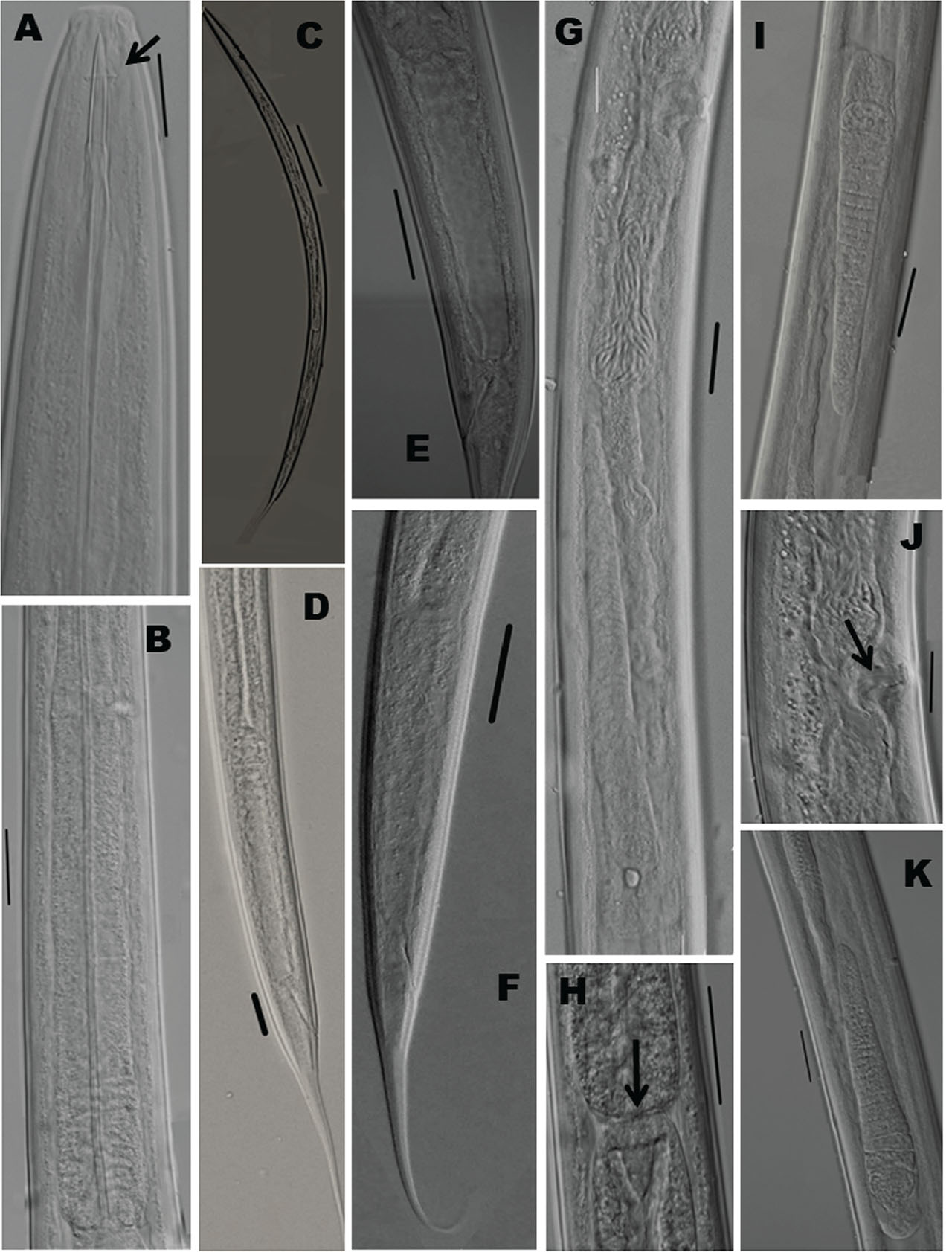
Fig. 1.
Laimydorus siddiqii (Female) from Uttarakhand, India (light microscopy). A: Anterior region with double guiding ring (arrowed); B: Pharyngeal expansion; C: Entire female; D: Posterior region; E: Prerectum; F: Tail region; G: Genital system; H: Cardiac region; I: Anterior ovary J: Vagina (arrowed); K: Posterior ovary. Scale bars: (A,G,H,I,K), 10 μm; (B,D,E,F) 20 μm; (C)100 μm.
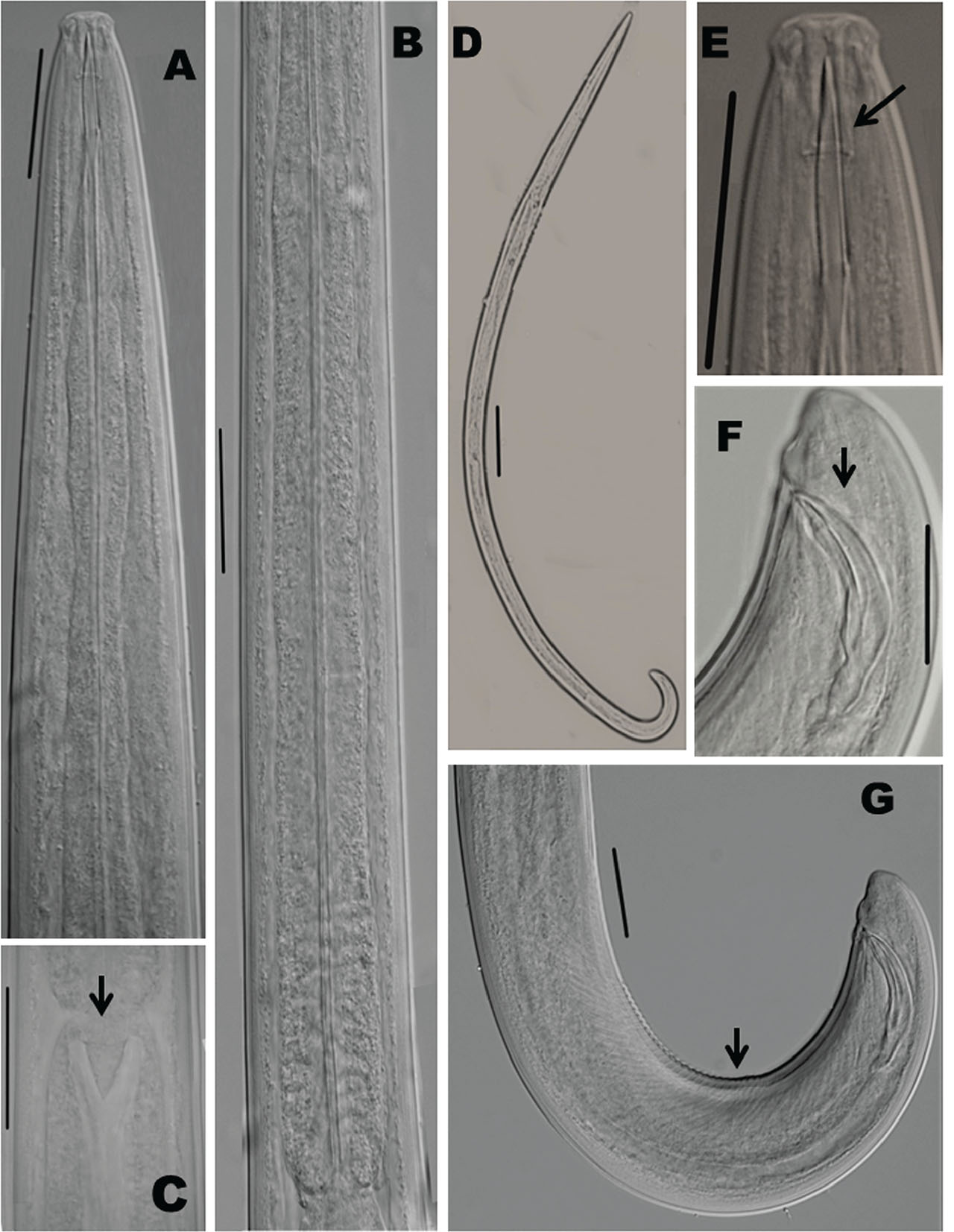
Fig. 2.
Laimydorus siddiqii (Male) from Uttarakhand, India (light microscopy). A: Anterior body region; B: Pharyngeal expansion; C: Pharyngointestinal junction; D: Entire male; E: Anterior region with double guiding ring; F: Spicules; G: Posterior body region; Scale bars: (A,E,C), 10 μm; (D) 100 μm; (B,F,G), 20 μm.
Table 1.
Morphometry of Laimydorus siddiqii Baqri and Jana, 1982 from Uttarakhand, India. All the measurements are in μm (except n, ratio and percentage) and are in the form of mean ± standard deviation (range).
| Characters | Females | Males |
|---|---|---|
| N | 10 | 6 |
| Total body length (L) | 2913 ± 162 (2601 – 3100) | 2710 ± 312 (2393 – 3108) |
| a (L/BD) | 38 ± 4.1 (31 – 42) | 35 ± 2.4 (33 – 39) |
| b (L/NL) | 5.1 ± 0.2 (4.8 – 5.2) | 4.6 ± 0.4 (4.2 – 5.2) |
| c (L/TL) | 12.1 ± 0.8 (11 – 14) | 110.14 ± 16.6 (94 – 141) |
| c' (T/ABD) | 7.9 ± 0.6 (6.5 – 8.9) | 0.8 ± 0.1 (0.7 – 1) |
| V % (AV/L) ×100 | 48 ± 1.9 (45 – 52) | – |
| Lip region width | 15.7 ± 1.2 (14 – 18) | 15.2 ± 0.4 (15 – 16) |
| Lip region height | 5.7 ± 0.4 (5.1 – 6) | 5.9 ± 05 (5 – 5.6) |
| Amphid aperture width | 8.2 ± 1.3 (7 – 10) | 6.6 ± 0.57 (6 – 7) |
| G1((AUL + AOVL+ AOL)/L×100) | 22.4 ± 1.5 (20.6 – 25.6) | – |
| G2 ((PUL+ POVL+ POL/L) × 100) | 21.4 ± 1.9 (19.3 – 23.6) | – |
| Cuticle at anterior region | 1.85 ± 0.2 (1.5 – 2) | 1.9 ± 0.2 (1.4 – 2) |
| Cuticle at mid region | 2 ± 0.35 (1.5 – 2.5) | 1.2 ± 0.2 (1 – 1.5) |
| Cuticle at tail region | 2.52 ± 0.4 (2 – 3) | 2.9 ± 0.2 (2.5 – 3) |
| Odontostyle length | 31.5 ± 0.8 (30 – 33) | 31.9 ± 0.6 (31 – 33) |
| Odontostyle length-dorsal side | 21.5 ± 2.0 (19 – 26) | 21.7 ± 1 (20 – 23) |
| Odontostyle length-ventral side | 30.7 ± 1.4 (29 – 34) | 30.6 ± 0.8 (30 – 32) |
| Odontostyle width | 3.6 ± 0.6 (3.1 – 5.2) | 3.7 ± 0.5 (3 – 4) |
| Odontostyle aperture length | 10.5 ± 0.9 (9 – 12) | 10.2 ± 1.1 (9 – 12) |
| Odontophore length | 35.8 ± 2.2 (33 – 40) | 36.4 ± 0.8 (35 – 37) |
| Distance guiding ring-anterior end | 19.3 ± 0.7 (18 – 20) | 18.2 ± 0.7 (17 – 19) |
| Distance nerve ring-anterior end | 170.6 ± 9.6 (155 – 185) | 182.3 ± 27.5 (155 – 210) |
| Neck length (NL) | 583 ± 31.7 (532 – 652) | 581.6 ± 12.9 (563 – 598) |
| Pharyngeal expansion length | 283 ± 21.2 (244 – 306) | 282 ± 14.8 (255 – 299) |
| Pharyngeal expansion width | 38 ± 2.8 (35 – 44) | 46.5 ± 3.1 (44 – 51) |
| Body diameter at neck base | 77 ± 8.2 (65.2 – 86) | 67.6 ± 2.6 (63 – 70) |
| Cardia length | 24.9 ± 3.1 (19 – 30) | 24.1 ± 3.1 (21 – 30) |
| Cardia width | 19.4 ± 1.9 (18 – 24) | 16.3 ± 1.6 (14 – 18) |
| Body diameter at vulva | 78.1 ± 8.1 (65 – 86) | – |
| Anterior uterus length (AUL) | 272.3 ± 11.5 (250 – 290) | – |
| Anterior oviduct length (AOVL) | 190.4 ± 0.5 (190 – 191) | – |
| Anterior ovary length (AOL | 187.8 ± 3.5 (183 – 192) | – |
| Posterior uterus length (PUL) | 261.6 ± 18 (225 – 292) | – |
| Posterior oviduct length (POVL) | 173.5 ± 7.7 (160 – 182) | – |
| Posterior ovary length (POL | 188.7 ± 5.3 (180 – 198) | – |
| Vagina length | 21.5 ± 1.9 (20 – 26) | – |
| Distance vulva-anterior end (AV) | 1407 ± 93.2 (1241 – 1558) | – |
| Prerectum length | 188 ± 16.9 (167 – 210) | 333 ± 61.9 (290 – 404) |
| Rectum length | 42.5 ± 5.2 (34 – 48) | 65.2 ± 10.10 (53 – 80) |
| Anal body diameter (ABD) | 30.4 ± 1.3 (28 – 32) | 31.5 ± 2.6 (28 – 35) |
| Tail length (TL) | 213 ± 27.8 (183 – 268) | 26.5 ± 1.3 (25 – 28) |
| Vulva to anus | 1272 ± 99.2 (1124 – 1410) | – |
| Body diameter (BD) | 78.1 ± 8.1 (65 – 86) | 72.1 ± 5.1 (63 – 78) |
| Spicule length | – | 59.5 ± 2.8 (56 – 63) |
| Max. width of spicule | – | 10.0 ± 0.8 (9.0 – 11.0) |
| Distance of hump from anterior end of spicule | – | 18.5 ± 0.7 (18 – 19) |
| Spicule width at posterior tip | – | 5.2 ± 0.6 (4.7 – 6) |
| Ventromedian supplements | – | 27.3 ± 0.8 (26 – 28) |
| Distance between supplements | – | 1.6 ± 0.2 (1.5 – 2.0) |
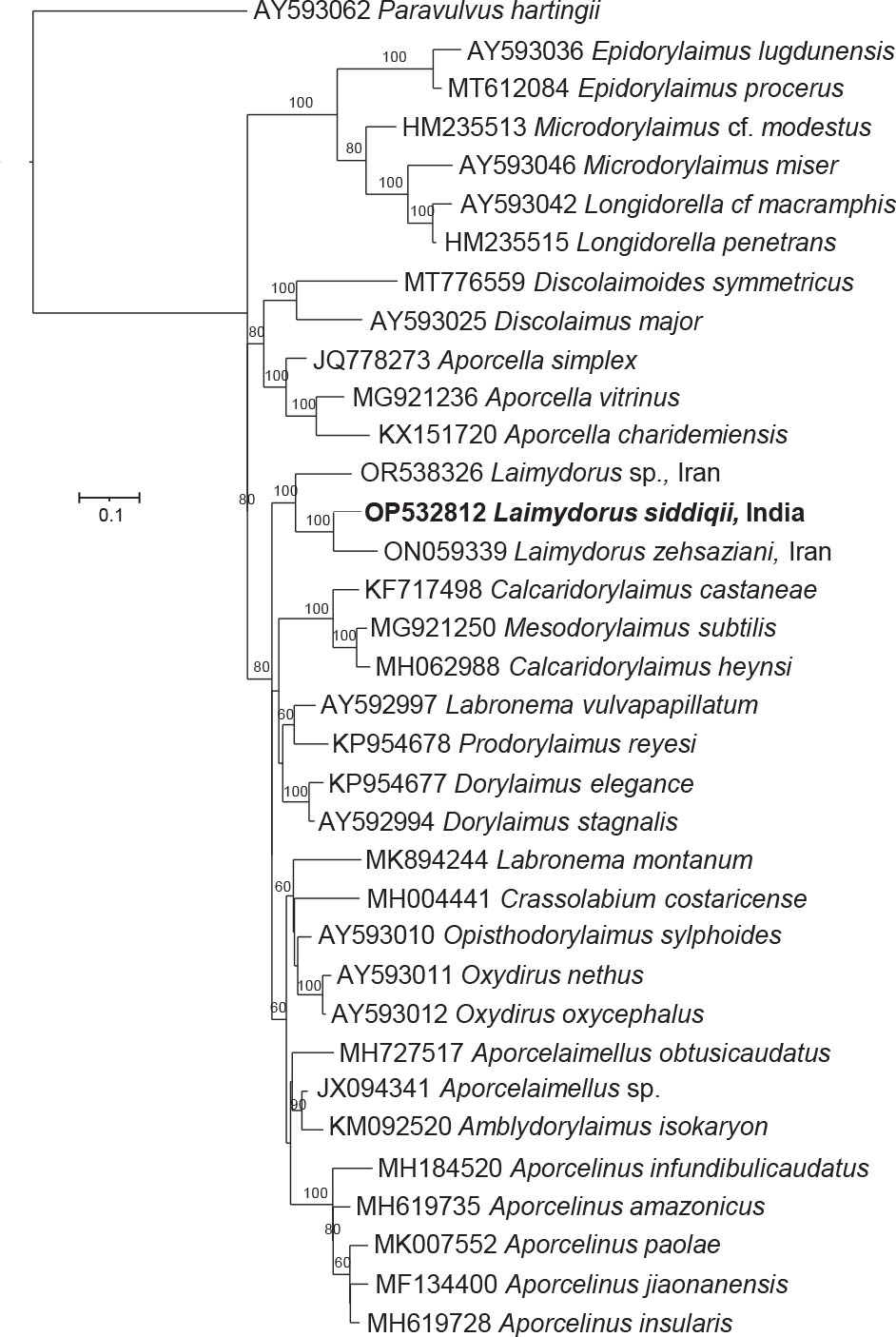
Fig. 3.
Phylogenetic tree based on D2-D3 expansion segments of the 28S rRNA gene sequences of the nematodes isolated in this study and several related species. Phylogenetic relationships based on the nucleotide sequences of the D2-D3 expansion segments of the 28S rRNA gene were inferred by using the Maximum Likelihood method based on the General Time Reversible Model. The tree with the highest log likelihood is shown. The percentage of trees in which the associated taxa clustered together is shown next to the branches. A discrete Gamma distribution was used to model evolutionary rate differences among sites. The tree is drawn to scale, with branch lengths measured in the number of substitutions per site. NCBI accession numbers of the sequences used for the analyses are shown.
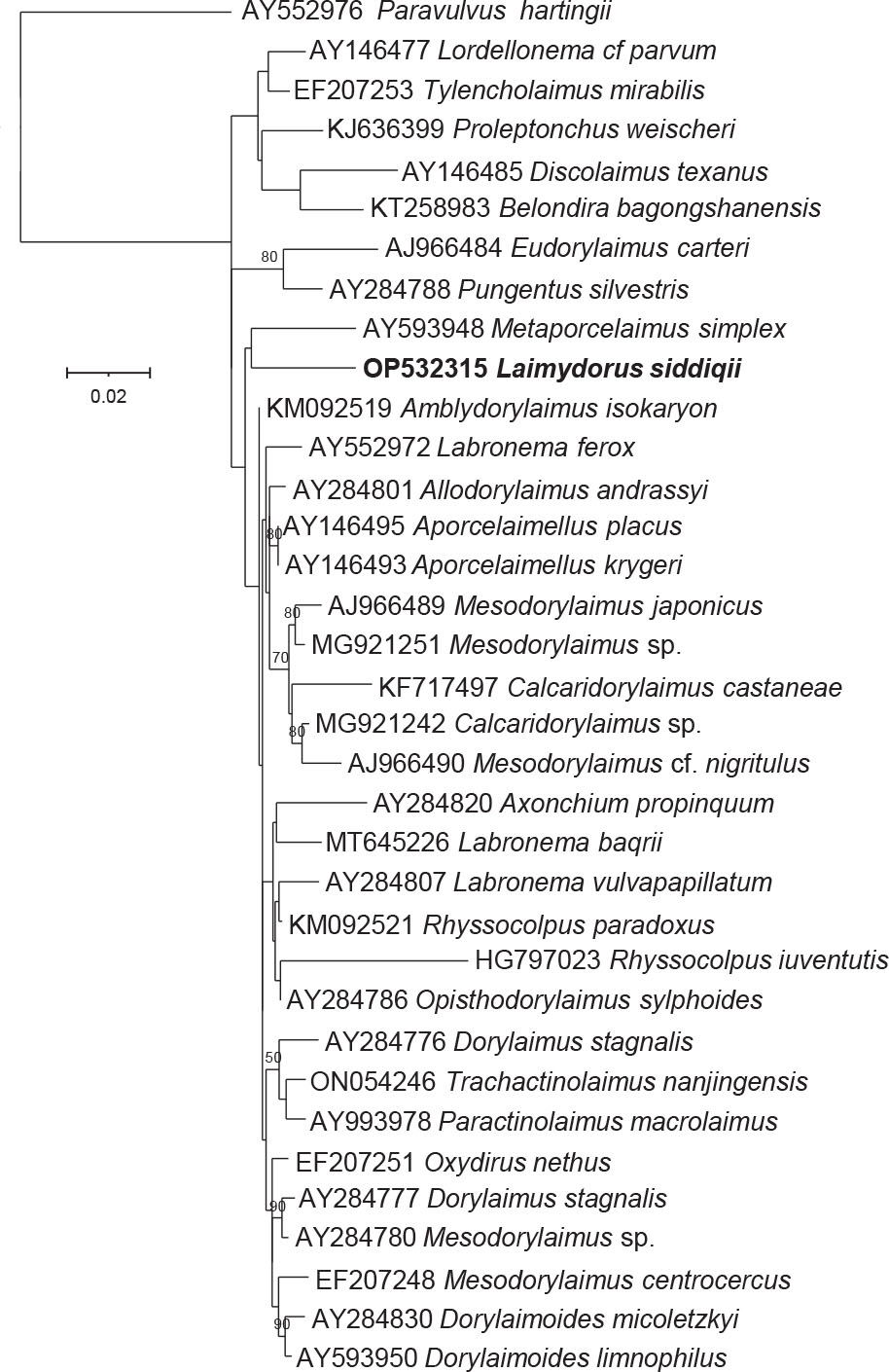
Fig. 4.
Phylogenetic tree based on 18S rRNA sequences of the nematodes isolated in this study and several related species. Phylogenetic relationships based on 18S rRNA gene sequences were inferred by using the Maximum Likelihood method based on the Tamura 3-parameter model. The tree with the highest log likelihood is shown. The percentage of trees in which the associated taxa clustered together is shown next to the branches. A discrete Gamma distribution was used to model evolutionary rate differences among sites. The tree is drawn to scale, with branch lengths measured in the number of substitutions per site. NCBI accession numbers of the sequences used for the analyses are shown.