Table 1.
Primers used for PCR and sequencing
| Primer | Sequence (5′–3′) | Source |
|---|---|---|
| 18S rDNA | ||
| WormA | ||
| 1270R | GCGAATGGCTCATTAAATCAG | Littlewood & Olson, 2001 |
| 930F | GCATGGAATAATGGAATAGG | Littlewood &Olson, 2001 |
| WormB | CTTGTTACGACTTTTACTTCC | Littlewood &Olson, 2001 |
| 28S rDNA | ||
| Ancy55F | GAGATTAGCCCATCACCGAAG | Littlewood &Olson, 2001 |
| Ancy1200R | CACCATCTTTCGGGTCTCAACC | Plaisance et al., 2005 |
| L300F | CAAGTACCGTGAGGGAAAGTTG | Plaisance et al., 2005 |
| ECD2 | CCTTGGTCCGTGTTTCAAGACGGG | Littlewood et al., 2000 |
Table 2.
Information on the capsalid monogenean species used for phylogenetic analysis based on the 18S and 28S gene sequences.
| Species | Host | Origin | GenBank accession No. | References |
|---|---|---|---|---|
| 18S gene | ||||
| Capsala martinieri | Mola mola | UK | AJ276423 | Littlewood & Olson, 2001 |
| Neobenedenia melleni | Lutjanus sp. | Malaysia | KU843502, KU843503, KU843504 | Ravi &Yahaya, 2016 |
| Benedenia epinepheli | Epinephelus sp. | Vietnam | EU707802 | Dang et al., 2011* |
| Benedenia sp. | Perciform teleost | UK | AJ228774 | Littlewood & Olson, 2001 |
| Benedenia humboldti | Seriola lalandi | USA | MW575871 | Baeza & González, 2021 |
| Allobenedenia epinepheli | Epinephelus sp. | Vietnam | EU707800 | Dang et al., 2011* |
| Neobenedenia melleni | Epinephelus sp. | Vietnam | EU707804 | Dang et al., 2011* |
| Neobenedenia girellae | Trachinotus blochii | South Korea | MT542140 | Nam et al., 2020* |
| Encotyllabe chironemi | Chironemus marmoratus | UK | AJ228780 | Littlewood & Olson, 2001 |
| Pseudobenedeniella johnstoni sp. n. | Notothenia coriiceps | West Antarctica | PP430573, PP430574, PP430575, PP430576 | Present study |
| Pseudobenedenia coriicepsi | Notothenia coriiceps | West Antarctica | OR289962, OR289963, OQ803310, Q803312 | Rubtsova et al., 2023 |
| Benedenia sp. | Dasyatis pastinaca | Turkey | MK106094 | Turgay, 2018* |
| 28S gene | ||||
| Neobenedenia sp. | Larimichthys polyactis | South Korea | OM333244 | Seo, 2022* |
| Neobenedenia girellae | Rachycentron canadum | Australia | MW690094 | Brazenor et al., 2018 |
| Neobenedenia girellae | Lates calcarifer | Australia | MH843708 | Brazenor et al., 2018 |
| Neobenedenia girellae | Trachinotus blochii | South Korea | MT549677 | Nam et al., 2020* |
| Neobenedenia melleni | Epinephelus sp. | Vietnam | EU707805 | Dang et al., 2011* |
| Neobenedenia sp. | Seriola rivoliana | Ecuador | MK202451 | Sepúlveda & González, 2019 |
| Neobenedenia melleni | Seriola dumerili | China | JN797596 | Ding et al., 2011* |
| Neobenedenia sp. | Paralabrax humeralis | Chile | MK202450 | Sepúlveda & González, 2019 |
| Neobenedenia sp. | Cheilodactylus variegatus | Chile | MT982168 | Taborda et al., 2023 |
| Neobenedenia sp. | Aplodactylus punctatus | Chile | MK202438 | Sepúlveda & González, 2019 |
| Neobenedenia sp. | Anisotremus scapularis | Chile | MK202439 | Sepúlveda & González, 2019 |
| Neobenedenia sp. | Sphoeroides annulatus | Mexico | AY486150 | Whittington et al., 2004 |
| Allobenedenia dischizosepta | Acanthistius patachonicus | Argentina | MH929436 | Bagnato et al., 2022 |
| Allobenedenia epinepheli | Epinephelus sp. | Vietnam | EU707801 | Dang et al., 2011* |
| Benedenia sciaenae | Argyrosomus japonicus | Australia | FJ971970 | Perkins et al., 2009 |
| Encotyllabe chironemi | Chironemus marmoratus | Australia | AF382054 | Olson & Littlewood, 2002 |
| Benedenia sekii | Chrysophrys auratus | Australia | FJ971971 | Perkins et al., 2009 |
| Benedenia lutjani | Gracilobenedenia lutjani | Japan | AY033939 | Whittington et al., 2001 |
| Benedenia rohdei | Seriola quinqueradiata | Japan | AY033940 | Whittington et al., 2001 |
| Benedenia seriolae | Seriola quinqueradiata | Japan | KC768341 | Sepúlveda & González, 2019 |
| Benedenia humboldti | Seriola lalandi | USA | MW575871 | Baeza & González, 2021 |
| Benedenia epinepheli | Epinephelus sp. | Vietnam | EU707803 | Dang et al., 2011* |
| Benedenia sargocentron | Sargocentron spiniferum | China | JN797597 | Ding et al., 2011* |
| Neoentobdella natans | Pastinachus sephen | Australia | FJ972009 | Perkins et al., 2009 |
| Entobdella stenolepis | Hippoglossus stenolepis | Canada | FJ971991 | Perkins et al., 2009 |
| Entobdella hippoglossi | Hippoglossus hippoglossus | UK | AY486151 | Whittington et al., 2004 |
| Capsaloides cristatus | NA | China | JN711434 | Yang, 2011* |
| Nasicola klawei | Thunnus albacares | USA | HQ721186 | Bullard et al., 2011 |
| Capsala martinieri | Mola mola | UK | AF382053 | Olson & Littlewood, 2002 |
| Capsala laevis | Istiophorus platypterus | China | JN980396, JN980397 | Yang & Hu, 2011* |
| Pseudobenedeniella johnstoni sp. n. | Notothenia coriiceps | West Antarctica | PP430577, PP430578, PP430579, PP430580 | Present study |
| Pseudobenedenia coriicepsi | Notothenia coriiceps | West Antarctica | OR295461, OR295462, OQ820944, OQ820945 | Rubtsova et al., 2023 |
| Neoentobdella taiwanensis | Taeniura meyeni | Taiwan | FJ972010 | Perkins et al., 2009 |
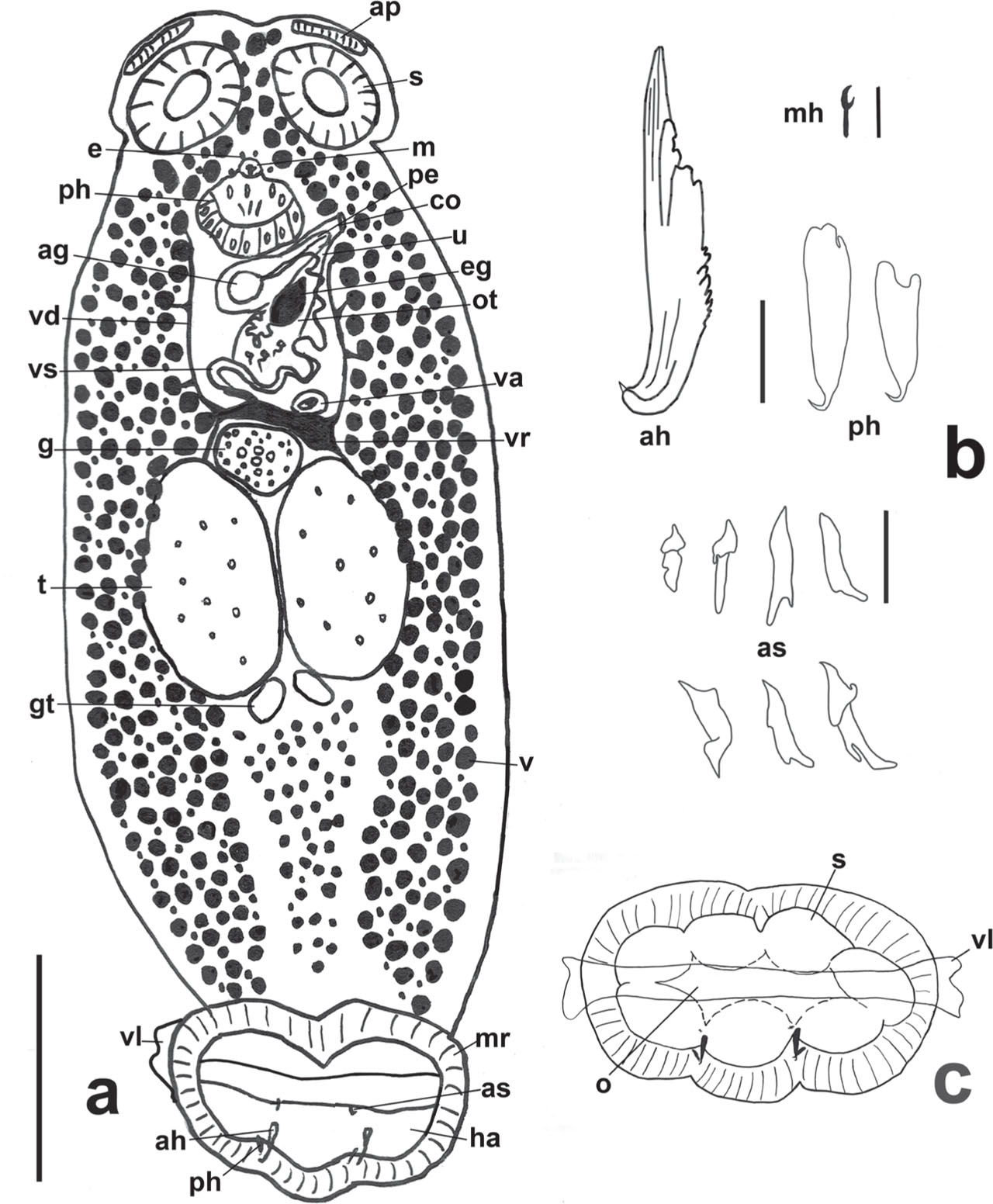
Fig. 1.
a – The anatomy of an adult specimen of Pseudobenedeniella johnstoni sp. n. in ventral view: ah, anterior hamulus; ag, accessory gland; ap, adhesive pad; as, accessory sclerite; co, common genital opening; e, eye; eg, egg; g, germarium; gt, Goto glands; ha, haptor; m, mouth; mr, muscular rim of haptor; ot, ootype; ph, pharynx; pe, penis; ph, posterior hamulus; s, muscular sucker; t, testis; u, uterus, v, vitellarium; va, vagina; vd, vitelline duct; vl, marginal valve; vr, vitelline reservoir; vs, vas deferens. Scale bar: 1 mm. b – Sclerotized structures of haptor of Pseudobenedeniella johnstoni sp. n.: mh, marginal hooklet (scale bar 0.02 mm); ah, anterior hamulus, ph, posterior hamulus (scale bar 0.1 mm); as, accessory sclerites (variations of shape), scale bar 0.07 mm. c – Schematic drawing of clamp-shaped haptor of Pseudobenedeniella johnstoni sp. n.: s, septum; o, opening of haptor; vl, marginal valve.
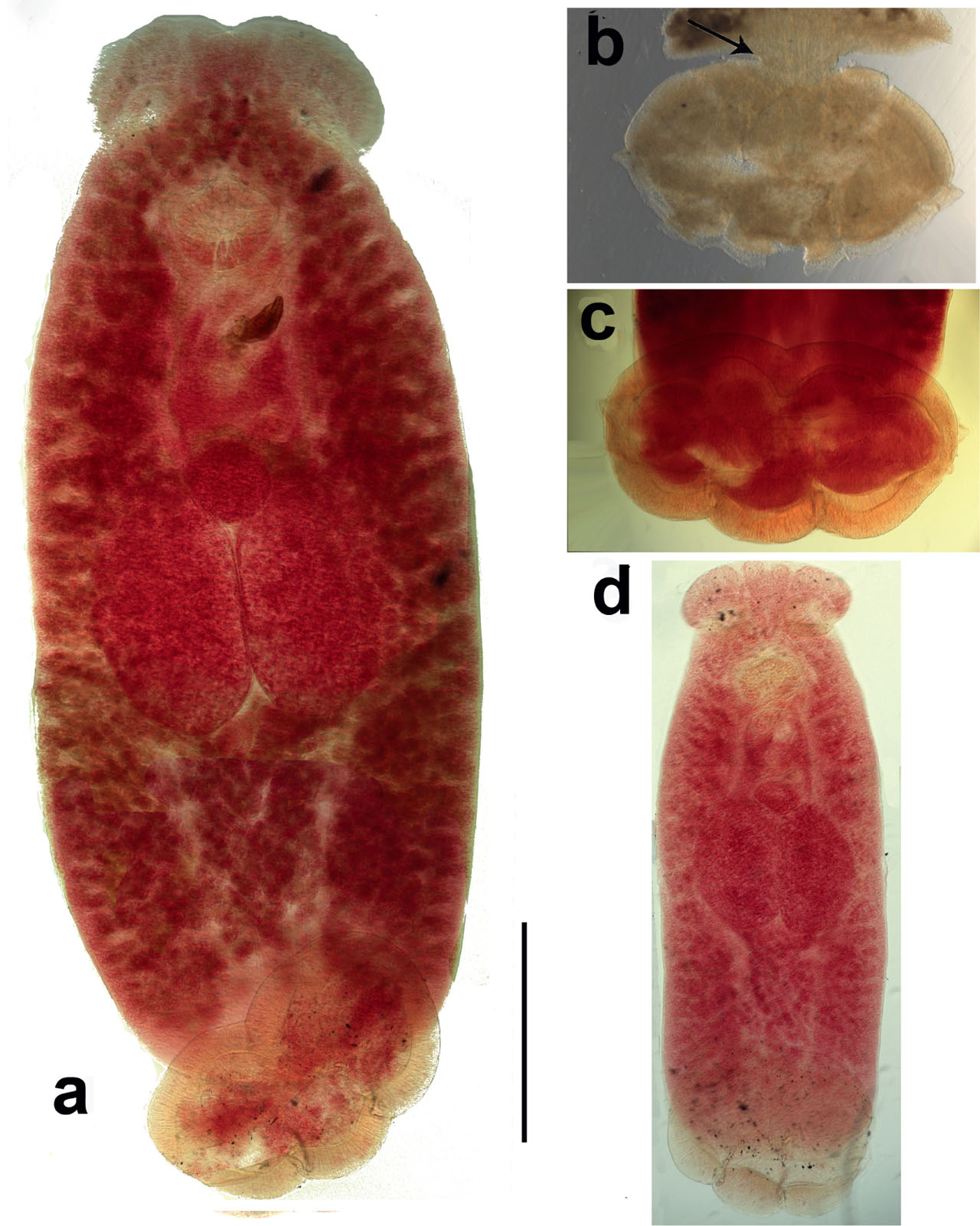
Fig 2.
a – Microscopic image of carmine-stained adult of Pseudobenedeniella johnstoni sp. n. Scale bar: 1 mm. b – Haptor of Pseudobenedeniella johnstoni sp. n. showed in profile. Note peduncle (arrow). c – Haptor of Pseudobenedeniella johnstoni sp. n. showed in its closed state. d – Juvenile specimen of Pseudobenedeniella johnstoni sp. n.
Table 3.
Morphometric characteristics of two species of Pseudobenedeniella from nototheniid fish in two localities.
| Host | Notothenia rossi | Notothenia coriiceps |
|---|---|---|
| Parasite | Pseudobenedeniella branchialis (Timofeeva et al., 1987) | Pseudobenedeniella johnstoni sp. n. |
| Authority | Timofeeva et al. (1987) | Present study |
| Sample size | 15 | 27 |
| Location | gills | gills |
| Type locality | South Georgia Island (54°30′28″S, 36°34′32″W)* | Galindez Island (65°15′S, 64°16′W) |
| Body length | 4.7 – 8.1 (6.3 ± 0.3) | 3.85 – 6.75 (5.54 ± 0.71) |
| Body width | 1.8 – 2.6 (2.2 ± 0.1) | 1.3 – 3.0 (2.17 ± 0.39) |
| Haptor diameter | 1.4 – 2.0 (1.7 ± 0.07) | 0.93 – 2.25 (1.8 ± 0.32) |
| Body width to haptor diameter ratio | 1.29 – 1.37 | 1.17 |
| Accessory sclerite length | 0.04 – 0.10 (0.07 ± 0.010) | 0.05 – 0.13 (0.07 ± 0.01) |
| Anterior hamulus length | 0.29 – 0.35 (0.32 ± 0.01) | 0.23 – 0.47 (0.33 ± 0.041) |
| Anterior hamulus shape | Cylindroid shaft, sharply recurved blade (according to Fig. 3 in Timofeeva et al. (1987), “without pronounced blade” ** | Widen (wing-like) shaft, serrated on one side, curved sickle-shaped with pronounced blade |
| Posterior hamulus length | 0.15 – 0.22 (0.18 ± 0.01) | 0.07 – 0.24 (0.18 ± 0.03) |
| Posterior hamulus shape | Short and cylindroid shaft, no serrations | Short and broad shaft, serrated distally |
| Haptor marginal valve width | 0.15 – 0.18 (0.16 ± 0.01) | 0.09 – 0.14 (0.12 ± 0.01) |
| Sucker diameter/width × length | 0.35 – 0.60 (0.43 ± 0.02) | 0.25 – 0.88 (0.63 ± 0.12) × 0.31 – 1.00 (0.53 ± 0.13) |
| Pharynx length × width | 0.46 – 0.67 (0.57 ± 0.02) × 0.64 – 0.81 (0.70 ± 0.02) | 0.23 – 0.75 (0.47 ± 0.09) × 0.36 – 0.95 (0.65 ± 0.14) |
| Germarium length × width | 0.37 – 0.51 (0.43 ± 0.02) × 0.37 – 0.59 (0.48 ± 0.02) | 0.23 – 0.58 (0.43 ± 0.08) × 0.36 – 0.57 (0.52 ± 0.07) |
| Testis length × width | 0.85 – 1.37 (1.03 ± 0.04) × 0.42 – 0.77 (0.66 ± 0.03) | 0.62 – 1.20 (0.96 ± 0.12 × 0.40 – 0.83 (0.59 ± 0.07) |
| Penis length × width | 0.48 – 0.71 (0.59 ± 0.03 × 0.20 – 0.30 (0.24 ± 0.02) | 0.46 – 1.43 (0.73 ± 0.12) × 0.16 – 0.62 (0.31 ± 0.05) |
| Penis shape | “Bottle-shaped”** | Pear-shaped |
| Egg length × diameter | 0.18 – 0.21 (0.19 ± 0.01)×0.09 – 0.14 (0.12 ± 0.01) | 0.16 – 0.28 (0.22 ± 0.02)×0.09 – 0.16 (0.13 ± 0.02) |
| Egg shape | “Tetrahedral shaped”**, both egg ends of same shape, one end has long coiled filament | Ovoid, more pointed anterior pole, posterior pole blunt with long coiled filament |
| Vagina outer diameter | 0.22*** | 0.14 – 0.25 (0.17 ± 0.04) |
| Vagina inner diameter | 0.11*** | 0.05 – 0.12 (0.08 ± 0.02) |
| Vagina shape | “Short, opens near vitelline reservoir”** | Has wide outer muscular part, and narrow inner part, possibly sclerotized |
** quote from Timofeeva et al. (1987)
*** based on drawing and data in the text in Timofeeva et al. (1987) using the scale bar provided
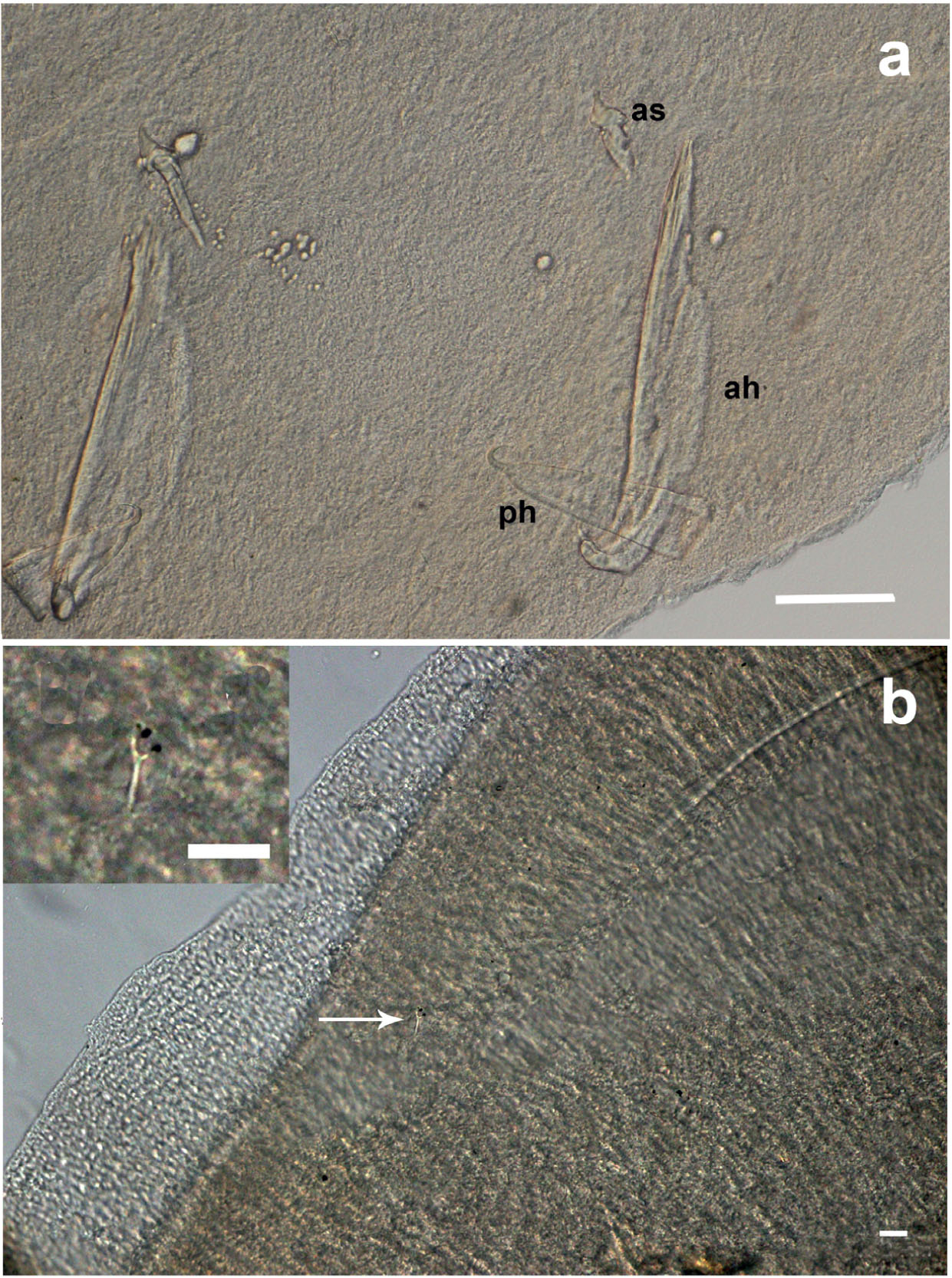
Fig. 3.
a – Flattened haptor of Pseudobenedeniella johnstoni sp. n. with well-seen sclerotized structures in profile (ah, anterior hamulus; as, accessory sclerite; ph, posterior hamulus), close view. Scale bar 0.1 mm. b – Marginal hooklet of Pseudobenedeniella johnstoni sp. n. (arrow). Inset: close view. Scale bar 0.02 mm.
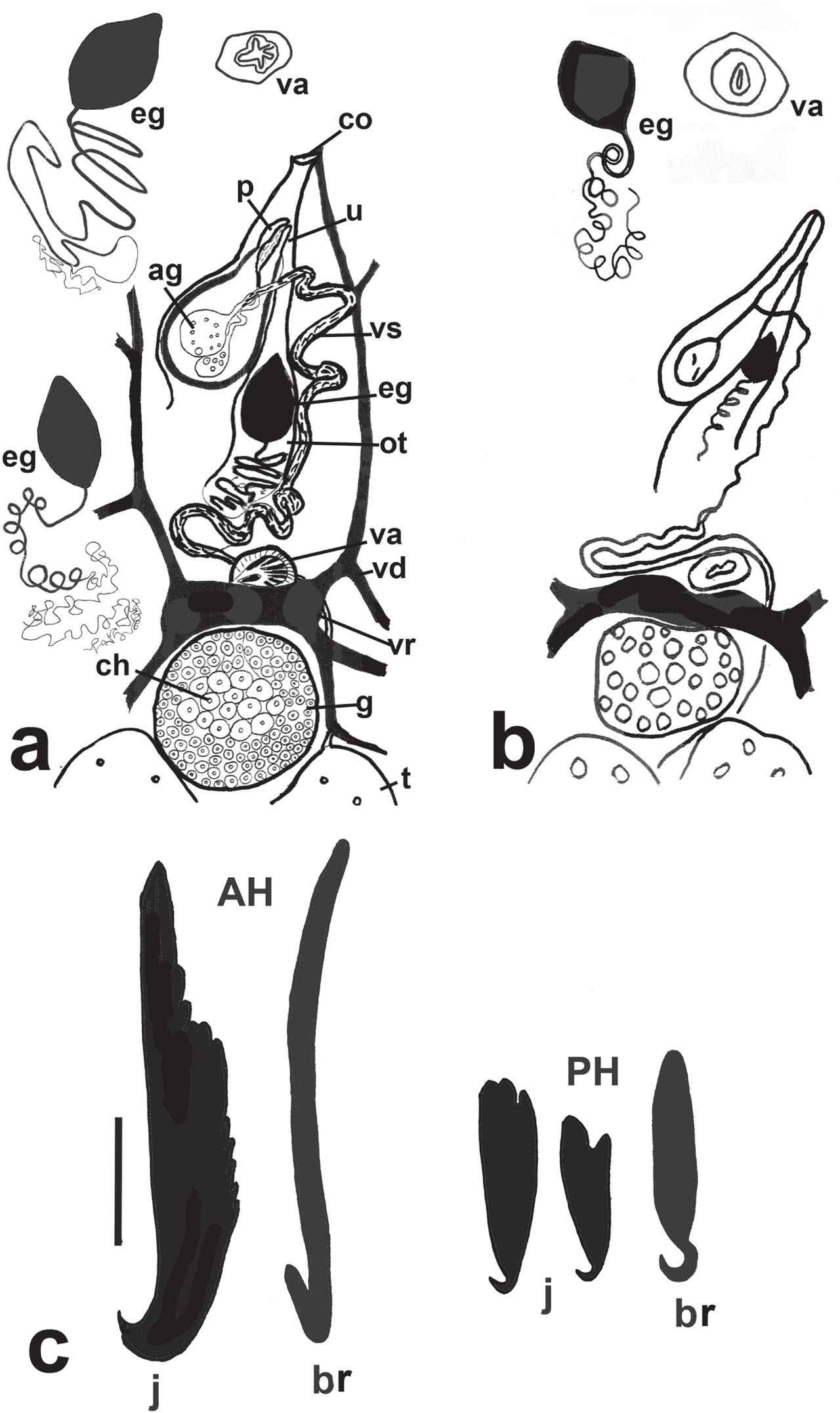
Fig. 4.
a – Schematic drawing of the reproductive system of Pseudobenedeniella johnstoni sp. n.: ag, accessory gland; co, common genital opening; ch, germarium chamber; eg, egg; g, germarium; ot, ootype; p, penis; va, vagina; vd, vitelline duct; vr, vitelline reservoir; vs, vas deferens; t, testis; u, uterus. Insets: variation of eggs (eg); vagina (va). b – Modified drawing of the reproductive system of Pseudobenedeniella branchialis from Timofeeva et al. (1987). c – Comparative drawings of silhouettes of anterior hamuli (AH) and posterior hamuli (PH) of Pseudobenedeniella johnstoni sp. n. (j) and Pseudobenedeniella branchialis (br) [modified from Timofeeva et al. (1987)].
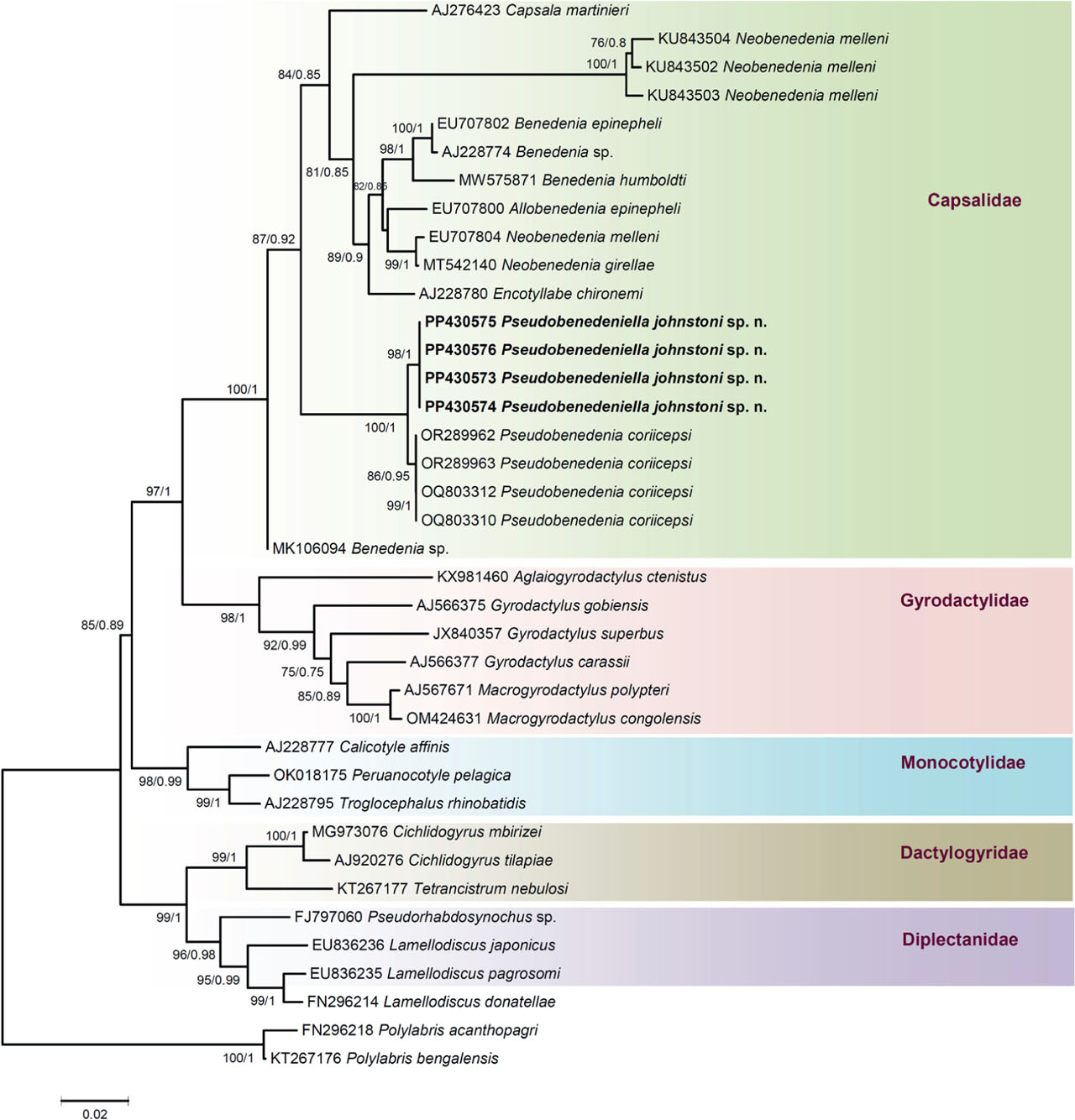
Fig 5.
Phylogenetic tree based on the 18S sequence data showing the relationships of Pseudobenedeniella johnstoni sp. n. Bootstrap values and Bayesian posterior probabilities shown next to the nodes as ML/BI. Bootstrap support values >70 for ML and >0.70 for Bayesian posterior probabilities are shown. Species sequenced in this study are in bold, and the GenBank accession numbers are listed along with the species names. Scale bars represent the branch length. Families are indicated on the right side.
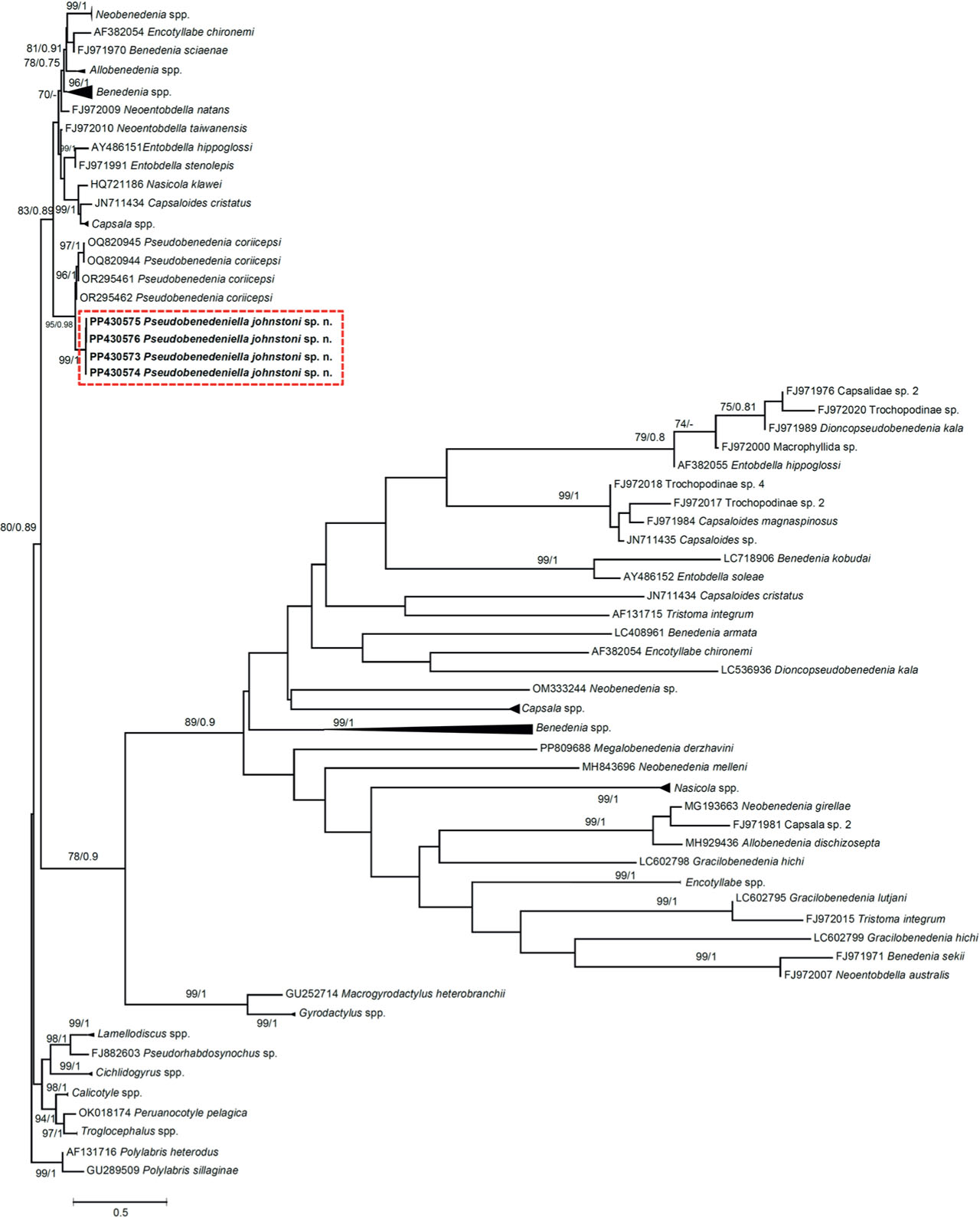
Fig. 6.
A phylogenetic tree of capsalid taxa produced from maximum likelihood and Bayesian inference analyses of the 28S nuclear sequence data for the Capsalidae with outgroup taxa. ML bootstrap and PP values are indicated with each node as ML/BI. Species in the red box are sequenced during the present study.
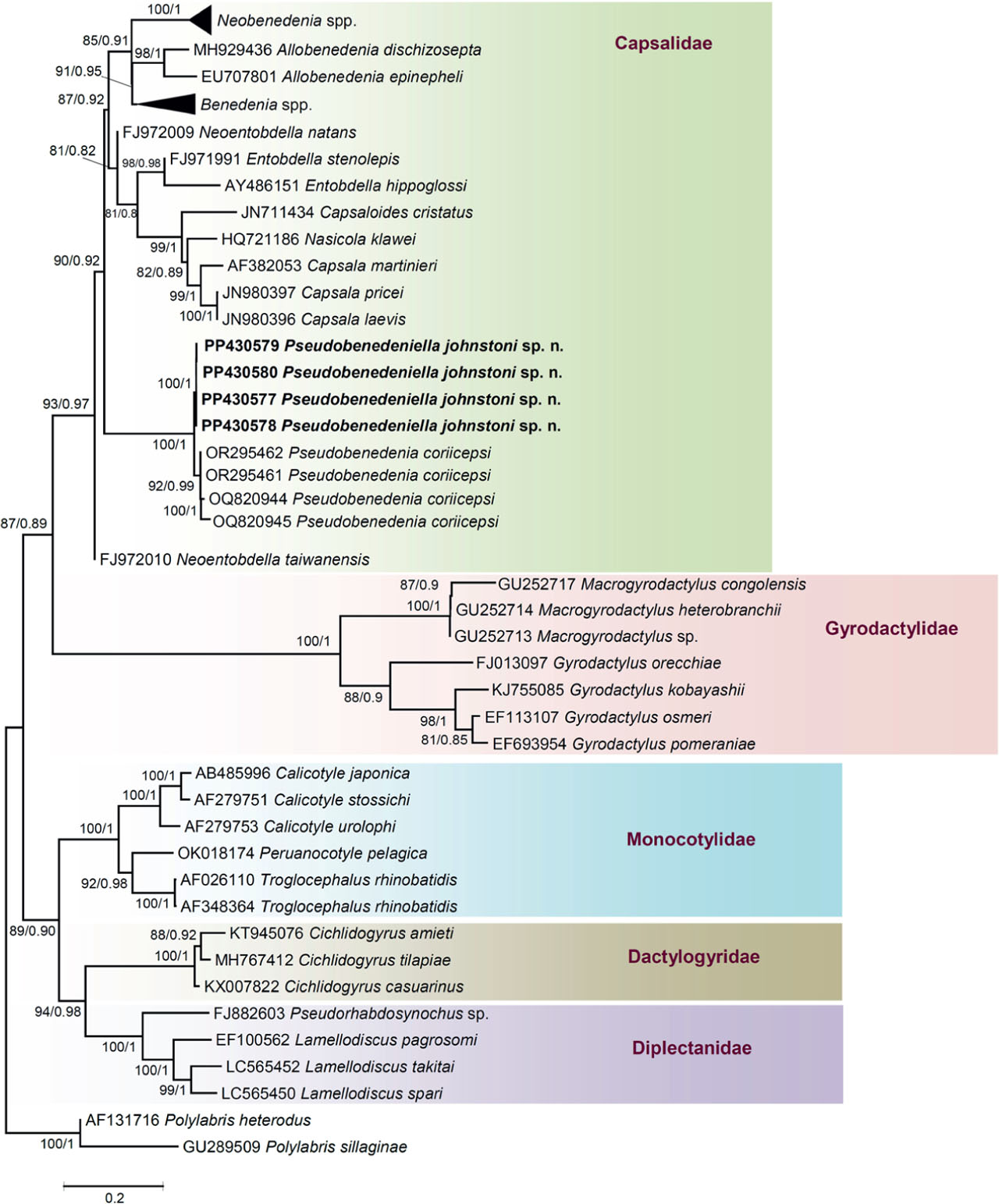
Fig. 7.
A phylogenetic tree was constructed using data from 28S rDNA sequences of Pseudobenedeniella johnstoni sp. n. and other monogeneans. Values shown at the nodes indicate posterior probabilities from ML analysis (>70) and BI posterior probabilities (>0.70). GenBank accession numbers precede species names. The scale bar indicates the expected number of substitutions per site. Species sequenced in the current study are shown in bold. Families are displayed on the right side.
Table 4.
The percent weights of phosphorus (P), sulfur (S), and calcium (Ca) in the attachment body parts of Pseudobenedeniella johnstoni sp. n. and Pseudobenedenia coriicepsi from Antarctic rockcod Notothenia coriiceps from the coastal waters of Galindez Island, West Antarctica obtained by the EDXA
| Pseudobenedeniella johnstoni sp. n. Present study | Pseudobenedenia coriicepsi (from Rubtsova et al., 2023) | |||||
|---|---|---|---|---|---|---|
| Location on fish body | gills | skin | ||||
| Element, % | P | S | Ca | P | S | Ca |
| Anterior body end | 0.87 | 1.54 | 1.59 | 0.25 | 0 | 1.45 |
| Haptor | 0 | 0.51 | 1.12 | 0 | 1.3 | 2.38 |
| Anterior hamulus edge | 0.04 | 8.06 | 1.54 | 0.01 | 0.01 | 0.67 |
| Anterior hamulus center | 0 | 3.97 | 0.68 | 0.44 | 8.83 | 1.95 |