Introduction
Fasciolosis is a parasite infection that affects both livestock and human health globally (McIlroy et al., 1990; Spithill et al., 1999; Lalor et al., 2021). The primary flukes that induce clinical infection are Fasciola hepatica (Linnaeus) and Fasciola gigantica (Cobbold) (Mas-Coma et al., 2007). Fasciolosis symptoms in animals include weight loss (Elitok et al., 2006), decreased milk and wool production (Schweizer et al., 2005; Charlier et al., 2007), fertility problems (Loyacano et al., 2002), liver necrosis (Daryani et al., 2014; Marcos et al., 2007), and death in severe infections (McIlroy et al., 1990; Rapsch et al., 2008). Fascioliasis reportedly causes livestock losses of over $3 billion annually worldwide (Mungube et al., 2006; McGonigle et al., 2008; Utrera-Quintana et al., 2022). In humans, pathogenesis can result from immature migratory flukes injuring the liver parenchyma and generating abscesses in blood vessels, stomach pain, fever, painful hepatomegaly, ascites, and jaundice (Moazeni et al., 2017). In addition, inflammation in the bile ducts leads to fibrosis (Tanwar et al., 2020).
Anthelmintic medications are commonly used to treat fasciolosis (Fairweather & Boray, 1999; López-Abán et al., 2007). Triclabendazole is the most regularly used medicine for controlling flukes (Boray et al., 1983; Keiser et al., 2005). However, the continued use of triclabendazole has resulted in fluke resistance, an issue that has been recorded in many regions of the world (Overend & Bowen, 1995; Moll et al., 2000; Olaechea et al., 2011; Daniel et al., 2012; Gordon et al., 2012; Hanna et al., 2015; Melinda et al., 2024). Thus, alternate fluke control measures are required. Plant extracts offer interesting alternatives to pharmaceutical control for liver flukes (Haçarız et al., 2009).
The majority of plant extract research has focused on suppressing adult flukes. Acacia Senegal (Alsadeg et al., 2015), Allium sativum, Ferula assa-foetida, Syzygium aromaticum, Lawsonia inermis, and Opuntia ficus-indica (Jeyathilakan et al., 2012) have all been evaluated in this position. However, controlling liver fluke eggs to prevent miracidia development or hatchability would be beneficial in reducing the spread of these parasites (McManus, 2020). Pereira et al. (2016) noted that there has been minimal research into the biocontrol of liver fluke eggs. This is the only study we know that has evaluated the ovicidal efficacy of 29 selected plants from various families against liver fluke eggs from cattle in Southern Africa.
Material and Methods
Plant materials
Twenty-nine plant samples (Table 1) were selected based on previous reports of their bioactivity against parasites (Ahmed et al., 2012; Fomum, 2018). Nine were collected from the University of KwaZulu-Natal (UKZN) Botanical Garden, Pietermaritzburg (KwaZulu-Natal Province), latitude 29.37 S, longitude 30.24 E, 655 meters above sea level. Eighteen plants were collected from a private garden in Pietermaritzburg, South Africa. Allium sativum bulbs and Syzygium aromaticum (clove) were purchased from a local market. All plants used were identified by the Department of Botany, UKZN. Voucher specimens of plants were deposited at the UKZN Herbarium, Pietermaritzburg and were assigned voucher numbers. Plant samples were washed and cut into small pieces, air dried under shade, and then dried in an oven (Model 5SOE1B, Labcon, Maraisburg, South Africa) at 50°C for 3 – 5 days. All plant samples were ground into a fine powder using an electric grinder (Retsch Haan, Germany). Crude powders fitted with a 1 mm diameter sieve, then preserved in airtight plastic containers, labeled and stored at 4°C until used in extract preparation. The same plant samples were used for all subsequent experiments.
Table 1.
List of plant species and the organs that were evaluated for their anthelmintic activity.
| No | Family Name | Scientific Name | Common Name | Organs Used |
|---|---|---|---|---|
| 1. | Fabaceae | Acacia karoo | Sweet thorn | Leaves and stem |
| 2. | Fabaceae | Acacia tortilis | Umbrella thorn | Leaves and stem |
| 3. | Asteraceae | Achillea millefolium | Yarrow | Leaves |
| 4. | Liliaceae | Allium sativum | Garlic | Bulbs |
| 5. | Asphodelaceae | Aloe ferox | Bitter aloe | Stem |
| 6. | Bromeliaceae | Ananas comosus | Pineapple | Leaves |
| 7. | Papaveraceae | Argemone mexicana | Mexican prickly poppy | Leaves and stem |
| 8. | Asteraceae | Artemisia afra | African wormwood | Leaves and stem |
| 9. | Asteraceae | Artemisia vulgaris | Mugwort | Leaves and stem |
| 10. | Aristolochiaceae | Asarum canadense | Wild ginger | Rhizomes |
| 11. | Asteraceae | Cichorium intybus. | Chicory | Leaves |
| 12. | Amaryllidaceae | Crinum moorei | Inanda lily | Leaves and stem |
| 13. | Cyatheaceae | Cyathea dealbata | Tree fern | Leaves and stem |
| 14. | Poaceae | Cymbopogon nardus | Lemon grass | Leaves |
| 15. | Apiaceae | Foeniculum vulgare | Fennel | Stem and fruit |
| 16. | Lamiaceae | Mentha piperita | Peppermint | Leaves and stem |
| 17. | Moringaceae | Moringa oleifera | Horse radish tree | Leaves |
| 18. | Lamiaceae | Ocimum gratissimum | African basil | Leaves and fruit |
| 19. | Poaceae | Oxytenanthera abyssinica | Lowland bamboo | Stem |
| 20. | Lamiaceae | Plectranthus sp1 | Supr flower | Leaves and bark |
| 21. | Lamiaceae | Plectranthus sp2 | Supr flower | Leaves and bark |
| 22. | Lamiaceae | Plectranthus sp3 | Supr flower | Leaves and bark |
| 23. | Lamiaceae | Plectranthus sp4 | Supr flower | Leaves and bark |
| 24. | Myrtaceae | Psidium guajava | Guava | Leaves |
| 25. | Rubiaceae | Psychotria capensis | Bird berry | Leaves |
| 26. | Myrtaceae | Syzygium aromaticum | Clove | Fruit |
| 27. | Myrtaceae | Syzygium cordatum | Water berry | Leaves |
| 28. | Canellaceae | Warburgia ugandensis | East African pepper | Leaves and bark |
| 29. | Canellaceae | Warburgia salutaris | Pepper bark | Leaves and bark |
Extraction procedure
Plant extraction techniques were carried out in the Department of Animal and Poultry Science, School of Agricultural, Earth, and Environmental Sciences (SAEES), UKZN. Extraction was carried out using ethanol as the solvent, which has been consistently proven to be the most effective solvent for extracting potentially bioactive compounds (McGaw & Eloff, 2008; Ahmed et al., 2012). Extraction was performed following (Ahmed et al., 2012). Ten grams of each plant sample were boiled in 100 mL of 80 % ethanol for 24 hours using a Soxhlet extractor. Each extract was transferred to a beaker and placed in a water bath (Model 101, Labotec, South Africa) at 60°C. Extracts were evaporated till dry. The dried extracts were stored in sealed glass vials in the dark at 4°C until tested for antihelmintic efficacy. The dried extracts were reconstituted in 80 % ethanol to bring up the concentration required for a specific assay.
Collection of faecal samples
Seventy-two fecal samples from randomly selected cattle from three different areas in Pietermaritzburg, KwaZulu-Natal Province, Impendle, (latitude 29.599696 S, longitude 29.867056 E, 6000 meters above sea level), the Cedara Research Institute (latitude 29.32 S, longitude 30.16 E, 1085 meters above sea level) and Mpumuza, (latitude 29.62 S, longitude 30.38 E, 596 meters above sea level). Twenty-four fecal samples were collected from naturally infected cattle (1 – 4 years old) in each area. All experimental animals were allowed to graze freely on planted Kikuyu pasture (Pennisetum clandestinum Hochst. ex Chiov.) under the same conditions as other animals. The experimental animals were also treated with an antiparasitic drug, following the deworming protocol used in each farm. Rectal fecal samples were taken by hand and stored in plastic bags. Samples were transported to the Department of Plant Pathology, UKZN, where egg samples were prepared and treated.
Preparation of the liver fluke eggs
For each sample, 100 g of feces was weighed and placed in a 1000 ml beaker filled with 500 ml distilled water. The contents were mixed thoroughly using a glass rod and poured through a tea strainer to remove large debris. The solution was poured into a 1000 ml conical flask, and the suspension was sedimented overnight. The supernatant was then removed. To obtain pure eggs, samples were passed twice through a 100 mm diameter sieve (330 mm pore size).
Egg samples were stored in sterilized sealed bottles at 4°C for further use.
Screening of ethanolic extracts for ovicidal activity against eggs of liver flukes
Ethanolic extracts of 29 plants were evaluated for their ovicidal efficacy against eggs of liver flukes at a 20 % concentration of the raw extract. Treatments were prepared by pipetting 125μl from the egg samples (containing approximately 10 eggs) into 96 wells of cell culture plate. From each plant extract, 125μl was added to the egg samples (3 replicates each). Two controls were undertaken: one treated with ethanol and one with distilled water. To determine the ovicidal activity of each plant extract, the treated eggs were incubated at 28°C for 15 days. Miracidial formation was observed under a light microscope using a 10-magnification.
The experiment was arranged in a randomized complete blocks design (RCBD).
Concentration-response bioassay
The five plant extracts that caused the highest mortality levels in the primary bioassay were selected to evaluate the effect of concentrations on their efficacy. All samples were then used at three concentrations, 5, 10 and 20 % of the raw extract. Each concentration was used to treat fluke egg samples. As in the first part of the experiment, ethanol and distilled water are used as controls. The experiment was a 5 × 3 factorial arranged in a randomized complete block design (RCBD).
Control mortalities were zero in both experiments. Data was subjected to analysis of variance (ANOVA) using GenStat for Windows, 18th edition (Payne et al., 2014). Means were compared using Fisher’s Least Significant Difference at a 5 % significance level.
Ethical Approval and/or Informed Consent
All applicable national and institutional guidelines for the care and use of animals were followed.
Results
Effects of ethanolic plant extracts on eggs of liver flukes from cattle
There were highly significant differences in the effects of plant extracts in their effects on eggs of liver flukes of cattle at a 20 % concentration (F= 320.08; P˂0.001) (Table 2). Mortality levels ranged from 0 to 100 % (Fig. 1). Extracts of two plants, M. oleifera and A. comosus, caused the highest mortality levels of 100 %. Extracts of three plants, F. vulgare, C. moorei and Plectranthus sp2, caused mortality levels higher than 80 %. Extracts of three plants, C. nardus, A. afra and W. salutaris, caused 50 to 62 % mortality levels. Extracts of the remaining 24 plants caused mortality levels of less than 50 % (Fig. 1).
Table 2.
ANOVA table for the main effect of 29 ethanolic plant extracts against eggs of liver flukes from cattle.
| Source of variation | d.f. | s.s. | m.s. | F value | P value |
|---|---|---|---|---|---|
| Plants | 29 | 87998.22 | 3034.421 | 320.08 | <0.001 |
| Residual | 58 | 549.844 | 9.48 | ||
| Total | 89 | 88556.22 | |||
| LSD | 5.032 | ||||
| Mean ± SE | 41.56 ± 2.514 | ||||
| CV% | 7.4 |
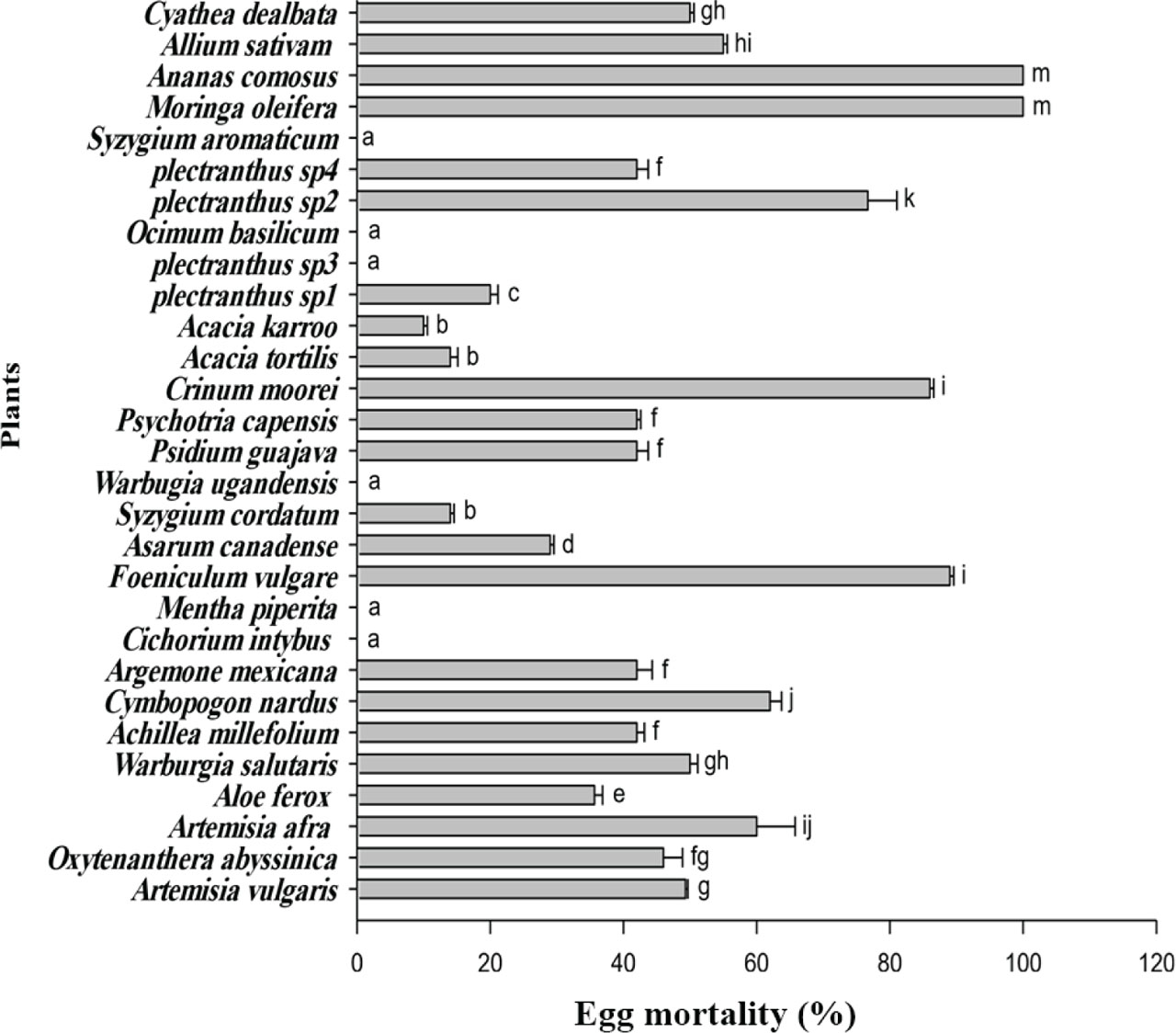
Fig. 1.
The effects of ethanolic extracts of 29 plants on the mortality of eggs of liver flukes from cattle, observed for 15 days after treatment. Mortality was zero in the control treatment.
Screening of three concentrations of plant extracts on liver flukes
There were highly significant differences between the plant extracts (F=67.51; P˂0.001) and between the three concentrations (F=72.26; P˂0.001). The interaction between plant extracts and concentrations was also significant (F=3.26; P˂0.005) (Table 3). The five selected plant extracts were effective at the three concentrations of 5, 10 and 20 % against the eggs of liver flukes. Mortality levels ranged from 30 – 82.67 % due to the 5 % extracts, 42 – 90 % for the 10 % extracts and 60 – 100 % for the 20 % extracts. Extracts of M. oleifera and A. comosus caused more significant mortalities than the other plant extracts at the 5, 10 and 20 % concentrations (Table 4). The concentration of 20 % was consistently more effective than 5 or 10 %. A relatively constant performance ranking resulted in straight-line regressions for efficacy × concentrations (Fig. 2).
Table 3.
ANOVA table for the activity of five plant extracts at three concentrations against eggs of liver flukes from cattle.
| Source of variation | d.f. | s.s. | m.s. | F value | P value |
|---|---|---|---|---|---|
| Plants | 5 | 19631.7 | 3926.34 | 67.51 | <0.001 |
| Concentrations | 2 | 8405.81 | 4202.91 | 72.26 | <0.001 |
| Plants x concentrations | 10 | 1896.41 | 189.64 | 3.26 | 0.005 |
| Residual | 34 | 1977.52 | 58.16 | ||
| Total | 53 | 31998.59 | |||
| LSD | 13.51 | ||||
| Mean ± SE | 67.4 ± 6.23 | ||||
| CV% | 12.65 |
Table 4.
In vitro efficacy of ethanolic extracts of five plants against eggs of liver flukes from cattle..
| Plants | 5% Extract Mortality (%) | 10% Extract Mortality (%) | 20% Extract Mortality (%) |
|---|---|---|---|
| Moringa oleifera | 82.67 fg | 90 gf | 100 h |
| Ananas comosus | 80 fg | 89 gf | 100 h |
| Foeniculum vulgare | 63 de | 75 ef | 89 gf |
| Cymbopogon nardus | 33 a | 47 bc | 62 de |
| Artemisia afra | 30 a | 42 ab | 60 cd |
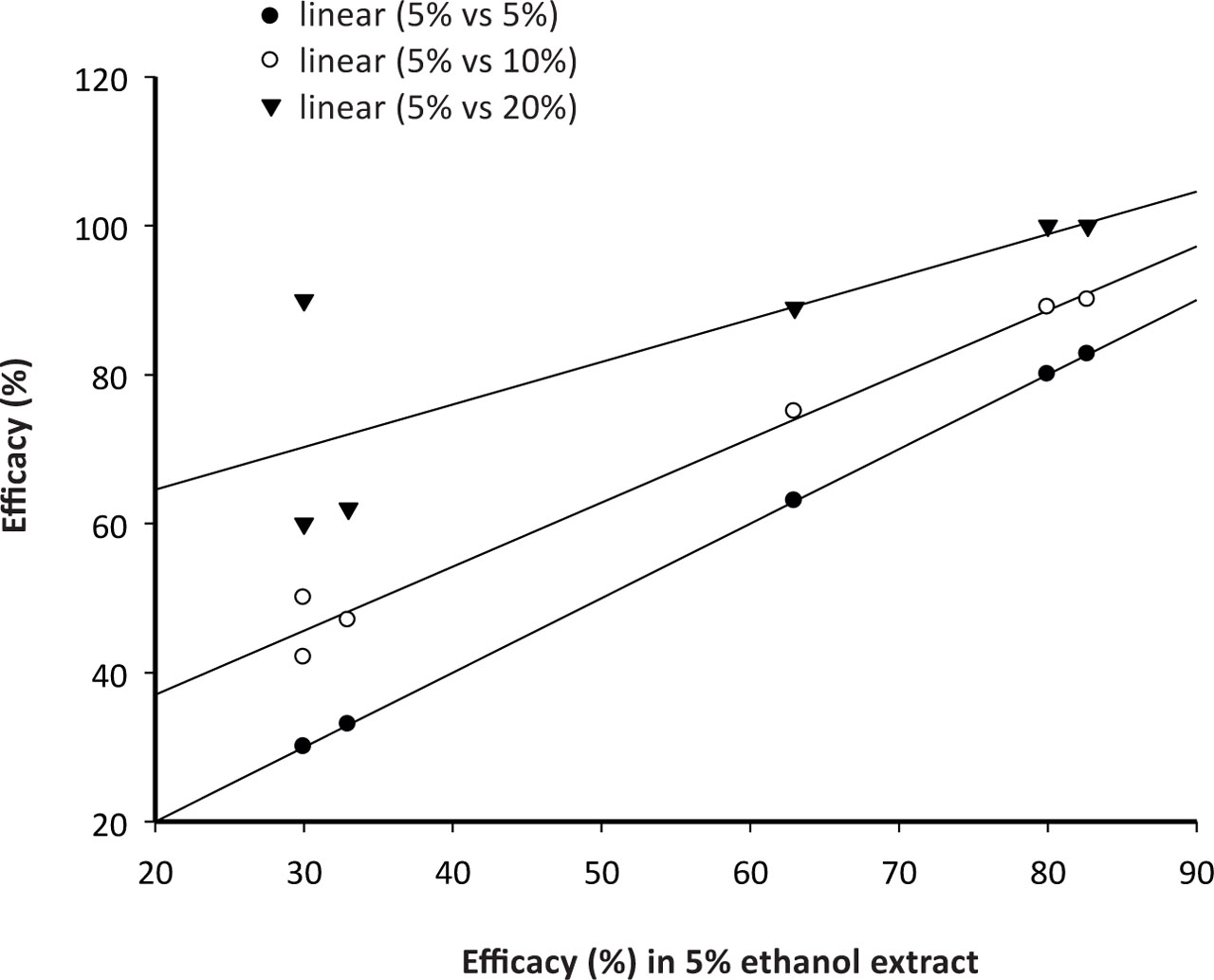
Fig. 2:
In vitro efficacy of three concentrations of five ethanolic plant extracts against eggs of liver flukes from cattle. 5% versus 10%: y = 13.8x + 27.2 R2 = 0.9115; 5% versus 20%: y = 11.8x + 46.8 R2 = 0.8808 ▼– five plants at 20% concentrations;  – five plants at 10% concentrations; ● – five plants and bromelain at 5% concentrations
Discussion
This study evaluated the ovicidal activity of ethanolic extracts of 29 selected plants to inhibit miracidia formation of liver flukes. These plant extracts caused mortality levels of 0 to 100 %. Extracts from five plants (M. oleifera, A. comosus, F. vulgare, C. moorei and Plectranthus sp2) strongly inhibited the hatching and development of eggs of liver flukes. Fahey (2005) and Wang et al. (2016) reported that M. oleifera contained various bioactive compounds with pharmacological activities such as anthelmintic properties. Pereria et al. (2016) noted the potential of Momordica charantia (L.) leafcured extract (CE) and its sub-fractions against the eggs of F. hepatica. After 12 days, no miracidia were formed in eggs incubated with M. charantia leaf CE at concentrations above 12.5 mg ml−1. The CE sub-fraction, at concentrations of 1000, 100, 10, 0.1 and 0.01g ml−1, affected the development of miracidia, with n-butanol causing the strongest inhibition of miracidia formation. Chemical analysis of the leaf extract suggested that flavonoids were responsible for this effect (Pereria et al., 2016). Jeyathilakan et al. (2012) evaluated aqueous extracts of Allium sativum (L.), Lawsonia inermis (L.) and Opuntia ficus-indica ((L.) Mill.) against F. gigantica adults at concentrations of 1, 2.5 and 5 % of the raw extract. Extracts of O. ficus-indica exhibited flukicidal effects at 2.5 and 5 % concentrations, whereas the other plants were effective at higher concentrations only. A methanolic stem bark extract of Acacia senegal (L.) against adults of F. gigantica from cattle was evaluated by Alsadeg et al. (2015). Anthelmintic activity with mortality levels of 100 % occurred at 1000 mg kg−1 and 500 mg kg−1 concentrations 6 and 12 hours after exposure, respectively. Ferreira et al. (2011) found trematodicidal activity when using the ethanolic extracts of Artemisia annua (L.), A. absinthium (L.), Asimina triloba ((L.) and Fumaria officinalis (L.) in vitro against mature Schistosoma mansoni (Sambon), F. hepatica, and Echinostoma caproni (Rudolphi). In the same context, Hossain et al. (2013) reported that a methanolic extract of Dregea volubilis ((L.) Benth. Ex Hook.), used at a concentration of 100 mg mL−1 had flukicidal activity against adults of F. hepatica.
Plants with the best activity in the first screening were compared in concentrations of 5, 10 and 20 % in a dose-response assay against the eggs of liver flukes. The highest concentration of 20 % was consistently better than the 5 and 10 % concentrations. However, there was no significant difference in activity between the 5 and 10 % extracts when using M. oleifera and A. comosus. Extracts of M. oleifera and A. comosus were more active than the extract of other plants at all concentrations. These results are in line with the findings of Moazeni & Khademolhoseini (2016), who studied the ovicidal activities of methanolic extracts of Zingiber officinale (L.) against eggs of F. hepatica at concentrations of 1, 5, 10, 25 and 50 mg ml−1. Control levels of 100 % were observed even at lower concentrations of 5 and 10 mg ml−1 after 48 and 24 hours of exposure time, respectively. Moxonet et al. (2010) reported that many proteins expressed during the early stages of embryogenesis are directly involved in cellular proliferation and cytoskeleton organization events. Thus, it is possible that compounds such as alkaloids, flavonoids and tannins present in M. oleifera, and bromelain in A. comosus, interact with the protein expression profile and therefore inhibit the development of eggs. However, further research is needed to conduct toxicity tests and determine how each plant extract affects protein expression and fluke egg development.
Conclusions
Ethanolic extracts of M. oleifera and A. comosus can inhibit the hatching and development of liver fluke eggs from cattle in vitro, even at low concentrations. Regularly adding these plants or plant extracts into animal feed could reduce the incidences of fascioliasis.
Notes
[2] Conflicts of interest Conflicts of Interest
The authors have no potential conflict of interest pertaining to this submission to Helminthologia.
Acknowledgment
The authors wish to thank Milk South Africa for funding this research.
The researchers would like to thank the Deanship of Graduate Studies and Scientific Research at Qassim University for financial support (QU-APC-202X).