Introduction
The first description of IgA in serum was published in 1953 (Kerr, 1990). It is the most prevalent antibody isotype produced in the body and is the second most dominant isotype in blood circulation, following IgG. It has been demonstrated that approximately 95 % of secretory IgA is produced locally, with the gastrointestinal system serving as the primary site of production. This occurs in several locations, including organised Peyer’s patches and isolated lymphoid follicles, as well as the disorganised lamina propria. The mechanisms involved in this process are both T-cell-dependent and T-cell-independent (Rabst & Slack, 2020). In the intestinal lumen, secretory IgA controls the composition of the microbiota and serves as a primary barrier that binds bacteria, limits contact between bacteria and enterocytes, and thus provides protection from bacterial invasion (Strugnell & Wijburg, 2010). The mounting evidence indicates that IgA in the gut plays a regulatory role in the colonization of the commensal microbiota, thereby influencing the microbiome-associated intestinal and extraintestinal diseases. A paucity of secretory IgA has been demonstrated to precipitate a spectrum of inflammatory disorders (Rawla et al., 2024). A deficiency in IgA leads to an increase in the abundance of pathogens, namely members of commensal bacteria that may cause damage to the host’s homeostasis. Although the precise nature of this interaction remains to be elucidated, it is evident that selective IgA deficiency is associated with an increase in proinflammatory cytokines, such as IL-6 and IL-17, which in turn results in an increase in pathogens (Fadlallah et al., 2018). There is a well-established link between decreased levels of secretory IgA (SIgA) and the development of various diseases. However, the available studies are limited, necessitating further research to determine the exact role of SIgA antibodies in the pathogenesis of these diseases.
Enterobius vermicularis is an intestinal parasite with a cosmopolitan distribution (Kucik et al., 2004). Infection in humans occurs through close contact between infected and non-infected individuals, through ingestion or inhalation of eggs (Fadlallah et al., 2018). Children are the most susceptible to infection as recent studies have indicated that 12.9 % of children worldwide are infected with E. vermicularis (Lashaki et al., 2023). The majority of infections with E. vermicularis are asymptomatic or cause nonspecific symptoms, such as perianal itching resulting from mechanical irritation in the perianal folds during egg laying. Infected individuals may exhibit symptoms such as poor appetite, restless sleep at night, and bruxism (teeth grinding). Other symptoms include abdominal discomfort, loss of appetite, weight loss, insomnia, restlessness and irritability (Vermund & Wilson, 2000; Burkhart & Burkhart, 2005). Complications may also arise, including enuresis, urinary tract infections or appendicitis (Zahariou et al., 2007; Otu-Bassey et al., 2011; Pogorelić et al., 2024).
The pathogenic influence of the pinworm is primarily attributable to mechanotraumatic effects resulting from its fixation in the gut mucosa (Chakarova, 2016). A granuloma, comprising eosinophils, lymphocytes and macrophages, is formed at the site of localisation. The parasite elicits distant reflex effects, manifesting as motor and secretory disturbances of the digestive tract and toxoallergic effects on the host organism (Chakarova, 2008). Enterobius triggers a relatively mild, local inflammatory response in the host (Despommier et al., 2017). Studies have demonstrated that in individuals with recurrent enterobiasis, there is a notable reduction in the number of immunoregulatory cells with T-helper activity. This is an important factor in the development of stable immunocopromentation and may further contribute to reinvasion (Marchenko & Stepanchenko, 2020).
Published studies regarding the impact of the parasite on the gut microbiome and the host immune response have drawn attention to the fact that gut SIgA levels are lower in Enterobius-infected individuals, which increases after treatment (Yang et al., 2017).
The data regarding the impact of pinworm on local immunity of the gastrointestinal tract are extremely scarce, yet of great importance for unravelling the pathogenetic mechanisms of this disease and in determining the susceptibility of patients to reinvasion or infection with other pathogens. Therefore, we set ourselves the goal to investigate intestinal secretory IgA levels in individuals infected with E. vermicularis and to compare them with the concentrations obtained in healthy individuals in Bulgaria, to determine the local immune response in this helminthiasis, and to evaluate its influence on clinical manifestations during infection.
Materials and Methods
Study design
This prospective cross-sectional study examines the local immune response of the gastrointestinal tract in individuals infected with E. vermicularis. It is being conducted at the National Centre of Infectious and Parasitic Diseases in Sofia, Bulgaria, and data collection commenced in January 2022 and is ongoing. The presented data set encompasses the period from January 2022 to December 2023.
Patients and samples
By Bulgarian legislation, large groups of people are obliged to undergo prophylactic testing for intestinal protozoa and helminths. These include individuals employed in the food industry, hospitality, food trade, and children attending nurseries and kindergartens. Furthermore, medical specialists, in the presence of clinical symptoms suggestive of a parasitic disease, conduct intestinal parasite tests following referral. The National Reference Laboratory (NRL) for Diagnosis of Parasitic Diseases at the National Centre of Infectious and Parasitic Diseases is a primary specialized institution in the country, performing both routine and highly specialized diagnostic work about local and imported parasitic pathology.
The individuals included in the study underwent examinations for intestinal protozoa and helminths by clinical, epidemiological, and prophylactic indications during the period covered by the study. The condition that they must meet to be included in one of the two studied groups is to be infected only and only with E. vermicularis (group of individuals with enterobiasis), or to have no laboratory evidence of the presence of a parasitic infection (group of non-infected persons). Anamnestic data and information on blood count abnormalities (if available) were collected on the day of the initial NRL visit. To facilitate a parasitological diagnosis, both a faecal sample and a perianal scotch tape slides were obtained concurrently. Following the subsequent confirmation of the diagnosis of enterobiasis through laboratory analysis, the appropriate treatment was then administered. In these individuals, the level of secretory IgA was determined in the faecal sample taken prior to the treatment.
A total of 142 individuals were included in the study, with fecal samples being analyzed to determine the SIgA values. The samples were distributed as follows, depending on the presence or absence of E. vermicularis infection:
Fecal samples from 102 persons with enterobiasis were examined, including 97 children and adolescents (88 children and 9 adolescents, of which 44 boys, and 53 girls, aged 1 to 18 years), and five adults (3 women and 2 men, aged 37 to 49 years).
Two persons were found to be co-infected with the protozoan parasite Giardia intestinalis and Blastocystis hominis and were therefore excluded from the study.
Fecal samples from 40 clinically healthy individuals (control group), six adults (5 females and one male aged 30 to 60 years), and 34 children and adolescents (32 children and 2 adolescents, of which 18 boys and 16 girls aged 1 to 18 years) were examined to exclude the presence of other intestinal parasites.
Subsequently, the fecal samples were frozen at −80°C until they were examined for the quantification of secretory IgA antibodies.
Parasitological diagnosis
In the NRL for the Diagnosis of Parasitic Diseases, a diverse array of diagnostic techniques are employed in the investigation of intestinal parasites, including direct wet smear, Lugol’s iodine, formalin-ether and other concentration techniques and culture of larvalstage nematodes. For intestinal protozoa, staining techniques, culture methods and rapid immunochromatographic tests were used. The diagnosis of enterobiasis in the subjects was confirmed by the detection of adult forms of the parasite visibly expelled with the stool (relatively rare) and with light microscopy (helminthovoscopy) of a perianal scotch tape slides taken by Graham’s method in the majority of cases. The diagnosis was based on the characteristic appearance of the eggs (Garcia, 2016; CDC, 2024). In order to facilitate a parasitological diagnosis, both a faecal sample and a perianal scotch tape slides were obtained concurrently.
ELISA for detection of secretory IgA in faecal samples
A commercial kit, IMMUCHROM (Germany), was employed to facilitate rapid and precise in vitro quantification of secretory IgA in biological samples. The SIgA ELISA determines human secretory IgA based on the so-called “sandwich” principle. The secretory IgA in the sample, standards and controls bind to antibodies that are attached to the microtiter plate. The concentration of SIgA can be calculated using a standard curve.
Absorbance readings were conducted automatically on a spectrophotometer at a wavelength of 450 nm (reference wavelength of 620 nm). The manufacturer’s reference values for SIgA in faeces fall within the range of 510 to 2040 μg/ml, with the clarification that these are merely indicative and can deviate from other published data. The assay has a detection limit of 27.5 μg/ml. Cross-reactivity to other plasma proteins was not determined in the faecal samples.
The faecal samples taken to check for parasites were also used to determine SIgA levels.
Statistical methods
The statistical package GraphPad Prism version 9 was employed for this study. Descriptive indicators, including frequencies, means, ranges, and confidence intervals of 95 %, were determined. To facilitate comparisons of SIgA levels across different groups of patients, the Mann-Whitney test and ANOVA were employed. In the statistical analysis of the data using the ANOVA, the Holm-Šídák multiple comparison test was employed as a post hoc test. A p-value of less than 0.05 was considered statistically significant.
Limitations
There are some limitations in our study, mainly related to the size of the two studied groups, as well as the age and gender of the individuals included. As the study is based on individuals undergoing parasitological examinations for various reasons, including the presence of clinical symptoms, abnormalities in blood parameters or prophylactic indications (see subsection “Patients and samples”), the number of individuals included in the study is uneven in terms of age and sex. This introduces a degree of complexity in the interpretation of the results. It is well documented that enterobiasis is most prevalent among children and adolescents, and therefore the number of adults included in the study was relatively small.
It should be noted that there are certain limitations in the interpretation of the values of SIgA antibodies. According to the manufacturer of the diagnostic kit, the reference range is only indicative. To facilitate the interpretation of the results, the two evaluated groups of persons (infected and non-infected) were divided into three subgroups: those with SIgA values within the reference range of the diagnostic kit, those with values below the lower reference value, and those above the upper reference value.
Ethical Approval and/or Informed Consent
The study was reviewed and approved by the Institutional Review Board (IRB) 00006384 and informed consent was obtained from the patients. No information that could reveal the identity of the patients who participated in the study was used.
Results
Clinically healthy individuals
In the individuals with no evidence of E. vermicularis infection and/or other intestinal parasites, SIgA levels ranged from 27.5 to 8999 μg/ml (mean 1752 μg/ml ± 2072.78 μg/ml SD). A statistically significant difference was found in the values of secretory antibodies depending on the age group of the examined persons. In children and adolescents, their mean value was significantly higher than that of adults. In the subjects of the male gender, higher mean values of SIgA were observed than in those of the female gender, although this difference was not statistically significant (Table 1).
Table 1.
Demographic data and SIgA levels in both groups studied: infected and non-infected
| Examined persons | without evidence of enterobiasis and/or other intestinal parasitic infection | with laboratory-confirmed enterobiasis | ||||||
|---|---|---|---|---|---|---|---|---|
| Children & adolescents | Adults | Male | Female | Children & adolescents | Adults | Male | Female | |
| No | 34 | 6 | 19 | 21 | 97 | 5 | 46 | 56 |
| SIgA values (µg/ml) | ||||||||
| Minimum | 27.50 | 27.50 | 27.50 | 27.50 | 27.50 | 37.50 | 27.50 | 27.50 |
| Maximum | 8999 | 1357 | 8999 | 4839 | 13916 | 981.5 | 13916 | 9704 |
| Range | 8971 | 1330 | 8971 | 4811 | 13889 | 944.0 | 13889 | 9676 |
| Mean | 1978 | 474,3 | 2060 | 1473 | 1815 | 481.7 | 1901 | 1625 |
| Std. Deviation | 2162 | 608.5 | 2561 | 1518 | 2562 | 398.2 | 2774 | 2300 |
| Lower 95% CI of mean | 1223 | −164.3 | 825.8 | 782.5 | 1299 | −12.84 | 1078 | 1009 |
| Upper 95% CI of mean | 2732 | 1113 | 3295 | 2164 | 2331 | 976.1 | 2725 | 2241 |
| Mann Whitney test | exact P value = 0.0295* | exact P value = 0.5915 | exact P value = 0.2808 | exact P value = 0.4568 | ||||
A review of the range of SIgA values in this group revealed that 15 individuals (37.5 %) exhibited values below the lower reference value of the diagnostic kit (510 μg/ml). Of these, five (three children and two adults) exhibited values at the diagnostic detection limit of 27.5 μg/ml. In 14 individuals (35 %), the values of faecal secretory immunoglobulin A fell within the reference range of the diagnostic kit, while in 11 children (27.5 %), they exceeded the upper reference limit (Fig. 1).
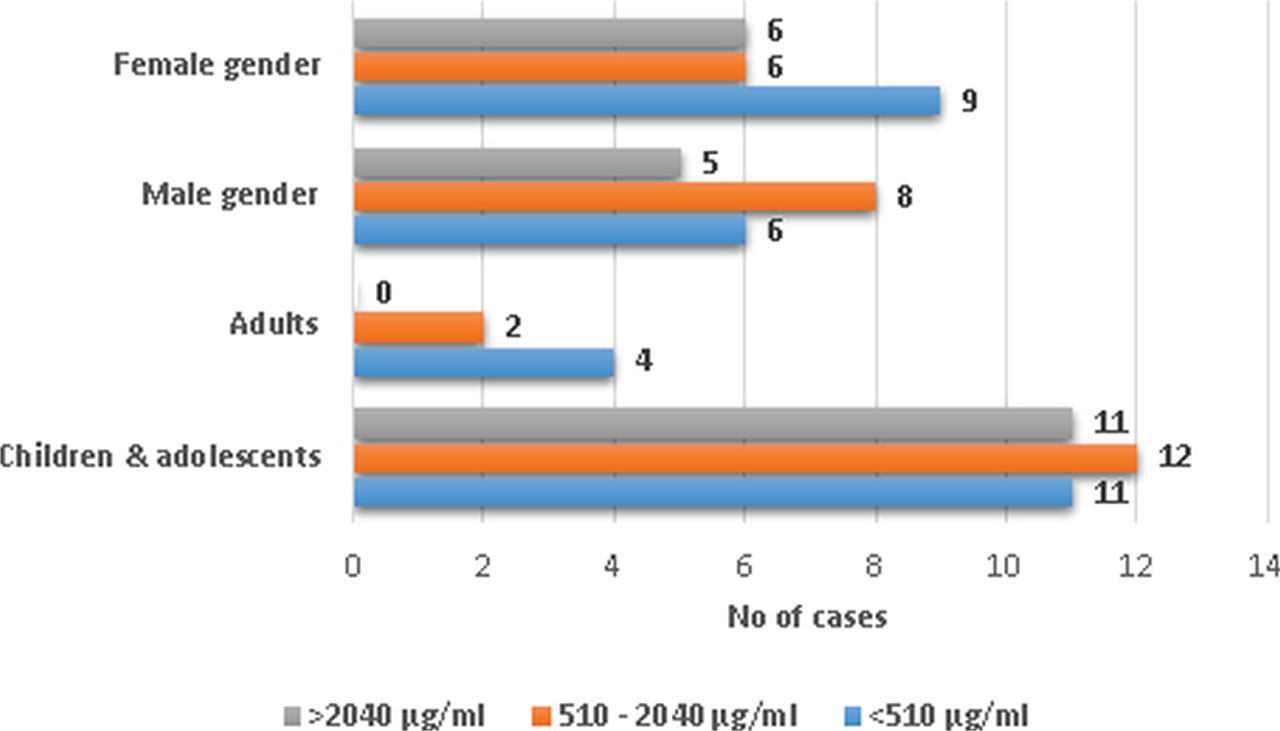
Fig. 1.
Distribution of secretory IgA values in clinically healthy controls by age group, gender, and the reference range of the diagnostic kit used.
The mean values of SIgA for the three subgroups of this group were 194.7 μg/ml, 1210 μg/ml and 4050 μg/ml, respectively, with statistically significant differences between them.
Individuals infected with Enterobius vermicularis
In subjects with enterobiasis, detected concentrations of secretory IgA antibodies ranged from 27.5 μg/ml to 13916 μg/ml (range 13888.50 μg/ml), with a mean value of 1 750 μg/ml ± 2 515.47 μg/ml SD (Table 1).
The results of the secretory IgA antibody analysis indicated that their concentrations were higher in males (n = 46) than in females (n = 56), although this difference was not statistically significant. Of the infected children and adolescents (n = 97), 36 (37 %) exhibited clinical symptomatology or laboratory findings suggestive of parasitic infection. These included 17 cases of perianal pruritus, 10 cases of abdominal pain, 5 cases of diarrhea, 3 cases of bruxism, and one case of eosinophilia. The remaining 61 children and adolescents (63 %) were asymptomatic and the diagnosis was made after prophylactic examinations. The levels of secretory IgA antibodies in the faecal samples of children infected with E. vermicularis were found to be higher in the group of symptomatic patients, with a mean value of 2198.7 μg/ml, compared to those in whom the presence of symptomatology was not reported, with a mean value of 1588.5 μg/ml. However, no statistically significant difference was observed (p = 0.259). In subjects presenting with clinical symptomatology, there were significant differences in mean SIgA values depending on the dominant symptom. Children with perianal pruritus exhibited the highest SIgA levels (3559.54 μg/ml), followed by those with abdominal pain (1383.66 μg/ml), and those with diarrhea (545.53 μg/ml), bruxism (556.25 μg/ml), and eosinophilia (409.40 μg/ml) had significantly lower mean secretory IgA antibody levels (Table 2).
Table 2.
Mean values of intestinal SIgA concentrations in the studied children, relative to the reported clinical symptom.
| No | SIgA mean value (μg/ml) | Std. Deviation | SIgA min. value (μg/ml) | SIgA max. value (μg/ml) | |
|---|---|---|---|---|---|
| Asymptomatic persons | 61 | 1 588.54 | 2046 | 27.5 | 9 422.44 |
| Patients with symptoms: | 36 | 2 198.74 | 3254 | 27.5 | 13 916.00 |
| perianal itching | 17 | 3 559.54 | 3949 | 27.5 | 13 916.00 |
| abdominal pain | 10 | 1 383.66 | 2493 | 27.5 | 8 064.51 |
| diarrhea | 5 | 545.53 | 654 | 27.5 | 1 488.38 |
| bruxism | 3 | 556.25 | N/A | 137.50 | 813.75 |
| eosinophilia | 1 | 409.40 | 366 | 409.40 | 409.40 |
| ANOVA test, P value = 0.049 | |||||
The data from this study indicated that 43 (42.2 %) of the individuals with enterobiasis exhibited SIgA concentrations within the reference range of the diagnostic kit employed (range 534.38 μg/ml to 1966.50 μg/ml, mean = 1065 μg/ml). The remaining 55.8 % exhibited values outside the reference range. Of these, 23 (22.5 %) exhibited SIgA levels above the upper reference limit with range 2222.50 μg/ml to 13,916.00 μg/ml (mean = 5178 μg/ml), while 36 (35.3 %) exhibited SIgA levels below the lower reference limit of the diagnostic kit with range 27.50 μg/ml to 504.15 μg/ml (mean = 148,7 μg/ml). In this group, statistically significant differences were observed in the values of SIgA among the individuals in the three subgroups stratified according to the reference range of the diagnostic kit.
In the group of infected adults, the fecal IgA antibody levels were below the diagnostic minimum in three individuals, while two had concentrations within the reference range. In the children, however, 33 (34 %) exhibited levels as low as 510 μg/ml, 41 (42 %) were within the reference range, and 23 (24 %) exhibited levels above the upper reference limit (above 2040 μg/ml).
Furthermore, there were notable variations in SIgA levels according to the gender of those infected. A greater proportion of subjects of female sex (24 of 36, 67 %) exhibited lower immunoglobulin levels compared to persons of male sex (n = 12, 33 %) (Fig. 2).
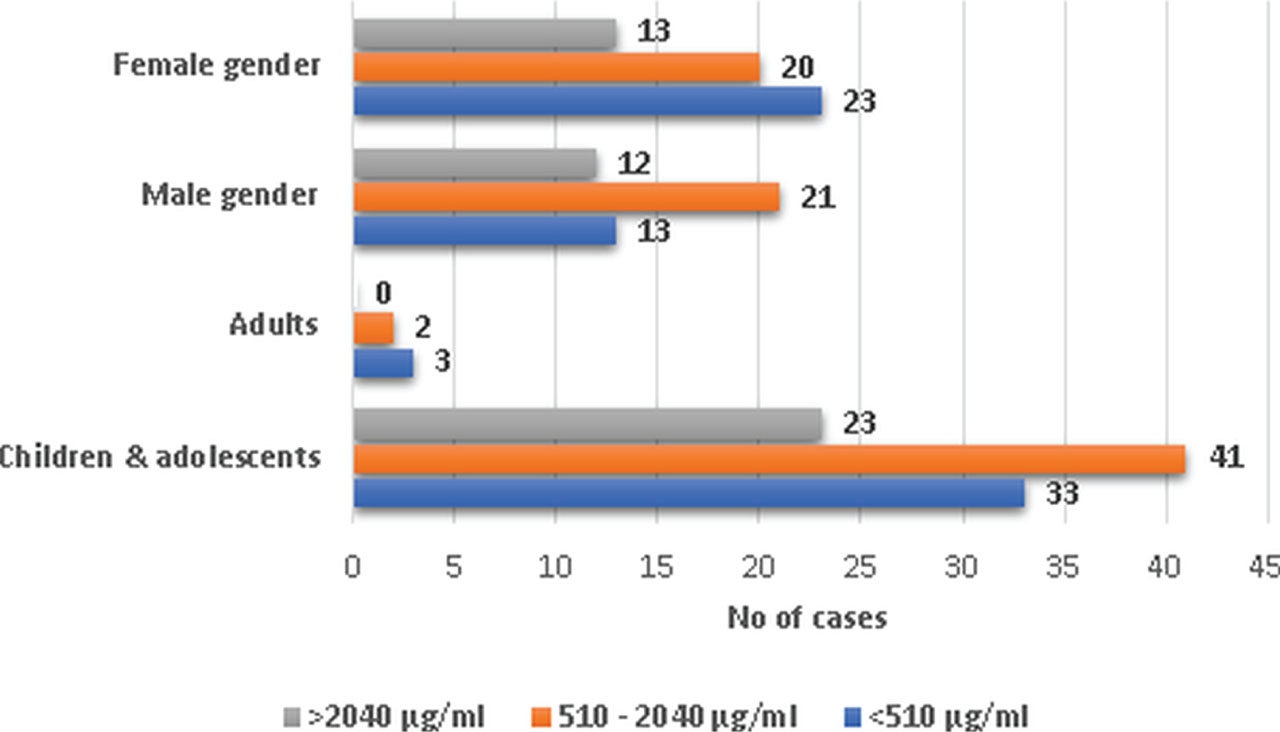
Fig. 2.
Distribution of secretory IgA values in persons with enterobiasis by age group, gender, and reference range of the diagnostic kit used.
Two individuals infected with pinworms underwent control tests 14 days after treatment, and a decrease from the initially detected fecal SIgA antibody values was reported (boy 11 years old – first test 4043.80 μg/ml, control test 3281.75 μg/ml; girl 9 years old - first test 8064.51 μg/ml, control test 336.18 μg/ml).
The mean SIgA concentrations in the two groups did not exhibit a statistically significant difference. However, both extremely high and extremely low values were identified among infected individuals (Fig. 3).
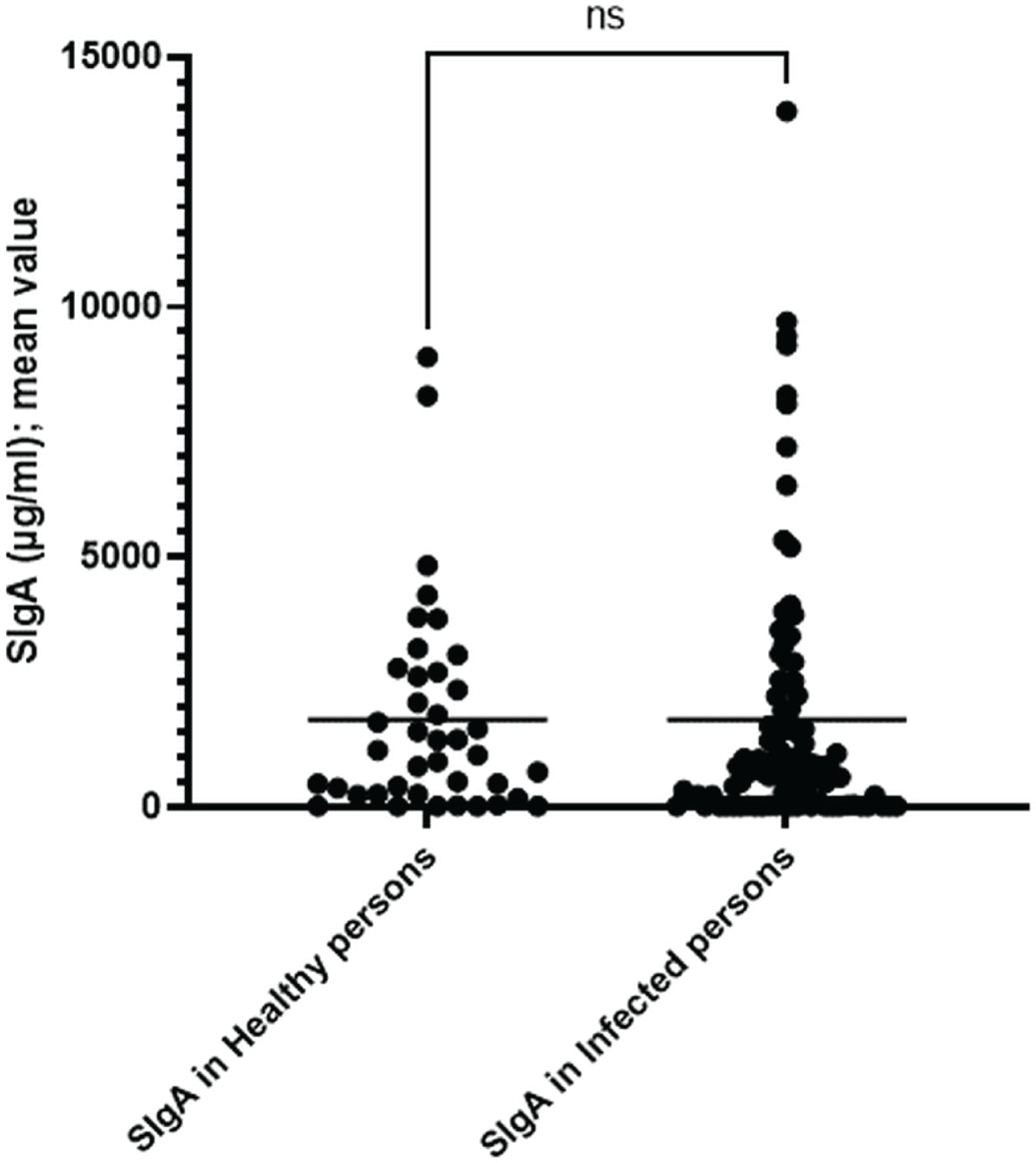
Fig. 3.
Concentrations of the fecal secretory IgA antibodies in healthy individuals and patients with enterobiasis. To establish statistically significant differences in the values of SIgA, a Mann-Whitney test was performed (exact P value = 0.4991).
Discussion
Secretory IgA antibodies play a main role in the immune exclusion of pathogenic microorganisms and the maintenance of intestinal homeostasis. They perform a multitude of functions within the gut, including regulating the composition of the normal microbiota, protecting the intestinal epithelium from pathogenic microorganisms, and serving as a pivotal factor in the development of the immune system (Inamine & Schnabl, 2018). There is mounting evidence indicating a correlation between IgA antibody deficiency and alterations in the human gut microbiome (Moll et al., 2021). The significance of intestinal IgA in the regulation of commensal microorganisms was initially elucidated by Fagarasan et al. (2002), but the precise mechanism by which IgA regulates commensal microbes in an opposing manner remains unclear. However, it has been postulated that SIgA is capable of recognizing rapidly growing bacteria, including pathogens, and eliminating them from the gut. Studies have shown that helminth infections in humans can increase intestinal bacterial diversity and affect microbiome composition (Lee et al., 2014; Yang et al., 2017). According to a pooled analysis of information in the literature, helminthiasis causes an imbalance in the gut microbiota (Lee et al., 2014). Enterobius vermicularis infection in children leads to suppression of non-specific immunity and the creation of secondary immunodeficiency causes hypoacidity and reduces the bactericidal effect of gastric juice, causing dysbacteriosis and contributing to the occurrence of various somatic, infectious and other diseases (Chakarova, 2008; Yang et al., 2017). Co-infections with other parasites are often reported (Dudlová et al., 2018).
Our study of the local humoral immune response in people with enterobiasis is the first of its kind in the country. A significant variation was observed in the concentrations of SIgA in both study groups. In individuals infected with E. vermicularis, the range of values was significantly greater in the direction of higher concentrations. However, no statistically significant difference was found between them and those without evidence of infection. Furthermore, mean SIgA values in individuals presenting with clinical symptoms were found to be higher than those observed in asymptomatic enterobiasis cases. This is particularly evident in individuals presenting with perianal pruritus, where the mean SIgA value (3559.54 ± 3949 SD) is significantly above the upper reference value of the diagnostic kit. A high average value was also observed in individuals who reported abdominal pain (1383.66 ± 2493 SD), while in those with other symptoms (diarrhoea, bruxism, eosinophilia), the values were much lower (Table 2). Although definitive evidence is currently lacking, we believe that this phenomenon may be attributed to heightened intensity of worming and corresponding antigenic stimulation, which in turn stimulates the humoral local immune response, resulting in an augmented production of secretory intestinal immunoglobulin A. Similar studies have been conducted on animal models (primates), wherein a significant correlation was reported between parasite burden/intensity of infection and SIgA concentrations (Gesquiere et al., 2020; Behringer et al., 2021). However, other authors posit that SIgA production in enterobiasis is suppressed. Their observations in individuals infected with E. vermicularis indicate that intestinal SIgA levels were significantly lower than those observed after treatment with mebendazole (Yang et al., 2017). In this regard, the data from our study differ significantly. Although the sample size is limited to only two cases, our data demonstrate a reduction in SIgA values following treatment (in our case of albendazole). The association of secretory IgA with protection against gastrointestinal protozoa is well known (Sardinha-Silva et al., 2022), but the same protection in the context of helminth infections has mainly been observed in mouse models. The studies conducted by Ramos et al. (2022) demonstrated an association between elevated IgA levels and diminished parasitological parameters in mice, rats, and sheep but the role of IgA in other host species, including cats, dogs, and humans, remains uncertain, which makes it difficult to reach definitive conclusions. While the data from this review are insufficient to conclude that IgA is a protective factor against intestinal helminthiasis, the findings may suggest the potential use of this immunoglobulin as a biomarker for the selection of resistant lineages. The discrepancies observed in the datasets of different researchers highlight the necessity for further comprehensive studies to elucidate the matter.
SIgA antibodies function in the context of a highly colonised, fluid, and dynamic ecosystem. Age is known to have a profound effect on the immune system (Mittelbrunn & Kroemer, 2021). In humans, serum concentrations of IgG and IgA increase slightly with age (Suzuki et al., 1984). In this context, the data from our study diverge to some extent. In both the infected and clinically healthy groups of children and adolescents, higher levels of SIgA were observed compared to adults. This was particularly evident in the healthy group, where the difference was statistically significant. This phenomenon may be due to the relatively limited number of subjects that have been studied to date. Nevertheless, the data provide a rationale for further investigation into the reactivity of the local intestinal humoral immune response in children and adults.
In addition to age, sex hormones also modulate humoral and cell-mediated immune responses (Lahita, 1985). There are notable differences in the immunological responses of men and women to antigens and these differences extend to the innate and adaptive immune responses (Klein & Flanagan, 2016). In particular, it has been observed that one of the two sexes is more sensitive than the other in the context of various parasitic infections (Morales-Montor et al., 2004). The data obtained from our study corroborate this observation, as higher levels of SIgA were found in males compared to females in both groups included in the study but without statistically significant differences between them.
In addition to the existing physiological characteristics of immunity and the influence of age and sex, it can be demonstrated that infection with E. vermicularis also has an impact on the local humoral immune response. However, despite our findings of differences in secretory IgA antibody levels in patients with enterobiasis by sex and age, the exact mechanisms that explain the results remain unclear at this stage.
A study by Marchenko and Stepanchenko (2020) demonstrated a decline in T-helper and T-suppressor cells in individuals with recurring enterobiasis. This was accompanied by a pronounced reduction in T-helper regulatory cells, which the researchers posit as a significant contributing factor to the development of immunocopromentation and subsequent reinvasion. The results of our study indicate that 35 % of patients diagnosed with E. vermicularis exhibited fecal secretory IgA antibody levels below the reference range of the diagnostic set. It is noteworthy that in the control group of healthy individuals, the proportion of those with low levels of SIgA is identical. This observation provides known grounds to suggest a potential correlation between the high susceptibility of the human population to this parasite and the low levels of SIgA. A reduction in the levels of SIgA antibodies is also a risk factor that predisposes to reinvasion with this parasite and contributes to the occurrence of other infections of the gastrointestinal tract, as well as to an increased possibility of the development of other extraintestinal manifestations, such as metabolic disorders, allergic and autoimmune diseases (Turnbaugh et al., 2009; Yel, 2010; Wang et al., 2011; Ludvigsson et al., 2014).
The proportion of individuals exhibiting exceptionally high levels of SIgA (above the diagnostic kit’s reference range) is comparable between the two study groups (20 % vs. 23 %). About clinically healthy individuals, it is challenging to explain this phenomenon. The absence of a parasitic intestinal infection does not rule out the possibility of another intestinal pathology that could be responsible for this observation. About individuals with enterobiasis, the explanation for the presence of patients with both very high and very low levels of secretory IgA antibodies is likely to lie in the stage of the disease. This is corroborated by the data, which revealed that significantly elevated levels of SIgA were observed predominantly in patients presenting with clinical symptoms, particularly those exhibiting perianal itching. This leads to the hypothesis that the levels of secretory antibodies are related to the clinical manifestations of infection. Enterobiasis is a parasitic infection characterised by frequent re-invasions and chronicity. This likely has a significant impact on the synthesis of secretory IgA antibodies directed at this “big” pathogen.
Conclusions
Although preliminary, the data from our study raise important questions about the role of secretory IgA antibodies in the pathogenesis of enterobiasis. The results clearly show a direct correlation between the presence of clinical symptoms in enterobiasis and elevated levels of secretory IgA in faeces. In addition, the age and sex of infected individuals appear to have a significant influence on their synthesis. However, the overall role of the local humoral immune response in enterobiasis is still unclear and further studies are needed to clarify this issue.
Acknowledgements
The Bulgarian National Science Fund funded this research (project no. KP-06-H53/4/11.11.2021) under the “Competition for financial support for basic research projects – 2021.
Notes
[1] Conflicts of interest Conflicts of Interest
The authors declare no conflicts of interest.
[2] Data Availability Statement
On request, the corresponding author will send you the information that was utilized to support the study’s findings.
[3] Contributed by Authors Contribution
Conceptualization: E.K. and R.H.; methodology: E.K.; software, R.H.; validation: D.V., I.A. and R.D.; formal analysis: R.B.; investigation, M.V. and N.T.; resources: E.K., D.V. and M.P.; data curation: A.I., D.V., M.P., and N.T.; writing original draft preparation: E.K.; writing review and editing: R.H.; visualization: R.H.; supervision: R.H.; project administration: E.K.; funding acquisition: E.K. All authors have read and agreed to the published version of the manuscript.