Table 1.
Comparative metrical data for Polylabris lingaoensis and their congeneric species.
| Comparable parameters | Tingbao et al. (2007) | Bayoumy et al. (2015) | Present study (2024) | |
|---|---|---|---|---|
| Host | Ambassis gymnocephalus | Acanthopagrus bifasciatus | Acanthopagrus bifasciatus | |
| Location | China | Egypt | Saudi Arabia | |
| Body | Length | 1356 (1130–1597) | 1231 (1120–1426) | 1398 (1275–1723) |
| Width | 239 (159–298) | 256 (179–286) | 280 (230–310) | |
| Buccal sucker | Length | 41 (34–48) | 43 (34–48) | 49 (42–61) |
| Width | 43 (37–50) | 46 (39–54) | 54 (42–70) | |
| Pharynx diameter | 34 (27–42) | 34 (27–42) | 35 (30–52) | |
| Oesophagus length | - | - | 111 (102–120) | |
| Number of genital spines | Unarmed | Unarmed | Unarmed | |
| Male copulatory organ | Length | 39 (34–45) | 41 (37–48) | 43 (39–50) |
| Width | 27 (22–33) | 29 (25–36) | 35 (30–45) | |
| Germarium | Length | - | - | 394 (387–411) |
| Width | - | - | 93 (81–102) | |
| Vaginae diameter | - | - | 49 (48–50) | |
| Number of testes | 5–7 | 6–8 | 6–8 | |
| Haptor | Length | 583 (478–735) | 623 (528–814) | 1498 (1452–1511) |
| Width | - | - | 216 (207–232) | |
| Number of clamp pairs | 30–43 | 33–45 | 35–45 | |
| Anterior clamp | Length | - | - | 58 (52–63) |
| Width | 43 (39–48) | - | 33 (30–34) | |
| Posterior clamp | Length | - | - | 22 (21–25) |
| Width | 36 (33–40) | - | 37 (36–38) | |
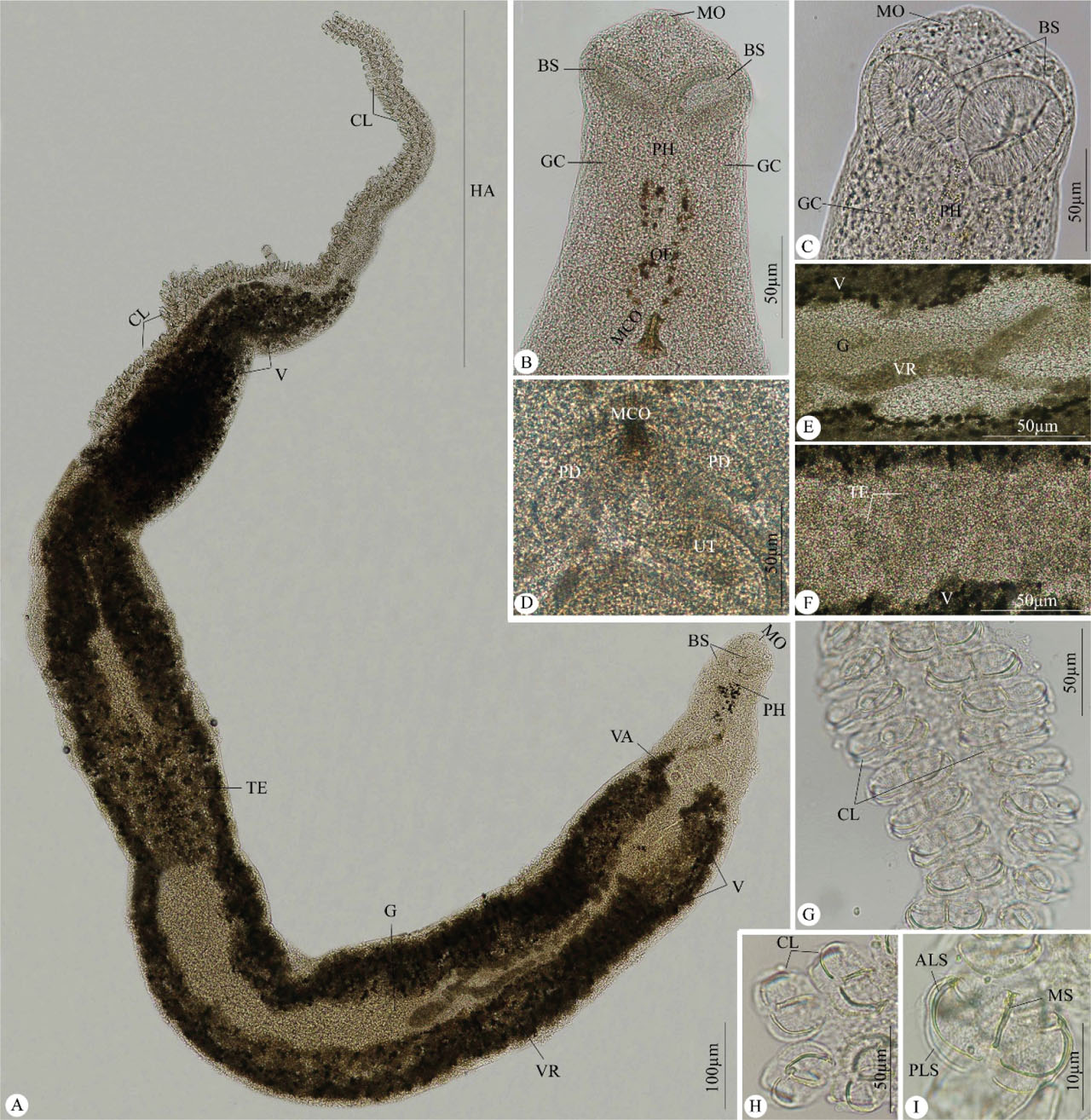
Fig. 1.
Photomicrographs of Polylabris lingaoensis. (A) Whole specimen. (B) Anterior part of prohaptor. (C) Detail of prohaptor. (D) Male copulatory organ and distal portion of seminal vesicle. (E) Germarium. (F) Testis. (G) Two clamp rows in the haptor. (H) Detail of haptoral clamps. (I) Structure of clamp. Note: ALS, antero-lateral sclerite; BS, buccal sucker; CL, clamps; G, Germarium; GC, gland cells; HA, haptor; MCO, male copulatory organ; Mo, mouth; MS, median sclerite; OE, oesophagus; PD, prostatic ducts; PH, pharynx; PLS, postero-lateral sclerite; TE, testes; UT, uterus; V, vitellaria; VA, vagina; VR, vitelline reservoir.
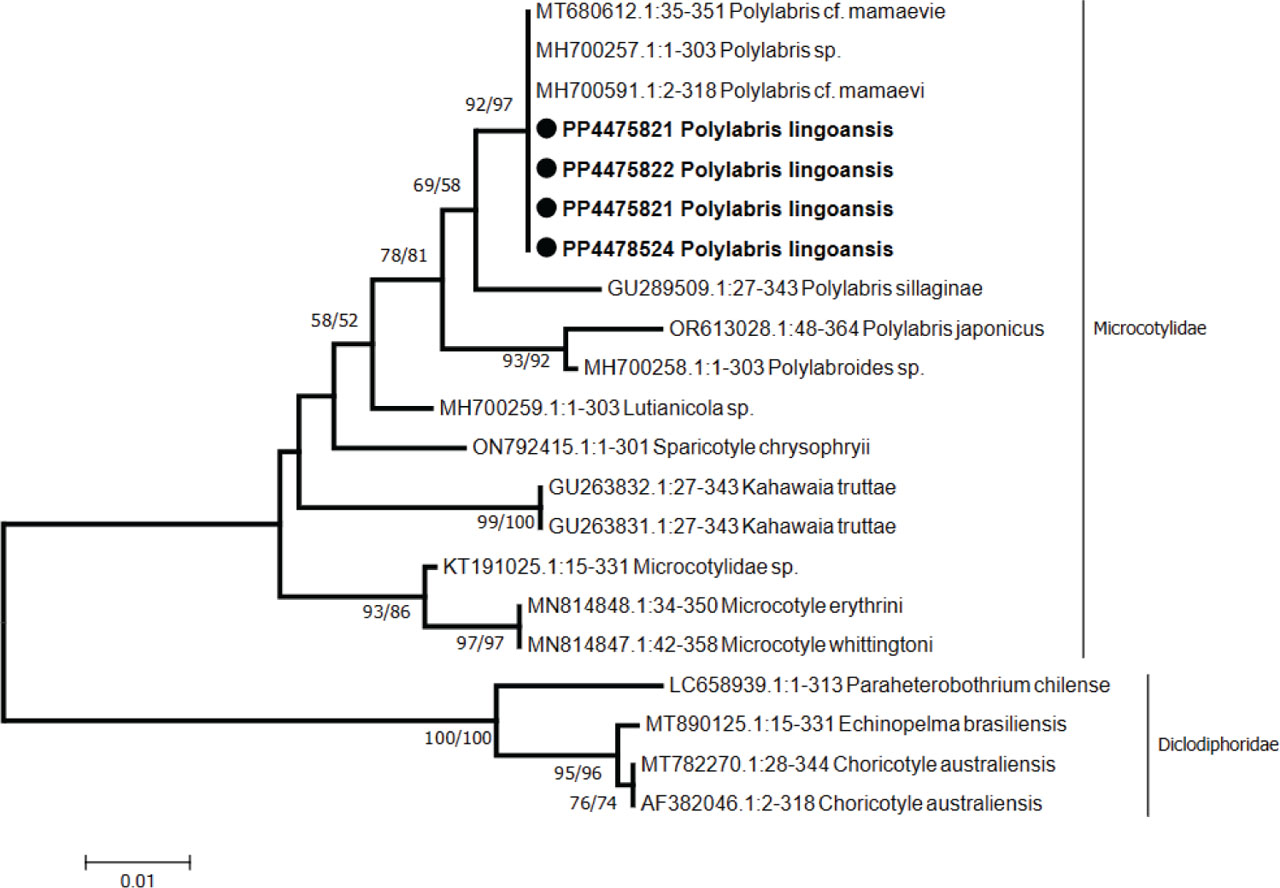
Fig. 2.
A consensus phylogenetic tree constructed with maximum likelihood (ML) and Neighbor-Joining (NJ) methods, inferred from the partial 28S rRNA. Numbers indicated at branch nodes are bootstrap values. Only bootstraps > 50% are shown.
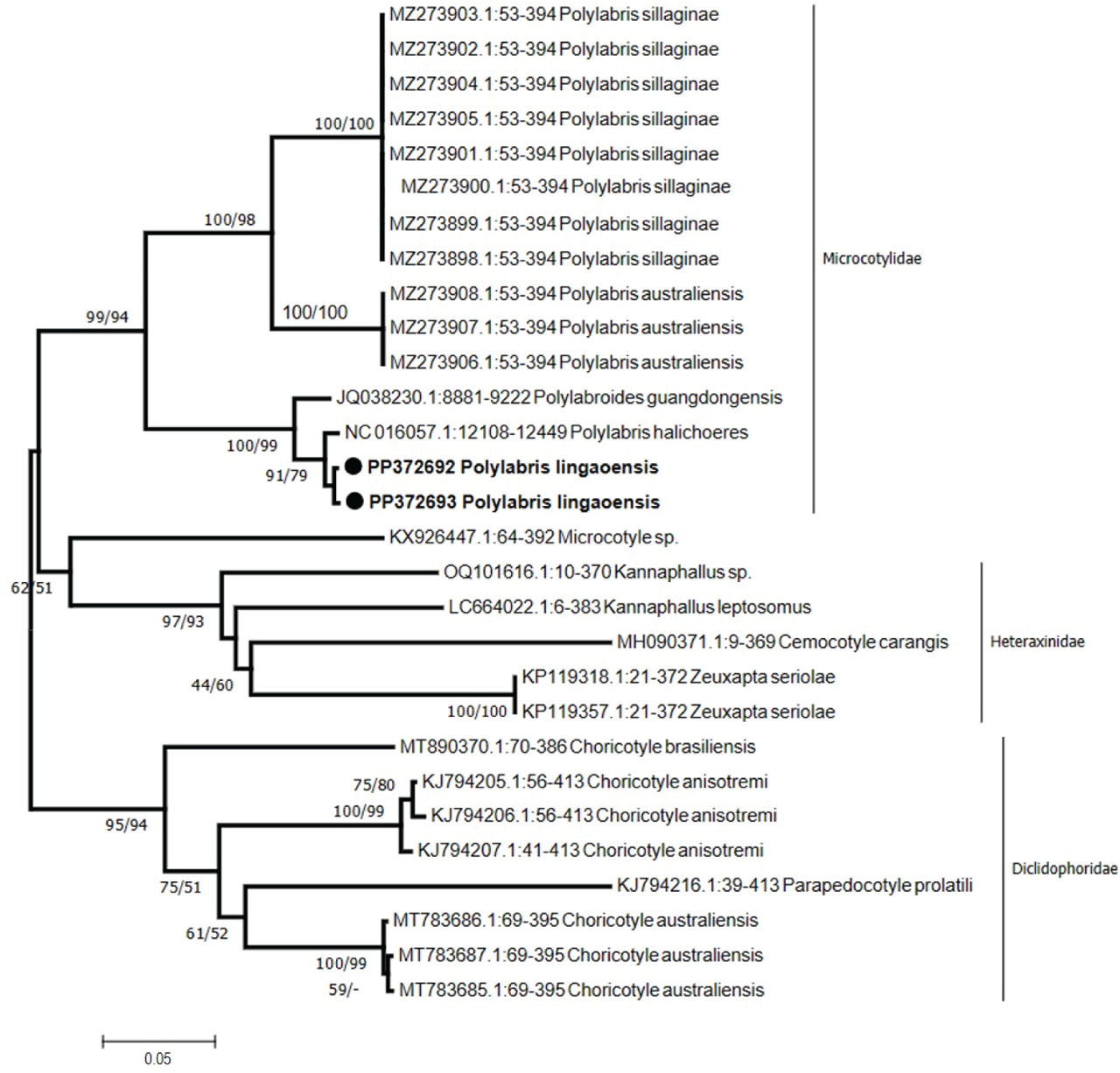
Fig. 3.
A consensus phylogenetic tree constructed with maximum likelihood (ML) and Neighbor-Joining (NJ) methods, inferred from the partial CO1. Numbers indicated at branch nodes are bootstrap values. Only bootstraps > 50% are shown.
Table 2.
Monogenean species used in the phylogenetic analysis of 28S rRNA gene of Polylabris lingaoensis.
| Parasite species | Host species | Infection site | Locality | Reference |
|---|---|---|---|---|
| PP375821 Polylabris lingaoensis | Acanthopagrus bifasciatus | Gills | Saudi Arabia | Present study |
| PP375822 Polylabris lingaoensis | Acanthopagrus bifasciatus | Gills | Saudi Arabia | Present study |
| PP375823 Polylabris lingaoensis | Acanthopagrus bifasciatus | Gills | Saudi Arabia | Present study |
| PP375824 Polylabris lingaoensis | Acanthopagrus bifasciatus | Gills | Saudi Arabia | Present study |
| MT680612 Polylabris cf. mamaevie | Siganus fuscescens | Gills | China | GenBank |
| MH700257 Polylabris sp. | - | - | China | GenBank |
| MH700591 Polylabris cf. mamaevi | - | - | China | GenBank |
| GU289509 Polylabris sillaginae | Sillaginodes punctatus | Gills | Australia | GenBank |
| OR613028 Polylabris japonicus | Acanthopagrus schlegeli | - | South Korea | GenBank |
| MH700258 Polylabroides sp. | - | - | China | GenBank |
| MH700259 Lutianicola sp. | - | - | China | GenBank |
| ON792415 Sparicotyle chrysophryii | Sparus aurata | Gills | Tunisia | GenBank |
| GU263832 Kahawaia truttae | Arripis trutta | Gills | Australia | GenBank |
| GU263831 Kahawaia truttae | Arripis trutta | Gills | Australia | GenBank |
| KT191025 Microcotylidae sp. | Dentex dentex | Gills | Greece | GenBank |
| MN814848 Microcotyle erythrini | Pagellus erythrinus | Gills | Spain | GenBank |
| MN814847 Microcotyle whittingtoni | Dentex dentex | Gills | Spain | GenBank |
| LC658939 Paraheterobothrium chilense | Hippoglossina macrops | - | Japan | GenBank |
| MT890125 Echinopelma brasiliensis | Pagrus pagrus | - | Brazil | GenBank |
| MT782270 Choricotyle australiensis | Chrysophrys auratus | Gills | Australia | GenBank |
| AF382046 Choricotyle australiensis | Choricotyle australiensis | - | Australia | GenBank |
Table 3.
Monogenean species used in the phylogenetic analysis of COI gene of Polylabris lingaoensis.
| Parasite species | Host species | Infection site | Locality | Reference |
|---|---|---|---|---|
| PP372692 Polylabris lingaoensis | Acanthopagrus bifasciatus | Gills | Saudi Arabia | Present study |
| PP372693 Polylabris lingaoensis | Acanthopagrus bifasciatus | Gills | Saudi Arabia | Present study |
| MZ273903 Polylabris sillaginae | Sillago flindersi | - | Australia | GenBank |
| MZ273902 Polylabris sillaginae | Sillago flindersi | - | Australia | GenBank |
| MZ273904 Polylabris sillaginae | Sillago flindersi | - | Australia | GenBank |
| MZ273905 Polylabris sillaginae | Sillago flindersi | - | Australia | GenBank |
| MZ273901 Polylabris sillaginae | Sillago flindersi | - | Australia | GenBank |
| MZ273900 Polylabris sillaginae | Sillago flindersi | - | Australia | GenBank |
| MZ273899 Polylabris sillaginae | Sillago flindersi | - | Australia | GenBank |
| MZ273898 Polylabris sillaginae | Sillago flindersi | - | Australia | GenBank |
| MZ273908 Polylabris australiensis | Engraulis australis | - | Australia | GenBank |
| MZ273907 Polylabris australiensis | Engraulis australis | - | Australia | GenBank |
| MZ273906 Polylabris australiensis | Engraulis australis | - | Australia | GenBank |
| JQ038230 Polylabroides guangdongensis | - | - | China | GenBank |
| NC016057 Polylabris halichoeres | - | - | - | GenBank |
| KX926447 Microcotyle sp. | Scorpaena notata | Gills | France | GenBank |
| OQ101616 Kannaphallus sp. | Gnathanodon speciosus | Gills | Australia | GenBank |
| LC664022 Kannaphallus leptosomus | Scyris indica | Gills | Malaysia | GenBank |
| MH090371 Cemocotyle carangis | Caranx latus | Gills | Brazil | GenBank |
| KP119318 Zeuxapta seriolae | Seriola lalandi | Gills | Chile | GenBank |
| KP119357 Zeuxapta seriolae | Seriola lalandi | Gills | Chile | GenBank |
| MT890370 Choricotyle brasiliensis | Orthopristis ruber | Gills | Brazil | GenBank |
| KJ794205 Choricotyle anisotremi | Anisotremus scapularis | Gills | Chile | GenBank |
| KJ794206 Choricotyle anisotremi | Anisotremus scapularis | Gills | Chile | GenBank |
| KJ794207 Choricotyle anisotremi | Anisotremus scapularis | Gills | Chile | GenBank |
| KJ794216 Parapedocotyle prolatili | Prolatilus jugularis | Gills | Chile | GenBank |
| MT783686 Choricotyle australiensis | Chrysophrys auratus | Gills | Australia | GenBank |
| MT783687 Choricotyle australiensis | Chrysophrys auratus | Gills | Australia | GenBank |
| MT783685 Choricotyle australiensis | Chrysophrys auratus | Gills | Australia | GenBank |