Introduction
Fish is considered an important nutritive niche for parasites in aquatic ecosystems. The twobar Seabream Acanthopagrus bifasciatus Forsskål, 1775 (Sparidae) is considered one of the main components for the fishery in different regions. Like all other fish species, they are affected by parasites. Monogenea are mainly ectoparasitic platyhelminths that live on fish’s fins, skin, gills and rarely in the urinary bladder, stomach, intestine, and blood system depending on their generic species (Whittington et al., 2000).
These monogenoids cause serious damage, especially to the gill filaments, after the invasiveness of their haptor and accompanying structures at the attachment site, reducing the fish’s marketability (Whittington & Chisholm, 2008). Within Mazocraeidea, the largest family is Microcotylidae Taschenberg, 1879, which accounts for 51 valid genera with parasitic species specific to marine fish (de Aguiar et al., 2022). M embers of the genus Polylabris Euzet and Cauwet, 1967 (Mazocraeidea: Polyospithocotylea: Microcotylidae), characterized by the conical shape of the sclerotized male copulatory organ, comprises 23 valid nominal species reported from a wide range of fish inhabiting marine waters (WoRMS, 2024). Of these taxa, 18 host-specific species (termed as oioxenic), infect one or restrict to a few host species with a specific attachment site on the gills (Hayward, 1996).
Species of Polylabris show a high morphological plasticity, so, molecular techniques have been widely utilized to support the specific identification of monogenoids (Hossen et al., 2022). To discriminate between monogeneans, various gene regions, such as nuclear large subunit (28S) ribosomal RNA (rRNA) and mitochondrial gene of cytochrome c oxidase I (COI) have been used (Catalano et al., 2010; Oliva et al., 2014; Mendoza-Franco et al., 2018; Víllora-Montero et al., 2020; Al-Nabati et al., 2021; Alghamdi et al., 2022; Abdel-Gaber et al., 2023). Polylabris species has 25 genetic sequences deposited in GenBank, of which thirteen are recorded for 18S and 28S rRNA genes, and twelve for COI. However, none of the studies regarding the sequences of Polylabris available in GenBank provided morphological descriptions, except for: P. sillaginae (Woolcock, 1936) Dillon, Hargis & Harrises, 1983, P. bengalensis Sailaja & Madhavi, 2011 and P. mamaevi Ogawa & Egusa, 1980 (Dilon & Hargis, 1985; Tingbao et al., 2007; Al-Daraji et al., 2010; Sailaja & Madhavi, 2011).
This study aims to provide molecular data using 28S rRNA and COI gene sequences to a monogenean species that previously lacked genetic sequences, to facilitate further phylogenetic analyses and enhance our understanding of the evolutionary history of Microcotylidae and Polylabris.
Material and Methods
Fish samples and parasitological study
From January to June 2023, forty specimens of Acanthopagrus bifasciatus (Sparidae) were purchased from local fishermen in the coastal region along the Arabian Gulf (Dammam, Saudi Arabia). The gills were removed from the fish, washed with saline solution, and examined for ectoparasites using a dissecting microscope (Nikon SMZ18) supplied with NIS ELEMENTS software. The terms “prevalence” and “mean intensity” follow Bush et al. (1997). Monogeneans were fixed in AFA (70 % ethyl alcohol-formalin-acetic acid) for morphological analysis and 100 % ethyl alcohol for the molecular study. Some monogeneans were stained by Aceto carmine (Sigma-Aldrich, Missouri, USA), cleared in xylene, and mounted in Canada balsam (Du Preez et al., 2017).
A few monogeneans were mounted in glycerin ammonium picrate (GAP; Sigma-Aldrich, Burlington, MA, USA) (Lim, 1991), to study haptor features and terminal genitalia organization. The mounted monogeneans were examined using a light microscope (Leica DM 2500, Leica Microsystems) and photomicrographs were taken for parasite specimens. Measurements (Table 1), all in micrometers, were taken with an ocular micrometer and presented as the mean followed by the range in parentheses.
Table 1.
Comparative metrical data for Polylabris lingaoensis and their congeneric species.
| Comparable parameters | Tingbao et al. (2007) | Bayoumy et al. (2015) | Present study (2024) | |
|---|---|---|---|---|
| Host | Ambassis gymnocephalus | Acanthopagrus bifasciatus | Acanthopagrus bifasciatus | |
| Location | China | Egypt | Saudi Arabia | |
| Body | Length | 1356 (1130–1597) | 1231 (1120–1426) | 1398 (1275–1723) |
| Width | 239 (159–298) | 256 (179–286) | 280 (230–310) | |
| Buccal sucker | Length | 41 (34–48) | 43 (34–48) | 49 (42–61) |
| Width | 43 (37–50) | 46 (39–54) | 54 (42–70) | |
| Pharynx diameter | 34 (27–42) | 34 (27–42) | 35 (30–52) | |
| Oesophagus length | - | - | 111 (102–120) | |
| Number of genital spines | Unarmed | Unarmed | Unarmed | |
| Male copulatory organ | Length | 39 (34–45) | 41 (37–48) | 43 (39–50) |
| Width | 27 (22–33) | 29 (25–36) | 35 (30–45) | |
| Germarium | Length | - | - | 394 (387–411) |
| Width | - | - | 93 (81–102) | |
| Vaginae diameter | - | - | 49 (48–50) | |
| Number of testes | 5–7 | 6–8 | 6–8 | |
| Haptor | Length | 583 (478–735) | 623 (528–814) | 1498 (1452–1511) |
| Width | - | - | 216 (207–232) | |
| Number of clamp pairs | 30–43 | 33–45 | 35–45 | |
| Anterior clamp | Length | - | - | 58 (52–63) |
| Width | 43 (39–48) | - | 33 (30–34) | |
| Posterior clamp | Length | - | - | 22 (21–25) |
| Width | 36 (33–40) | - | 37 (36–38) | |
Molecular phylogenetic analysis
Genomic DNA was extracted using the QIAamp® DNA Mini Kit (Qiagen, Germany) following the manufacturer’s instructions. The partial 28S rRNA and COI gene regions were amplified using standard PCR. The U178/L1642 primers were used for amplifying 28S rRNA as designed by Lockyer et al. (2003). The COI gene was amplified with primers COI-ASmit1/COI-ASmit2 designed by Littlewood et al. (1997) and Ward et al. (2005), respectively. To amplify the targeted genes, the cycling conditions were as follows: initial denaturation at 94°C for 5 min, followed by 35 cycles of denaturation at 94°C for 30 sec, annealing at 56°C (28S rRNA) and 50°C (COI) for 30 sec, extension at 72°C for 1 min, and final extension 72°C for 10 min. Each amplicon (3 µl) was electro-phoresed on a 1.5 % agarose gel, stained with SYBR green (Thermo Fischer Scientific, Ottawa, Canada) and 100 bp GeneRuler (Fermentas, Lithuania), and examined using a gel documentation system. Representative monogenean samples were sent to Macrogen’s facilities unit in Seoul, South Korea, where they were subjected to Sanger sequencing using the same primer sets as PCR.
The sequences were deposited in GenBank and compared to the database through Basic Local Alignment Search (BLAST). Phylogenetic relationships were inferred using MEGA X (Kumar et al., 2018). Bootstrap values were determined for the 28S rRNA and COI molecular data sets using 1000 replicates each.
Ethical Approval and/or Informed Consent
This research was approved by the Research Ethics Committee (REC) at King Saud University (approval number KSU-SU-23-76).
Results
The gills of 40 twobar seabream fish, Acanthopagrus bifasciatus, were collected from Dammam (Eastern region Saudi Arabia) and then examined for monogenoids. Thirteen twobar seabreams were infected by a species of Microcotylidae, described below as Polylabris lingaoensis Tingbao, Kritsky, and Jun, 2007. Intensity among infected fish did not exceed ten.
Description
Body lanceolate, 1398 (1275 – 1723) long, 280 (230 – 310) wide (Fig. 1 A). Anterior end equipped with pair of elliptical prohaptoral suckers, septate, and open medially, with muscular anterior, posterior, and lateral walls; septum extended diagonally across the anterolateral half of sucker (Fig. 1 A – C). Each sucker 49 (42 – 61) long, 54 (42 – 70) wide. Pharynx spherical, 35 (30 – 52) in diameter (Fig. 1 A and B). Oesophagus relatively long, 111 (102 – 120) long, bifurcated at the level of male copulatory organ, forming two intestinal caeca reaching haptor (Fig. 1 A – C). Genital atrium unarmed and equipped with a mid-ventral genital pore.
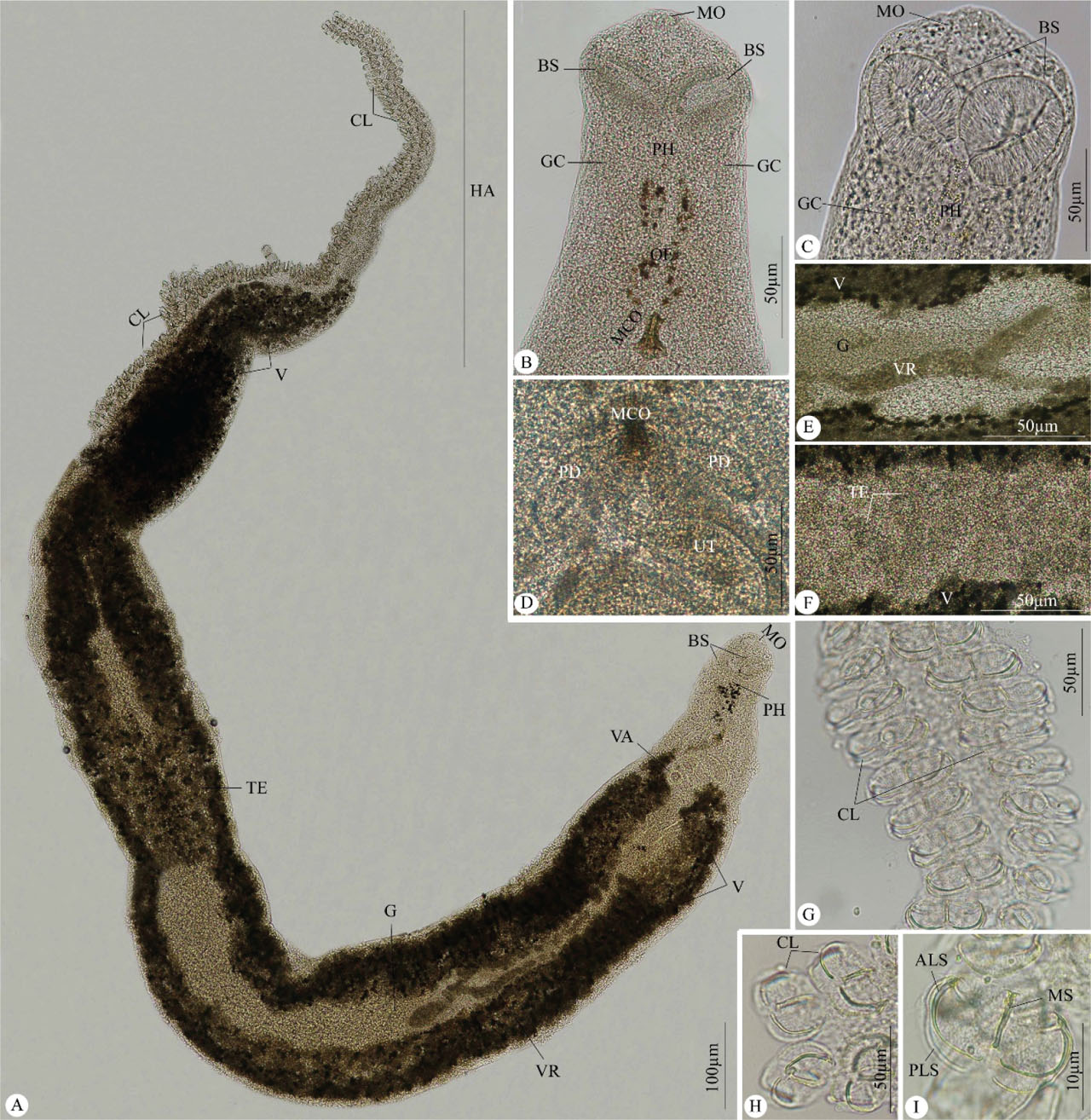
Fig. 1.
Photomicrographs of Polylabris lingaoensis. (A) Whole specimen. (B) Anterior part of prohaptor. (C) Detail of prohaptor. (D) Male copulatory organ and distal portion of seminal vesicle. (E) Germarium. (F) Testis. (G) Two clamp rows in the haptor. (H) Detail of haptoral clamps. (I) Structure of clamp. Note: ALS, antero-lateral sclerite; BS, buccal sucker; CL, clamps; G, Germarium; GC, gland cells; HA, haptor; MCO, male copulatory organ; Mo, mouth; MS, median sclerite; OE, oesophagus; PD, prostatic ducts; PH, pharynx; PLS, postero-lateral sclerite; TE, testes; UT, uterus; V, vitellaria; VA, vagina; VR, vitelline reservoir.
Testes 6 to 8 in number, and intercaecal in the posterior half of the body (Fig. 1 A and F). Male copulatory organ conical, 43 (39 – 50) long, 35 (30 – 45) wide, formed by inner tube and outer sheath (Fig. 1 D). Inner tube slightly expanded with parallel margins basally, narrowing before entering the distal portion of the outer sheath. Anterior portion of male copulatory organ flat and recurved dorsally. Pair of bilateral prostatic ducts join to produce a single common prostatic duct that enters a small circular pore on the dorsal side of the male copulatory organ’s external sheath (Fig. 1 D). Germarium pre-testicular (Fig. 1 A and E), shaped as an interrogation mark, intercaecal, dorsal to vitelline ducts, 394 (387 – 411) long, 93 (81 – 102) wide. Uterus elongated, reaching from body’s midline to genital atrium (Fig. 1 D). Vaginae unarmed, measuring 49 (48 – 50) in diameter, opening into a single medioventral aperture posterior to the common genital opening (Fig. 1 A). Vitelline reservoir vase-shaped and positioned ventrally to germarium (Fig. 1 A, E, and F). Vitelline follicles coextensive with the intestinal ceca and extended into haptor.
Haptor 1498 (1452 – 1511) long, 216 (207 – 232) wide with two parallel subequal rows of 35 – 45 pairs of microcotylid clamps each (Fig. 1 A and G). Each clamp bilaterally symmetrical with paired antero- and postero-lateral sclerites, as well as a median sclerite with bifid ends (Fig. 1 H and I). Anterior and posterior clamps were 58 (52 – 63) long × 33 (30 – 34) wide and 22 (21 – 25) long × 37 (36 – 38) wide.
Taxonomic summary
Type host: Twobar seabream Acanthopagrus bifasciatus Forsskål, 1775 (Sparidae)
Type locality: Gills of the infected fish.
Prevalence and mean intensity: 32.5 % (13 fish infested of a total of 40); mean of 10 monogeneans per infested fish (range 8 – 13).
Molecular analysis (Figs. 2,3)
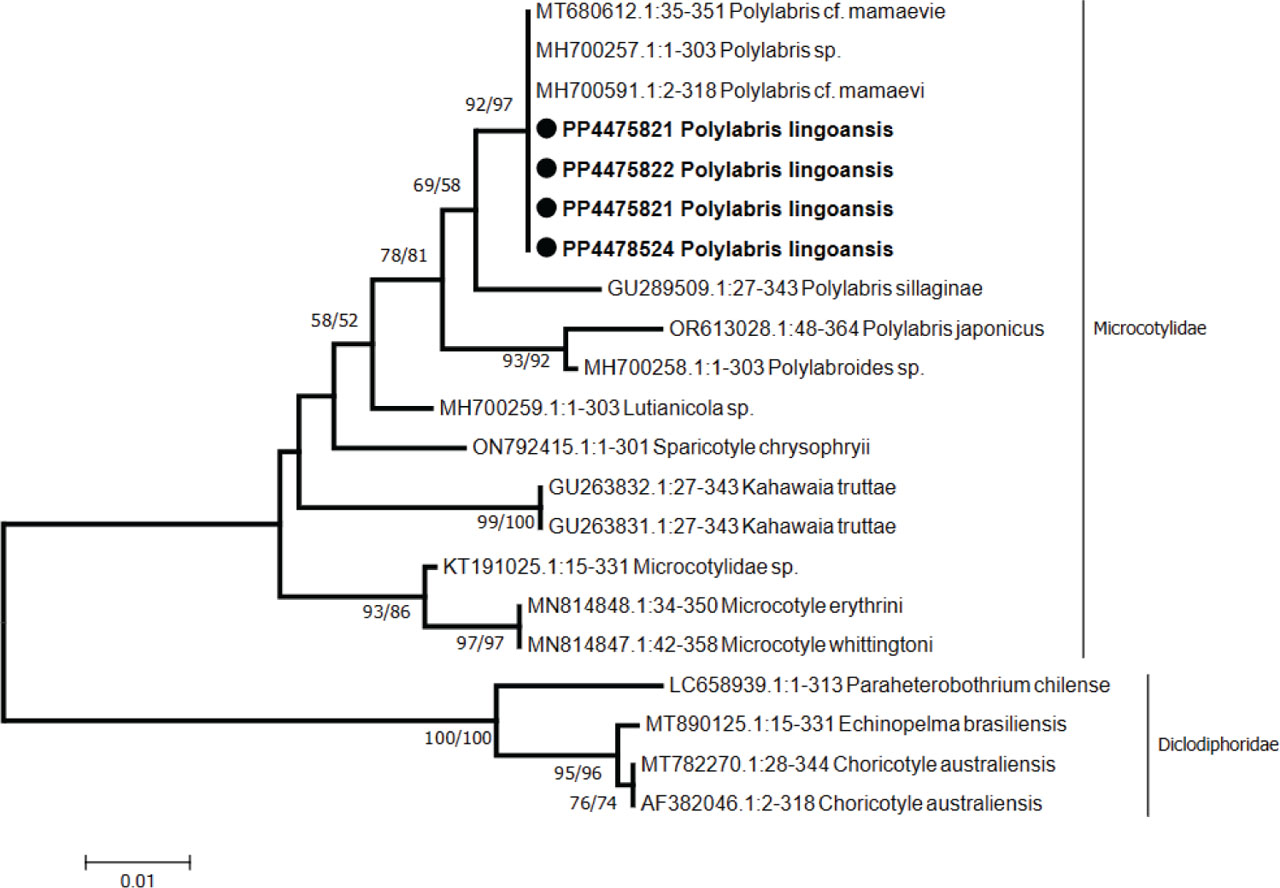
Fig. 2.
A consensus phylogenetic tree constructed with maximum likelihood (ML) and Neighbor-Joining (NJ) methods, inferred from the partial 28S rRNA. Numbers indicated at branch nodes are bootstrap values. Only bootstraps > 50% are shown.
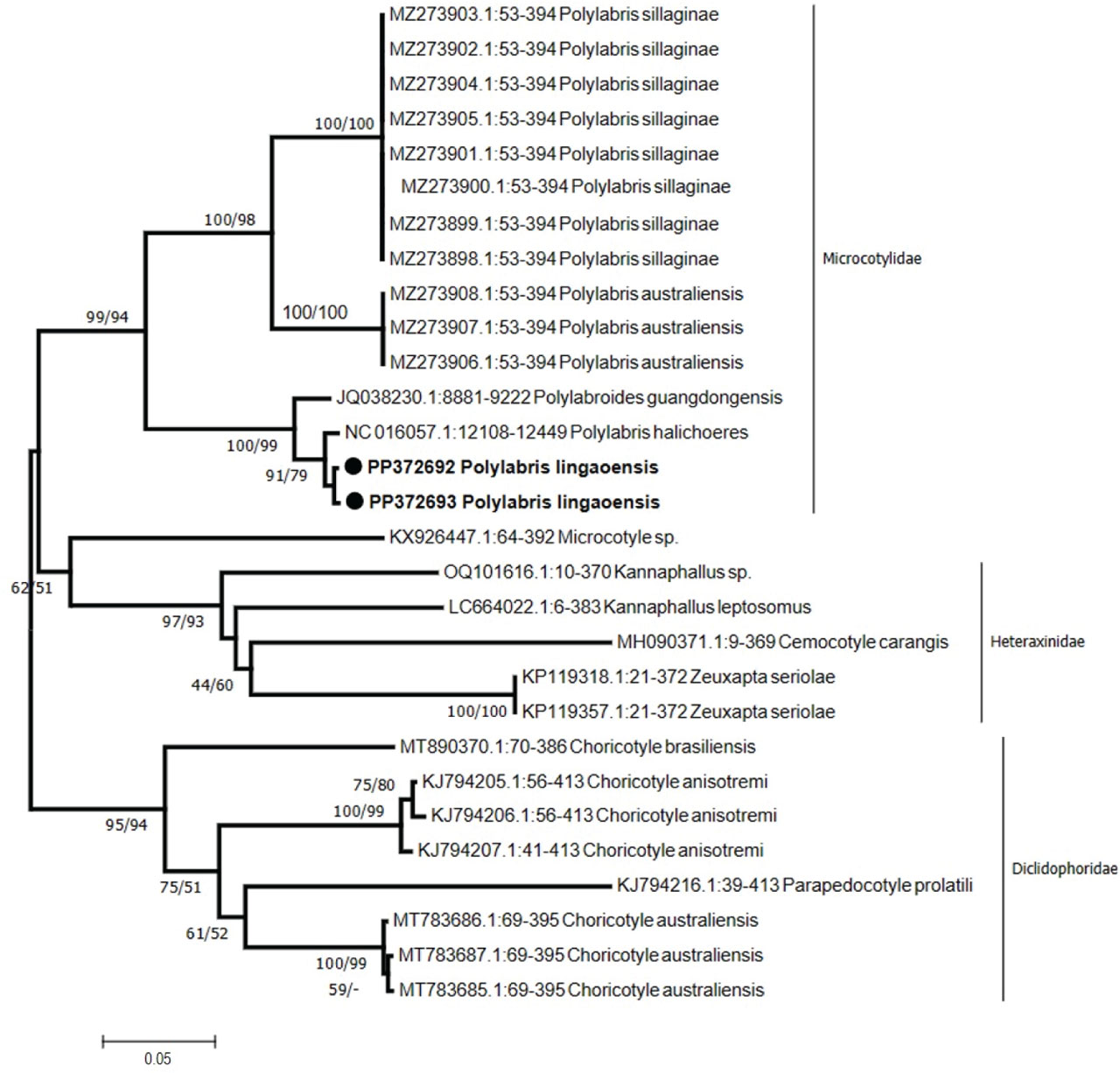
Fig. 3.
A consensus phylogenetic tree constructed with maximum likelihood (ML) and Neighbor-Joining (NJ) methods, inferred from the partial CO1. Numbers indicated at branch nodes are bootstrap values. Only bootstraps > 50% are shown.
PCR amplification of the 28S rRNA and COI regions yielded 350 bp and 420 bp, respectively. The 28S rRNA gene provided four sequences, while the COI gene amplification produced two sequences. The sequences derived from the 28S rRNA region were all identical and were deposited in GenBank with the accession numbers PP375821 to PP375824. COI sequences were also deposited in GenBank, with accession numbers PP372692 and PP372693. The 28S rRNA sequences were grouped with those from the Family Microcotylidae, with two sequences from Polylabris cf. mamaevi (MT680612 and MH700591) and Polylabris sp. (MH700257) demonstrating a significant bootstrap value (Table 2). The sequences obtained in this study had a 100 % similarity to those of Polylabris cf. mamaevi and Polyabris sp. The present study’s sequences indicated 98 % similarity to Polylabris silaginae (GU289509), Polylabroides sp. (MH700258), and Lutianicola sp. (MH700259), as well as 97 % similarity to Polylabris japonicus (OR613028). Both Maximum Likelihood (ML) and Neighbor-Joining (NJ) phylogenetic trees based on 28S rRNA sequences revealed the same topology, with sequences related to P. lingaoensis obtained in the current study clustering with Polylabris cf. mamaevi and Polylabris sp. The present sequences were distinct from those of P. silaginae and P. japonicus (Fig. 2).
Table 2.
Monogenean species used in the phylogenetic analysis of 28S rRNA gene of Polylabris lingaoensis.
| Parasite species | Host species | Infection site | Locality | Reference |
|---|---|---|---|---|
| PP375821 Polylabris lingaoensis | Acanthopagrus bifasciatus | Gills | Saudi Arabia | Present study |
| PP375822 Polylabris lingaoensis | Acanthopagrus bifasciatus | Gills | Saudi Arabia | Present study |
| PP375823 Polylabris lingaoensis | Acanthopagrus bifasciatus | Gills | Saudi Arabia | Present study |
| PP375824 Polylabris lingaoensis | Acanthopagrus bifasciatus | Gills | Saudi Arabia | Present study |
| MT680612 Polylabris cf. mamaevie | Siganus fuscescens | Gills | China | GenBank |
| MH700257 Polylabris sp. | - | - | China | GenBank |
| MH700591 Polylabris cf. mamaevi | - | - | China | GenBank |
| GU289509 Polylabris sillaginae | Sillaginodes punctatus | Gills | Australia | GenBank |
| OR613028 Polylabris japonicus | Acanthopagrus schlegeli | - | South Korea | GenBank |
| MH700258 Polylabroides sp. | - | - | China | GenBank |
| MH700259 Lutianicola sp. | - | - | China | GenBank |
| ON792415 Sparicotyle chrysophryii | Sparus aurata | Gills | Tunisia | GenBank |
| GU263832 Kahawaia truttae | Arripis trutta | Gills | Australia | GenBank |
| GU263831 Kahawaia truttae | Arripis trutta | Gills | Australia | GenBank |
| KT191025 Microcotylidae sp. | Dentex dentex | Gills | Greece | GenBank |
| MN814848 Microcotyle erythrini | Pagellus erythrinus | Gills | Spain | GenBank |
| MN814847 Microcotyle whittingtoni | Dentex dentex | Gills | Spain | GenBank |
| LC658939 Paraheterobothrium chilense | Hippoglossina macrops | - | Japan | GenBank |
| MT890125 Echinopelma brasiliensis | Pagrus pagrus | - | Brazil | GenBank |
| MT782270 Choricotyle australiensis | Chrysophrys auratus | Gills | Australia | GenBank |
| AF382046 Choricotyle australiensis | Choricotyle australiensis | - | Australia | GenBank |
Sequences for the recovered monogenoid species from the COI region (PP372692 and PP372693) were not similar, and the alignment revealed one mutation (transversion) at position 201, which was an A on PP372692 and a T on PP372693. However, the amino acids produced during translation remained unchanged. Phylogenetic trees (NJ and ML) derived from the analysis of P. lingaoensis COI sequences and sequences from other Polylabris species available in GenBank (Table 3) revealed two separate clades of Polyabris spp. One clade included P. sillaginae and P. australiaensis, while another included P. ligaoensis, P. halichoeres, and Polylabroides guangdongensis (Fig. 3). The closest relation of P. lingaoensis was seen with P. guangdongensis, with variations in 4 to 5 nucleotides. The difference with P. guangdongensis was seen on 10 to 11 nucleotides.
Table 3.
Monogenean species used in the phylogenetic analysis of COI gene of Polylabris lingaoensis.
| Parasite species | Host species | Infection site | Locality | Reference |
|---|---|---|---|---|
| PP372692 Polylabris lingaoensis | Acanthopagrus bifasciatus | Gills | Saudi Arabia | Present study |
| PP372693 Polylabris lingaoensis | Acanthopagrus bifasciatus | Gills | Saudi Arabia | Present study |
| MZ273903 Polylabris sillaginae | Sillago flindersi | - | Australia | GenBank |
| MZ273902 Polylabris sillaginae | Sillago flindersi | - | Australia | GenBank |
| MZ273904 Polylabris sillaginae | Sillago flindersi | - | Australia | GenBank |
| MZ273905 Polylabris sillaginae | Sillago flindersi | - | Australia | GenBank |
| MZ273901 Polylabris sillaginae | Sillago flindersi | - | Australia | GenBank |
| MZ273900 Polylabris sillaginae | Sillago flindersi | - | Australia | GenBank |
| MZ273899 Polylabris sillaginae | Sillago flindersi | - | Australia | GenBank |
| MZ273898 Polylabris sillaginae | Sillago flindersi | - | Australia | GenBank |
| MZ273908 Polylabris australiensis | Engraulis australis | - | Australia | GenBank |
| MZ273907 Polylabris australiensis | Engraulis australis | - | Australia | GenBank |
| MZ273906 Polylabris australiensis | Engraulis australis | - | Australia | GenBank |
| JQ038230 Polylabroides guangdongensis | - | - | China | GenBank |
| NC016057 Polylabris halichoeres | - | - | - | GenBank |
| KX926447 Microcotyle sp. | Scorpaena notata | Gills | France | GenBank |
| OQ101616 Kannaphallus sp. | Gnathanodon speciosus | Gills | Australia | GenBank |
| LC664022 Kannaphallus leptosomus | Scyris indica | Gills | Malaysia | GenBank |
| MH090371 Cemocotyle carangis | Caranx latus | Gills | Brazil | GenBank |
| KP119318 Zeuxapta seriolae | Seriola lalandi | Gills | Chile | GenBank |
| KP119357 Zeuxapta seriolae | Seriola lalandi | Gills | Chile | GenBank |
| MT890370 Choricotyle brasiliensis | Orthopristis ruber | Gills | Brazil | GenBank |
| KJ794205 Choricotyle anisotremi | Anisotremus scapularis | Gills | Chile | GenBank |
| KJ794206 Choricotyle anisotremi | Anisotremus scapularis | Gills | Chile | GenBank |
| KJ794207 Choricotyle anisotremi | Anisotremus scapularis | Gills | Chile | GenBank |
| KJ794216 Parapedocotyle prolatili | Prolatilus jugularis | Gills | Chile | GenBank |
| MT783686 Choricotyle australiensis | Chrysophrys auratus | Gills | Australia | GenBank |
| MT783687 Choricotyle australiensis | Chrysophrys auratus | Gills | Australia | GenBank |
| MT783685 Choricotyle australiensis | Chrysophrys auratus | Gills | Australia | GenBank |
Discussion
Monogenea are ectoparasitic platyhelminths that live on the body surfaces, fins, head, gills, eyes, and oral and branchial cavities of several fish species (Whittington & Chisholm, 2008). These worms cause significant damage due to the invasiveness of their suckers, clamps, and hooks at the attachment site (Hutson et al., 2007). Many monogenean taxa have been described globally from marine fish species. Little information is available on species of the family Microcotylidae. Polylabris currently contains twenty-three species found in various fish hosts and locations (WoRMS, 2024). The monogenean specimens found herein were identified following the dichotomous keys of Hussey (1986), Hayward (1996), and Tingbao et al. (2007) for the genus Polylabris for the first time in the sparid fish from Saudi Arabia.
In this investigation, the gills of thirteen twobar seabreams (32.5 %) were found to be infected with a polyopisthocotylean parasite from the Polylabris genus, with an average intensity of 10. The current prevalence is lower than the previous data of Polylabris bengalensis reported by Sailaja and Madhavi (2011) in Siganus javus and S. oramin from Visakhapatnam coast (Bay of Bengal, India) (Prevalence =50 %) and mean intensity of 17.8, Polylabris lingaoensis reported by Bayoumy et al. (2015) in Acanthopagrus bifasciatus from Red Sea (Hurghada, Egypt) (Prevalence =53.3 %), and Polylabris sillaginae reported by Hossen et al. (2022) in Sillago flindersi from NSW coast and Victorian coast (Australia) (prevalence =55 % and 3 %) with a mean intensity of 1.93 and 1 parasites/host, respectively. Furthermore, this prevalence is higher than the previous data of Polylabris tubicirrus reported by Santos et al. (1996) in Diplodus argenteus Copacabana beach (Rio de Janeiro, Brazil) (prevalence =12 %), and Polylabris mamaevi reported by Al-Daraji et al. (2010) in Acanthopagrus latus from Khor Abdullah (Northwest Arabian Gulf) (prevalence =17 %) with a mean intensity of 1.3 parasites/host.
Members of the Polylabris genus differ from other microcotylids in that they have a single sclerotized male copulatory organ generally conical (Hayward 1996). These Polylabis species might be distinguished by the morphology of the male copulatory organ, the number of vaginal pores (uni- or bi-vaginate), the number and form of testes, the number of clamp pairs, and the extent of caeca. The current microcotylid specimens are identical to P. lingaoensis identified previously by Tingbao et al. (2007) from the gills of Ambassis gymnocephalus (India) and Bayoumy et al. (2015) from the gills of Acanthopagrus bifasciatus (Egypt). The only variation between P. lingaoensis from A. bifasciatus and two specimens from A. gymnocephalus and A. bifasciatus, is the size of the haptor concerning the body length, the number of clamps, and the copulatory organ size. In contrast, body size is not considered a reliable feature to be used for discriminating Polylabris species, especially in the presence of various fish species (type host), and this is supported by Bayoumy et al. (2015), who reported that Polylabris species can be significantly smaller than the average even when isolated from their usual host.
Some Polylabris species exhibit a high level of host specificity by being restricted to fish of the family Sparidae including P. diplodi, P. acanthopagri, P. tubicirrus, P. japonicus, P. angifer, P. rhabdosargi, and P. lingaoensis, whilst those appearing on several host species within different families (i.e. Kuhliidae, Gobiidae, Gerreidae, Pomacentridae, Siganidae, Sillaginidae, Leiognathidae, Mugilidae, Kyphosidae, and Labridae) with diversity in geographical distribution are limited to fishes with relatively tight phylogenetic relationships, such as Tingbao et al. (2007) stated that this pattern of host ranges shows a low possibility of cospeciation among Polylabris species, with adaptive forms of speciation dominating the genus Polylabris’ evolutionary history and development.
Moreover, P. lingaoensis could be differentiated from other Polylabris species based on the morphology of testes (oval and arranged linearly in P. mamaevi), as well as the number of testes (5 in P. sigani; 5 – 6 in P. carnarvonensis; 18 – 20 in P. virgatarum; 18 – 24 (by Mamaev & Parukhin, 1976) and 9 – 14 (by Tingbao et al., 2007) in P. mamaevi; numerous follicular in P. bengalensis; 9 – 10 in P. indica; 9 – 13 in P. halichoeres; 9 – 17 in P. angifer; 12 – 16 in P. diplodi; 13 – 15 in P. tubicirrus).
Regarding to the number of clamps per row, the present species could be distinguished from other related ones (19 – 25 in P. acanthogobii; 20 – 35 (Hossen et al., 2022), 19 – 36 (Hayward, 1996) in P. australiensis; 23 – 32 in P. halichoeres; 25 – 44 (Mamaev & Parukhin, 1976) and 27 – 47 (Tingbao et al., 2007) in P. mamaevi; 30 in P. sigani; 27 – 40 (Hossen et al., 2022), 22 – 34 (Dillon et al., 1985), 21 – 25 (Williams, 1991), and 27 – 39 (Hayward, 1996) in P. sillaginae; 32 – 39 in P. bengalensis; 41 – 47 in P. carnarvonensis; 48 – 50 in P. virgatarum; 58 in P. tubicirrus; 55 – 60 in P. diplodi; 53 – 63 in P. japonicus; 50 – 70 in P. angifer).
According to the reproductive organs features, there are some points differentiate the current species from those described previously, as following the number of vaginae (bi-vaginate in P. sigani, P. sillaginae, P. australiensis, P. williamsi, P. carnarvonensis), the genital atrium armature (armed in P. acanthopagri), and the anterior portion of the male copulatory organ (straight with outer sheath strongly sclerotized with broad base and parallel proximal margins in P. kuhliae).
The morphological identification of Polylabris species requires molecular analysis to establish its generic position utilizing the partial 28S rRNA and COI gene sequences obtained during this study. Sequences from the 28S rRNA related to P. lingaoensis were identical to those from Polylabris cf. mamaevi and Polylabris sp., indicating that the 28S rRNA region is unsuitable for differentiation between congeners of Polylabris, as stated by previous works (Mendoza-Franco et al., 2018). Mendoza-Franco et al. (2018) found that all microcotylids exhibited little variation at the molecular level with their relevant organisms from distant geographic locations. Even when they showed remarkable morphologic differences, as seen herein. That was attributed to the region of the 28S rRNA being highly conserved in microcotylids, which demonstrated that using sequences from the mitochondrial DNA such as COI should be prioritized when distinguishing between species of monogeneans, which is reinforced by the results of the present work (Mendoza-Franco et al., 2018). Even within the two sequences we described herein there was a mutation at one point which has shown intraspecific variation. Therefore, COI is a useful marker to differentiate between different members of the family Microcotylidae. Mitochondrial DNA sequences, represented by COI, from specimens of the present study clearly showed distinction from P. autraliensis, P. silaginae, Polylabroides guangdongensis, and Polylabris halichoeres. Based on the morphological characteristics the organism under study is related to P. lingaoensis.
Conclusion
The present findings update the available data about P. lingaoensis (Microcotylidae) from the gills of A. bifasciatus. This is the first report of this monogenean parasite in marine fish in Saudi Arabia. Moreover, we have also shown both 28S rRNA and COI sequences from P. lingaoensis for the first time. Sequences of COI were found to be more informative in elucidating the phylogenetic position of P. lingaoensis with related taxa.
Notes
[1] Conflicts of interest Conflict of Interest
No conflict of interest was declared by the authors regarding the content of this article.
[2] Consent to Participate
All authors in this study agreed to participate.
[3] Consent to Publish
All authors in this study agreed to publish the data.
[4] Availability of Data and Materials
All the datasets generated or analyzed during this study are included in this published article.
Ackonowledgement
This study was supported by the Researchers Supporting Project (RSP2024R25), King Saud University, Riyadh, Saudi Arabia.