Fig. 1.
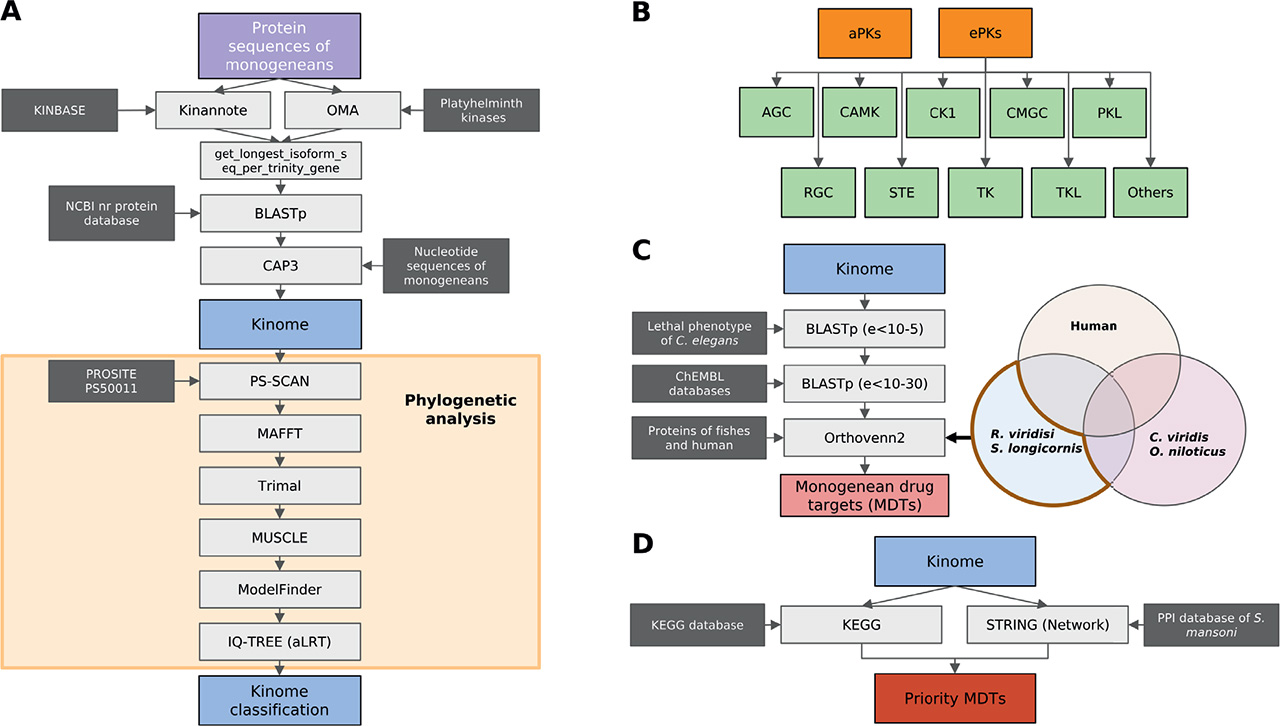
Bioinformatic pipeline for the identification, classification, and selection of potential drug targets. A) Pipeline for the identification and classification of monogenean kinases. B) Classification of protein kinases. C) Pipeline used for the identification of drug targets. D) Pipeline used for the prioritization of monogenean drug targets (MDTs). ePKs, eukaryotic protein kinases; aPKs, atypical protein kinases; AGC, cAMP-dependent protein kinase/protein kinase G/protein kinase C extended family; CAMK, calcium/calmodulin-dependent kinase; CK1, cell kinase 1; CMGC, cyclin-dependent kinases and other close relatives; PKL, protein kinase-like; RGC, receptor guanylate cyclase; STE, MAP kinase cascade kinases; TK, protein tyrosine kinase; TKL, tyrosine kinase-like.
Table 1.
Classification of kinases in various platyhelminths.
| Group | AGC | CAMK | CK1 | CMGC | PKL | Other | RGC | RGC/CAMK | STE | TK | TKL | Unknown | Atypical | Total general | |
|---|---|---|---|---|---|---|---|---|---|---|---|---|---|---|---|
| Monogenea | R. viridisi | 29 | 17 | 10 | 30 | 5 | 25 | 2 | - | 13 | 19 | 9 | - | 1 | 160 |
| S. longicornis | 32 | 27 | 11 | 34 | 4 | 29 | 2 | - | 13 | 26 | 13 | - | 2 | 193 | |
| Cestoda | E. multilocularis | 43 | 35 | 11 | 44 | - | 30 | 5 | - | 25 | 46 | 26 | - | - | 265 |
| E. granulosus | 41 | 35 | 11 | 43 | - | 30 | 5 | - | 24 | 42 | 22 | - | - | 253 | |
| T. solium | 56 | 36 | 12 | 61 | - | 37 | 11 | 1 | 28 | 45 | 23 | - | - | 310 | |
| H. microstoma | 48 | 33 | 13 | 64 | - | 30 | 6 | - | 28 | 33 | 18 | - | - | 273 | |
| Trematoda | S. mansoni | 34 | 38 | 9 | 44 | - | 39 | 3 | - | 27 | 34 | 19 | 5 | - | 252 |
| S. haematobium | 39 | 41 | 9 | 51 | 4 | 40 | 3 | - | 27 | 31 | 20 | 4 | - | 269 | |
| S. japonicum | 27 | 33 | 8 | 41 | 6 | 35 | 4 | - | 23 | 31 | 13 | - | 1 | 222 | |
| F. gigantica | 44 | 55 | 13 | 66 | - | 45 | 0 | - | 35 | 34 | 16 | - | - | 308 | |
| F. buski | 33 | 42 | 10 | 47 | - | 40 | 1 | - | 23 | 39 | 15 | - | - | 250 | |
[i] Information taken from Andrade et al. (2011), Young et al. (2011), Tsai et al. (2013), Stroehlein et al. (2015), Giuliani et al. (2018), and the present study.
Table 2.
Kinases of Rhabdosynochus viridisi and Scutogyrus longicornis predicted to be monogenean drug targets (MDTs).
| Species | ID | Classification (group/family/subfamily) | Priority for molecular docking *** |
|---|---|---|---|
| R. viridisi | Contig3487.p1 | (CK1/CK1/CK1-A) | - |
| R. viridisi | Contig474.p1 | (AGC) | - |
| R. viridisi | Contig130.p1 | (AGC/RSK/RSKp70) | 1** |
| R. viridisi | TRINITY_DN128_c1_g2_i2.p1 | (TK/Ack) | - |
| R. viridisi | TRINITY_DN430_c0_g1_i4.p1 | (TK/Fer) | - |
| R. viridisi | Contig2641.p1 | (AGC/PKG) | - |
| R. viridisi | TRINITY_DN4663_c0_g2_i1.p1a | (CAMK/CAMKL/BRSK) | - |
| R. viridisi | Contig4408.p1 | (CAMK/MLCK) | - |
| R. viridisi | Contig5219.p1 | (CMGC/GSK) | - |
| R. viridisi | TRINITY_DN1044_c0_g2_i2.p2 | (STE/STE11/MEKK1) | 3* |
| R. viridisi | Contig3286.p1 | (CAMK/CAMKL/MARK) | - |
| S. longicornis | Contig1825.p1 | (TK/Ack) | - |
| S. longicornis | TRINITY_DN2502_c0_g3_i3__g.25108 | (TK) | - |
| S. longicornis | TRINITY_DN770_c0_g1_i4__g.58217 | (TK/Fer) | - |
| S. longicornis | Contig3492.p1 | (AGC/PKG) | - |
| S. longicornis | TRINITY_DN1812_c0_g1_i2__g.5503 | (AGC/RSK/RSKp70) | 1* |
| S. longicornis | TRINITY_DN7486_c0_g6_i1__g.37596 | (CAMK/MLCK) | - |
| S. longicornis | TRINITY_DN1065_c0_g1_i1__g.51110 | (CMGC/GSK) | - |
| S. longicornis | TRINITY_DN14095_c0_g1_i1__g.60752 | (CK1/CK1/CK1-A) | - |
| S. longicornis | Contig772.p1a | (CAMK/CAMKL/BRSK) | 2** |
| S. longicornis | Contig773.p1a | (CAMK/CAMKL/BRSK) | 2** |
| S. longicornis | Contig3764.p1 | (CAMK/CAMKL/MARK) | - |
Table 3.
The highest binding affinities (≤ −9.0 kcal/mol) obtained from molecular docking using a set of FDA-approved drugs.
| Drug | Species | Receptor id | Binding affinity (kcal/mol) |
|---|---|---|---|
| Dihydroergotaminea | S. longicornis | Contig773.p1 and Contig772.p1 | −9.7 |
| Lomitapideb | R. viridisi | TRINITY_DN1044_c0_g2_i2.p2 | −9.5 |
| Dihydroergotaminea | R. viridisi | TRINITY_DN1044_c0_g2_i2.p2 | −9.4 |
| Ergotaminec | S. longicornis | Contig773.p1 and Contig772.p1 | −9.2 |
| Bicalutamided | R. viridisi | Contig130.p1 | −9.1 |
| Piroxicame | R. viridisi | TRINITY_DN1044_c0_g2_i2.p2 | −9.0 |
| Suvorexantf | R. viridisi | TRINITY_DN1044_c0_g2_i2.p2 | −9.0 |
Description according DrugBank (Wishart et al., 2018):
a dihydroergotamine (ZINC ID: ZINC3978005) is an ergot alkaloid used in the acute treatment of migraine and cluster headaches;
b lomitapide (ZINC ID: ZINC27990463) is a microsomal triglyceride transfer protein inhibitor used to lower cholesterol associated with homozygous familial hypercholesterolemia, reducing the risk of cardiovascular events such as myocardial infarction and stroke;
c ergotamine (ZINC ID: ZINC52955754) is an α1-selective adrenergic agonist vasoconstrictor used to treat migraines with or without aura and cluster headaches;
d bicalutamide (Casodex, ZINC ID: ZINC538564) is an androgen receptor inhibitor used to treat stage D2 metastatic carcinoma of the prostate;