
Table 1.
Geographical location, information on sampling stations and methods used in the three study cases: forest, grassland and maize crop systems.
| Charactersitcs of the study area | Forest | Grassland | Maize crop |
|---|---|---|---|
| Reference | Čerevková et al., 2021 | Čerevková, 2006 | Čerevková et al., 2018 |
| Study Area | Slovakia | Slovakia | Denmark, Spain, Slovakia, and Sweden |
| Sampling locations and coordinates | Mount Poľana (48°37′ N 19°30′ E) |
|
|
| Environmental factors compared |
|
|
|
| Sampling date | August 2019 | October 2003 – 2004 | 2013/2014 (during the flowering phase of maize) |
| No. of plots sampled | 15 | 4 | 10 |
| No. of replicates for plot | 5 | 5 | 3 |
| Extraction method | Baermann technique | Cobb's flotation-sieving method | Baermann technique |
| Total genera found | 51 | 65 | 45 |
| Type of soil | Cambisol |
|
|
| Relevant environmental parameters information (pH, temperature etc..) | pH: 4.69 – 4.93; C%: 9.10 – 9.71; N%: 0.76 – 0.82; C/N: 11.66 – 12.07 | pH: 6.95-7-8.2; Cox 3.42-6.16 | pH: 5.97 – 7.55; C%. 1.24 – 1.68; N%: 0.13 – 0.17; C/N: 8.68 – 13.11 |
| Type of vegetation | BEE: Fagus sylvatica L. Acer spp.; SPR: Picea abies (L.) H. Karst.); UNM: F. sylvatica, Abies alba Mill., Acer pseudoplatanus L., Fraxinus excelsior L., P. abies and Ulmus glabra H. | NM: Dactylis glomerata L., Festuca rubra L. and Lolium perene L.; PM: indigenous multispecies vegetation irregularly mown; PP: indigenous vegetation regularly grazed | Bt and isogenic (ISO) hybrids DKC3872YG (Bt maize line MON810) and its near-isogenic line DKC3871 DKC6451YG (Bt maize line MON810) and its near-isogenic line DKC6450 |
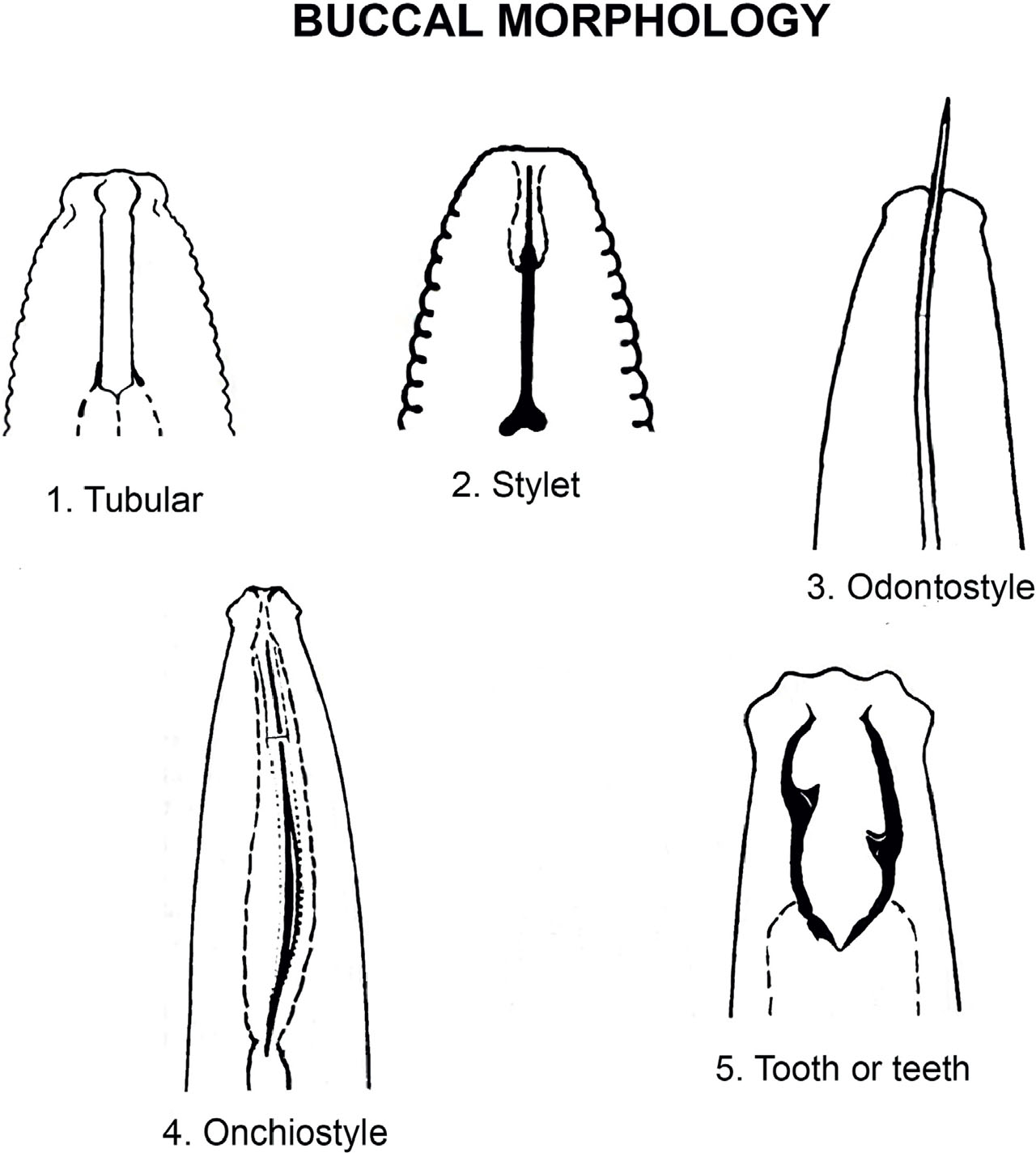
Fig. 1.
Occurrence and morphology of possible cuticularizations in the buccal cavity: 1.unarmed buccal cavity; 2. stylet; 3. odontostyle; 4. onchiostyle; 5. tooth or teeth.
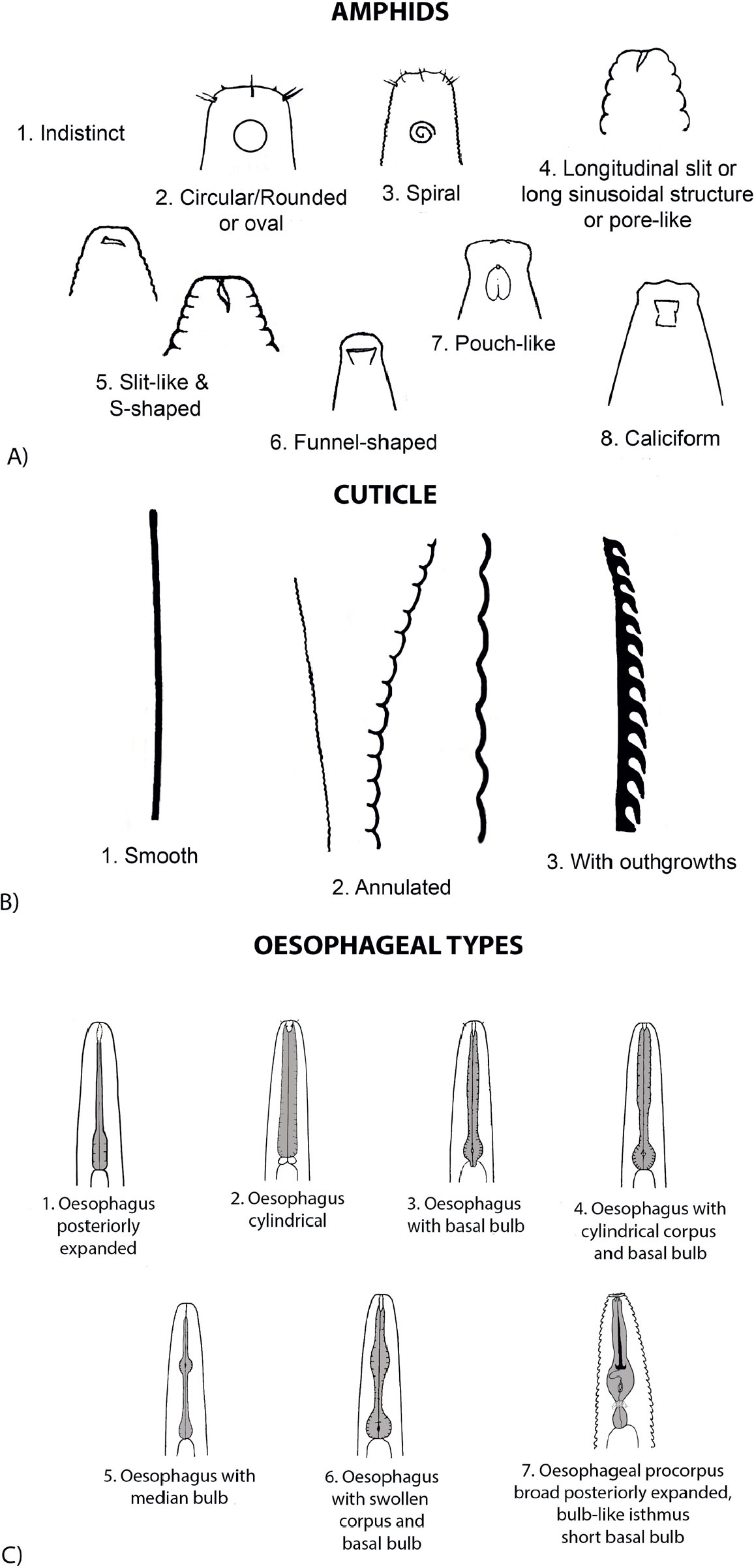
Fig. 2.
A) Amphideal fovea: 1. undetected; 2. circular/rounded or oval; 3. spiral; 4. thin, narrow slit or pore-like; 5. large slite-like & S-shape; 6. funnel-shape; 7. pouch-like; 8. caliciform. B) Cuticles: 1. smooth; 2. annulated; 3. with outhgrowths; C) Oesophageal shape: 1. oesophagus posteriorly expanded; 2. oesophagus cylindrical; 3. oesophagus with basal bulb; 4. oesophagus with cylindrical corpus and basal bulb; 5. oesophagus with median bulb; 6. oesophagus with median bulb; 6. oesophagus with swollen corpus and basal bulb; 7. oesophageal procorpus broad posteriorly expanded, bulb-like isthmus short basal bulb.
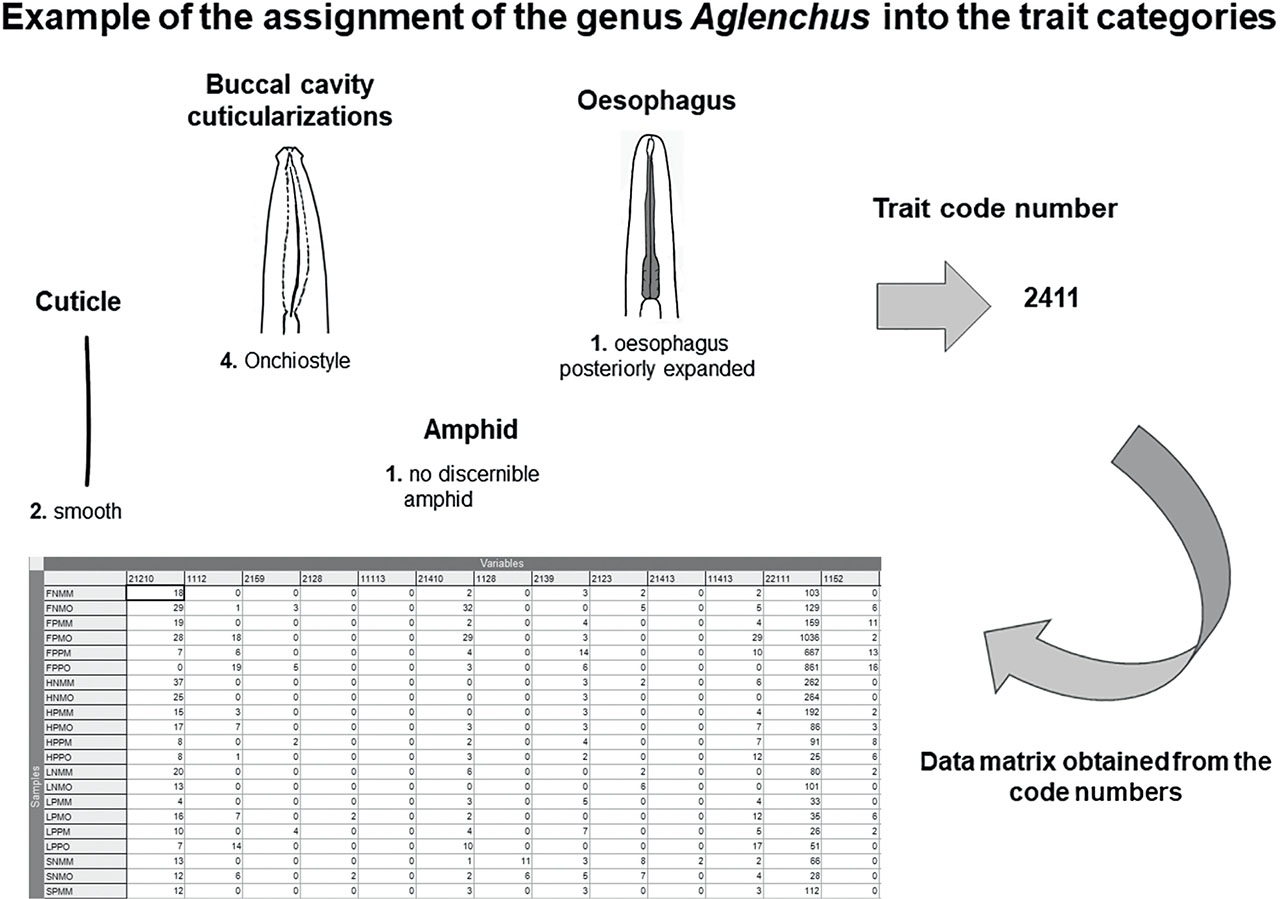
Fig. 3.
Assignment of each genus in the four morpho-functional traits and creation of the data matrix based on their combinations.
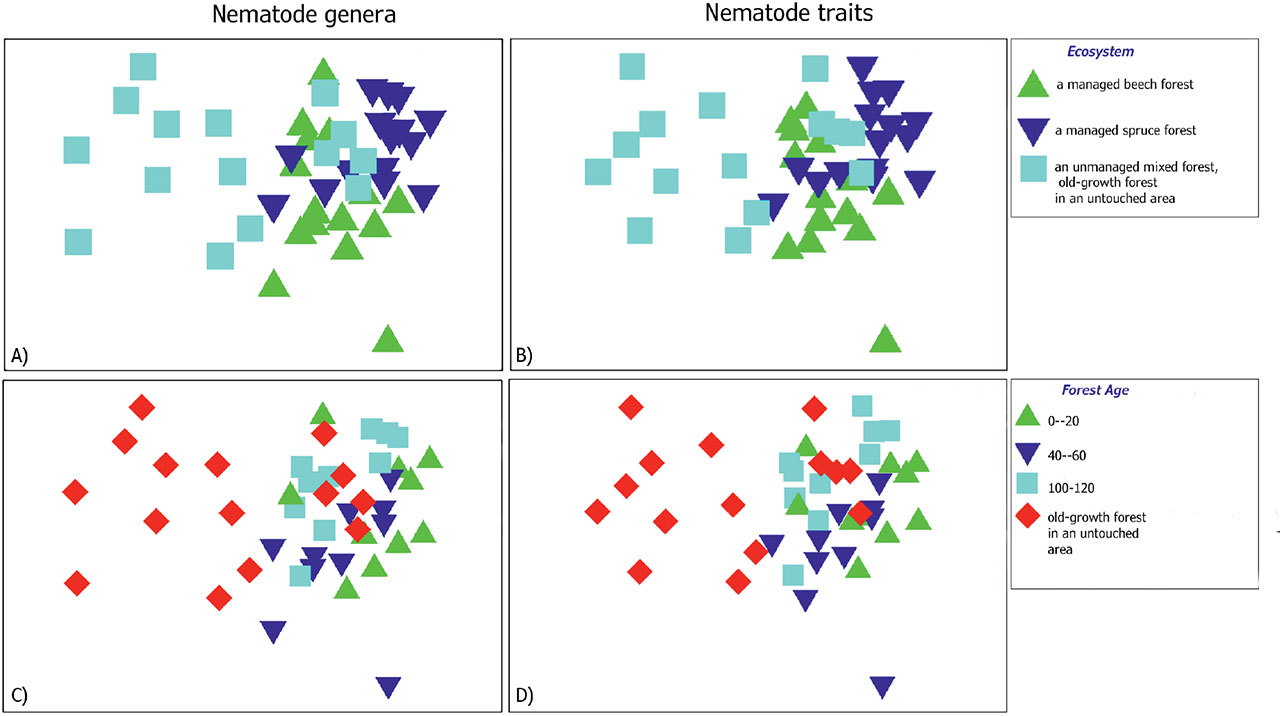
Fig. 4.
nMDS carried out on both nematode genera and trait codes (Bray–Curtis similarity, untransformed data) from forest ecosystems in Slovakia. Factors analyzed: A, B) managed beech forest (BEE), managed spruce forest (SPR), and unmanaged mixed forest (UNM). C-D) BEE and SPR plots were stratified by stand age: 0–20, 40–60, and 100–120 age.
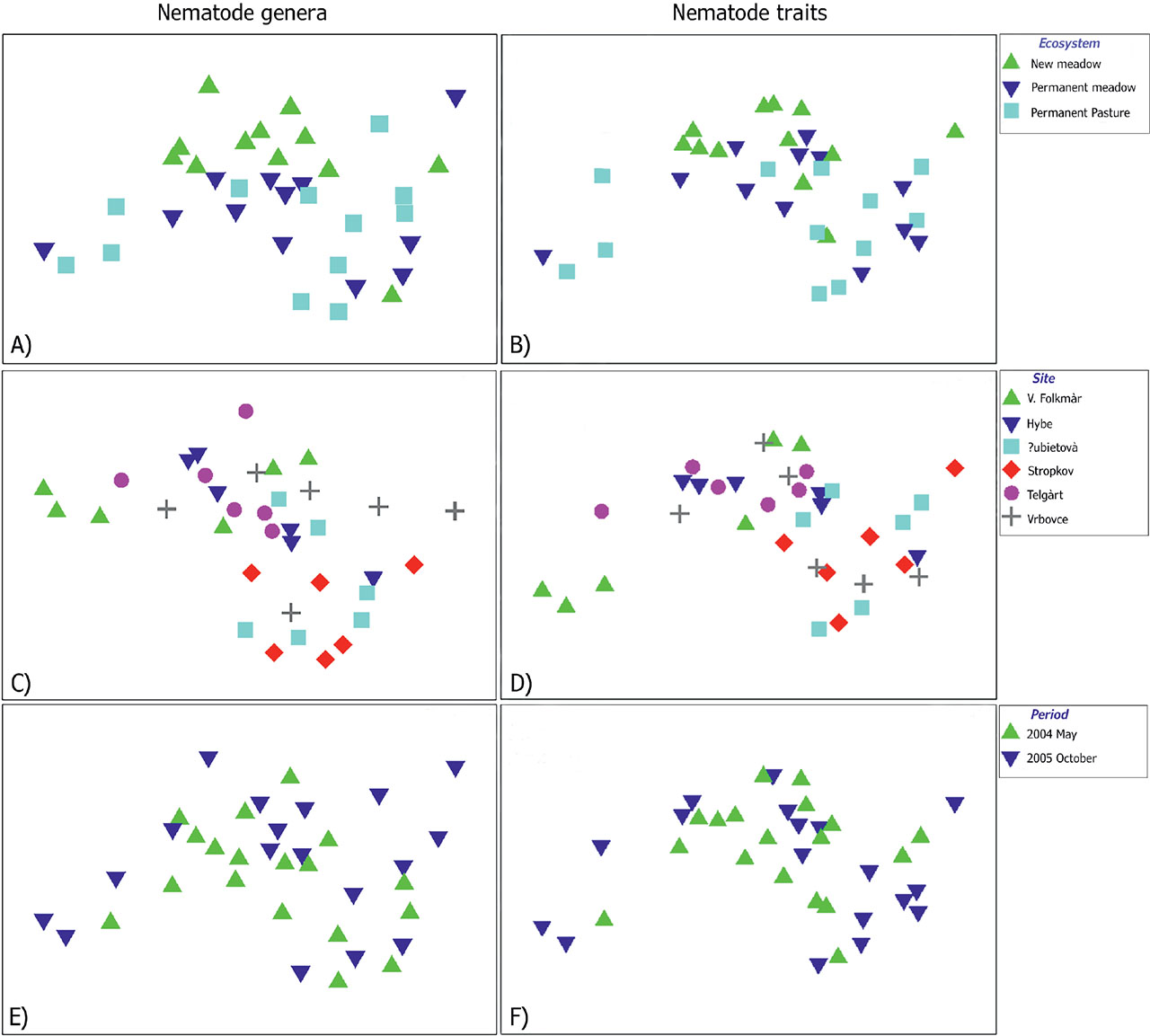
Fig. 5.
nMDS carried out on both nematode genera and trait codes (Bray–Curtis similarity, untransformed data) from grassland types of various regions of the Slovak Republic. Factors analyzed: A, B) localities placed around Slovakia (i.e. Ľubietová, Stropkov, Telgárt, Vrbovce and Veľký Folkmár); C, D) type of grassland: NM (established during last 3 years), PM (covered with indigenous multispecies vegetation irregularly mown) and PP (with indigenous vegetation regularly grazed); E, F) period (May 2004 and October 2005).
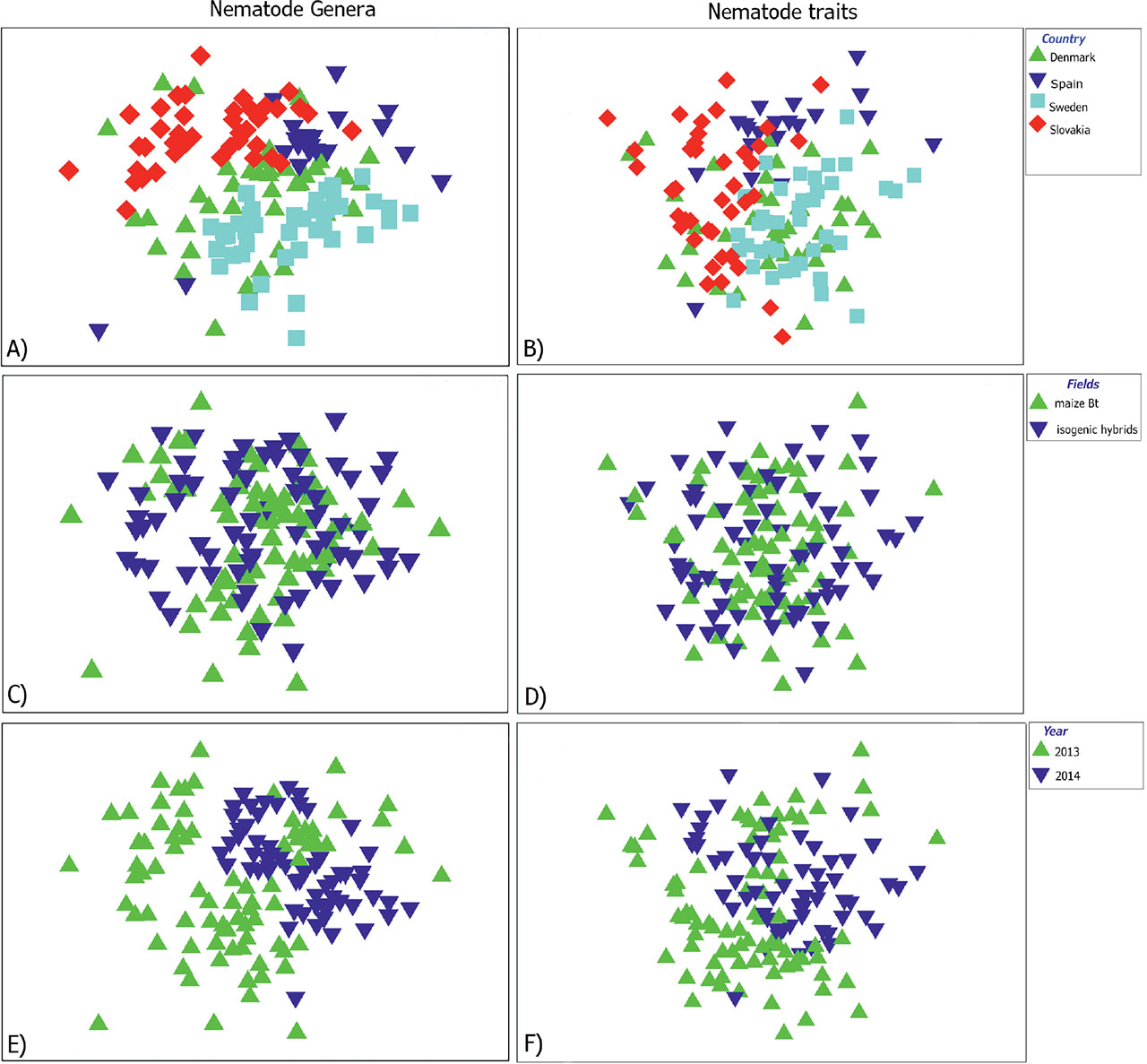
Fig. 6.
nMDS carried out on both nematode genera and trait codes (Bray–Curtis similarity, untransformed data) from different maize-growing regions in Europe. Factors analyzed: A, B) country (i.e. Denmark, Slovakia, Sweden and Spain); C, D) maize Bt and isogenic (ISO) hybrids and E, F) period (year 2013, 2014).
Table 2.
Results of Analysis of Similarities (ANOSIM) carried out to detect the potential occurrence of significant differences among the factors under scrutiny in each of the three study cases (n.s. indicates when significant differences were not found and abbreviations are as follows: BEE: managed beech forest; SPR: managed spruce forest; UNM: unmanaged mixed forest; 0–20, 40–60, and 100–120 stage age; NM: new meadow; PM: permanent meadow; PP: permanent pasture).
| Case study | Genus level structure Global statistic | Pairwise Test | Trait combination level Global statistic | Pairwise Test |
|---|---|---|---|---|
| Forest ecosystem | R = 0.29; p = 0.001 | SPR vs UNM: R = 0.39; p = 0.001 | R = 0.29; p = 0.001 | SPR vs UNM: R = 0.40; p = 0.001 |
| BEE vs SPR: R = 0.27; p = 0.001 | BEE vs UNM: R = 0.27; p = 0.002 | |||
| BEE vs UNM: R = 0.25; p = 0.002 | BEE vs SPR: R = 0.22; p = 0.002 | |||
| Forest age | R = 0.15; p = 0.001 | 0–20 vs old forest: R=0.34; p=0.002 | R = 0.16; p = 0.001 | 0–20 vs old forest: R=0.35; p=0.004 |
| 40–60 vs old forest: R=0.21; p=0.013 | 40–60 vs old forest: R=0.23; p=0.006 | |||
| 0–20 vs 100–120: R=0.19; p=0.02 | 0–20 vs 100–120; R=0.20; p=0.012 | |||
| 100–120 vs old forest: R=0.15; p=0.04 | 100–120 vs old forest; R=0.15; p=0.027 | |||
| 0–20 vs 40–60: R=0.14; p= 0.03 | 40–60 vs 100–120; R=0.14; p=0.036 | |||
| 40–60 vs 100–120: R= 0.14; p=0.04 | ||||
| Grassland ecosystem | R=0.12; p=0.005 | NM vs PP: R= 0.23; p=0.006 | R=0.12; p=0.012 | NM vs PP: R= 0.26; p=0.005 |
| NM vs PM: R= 0.15; p=0.001 | NM vs PM: R= 0.11; p=0.042 | |||
| Grassland site | R=0.24; p=0.002 | Stropkov vs Telgárt: R=0.67; p=0.002 | R=0.18; p=0.004 | Stropkov vs Telgárt: R=0.55; p=0.002 |
| V. Folkmár vs Stropkov: R=0.58; p=0.001 | V. Folkmár vs Stropkov: R=0.49; p=0.004 | |||
| Hybe vs Stropkov: R=0.50; p=0.004 | V. Folkmár vs Ľubietová: R=0.44; p=0.004 | |||
| Ľubietová vs Telgárt: R=0.47; p=0.004 | Ľubietová vs Telgárt: R=0.44; p=0.002 | |||
| V. Folkmár vs Ľubietová: R=0.41; p=0.001 | Hybe vs Stropkov: R=0.33; p=0.032 | |||
| Grassland date | p=n.s. | p=n.s. | p=n.s. | p=n.s. |
| Type of maize crop | p=n.s. | p=n.s. | p=n.s. | p=n.s. |
| Country | R = 0.38; p = 0.001 | Sweden vs Slovakia: R=0.53; 0.001 | R = 0.28; p<0.001 | Sweden vs Spain: R=0.52; p=0.001 |
| Spain vs Slovakia: R=0.44; p=0.001 | Denmark vs Spain: R=0.36; p=0.001 | |||
| Denmark vs Spain: R=0.38; p=0.001 | Sweden vs Slovakia: R=0.33; 0.001 | |||
| Sweden vs Spain: R=0.38; p=0.001 | Spain vs Slovakia: R=0.31; p=0.001 | |||
| Denmark vs Slovakia: R=0.33; p=0.001 | Denmark vs Slovakia: R=0.24; p=0.001 | |||
| Denmark vs Sweden: R=0.23; p=0.001 | Denmark vs Sweden: R=0.10; p=0.001 | |||
| Year | R=0.19; p=0.001 | R=0.07; p=0.002 |
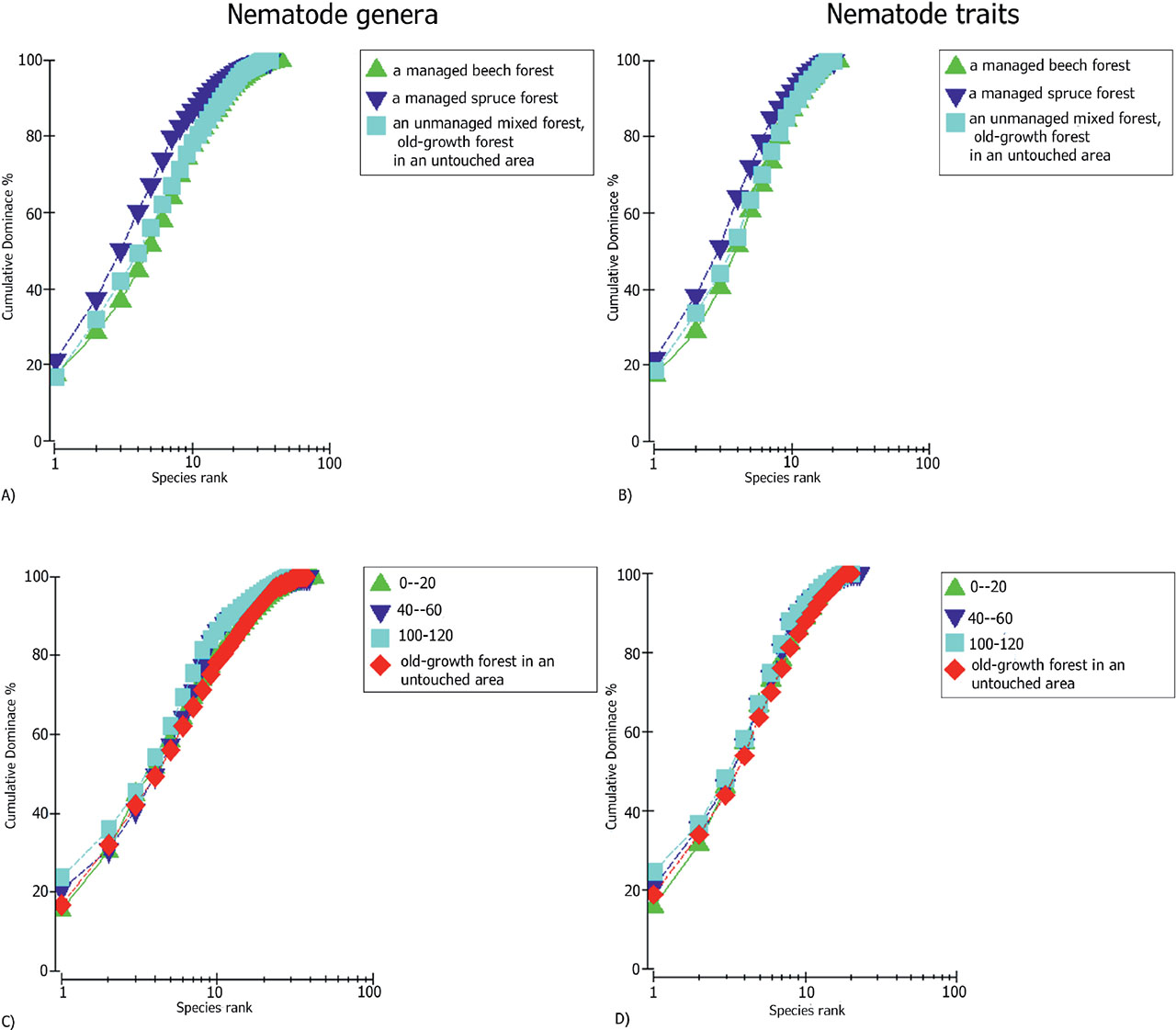
Fig. 7.
k-dominance curves carried out on both nematode genera and trait codes from forest ecosystems in Slovakia. Factors analyzed: A, B) managed beech forest (BEE), managed spruce forest (SPR), and unmanaged mixed forest (UNM). C-D) BEE and SPR plots were also stratified by stand age: 0–20, 40–60, and 100–120 age.
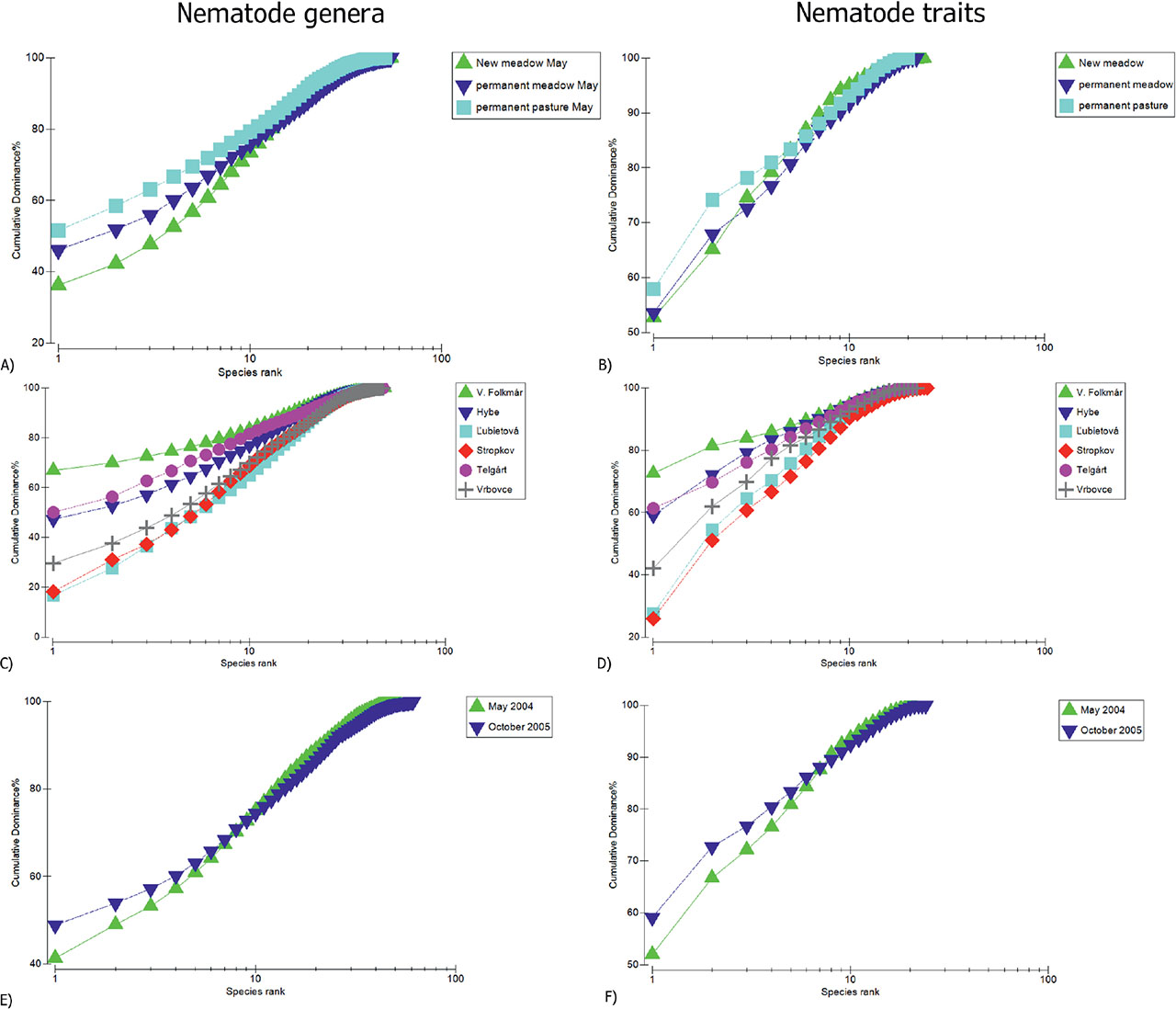
Fig. 8.
k-dominance curves carried out on both nematode genera and trait codes from grassland types of various regions of the Slovak Republic. Factors analyzed: A, B) type of grassland: NM (established during last 3 years), PM (covered with indigenous multispecies vegetation irregularly mown) and PP (with indigenous vegetation regularly grazed); C, D) localities placed around Slovakia (i.e. Ľubietová, Stropkov, Telgárt, Vrbovce and Veľký Folkmár); E, F) period (May 2004 and October 2005).
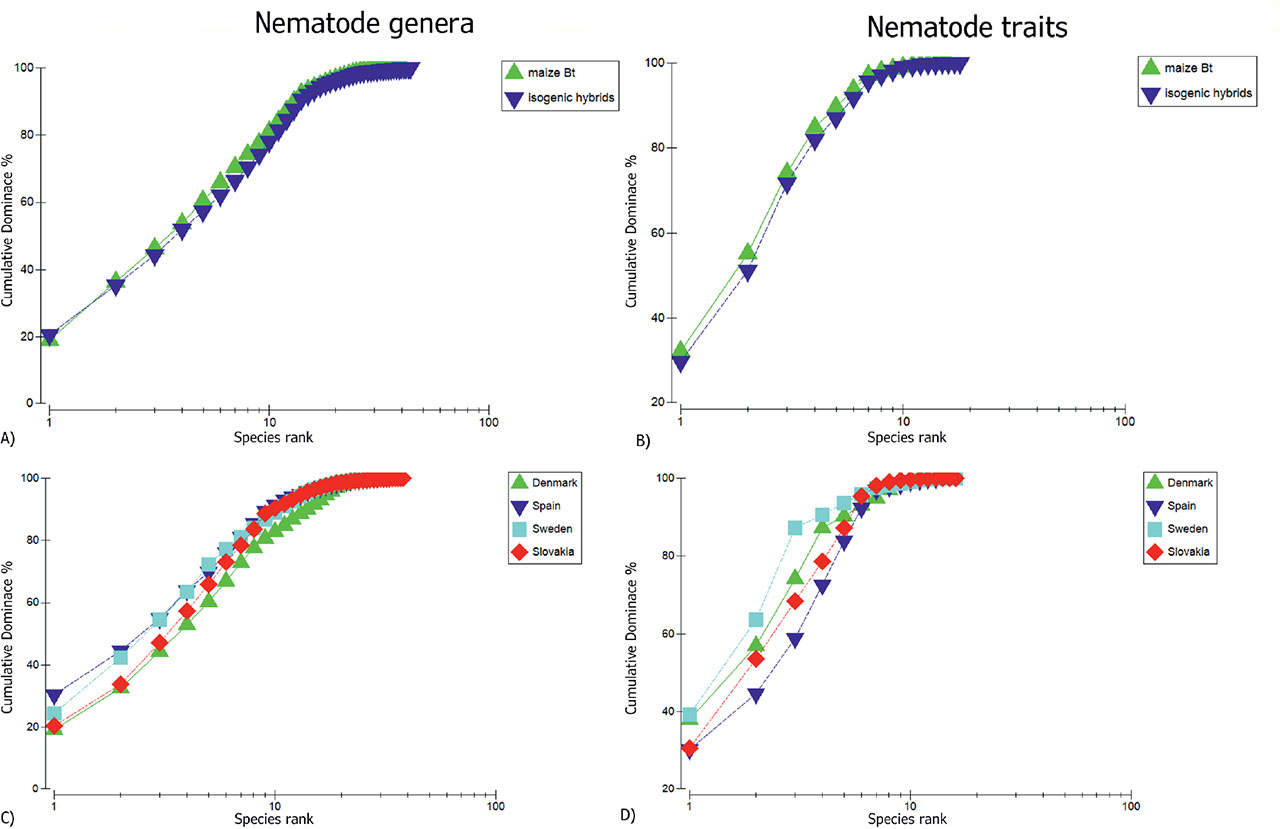
Fig. 9.
k-dominance curves carried out on both nematode genera and trait codes from different maize-growing regions in Europe. Factors analyzed: A, B) maize Bt and isogenic (ISO) hybrids and E, F) period (year 2013, 2014); C, D) country (i.e. Denmark, Slovakia, Sweden and Spain).