Table 1.
Age and gender distribution of epileptic patients.
| Age (years) | Male (%) | Female (%) | Total (%) |
|---|---|---|---|
| < 15 | 3 (11.53) | 1 (3.84) | 4 (15.38) |
| 15–29 | 8 (30.76) | 3 (11.53) | 11 (42.30) |
| 30–44 | 7 (26.92) | 3 (11.53) | 10 (38.46) |
| ≥45 | 1 (3.84) | 0 (0) | 1 (3.84) |
| Total | 19 (73.07) | 7 (26.93) | 26 (100.0) |
Table 2.
Seropositivity result by indirect IgG-ELISA according to type of antigens and CT/MRI lesions*.
| Type of lesion | Number of Patients (%) | Number of patients seropositive against the antigens | ||||
|---|---|---|---|---|---|---|
| WCA (%) | CFA (%) | SA (%) | ESA (%) | MBA (%) | ||
| Granular nodular | 4 (15.38) | 0 | 0 | 1 (25.0) | 0 | 0 |
| Calcified granular | 13 (50.0) | 2 (15.38) | 3 (23.07) | 6 (46.15) | 5 (38.46) | 1 (7.69) |
| Ring enhancing | 6 (23.07) | 3 (50.0) | 2 (33.33) | 3 (50.0) | 3 (50.0) | 2 (33.33) |
| Calcified spots | 3 (11.53) | 0 | 1 (33.33) | 0 | 0 | 0 |
| Total | 26 (100.0) | 5 (19.23) | 6 (23.07) | 10 (38.46) | 8 (30.76) | 4 (15.38) |
Table 3.
Seropositivity by indirect IgG-ELISA according to location of lesions.
| Location of lesions | Number of patients (%) | Anti-Cysticercus IgG-ELISA positivity | ||||
|---|---|---|---|---|---|---|
| WCA | CFA | SA | ESA | MBA | ||
| Left parietal lobe | 14 (53.84) | 4 (28.57) | 5 (35.71) | 7 (50.0) | 5 (35.74) | 3 (21.42) |
| Right parietal lobe | 2 (7.69) | 0 | 0 | 1 (50.0) | 1 (50.0) | 0 |
| Left frontal lobe | 4 (15.38) | 1 (25.0) | 1 (25.0) | 0 | 1 (25.0) | 0 |
| Right frontal lobe | 3 (11.53) | 0 | 0 | 0 | 0 | 1 (33.0) |
| Occipital lobe | 1 (3.84) | 0 | 0 | 1 (100.0) | 0 | 0 |
| Temporal lobe | 1 (3.84) | 0 | 0 | 0 | 0 | 0 |
| Basal ganglia | 1 (3.84) | 0 | 0 | 1 (100.0) | 1 (100.0) | 0 |
| Total | 26 (100.0) | 5 (19.23) | 6 (23.07) | 10 (38.41) | 8 (30.76) | 4 (15.38) |
Table 4.
Seropositivity by indirect IgG-ELISA according to number of lesions.
| Number of lesions | Number of patients | Anti-cysticercus IgG ELISA positivity | ||||
|---|---|---|---|---|---|---|
| WCA | CFA | SA | ESA | MBA | ||
| Single lesion | 19 (73.07) | 3 (15.78) | 2 (10.52) | 8 (42.14) | 4 (21.05) | 3 (15.78) |
| Multiple lesions | 7 (26.93) | 2 (28.57) | 4 (57.14) | 2 (28.57) | 4 (57.14) | 1 (14.28) |
| Total | 26 (100.0) | 5 (19.23) | 6 (23.07) | 10 (38.41) | 8 (30.76) | 4 (15.38) |
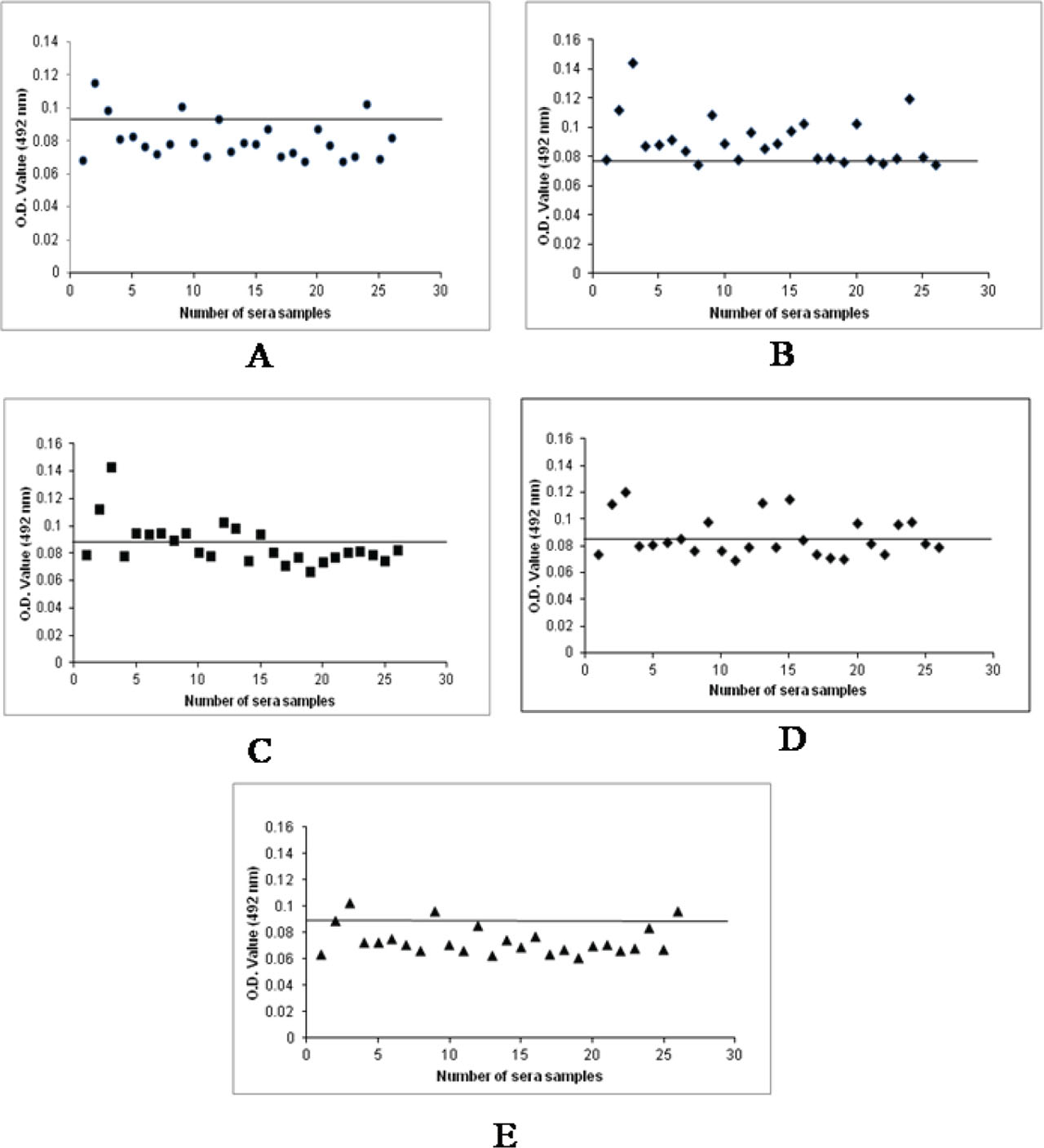
Fig. 1.
(A–E) ELISA OD values using WCA (Fig. 1A), CFA (Fig. 1B), SA (Fig. 1C), ESA (Fig. 1D) and MBA (Fig. 1E) against sera samples from epileptic patients (n=26). The horizontal bar denotes cut-off.
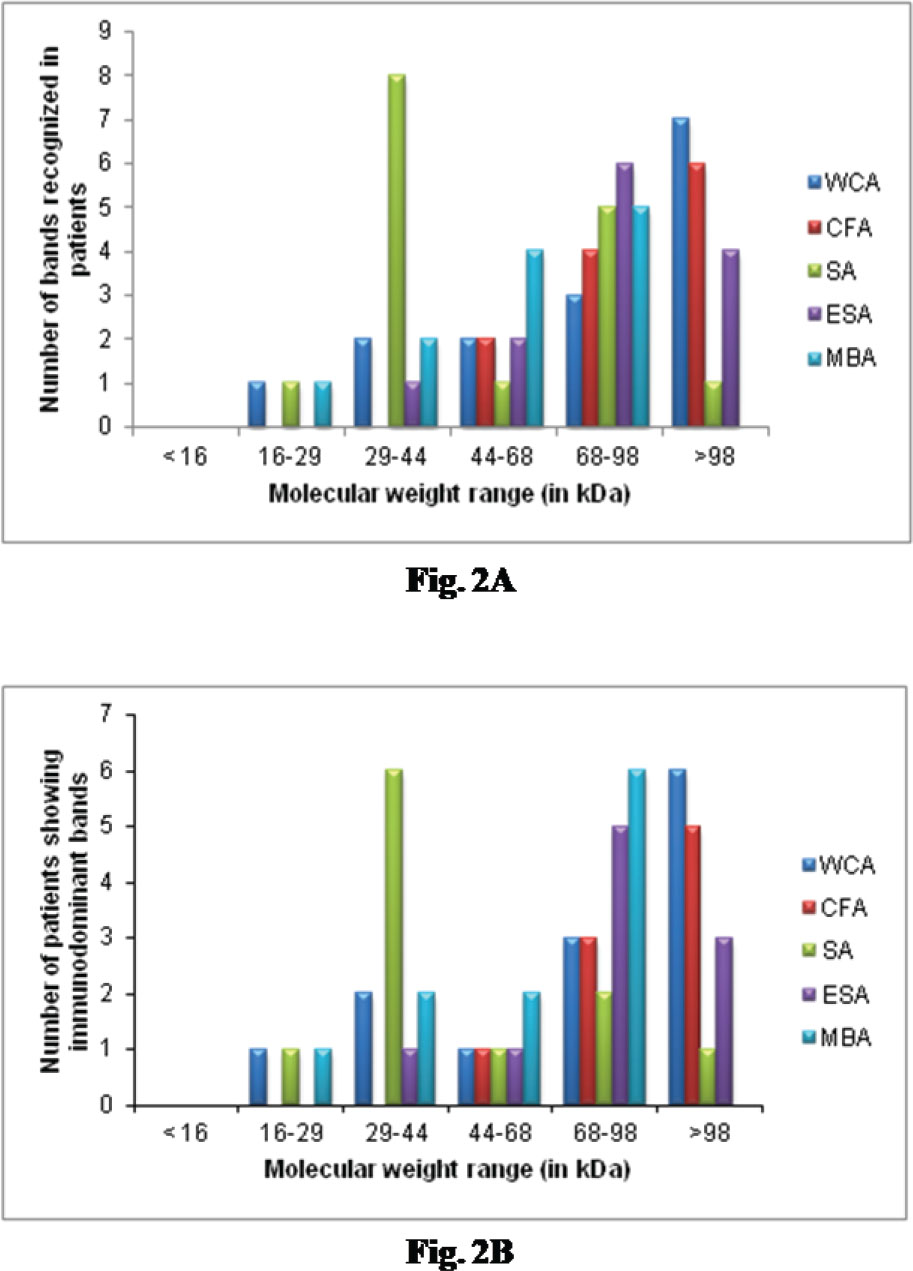
Fig. 2.
(A–B) Number (Fig. 2A) and reactivity frequency (Fig. 2B) of immunodominant bands recognized by anti-cysticercus antibodies in the sera of patients (n=26) against respective antigens.
Table 5.
Seropositivity by indirect IgG-ELISA and EITB assay against the antigens under study.
| Scenario | Number of patients showing seropositive results in ELISA and(or) EITB | ||||
|---|---|---|---|---|---|
| WCA | CFA | SA | ESA | MBA | |
| Presence of both Anti-Cysticercus antibody in IgG-ELISA and Immunodominant band in EITB | 2 | 3 | 7 | 6 | 4 |
| Presence of Anti-Cysticercus antibody in IgG-ELISA, but absence of Immunodominant band in EITB | 3 | 3 | 2 | 2 | 0 |
| Absence of Anti-Cysticercus antibody in IgG-ELISA, but presence of Immunodominant band in EITB | 8 | 4 | 1 | 1 | 5 |
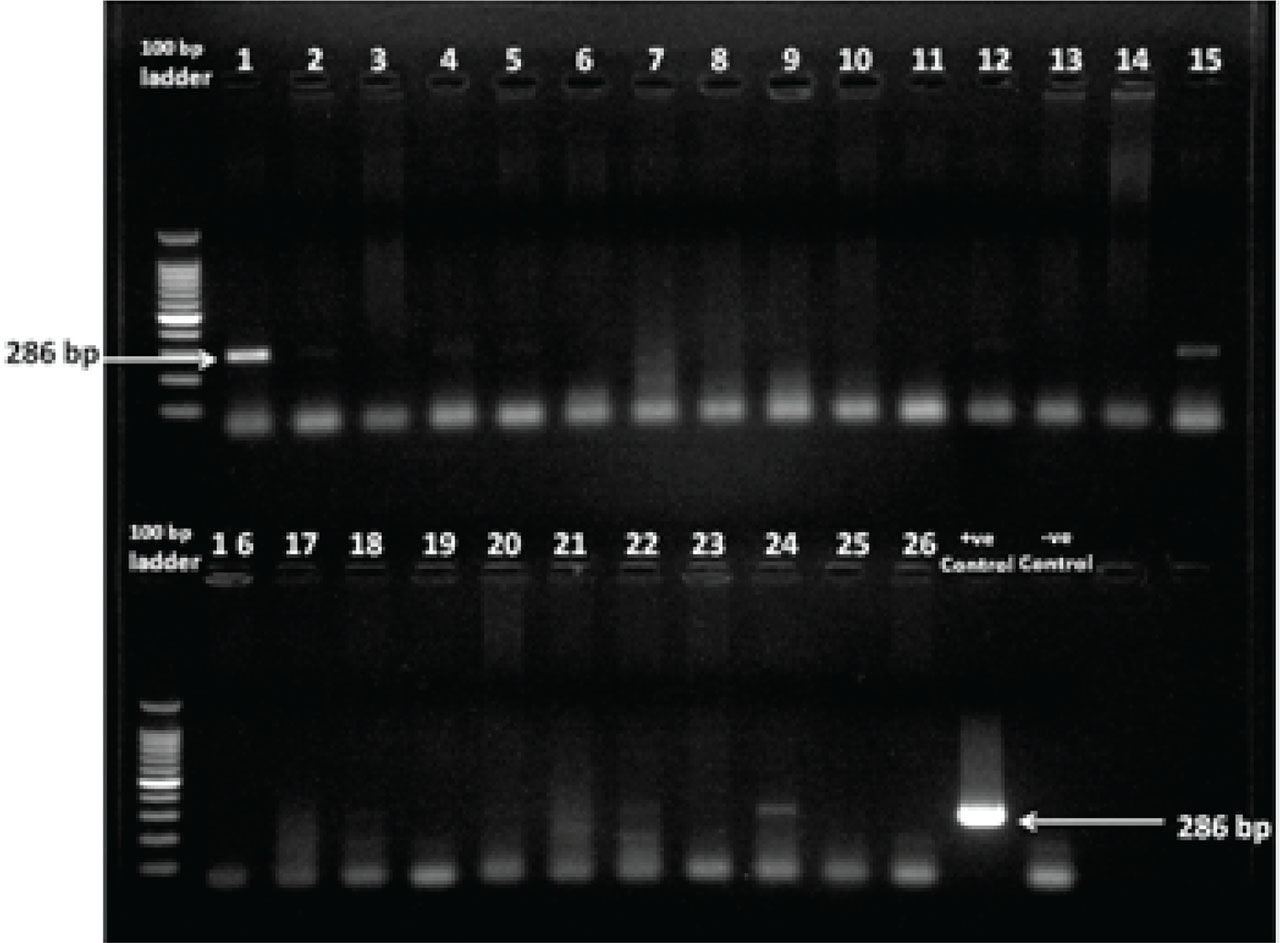
Fig. 3.
Agarose gel electrophoresis showing amplification product (286 bp) by PCR targeted at large subunit rRNA gene of Taenia solium for detection of NCC in epileptic patients. The numbers (1–26) designate the patients under study. DNA extracted from metacestodes of T. solium is used as positive control and nuclease free water as negative control respectively.