Table 1.
Chronological taxonomic history of Corynosoma australe from marine mammals, with special reference to ventral trunk spines in females.
| Author | Host | Locality | Described as | Stage | Ventral spines |
|---|---|---|---|---|---|
| Johnston (1937) | Neophoca cinerea (Péron) | South Australia | C. australe | Adults | Discontinuous |
| Lincicome (1943) | Zalophus californianis (Lesson) | San Diego, California | C. obtuscens | Adults | Continuous |
| Van Cleave (1953) | Mycteroperca pardalis Gilbert | Mazatalán, Mexico | C. obtuscens | Cystacanth | Continuous |
| Morini & Boero (1960) | Otaria flavescence Shaw | Argentina | C. otariae | Adults | Discontinuous |
| Zdzitowiecki (1984) | Hydrurga leptonyx (Blainville) | South Shetlands, Antarctica | C. australe | Adults | 25% continuous |
| Smales (1986) | Neophoca cinerea (Péron) Arctocephalus pusillatus Schreber | South Australia | C. australe | Adults (Figs. 10,11) | Discontinuous |
| Zdzitowiecki (1991) | Few “suitable” definitive & paratenic hosts | Antarctica | C. australe | Adults (Figs. 15 b, e) | Discontinuous |
| Sardella et al. (2005) | Arctocephalus australis (Zimmerman) Mirounga leonina (Linn.) Cynoscion guatucupa (Cuvier) | Argentina | C. australe C. australe C. australe | Adults Adults Cystacanths | 85–100% continuous 85–100% continuous 85–89% continuous |
| Aznar et al. (2012) | Otaria flavescens (Shaw) | Argentina | C. australe | Adults (Fig. 1B) | Discontinuous |
| Hernández-Orts et al. (2017a) | Spheniscus magellanicus (Foster) | Brazil | C. australe | Adults (Fig. 2B) Adults (Fig. 4B) | Continuous & 82–89% continuous |
| Lisitsyna et al. (2018) | Zalophus californianus (Lesson) | Sausalito California | C. obtuscens | Adults | Continuous |
| Lisitsyna et al. (2019) | Zalophus californianus (Lesson) | Sausalito California | C. obtuscens & C. australe | Adults | 1% discontinuous |
| Present paper | Zalophus californianus (Lesson) | Sausalito California | C. australe | Adults | Continuous with post. constriction |
Table 2.
List of acanthocephalan species used for phylogenetic analysis based on the 18S rDNA gene sequences. Newly generated sequences are presented in bold, NA=host name not available.
| Species | Host | Host origin | GenBank accession nos. | References |
|---|---|---|---|---|
| Corynosoma australe | Zalophus californianus | USA | ON614192, ON614199 | present study |
| Zalophus californianus | USA | MK119255 | Lisitsyna et al., 2019 | |
| Phocarctos hookeri | Mexico | JX442168 | García-Varela et al., 2013 | |
| Corynosoma obtuscens | Callorhinus ursinus | Mexico | JX442169 | García-Varela et al., 2013 |
| Corynosoma validum | Callorhinus ursinus | Mexico | JX442170 | García-Varela et al., 2013 |
| Corynosoma enhydri | NA | USA | AF001837 | Near et al., 1998 |
| Corynosoma magdaleni | Phoca hispida botnica | Mexico | EU267803 | García-Varela et al., 2009 |
| Corynosoma strumosum | Phoca vitulina | Mexico | EU267804 | García-Varela et al., 2009 |
| Bolbosoma balaenae | Nyctiphanes couchii | Spain | JQ040306 | Gregory et al., 2011* |
| Bolbosoma turbinella | Eschrichtius robustus | Mexico | JX442166 | García-Varela et al., 2013 |
| Bolbosoma vasculosum | Lepturacanthus savala | Indonesia | JX014225 | Verweyen et al., 2011 |
| Andracantha gravida | Phalacrocorax auritus | Mexico | EU267802 | García-Varela et al., 2009 |
| Hexaglandula corynosoma | Nyctanassa violacea | Mexico | EU267808 | García-Varela et al., 2009 |
| Pseudocorynosoma anatarium | Bucephala albeola | Mexico | EU267801 | García-Varela et al., 2009 |
| Pseudocorynosoma constrictum | Anas clypeata | Mexico | EU267800 | García-Varela et al., 2009 |
| Profilicollis bullocki | Emerita analoga | Mexico | JX442174 | García-Varela et al., 2013 |
| Profilicollis botulus | Somateria mollissima | Mexico | EU267805 | García-Varela et al., 2009 |
| Polymorphus trochus | Fulica americana | Mexico | JX442196 | García-Varela et al., 2013 |
Table 3.
List of acanthocephalan species used for phylogenetic analysis based on the mt Cox1 gene sequences. Newly generated sequences are presented in bold.
| Species | Host | Host origin | GenBank accession nos. | References |
|---|---|---|---|---|
| Corynosoma australe | Zalophus californianus | USA | ON619618, ON614719 | present study |
| Zalophus californianus | USA | MK119245–MK119249 | Lisitsyna et al., 2019 | |
| Zalophus californianus | Mexico | MT676808–MT676818 | García-Varela et al., 2020 | |
| Merluccius hubbsi | Argentina | MT676819–MT676822 | García-Varela et al., 2020 | |
| Raneya brasiliensis | Argentina | MT676823–MT676824 | García-Varela et al., 2020 | |
| Paralichthys isosceles | Brazil | KU314822 | Fonseca et al., 2019 | |
| Stenella clymene | Argentina | MW724483 | Hernández-Orts et al., 2021 | |
| Arctocephalus australis | Argentina | MF497333 | Hernández-Orts et al., 2017a | |
| Spheniscus magellanicus | Brazil | MF497335 | Hernández-Orts et al., 2017a | |
| Otaria flavescens | Argentina | KX957714, MF497334 | Hernández-Orts et al., 2017a, b | |
| Paralichthys adspersus | Peru | MZ920052–MZ920055 | Mondragon-Martinez et al., 2021* | |
| Paralabrax humeralis | Peru | MZ920056–MZ920059 | Mondragon-Martinez et al., 2021* | |
| Cheilodactylus variegatus | Peru | MZ920060–MZ920063 | Mondragon-Martinez et al., 2021* | |
| Otaria byronia | Peru | MZ920064–MZ920067 | Mondragon-Martinez et al., 2021* | |
| Corynosoma hannae | Colistium guntheri | New Zealand | KX957724, KX957725 | Hernández-Orts et al., 2017b |
| Leucocarbo chalconotus | New Zealand | KX957718–KX957721, KX957723 | Hernández-Orts et al., 2017b | |
| Phalacrocorax punctatus | New Zealand | KX957722 | Hernández-Orts et al., 2017b | |
| Phocarctos hookeri | New Zealand | KX957715–KX957717, JX442191 | Hernández-Orts et al., 2017b; García-Varela et al., 2013 | |
| Peltorhamphus novaezeelandiae | New Zealand | KY909260–KY909263 | Anglade & Randhawa, 2018 | |
| Corynosoma semerme | Halichoerus grypus | Germany | MF001277 | Waindok et al., 2018 |
| Corynosoma semerme | Callorhinus ursinus | USA | MK119253 | Lisitsyna et al., 2019 |
| Corynosoma obtuscens | Halichoerus grypus | New Zealand | JX442192 | García-Varela et al., 2013 |
| Corynosoma villosum | Callorhinus ursinus | USA | MK119251 | Lisitsyna et al., 2019 |
| Corynosoma validum | Callorhinus ursinus | USA | MK119252 | Lisitsyna et al., 2019 |
| Corynosoma enhydri | Enhydra lutris | USA | DQ089719 | García-Varela & Nadler, 2006 |
| Corynosoma magdaleni | Phoca vitulina | Germany | MF078642 | Waindok et al., 2018 |
| Corynosoma nortmeri | Phoca vitulina | Germany | MF001278 | Waindok et al., 2018 |
| Corynosoma strumosum | Phoca vitulina | USA | EF467870 | García-Varela & Pérez-Ponce de León, 2008 |
| Pusa hispida botnica | Finland | EF467871 | García-Varela & Pérez-Ponce de León, 2008 | |
| Zalophus californianus | USA | MK119250 | Lisitsyna et al., 2019 | |
| Bolbosoma balaenae | Balaenoptera physalus | Italy | MZ047281 | Santoro et al., 2021 |
| Bolbosoma turbinella | Eschrichtius robustus | USA | JX442189 | García-Varela et al., 2013 |
| Andracantha phalacrocoracis | Zalophus californianus | USA | MK119254 | Lisitsyna et al., 2019 |
| Hexaglandula corynosoma | Nyctanassa violacea | Mexico | EU189488 | Guillén-Hernández et al., 2008 |
| Pseudocorynosoma anatarium | Bucephala albeola | Mexico | KX688148 | García-Varela et al., 2017 |
| Pseudocorynosoma tepehuanesi | Oxyura jamaicensis | Mexico | KX688139 | García-Varela et al., 2017 |
| Polymorphus obtusus | Aythya affinis | Mexico | JX442195 | García-Varela et al., 2013 |
| Profilicollis bullocki | Emerita analoga | Mexico | JX442197 | García-Varela et al., 2013 |
| Profilicollis chasmagnathi | Oligosarcus jenynsii | Argentina | MT580124 | Levy et al., 2020 |
| Polymorphus trochus | Fulica americana | Mexico | JX442196 | García-Varela et al., 2013 |
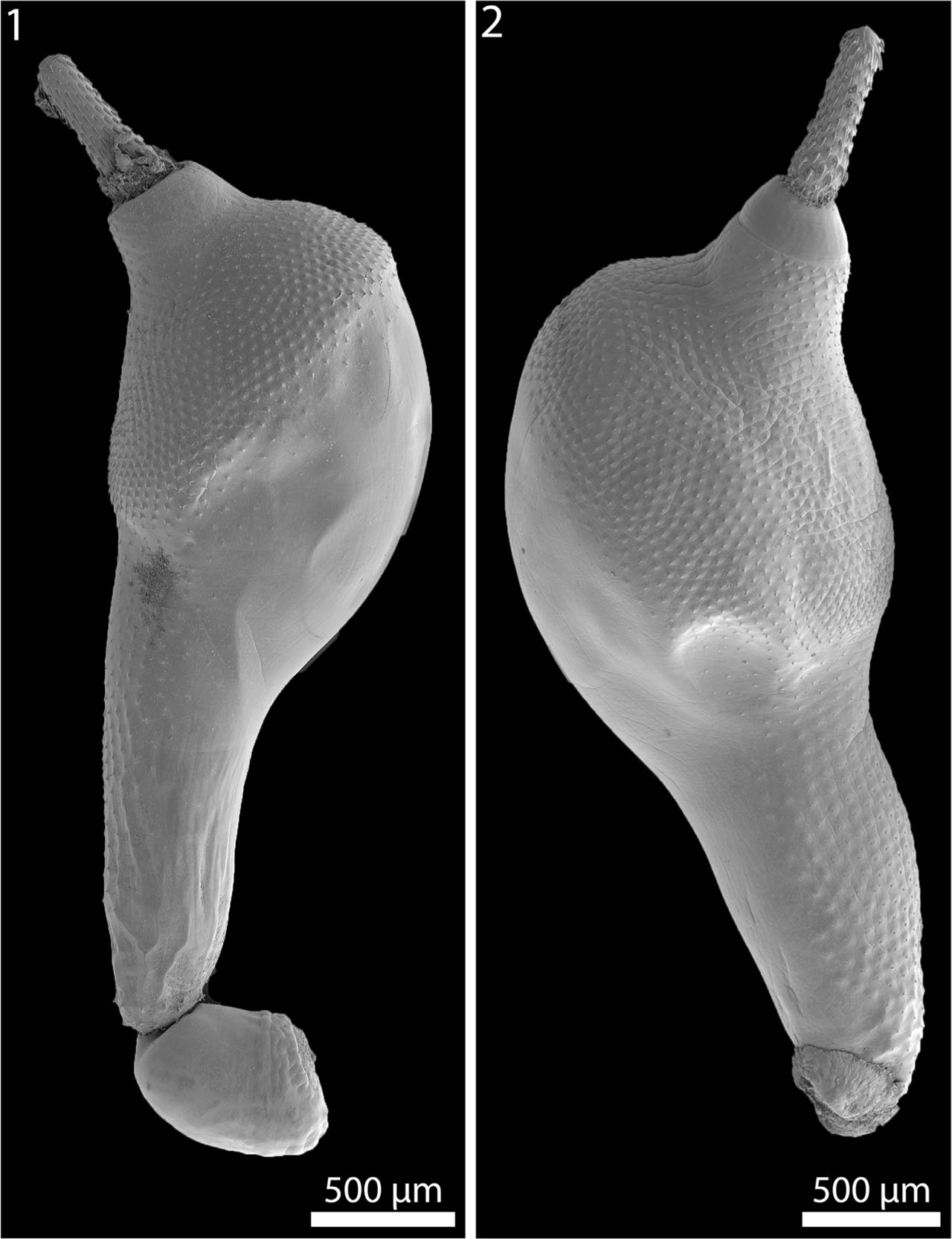
Figs. 1, 2.
SEM of whole male (Fig. 1) and female (Fig. 2) specimens of Corynosoma australe from the intestines of Zalophus californianus in California. Note the continuity of the ventral field of spines from the neck to the genital area in the female which is covered with a copulation plug (Fig. 2).
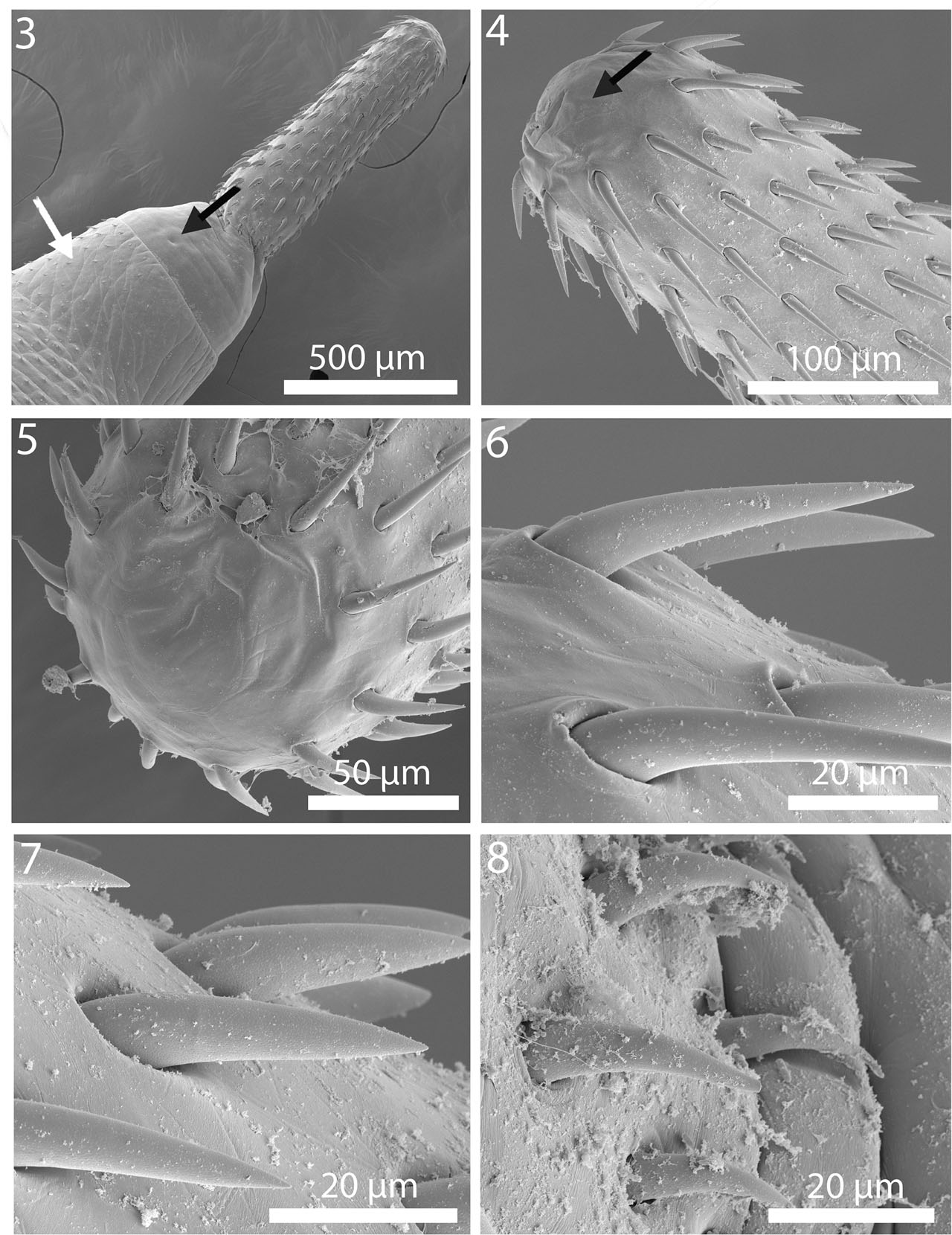
Figs. 3–8.
SEM of male and female specimens of Corynosoma australe from the intestines of Zalophus californianus in California. 3. Praesoma of a male worm showing the conical neck and the ventral spinose part of the anterior part of the trunk just anterior to the bulbus (white arrow) and the sensory pore (black arrow). 4. The anterior proboscis of a specimen showing the organization of the longitudinal rows of large hooks and the external appearance of the apical organ (arrow). 5. Apical view of the proboscis in Fig. 4 showing the external surface of the apical organ. 6. Lateral view of apical and subapical hooks. 7. Lateral view of middle hooks. 8. Posterior-most spine-like hooks. Note their arched curvature compared to more anterior hooks.
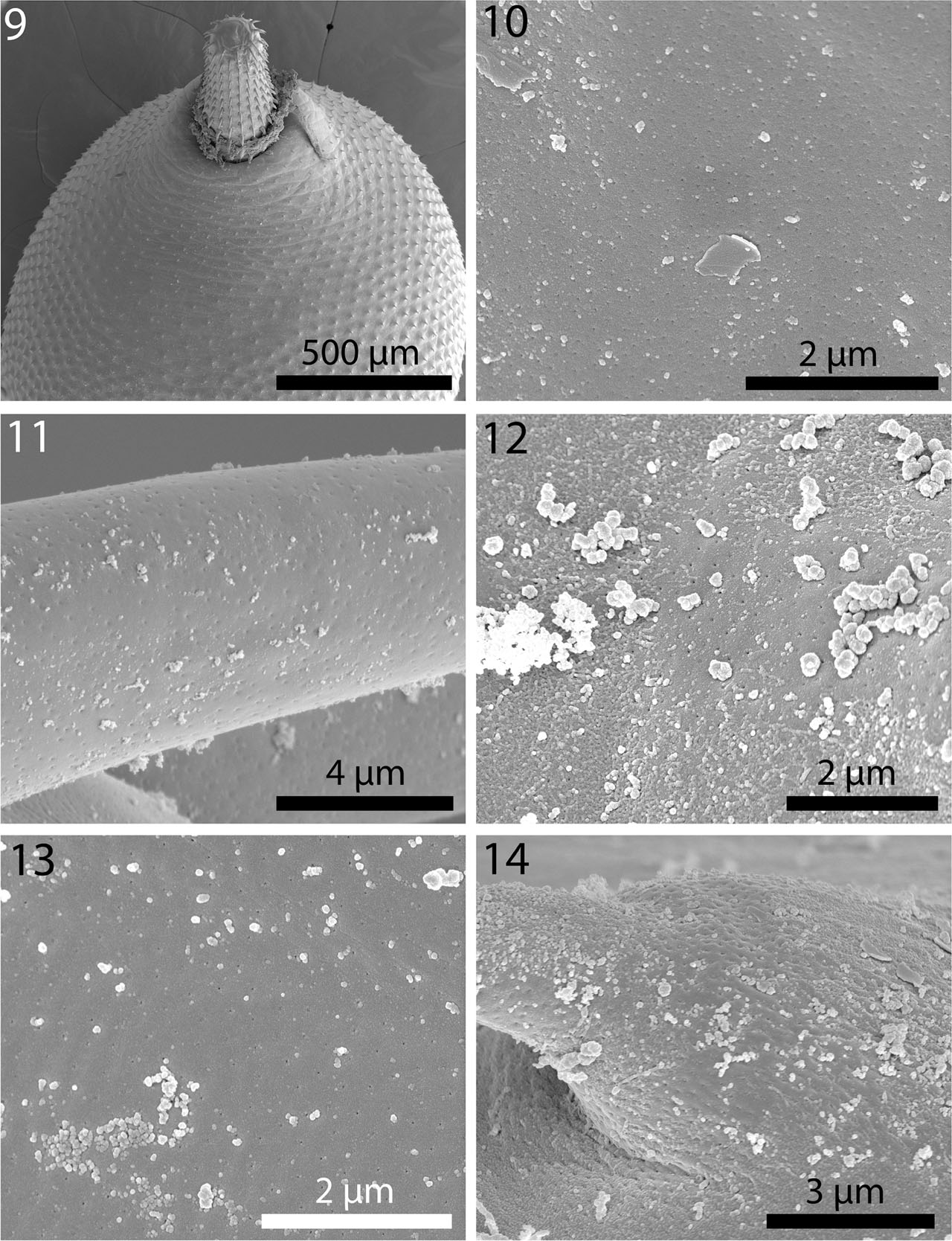
Figs. 9–14.
SEM of anterior bulbus and micropores of male and female specimens of Corynosoma australe from the intestines of Zalophus californianus in California. 9. Anterio-ventral view of the proboscis and bulbus of a female specimen. 10. Micropores at the anterior end of a proboscis. 11. Micropores on an anterior proboscis hook. 12. Micropores on anterior trunk spine. 13. Micropores at anterior end of a male trunk away from spines. 14. Micropores on the base of a posterior trunk spine in a male specimen.
Table 4.
Chemical composition of trunk spines and eggs of Corynosoma australe from Zalophus californianus in California.
| Elements* | Spines (longitudinal sections) | Eggs (cross sections) | |||
|---|---|---|---|---|---|
| Anterior | Middle | Posterior | Edge (shell) | Center (acanthor) | |
| Magnesium (Mg) | 0.00 | 0.00 | 0.09 | 0.00 | 0.50 |
| Sodium (Na) | 0.00 | 0.00 | 0.00 | 0.00 | 0.00 |
| Phosphorous (P) | 1.39 | 0.00 | 1.16 | 0.91 | 7.73 |
| Sulfur (S) | 12.64 | 5.97 | 15.61 | 0 | 2.30 |
| Calcium (Ca) | 1.64 | 1.07 | 1.96 | 1.34 | 3.41 |
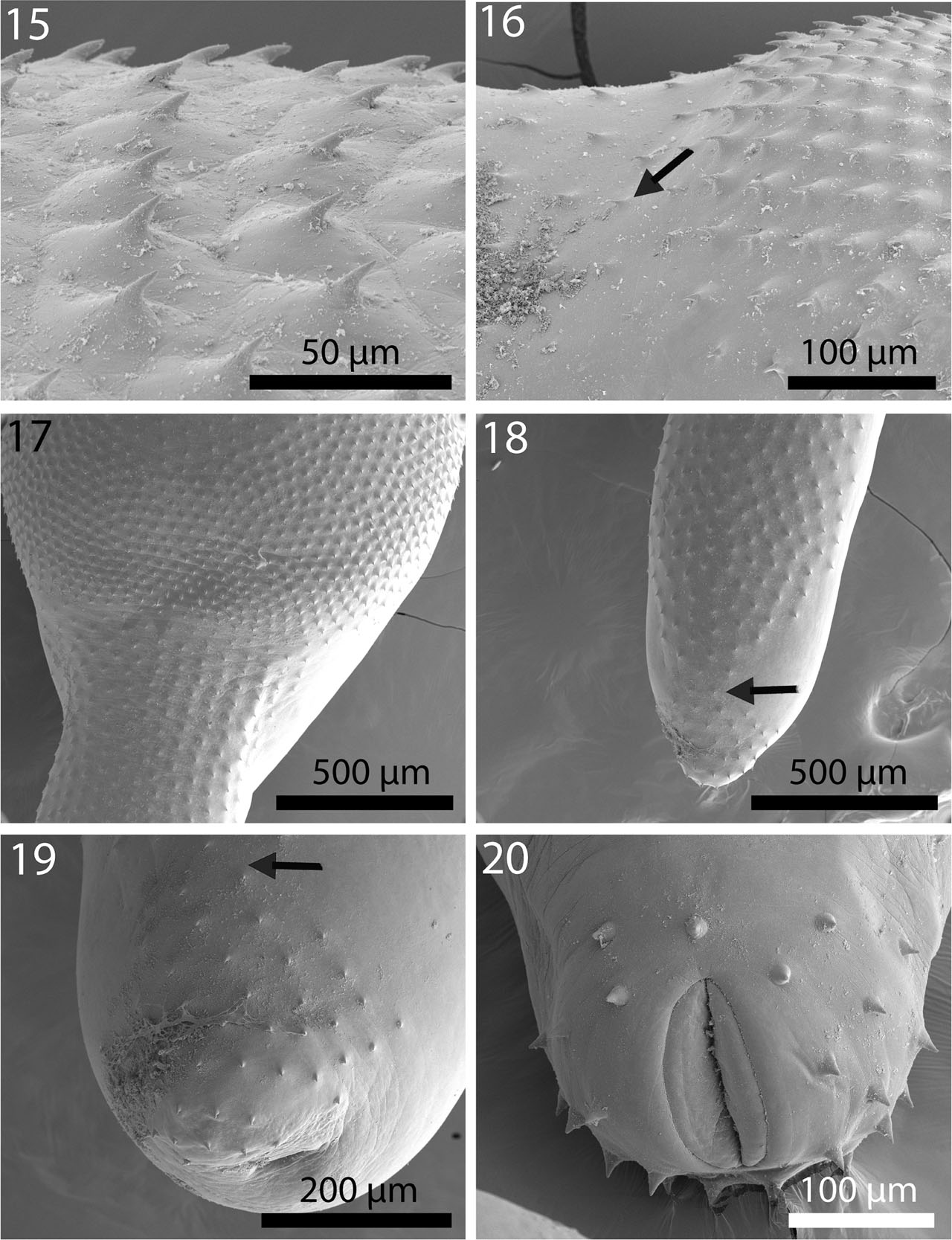
Figs. 15–20.
SEM of spines in male and female specimens of Corynosoma australe from the intestines of Zalophus californianus in California. 15. Anterior trunk spines in the bulbus area. 16. Transition area between bulbus spines (right) and posterior trunk spines. 17–19. Continuous ventral spines in one female specimen: 17. Midventral spines. 18. Posterior ventral spines. Note that the field of spines anterior to the genital spines constricts (arrow) but remains continuous with the genital spines without breaks. 19. Another, more detailed, perspective of posterior ventral spines of the same female in Fig. 17, 18 with arrow pointing to greatest constriction. Female gonopore is on the opposite, ventral, side (dorso-subterminal). 20. Posterior end of a male specimens with invaginated bursa revealing the organization of the genital spines there.
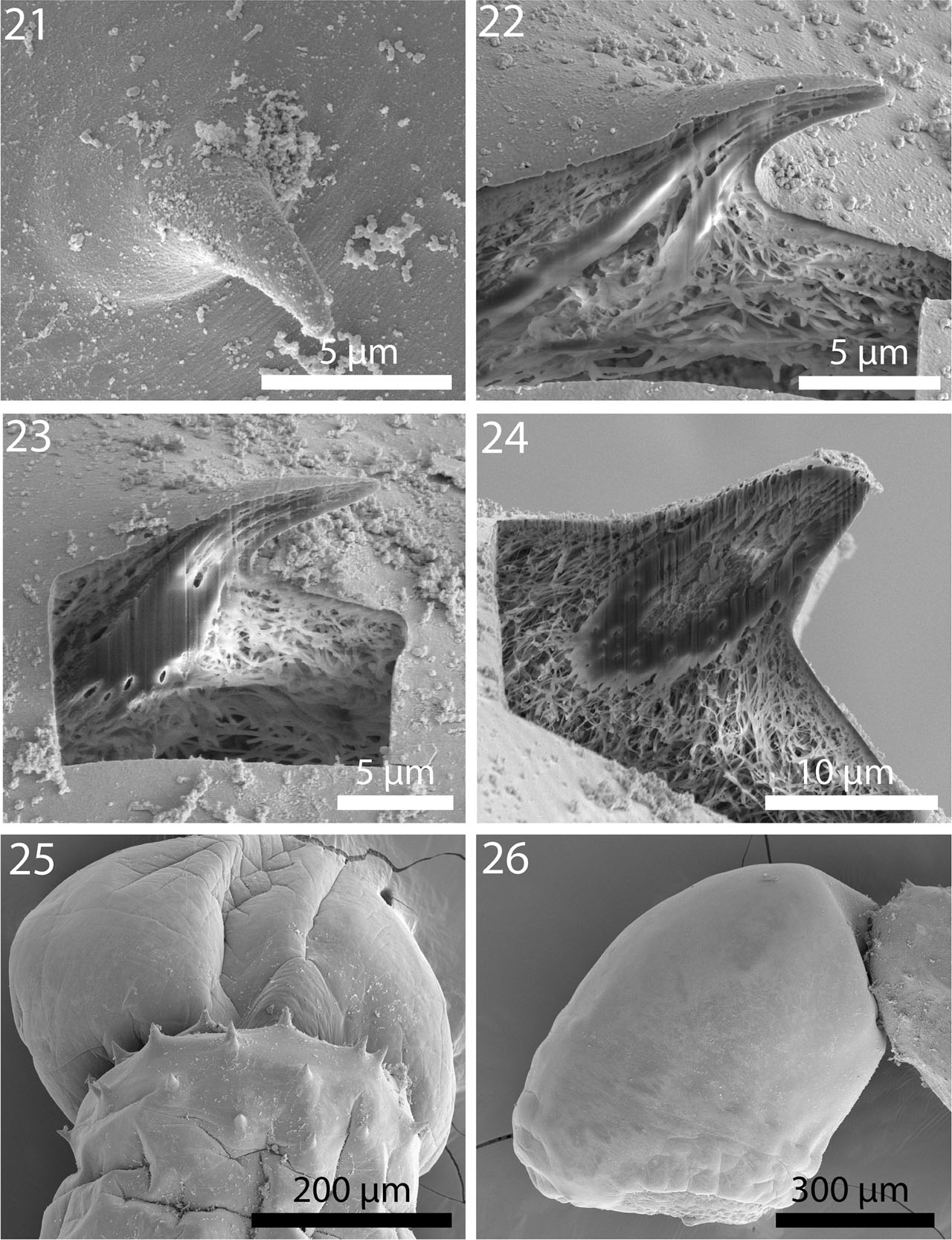
Figs. 21–26.
Detail of spines in specimens of Corynosoma australe from the intestines of Zalophus californianus in California using SEM and Gallium-cut sections. 21. SEM of an anterior trunk spine in the bulbus area. 22. A longitudinal Gallium-cut section of an anterior bulbus spine. Note the structure of the core element. 23. A longitudinal Gallium-cut section of a mid-trunk spine. 24. A longitudinal Gallium-cut section of a posterior spine. Note the structural differences between the outline and core of the spine types. 25. A dorso-terminal view of the posterior end of a male specimen showing the arrangement of the genital spines. Compare with Fig. 20. 26. A lateral view of a bursa showing its distal undulations and part of the genital spines (right).
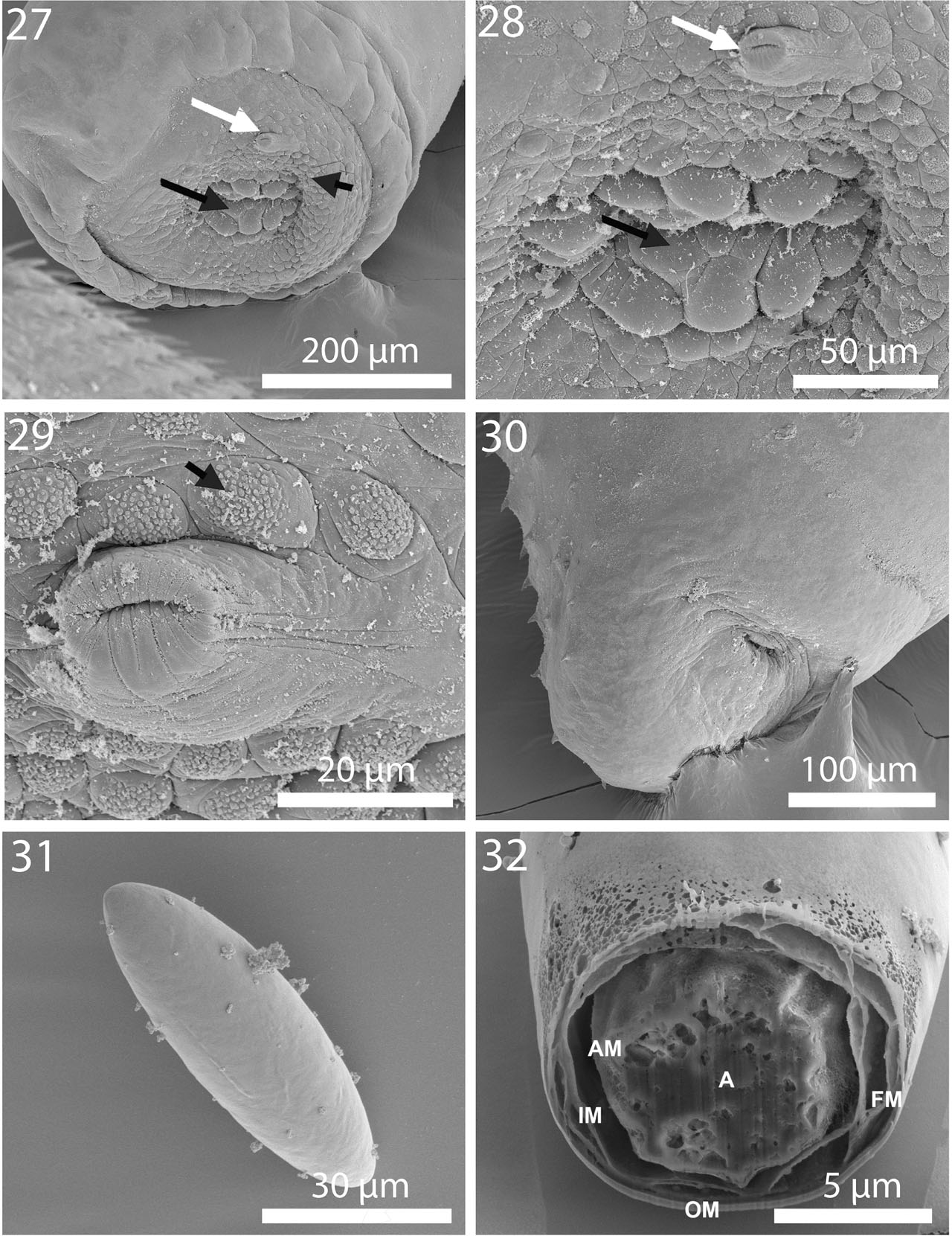
Figs. 27–32.
External orifices of male and female reproductive systems and eggs of Corynosoma australe from the intestines of Zalophus californianus in California using SEM and Gallium-cut sections. 27–29. The male bursa. 27. Bursa with the undulating lip, penis (white arrows), central cluster of prominent sensory bulbs (black arrows), and surrounding circles of specialized sensory domes (short black arrows). 28. The central part of a bursa showing the two types of sensory structures and the penis. 29. A higher magnification of the penis and the surrounding type of sensory domes. 30. The posterior end of a female showing the dorsal gonopore (right) and the continuity of the posterior ventral spines with the genital spines. 31. A smooth egg with no external ornamentation or dentations. 32. A cross Gallium-cut section of an egg showing 3 external egg shell membranes FM: fertilization membrane, IM: inner membrane, OM: outer membrane) with the fourth tightly enveloping the acanthor (A).
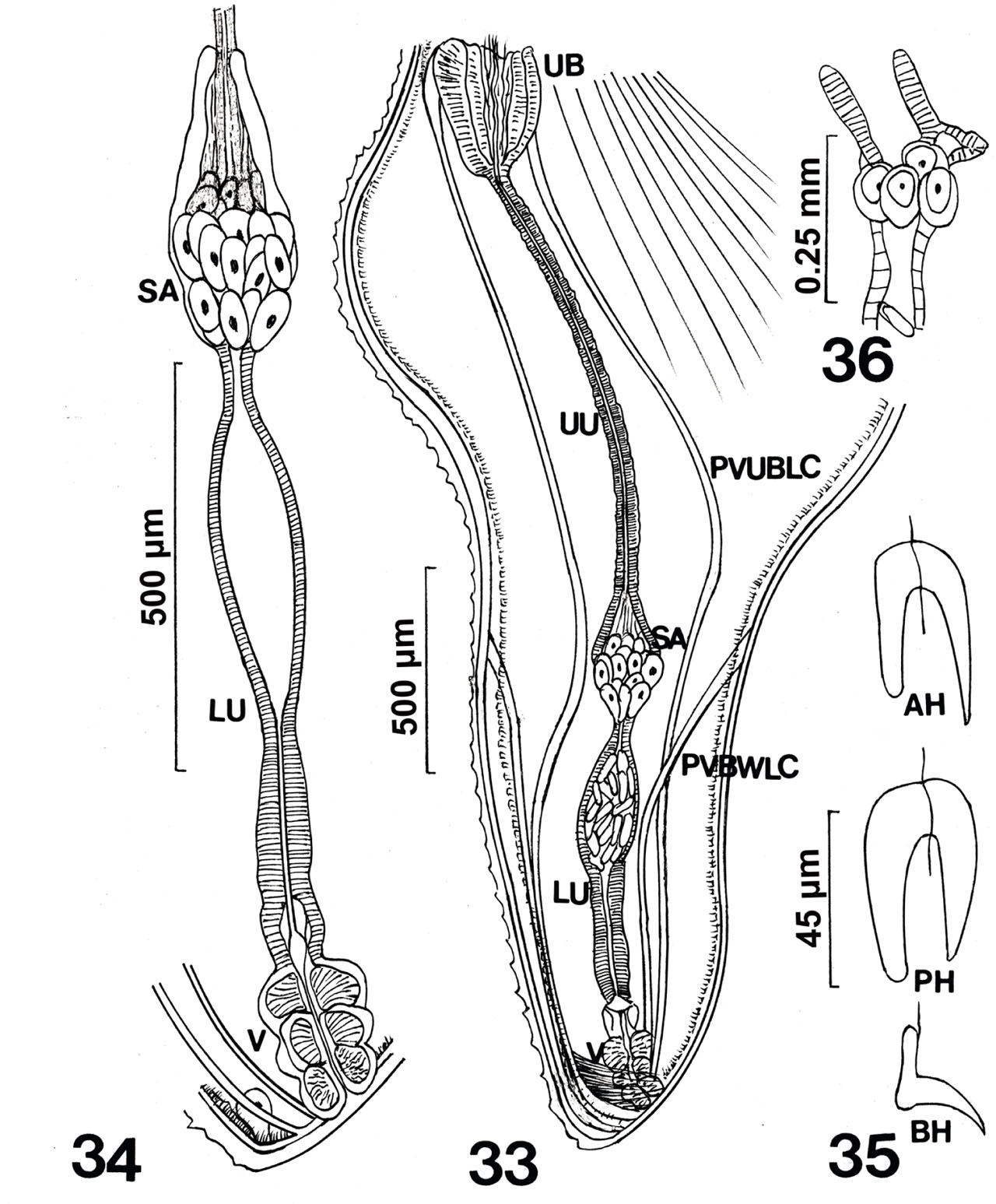
Figs. 33–36.
Line drawings of the female reproductive system and 3 selected hooks of Corynosoma australe from the intestines of Zalophus californianus in California. Fig. 33. The whole reproductive system of a 3.2 mm. long female. Note the presence of the Selective apparatus (SA) almost half way between the upper uterus (UU) connecting with the uterine bell (UB) and the lower uterus (LU) connecting with the dorsal vagina (V). Also note the dorsal and ventral short paravaginal ligament cords inserting in the body wall (PVBWLC) and the dorsal and ventral longer paravaginal ligament cords connecting with the uterine bell (PVUBLC). The para-vaginal muscular sheet wrapping around vagina can be observed. The continuity of trunk spines on the ventral side is evident. Fig. 34. A higher magnification of the posterior half of the reproductive system of a second female. Posterior muscular wrap not shown. Fig. 35. The 3 hook types: an anterior slender subapical hook (AH) with shorter root; a robust hook at the inflated part of the posterior proboscis (PH) with slightly longer root; and a small curved basal or near-basal hook (BH) with anteriorly directed root (manubrium). Fig. 36. The “uterine bell” of Corynosoma australe after Zdzitowiecki (1984, Fig. 2e, p. 362).
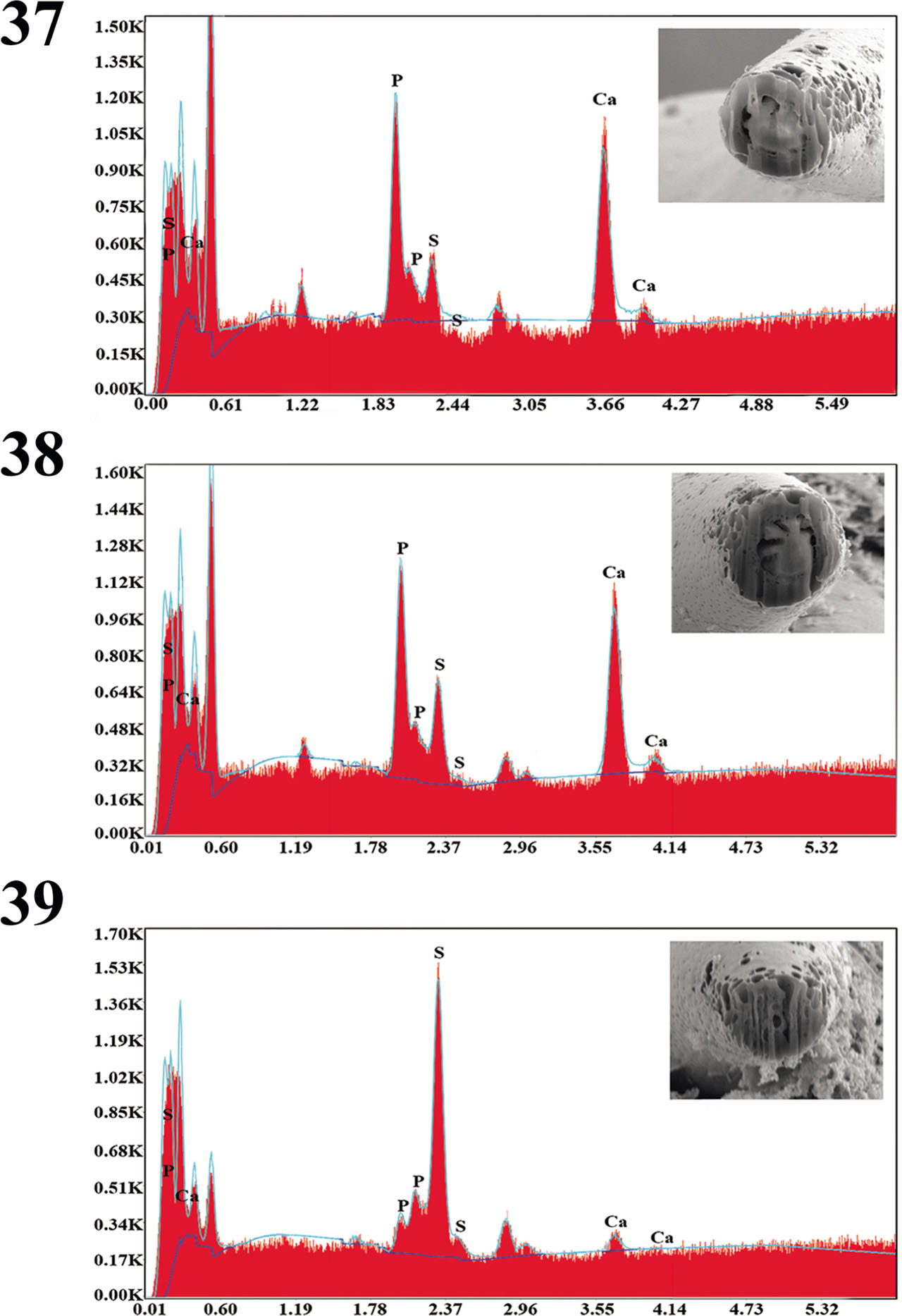
Figs. 37–39.
Energy Dispersive X-Ray spectra of Gallium cut anterior hook tip x-section (37), middle hook tip x-section (38), and posterior hook tip x-section (39) showing levels of sulfur in calcium and phosphorous in all hooks See Table 2 for more specific figures (bolded). Inserts: SEM of Gallium cut anterior hook tip cross-section (37), SEM of Gallium cut middle hook tip cross-section (38), and SEM of Gallium cut posterior hook tip cross-section (39). Note the high levels of calcium and phosphorous in anterior and middle hooks and the high level of sulfur in posterior hooks.
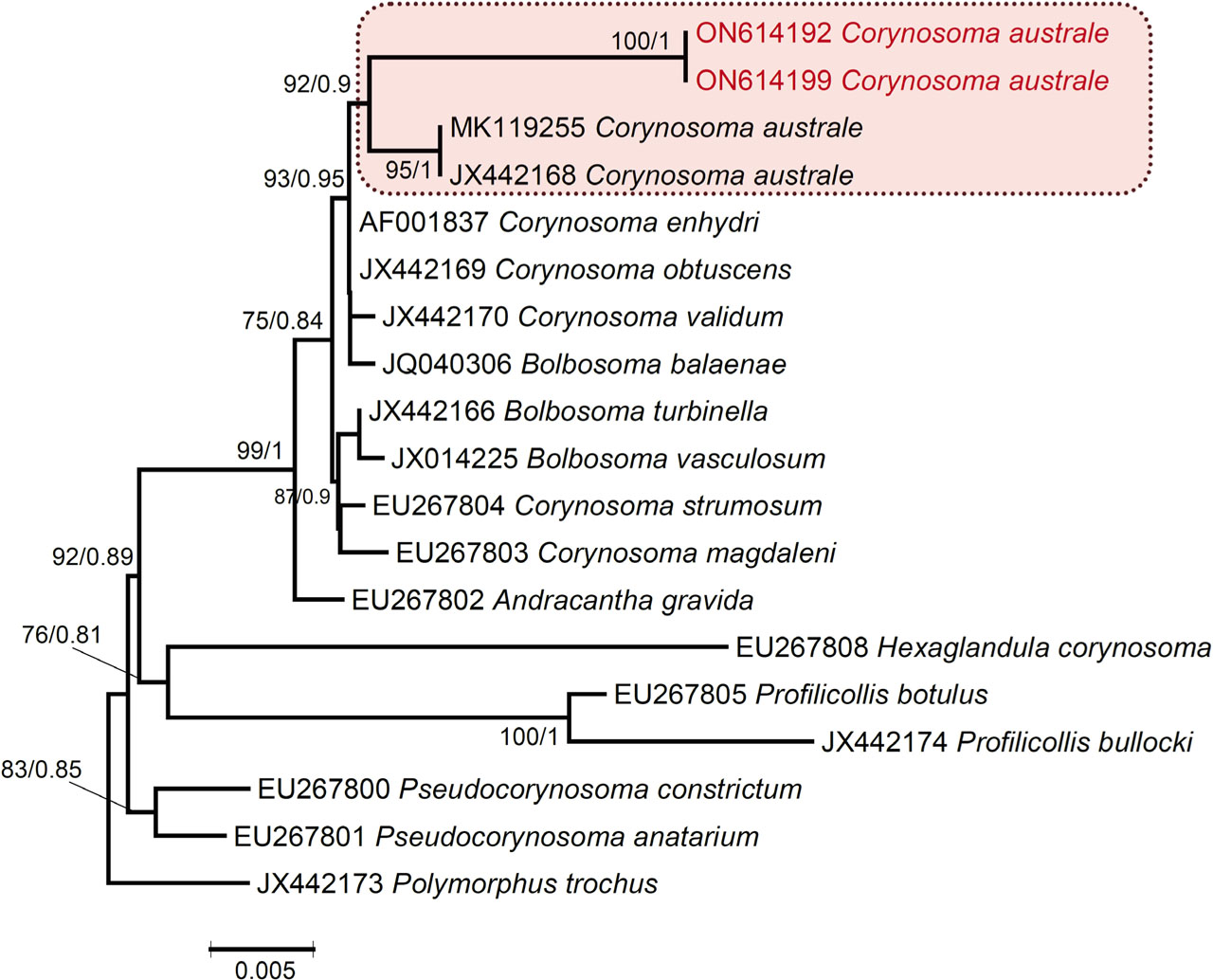
Fig. 40.
Phylogenetic relationships inferred using 18S gene sequences of Corynosoma australe and other acanthocephalan species. Nodal support from the two analyses is indicated as ML/BI and indicates values of bootstrap >70%. The scale-bar indicates the expected number of substitutions per site.
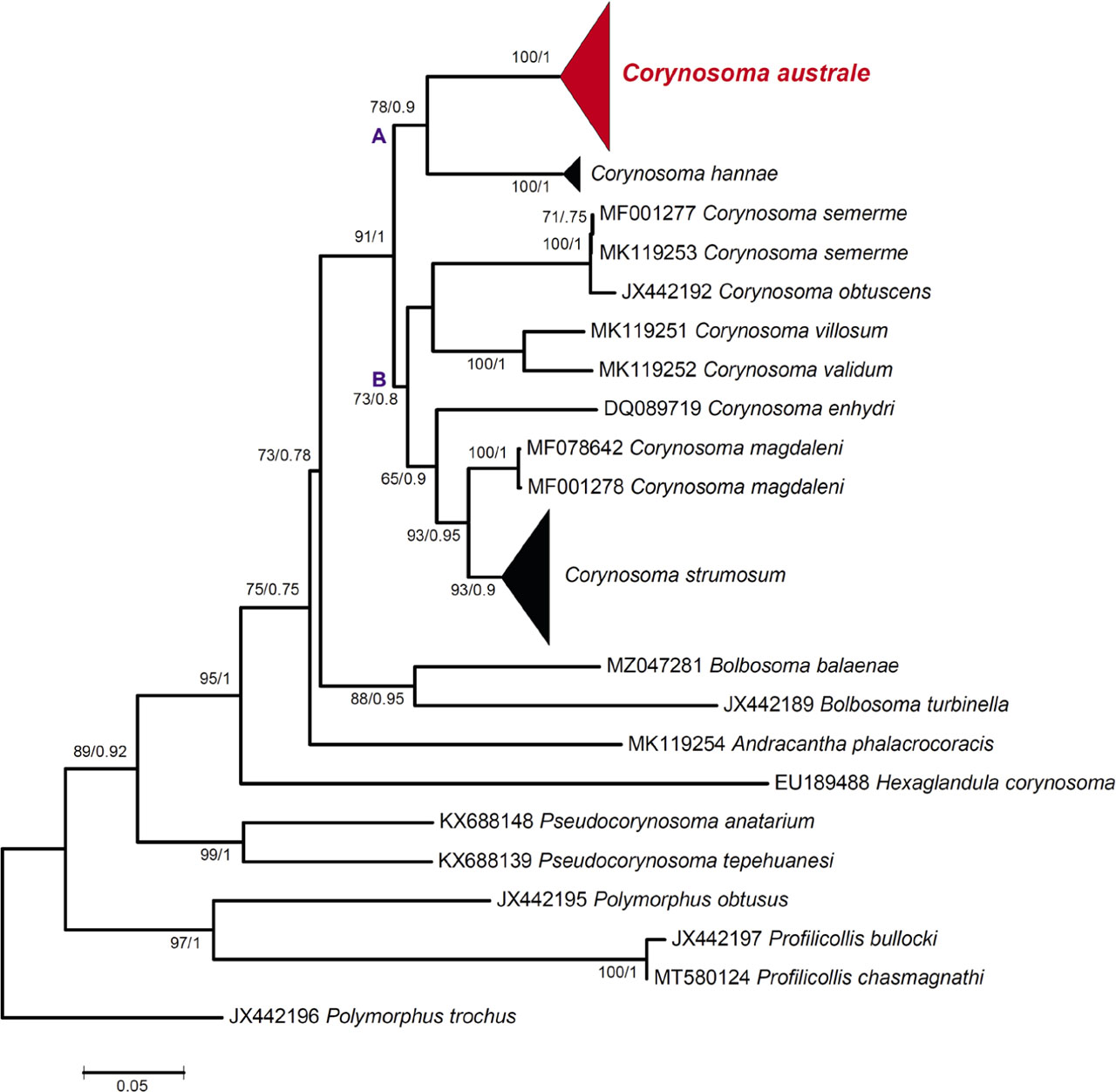
Fig. 41.
Phylogenetic reconstruction using mt Cox1 sequences of Corynosoma australe and sequences of other Acanthocephala deposited in the GenBank. The numbers indicate values of bootstrap >50%. Numbers above branches indicate nodal support as maximum likelihood (ML) and posterior probabilities from BI. The scale-bar indicates the expected number of substitutions per site.
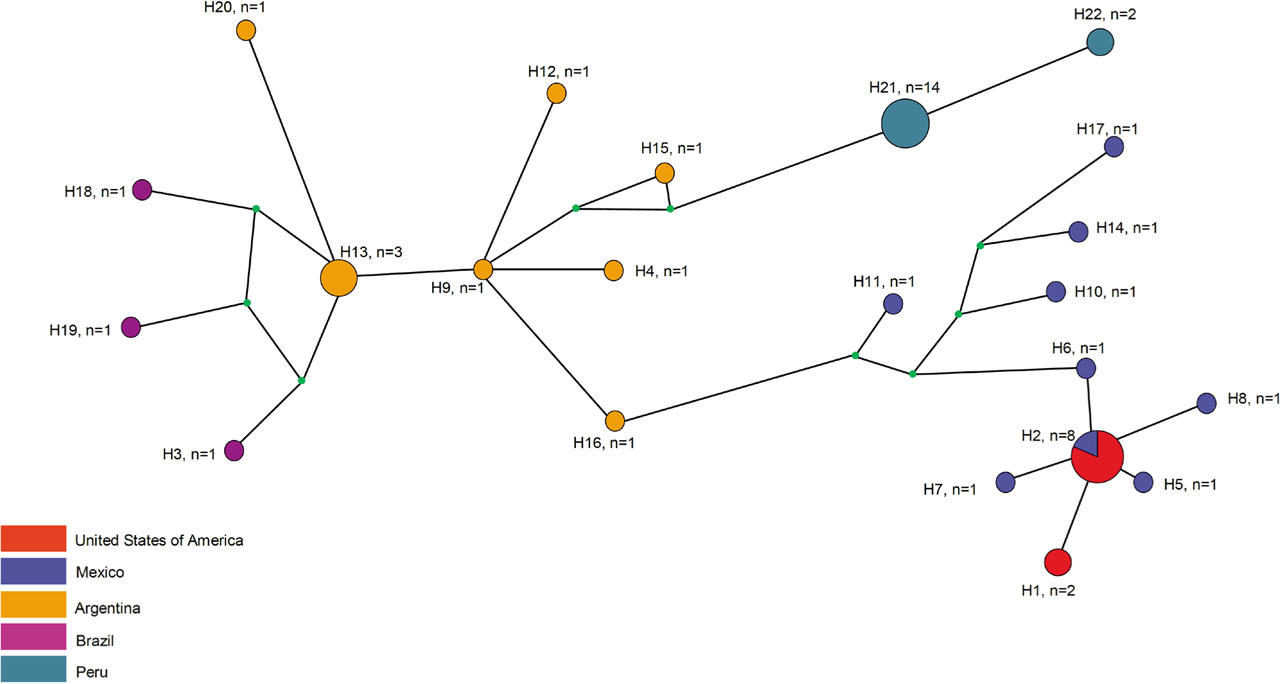
Fig. 42.
Median-joining haplotype networks based on Cox1 sequence data of Corynosoma australe. Each circle size represents the frequency of a haplotype as in the population.
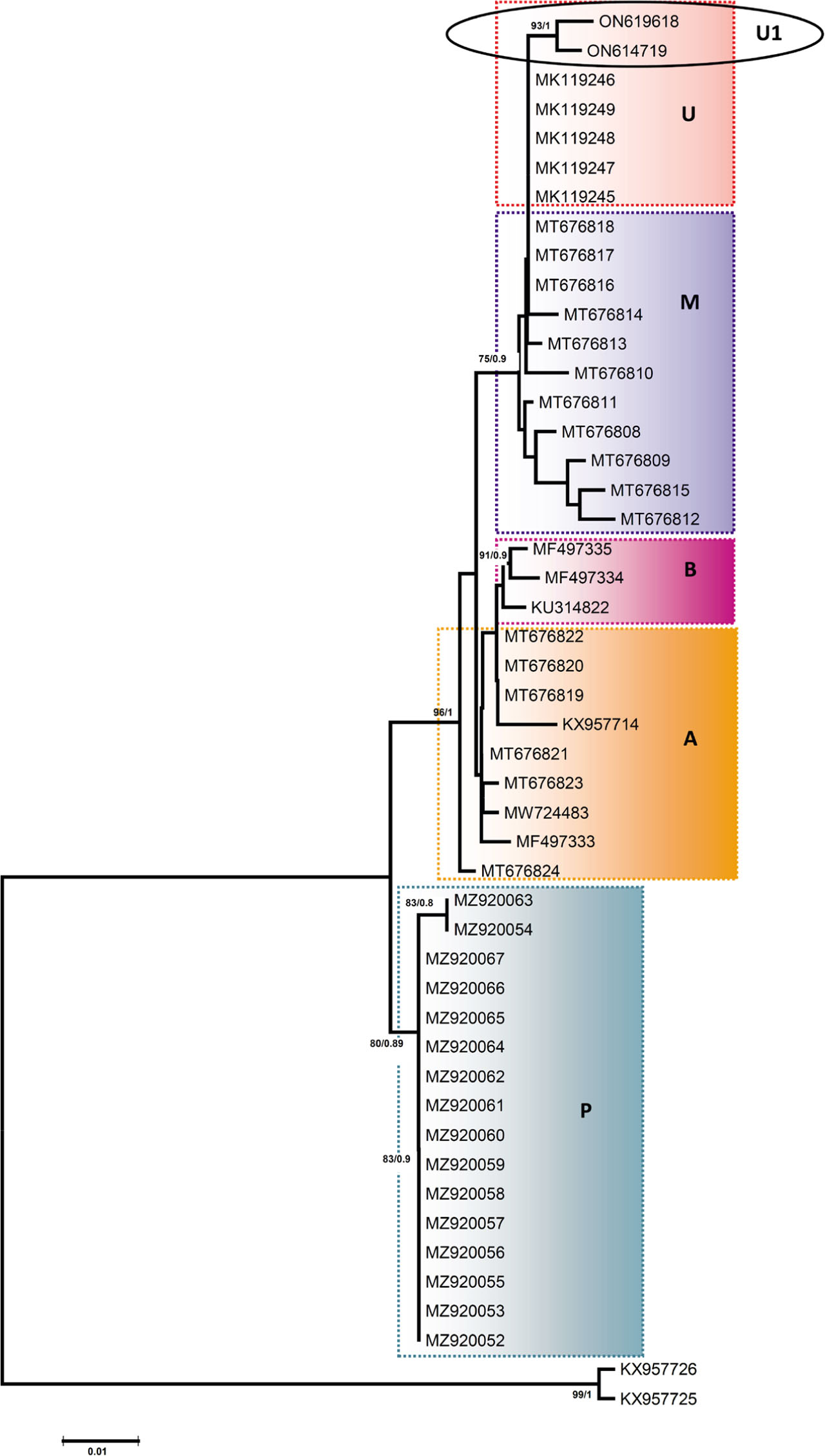
Fig. 43.
Phylogenetic tree from Maximum likelihood and Bayesian inference analysis of the Cox1 sequences of Corynosoma australe population. Outgroup: Corynosoma hannae. The scale-bar indicates the expected number of substitutions per site. Abbreviations used for isolates country: U1- present study isolates from USA, U- USA, M- Mexico, B- Brazil, A- Argentina, P- Peru. The color refers to isolates obtained as in the haplotype network (Fig. 42; red: USA, blue: Mexico, orange: Argentina, magenta: Brazil, aqua blue: Peru).
Table 5.
Chemical composition and localization of elements in hooks of Corynosoma australe from Zalophus californianus in California.
| Anterior hooks | Middle hooks | Posterior hooks | |||||||
|---|---|---|---|---|---|---|---|---|---|
| Element* | Tip x-section | Middle | Longitudinal section | Tip x-section | Tip edge | Middle x-section | Middle edge | Tip x-section | Middle edge |
| Magnesium (Mg) | 1.21 | 0.23–1.67** | 0.02–0.07 | 0.63 | 0.62 | 1.61 | 0.66 | 0.02 | 0.78–1.52 |
| Sodium (Na) | 0.25 | 0.00–0.04 | 0.00–0.03 | 0.00 | 0.03 | 0.08 | 0.00 | 0.02 | 0.05–0.07 |
| Phosphorous (P) | 9.95 | 15.74–18.71 | 12.78–20.35 | 10.64 | 11.00 | 21.32 | 16.10 | 2.82 | 14.91–20.49 |
| Sulfur (S) | 2.96 | 0.09–7.10 | 0.34–3.50 | 5.50 | 15.38 | 0.03 | 4.34 | 23.52 | 1.18–14.09 |
| Calcium (Ca) | 18.99 | 30.80–34.84 | 32.03–72.06 | 19.98 | 19.11 | 42.48 | 34.18 | 3.16 | 27.05–40.39 |
Table 6.
Data for the population of Corynosoma australe used in the haplotype networking using mt Cox1 gene. Asterisk shows sequences unpublished on NCBI database. Newly generated sequences are presented in bold.
| Geographical Locality* | Cox1 Haplotype no. | ID in Fig. 46 | GenBank accession nos. | References |
|---|---|---|---|---|
| Pacific coast near San Francisco, California, USA | H1 | U1 | ON619618, ON614719 | Present study |
| Sausalito, California, USA | H2 | U | MK119245-MK119249 | Lisitsyna et al. 2019 |
| Baja California, Mexico | H2 | M | MT676816-MT676818 | García-Varela et al. 2021 |
| Rio de Janeiro, Brazil | H3 | B | KU314822 | Fonseca et al. 2019 |
| Chubut, Argentina | H4 | A | MW724483 | Hernández-Orts et al. 2021 |
| Baja California, Mexico | H5 | M | MT676813 | García-Varela et al. 2021 |
| Sonora, Mexico | H6 | M | MT676811 | García-Varela et al. 2021 |
| Baja California, Mexico | H7 | M | MT676814 | García-Varela et al. 2021 |
| Sonora, Mexico | H8 | M | MT676810 | García-Varela et al. 2021 |
| Northern Patagonia, Argentina | H9 | A | MT676821 | García-Varela et al. 2021 |
| Sonora, Mexico | H10 | M | MT676809 | García-Varela et al. 2021 |
| Baja California Sur, Mexico | H11 | M | MT676808 | García-Varela et al. 2021 |
| Northern Patagonia, Argentina | H12 | A | MT676823 | García-Varela et al. 2021 |
| Northern Patagonia, Argentina | H13 | A | MT676819, MT676820, MT676822 | García-Varela et al. 2021 |
| Baja California, Mexico | H14 | M | MT676815 | García-Varela et al. 2021 |
| Northern Patagonia, Argentina | H15 | A | MT676824 | García-Varela et al. 2021 |
| Northern Patagonia, Argentina | H16 | A | MF497333 | Hernández-Orts et al. 2021 |
| Baja California, Mexico | H17 | M | MT676812 | García-Varela et al. 2021 |
| Rio de Janeiro, Brazil | H18 | B | MF497335 | Hernández-Orts et al. 2021 |
| Northern Patagonia, Argentina | H19 | A | MF497334 | Hernández-Orts et al. 2021 |
| Northern Patagonia, Argentina | H20 | A | KX957714 | Fonseca et al. 2019 |
| Peru | H21 | P | MZ920052, MZ920053, MZ920055, MZ920056-MZ920062, MZ920064-MZ920067 | Mondragon-Martinez et al. 2021* |
| Peru | H22 | P | MZ920054, MZ920063 | Mondragon-Martinez et al. 2021* |