Introduction
Seat worms, pinworms, and threadworms are all common names for the parasitic helminth Enterobius vermicularis (Nematoda, Oxyuridae). This parasite was first described in humans nearly about 10.000 years. E. vermicularis is a cosmopolitan parasite that affects over 200 million people worldwide (Fan et al., 2019). Tropical residents and school-aged children are among the most vulnerable groups (Dudlová et al., 2018; Fan et al., 2019). The feces-oral route is the most typical method of transmission. People catch pinworm infections by swallowing (ingesting), frequently accidentally, infected pinworm eggs present on fingers, under fingernails, on clothing, bedding, and other contaminated objects and surfaces. Due to their tiny size, pinworm eggs can occasionally become airborne and get inhaled when breathing (Cook, 1994). Poor personal hygiene, contaminated food or water consumption, poor environmental sanitation, and living with sick individuals have all been linked to a high incidence rate of E. vermicularis (Muliawati et al., 2020). In Iraq, many elements have contributed to considerable societal changes since 2003, including developing a public health system that focuses on preventative and control programs, particularly those dealing with parasite infections. Despite these advances, E. vermicularis remains the most prevalent helminth parasite and severe public health concern (Al-Saqur et al., 2016; Al-Saqur et al., 2020). On the other hand, Iraq has suffered from many wars and internal migrations. ISIS directly affected the health system. This could cause the spread of some diseases, especially parasitic diseases (Ibrahim et al., 2021). Many studies have documented the epidemiology of E. vermicularis in Iraqi populations from various regions.
A total prevalence of pinworm infection (70.75 %) was reported among 212 children aged 6 – 12 years in Al-Basrah province (Jarallah & Mansour, 2014). In Duhok, north of Iraq, a prevalence rate of (18.01 %) was reported among 261 children aged between 3 – 12 years (Hussein & Meerkhan, 2019). In Baghdad, the capital, the prevalence rate was (73.77 %) among 122 children aged between (1 – 14) years (Dohan & Al-Warid, 2020). Other researchers looked at enterobiasis and its relationship to enuresis, anemia, biochemical parameters, and micronutrients deficiencies (Al-Qadhi et al., 2011; Al-Daoody & Al-Bazzaz, 2020; Dohan & Al-Warid, 2022). Despite the fact that E.vermicularis has been the subject of numerous studies, there is still a knowledge gap in its regional distribution. Because the spread of Enterobiasis in Iraq has gotten little attention, even a simple spatial mapping of reported cases could be useful. The overall purpose of this research was to examine data on enterobiasis spread provided by the Communicable Diseases Control Center (CDCC). At a macro-epidemiological level, the geographic information system (GIS) approaches were used to identify the basic demographic and spatial variables to highlight basic spatial and demographic patterns that may be useful in developing future management strategies for national public health institutes.
Materials and Methods
Study area
Iraq has a population of almost 40 million people. Iraq lies between the latitudes of 29° 5’ and 37° 22’ N and the longitudes of 38° 45’ and 48° 45’ E. The total area is 437,000 km2. Iran, Turkey, Syria, Jordan, Saudi Arabia, and Kuwait are bordering countries. Except for the northern and northeastern mountainous parts, which have a Mediterranean climate, most of Iraq has a continental and subtropical semiarid climate. Iraq environment: mostly desert; mild to cool winters; dry, hot, cloudless summers; cold winters with sporadic heavy snowfall that melts in early spring, occasionally producing severe flooding in northern mountainous regions along Iranian and Turkish borders (Osman et al., 2017).
Population data
In Iraq, enterobiasis is an observed disease with diagnoses reported from all provinces to the CDCC, Ministry of Health, Baghdad. Diagnoses and demographic characteristics were derived from each province’s Central Statistical Organization annual reports (CSO, 2011; CSO, 2012; CSO, 2013; CSO, 2014; CSO, 2015). Data from 220607 patients admitted to Iraqi hospitals and primary health care centers between 2011 – 2015 were included in the study. Diagnoses of Enterobiasis were confirmed by scotch tape. Before attaching the tape to a glass slide, cellophane tape (Scotch, USA) was applied to the participant’s anal and perianal regions utilizing the adhesive side of the tape for a few repetitions (Dudlová et al., 2018). For each patient, information was collected and classified according to sex, age group as <1, 1 – 4, 5 – 14, and >15 years, province, population (rural and urban), family size and the month of diagnosis.
Spatial data and statistical analyses
ArcGIS version 10.4 (http:// www.esri.com/arcgis) was used to map geospatial and related demographic information.
Spearman’s correlation coefficient and multiple linear regressions were used for contrasting correlations of the population (rural and urban) and family size on Enterobiaisis incidence using Statistical Package for the Social Sciences (SPSS Inc, Chicago IL, USA). Values of P < 0.05 are considered statistically significant.
Ethical Approval and/or Informed Consent
This study protocol was approved by the local ethics committee (Ref.: BEC/0122/0018) in the College of Science, University of Baghdad.
Results
Between 2011 and 2014, the cases of infection fluctuated between 33,112 and 41,807. However, in 2015 the infection by E. vermicularis increased considerably to 74,581 cases (Fig. 1).
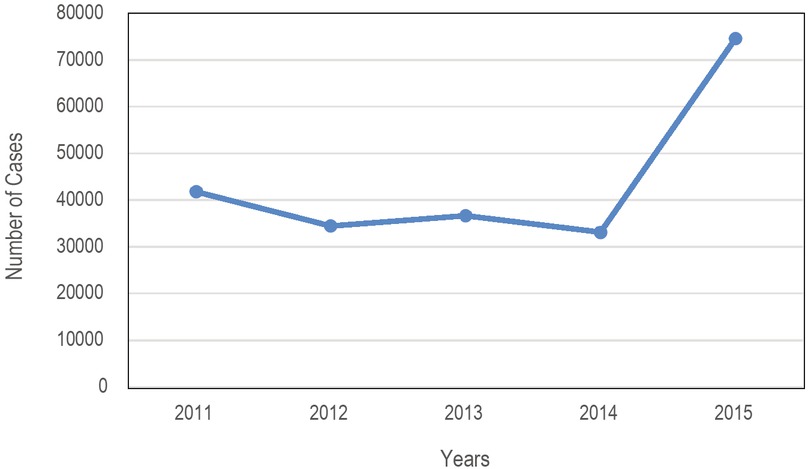
Fig. 1
The distribution of enterobiasis in Iraq for the years 2011 – 2015.
Nonetheless, there were strong biases towards diagnoses in females and older individuals each year. A more significant percentage of cases was observed in females (53.75 %) across the five-year reporting time frame, although there was variability in the sex ratio of cases (Table 1). In 2011 and 2012, there were 1.3 diagnosed females per diagnosed males, with that ratio decreasing slightly in 2014 (1.07) and 2015 (1.2). Enterobiasis also occurred in a high percentage (30.58 %) among the age group (5 – 14) years old compared to other age groups that showed fewer percentages (Table 2).
Table 1
Sex of 220607 Iraqi enterobiasis patients reported between 2011 and 2015.
| 2011 | 2012 | 2013 | 2014 | 2015 | Total | |||||||
|---|---|---|---|---|---|---|---|---|---|---|---|---|
| Sex | Number | % | Number | % | Number | % | Number | % | Number | % | Number | % |
| Male | 18024 | 43.11 | 14548 | 42.22 | 20171 | 55.02 | 15992 | 48.29 | 33279 | 44.62 | 102014 | 46.24 |
| Female | 23783 | 56.88 | 19903 | 57.77 | 16485 | 44.97 | 17120 | 51.7 | 41302 | 55.37 | 118593 | 53.75 |
| Total | 41807 | 34451 | 36656 | 33112 | 74581 | 220607 |
Table 2
Age of 220607 Iraqi enterobiasis patients reported between 2011 and 2015.
| 2011 | 2012 | 2013 | 2014 | 2015 | Total | |||||||
|---|---|---|---|---|---|---|---|---|---|---|---|---|
| Age | Number | % | Number | % | Number | % | Number | % | Number | % | Number | % |
| ˂1 | 97 | 0.23 | 109 | 0.31 | 799 | 2.17 | 5440 | 16.42 | 4437 | 5.94 | 10882 | 4.93 |
| (1 – 4) | 5023 | 12.04 | 5028 | 14.95 | 6605 | 18.01 | 5812 | 17.55 | 18084 | 24.24 | 40552 | 18.38 |
| (5 – 14) | 13009 | 31.11 | 13893 | 40.32 | 11004 | 30.01 | 6825 | 20.61 | 22743 | 30.49 | 67474 | 30.58 |
| (15 – 44) | 19233 | 46 | 9803 | 28.45 | 10916 | 29.77 | 8878 | 26.81 | 14916 | 19.99 | 63746 | 28.89 |
| ˃45 | 4445 | 10.63 | 5618 | 16.3 | 7332 | 20 | 6157 | 18.59 | 14401 | 19.3 | 37953 | 17.2 |
| Total | 41807 | 34451 | 36656 | 33112 | 74581 | 220607 |
Patients with E. vermicularis were reported from all of Iraq’s provinces. About half (51.14 %) of the cases were reported in Al-Basrah, Baghdad and Thi Qar (Table 3). However, the high numbers of cases were not significantly (rs=0.43, P=0.07) related to greater population size (the data of 2011 was considered). The per capita occurrence rates were higher in these provinces, particularly in Al-Basrah and Thi Qar. At the same time, the highest per capita rate was noticed in Al-Sulaymaniyah province, with the lowest occurrence rate across the five years (Fig. 2).
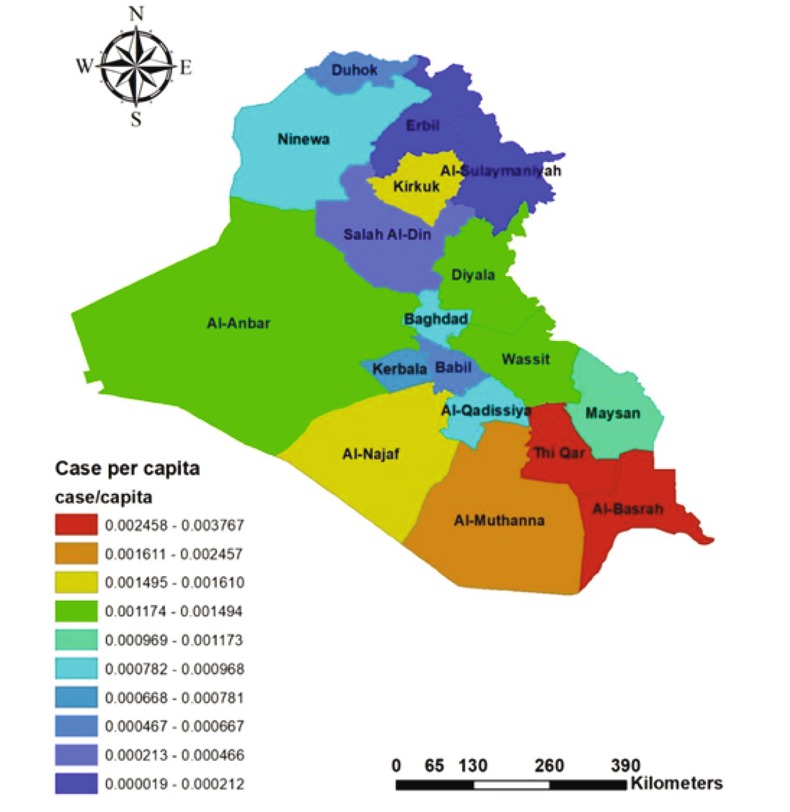
Fig. 2
The number of cases of enterobiasis in Iraq per 100000 capita between 2011 and 2015
Table 3
The distribution of enterobiasis among the Iraqi provinces for the years 2011 – 2015.
| Province | Year | total | average | SD | Population size of 2011 | ||||
|---|---|---|---|---|---|---|---|---|---|
| 2011 | 2012 | 2013 | 2014 | 2015 | |||||
| Al-Anbar | 1545 | 737 | 4104 | 3628 | 1583 | 11597 | 2319.4 | 1461.438 | 1675600 |
| Al-Basrah | 8310 | 10613 | 7317 | 5974 | 15480 | 47694 | 9538.8 | 3728.468 | 2532000 |
| Al-Muthanna | 2053 | 1128 | 1164 | 1417 | 3702 | 9464 | 1892.8 | 1077.186 | 770500 |
| Al-Najaf | 904 | 914 | 1223 | 1698 | 5574 | 10313 | 2062.6 | 1989.311 | 1285500 |
| Al-Qadissiya | 621 | 1459 | 1382 | 944 | 1503 | 5909 | 1181.8 | 384.4265 | 1220300 |
| Al-Sulaymaniyah | 0 | 37 | 53 | 74 | 12 | 176 | 35.2 | 30.01166 | 1878800 |
| Babil | 952 | 1097 | 728 | 1825 | 1666 | 6268 | 1253.6 | 471.2518 | 1878700 |
| Baghdad | 2482 | 1723 | 3183 | 5483 | 19904 | 32775 | 6555 | 7593.631 | 7055200 |
| Diyala | 1751 | 2603 | 4056 | 1335 | 1038 | 10783 | 2156.6 | 1214.269 | 1443200 |
| Duhok | 117 | 273 | 713 | 870 | 1721 | 3694 | 738.8 | 629.7223 | 1128700 |
| Erbil | 617 | 350 | 332 | 255 | 159 | 1713 | 342.6 | 170.9131 | 1612700 |
| Kerbala | 164 | 1049 | 797 | 575 | 1581 | 4166 | 833.2 | 529.5236 | 1066600 |
| Kirkuk | 3435 | 3553 | 1371 | 574 | 2301 | 11234 | 2246.8 | 1292.884 | 1395600 |
| Maysan | 828 | 1742 | 2016 | 753 | 357 | 5696 | 1139.2 | 705.333 | 971400 |
| Ninewa | 8112 | 2434 | 2205 | 1619 | 391 | 14761 | 2952.2 | 2991.135 | 3270400 |
| Salah Al-Din | 1321 | 999 | 744 | 216 | 0 | 3280 | 656 | 545.7916 | 1408200 |
| Thi Qar | 7301 | 2396 | 2717 | 4051 | 15890 | 32355 | 6471 | 5611.617 | 1836200 |
| Wassit | 1294 | 1379 | 2516 | 1821 | 1719 | 8729 | 1745.8 | 484.3157 | 1210600 |
The south region provinces (Thiqar, Miasan, Basrah and Wassit provinces) showed the highest number of cases (n=94474, 42.82 %), followed by the middle region (Baghdad, Al-Anbar, Diyala and Salah Al-Din provinces) (n=58849, 26.67 %). While both the middle Euphrates region (Babil, Kerbala, Al-Najaf, Al-Qadissiya and Al-Muthanna provinces) and the north region (Ninewa, Al-Sulaymaniyah, Kirkuk, Erbil and Duhok provinces) showed the lowest number of cases (n=36120, 16.37 % ) and (n=20344, 9.22 %) respectively (Table 4 and Fig. 3).
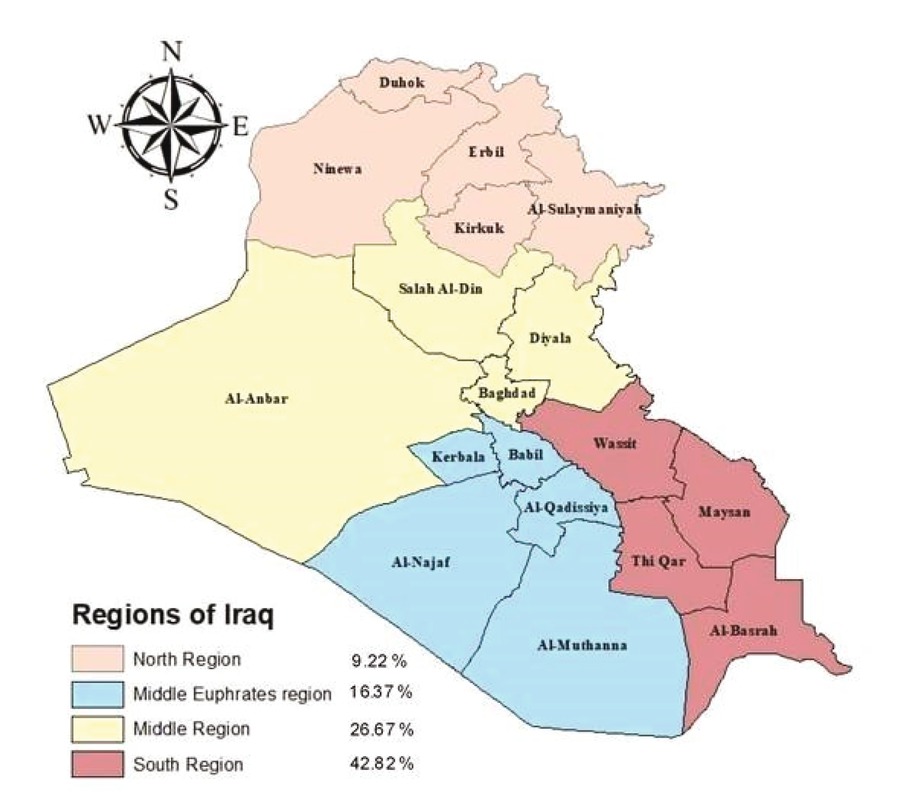
Fig. 3
The distribution of enterobiasis among the Iraqi regions.
Table 4
The distribution of enterobiasis among the Iraqi regions (South region provinces, Middle region provinces, Middle Euphrates provinces and North region provinces) for the years
| Region | Provinces | Number | % |
|---|---|---|---|
| South | (Thiqar, Miasan, Al-Basrah and Wassit) | 94474 | 42.82 |
| Middlel | (Baghdad, Al-Anbar, Diyala and Salah Al-Din) | 58849 | 26.67 |
| Middle Euphrates | (Babil, Kerbala, Al-Najaf, Al-Qadissiya and Al-Muthanna) | 36120 | 16.37 |
| North region | (Ninewa, Al-Sulaymaniyah, Kirkuk, Erbil and Duhok) | 20344 | 9.22 |
Diagnoses of enterobiasis revealed no clear patterns of seasonality (Fig. 4). The peak of cases differed from one year to another. The peaks of enterobiasis were in April (2011), December (2012), November (2013 and 2015) and March (2014), while the declines in the number of cases were noticed in December (2011), March (2012), January (2013 and 2015) and February (2015).
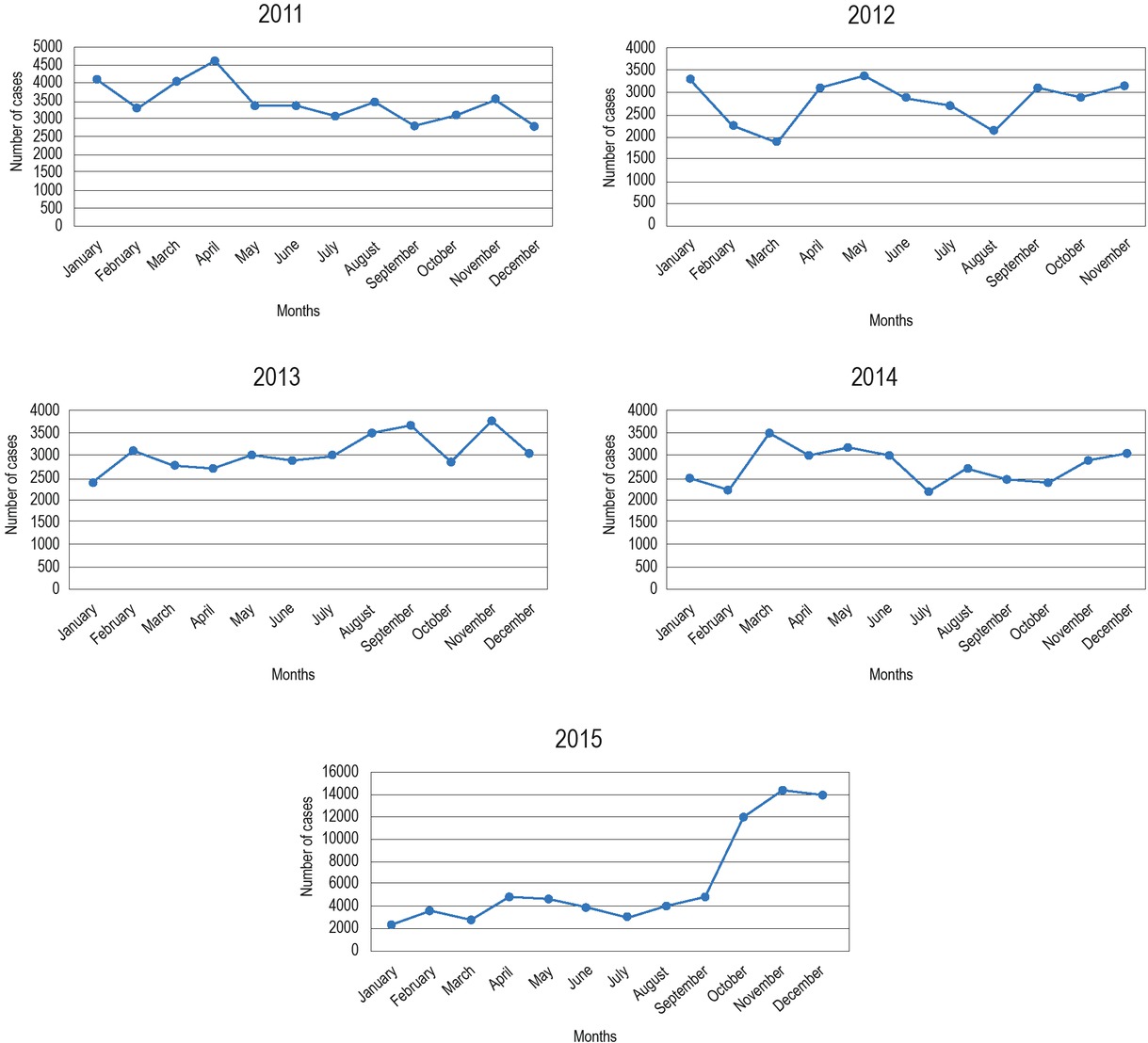
Fig. 4
The annual pattern of enterobiasis in Iraq based on data collected between 2011 and 2015.
Statistical analyses revealed no significant relation (rs= 0.02; P=0.9) between the rural population and disease occurrence. Results also showed that 15.7 % of the cases occurred in provinces with a rural population below 20 %, while the other 84.3 % of cases occurred in provinces with a rural population of 20.1 % – 56.3 % (Fig. 5).
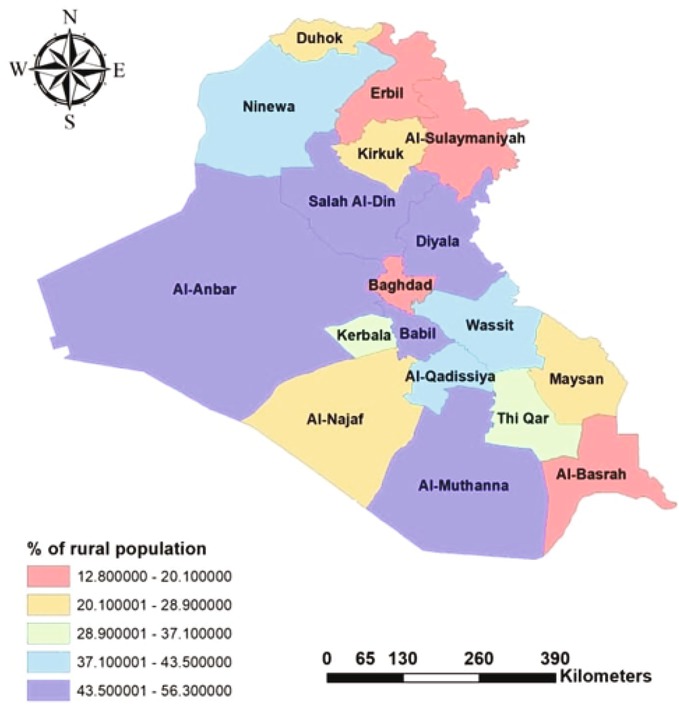
Fig. 5
Distribution of the percentage of rural people inhabiting Iraqi provinces.
The result also revealed that the average size of a family member had no significant effect (rs= 0.13; P=0.5) on the occurrence of the disease. 72.4 % of cases were reported in the province with an average family size≥ 7, while the other 27.6 % of cases were reported in provinces with an average family member from 5 to 6.6 (Fig. 6). The adults percentages also had no significant relation (rs= -0.3; P=0.1) with the occurrence of enterobiasis. The results indicated that 33.9 % of infections occurred in governorates whose population consisted of a high percentage of adults (60 – 68 %). At the same time, about 60 % of cases occurred in governorates whose population consisted of fewer percentages of adults that ranged between 56 % – 59.7 % (Fig. 7).
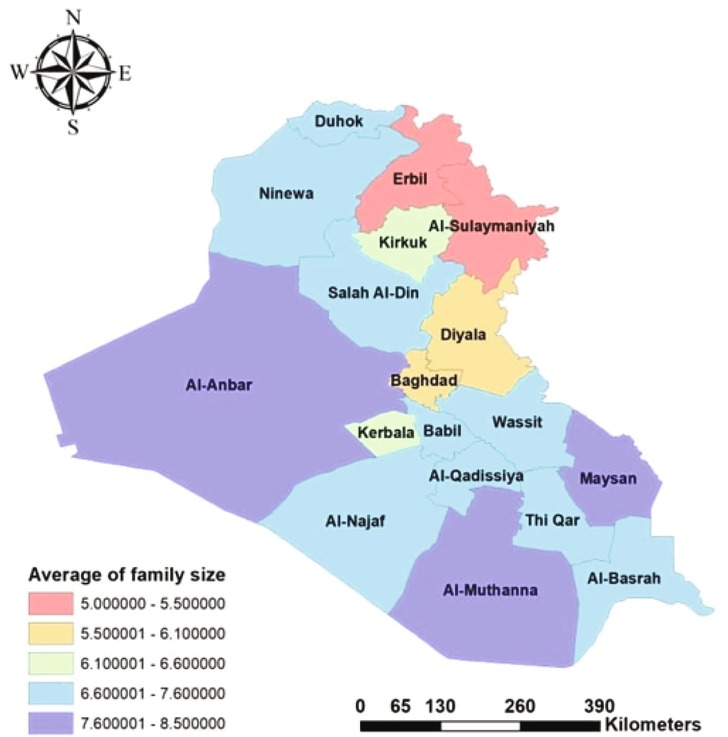
Fig. 6
Distribution of the average family size among Iraqi provinces.
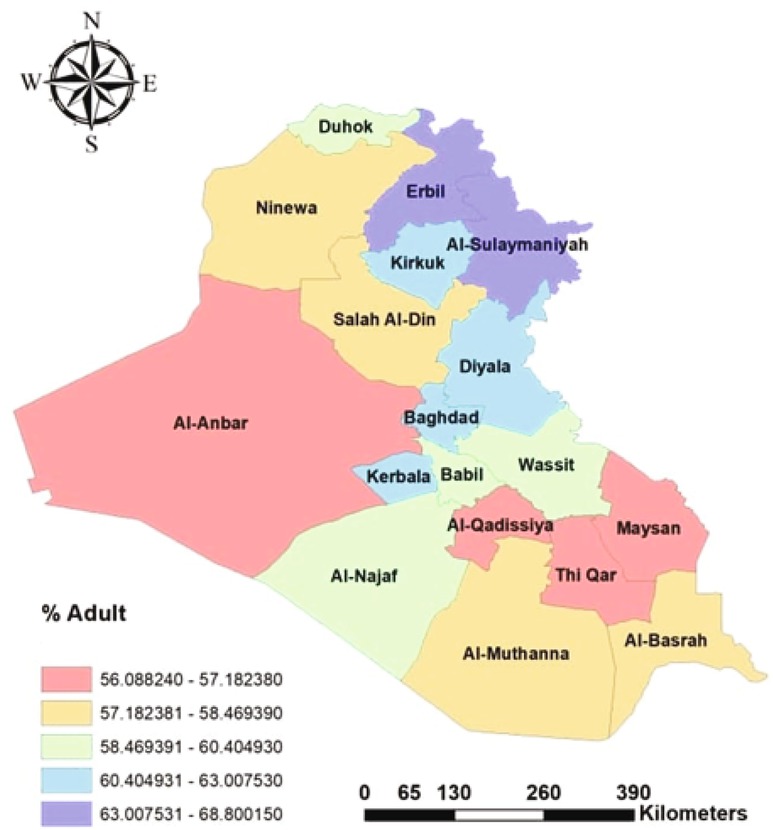
Fig. 7
Distribution of the adult people inhabiting Iraqi provinces.
Discussion
In Iraq, enterobiasis is not considered a serious disease, but the morbidity level is significant, especially in children (Al-Qadhi & Al-Warid, 2011; Al-Daoody & Al-Bazzaz, 2020; Dohan & Al-Warid, 2022). The results showed that the number of infected people fluctuated yearly. This discrepancy in the results can be explained due to some factors that may influence the E.vermicularis infectivity rate, such as people’s activities and behavior (Dudlová et al., 2018), hygienic status, education status, availability of effective anti-helminthic drugs and overcrowding (Kubiak et al., 2017). Nonetheless, there was a dramatic increase in the number of cases recorded between 2014 and 2015. This rise was most likely caused by the violence that displaced almost a million people due to ISIS’ occupation of these parts of Iraq. ISIS significantly influenced a health system that had already been damaged by years of strife and underfunding. Despite the fact that ISIS had been operating in several areas for some time, many health facilities had little notice of the imminent attack (Ibrahim et al.,2021). Most cases were detected in female individuals compared to males. This result agreed with other investigation that presented higher infection rates of E. vermicularis among females (Al-Daoody & Al-Bazzaz, 2020). This bias is nonetheless disagreed with other reports in Iraq such as those (Hussein & Meerkhan, 2019) and (Dohan & Al-Warid, 2022). They showed high infection rates in males compared to females.
The results showed that more than half of cases were noticed in governorates whose population consisted of fewer percentages of adults. As well as, the overall incidence of Enterobiasis is far greater among (4 – 15) years old compared to other age classes. This high infection rate among children could be due to direct contact transmission, which is particularly common among children in kindergartens and elementary schools (Park et al., 2005). As well as such age school children demonstrate changes in exposure to settings that encourage the transmission of the infective stages of most helminths, including E. vermicularis; other researchers found that this age group’s hand-washing practice is very poor (Curtis & Cairncross, 2003). Most of the cases in this survey were reported as having a high prevalence in South region provinces followed by the middle region provinces. It is well known that E. vermicularis is more common in warm climates (Fan et al., 2019) and this may be the reason for the high prevalence rates in the country’s southern area. The majority of enterobiasis in the current survey also occurred in provinces with a rural population of 20.1 % – 56.3 %. This came in line with a study (Lee et al., 2000), which found that people who live in rural areas had higher chances of acquiring pinworm infections.
No significant seasonal variation of E. vermicularis infections was identified in this survey. Although the peaks of enterobiasis were noticed in November, December, March, and April for different years, all these months fall within the school season in Iraq. Overcrowding, which is very common in kindergartens and primary schools during the school season, is an essential element related to the transmission of infections.
The average family member had no significant effect on the occurrence of enterobiasis in this current study, although most cases were reported in provinces with an average of family 7 ≥ members. Overcrowding, even in the home can be considered a significant factor related to the occurrence of enterobiasis (Remm & Remm, 2008). Enterobiasis is transmitted directly from one person to another and does not require any intermediate host. Therefore, it is more likely to spread among members of the same family. In addition, clinically mild cases and asymptomatic infected individuals may provide a hidden reservoir of infection in the family population (Matsen & Turner, 1969). This result agrees with some other investigators, who reported that the rate of enterobiasis could be increased as a function of large family size (Cazorla et al., 2006; Artan et al., 2008; Al-Daoody & Al-Bazzaz, 2020).
Finally, our survey showed a significant incidence of pinworm in the sampled community, necessitating long-term control actions to enhance living and sanitary conditions, including treating afflicted people. In addition, a coordinated health education campaign would help to maximize the effects of these actions by promoting healthy behavior and decreasing the risk of contracting the E. vermicularis infections.
Notes
Acknowledgments
This work was facilitated by the support of the Communicable Diseases Control Center (CDCC), Iraq.