Introduction
Cystic echinococcosis (CE) is a zoonotic parasitic disease. According to the World Health Organization (WHO), worldwide economic losses due to CE exceed three billion US dollars annually (WHO, 2020). Globally, most human CE cases are caused by E. granulosus sensu stricto, sheep strain (G1 and G3) (Agudelo Higuita et al., 2016). The adult worms reside in the small intestines of the definite host, which are mainly dogs or other canids. Parasite eggs are then released in the feces and consumed by intermediate hosts, which are commonly sheep or other ruminants. Humans can become aberrant intermediate hosts if they ingest substances, such as water or vegetables that are contaminated with Echinococcus eggs (Otero-Abad et al., 2013). Cystic lesions typically occur in the liver, lungs or both, but can develop in other organs (Engin et al., 2000). Infected individuals may remain asymptomatic for months or years (Almulhim & John, 2019).
In Pakistan, CE is considered an endemic disease (Ahmed et al., 2017). However, the burden of CE on Pakistan has been poorly studied due to a general lack of awareness (Khan et al., 2019a). In addition to long-term residents of Pakistan, immigrants from Afghanistan with CE are also commonly treated in Pakistan (Khan et al., 2019b). The current study describes the demographic characteristics of CE patients who were treated surgically at Shaukat Khanum Memorial Cancer Hospital and Research Centre (SKMCH & RC) in Lahore, Punjab Province, Pakistan from 2007 to 2018.
Materials and Methods
Study area
Pakistan is located in South Asia and is the fifth most populated country in the world . In 2019, the population of Pakistan was approximately 211.2 million, with 61.4 % of the population 15 – 64 years of age, 22.1 % of the population 5 – 14 years of age, 12.1 % of the population 4 years of age and younger, and 4.4. % of the population 65 years of age and older (GOP, 2020). Males make up 51 % of the population (GOP, 2020). Most of Pakistan’s population lives in rural and peri-rural areas (GOP, 2020). Due to a lack of medical facilities, in rural areas, most of the population must visit larger cities for medical treatment. Pakistan is a largely agricultural country with a semi-arid landscape and a subtropical climate (Ahmed et al., 2012). The country’s economy relies heavily on livestock production, with a large part of the population involved with livestock husbandry. The livestock population of Pakistan consists of over 49 million cattle, 41 million buffaloes, 31 million sheep, 78 million goats, 5.5 million donkeys, 1.1 million camels, 400,000 horses, and 200,000 mules (GOP, 2020).
Punjab province is located in the southern part of the country, with fertile agricultural land and deserts (Khan et al., 2020a). It has one of the largest provincial populations, with a 2017 census population of 110,012,615. The province also contains much of the country’s livestock population, including 49 % of the country’s cattle, 65 % of the country’s buffaloes, 24 % of the country’s sheep, 37 % of the country’s goats, 22 % of the country’s camels, 47 % of the country’s horses, 41 % of the country’s mules, and 52 % of the country’s donkeys (GOP, 2006).
Patient Information
In current study, data was collected retrospectively for CE patients treated surgically at SKMCH & RC from 2007 to 2018 were included in this study. Pre-surgical diagnosis was performed via ultrasound (US), magnetic resonance imaging (MRI), or computed tomography (CT) scan. All cases were confirmed by histopathology performed on surgically removed cysts. In addition to surgical management, all patients received antiparasitic treatment with albendazole (400 mg twice a day for 28 to 90 days). Patient medical charts were reviewed to collect demographic information, including age, sex, ethnicity, and place of residence. Cyst localization and number of cysts per organ were documented.
Statistical analysis
Frequencies of the assessed variables were recorded as percentages, with patient age presented using 10-year age categories.
Ethical Approval and/or Informed Consent
This study was approved by the SKMCH & RC Institutional Ethics Committee under EXMPT-22-06-18-01. Informed consent for the use of medical records for future research was obtained from all patients at the time of treatment.
Results
In total, 536 surgically confirmed CE cases were treated at SKMCH & RC from 2007 to 2018. Out of the 536 patients, 226 (42.2 %) were male and 310 (57.8 %) were female. Patient age ranged from 1 to 82 years of age (Table 1). Males made up 50.3 % of cases 20 year of age or younger, 36.7 % of cases aged 21 – 50 years, and 49.3 % of cases 51 years of age and older. Patients were from throughout Pakistan, with 336 cases (62.7 %) from the province of Khyber Pakhtunkhwa, 147 cases (27.4 %) from Punjab, 18 cases (3.3 %) from Baluchistan, 3 cases (0.6 %) from Sindh, 2 cases (0.4 %) from Islamabad, 1 case (0.2 %) from Gilgit, and 1 case (0.2 %) from Azad Jammu and Kashmir. An additional 28 cases (5.2 %) were from the neighboring country of Afghanistan (Fig. 1; Table 2). A further breakdown by city of origin is presented as supplementary material (Table S1). Most patients were members of the Pashtun (n=197; 36.7 %), Hindku (n=142; 26.5 %), and Punjabi (n=118; 22.0 %) ethnic groups (Table 3).
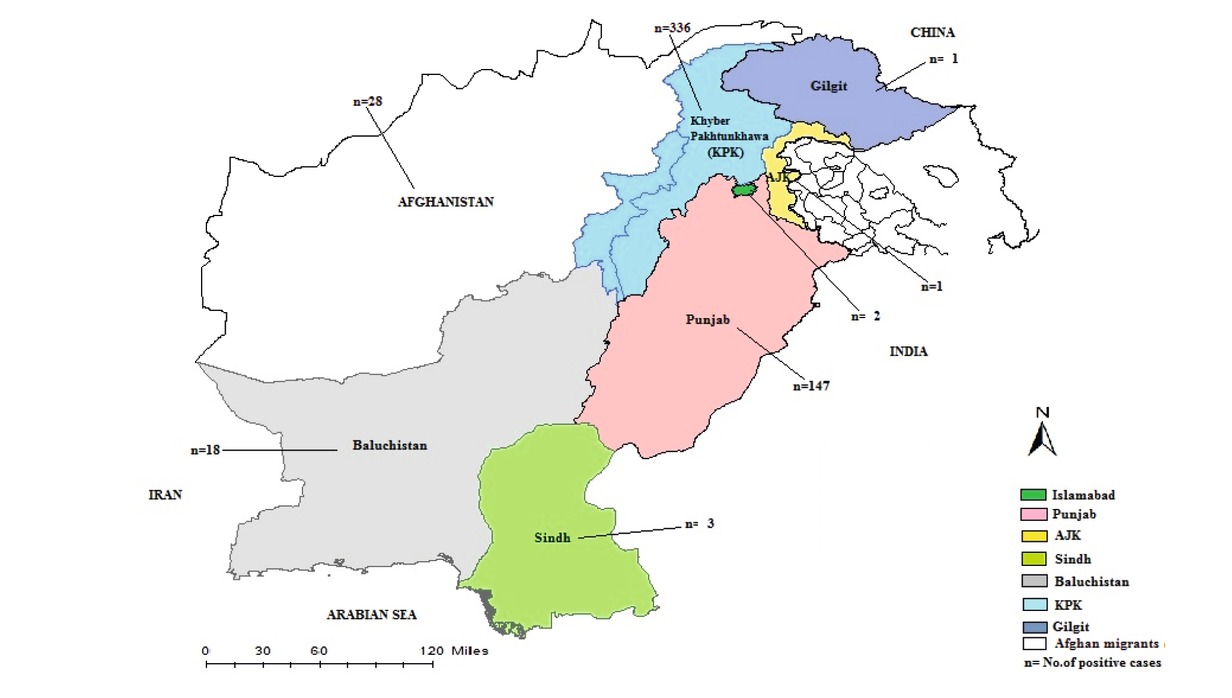
Fig. 1
Province level distribution of 536 CE cases treated surgically at Shoukat Khanum Memorial Cancer Hospital and Research Centre in Lahore, Pakistan from 2007 – 2018.
Table 1
Age and sex of 536 CE cases treated surgically at Shoukat Khanum Memorial Cancer Hospital and Research Centre in Lahore, Pakistan from 2007 – 2018.
| Age (years) | Male (%) | Female (%) | Total Cases (%) |
|---|---|---|---|
| 1 – 10 | 32 (14.1) | 20 (6.4) | 52 (9.7) |
| 11 – 20 | 41 (18.1) | 52 (16.7) | 93 (17.3) |
| 21 – 30 | 52 (23) | 83 (26.7) | 135 (25.2) |
| 31 – 40 | 37 (16.3) | 68 (21.9) | 105 (19.6) |
| 41 – 50 | 27 (11.9) | 49 (15.8) | 76 (14.2) |
| 51 – 60 | 17 (7.5) | 25 (8.1) | 42 (7.8) |
| 61 ≥ | 20 (8.8) | 13 (4.2) | 33 (6.2) |
| 226 (42.2) | 310 (57.8) | 536 (100) |
Table 2
Province or region of origin for 536 CE cases treated surgically at Shoukat Khanum Memorial Cancer Hospital and Research Centre in Lahore, Pakistan from 2007 – 2018.
| Province or Region | 2007 – 2010 | 2011 – 2014 | 2015 – 2018 | Total Cases (%) |
|---|---|---|---|---|
| Khyber Pakhtunkhwa | 65 | 158 | 113 | 336 (62.7) |
| Punjab | 45 | 53 | 49 | 147 (27.4) |
| Afghanistan | 5 | 16 | 7 | 28 (5.2) |
| Baluchistan | 2 | 8 | 8 | 18 (3.3) |
| Sindh | 2 | - | 1 | 3 (0.6) |
| Islamabad | - | 1 | 1 | 2 (0.4) |
| Gilgit Baltistan | - | - | 1 | 1 (0.2) |
| Azad Jammu and Kashmir | - | 1 | - | 1 |
| 119 (22.20%) | 237 (44.22%) | 180 (33.58%) | (0.2) 536 (100) |
Table 3
Ethnicity for 536 CE cases treated surgically at Shoukat Khanum Memorial Cancer Hospital and Research Centre in Lahore, Pakistan from 2007 – 2018.
| Ethnicity | Total cases (%) |
|---|---|
| Pashtun | 197 (36.7) |
| Hindku | 142 (26.5) |
| Punjabi | 118 (22.0) |
| Afghani | 28 (5.2) |
| Saraiki | 26 (4.9) |
| Balochi | 18 (3.4) |
| Other* | 7 (1.3) |
| Total | 536 (100) |
The highest number of CE cases was reported in 2013 (n=90), with the lowest number of cases in 2007 (n=24) (Table 4). The largest number of cysts was obtained from the liver (137/536; 25.6 %), followed by the lungs (86/536; 16.0 %), brain (43/536, 8.0 %), abdomen (41/536; 7.6 %), uterus and ovaries (26/536; 4.9 %), chest (25/536; 4.7 %), spleen (24/536; 4.5 %), and kidneys (14/536; 2.6 %), with anatomical location not available for 52 (9.7 %) cysts (Table 4). Twenty-six (4.8 %) patients presented with multiple cysts. Data on World Health Organization Informal Working Group on Echinococcosis (WHO-IWGE) ultrasound-based cyst staging were not available. A detailed breakdown of cases by age, sex, ethnicity, and cyst location is provided as supplementary material (Table S2).
Table 4
Treatment year, anatomic cyst location, and imaging technique used for 536 CE cases treated surgically at Shoukat Khanum Memorial Cancer Hospital and Research Centre in Lahore, Pakistan from 2007 – 2018.
| Parameter | Number of Cases | Percentage (%) |
|---|---|---|
| Year | ||
| 2007 | 24 | 4.5 |
| 2008 | 28 | 5.2 |
| 2009 | 41 | 7.6 |
| 2010 | 30 | 5.6 |
| 2011 | 52 | 9.7 |
| 2012 | 51 | 9.5 |
| 2013 | 90 | 16.8 |
| 2014 | 51 | 9.5 |
| 2015 | 48 | 9.0 |
| 2016 | 48 | 9.0 |
| 2017 | 38 | 7.1 |
| 2018 | 35 | 6.5 |
| Cyst location | ||
| Liver | 137 | 25.6 |
| Lungs | 86 | 16.0 |
| Brain | 43 | 8.0 |
| Abdomen | 41 | 7.6 |
| Uterus and ovary | 26 | 4.9 |
| Chest | 25 | 4.7 |
| Spleen | 24 | 4.5 |
| Kidney | 14 | 2.6 |
| *Other | 88 | 16.4 |
| Site not mentioned | 52 | 9.7 |
| Imaging technique | ||
| Computed tomography scan | 405 | 75.6 |
| Ultrasound | 223 | 41.6 |
| Magnetic resonance imaging | 107 | 20.0 |
| Radiography | 87 | 16.2 |
| Data not available | 52 | 9.7 |
Table S1
City and province of origin for 536 CE cases treated at Shoukat Khanum Memorial Cancer Hospital and Research Centre Lahore, Pakistan from 2007 - 2018.
| City | Province | 2007 | 2008 | 2009 | 2010 | 2011 | 2012 | 2013 | 2014 | 2015 | 2016 | 2017 | 2018 | Total |
|---|---|---|---|---|---|---|---|---|---|---|---|---|---|---|
| Afghanistan | Afghanistan | 1 | 3 | 1 | 14 | 2 | 1 | 2 | 1 | 3 | 28 | |||
| Islamabad | Islamabad | 1 | 1 | 2 | ||||||||||
| Bagh | AJK | 1 | 1 | |||||||||||
| Abbottabad | KPK | 1 | 1 | 2 | ||||||||||
| Bajaur | KPK | 1 | 1 | 1 | 3 | |||||||||
| Bannu | KPK | 2 | 2 | 1 | 1 | 6 | ||||||||
| Bara | KPK | 1 | 2 | 1 | 2 | 1 | 7 | |||||||
| Charsada | KPK | 2 | 1 | 2 | 1 | 1 | 1 | 8 | ||||||
| Dassu | KPK | 1 | 1 | |||||||||||
| Dera Ismail Khan | KPK | 1 | 1 | 1 | 2 | 5 | ||||||||
| Daggar | KPK | 1 | 1 | |||||||||||
| Hangu | KPK | 1 | 1 | 1 | 3 | |||||||||
| Jamrud | KPK | 1 | 1 | 2 | ||||||||||
| Kohat | KPK | 1 | 1 | 2 | 1 | 5 | ||||||||
| Kurram | KPK | 1 | 1 | |||||||||||
| Karak | KPK | 1 | 1 | 1 | 2 | 1 | 2 | 8 | ||||||
| Khar Bajaur | KPK | 1 | 2 | 1 | 4 | |||||||||
| Khyber | KPK | 1 | 1 | |||||||||||
| Kabal | KPK | 3 | 22 | 2 | 1 | 28 | ||||||||
| Landi Kotal | KPK | 1 | 1 | |||||||||||
| Lakki Marwat | KPK | 1 | 1 | 3 | 5 | |||||||||
| Lower Dir | KPK | 1 | 1 | 1 | 1 | 4 | ||||||||
| Malakand | KPK | 1 | 1 | 1 | 1 | 2 | 1 | 7 | ||||||
| Mansehra | KPK | 1 | 1 | |||||||||||
| Mardan | KPK | 1 | 1 | 1 | 3 | 2 | 1 | 1 | 2 | 12 | ||||
| Miran Shah | KPK | 1 | 1 | 1 | 3 | |||||||||
| Mohmand | KPK | 1 | 1 | |||||||||||
| N.Waziristan | KPK | 1 | 2 | 3 | ||||||||||
| Nowshera | KPK | 2 | 2 | 1 | 1 | 3 | 9 | |||||||
| Peshawar | KPK | 3 | 11 | 15 | 14 | 15 | 19 | 25 | 4 | 9 | 10 | 6 | 9 | 140 |
| Parachanar | KPK | 1 | 1 | |||||||||||
| Razmak | KPK | 1 | 1 | 2 | ||||||||||
| Sawabi | KPK | 1 | 1 | |||||||||||
| Swat | KPK | 1 | 1 | 5 | 3 | 20 | 14 | 9 | 3 | 2 | 58 | |||
| Upper Dir | KPK | 1 | 1 | 2 | ||||||||||
| Waziristan | KPK | 1 | 1 | |||||||||||
| Arifwala | Punjab | 1 | 1 | |||||||||||
| Attock | Punjab | 1 | 1 | 1 | 3 | |||||||||
| Bahawalnagar | Punjab | 2 | 2 | |||||||||||
| Bhakkar | Punjab | 1 | 1 | |||||||||||
| Bahawalnagar | Punjab | 1 | 1 | |||||||||||
| Bahawalpur | Punjab | 1 | 1 | 1 | 1 | 4 | ||||||||
| Bakkar | Punjab | 1 | 1 | |||||||||||
| D.G Khan | Punjab | 2 | 2 | 1 | 5 | |||||||||
| Faisalabad | Punjab | 2 | 1 | 1 | 1 | 1 | 2 | 8 | ||||||
| Gujranwala | Punjab | 2 | 1 | 1 | 1 | 1 | 2 | 2 | 2 | 12 | ||||
| Gujrat | Punjab | 1 | 1 | 2 | ||||||||||
| Jhang | Punjab | 1 | 1 | 2 | 5 | |||||||||
| Jehlum | Punjab | 1 | 1 | |||||||||||
| Kasur | Punjab | 1 | 1 | |||||||||||
| Khanpur | Punjab | 1 | 1 | 2 | ||||||||||
| Lodhran | Punjab | 1 | 1 | |||||||||||
| Lahore | Punjab | 9 | 5 | 6 | 4 | 3 | 4 | 11 | 5 | 1 | 5 | 8 | 4 | 65 |
| Mianwali | Punjab | 1 | 1 | |||||||||||
| Multan | Punjab | 1 | 2 | 1 | 1 | 5 | ||||||||
| Muzaffargarh | Punjab | 1 | 1 | 2 | ||||||||||
| Okara | Punjab | 1 | 1 | 2 | ||||||||||
| Rahim Yar Khan | Punjab | 1 | 1 | 1 | 1 | 1 | 5 | |||||||
| Rawalpindi | Punjab | 1 | 1 | 1 | 1 | 1 | 5 | |||||||
| Sadiq abad | Punjab | 1 | 1 | |||||||||||
| Sialkot | Punjab | 1 | 1 | 1 | 3 | |||||||||
| Sahiwal | Punjab | 1 | 1 | |||||||||||
| Sargodha | Punjab | 1 | 1 | 1 | 1 | 2 | 6 | |||||||
| Taunsa | Punjab | 1 | 1 | |||||||||||
| Chaman | Balochistan | 1 | 1 | 2 | ||||||||||
| Quetta | Balochistan | 1 | 1 | 1 | 3 | 1 | 2 | 3 | 2 | 2 | 16 | |||
| Karachi | Sindh | 1 | 1 | 2 | ||||||||||
| Sukkur Taluka | Sindh | 1 | 1 | |||||||||||
| Skardu | Gilgit Baltistan | 1 | 1 | |||||||||||
| Total | 24 | 28 | 38 | 29 | 52 | 50 | 84 | 51 | 45 | 52 | 38 | 45 | 536 |
Table S2
Sex, ethnicity, and cyst location by age group for CE patients (n=546) treated at Shoukat Khanum Memorial Cancer Hospital and Research Centre Lahore, Pakistan from 2007 - 2018.
| Age (in years) | |||||||||||||
|---|---|---|---|---|---|---|---|---|---|---|---|---|---|
| Parameters | <7 | 7-12 | 13-18 | 19-24 | 25-30 | 31-36 | 37-42 | 43-48 | 49-54 | 55-60 | 61+ | Total | |
| Sex | |||||||||||||
| Female | 4 | 26 | 27 | 34 | 64 | 36 | 40 | 29 | 18 | 20 | 13 | 311 | |
| Male | 11 | 28 | 28 | 20 | 38 | 27 | 12 | 15 | 11 | 16 | 19 | 225 | |
| Ethnicity | |||||||||||||
| Pashtun | 8 | 20 | 19 | 22 | 33 | 27 | 18 | 12 | 16 | 15 | 7 | 197 | |
| Hindko | 5 | 18 | 13 | 16 | 32 | 14 | 15 | 8 | 7 | 9 | 5 | 142 | |
| Punjabi | 8 | 14 | 8 | 22 | 14 | 13 | 17 | 3 | 7 | 12 | 118 | ||
| Afghani | 1 | 3 | 6 | 2 | 2 | 4 | 2 | 3 | 2 | 1 | 2 | 28 | |
| Saraiki | 3 | 2 | 4 | 4 | 2 | 4 | 2 | 5 | 26 | ||||
| Balochi | 1 | 2 | 1 | 1 | 8 | 2 | 2 | 1 | 18 | ||||
| Other | 1 | 1 | 2 | 1 | 1 | 1 | 7 | ||||||
| Cyst location | |||||||||||||
| Liver | 4 | 9 | 14 | 16 | 22 | 17 | 11 | 11 | 9 | 15 | 9 | 137 | |
| Lung | 3 | 17 | 10 | 9 | 18 | 13 | 7 | 3 | 1 | 2 | 3 | 86 | |
| Brain | 3 | 4 | 8 | 6 | 9 | 6 | 3 | 4 | 43 | ||||
| Abdomen | 2 | 3 | 4 | 7 | 6 | 4 | 3 | 3 | 4 | 5 | 41 | ||
| Uterus and ovary | 1 | 1 | 2 | 7 | 7 | 4 | 2 | 1 | 1 | 26 | |||
| Chest | 1 | 4 | 1 | 9 | 3 | 2 | 3 | 1 | 1 | 25 | |||
| Spleen | 2 | 1 | 6 | 2 | 4 | 5 | 1 | 1 | 2 | 24 | |||
| Kidney | 2 | 2 | 3 | 2 | 1 | 1 | 3 | 14 | |||||
| Eye | 1 | 5 | 2 | 2 | 2 | 12 | |||||||
| Pelvic region | 2 | 1 | 3 | 2 | 1 | 1 | 10 | ||||||
| Face | 1 | 1 | 1 | 1 | 1 | 5 | |||||||
| Gallbladder | 1 | 2 | 2 | 1 | 6 | ||||||||
| Neck | 1 | 1 | 1 | 1 | 1 | 5 | |||||||
| Thigh | 1 | 1 | 1 | 1 | 1 | 5 | |||||||
| Intestines | 1 | 2 | 1 | 1 | 1 | 6 | |||||||
| Back | 1 | 1 | 1 | 3 | |||||||||
| Calf | 1 | 1 | 2 | ||||||||||
| Femur | 1 | 1 | 2 | ||||||||||
| Heart | 1 | 1 | 2 | ||||||||||
| Shoulder | 1 | 1 | 2 | ||||||||||
| Thyroid | 2 | 2 | |||||||||||
| Pancreas | 1 | 1 | |||||||||||
| Pituitary | 1 | 1 | |||||||||||
| Skin | 1 | 1 | 2 | ||||||||||
| Liver and spleen | 1 | 3 | 1 | 1 | 1 | 1 | 1 | 9 | |||||
| Pancreas and spleen | 1 | 1 | 1 | 3 | |||||||||
| Spleen and lung | 1 | 1 | |||||||||||
| Liver and gallbladder | 1 | 1 | 1 | 1 | 2 | 3 | 9 | ||||||
| Not provided | 1 | 5 | 5 | 2 | 16 | 3 | 6 | 6 | 2 | 2 | 4 | 52 | |
Discussion
CE is considered a neglected tropical disease (NTD) of global concern (Khan et al., 2019b). As there have been few studies conducted in Pakistan while it is known that CE is endemic in this region. Therefore, studies evaluating the distribution of human cases are needed. In the present study, there were more female than male cases, which concurs with the findings of other studies (Khan et al., 2018, 2019c). In some locations, females are believed to be of higher risk due to increased interaction with dogs as well as gardening. However, this does not appear to be globally applicable since in some areas the condition appears to be more common in males (Aksu et al., 2013; Sharma et al., 2013; Torgerson et al., 2013; Khan et al., 2019c).
In the current study, the highest numbers of cases were in young and middle age adults. However, of note, is the large number of patients under 11 years of age (n=52; 9.7 %), indicating recent parasite transmission. This finding concurs with another study conducted in Pakistan where 10.5 % of reported cases were in children less than 11 years of age (Khan et al., 2019c). Younger individuals may be at higher risk due to greater exposure to dogs, especially in an agricultural setting (Khan et al., 2019c). In the current study, the 21 – 30-year age group made up of 25.2 % of the evaluated cases. Similar observations were found by Muqaddas et al. (2019) who reported 29.8 % of cases in this age group in the cities of Lahore, Karachi, and Multan. Comparable outcomes have been reported in other countries, including Iraq (Abdulhameed et al., 2018), Nepal (Ghartimagar et al., 2013), and Ethiopia (Kebede et al., 2010). Clinical disease in young adults can have detrimental impacts on the local workforce and economy (Amini et al., 2008; Mousavi et al., 2012).
The largest numbers of cysts were obtained from the liver and lungs, which is in line with studies from other geographic locations in Pakistan (Khan et al., 2018; Khan et al., 2019c; Muqaddas et al., 2019; Butt et al., 2020). These finding are also similar to those found in Turkey (Akalin et al., 2014), Iran (Mahmoudi et al., 2019; Khazaei et al., 2016; Aliabadi et al., 2015), Tanzania (Ernest et al., 2010), Kyrgyzstan (Torgerson et al., 2003), and Italy (Conchedda et al., 2010). While liver and lung cysts were most common, the large number of cysts found in other organ systems is likely due to more complicated cysts and unusual presentations of CE being surgically treated at SKMCH & RC. Therefore, it is unlikely that the distribution of cyst locations found in the current study is applicable to all CE cases in the country. Overall, the number of CE cases treated surgically at the SKMCH & RC appears to have risen somewhat during the last half of the study period. This increase is likely due to improvements in the hospital’s data management system rather than a true increase in the number of treated cases. The large number of reported surgical cases in 2013 was likely due to the establishment that year of the new Ministry of National Health Services, Regulation, and Coordination, which may have increased the likelihood that surgeons appropriately documented CE cases. Since surgical CE case data were collected from a single hospital, it would not be appropriate to try extrapolate CE incidence to a larger geographic area.
The majority of cases presenting to SKMCH & RC during 2007 – 2018 were from Khyber Pakhtunkhwa Province, which is a neighboring province to Punjab. A recent retrospective study conducted on hospital records from five major metropolitan cities located in Pakistan showed that the majority of treated patients were from Sindh Province (67.5 %), with 32.4 % of the patients from Punjab (Muqaddas et al., 2019). However, there has yet to be a study that evaluates the regional frequency of human CE cases in Pakistan. Hospitals in Pakistan treat a large immigrant population. While in European countries, many of the CE cases among immigrants come from countries such as Turkey, Greece, Bulgaria, Afghanistan, Kosovo, Macedonia, Morocco, Syria, and Iraq, almost all immigrants treated for CE in Pakistan are from Afghanistan (Khan et al., 2019b; Anonymous, 2017). In addition to acting as a strain on the healthcare system, a secondary concern is that these immigrants may also bring infected dogs and livestock with them into the country.
Demographically, in Pakistan, the largest ethnic group is Punjabi (44.7 %), followed by Pushtun (15.4 %), Sindhi (14.1 %), Saraiki (8.4 %), Muhajir (7.6 %), Hindku (6.2 %), and Balochi (3.6 %) (Misachi, 2019). The current findings showed that most CE cases treated in the hospital in Lahore were Pashtun (36.7 %), followed by Hindku (26.5 %), and Punjabi (22.0 %). In comparison, a study by Khan et al. (2018) found that 93.4 % of cases seen in northeastern Punjab Province were Punjabi, while only 6.6 % where Pashtun (6.6 %) (Khan et al., 2018). These findings likely represent the geographic distribution of these ethnic groups in Pakistan. Additional studies are needed to evaluate any sociocultural risk factors for CE within the various ethnic groups.
This study described the epidemiological characteristics of CE cases managed surgically at a single reference hospital in the city of Lahore. While these cases don’t portray the full spectrum of cases seen in the country, most CE patients in Pakistan continue to be treated surgically despite WHO-IWGE guidelines indicating that certain cases are best managed medically or using a watch-and-wait approach (Brunetti et al., 2010). As a result, CE likely results in higher costs to the Pakistan healthcare system than if a cyst stage-specific approach was taken. Albendazole drug appears to be commonly used, although primarily in association with surgery (Khan et al., 2020b). According to Khan et al., (2020c; 2020d), albendazole is commonly recommended to all CE patients, while the combination of albendazole and praziquantel or albendazole and nitazoxanide is occasional prescribed (Bygott et al., 2009; Lötsch et al., 2016; Monge-Maillo et al., 2017). As of now, there does not appear to be a system in place to share best practices for treating CE in Pakistan. Healthcare centers could contribute to combatting CE by sharing patient data and treatment strategies (Junghanss et al., 2008; Brunetti et al., 2010; Khan et al., 2020b).
Conclusion
This study showed that CE continues to be a problem throughout the country of Pakistan. There is an urgent need for community-based US screening following WHO-IWGE international guidelines to ensure the timely diagnosis and appropriate cyst stage-based management of the disease (WHO-IWGE, 2003; Brunetti et al., 2010). These studies would also assist in determining the extent of non-healthcare seeking cases. In addition, surveys to estimate the CE burden in humans and animals would help direct public health efforts, similar to the work done by the HERACLES project in Balkan countries (Tamarozzi et al., 2018). Overall, a well-organized surveillance system is needed to help inform decision-makers on how to best approach CE control.
Acknowledgements
The authors are thankful to staff members of SKMCH & RC for their support during data collection.