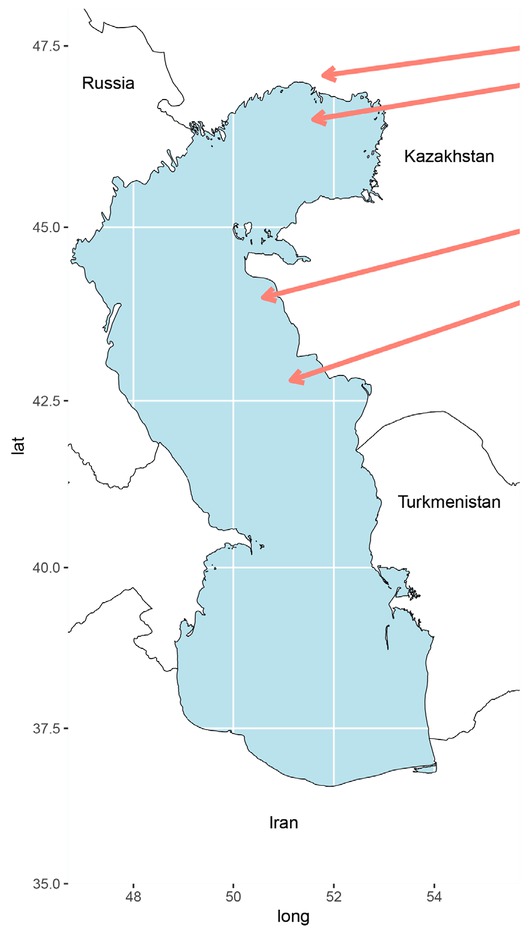
Fig. 1
Study sites in the Caspian Sea. Top arrow indicates lower reaches of the Ural river, whilst the other sites were within the Caspian Sea.
Table 1
The number of fish infected and range of intensity of infection of parasites in fish of order Clupeiformes.
| Fish host | Parasite | Number infected (prevalence, confidence intervals) | Development stage of parasite recovered and localization | Range of intensity | Mean abundance | Parasite Taxon |
|---|---|---|---|---|---|---|
| Alosa saposchnikowii | Anisakis schupakovi Mozgovoi, 1951 | 1 (2, 0.1 – 11) | Third stage larva (Abdominal cavity, muscle, serous membrane) | 2 | 0.04 | Nematoda: Anisakidae |
| Porrocaecum reticulatum Linstow, 1899 | 6 (12, 5 – 24) | Third stage larva (Abdominal cavity) | 1 – 4 | 0.2 | Nematoda: Ascaridoidea | |
| Neogryporhynchus cheilancristrotus Wedl, 1855 | 1 (2, 0.1 – 11) | Metacestode (Abdominal cavity) | 14 | 0.28 | Cestoda: Dilepididae | |
| Mazocraes alosae Hermann, 1782 | 42 (84, 71 – 93) | Аdult (Gills) | 1 – 276 | 36.5 | Monogenea: Mazocraeidea | |
| Clupeonella cultriventris | Anisakis schupakovi | 12 (24, 13 – 38) | Third stage larva (Muscle) | 1 – 6 | 0.6 | Nematoda: Anisakidae |
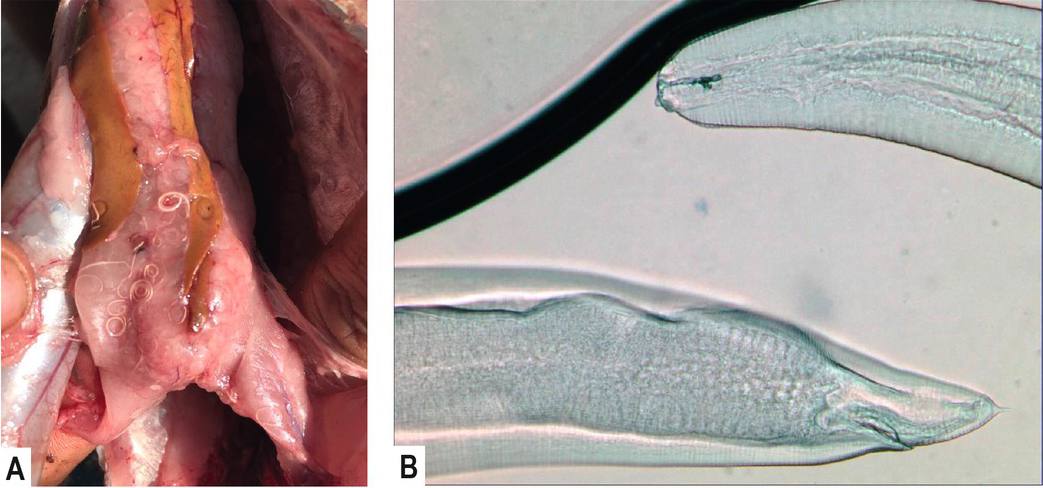
Fig. 2
Anisakis schupakovi. A – third stage larvae in the abdominal cavity of the Sander lucioperca.
B – head and tail of 3rd stage larvae recovered from Abramis brama orientalis.
Table 2
The number of fish infected and range of intensity of infection of parasites in fish of order Perciformes.
| Fish host | Parasite | Number infected (prevalence, confidence intervals) | Development stage of parasite recovered | Range of intensity | Mean abundance | Parasite Taxon |
|---|---|---|---|---|---|---|
| Sander lucioperca | Anisakis schupakovi | 42(84,71-93) | Third stage larva (Muscle, serous membrane) | 7-161 | 27.0 | Nematoda: Anisakidae |
| Contracecum sp. | 9(18,9-31) | Third stage larva (Abdominal cavity, serous membrane) | 7-121 | 6.8 | Nematoda: Anisakidae | |
| Ancyrocephalus paradocus | 6(12,5-24) | Adult | 1-17 | 0.62 | Monogenea: Ancyrocephalidae | |
| Creplin, 1839 | (Gills) | |||||
| Diplostomum spathaceum | 10(20,10-33) | Metacercaria | 2-20 | 1.46 | Trematoda: Diplostomidae | |
| Rudolphi, 1819 | (Eyes) | |||||
| Gyrodactylus cernuae Malmberg, | 2(4,0.5-14) | Adult | 2-5 | 0.14 | Monogeneas: Gyrodactylidae | |
| 1957 | (Gills) | |||||
| Tylodelphys clavata Diesing, | 2(4,0.5-14) | Metacercaria | 1-4 | 0.1 | Trematoda: Diplostomidae | |
| 1850 | (Eyes) | |||||
| Synergasilus major Markevitsch, | 17(34,21-49 | Adult | 1-19 | 1.72 | Crustacea: Ergasilidae | |
| 1940 | (Gills) | |||||
| Sander marinus | Anisakis schupakovi | 6(12,5-24) | Third stage larva (Abdominal cavity, serous membrane) | 1-12 | 0.4 | Nematoda: Anisakidae |
| Gyrodactylus luciopercae Gusev, | 2(4,0.5-14) | Adult | 14-29 | 0.86 | Monogeneas: Gyrodactylidae | |
| 1962 | (Gills, skin) | |||||
| Ergasilus briani Markewitsch, | 2(4,0.5-14) | Adult | 2 | 0.04 | Crustacea: Ergasilidae | |
| 1993 | (Gills) | |||||
| Sander | Anisakis schupakovi | 27 (54, 39 - 68) | Third stage larva | 1-19 | 3.0 | Nematoda: Anisakidae |
| volgensis | (Abdominal cavity, muscle, serous membrane) | |||||
| Diplostomum gobiorum Shigin, 1965 | 3(6,1.3-17) | Metacercaria (Eyes) | 6-42 | 1.2 | Trematoda: Diplostomidae | |
| Diplostomum mergi Dubois, 1932 | 1(2,0.1-11) | Metacercaria (Eyes) | 4 | 0.08 | Trematoda: Diplostomidae | |
| Diplostomum spathaceum | 19(38,25-53) | Metacercaria (Eyes) | 2-64 | 4.36 | Trematoda: Diplostomidae | |
| Tylodelphys clavata | 8(16,7-29) | Metacercaria (Eyes) | 2-8 | 0.64 | Trematoda: Diplostomidae |
Table 3
The number of fish infected and range of intensity of infection of parasites in fish of order Mugiliformes.
| Fish host | Parasite | Number infected (prevalence, confidence intervals) | Development stage of parasite recovered | Range of intensity | Mean abundance | Parasite Taxon |
|---|---|---|---|---|---|---|
| Liza aurata syn Chelon aurata | Ligophorus vanbenedenii Parona & Perugia, 1890 | 9 (18, 8.6 – 31) | Аdult (Gills) | 1 – 8 | 0.56 | Monogenea: Ancyrocephalidae |
| Tylodelphys clavata | 1 (2, 0.1 – 11) | Metacercaria (Еyes) | 10 | 0.2 | Trematoda: Diplostomidae | |
| Еrgasilus sieboldi Kaletskaia 1970 | 1 (2, 0.1 – 11) | Аdult (Gills) | 1 | 0.02 | Crustacea: Ergasilidae |
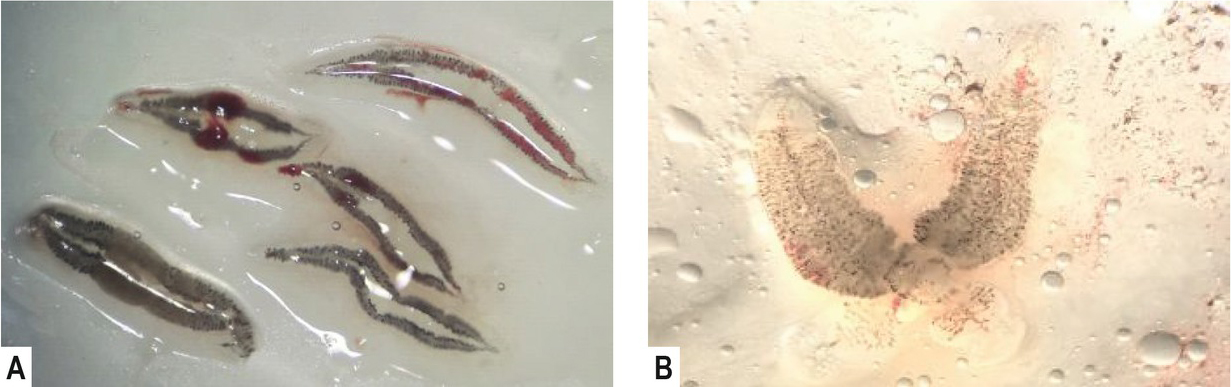
Fig. 3
Mongeneans recovered. A – Mazocraes alosae from the branchial arces of Alosa saposchnikowii.
B – Diplozoon paradoxum from the branchial arches of Abramis brama orientalis.
Table 4
The number of fish infected and range of intensity of infection of parasites in fish of order Cypriniformes
| Fish host | Parasite | Number infected (prevalence, confidence intervals) | Development stage of parasite recovered | Range of intensity | Mean abundance | Parasite Taxon |
|---|---|---|---|---|---|---|
| Abramis brama | Anisakis schupakovi | 1(2,0.1-11) | Third stage larva | 1 | 0.02 | Nematoda: Anisakidae |
| Diplostomum gobiorum | 15(20,18-45) | (Abdominal cavity) Metacercaria (Eyes) | 2-14 | 1.7 | Trematoda: Diplostomidae | |
| Diplostomum spathaceum | 25(50,36-64) | Metacercaria (Eyes) | 1-39 | 6.26 | Trematoda: Diplostomidae | |
| Tylodelphys clavata | 3(6,1.3-17) | Metacercaria (Eyes) | 3-6 | 0.24 | Trematoda: Diplostomidae | |
| Dactylogyrus wunderi Bychowsky, 1931 | 2(4,0.5-14) | Adult (Gills) | 1 | 0.04 | Monogenea: Dactylogyridae | |
| Bothriocephalus opsariichthydis Yamaguti, 1934 | 1 (2,0.1-11) | Adult (Intestines) | 6 | 0.64 | Cestoda:Bothriocephalidae | |
| Leuciscus aspius | Anisakis schupakovi | 42 (84, 71 - 93) | Third stage larva (Abdominal cavity, muscle, serous membrane) | 3-1197 | 87.8 | Nematoda: Anisakidae |
| Porrocaecum reticulatum | 13(26,15-40) | Third stage larva (Abdominal cavity, serous membrane) | 12-356 | 32.8 | Nematoda: Ascaridoidea | |
| Diplostomum gobiorum | 2(4,0.5-14) | Metacercaria (Eyes) | 6-10 | 0.32 | Trematoda: Diplostomidae | |
| Diplostomum helveticum Shigin, 1977 | 1 (2,0.1-11) | Metacercaria (Eyes) | 6 | 0.12 | Trematoda: Diplostomidae | |
| Diplostomum mergi | 5(10,3.3-22) | Metacercaria (Eyes) | 2-6 | 0.44 | Trematoda: Diplostomidae | |
| Diplostomum spathaceum | 24(48,34-63) | Metacercaria (Eyes) | 2-20 | 3.06 | Trematoda: Diplostomidae | |
| Dactylogyrus tubaKaletskaia 1969 | 2(4,0.5-14) | Adult (Gills) | 3-8 | 0.22 | Trematoda: Diplostomidae | |
| Diplostomum volvens Nordmann, 1832 | 1 (2,0.1-11) | Metacercaria (Eyes) | 7 | 0.14 | Trematoda: Diplostomidae | |
| Tylodelphys clavata | 2(4,0.5-14) | Metacercaria (Eyes) | 3-4 | 0.14 | Trematoda: Diplostomidae | |
| Ergazilus sieboldi | 1 (2,0.1-11) | Adult (Gills) | 1 | 0.02 | Crustacea: Ergasilidae | |
| Carassius auratus | Dactylogyrus anchoratus Wagener, 1857 | 2(4,0.5-14) | Adult (Gills) | 4-18 | 0.44 | Monogenea: Dactylogyridae |
| Diplostomum gobiorum Diplostomum mergi | 2(4,0.5-14) 2(4,0.5-14) | Metacercaria (Eyes) Metacercaria (Eyes) | 2-8 2-4 | 0.2 0.12 | Trematoda: Diplostomidae Trematoda: Diplostomidae | |
| Diplostomum spathaceum | 66(12,5-24) | Metacercaria (Eyes) | 2-12 | 0.64 | Trematoda: Diplostomidae | |
| Tylodelphys clavata | 1 (2,0.1-11) | Metacercaria (Eyes) | 3 | 0.06 | Trematoda: Diplostomidae | |
| Cyprinus carpio | Diplostomum gobiorum | 3(6,1.3-17) | Metacercaria (Eyes) | 6-12 | 0.48 | Trematoda: Diplostomidae |
| Diplostomum spathaceum | 19(38,25-53) | Metacercaria (Eyes) | 4-18 | 2.24 | Trematoda: Diplostomidae | |
| Diplostomum volvens | 5(10,3.3-22) | Metacercaria | 2-4 | 0.32 | Trematoda: Diplostomidae | |
| Gyrodactylus cyprini Diarova 1964 | 5(10,3.3-22) | Adult (Gills) | 2-3 | 0.26 | Monogenea:Gyrodactylidae | |
| Tylodelphys clavata | 6(12,5-24) | Metacercaria (Eyes) | 2-36 | 1.28 | Trematoda: Diplostomidae | |
| Rutilus rutilus caspius | Anodonta sp Nematode sp | 7(14,5.8-27) 9(18,8.6-31) | Glochidium (larva) (Gills) - | 1-13 1-4 | 0.5 0.4 | Bivalvia: Unionidae Nematoda: |
| Camallanus sp. | 3(6,1.3-17) | Adult (Intestines) | 1-2 | 0.08 | Nematoda: Camallanidae |
Table 5
The number of fish infected and range of intensity of infection of parasites in fish of order Siluriformes.
| Fish host | Parasite | Number infected (prevalence, confidence intervals) | Development stage of parasite recovered | Range of intensity | Mean abundance | Parasite Taxon |
|---|---|---|---|---|---|---|
| Silurus glanis | Anisakis schupakovi | 4 (67, 22 - 96) | Third stage larva (Abdominal cavity) | 12-563 | 114.3 | Nematoda: Anisakidae |
| Eustrongylus excisus Jägerskiöld, 1909 | 2(33,4.3-78) | Third stage larva (Abdominal cavity, serous membrane) | 72-254 | 54.33 | Nematoda: Dioctophymatidae | |
| Diplostomum mergi | 1(17,0.4-64) | Metacercaria (Eyes) | 4 | 0.67 | Trematoda: Diplostomidae | |
| Silurodiscoides magnus | 2(33,4.3-78) | Adult (Gills) | 4-6 | 1.67 | Monogenea:Ancyrocephalidae |
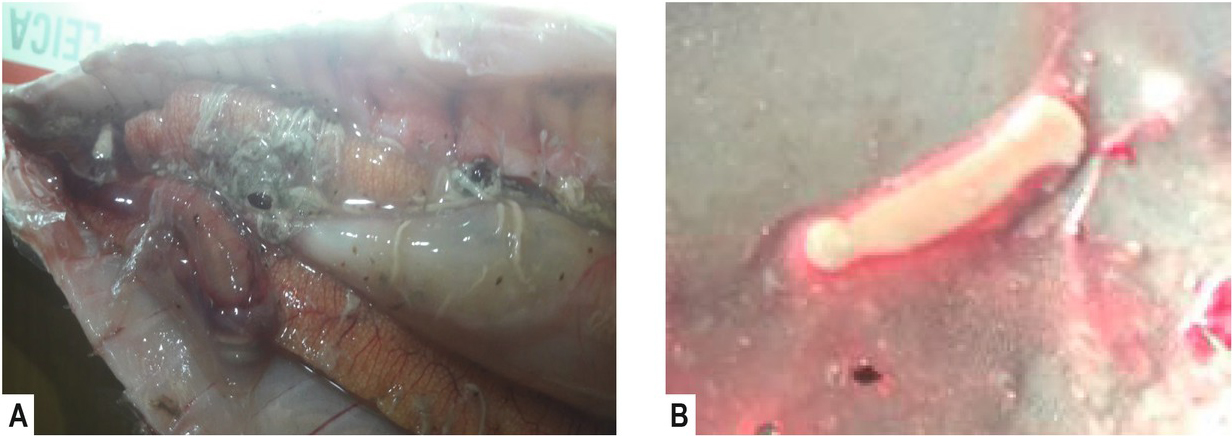
Fig. 4
cestodes recovered. A – Neogryporhynchus cheilancristrotus from the abdominal cavity of Alosa saposchnikowii.
B – Khawia sinensis from the abdominal cavity of Cyprinus carpio.
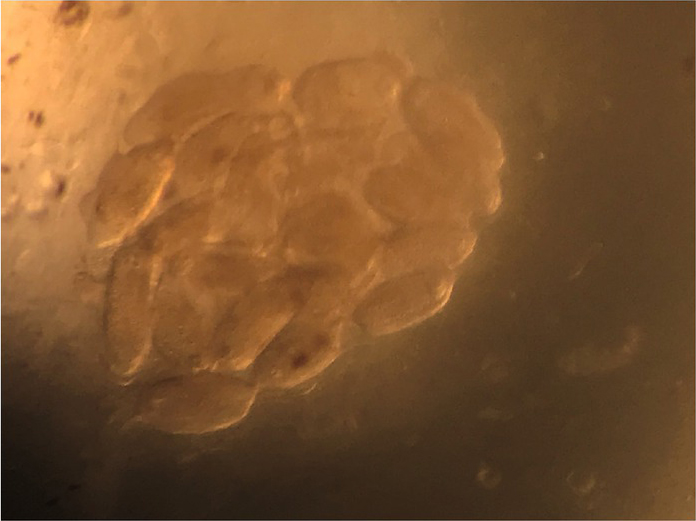
Fig. 5
The eye trematode Tylodelphus clavata from the lens of the eye of Abramis brama orientalis.
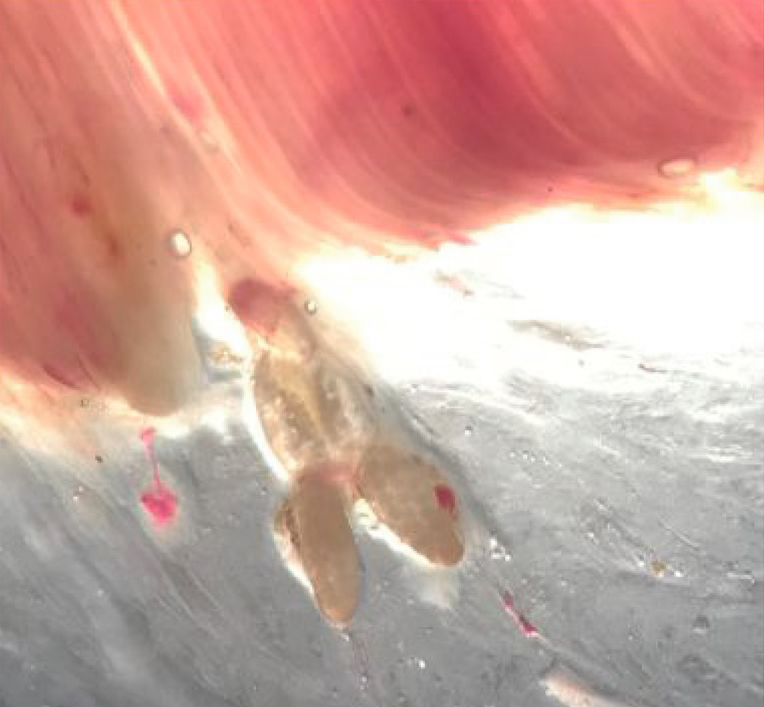
Fig. 6
Parasitic copepod Ergasilus sieboldi in the lamellae of the gill apparatus of Sander lucioperca.