Introduction
The Caspian Sea with the lower reaches of the rivers flowing into it are Kazakhstan’s most important fisheries. Here there are about 0.3 million tons of fish caught annually. Fish parasitoses act as a potential factor restraining the growth of fish productivity. Some helminths of fish may also be zoonoses and therefore represent a public health problem. Therefore the study of parasites presently infecting fish in the Caspian Sea basin may provide important information to reduce the risk of spreading economically important diseases of fish in the region. Such studies may also contribute to ameliorating the public health risk of some helminths. Furthermore we aimed to identify potential pathogenic effects by analyzing the association of Fulton’s condition index with the intensity of infection with parasites identified.
The Caspian fisheries are of commercial importance. There are a number of studies from the southern sectors of the Caspian, mainly from Iran (eg Khara et al., 2011; Sattari et al., 2008; Mazandarani et al., 2016) and some regional reports from Turkey (eg Çolak, 2013; Özer & Kirca, 2013). Studies of fish parasites in the Soviet sector of the Caspian sea were first carried out in 1931 – 1932 by Dogel and Bykhovsky (1939) and more recently by Tokpan and Rakhimov (2010).
The purpose of the work is to study the distribution of Anisakis spp and other possible zoonoses together with other helminths infecting fish in the north-eastern part of the Caspian Sea. In total the infection of 13 species of Caspian fish from 6 families was studied.
Materials and Methods
To determine the infection with anisakidosis and other potentially zoonotic parasites, 606 fish were investigated from the Kazakhstan sector of the Caspian Sea (Fig. 1). For each of 12 species, 50 fish were examined (Tables1 – 4). For one species, the European catfish Sirulis glanis only 6 specimens were available for examination (Table 5).
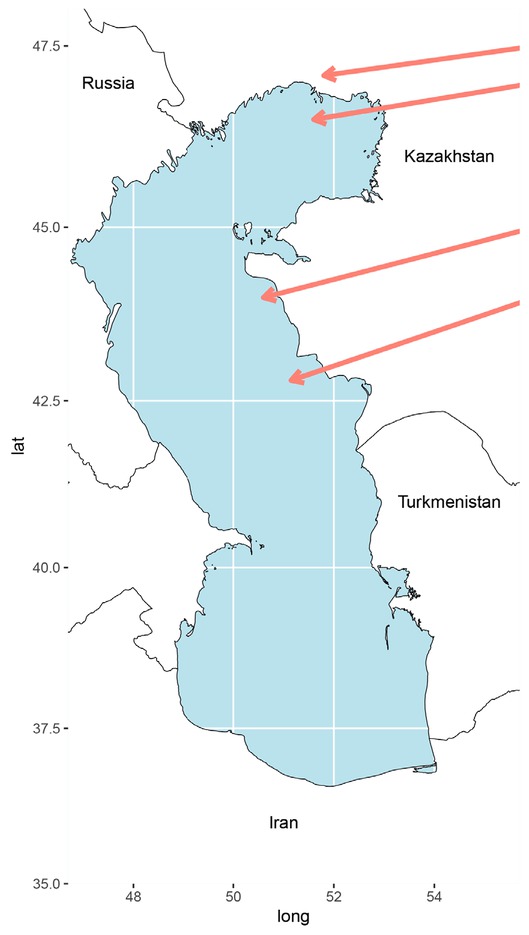
Fig. 1
Study sites in the Caspian Sea. Top arrow indicates lower reaches of the Ural river, whilst the other sites were within the Caspian Sea.
Table 1
The number of fish infected and range of intensity of infection of parasites in fish of order Clupeiformes.
| Fish host | Parasite | Number infected (prevalence, confidence intervals) | Development stage of parasite recovered and localization | Range of intensity | Mean abundance | Parasite Taxon |
|---|---|---|---|---|---|---|
| Alosa saposchnikowii | Anisakis schupakovi Mozgovoi, 1951 | 1 (2, 0.1 – 11) | Third stage larva (Abdominal cavity, muscle, serous membrane) | 2 | 0.04 | Nematoda: Anisakidae |
| Porrocaecum reticulatum Linstow, 1899 | 6 (12, 5 – 24) | Third stage larva (Abdominal cavity) | 1 – 4 | 0.2 | Nematoda: Ascaridoidea | |
| Neogryporhynchus cheilancristrotus Wedl, 1855 | 1 (2, 0.1 – 11) | Metacestode (Abdominal cavity) | 14 | 0.28 | Cestoda: Dilepididae | |
| Mazocraes alosae Hermann, 1782 | 42 (84, 71 – 93) | Аdult (Gills) | 1 – 276 | 36.5 | Monogenea: Mazocraeidea | |
| Clupeonella cultriventris | Anisakis schupakovi | 12 (24, 13 – 38) | Third stage larva (Muscle) | 1 – 6 | 0.6 | Nematoda: Anisakidae |
The species composition of the fish was determined on the basis of a taxonomic descriptions according to Berg (1949), Kazancheyev (1981) and Reshetnikova (2002). A complete biological analysis of the fish was carried out with the determination of the length, mass, sex, maturity stages of the gonads (Pravdin 1966). The age of the fish were determined by rings on the scales or otoliths or by cuts of the marginal rays of the pectoral fins (Chugunova, 1959; Konoplev, 1975). The body length of all fish was measured from the top of the snout to the end of the scaly cover and to the end of the caudal fin. Fish were weighed on an electronic scale with an accuracy of 1 g. For small fish (atherin and common sprat) this was with an accuracy of 0.1 g. Fulton’s condition index (F) was calculated for each fish as:
F = 100*W/L3
where W = the weight in grams and L is the length in cm (Nash and Valencia 2006)
In the field, a complete parasitological dissection of fish was carried out according to the standard classical method (Skrabin, 1928; Dogel, 1933; Bykhovskaya – Pavlovskaya, 1985). The results of the autopsies of the fish were recorded. These included the fish species, the place of investigation, sex, age, weight of the fish, and the number, species and localization of detected parasites.
With a complete parasitological study, fish muscles and all internal organs were examined under a KRUSSMSZ5000 stereomicro-scope with a range of 7 – 45x. Parasites were fixed in various fixatives: monogeneans, trematodes, cestodes, and parasitic crustaceans in 700 alcohol, and nematodes in Barbagallo fluid. For species identification, nematodes were placed in a solution of glycerol with water (1: 1) in order to clear them and then view the internal structure of helminths. This therefore enabled the taxonomic identification based on the morphological features of the parasites. To investigate any affects of parasitism on the fish, a multivariable generalised linear model was used to analyse the association of the intensity of infection of each individual fish with the Fulton’s condition index. A backward selection method was used with all variables included in the initial model with each non significant variable with a p >0.15 being removed sequentially, with only significant variables remaining in the final model. In addition and associations in the intensity of infection with individual parasites were analysed. All analyses were undertaken in R (R Core Team, 2019).
Ethical Approval and/or Informed Consent
For this study formal consent is not required.
Results
A total of 656 fish belonging to 13 different species representing 6 orders were examined. In the present study 25 species of parasites were identified. These included 5 species of nematode, 8 species of trematodes, 6 monogean species, 2 cestode and 2 crustacea. In addition one unidentified species of nematode was recovered and one molusc. The number of fish infected with each parasite identified; abundance and range of intensity of infection; prevalence; developmental stage of the parasite recovered, and the organ of the fish from which the parasite was recovered are presented in Tables 1 – 5. Figures 2 – 6 illustrate some of the parasites recovered during this study.
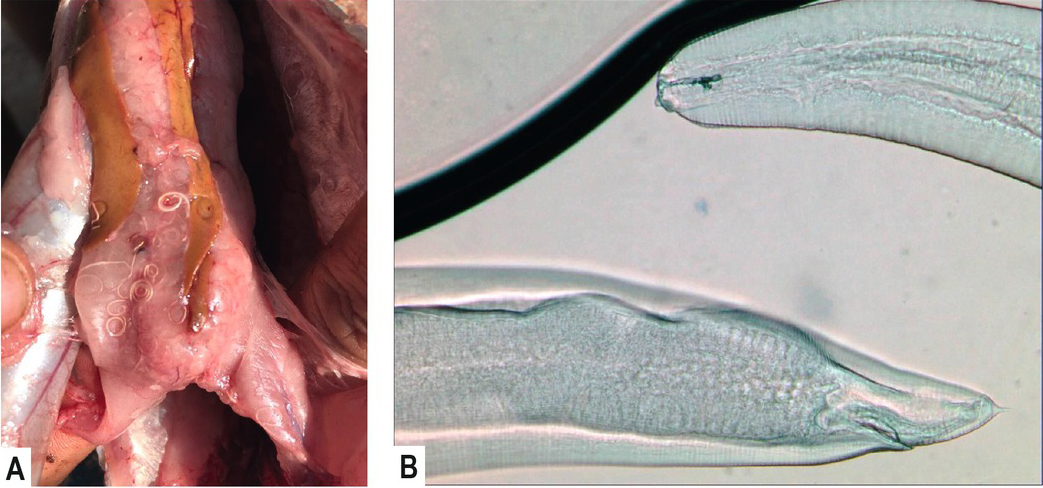
Fig. 2
Anisakis schupakovi. A – third stage larvae in the abdominal cavity of the Sander lucioperca.
B – head and tail of 3rd stage larvae recovered from Abramis brama orientalis.
There were 2 fish species from the order Clupeiformes and 4 different parasite species were found infecting these fish. These included 2 nematode one cestode and 1 Trematode species. Details are given in Table 1.
There were 3 fish species from the order Perciformes and 11 different parasite species were found infecting these fish. These included 2 nematode, 7 monogenean and 1 crustacean species (Table 2)
Liza aurata (syn Chelon aurata) was the only fish species from the order Mugiliformes and this was infected by one monogenean and one trematode parasite (Table 3).
Atherina boyeri was the only fish species from the order Atheriniformes. Only one parasite was detected in this species: Anisakis schupakovi. In total 5 fish were infected with a range of intensity of 1 – 2 parasites per infected fish.
There were 5 fish species from the order Cypriniformes and 14 different parasite species were found infecting these fish. These included 2 nematode, 11 monogenean and 1 cestode species.
Table 2
The number of fish infected and range of intensity of infection of parasites in fish of order Perciformes.
| Fish host | Parasite | Number infected (prevalence, confidence intervals) | Development stage of parasite recovered | Range of intensity | Mean abundance | Parasite Taxon |
|---|---|---|---|---|---|---|
| Sander lucioperca | Anisakis schupakovi | 42(84,71-93) | Third stage larva (Muscle, serous membrane) | 7-161 | 27.0 | Nematoda: Anisakidae |
| Contracecum sp. | 9(18,9-31) | Third stage larva (Abdominal cavity, serous membrane) | 7-121 | 6.8 | Nematoda: Anisakidae | |
| Ancyrocephalus paradocus | 6(12,5-24) | Adult | 1-17 | 0.62 | Monogenea: Ancyrocephalidae | |
| Creplin, 1839 | (Gills) | |||||
| Diplostomum spathaceum | 10(20,10-33) | Metacercaria | 2-20 | 1.46 | Trematoda: Diplostomidae | |
| Rudolphi, 1819 | (Eyes) | |||||
| Gyrodactylus cernuae Malmberg, | 2(4,0.5-14) | Adult | 2-5 | 0.14 | Monogeneas: Gyrodactylidae | |
| 1957 | (Gills) | |||||
| Tylodelphys clavata Diesing, | 2(4,0.5-14) | Metacercaria | 1-4 | 0.1 | Trematoda: Diplostomidae | |
| 1850 | (Eyes) | |||||
| Synergasilus major Markevitsch, | 17(34,21-49 | Adult | 1-19 | 1.72 | Crustacea: Ergasilidae | |
| 1940 | (Gills) | |||||
| Sander marinus | Anisakis schupakovi | 6(12,5-24) | Third stage larva (Abdominal cavity, serous membrane) | 1-12 | 0.4 | Nematoda: Anisakidae |
| Gyrodactylus luciopercae Gusev, | 2(4,0.5-14) | Adult | 14-29 | 0.86 | Monogeneas: Gyrodactylidae | |
| 1962 | (Gills, skin) | |||||
| Ergasilus briani Markewitsch, | 2(4,0.5-14) | Adult | 2 | 0.04 | Crustacea: Ergasilidae | |
| 1993 | (Gills) | |||||
| Sander | Anisakis schupakovi | 27 (54, 39 - 68) | Third stage larva | 1-19 | 3.0 | Nematoda: Anisakidae |
| volgensis | (Abdominal cavity, muscle, serous membrane) | |||||
| Diplostomum gobiorum Shigin, 1965 | 3(6,1.3-17) | Metacercaria (Eyes) | 6-42 | 1.2 | Trematoda: Diplostomidae | |
| Diplostomum mergi Dubois, 1932 | 1(2,0.1-11) | Metacercaria (Eyes) | 4 | 0.08 | Trematoda: Diplostomidae | |
| Diplostomum spathaceum | 19(38,25-53) | Metacercaria (Eyes) | 2-64 | 4.36 | Trematoda: Diplostomidae | |
| Tylodelphys clavata | 8(16,7-29) | Metacercaria (Eyes) | 2-8 | 0.64 | Trematoda: Diplostomidae |
Table 3
The number of fish infected and range of intensity of infection of parasites in fish of order Mugiliformes.
| Fish host | Parasite | Number infected (prevalence, confidence intervals) | Development stage of parasite recovered | Range of intensity | Mean abundance | Parasite Taxon |
|---|---|---|---|---|---|---|
| Liza aurata syn Chelon aurata | Ligophorus vanbenedenii Parona & Perugia, 1890 | 9 (18, 8.6 – 31) | Аdult (Gills) | 1 – 8 | 0.56 | Monogenea: Ancyrocephalidae |
| Tylodelphys clavata | 1 (2, 0.1 – 11) | Metacercaria (Еyes) | 10 | 0.2 | Trematoda: Diplostomidae | |
| Еrgasilus sieboldi Kaletskaia 1970 | 1 (2, 0.1 – 11) | Аdult (Gills) | 1 | 0.02 | Crustacea: Ergasilidae |
There was also 1 further unidentified nematode species (Table 4). Silurus glanis was the only fish species from the order Siluriformes and this was infected by two nematode and 1 monogenean parasites (Table 5).
There was no association between Fulton’s condition index and the intensity of parasite infection for any of the fish species. For Cyprinus carpio and Rutilus rutilus, Fulton’s index increased with age (p=0.0026 and p=0.043 respectively). For Sander lucioperca male fish had significantly higher intensity of infection with trematodes compared to females (p=0.008). There was also a positive association between the intensity of infection with nematode larvae and monogeans (p=0.04).
Discussion
This study aimed to identify important parasitic pathogens and zoonoses of fish from the Kazakhstan sector of the Caspian Sea and associated river basin. The fish studied also represent important species for commercial fisheries in this region and therefore this information makes a contribution to understanding parasitic diseases that may affect such stocks.
Anisakis schupakovi was the most frequently identified parasite. It was found in 8 of the 13 fish species we examined, with prevalences of up to 84 % found in the asp (Leuciscus aspius) and individual intensity of infection of up to 1197 parasites. Anisakis spp. are known zoonoses and a food safety issue (Nieuwenhuizen & Lopata, 2013). The definitive host of A. schupakovi is the Caspian seal Phoca caspica (Davey, 1971; Popov et al., 1989, Bilska-Zając et al., 2015). This seal is only found in the Caspian Sea which is the world’s largest inland body of water with no connection to the sea. Thus A. schupakovi is believed to be found only in Caspian Sea basin. A Contracecum sp. is also an anisakid parasite and hence a potential fish borne zoonoses and this was recovered from 9 zander (Sander lucioperca). Therefore these findings are of potential public health significance and indicate that fish from this region should be cooked or frozen prior to consumption.
Diplostomum spathaceum was frequently recovered from a number of the fish species examined. This is a rare zoonosis causing dermatitis in humans when cercariae attempt to invade the skin and occasionally have penetrated the eye and have been associated with cataracts (Smyth, 1995 ). However, the public health risk is not from consuming fish but from swimming or bathing in water where there are cercariae.
Alosa saposchnikowii, or the saposhnikovi shad, is a species of fish in the clupeid genus Alosa. Anisakis, Porrocaecum, Neogryporhynchus and Mazocrase spp were found in this fish species. Studies from the southern Caspian identified 3 parasitic species infecting this fish: Pronoprymna ventricosa (Trematoda,Faustulidae), Anisakis simplex and Eustrongylides sp. (Mazandarani et al., 2016). In the Kazakh sector previous studies have found Anisakis schupakovi, Porrocaecum reticulatum and Mazocraes alosae (Tokpan & Rakhimov, 2010) and additionally Contracoecum spiculogerum and Hemiurus appendicularis. Our studies also describe the cestode Neogryporhynchus cheilancristrotus. Whilst a small proportion of fish were infected with the nematode and cestode species, most fish were infected with the monogean (Table 2).
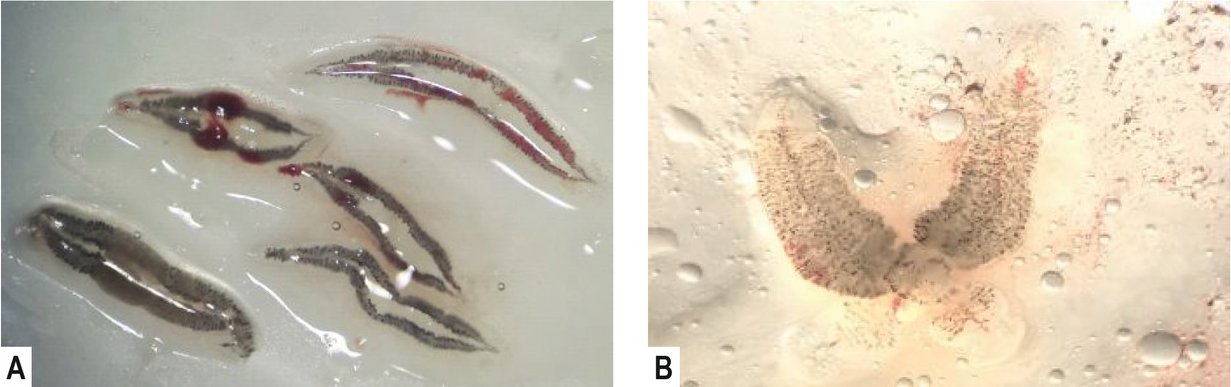
Fig. 3
Mongeneans recovered. A – Mazocraes alosae from the branchial arces of Alosa saposchnikowii.
B – Diplozoon paradoxum from the branchial arches of Abramis brama orientalis.
Table 4
The number of fish infected and range of intensity of infection of parasites in fish of order Cypriniformes
| Fish host | Parasite | Number infected (prevalence, confidence intervals) | Development stage of parasite recovered | Range of intensity | Mean abundance | Parasite Taxon |
|---|---|---|---|---|---|---|
| Abramis brama | Anisakis schupakovi | 1(2,0.1-11) | Third stage larva | 1 | 0.02 | Nematoda: Anisakidae |
| Diplostomum gobiorum | 15(20,18-45) | (Abdominal cavity) Metacercaria (Eyes) | 2-14 | 1.7 | Trematoda: Diplostomidae | |
| Diplostomum spathaceum | 25(50,36-64) | Metacercaria (Eyes) | 1-39 | 6.26 | Trematoda: Diplostomidae | |
| Tylodelphys clavata | 3(6,1.3-17) | Metacercaria (Eyes) | 3-6 | 0.24 | Trematoda: Diplostomidae | |
| Dactylogyrus wunderi Bychowsky, 1931 | 2(4,0.5-14) | Adult (Gills) | 1 | 0.04 | Monogenea: Dactylogyridae | |
| Bothriocephalus opsariichthydis Yamaguti, 1934 | 1 (2,0.1-11) | Adult (Intestines) | 6 | 0.64 | Cestoda:Bothriocephalidae | |
| Leuciscus aspius | Anisakis schupakovi | 42 (84, 71 - 93) | Third stage larva (Abdominal cavity, muscle, serous membrane) | 3-1197 | 87.8 | Nematoda: Anisakidae |
| Porrocaecum reticulatum | 13(26,15-40) | Third stage larva (Abdominal cavity, serous membrane) | 12-356 | 32.8 | Nematoda: Ascaridoidea | |
| Diplostomum gobiorum | 2(4,0.5-14) | Metacercaria (Eyes) | 6-10 | 0.32 | Trematoda: Diplostomidae | |
| Diplostomum helveticum Shigin, 1977 | 1 (2,0.1-11) | Metacercaria (Eyes) | 6 | 0.12 | Trematoda: Diplostomidae | |
| Diplostomum mergi | 5(10,3.3-22) | Metacercaria (Eyes) | 2-6 | 0.44 | Trematoda: Diplostomidae | |
| Diplostomum spathaceum | 24(48,34-63) | Metacercaria (Eyes) | 2-20 | 3.06 | Trematoda: Diplostomidae | |
| Dactylogyrus tubaKaletskaia 1969 | 2(4,0.5-14) | Adult (Gills) | 3-8 | 0.22 | Trematoda: Diplostomidae | |
| Diplostomum volvens Nordmann, 1832 | 1 (2,0.1-11) | Metacercaria (Eyes) | 7 | 0.14 | Trematoda: Diplostomidae | |
| Tylodelphys clavata | 2(4,0.5-14) | Metacercaria (Eyes) | 3-4 | 0.14 | Trematoda: Diplostomidae | |
| Ergazilus sieboldi | 1 (2,0.1-11) | Adult (Gills) | 1 | 0.02 | Crustacea: Ergasilidae | |
| Carassius auratus | Dactylogyrus anchoratus Wagener, 1857 | 2(4,0.5-14) | Adult (Gills) | 4-18 | 0.44 | Monogenea: Dactylogyridae |
| Diplostomum gobiorum Diplostomum mergi | 2(4,0.5-14) 2(4,0.5-14) | Metacercaria (Eyes) Metacercaria (Eyes) | 2-8 2-4 | 0.2 0.12 | Trematoda: Diplostomidae Trematoda: Diplostomidae | |
| Diplostomum spathaceum | 66(12,5-24) | Metacercaria (Eyes) | 2-12 | 0.64 | Trematoda: Diplostomidae | |
| Tylodelphys clavata | 1 (2,0.1-11) | Metacercaria (Eyes) | 3 | 0.06 | Trematoda: Diplostomidae | |
| Cyprinus carpio | Diplostomum gobiorum | 3(6,1.3-17) | Metacercaria (Eyes) | 6-12 | 0.48 | Trematoda: Diplostomidae |
| Diplostomum spathaceum | 19(38,25-53) | Metacercaria (Eyes) | 4-18 | 2.24 | Trematoda: Diplostomidae | |
| Diplostomum volvens | 5(10,3.3-22) | Metacercaria | 2-4 | 0.32 | Trematoda: Diplostomidae | |
| Gyrodactylus cyprini Diarova 1964 | 5(10,3.3-22) | Adult (Gills) | 2-3 | 0.26 | Monogenea:Gyrodactylidae | |
| Tylodelphys clavata | 6(12,5-24) | Metacercaria (Eyes) | 2-36 | 1.28 | Trematoda: Diplostomidae | |
| Rutilus rutilus caspius | Anodonta sp Nematode sp | 7(14,5.8-27) 9(18,8.6-31) | Glochidium (larva) (Gills) - | 1-13 1-4 | 0.5 0.4 | Bivalvia: Unionidae Nematoda: |
| Camallanus sp. | 3(6,1.3-17) | Adult (Intestines) | 1-2 | 0.08 | Nematoda: Camallanidae |
Table 5
The number of fish infected and range of intensity of infection of parasites in fish of order Siluriformes.
| Fish host | Parasite | Number infected (prevalence, confidence intervals) | Development stage of parasite recovered | Range of intensity | Mean abundance | Parasite Taxon |
|---|---|---|---|---|---|---|
| Silurus glanis | Anisakis schupakovi | 4 (67, 22 - 96) | Third stage larva (Abdominal cavity) | 12-563 | 114.3 | Nematoda: Anisakidae |
| Eustrongylus excisus Jägerskiöld, 1909 | 2(33,4.3-78) | Third stage larva (Abdominal cavity, serous membrane) | 72-254 | 54.33 | Nematoda: Dioctophymatidae | |
| Diplostomum mergi | 1(17,0.4-64) | Metacercaria (Eyes) | 4 | 0.67 | Trematoda: Diplostomidae | |
| Silurodiscoides magnus | 2(33,4.3-78) | Adult (Gills) | 4-6 | 1.67 | Monogenea:Ancyrocephalidae |
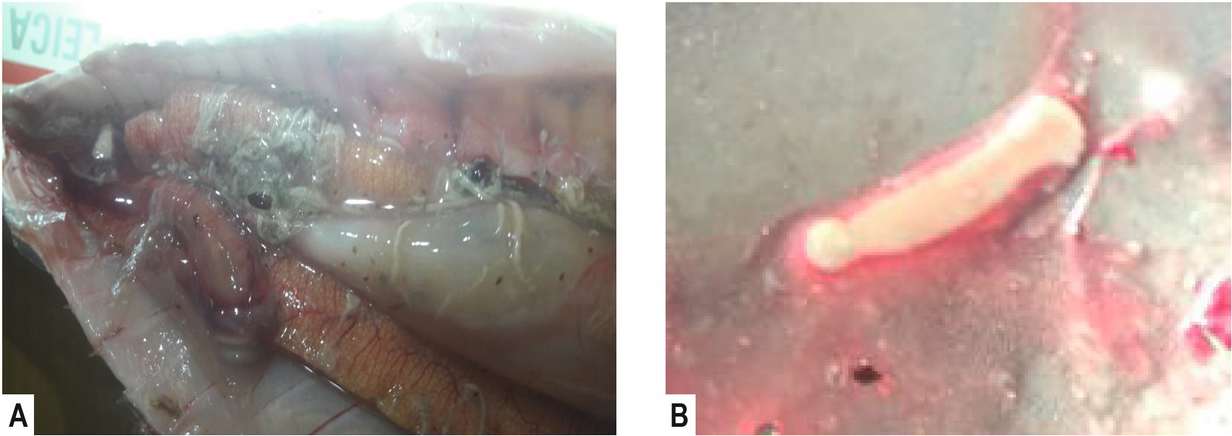
Fig. 4
cestodes recovered. A – Neogryporhynchus cheilancristrotus from the abdominal cavity of Alosa saposchnikowii.
B – Khawia sinensis from the abdominal cavity of Cyprinus carpio.
Clupeonella cultriventris or the Caspian and Black Sea sprat is a species of fish in the family Clupeidae. It is found in the Caspian Sea and in the lower reaches of the rivers Volga and Ural. Previously Corynosoma strumosum (Acanthocephala), Pseudopentagramma symmetricum (Trematoda); Contracaecum sp. (Nematoda) and Unio sp. (Molusc) have been described from this fish (Habibi & Shamsi, 2018; Voronina, 2019). The present study indicates that this fish species is also infected by Anisakis schupakovi.
The zander is a species of fish from freshwater and brackish habitats in western Eurasia. Anisakis schupakovi was found in the majority of fish examined as well as many of the other species of fish. Zhokhov and Molodozhnikova (2008) list the zander as a host for this parasite and for Contracecum sp. Tokpan and Rakhimov (2010) previously reported Anisakis schupakovi, and Tylodelphys clavata in the zander from the Caspian region. Ancyrocephalus paradoxus has been previously reported in zander from Poland (Bielat et al., 2015) and Diplostomum spathaceum has been recovered previously from zander in Iran (Movahed et al., 2016). No previous information on Gyrodactylus and Synergasilus infection of the zander was found.
No previous information was found on the parasites of Sander marinus, the estuarine perch, also called the sea pike perch or sea zander. But the overlapping habitat with the Caspian seal would explain the presence of Anisakis schupakovi. We recovered a number of parasites from Sander volgensis, the Volga pike perch or Volga zander which is also present in the Caspian Sea basin in the Volga River and Ural River drainages. We were unable to find previous information on the helminths of this species.
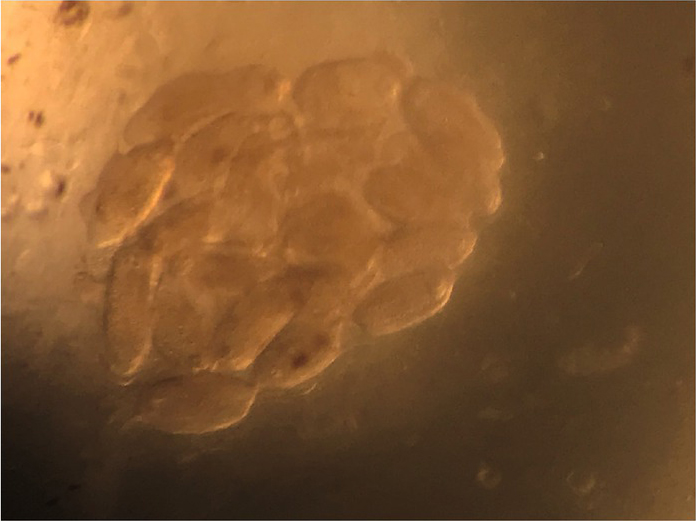
Fig. 5
The eye trematode Tylodelphus clavata from the lens of the eye of Abramis brama orientalis.
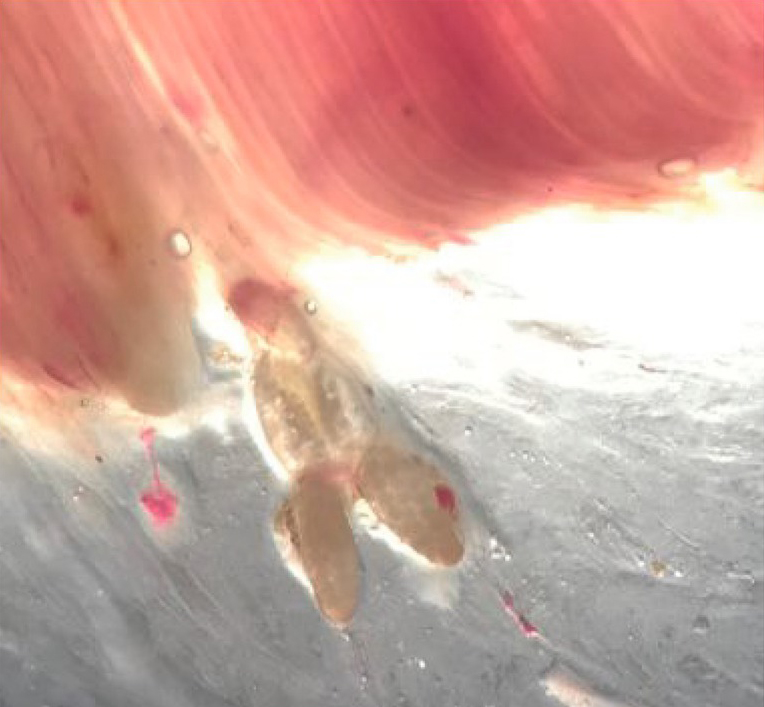
Fig. 6
Parasitic copepod Ergasilus sieboldi in the lamellae of the gill apparatus of Sander lucioperca.
The golden grey mullet (Liza aurata syn Chelon aurata) is an introduced species into the Caspian Sea. There is little previous information on the parasitic fauna infecting this fish in the Caspian, although there are reports of various monogenean and trematode species from Turkey (Özer & Kirca, 2013; Öztürk, 2013) with Ligophorus vanbenedenii being isolated from fish from the Black Sea (reviewed by Özer & Kirca, 2013). Tylodelphys clavata has also been reported from Liza aurata in Turkey (Özer & Kirca, 2013).
Six species of helminths were found in the bream (Abramis brama). Of these Anisakis chupakovi, two species of ophthalmic trematodes (Diplostomum spathaceum, and Tylodelphys clavata) and one species of the monogenetic fluke Dactylogyrus wunderi have been previously described by Tokpan and Rakhimov (2010) whilst Anisakis was reported by Sattari et al (2005). Our studies add the opthalmic trematode Diplostomum gobiorum and the cestode Bothriocephalus opsariichthydis to the list of parasites known to infect the bream in the Caspian Sea basin.Various Diplostonum and Dactylogyrus spp have been recovered from bream from other locations (eg Germany: Rückert et al., 2007).
The carp (Cyprinus carpio) parasitofauna is represented by 5 species, of which 4 species are ocular trematodes: monogenetic flukes Gyrodactylus cyprini, trematodes represented by 2 genera Tylodelphys and Diplostomum (Diplostomum spathaceum, Diplostomum gobiorum, Diplostomum volvens. Previously In 2008 – 2010 2 species of parasites were found in the common carp: metacercariae of Diplostomum spathatum and Caryophyllaeus laticeps (Tokpan & Rakhimov 2010). Only Diplostomum spathaceum was found in carp, both in the previous study and the present study. Carassius auratus and Gyrodactylus cyprini have also been described in carp in the Russian sector of the Caspian (Pazooki & Masoumian, 2012).
Five species of parasites were found in silver crucian carp Carassius auratus (Table 5). Diplostomum and Tylodelphys spp have been described in Carassius auratus from the Caspian sea region previously (Pazooki & Masoumian, 2012).
We have described 9 helminth species parasitizing the Asp (Leuciscus aspius) and one crustacian (Table 5). Previous studies in the Caspian described 6 species of parasite: Anisakis schupakovi, Diplostomum spathaceum, Contracoecum spiculogerum, Caligus lacustris, Eustrongylides excisus and Caspiobdella caspica. Only 2 of these were found in the present study (Tokpan & Rakhimov 2010).
Diplostomum has been descriped in the Asp from Norway (Sterud & Appleby, 1996).
We were not able to identify the parasites we recovered from Rutilus rutilus caspicus species level so it is not possible to discuss further,
Anisakis schupakovi, Eustrongylus excisus and Diplostomum spp have previously been found in Silurus glanis in the Caspian region or in Turkey (Pazooki & Masoumian, 2012) (Daghigh Roohi et al., 2014; Çolak, 2013).
There was no relationship between Fulton’s condition score and the intensity of parasitic infection. This may indicate that the parasites have a low pathogenicity for the fish species investigated or that the intensity of infection was insufficient to cause any effects in the fish. We did find an increase in Fulton’s condition score with age in Carp and the Caspian Roach indicating an improvement in condition as the fish mature. Male zander were significantly more intensely infected with trematodes compared to females which may indicate a gender associated increased susceptibilities to infection or gender associated behavior resulting in an increased parasite burden. The associated between intensity of infection with monogeans and nematode larvae could be consistent with certain individuals having increased susceptibility to polyparasitsim or a statistical error as the p values was 0.04.
In summary this study has identified parasite species across 13 fish species that are endemic to the north Caspian Sea and drainage basin. A high proportion of the fish are infected with parasites of a zoonotic potential and therefore appropriate controls in the food chain should be considered to prevent human infection.
Notes
Acknowledgements
This research is funded by the Science Committee of the Ministry of Education and Science of the Republic of Kazakhstan (Grant No. АР05131687). This is part of the project “Assessment of the natural foci of anisacidosis and the risks of epizootics in the shelf zones of the north-eastern part of the Caspian Sea ” and supported by the 217 budget program of the Ministry of Education and Science of the Republic of Kazakhstan.