
Introduction
Paragonimiasis, which is caused by lung flukes (also called Paragonimus), is considered a neglected tropical disease by the World Health Organization (Cumberlidge et al., 2018) and contributes to serious disease burdens all over the world. Worldwide, approximately 23 million people suffer from paragonimiasis (Blair, 2014), and an estimated 293.8 million people are at risk (Keiser & Utzinger, 2005; Silachamroon & Wattanagoon, 2020). At least 50 Paragonimus species, 46 of which are registered in the NationalCenter for Biotechnology Information (NCBI) database, have been discovered in the past decades (Kong et al., 2015). Increasingly, Paragonimus species, including Paragonimus westermani, Paragonimus africanus, Paragonimus heterotremus, Paragonimus kellicotti, Paragonimus mexicanus, Paragonimus siamensis, Paragonimus skrjabini, Paragonimus skrjabini miyazakii, and Paragonimus uterobilateralis, are reported to cause human infections (Chai, 2013). Therefore, greater attention should be paid to seemingly rare parasite species such as these.
P. proliferus was first isolated in 1964 from freshwater crabs in Yunnan Province, China (Chung et al., 1964). The lineage of P. proliferus is cellular organisms, Eukaryota, Opisthokonta, Metazoa, Eumetazoa, Bilateria, Platyhelminthes, Trematoda, Digenea, Plagiorchiida, Troglotremata, Troglotrematidae, Paragonimus. The reported natural foci of P. proliferus include several counties in Yunnan Province in southern China, including Xishuangbanna Dai Autonomous Prefecture (formerly known as Jinghong County) (Chung et al., 1964), and Lvchun County (Yang et al., 2007), as well as Lai Chau Province in northern Vietnam and Quang Binh Province in central Vietnam (Doanh et al., 2013).
P. proliferus can be distinguished from other Paragonimus species by a number of biological differences. Morphologically, P. proliferus metacercaria and the uterus of the adult worm, which is located near the ventral sucker, are very large. However, an encysted metacercaria is difficult to detect because the cyst wall covering is so thin and fragile that the metacercaria can rapidly excyst. Another significant difference between the species is host preference. The natural definitive or paratenic hosts of P. proliferus include rats, but not monkeys, dogs, or cats (Ben-jiang, 2004). In contrast, dogs and cats are suitable hosts for other Paragonimus species, such as P. kellicotti (Harrus, Nyska, Colorni, & Markovics, 1997; Peregrine, Nykamp, Carey, & Kruth, 2014), P. skrjabini (Doanh et al., 2016), Paragonimus miyazakii (Madarame et al., 2009), and P. westermani (Doanh et al., 2016; Irie et al., 2017). The distinct host permissiveness of different Paragonimus species strongly suggests that their virulence and pathogenicity may also differ considerably. Therefore, it is necessary to explore the interspecies differences between P. proliferus and other Paragonimus species at the molecular level.
Transcriptome analysis is an efficient method to assess the molecular and biological features of a causative agent. However, according to the NCBI database, of 46 known Paragonimus species, the transcriptomes of only four have been sequenced, including P. skrjabini, P. kellicotti, P. miyazakii, and P. westermani, whereas the transcriptomes of the remaining species, including P. proliferus, have not. However, the transcriptomic datasets of other Paragonimus species do not represent the complete biological and molecular characteristics of P. proliferus, as it is difficult to predict interspecific and intraspecies differences induced by genetic variation during evolution.
Given that little is known about the molecular biology of P. proliferus, analysis of high-throughput transcriptome sequences is a fundamental approach to determine the mechanism of development of the unique features of P. proliferus as well as its virulence and pathogenicity. In this study, an Illumina Hi-Seq 4000 platform was used to sequence the transcriptome of P. proliferus adult worms. Homologous genes were predicted by comparison with four other Paragonimus species (P. skrjabini, P. kellicotti, P. miyazakii, and P. westermani), the transcriptomes of which are available in the NCBI database. The identification of these genes will provide a foundation to explore interspecies differences between P. proliferus and other Paragonimus species at the transcriptome level.
Material and Methods
Preparation of P. proliferus samples
Freshwater crabs were collected from a natural stream in Mengla County, Xishuangbanna Dai Autonomous Prefecture, Yunnan Province, China. The shells of the crabs were removed, and the limbs, muscles, viscera, and other soft tissues were torn or triturated into tiny pieces, which were then repeatedly ground in a wire mesh. Samples were then rinsed by passing a large amount of water through the wire mesh into a 1000 ml tapered cylinder. The turbid liquid was allowed to settle for 30 minutes and the supernatant was carefully discarded, leaving approximately one third of the cylinder filled with sediment. After three to five washes, the remaining turbid liquid was shaken and poured into several petri dishes on a black backdrop. Enough suspension was poured into the dishes for tiny worms to easily be detected by visual inspection or under a light microscope. Using a pipette, the detected metacercariae were moved into normal saline and kept at 4°C until further use. The obtained metacercariae were used to infect Sprague-Dawley rats (eight metacercariae per rat) via subcutaneous injection (Lin & Xueming, 2001) into the abdominal wall. The rats were maintained at the Animal Lab Center of Kunming Medical University and provided with food and water ad libitum. Eight weeks post-infection (PI), the rats were euthanized under anesthesia by intraperitoneal injection of pentobarbital. Adult P. proliferus worms were isolated from the lungs of the rats, and a sample of three adult worms, whose viscera were removed under a light microscope, was stored at -80 °C until further use.
Transcriptome data of P. proliferus and other Paragonimus species Three P. proliferus adults were homogenized in 1 ml TRIzol reagent using a microcentrifuge pestle, and total RNA was extracted from the homogenate using a TRIzol Plus RNA Purification Kit (Thermo Fisher Scientific). RNA was treated with DNase I, and oligo(dT) was used to isolate mRNA. mRNA was fragmented by mixing with fragmentation buffer, and cDNA was synthesized using the mRNA fragments as templates. Short fragments were purified and resolved with elution buffer for end reparation and single nucleotide A (adenine) addition, followed by the addition of adapters. Suitable fragments were then selected for PCR amplification. An Agilent 2100 Bioanaylzer and an ABI StepOnePlus Real-Time PCR System (Applied Biosystems) were used to assess the quantity and quality of the sample library. The library was then sequenced using an Illumina Hi-Seq 4000 RNA-Seq platform with a depth of 12 Gb. The four available Paragonimus transcriptomic datasets were downloaded from the following NCBI database websites: P. skrjabini (https://www.ncbi.nlm.nih.gov/sra/SRX1507709)P. kellicotti (https://www.ncbi.nlm.nih.gov/sra/SRX530756)P. miyazakii (https://www.ncbi.nlm.nih.gov/sra/SRX1100074) and P. westermani (https://www.ncbi.nlm.nih.gov/sra/SRX1507710)
Pretreatment of raw reads and de novo assembly
After obtaining raw reads of the five Paragonimus species, namely P. proliferus, P. skrjabini, P. kellicotti, P. miyazakii, and P. westermani, low-quality and adaptor-polluted reads and reads with a high content of unknown bases (N) were removed to obtain clean reads, which were then used to perform de novo assembly of unigenes using Trinity (version 2.0.6).
Transcript annotation: We used BLAST (version 2.2.23) to align unigenes to Non-Redundant Protein Sequence (NR), Nucleotide Sequence (NT), Clusters of Orthologous Groups (COG), Kyoto Encyclopedia of Genes and Genomes (KEGG) and Swiss-Prot annotations. Blast2GO (version 2.5.0) was used to obtain NR and Gene Ontology (GO) annotations, and InterProScan5 (version 5.11-51.0) was used to obtain InterPro annotations.
Prediction of differentially expressed homologous P. proliferus genes
Four bilateral comparisons of unigenes were performed among the five species (P. proliferus versus P. skrjabini, P. kellicotti, P. miyazakii, and P. westermani) using BLAST. Transcripts that were the best match between two species (e-value=10e-5) were defined as homologous genes. Pairwise comparisons were also performed using NOISeq to identify differentially expressed homologous genes with |log2FC|≥1 and probability > 0.8. Mutually differentially expressed genes among the four pairs of comparisons were considered core genes.
Ethical Approval and/or Informed Consent
This study was approved by the Ethics Committee of Kunming Medical University. The methods were carried out in accordance with approved guidelines.
Results and Discussion
Morphological identification of P. proliferus
Their extremely thin and fragile cystic wall, spindle or scaphoid shape, and huge size of 2.253 ± 0.364 mm × 0.668 ± 0.071 mm allowed metacercariae to easily and rapidly excyst after isolation from crabs and exposure to the environment. The ventral sucker, which was approximately three times the size of the oral sucker, was located in the anterior third end of the body. The two intestinal branches that extended alongside the body wall and towards the tail end were thin and curved before the ventral sucker level, and became thick and smooth thereafter (Fig. 1a).
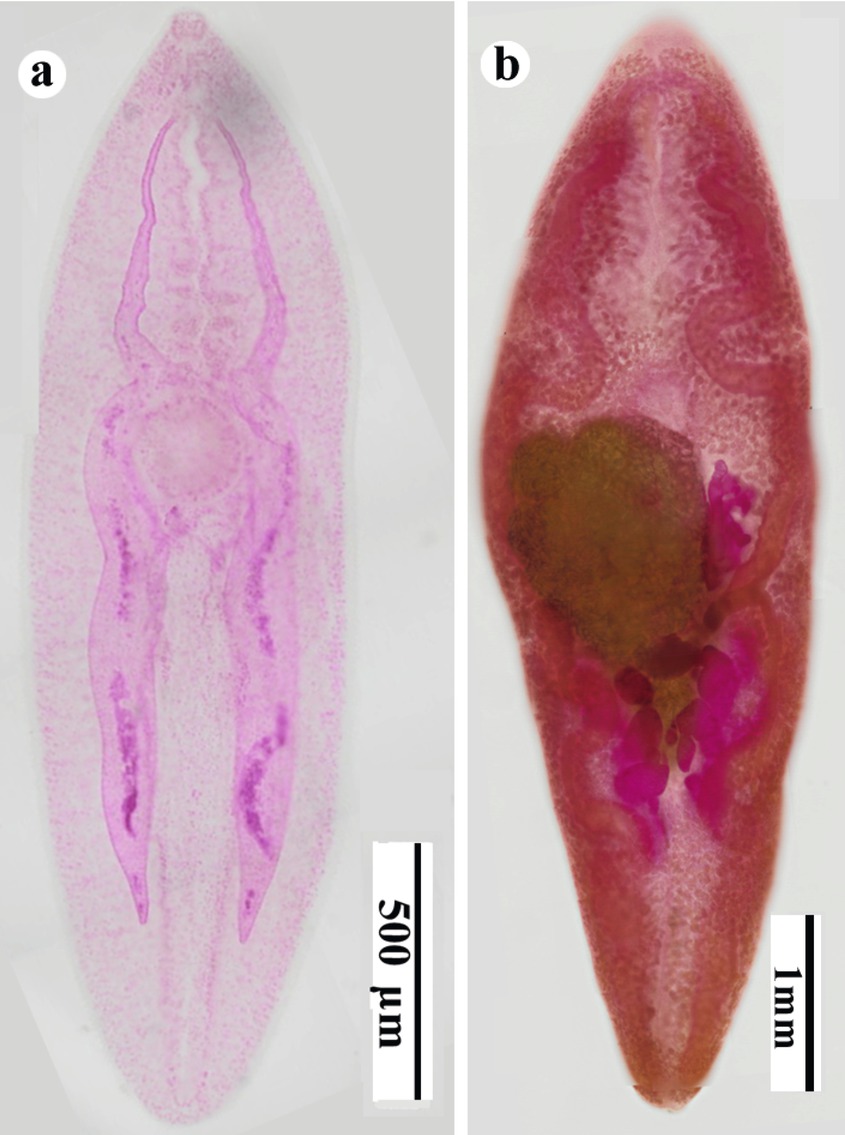
Fig. 1
Metacercaria and adult worms stained magenta with hydrochloric acid.
A metacercaria isolated from a crab (a), and an adult worm recovered from the lung tissue of a rat (b).
Eight weeks PI, adult worms (identified by mature reproductive organs that could be clearly visualized under a light microscope) of 7.238 ± 0.704 mm × 3.571 ± 0.655 mm in size were detected in the lung tissue or thorax of rats. An abundance of eggs filled an eiloid uterus, which was located right at the ventral sucker level. One ovary was located at the opposite side of the uterus, and the two testicles, located in the middle-posterior part of the body, were flamboyancy with 4 – 6 lobules. The uterus and testes were also extremely huge (Fig. 1b).
The morphological features of both metacercariae and adults were identical to those of P. proliferus described by Ben-jiang ( 2004) and Doanh et al. (2008; 2013).
Overall description of P. proliferus transcriptome
As shown in Fig. 2, RNA-Seq was used to sequence the transcriptome of adult P. proliferus worms. The sequences were then assembled de novo and filtered to include only high-confidence transcript sequences. Of 89.34 Mb clean reads obtained from 119.20 Mb raw reads, a total of 47,959 transcripts corresponding to 29,967 unigenes were generated after removal of low-quality and adaptor-polluted reads and reads with a high content of unknown bases (N). The total length, mean length, N50, and GC content were 17,089,849 bp, 570 bp, 826 bp, and 47.36 %, respectively. Overall, a total of 20,669 (68.97 %) unigenes were annotated to seven functional databases (NR, NT, GO, COG, KEGG, Swiss-Prot, and InterPro). Fig. 3 shows that the annotated unigenes belonged to Opisthorchis viverrini (26.25 %), Culex quinquefasciatus (22.36 %), Clonorchis sinensis (20.83 %), Halyomorpha halys (3.7 %), and other species (28.86 %).
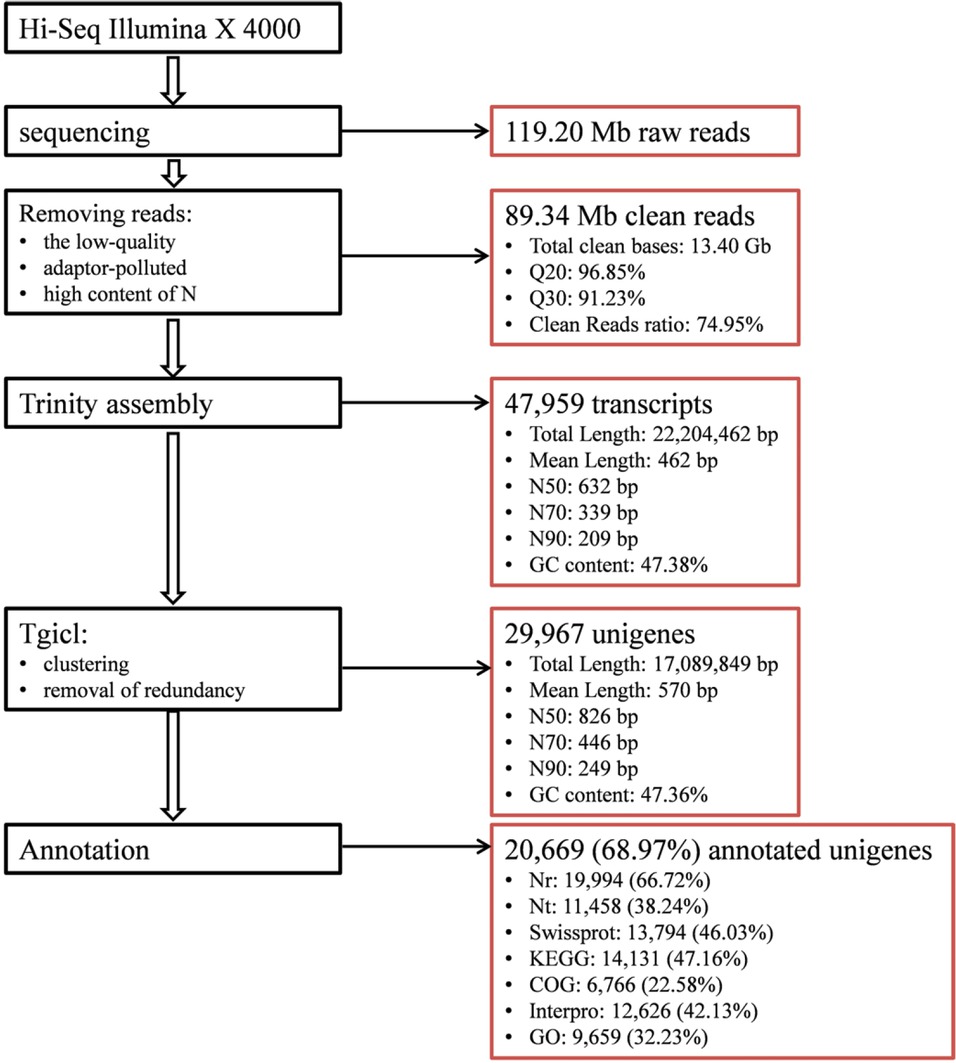
Fig. 2
Sequencing, pretreatment, and annotation of Paragonimus proliferus transcriptome. The transcriptome of adult P. proliferus was sequenced using RNA-Seq (Hi-Seq Illumina X 4000). A total of 119.20 Mb raw reads were obtained, and 89.34 clean reads remained after removing low-quality and adaptor-polluted reads and reads with a high N content. The total number of clean bases, Q20, Q30, and clean reads ratio were 13.40 Gb, 96.85%, 91.23%, and 74.95, respectively. Trinity assembly of the clean reads generated 47,959 transcripts (total length: 22,204,462 bp, mean length: 462 bp, N50: 632 bp, N70: 339 bp, N90: 209 bp, GC content: 47.83%). A total of 29,967 unigenes (total length, 17,089,849 bp; mean length, 570 bp; N50, 826 bp; N70, 446 bp; N90, 249 bp; GC content, 47.36%) were further obtained after clustering and removal of redundant sequences using Tgicl. Finally, a total of 20,669 (68.97%) unigenes were annotated using seven functional databases: NR, 19,994 (66.72%); NT, 11,458 (38.24%); Swiss-Prot, 13,794 (46.03%); KEGG, 14,131 (47.16%); COG, 6,766 (22.58%); Interpro, 12,626 (42.13%); and GO, 9,659 (32.23%).
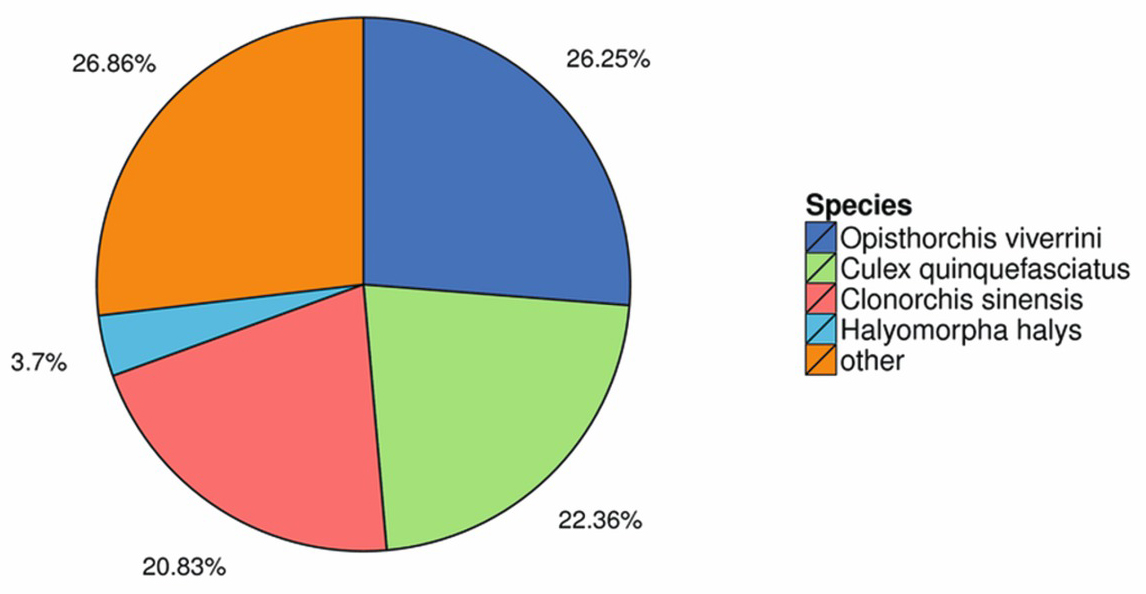
Fig. 3
Species distribution of annotated unigenes in the Paragonimus proliferus transcriptome. A total of 26.25%, 22.36%, 20.83%, and 3.7% of the annotated unigenes belonged to the genera and species Opisthorchis viverrini, Culex quinquefasciatus, Clonorchis sinensis, and Halyomorpha halys, respectively, whereas 28.86% belonged to other species.
Homologous genes and differential expression
As shown in the Venn diagram in Fig. 4, a total of 10,629 (19.13 % of P. proliferus genes), 12,074 (21.74 %), 13,558 (24.41 %), and 8,051 (14.49 %) homologous genes were identified between P. proliferus and P. skrjabini, P. kellicotti, P. miyazakii, and P. westermani, respectively.
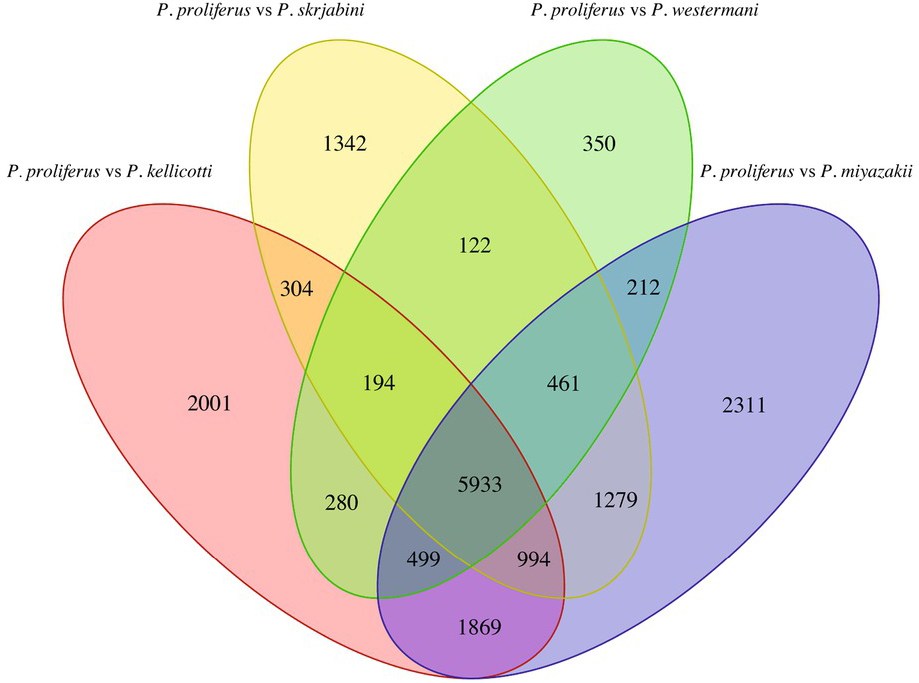
Fig. 4
Venn diagram showing homologous genes among comparisons of Paragonimus proliferus vs. Paragonimus skrjabini, Paragonimus kellicotti,Paragonimus miyazakii, or Paragonimus westermani.
To characterize the interspecies differences in homologous gene expression, pairwise comparisons were performed using NOISeq, which identified 8192 differentially expressed homologous genes among the five species, 7393 of which had |log2FC| ≥ 1 and probability > 0.8. Surprisingly, as shown in Fig. 5, 3950/5622 (70.26 %), 1049/1084 (96.77 %), 388/473 (82.03 %), and 189/214 (88.32 %) genes were expressed at lower levels in P. proliferus compared to P. kellicotti, P. skrjabini, P. westermani, and P. miyazakii, respectively. The biological characteristics of P. proliferus related to lower expression of these genes requires further exploration, but there is indeed a possibility that these genes influence growth, development, invasion, reproduction, virulence, and motility.
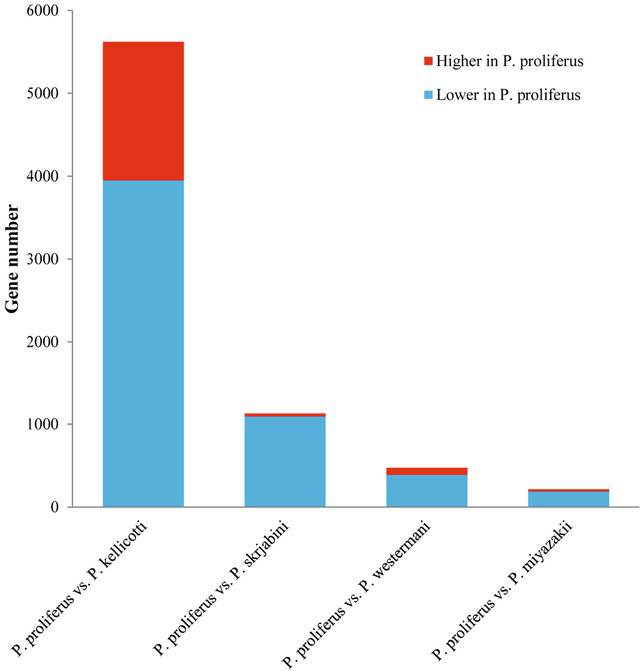
Fig. 5
Changes in expression of differentially expressed homologous genes between Paragonimus proliferus and four other common Paragonimus species. A total of 3950/5622 (70.26 %), 1049/1084 (96.77 %), 388/473 (82.03 %), and 189/214 (88.32 %) genes were expressed at lower levels in P. proliferus compared to Paragonimus kellicotti, Paragonimus skrjabini, Paragonimus westermani, and Paragonimus miyazakii, respectively.
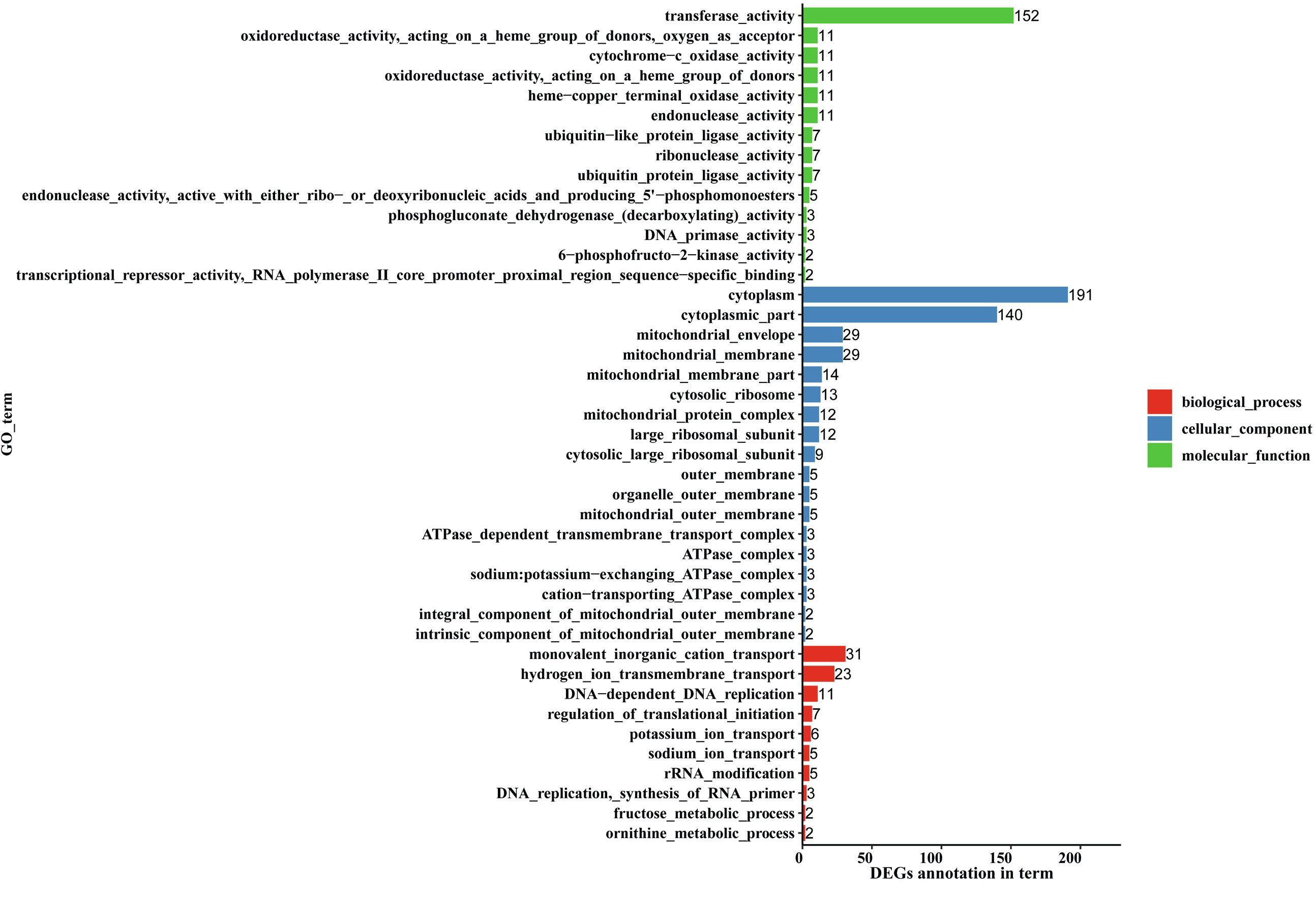
Fig. 6
Forty-two Gene Ontology (GO) terms significantly enriched by differentially expressed homologous genes (P < 0.05).
Eight genes were assigned to cellular components (CC), 10 to biological processes (BP), and 14 to molecular functions (MF).
GO annotations of differentially expressed homologous genes
There were 527, 693, and 757 genes annotated as cellular components (CC; 207 terms, 18 of which were significantly enriched with P < 0.05), biological processes (BP; 930 terms, 10 with P < 0.05), and molecular functions (MF; 756 terms, 14 with P < 0.05), respectively. The top 42 enriched GO terms (P < 0.05) are shown in Fig. 6.
Of the 10 significantly enriched GO terms belonging to BP, four participate in “genetic central dogma”, such as DNA replication/ synthesis of RNA primers, regulation of translational initiation, rRNA modification, and DNA-dependent DNA replication. The remaining six terms (monovalent inorganic cation transport, potassium ion transport, hydrogen ion transmembrane transport, ornithine metabolic process, and fructose metabolic process) are related to energy metabolism. These findings are in line with the enrichment of MF; at least five of the 14 terms (P < 0.05) take part in “duplication, transcription, or translation”, such as endonuclease activity, DNA primase activity, ribonuclease activity, and transcriptional repressor activity. The majority of the remaining terms were related to the oxidation respiratory chain and the activity of some energy production-related enzymes. Therefore, we inferred that changes in the processes of “duplication, transcription, or translation” and “energy metabolism” in P. proliferus may lead to key interspecies differences in development or biological behavior. This was further verified by the significantly enriched GO terms belonging to CC; seven of 18 terms (P < 0.05) belonged to chondriosome-related cellular components, four of 18 to ATPase, and three of 18 to ribosome. As is well known, the chondriosome is the site of the oxidation respiratory chain, and the ribosome is critical for protein synthesis.
KEGG annotations of differentially expressed homologous genes
A total of 1412 genes were annotated to 290 KEGG pathways (as shown in Table 1, 13 pathways were significantly enriched with P < 0.05). Of the 13 pathways, four were assigned to signal transduction, including forkhead box, class O (FoxO), transforming growth factor (TGF) β, vascular endothelial growth factor (VEGF), and mechanistic target of rapamycin (mTOR) signaling, all of which participate in important biological processes; two were related to metabolism, mainly pyruvate metabolism and terpenoid backbone biosynthesis; and two (aldosterone-regulated sodium reabsorption and bile secretion) were assigned to the excretory and digestive systems. However, these genes also intrinsically belong to ion or lipid metabolism as well as pathways related to DNA replication and repair.
Table 1
Top 13 Kyoto Encyclopedia of Genes and Genomes (KEGG) pathways significantly enriched by differentially expressed homologous genes (P < 0.05).
| Pathways | Involving genes | P value | Pathway ID | Level 2 |
|---|---|---|---|---|
| Bladder cancer | 8 | 0.006593 | ko05219 | Cancers: Specific types |
| Melanoma | 9 | 0.02046 | ko05218 | Cancers: Specific types |
| Thyroid cancer | 9 | 0.03693 | ko05216 | Cancers: Specific types |
| Pyruvate metabolism | 20 | 0.03104 | ko00620 | Carbohydrate metabolism |
| Bile secretion | 14 | 0.04864 | ko04976 | Digestive system |
| Aldosterone-sodium reabsorption regulated | 12 | 0.002475 | ko04960 | Excretory system |
| Primary immunodeficiency | 6 | 0.02711 | ko05340 | Immune diseases |
| Terpenoid backbone biosynthesis | 10 | 0.03597 | ko00900 | Metabolism of terpenoids and polyketides |
| DNA replication | 17 | 0.01765 | ko03030 | Replication and repair |
| FoxO signaling pathway | 24 | 0.0109 | ko04068 | Signal transduction |
| TGF-beta signaling pathway | 15 | 0.01839 | ko04350 | Signal transduction |
| VEGF signaling pathway | 11 | 0.03018 | ko04370 | Signal transduction |
| mTOR signaling pathway | 13 | 0.03336 | ko04150 | Signal transduction |
In mammals, FoxO family members are involved in cell metabolism, growth, differentiation, oxidative stress, senescence, autophagy, and aging (Lee & Dong, 2017), and we suspect that they have similar biological functions in Paragonimus. TGF-β or its parasite mimics may regulate the immune response of the host (Musah-Eroje & Flynn, 2018), and mTOR signaling is related to Leishmania proliferation (Jaramillo et al., 2011). Energy metabolism is closely related to parasitic growth or adaptation to the host environment (Caddigan et al., 2017), as well as replication and virulence (Mancio-Silva et al., 2017). Recently, it was reported that pyruvate homeostasis is a determinant of parasite growth and metabolic plasticity in Toxoplasma gondii (Xia et al., 2019).
The processes of signal transduction, metabolism, and DNA replication and repair may affect the biological characteristics of P. proliferus; further functional verifications should be performed to determine the effect of genes on the key targets of these signaling pathways.
Core differentially expressed homologous genes
As shown in the Venn diagram in Fig. 7, of the 8192 differentially expressed homologous genes, 49 mutually differentially expressed genes were identified among the four pairs of comparisons and defined as core genes that may play key roles in the biological differences between P. proliferus and other Paragonimus species. Interestingly, a majority (48/49) of these core genes were expressed at lower levels in P. proliferus than in the four other species. A total of 16 of the 49 core genes were annotated by functional databases (partial annotation information is listed in Table 2), whereas the remaining 33 were not.
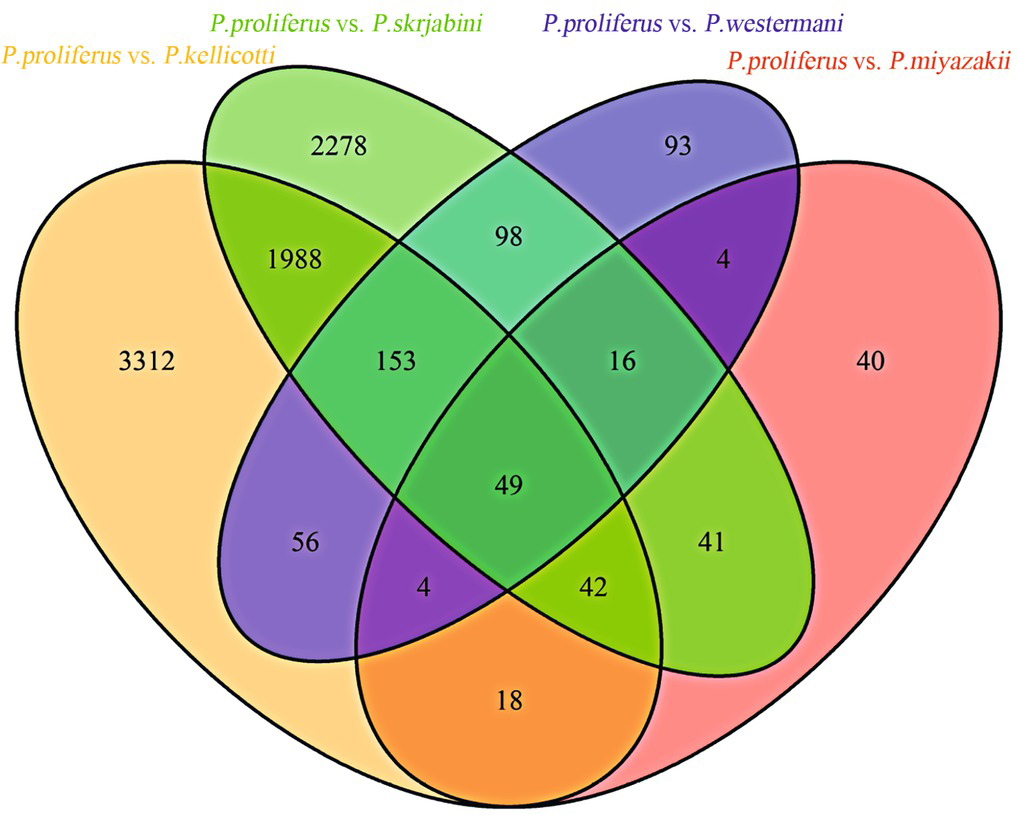
Fig. 7
Venn diagram showing 49 core genes identified from the 8192 differentially expressed homologous genes.
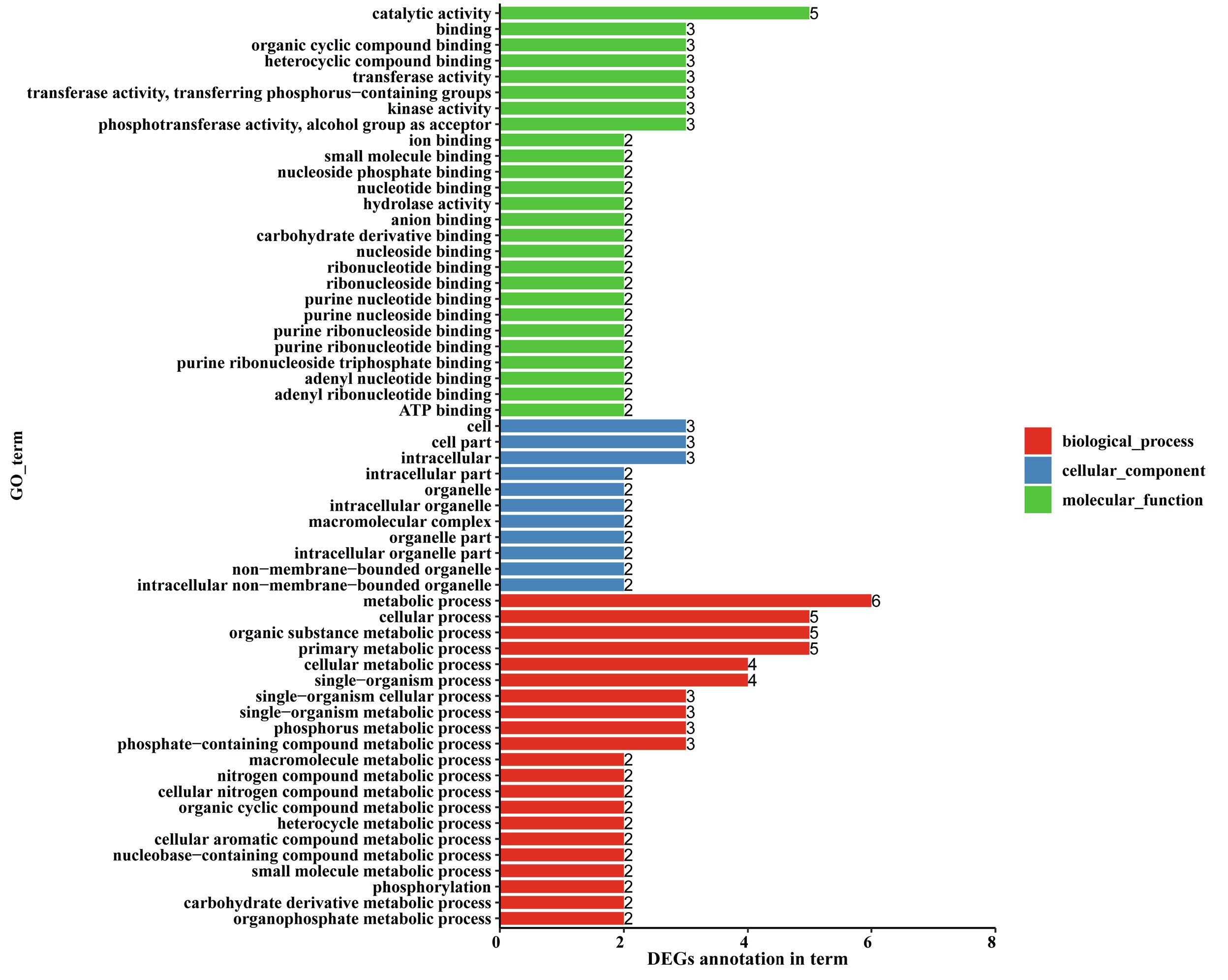
Fig. 8
Fifty-eight Gene Ontology (GO) terms (11 cellular components [CC], 21 biological processes [BP], and 26 molecular functions [MF]) enriched by core genes. Four BP (phosphate-containing compound metabolic process, organophosphate metabolic process, phosphorus metabolic process, and carbohydrate derivative metabolic process) and three MF (phosphotransferase activity/alcohol group as acceptor, kinase activity, and transferase activity/transferring phosphorus-containing groups) were significantly enriched at P < 0.05.
Table 2
Annotation information for the 16 core genes.
| Gene-ID | Database | Annotated ID | Description |
|---|---|---|---|
| TR11359|c0_g1 | KEGG | smm:Smp_137080 | multidrug resistance protein; K05658 ATP-binding cassette, subfamily B (MDR/TAP), member 1 [EC:3.6.3.44] |
| TR12766|c0_g1 | KEGG | oas:101108295 | tubulin alpha-3 chain; K07374 tubulin alpha |
| TR16634|c0_g1 | KEGG | smm:Smp_164960 | phosphatidylinositol-45-bisphosphate 3-kinase catalytic subunit alpha PI3K; K00922 phosphatidylinositol-4,5-bisphosphate 3-kinase [EC:2.7.1.153] |
| TR17957|c0_g1 | KEGG | fab:101816860 | WASF2; WAS protein family, member 2; K05748 WAS protein family, member 2 |
| TR89500|c0_g1 | KEGG | smm:Smp_159120 | family C48 unassigned peptidase (C48 family); K08596 sentrin-specific protease 7 [EC:3.4.22.68] |
| TR10230|c0_g1 | NR | gi|358340450|dbj|GAA48338.1| | retrovirus-related Pol polyprotein from transposon opus [Clonorchis sinensis] |
| TR11281|c0_g1 | NR | gi|358253292|dbj|GAA52762.1| | serine/threonine-protein phosphatase 2A regulatory subunit B′′ subunit alpha [Clonorchis sinensis] |
| TR15039|c0_g2 | NR | gi|684389238|ref|XP_009169318.1| | hypothetical protein T265_05919 [Opisthorchis viverrini] >gi|663050934|gb|KER26939.1| hypothetical protein T265_05919 [Opisthorchis viverrini] |
| TR18101|c0_g1 | NR | gi|684372571|ref|XP_009164145.1| | hypothetical protein T265_01791 [Opisthorchis viverrini] >gi|663056274|gb|KER32181.1| hypothetical protein T265_01791 [Opisthorchis viverrini] |
| TR22019|c0_g1 | NR | gi|358337500|dbj|GAA32515.2| | cell wall protein Awa1p [Clonorchis sinensis] |
| TR18820|c0_g1 | SwissProt | sp|Q64640|ADK_RAT | Adenosine kinase OS=Rattus norvegicus GN=Adk PE=1 SV=3 |
| TR18976|c0_g1 | SwissProt | sp|Q9D6Z1|NOP56_MOUSE | Nucleolar protein 56 OS=Mus musculus GN=Nop56 PE=1 SV=2 |
| TR20969|c0_g1 | SwissProt | sp|Q5EB30|ODF3A_XENTR | Outer dense fiber protein 3 OS=Xenopus tropicalis GN=odf3 PE=2 SV=1 |
| TR21606|c0_g1 | SwissProt | sp|Q9P2D7|DYH1_HUMAN | Dynein heavy chain 1, axonemal OS=Homo sapiens GN=DNAH1 PE=2 SV=4 |
| TR275|c0_g1 | SwissProt | sp|Q6DTY7|F264_MOUSE | 6-phosphofructo-2-kinase/fructose-2,6-bisphosphatase 4 OS=Mus musculus GN=Pfkfb4 PE=2 SV=4 |
| TR50927|c0_g1 | SwissProt | sp|Q3UM45|PP1R7_MOUSE | Protein phosphatase 1 regulatory subunit 7 OS=Mus musculus GN=Ppp1r7 PE=1 SV=2 |
GO and KEGG annotations of core genes
Six core genes were annotated to 11, 21, and 26 GO terms belonging to CC (DNAH1, NOP56, and PI3K), BP (SSP7, PFK-2/ FBPase2, DNAH1, Adk, PI3K, and NOP56), and MF (SSP7, PFK-2/FBPase2, DNAH1, Adk, PI3K, and NOP56), respectively, as shown in Fig. 8. Of the 21 terms belonging to BP, 17 were involved in metabolism, and at least 12 of the 26 nucleotide or ribonucleotide-related terms belonging to MF may be involved in DNA replication and repair. Of all the enriched GO terms, four belonging to BP (phosphate-containing compound metabolic process, organophosphate metabolic process, phosphorus metabolic process, and carbohydrate derivative metabolic process) and three belonging to MF (phosphotransferase activity/alcohol group as acceptor, kinase activity, and transferase activity/transferring phosphorus-containing groups) were significantly enriched with P < 0.05, which seems to indicate that phosphorus and carbohydrate metabolism may play an important role in the interspecies differences between P. proliferus and other Paragonimus species.
The six genes annotated to the GO terms mentioned above, as well as four others annotated to the KEGG Orthology (MRP, Tuba, Wasf2, and Ppp1r7), were also annotated to 87 KEGG pathways, 28 of which had a P value < 0.05 (Table 3) and all of which were enriched with four genes (PI3K, WASF2, MRP, and PFK-2/FB-Pase2). Of the 28 pathways, four were assigned to signal transduction (including 5’ adenosine monophosphate-activated protein kinase [AMPK], Janus kinase/signal transduces and activators of transcription [JAK-STAT], VEGF, and mTOR signaling), four participated in immune-related signaling (Fc gamma R-mediated phagocytosis, and Toll-like receptor, Fc epsilon RI, and B cell receptor signaling pathways), and seven were related to digestive or endocrine systems, as well as carbohydrate metabolism, and signaling pathways that are always involved directly or indirectly in metabolism. It is worth noting that there were also nine pathways related to level 2 cancers according to KEGG enrichment, which suggests that parasite infections may be a risk factor for tumorigenesis, a view that is supported by other reports (Feng & Cheng, 2017; van Tong et al., 2017).
Table 3
Top 28 Kyoto Encyclopedia of Genes and Genomes (KEGG) pathways significantly enriched by core genes (P < 0.05).
| Pathway | Pathway ID | Level 2 | Pvalue | Involving DEHGs |
|---|---|---|---|---|
| Choline metabolism in cancer | ko05231 | Cancers: Overview | 0.004227 | PI3K;WASF2 |
| MicroRNAs in cancer | ko05206 | Cancers: Overview | 0.01585 | PI3K;MRP |
| Melanoma | ko05218 | Cancers: Specific types | 0.02688 | PI3K |
| Acute myeloid leukemia | ko05221 | Cancers: Specific types | 0.0292 | PI3K |
| Non-small cell lung cancer | ko05223 | Cancers: Specific types | 0.03013 | PI3K |
| Pancreatic cancer | ko05212 | Cancers: Specific types | 0.03338 | PI3K |
| Endometrial cancer | ko05213 | Cancers: Specific types | 0.04168 | PI3K |
| Chronic myeloid leukemia | ko05220 | Cancers: Specific types | 0.04397 | PI3K |
| Colorectal cancer | ko05210 | Cancers: Specific types | 0.04718 | PI3K |
| Fructose and mannose metabolism | ko00051 | Carbohydrate metabolism | 0.04352 | PFK-2/FBPase2 |
| Apoptosis | ko04210 | Cell growth and death | 0.03661 | PI3K |
| Carbohydrate digestion and absorption | ko04973 | Digestive system | 0.0292 | PI3K |
| Type II diabetes mellitus | ko04930 | Endocrine and metabolic diseases | 0.02781 | PI3K |
| Regulation of lipolysis in adipocytes | ko04923 | Endocrine system | 0.03292 | PI3K |
| Thyroid hormone signaling pathway | ko04919 | Endocrine system | 0.03431 | PI3K;PFK-2/FBPase2 |
| Prolactin signaling pathway | ko04917 | Endocrine system | 0.03754 | PI3K |
| Aldosterone-regulated sodium reabsorption | ko04960 | Excretory system | 0.03013 | PI3K |
| Fc gamma R-mediated phagocytosis | ko04666 | Immune system | 0.005578 | PI3K;WASF2 |
| Toll-like receptor signaling pathway | ko04620 | Immune system | 0.02641 | PI3K |
| Fc epsilon RI signaling pathway | ko04664 | Immune system | 0.03477 | PI3K |
| B cell receptor signaling pathway | ko04662 | Immune system | 0.03754 | PI3K |
| Bacterial invasion of epithelial cells | ko05100 | Infectious diseases: Bacterial | 0.02904 | PI3K;WASF2 |
| Chagas disease (American trypanosomiasis) | ko05142 | Infectious diseases: Parasitic | 0.04214 | PI3K |
| ABC transporters | ko02010 | Membrane transport | 0.0426 | MRP |
| AMPK signaling pathway | ko04152 | Signal transduction | 0.007408 | PI3K;PFK-2/FBPase2 |
| Jak-STAT signaling pathway | ko04630 | Signal transduction | 0.03615 | PI3K |
| VEGF signaling pathway | ko04370 | Signal transduction | 0.03846 | PI3K |
| mTOR signaling pathway | ko04150 | Signal transduction | 0.04901 | PI3K |
Phosphoinositide 3-kinase (PI3K), which is critical for parasite virulence, was involved in 26 significantly enriched pathways. In Entamoeba histolytica, PI3K signaling plays an important role in motility, phagocytosis, host cell adhesion, and proteolysis of the extracellular matrix (Koushik et al., 2014). In Trypanosoma cruzi, PI3K-like activity plays an important role in host cell invasion, and parasite entry is impaired in trypomastigotes treated with a PI3K inhibitor prior to infection (Wilkowsky et al., 2001). Recently, PIKs have been proposed to be targets for the treatment of T. cruzi infection (Gimenez et al., 2015). Phosphofructokinase (PFK-2)/ fructose 1,6-bisphospatase (FBPase), which is also found in Trypanosoma brucei, Leishmania major, and T. cruzi (Chevalier et al., 2005), was identified as being involved in fructose and mannose metabolism and thyroid hormone signaling in our study.
According to KEGG enrichment of the analyzed transcriptome, Wiskott-Aldrich syndrome protein family member 2 (WASF2), which was annotated to signaling of choline metabolism in cancer, Fc gamma R-mediated phagocytosis, and bacterial invasion of epithelial cells, may be involved in parasite metabolism, invasion, and host immunity. Mitochondrial RNA processing (MRP) belongs to signaling of microRNAs in cancer and ATP-binding cassette (ABC) transporter classes. Reports have revealed that disruption of MRP in Plasmodium falciparum was related to a reduction in parasitemia, removal of toxic metabolites, and transport of antimalarial drugs (Raj et al., 2009). Additionally, drug efflux transporters of the ABC gene superfamily can confer drug resistance to pathogens (Carmona-Antonanzas et al., 2015).
Tubulin alpha-8 chain (TUBA) is also essential for host cell invasion and parasite survival in T. gondii (Morrissette, 2015). Adenosine kinase, encoded by the Adk gene, is a key enzyme in the purine-salvage pathway, adenosine phosphorylation, and activation of cytotoxic analogues (Romanello et al., 2013; Timm et al., 2014). In T. brucei, inhibition or downregulation of adenosine kinase results in resistance to cordycepin, demonstrating its role in the activation of adenosine antimetabolites (Luscher et al., 2007) and silencing of nucleolar protein (NOP) 1, which contributes to defects in rRNA-processing and causes lethal modifications (Barth et al., 2008). However, it is unclear whether NOP56 has a similar role. Protein phosphatases (PPs) are also related to reproduction and development. For example, in T. cruzi protein phosphatase 2A is important for the complete transformation of trypomastigotes into amastigotes (Gonzalez et al., 2003), and recent research in Toxocara canis has shown that PP1 regulates kinetochore-microtubule interactions during spermatogenesis via PP1cα-PP1r7 mechanisms (Ma et al., 2015). The functions of dynein axonemal heavy chain 1 (DNAH1) and Ssp7 are still unknown in parasites, especially in P. proliferus, and further research on the molecular biology of these genes in parasites is necessary.
Serine/threonine-protein phosphatase 2A regulatory subunit B (STP) may play a functional role in parasite reproduction (Boag et al., 2003; Ma et al., 2014). In T. canis, STP is not detected in adult females, but is expressed at high levels in the spermary, vas deferens, and musculature of the adult male, suggesting that STP may be involved in spermatogenesis and mating behavior and may represent a potential molecular target for controlling the reproduction of T. canis (Ma et al., 2014). The outer dense fiber (ODF), a coiled-coil protein, is the main cytoskeletal structural component of the sperm tail in animals and is potentially involved in building the cellular cytoskeleton (Petersen et al., 2002). Some ODF genes were found to be aberrantly expressed in tumors, such as prostate adenocarcinomas (Ghafouri-Fard et al., 2012), but the functions of parasite ODF, retrovirus-related Pol polyprotein from transposon opus, STP, and the cell wall protein Awa1p, require further research.
Conclusions
This study is the first to analyze and characterize the transcriptome of P. proliferus. Bioinformatics analysis and comparison with other Paragonimus species revealed that differentially expressed homologous genes were mainly related to “duplication, transcription, or translation” and energy or nutrient metabolism, as well as parasite growth, proliferation, motility, invasion, adaptation to the host, or virulence. These differences may be the key to reported differences in morphology or host preference. More importantly, the identified differentially expressed homologous genes related to virulence, motility, or invasion may explain differences in the pathogenicity of P. proliferus. It will be valuable to further explore the functions of these genes in P. proliferus.
Acknowledgments
We acknowledge the residents of Mengla County, Yunnan Province, China for their assistance in collecting local freshwater crabs. We also thank International Science Editing (http://www.internationalscienceediting.com) for editing this manuscript.
Notes
[1] Conflicts of interest Conflict of Interest
The authors declare that they have no competing interests. All authors read, edited, and approved the final manuscript, and consent to its publication.
[2] Financial disclosure Financial Support
This study was supported by Yunnan Local Colleges Applied Basic Research Projects (Grant No. 2018FH001-087), Projects Of Kunming Assurance Plan On Science And Technology Of People’s Livelihood (Grant No. Kkjz2019-1-s-25318000000808), the National Natural Science Foundation of China (Grant No. 81360252), the Association Foundation Program of Yunnan Provincial Science and Technology Department and Kunming Medical University (Grant No. 201801PH00065), and the Scientific Research Foundation of Yunnan Education (Grant No. 2018JS157).