Fig. 1
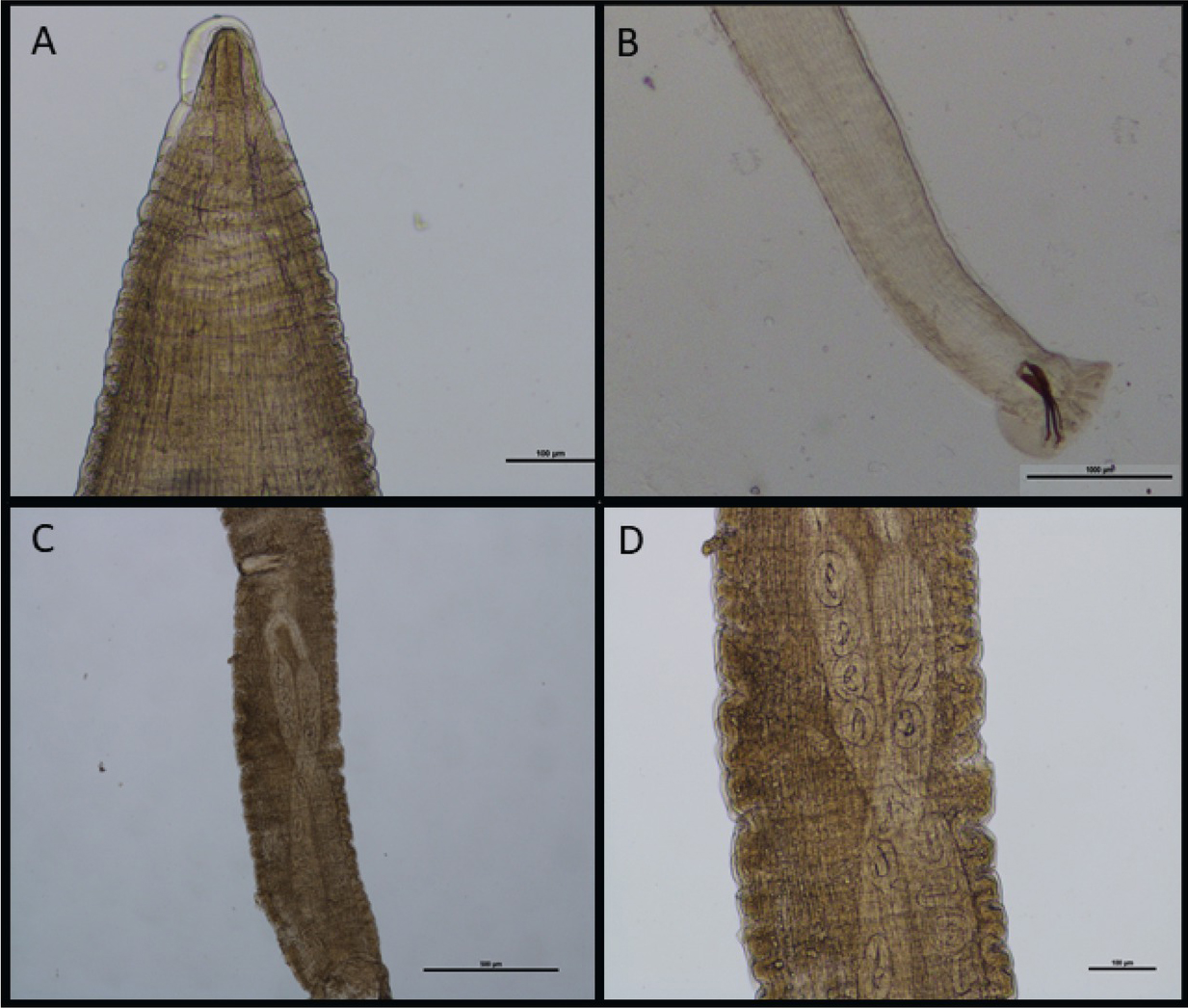
Morphological characteristics for the identification of Crenosoma striatum. A - rudimentary buccal capsule with a cross striation body cutile, B – copulatory bursa with two spicules, C – median vulva, D – eggs with ovoid shape that contain L1.
Table 1
Characterization of necropsied hedgehogs lung lesions and cause of death.
| Case nr | Gender | Season | Lung lesions | Concurrent lungworm | Cause of death |
|---|---|---|---|---|---|
| 1 | Male | Spring | Diffuse subacute bronchopneumonia | Yes | Parasitic pneumonia |
| 2 | Female | Autumn | Pulmonary edema | No | Heart chronic failure |
| 3 | Female | Winter | Hyperemia and pulmonary edema | No | Heart chronic failure |
| 4 | Male | Spring | Subacute multifocal to diffuse pneumonia | No | Pneumonia |
| 5 | Female | Spring | Multifocal chronic interstitial pneumonia | No | Chronic pneumonia |
| 6 | Male | Spring | Fibrinopurulent pleuropneumonia | No | Pleuropneumonia |
| 7 | Male | Spring | Diffuse subacute bronchopneumonia | Yes | Parasitic pneumonia |
| 8 | Male | Autumn | Diffuse subacute bronchopneumonia | Yes | Parasitic pneumonia |
| 9 | Male | Autumn | Diffuse subacute interstitial pneumonia | No | Pneumonia |
| 10 | Male | Autumn | Diffuse subacute bronchopneumonia | Yes | Parasitic pneumonia |
| 11 | Female | Autumn | Diffuse subacute bronchopneumonia | Yes | Parasitic pneumonia |
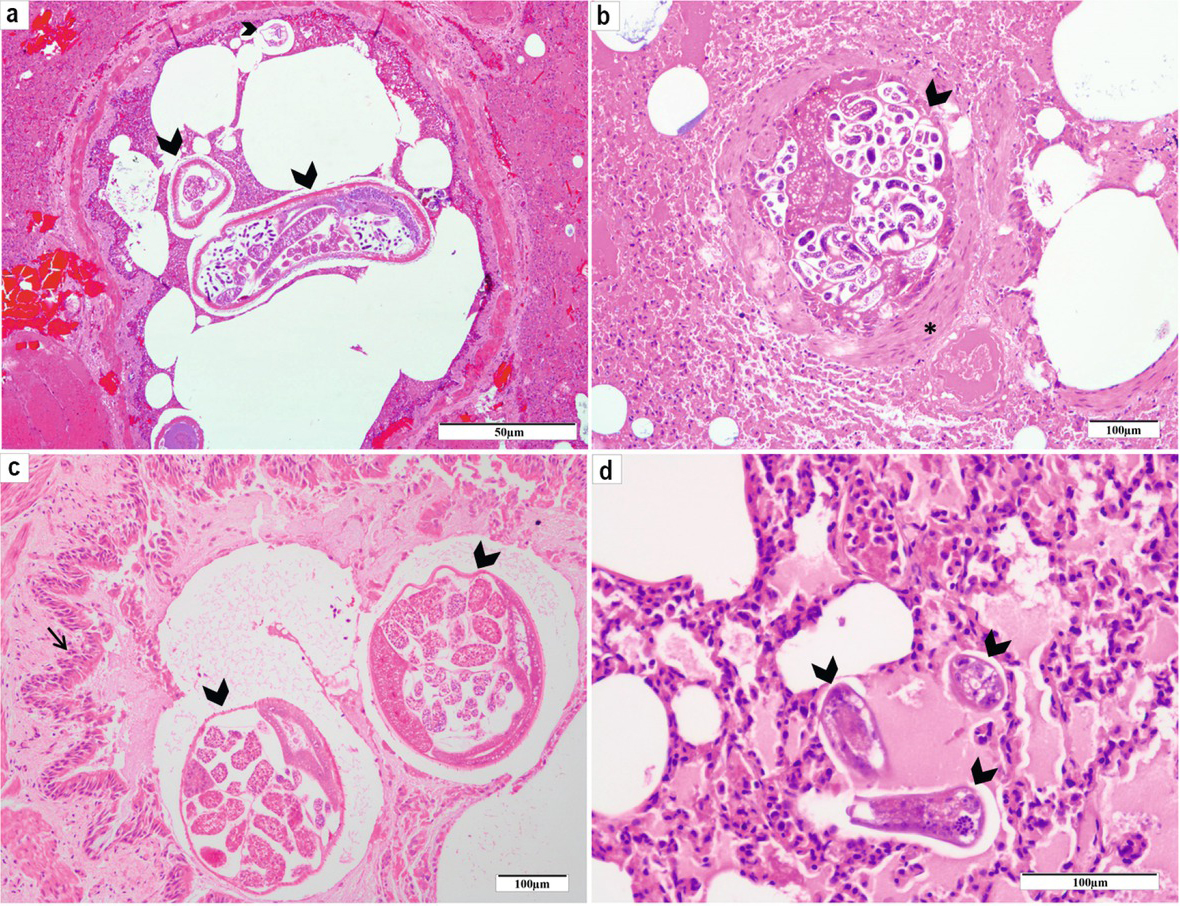
Fig. 2
a) and b) Presence of worms (arrowhead) within the bronchi and bronchioles. The alveoli are oedematous and contain abundant mixed inflammatory infiltrate and smooth-muscle hyperplasia (*) around the bronchiole is observed (case 7). c) Hyperplasia of the bronchial epithelium (arrow). Presence of intraluminal worms mixed with mucus and increased number of macrophages (case 1). d) Alveoli are filled with worms, proteinaceous material (oedema) and inflammatory infiltrate composed of neutrophils, eosinophils, macrophages, lymphocytes and plasma cells (case 8).
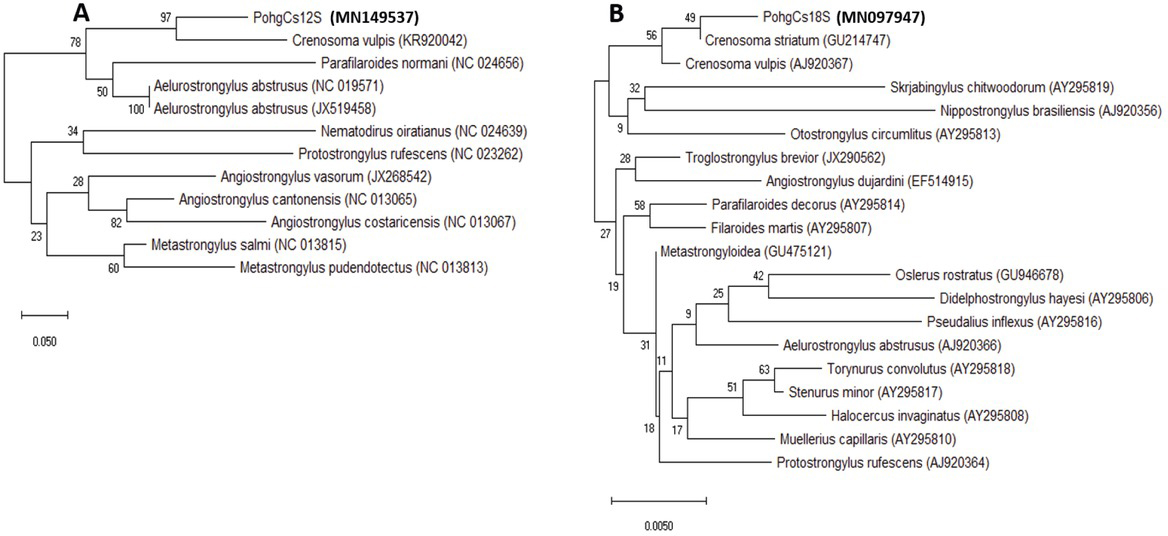
Fig. 3
Phylogenetic trees based on ribosomal 12S rRNA and 18S rRNA were constructed using the Maximum Likelihood method based on the Hasegawa-Kishino-Yano model (A) and the Neighbor-Joining method based on the Kimura 2-parameter model (B), and bootstrap values are based on 5000 replicates.