Introduction
Soil is an extremely heterogeneous environment in all aspects: biological, physical, chemical, and structural. Biological diversity is substantially higher in soil than above it, numbers are much larger for populations of soil organisms than aboveground communities (Young & Ritz, 1998). Microbes (fungi, bacteria, and algae), microfauna (protozoa), and mesofauna (arthropods and nematodes) belong to the most diverse soil organisms (Neher, 2001), affected mainly by vegetation and edaphic factors (Nielsen et al., 2014).
Nematodes inhabit nearly every environment and as biotic indicators are one of the most studied groups of soil organisms (Bhusal et al., 2014). Since nematodes have diverse feeding behaviour and life strategies and play a key role in soil food web, they function as important indicator for ecosystems processes (Ferris 2010). As nematodes show different degrees of sensitivity to the environmental stimuli, alterations or disturbances because they have different long life cycles and reproduction capacity (Bongers, 1990), species diversity and structure of community what is important indicator of soil health and conditions (Neher, 2001). In addition, nematode indices allow the evaluation of ecosystem nutrient status (enriched vs. depleted), structure of soil food web (complexity vs. simplicity) and the prevailing decomposition of organic matter (slower fungal vs. faster bacterial) (Ferris et al., 2001).
In contrast to nematode community’s structure, however, potential microbial community structure for use as indicators of soil quality and functioning are hampered by a lack of standardised assays of microbial ecological diversity (Schutter et al., 2001). Culturing techniques have been used to identify the number of specific taxonomic or functional groups, but only a small fraction of a microbial community (1 – 10 %) can be identified with these methods (Olembo & Hawksworth, 1991; Nannipieri et al., 2003). Analyses of microbial DNA (Martin-Laurent et al., 2001, Zhang et al., 2014) can identify taxonomic groups at different levels, but developing specific primers, for example, is problematic. PLFA analyses cannot identify organisms to the species level but can be used to estimate gross changes in community structure (Kaur et al., 2005). BIOLOG® EcoPlates are now commonly used for measuring microbial functional diversity based on the use of sources of available carbon (C) (Garland & Mills, 1991), and the method proposed by Degens and Harris (1997) for measuring the catabolic potential of microbial communities is often used in measurements of the impacts of soil management due to the easy use of both methods. Nevertheless, several microbial and biochemical attributes such as respiration, N mineralisation, or enzymatic activities can be reliably measured and are also frequently used as indicators of soil quality (Blagodatskii et al., 2008; Gömöryová et al., 2013, Bobuľská et al., 2015, Zhang et al., 2014).
Worldwide, several particular studies have revealed that environmental conditions determines the degree of species diversity of soil nematodes or nematode abundance e.g. ecosystem type and its properties (Neher et al., 2005; Nielsen et al., 2014), soil type and its properties (Lišková et al., 2008, Hu et al., 2018; Lima da Silva et al., 2019); vegetation and its species diversity (Cesarz et al., 2013; Renčo & Baležentiené, 2015). Similar, microbial activity and biomass have been evaluated in arable soils due to crop production as affected by tillage (Mangalassery et al, 2015); fertilizers (Kautz et al., 2004; Zakarauskaitė, et al., 2008) or management system (Bloem et al., 1992); in forest soil as affected by forest type (Fang et al., 2016) or in grasslands affected by plant diversity (Lange et al., 2015). The structure of soil nematode communities and microbial diversity, however, have not been investigated or compared amongst various land use (ecosystems) and main soil types in the territory of Slovak Republic in collaborative study. We studied the soil properties and nematode-microbial assemblages in three soil types and three ecosystems to evaluate 1) nematode and microbial diversity in ecosystems with different soil types, 2) the fundamental variability in soil properties amongst and within the ecosystems and soil types, and 3) the effects of soil properties and sampling date on the nematodes and microbes in the ecosystems and soil types. We hypothesised that biological diversity would be lower in agroecosystems, that soil trophic webs would be more coherent in natural habitats, but that the differences between ecosystems would vary with the physicochemical properties of the soil type.
Materials and Methods
Site selection
We examined the physical and chemical properties, nematode communities, and microbial attributes in soil samples collected from a Stagnosol (SS), a Cambisol (CS), and a Chernozem (CM) in each of a forest (FOR), a meadow (MEA), and an agricultural field (AGR) ecosystems. The soil types, ecosystems, locations, and vegetation characteristics are shown in Table 1.
Table 1
Soil type, location, ecosystem type, and vegetation characteristics of the study plots.
| Soil type | Location/characteristics | Ecosystem | Vegetation |
|---|---|---|---|
| Hanušovce nad Topľou Altitude 258 – 308 m a.s.l., slope 3 – 7° | Forest 49°00.339′N, 21°31.248′E | Carpinus betulus (90 %), Pinus sylvestris (5 %), sporadically Prunus avium, Fagus sylvatica, and Betula pendula. Understory vegetation dominated by grasses Carex pilosa, Festuca drymeja, and Poa memoralis and | |
| Soil with strong mottling of the soil profile due to redox processes | herbs Dentaria bulbifera and Fragaria vesca | ||
| Stagnosol | caused by stagnating surface water, The topsoil can also be completely bleached (albic horizon). A common name in many national classification systems for most Stagnosols is | Meadow 49°00.658′N, 21°30.058′E | Carex sp., Lolium perenne, Fragaria vesca, Trifolium pratense, Plantago sp. Leucanthemum sp. |
| pseudogley. | Agricultural field 49°00.727′N, 21°30.344′E | Zea mays monoculture | |
| Tŕnie Altitude 550 – 554 m a.s.l., slope 3 – 7° | Forest 48°36.712′N, 19°01.462′E | Carpinus betulus (75 %), Quercus robur (10 %), Tilia cordata (10 %), and sporadically Prunus avium Understory herbaceous vegetation dominated by Viola reichenbachiana, Geranium robertianum, | |
| Soil with a beginning of soil formation. The horizon differentiation is weak. This | Asarum europaeum, Luzula sylvatica, Galium odoratum, and Hedera helix. | ||
| Cambisol | is evident from weak, mostly brownish discolouration and/or structure formation in the soil profile. Cambisols are | Meadow 48°36.683′N, 19°01.494′E | Trifolium pratense, Agrimonia eupatoria, and grasses such as Carex sp., Poa sp., Dactylis glomerata, Trifolium pratense, Rumex acetosa |
| developed in medium and fine-textured materials derived from | |||
| a wide range of rocks, mostly in alluvial, colluvial and aeolian deposits. | Agricultural field N 48°36.660′N, E 19°01.503′E | Zea mays monoculture | |
| Močenok Altitude 135 – 180 m a.s.l., | Forest 48°12.960′N, | Fraxinus excelsior (80 %), Quercus petraea (20 %), and sporadically Robinia pseudoacacia. | |
| slope 0 – 3° Black-colored soil containing a high percentage of humus (4 % to 16 %) | 17°57.854′E | Understory vegetation dominated by grasses Poa nemoralis, Brachypodium sylvaticum, Melica uniflora, and Dactylis polygama | |
| Chernozem | and high percentages of phosphoric cids, phosphorus, and ammonia. Chernozem is very fertile and can produce high agricultural yields with its high moisture storage capacity. Chernozems are also a reference soil group of the World reference | Meadow 49°00.339′N, 21°30.344′E | Carex sp., Phleum pratense, Arrhenatherum elatius, Trifolium pratense, Vicia sp., Rumex acetosa, Achillea millefolium |
| base for soil resources | Agricultural field 49°00.339′N, 21°30.344′E | Zea mays monoculture | |
Soil samples and properties
Soil samples from each soil type and ecosystem were collected from five randomly established 1 × 1 m quadrats in selected plots of 20 × 20 m in May (M), July (J), and September (S) 2016. Five randomised subsamples were collected from the quadrats, one from each corner and one from the centre of the plots, for analysing the soil nematode communities, microbial activities, and physicochemical properties. The subsamples were bulked to produce a representative sample for the plot (1 kg). Samples were collected from a depth of 10 cm, excluding the surface humus layer. A total of 135 representative samples were collected; 5 from each ecosystem (FOR, MEA, and AGR, 5x3=15), from three soil type (SS, CS, and CM; 15x3=45), in three sampling date (M, J, and S; 45x3=135). The samples were transferred to the laboratory in sealed plastic bags and stored at 5 °C until processing for the nematode analysis or at -20 °C for the microbial analysis.
Total soil C and nitrogen (N) contents, soil moisture (SM) contents, and pH were measured in all samples. The organic C and total N contents were determined using a Vario MACRO Elemental Analyzer (CNS Version; Elementar, Hanau, Germany). Organic C content was determined based on the difference between total C and C bound in carbonates. SM content was estimated gravimetrically by oven-drying fresh soil at 105 °C overnight, and pH was measured potentiometrically in 1M KCl suspension by a digital pH meter separately for each representative sample.
Analysis of nematode communities
Each sample was homogenised by gentle hand mixing, and stones were manually removed. The nematodes were extracted from 100 g of fresh soil by a combination of Cobb sieving and decanting (Cobb 1918) and a modified Baermann technique (van Benzoijen, 2006). One hundred grams of soil from each representative sample were soaked in l L of tap water for 60 min to disrupt soil aggregates and promote nematode movement. The soaked sample was carefully passed through a 1-mm sieve (16 mesh) to remove plant parts and debris, and this suspension was passed through a 50-μm sieve (300 mesh) 2 min later to remove water and very fine soil particles. The nematodes were then extracted from the soil/water suspension by a set of two cotton-propylene filters in the Baermann funnels. Two filter trays were used per sample to limit material thickness to <0.5 cm. Suspensions containing the nematodes were collected after extraction for 24 h at room temperature. The nematodes were killed and fixed in a hot 99:1 solution of 4 % formaldehyde and pure glycerol (Seinhorst, 1962). The all nematodes were microscopically (100, 200, 400, 600, and 1000× magnification) identified to the species level (juveniles to the genus level) from temporary slides using an Eclipse 90i light microscope (Nikon Instruments Europe BV, Netherlands). Nematode abundance was expressed as the number of individuals per 100 g of dry soil.
The nematodes were assigned to fifteen functional guilds integrating nematode feeding strategies (trophic groups) and the nematode coloniser-persister (c-p) scale (Bongers & Bongers, 1998). The five nematode trophic groups were: bacterivores (Ba), fungivores (Fu), carnivores (Ca), omnivores (Om), and plant parasites (Pp) (Wasilewska, 1997). The Pp group included both obligatory plant parasites and facultative plant parasites that may attack plants or fungi. Colonisers-persisters characterising nematode life strategies are classified on a scale of 1 to 5 (Bongers, 1990). C-p1 represents “r-strategists” (colonisers) with short life cycles, small eggs, high fecundity, high colonisation ability, and high tolerance to disturbance, eutrophication, and anoxybiosis. Colonisers generally live in ephemeral habitats. At the other end of the scale, c-p5 nematodes represent “k-strategists” (persisters) with the longest generation times, largest bodies, lowest fecundities, and the highest sensitivity to disturbance. Persisters are never dominant in a sample and generally live in stable habitats where they become very abundant (Bongers, 1990). C-p scaling allows the calculation of the basal maturity index (MI) for non-parasitic nematodes, the plant parasitic index (PPI) for plant parasites only (Bongers, 1990), and the summ maturity index (ΣMI) (Yeates, 1994) for all nematode taxa. Functional guilds allow the calculation of the enrichment index (EI), the structure index (SI), and the channel index (CI) proposed by Ferris et al., (2001). The species-diversity index (H´) defined by Shannon and Weaver (1949), the nematode channel ratio (NCR) defined by Yeates (2003), and trophic diversity (TD) defined by Heip et al., (1998) were also calculated.
Nematode species were characterised as dominant at D >5 % (the species represents more than 5 % of the total nematode abundance in the ecosystem or soil type) and subdominant at D >2 % (the species represents more than 2 % of the total nematode abundance in the ecosystem or soil type) (Losos et al., 1984).
Microbial biomass
Microbial biomass C (Cmic) content was determined following the procedure described by Islam and Weil (1998). Ten grams of oven-dried equivalent (ODE) of field moist soil adjusted to 80 % water-filled porosity was irradiated twice by microwaves (MW) at 400 J g-1 ODE soil to kill the microorganisms. The cooled samples were extracted with 0.5 M K2SO4, and the C content of the extract was quantified by oxidation with K2Cr2O7/H2SO4. The same procedure was performed with a non-irradiated sample. Cmic content was determined as (Cirradiated content - Cnon-irradiated content)/KME, where KME represents the extraction efficiency (0.213) recommended by Islam and Weil (1998).
Functional diversity of microbial communities
The functional diversity of the soil microbiota was determined using the methods described by Insam (1997). Each well in a BIOLOG EcoPlate received 150 μl of an extract prepared by resuspending of fresh soil in 0.85 % NaCl and diluted 1:10 000. The plates with the extracts were then incubated at 27 °C for 6 d, and absorbance at 590 nm was recorded every 24 h using a Sunrise Microplate reader (Tecan, Salzburg, Austria). The data were corrected against the initial readings at time zero and were expressed as optical densities of individual wells. The richness of the soil microbial community (Richn) was determined as the number of substrates used by the microbial community, i.e. the number of wells with a positive response after background correction. Hill’s diversity index (Diver) (Hill, 1973) based on Eq. 1 was calculated for estimating the diversities of the microbial functional groups:
in which pi is the ratio of the activity on a substrate to the sum of activities on all substrates.
Data analysis
Data were log-transformed before analysis to improve normality. Soil and ecosystem types were included as fixed factors. The effects of soil type (SS, CS, and CM), type of ecosystem (FOR, MEA, and AGR), and sampling date (M, J, and S) on nematode trophic-web descriptors and functional guilds, soil properties, and microbial biomass, diversity, and richness were analysed by factorial analyses of variance (ANOVAs). Nonparametric Spearman’s correlation coefficient (rs) was calculated to test the relationships between nematode functional guilds, microbial parameters, and soil parameters for each sample using STATISTICA v9.0. Correlations obtained at P<0.05 were considered significant.
We then used multivariate analyses to evaluate the effects of soil and ecosystem types on nematode-community composition and the microbial characteristics. The composition of the nematode functional guilds and the microbial parameters were thus used as response variables, and the soil and ecosystem types were used as explanatory variables in a multivariate framework of a redundancy analysis (RDA). The soil physicochemical parameters were used as supplementary variables. Canoco 5 for Windows was used for the multivariate analyses (vers. 5.04; Ter Braak & Šmilauer, 2012).
Ethical Approval and/or Informed Consent
This article does not contain any studies with human participants or animals by any of the authors, so formal consent is not required. Authors have no potential conflict of interest pertaining to this submission to Helminthologia.
Results
Soil properties
The factorial ANOVA found that ecosystem type (FOR, MEA, and AGR) and soil type (SS, CS, and CM) significantly affected all soil properties (except SM content vs. soil type) and that sampling date (M, J, and S) affected only SM content (P<0.01, Table 2). The bi-factorial interaction ecosystem × soil significantly affected all soil properties, ecosystem × date affected half of the properties, and soil × date and the interaction of all three factors (ecosystem × soil × date) had minor or no effects on the soil properties. The values of the soil properties were generally higher in the FOR soils (except pH) than the MEA and AGR soils and higher in CM (including pH) than CS and SS. pH and the C/N ratio were correlated negatively in FOR but positively in AGR and MEA (Fig. 1).
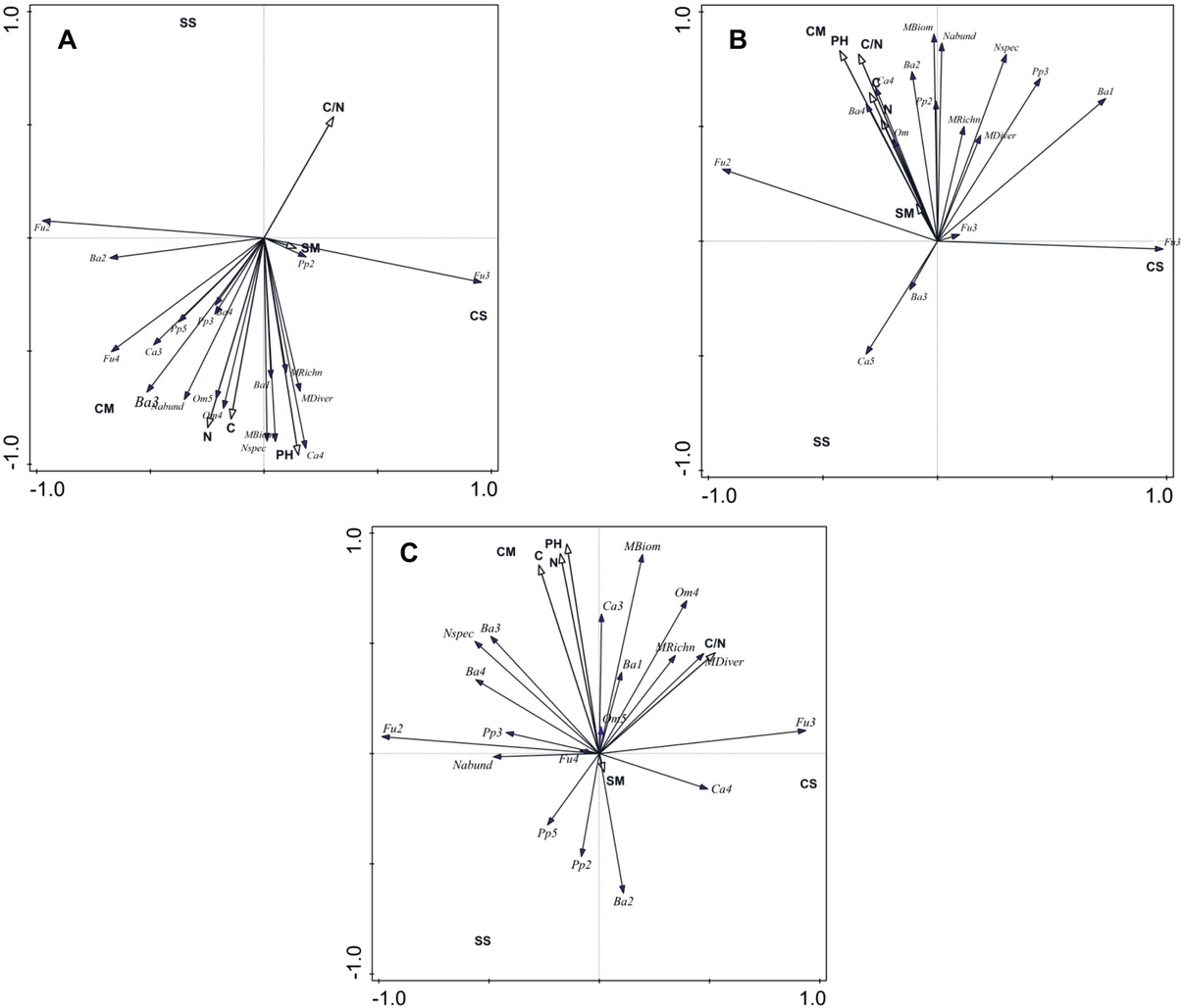
Fig. 1
RDA triplots of the relationships of abundance of nematode functional guilds, microbial parameters, and soil properties in the forest (A), agricultural field (B), and meadow (C) ecosystems and the Stagnosol (SS), Cambisol (CC), and Chernozem (CM) soil types.
Table 2
Effects of ecosystem type (E), type of soil (S), sampling date (D), and their interactions on basic soil physical and chemical characteristics.
| Ecosystem | Soil | Date | E × S | E × D | S × D | Ecosystem | Soil | Date | E × S × D | ||||||||||||||
|---|---|---|---|---|---|---|---|---|---|---|---|---|---|---|---|---|---|---|---|---|---|---|---|
| F | P | F | P | F | P | F | P | F | P | F | P | Meadow | Agricultural field | Forest | Stagnosol | Cambisol | Chernozem | May | July | Sept | F | P | |
| pH/H2O | 28.91 | < 0.01 | 598.43 | < 0.01 | 2.95 | ns | 80.12 | <0.01 | 2.63 | <0.05 | 2.05 | ns | 5.88±0.78 | 5.79±0.75 | 5.54±1.08 | 4.82±0.61 | 5.71±0.41 | 6.68±0.32 | 5.68±0.88 | 5.71±0.87 | 5.81 ±0.92 | 1.08 | ns |
| SM | 60.14 | < 0.01 | 0.99 | ns | 131.43 | < 0.01 | 2.72 | < 0.05 | 5.39 | < 0.01 | 33.88 | ns | 26.33±7.28 | 22.14±5.14 | 30.78±8.64 | 26.15±8.96 | 26.93±8.85 | 26.15±5.75 | 26.68±8.04 | 20.52±5.47 | 32.10±5.3 | 2.53 | <0.05 |
| N | 156.52 | < 0.01 | 122.56 | < 0.01 | 0.15 | ns | 11.22 | < 0.01 | 0.29 | ns | 2.60 | ns | 0.377±0.10 | 0.205±0.07 | 0.395±0.13 | 0.244±0.06 | 0.300±0.09 | 0.434±0.15 | 0.326±0.12 | 0.321±0.12 | 0.331±0.16 | 1.36 | ns |
| C | 275.46 | < 0.01 | 140.58 | < 0.01 | 0.08 | ns | 6.33 | < 0.01 | 0.41 | ns | 1.89 | ns | 3.588±1.05 | 1.955±0.85 | 4.395±1.28 | 2.429±0.84 | 3.127±1.321 | 4.382±1.48 | 3.298±1.38 | 3.271±1.40 | 3.369±1.64 | 1.87 | ns |
| S | 32.62 | < 0.01 | 51.84 | < 0.01 | 2.11 | ns | 10.39 | < 0.01 | 4.79 | < 0.01 | 3.75 | ns | 0.071±0.02 | 0.048±0.01 | 0.070±0.02 | 0.049±0.02 | 0.060±0.01 | 0.082±0.02 | 0.067±0.03 | 0.060±0.18 | 0.063±0.02 | 2.71 | <0.01 |
| C/N | 171.64 | < 0.01 | 7.51 | < 0.01 | 1.81 | ns | 49.09 | < 0.01 | 1.86 | ns | 1.21 | ns | 9.49±0.54 | 9.35±0.98 | 11.28±1.06 | 9.86±1.70 | 10.08±1.21 | 10.18±0.56 | 9.95±1.32 | 10.04±1.24 | 10.14±1.16 | 1.80 | ns |
[i] E: meadow, agriculture and forest; S: Stagnosol, Cambisol and Chernozem; D: May, July, and September
pH/H2O, acidity; SM, soil moisture content N, total nitrogen content C, organic carbon content S, total sulphur content; C/N, carbon to nitrogen ratio. The means ±SEs of nematode abundance for the three ecosystems, soil types, and sampling dates are shown.
Nematode and microbial trophic webs
The three ecosystems and soil types contained 133 nematode species (32 bacterivores, 26 fungivores, 9 carnivores, 24 omnivores, and 42 plant parasites) (Table S1). Heterocephalobus eurystoma, Stegetellina leopolitensis, Ditylenchus parvus, Ditylenchus tenuides, Paraphelenchus obscurus, Boleodorus volutus, Cephalenchus intermedius, and Ecphyadophora tenusissima were new to the list of Slovak nematode fauna, increasing the total number of soil nematode species to 732. The number of species (99) and diversity were highest in the FOR soils, followed by the MEA (90) and AGR (53) soils. Nematode species number and diversity were higher in CM than CS and SS (102, 81, and 60, respectively) (Tables S1, 4). The most abundant nematode species by trophic group were Acrobeloides nanus and Chiloplacus propinquus (bacterivores), Aphelenchus avenae and Filenchus vulgaris (fungivores), Clarkus papillatus and Mylonchulus brachyuris (carnivores), Eudorylaimus carteri (omnivores), and Aglenchus agricola, Boleodorus thylactus, and Bitylenchus dubius (facultative and obligate plant parasites) (Table S1).
Table 3
Effects of ecosystem type (E), type of soil (S), sampling date (D), and their interactions on nematode abundance, functional guilds and microbial communities.
| Ecosystem | Soil | Date | E × S | E x D | S :D x | Ecosystem | Soil | Date | E × S × D | ||||||||||||||
|---|---|---|---|---|---|---|---|---|---|---|---|---|---|---|---|---|---|---|---|---|---|---|---|
| F | P | F | P | F | P | F | P | F | P | F | P | Meadow | Agricultural field | Forest | Stagnosol | Cambisol | Chernozem | May | July | Sept | F | P | |
| Nabund | 2.36 | ns | 92.49 | < 0.01 | 15.04 | < 0.01 | 37.97 | < 0.01 | 5.57 | < 0.01 | 1.63 | ns | 479.8±119.8 | 540.1±322.5 | 451.8±169.5 | 351.6±150.1 | 435.8±104.9 | 671.3±260.3 | 549.2±276.3 | 418.1±165.9 | 504.1±201.8 | 1.59 | ns |
| Nspec | 5.69 | < 0.01 | 4.87 | <0.01 | 0.88 | ns | 12.45 | < 0.01 | 1.98 | ns | 2.98 | ns | 33.2±5.7 | 25.2±6.2 | 37.1±4.1 | 24.1±5.8 | 32.5±6.3 | 38.5±7.5 | 33.0±7.7 | 29.0±11 | 31.7±8.4 | 1.12 | ns |
| Ba1 | 6.19 | < 0.01 | 85.42 | <0.01 | 1.24 | ns | 21.63 | < 0.01 | 1.78 | ns | 1.76 | ns | 10.9±11.1 | 38.6±43.9 | 22.18±21.8 | 4.2±5.8 | 41.9±41.6 | 25.6±20.7 | 22.6±30.4 | 21.1±25.6 | 28.1±36.3 | 0.97 | ns |
| Ba2 | 5.49 | < 0.01 | 12.36 | <0.01 | 11.48 | < 0.01 | 35.72 | < 0.01 | 6.11 | < 0.01 | 2.44 | ns | 159.4±80.3 | 181.8±118.6 | 190.8±84.5 | 145.8±87.3 | 150.3±52.0 | 214.6±122.0 | 207.8±117.8 | 147.2±75.4 | 165.8±81.2 | 1.70 | ns |
| Ba3 | 39.96 | < 0.01 | 117.06 | <0.01 | 2.9 | ns | 29.93 | < 0.01 | 1.24 | ns | 3.98 | ns | 2.3±5.0 | 0.0±0.0 | 3.1±5.5 | 0.0±0.0 | 0.2±0.7 | 5.11±6.5 | 1.0±2.6 | 2.9±6.4 | 1.4±3.3 | 2.12 | ns |
| Ba4 | 5.82 | < 0.01 | 28.8 | <0.01 | 0.07 | ns | 1.9 | ns | 0.69 | ns | 0.77 | ns | 3.7±7.2 | 1.5±3.6 | 2.9±4.0 | 0.9±1.6 | 0.6±1.3 | 6.6±7.5 | 2.9±6.3 | 2.5±4.8 | 2.7±4.7 | 0.83 | ns |
| Ca3 | 15.89 | < 0.01 | 24.98 | <0.01 | 0.67 | ns | 7.47 | < 0.01 | 0.47 | ns | 0.27 | ns | 1.0±1.7 | 0.0±0.0 | 0.6±1.2 | 0.0 ±0.0 | 0.3±0.9 | 1.3±1.8 | 0.4±1.2 | 0.6±1.4 | 0.5±1.3 | 0.22 | ns |
| Ca4 | 45.67 | < 0.01 | 63.63 | <0.01 | 0.08 | ns | 31.3 | < 0.01 | 0.23 | ns | 0.14 | ns | 3.9±3.9 | 1.8±3.5 | 10.4±9.7 | 1.0±2.2 | 7.0±7.6 | 8.1±8.4 | 5.1±6.8 | 5.8±8.3 | 5.2±6.9 | 0.80 | ns |
| Ca5 | 11.63 | < 0.01 | 11.63 | <0.01 | 1.22 | ns | 11.63 | < 0.01 | 1.22 | ns | 1.22 | ns | 0.0±0.0 | 0.6±1.6 | 0.0±0.0 | 0.6±1.6 | 0.0±0.0 | 0.0±0.0 | 0.2±0.9 | 0.3±1.3 | 0.1 ±0.4 | 1.22 | ns |
| Fu2 | 7.03 | < 0.01 | 50.64 | <0.01 | 3.42 | < 0.05 | 30.43 | < 0.01 | 6.69 | < 0.01 | 1.42 | ns | 97.8±34.7 | 155.6±156.7 | 87.5±52.6 | 68.1±38.5 | 90.1±40.4 | 182.7±143.5 | 122.4±127.5 | 92.2±126.2 | 126.2±104.5 | 1.42 | ns |
| Fu3 | 4.06 | < 0.05 | 4.06 | <0.05 | 0.79 | ns | 7.88 | < 0.01 | 0.57 | ns | 0.57 | ns | 1.4±4.5 | 0.0±0.0 | 0.3±1.2 | 0.3±1.2 | 0.0±0.0 | 1.4±4.5 | 0.5±0.3 | 0.5±1.2 | 0.8±2.7 | 0.68 | ns |
| Fu4 | 29.26 | < 0.01 | 18.65 | < 0.01 | 0.18 | ns | 14.74 | < 0.01 | 1.20 | ns | 0.90 | ns | 3.7±4.9 | 0.0±0.0 | 5.3±9.3 | 1.9±4.4 | 0.9±2.2 | 6.2±9.2 | 3.6±8.3 | 2.8±5.4 | 2.5±5.3 | 0.89 | ns |
| Om4 | 4.24 | < 0.05 | 43.16 | < 0.01 | 2.41 | ns | 10.80 | < 0.01 | 0.62 | ns | 1.13 | ns | 31.2±29.8 | 21.7±19.0 | 41.0±37.0 | 16.0±16.8 | 35.8±22.2 | 52.1 ±35.1 | 41.5±37.2 | 33.2±25.2 | 29.3±24.0 | 0.55 | ns |
| Om5 | 5.32 | < 0.05 | 22.74 | < 0.01 | 0.94 | ns | 4.84 | < 0.01 | 0.65 | ns | 2.36 | ns | 19.8±7.4 | 8.7±12.1 | 15.4±13.2 | 8.2±9.1 | 8.6±5.3 | 20.1±13.7 | 12.8±10.3 | 12.5±14.2 | 11.7±9.1 | 1.87 | ns |
| Pp2 | 19.66 | < 0.01 | 1.02 | ns | 6.47 | < 0.01 | 9.28 | < 0.01 | 1.03 | ns | 2.55 | ns | 62.4±42.9 | 54.8±47.0 | 25.3±20.1 | 46.7±46.9 | 43.3±29.1 | 52.4±46.3 | 49.4±33.9 | 33.0±27.5 | 59.9±54.4 | 2.55 | ns |
| Pp3 | 27.71 | < 0.01 | 24.21 | < 0.01 | 0.11 | ns | 14.19 | < 0.01 | 0.75 | ns | 5.04 | < 0.01 | 74.9±43.3 | 57.8±39.2 | 28.1±24.5 | 36.6±36.2 | 49.2±30.5 | 74.7±46.3 | 58.4±46.8 | 49.1±34.6 | 52.9±41.5 | 2.38 | ns |
| Pp5 | 3.46 | < 0.05 | 3.78 | <0.05 | 0.59 | ns | 7.78 | < 0.01 | 0.37 | ns | 0.37 | ns | 0.27±0.95 | 0.0±0.0 | 0.5±1.3 | 0.3±0.9 | 0.0±0.0 | 0.5±1.3 | 0.4±1.2 | 0.2±0.8 | 0.2±0.8 | 0.48 | ns |
| Cmic | 175.55 | < 0.01 | 295.91 | <0.01 | 2.84 | ns | 5.02 | < 0.01 | 0.69 | ns | 2.64 | <0.05 | 335.2±118.3 | 207.9±91.5 | 400.1±145.5 | 183.0±65.9 | 325.9±119.4 | 434.4±109.2 | 316.0±129.1 | 300.4±143.4 | 326.8±157.8 | 19.0 | ns |
| Richn | 3.60 | < 0.05 | 50.90 | <0.01 | 11.28 | < 0.01 | 1.88 | ns | 0.68 | ns | 14.01 | < 0.01 | 26.2±2.39 | 25.5±1.86 | 26.5±2.93 | 24.2±2.3 | 26.8±1.96 | 27.2±1.9 | 25.8±1.8 | 26.9±1.9 | 25.5±3.2 | 3.19 | < 0.01 |
| Diver | 3.15 | <0.05 | 53.52 | <0.01 | 0.69 | ns | 1.96 | ns | 2.24 | ns | 4.69 | < 0.01 | 14.51±2.6 | 13.85±2.4 | 14.9±3.0 | 12.1 ±2.9 | 15.6±2.3 | 15.6±2.4 | 14.2±2.1 | 14.7±2.7 | 14.5±3.2 | 34.2 | < 0.01 |
| E: meadow, agriculture and forest; S: Stagnosol, Cambisol and Chernozem; D: May, July, and September | |||||||||||||||||||||||
[i] Ba1,2,3,4, bacterivores; Fu2,3,4, fungivores; Ca3,4,5, carnivores; Om4,5, omnivores; Pp2,3,5, plant parasites; Nabund, meannematode abundance/100 g dry soil, Nspec, mean nematode species number/100 g dry soil; Cmic, microbial biomass carbon content; Richn, richness of microbial functional groups; Diver, diversity of microbial functional groups. The means ±SEs of nematode abundance for the three ecosystems, soil types, and sampling dates are shown.
Table 4
Effects of ecosystem type (E), type of soil (S), sampling date (D), and their interactions on nematode trophic-web descriptors.
| Ecosystem | Soil | Date | E × S | E × D | S × D | Ecosystem | Soil | Date | E × S × D | ||||||||||||||
|---|---|---|---|---|---|---|---|---|---|---|---|---|---|---|---|---|---|---|---|---|---|---|---|
| F | P | F | P | F | P | F | P | F | P | F | P | Meadow | Agricultural field | Forest | Stagnosol | Cambisol | Chernozem | May | July | Sept | F | P | |
| MI | 18.86 | < 0.01 | 21.28 | <0.01 | 5.56 | < 0.01 | 44.11 | < 0.01 | 4.22 | < 0.01 | 2.04 | <0.05 | 2.32±0.19 | 2.21±0.23 | 2.37±0.23 | 2.25±0.20 | 2.24±0.23 | 2.41±0.23 | 2.33±0.25 | 2.32±0.24 | 2.24±0.19 | 1.83 | <0.05 |
| ΣMI | 11.34 | < 0.01 | 25.74 | < 0.01 | 3.89 | < 0.05 | 28.66 | < 0.01 | 2.27 | ns | 0.95 | ns | 2.38±0.17 | 2.28±0.16 | 2.39±0.21 | 2.28±0.15 | 2.30±0.15 | 2.45±0.20 | 2.35±0.22 | 2.38±0.18 | 2.31 ±0.16 | 1.46 | ns |
| PPI | 0.70 | ns | 16.05 | < 0.01 | 7.03 | < 0.01 | 8.30 | < 0.01 | 2.24 | ns | 6.25 | < 0.01 | 2.5±0.20 | 2.53±0.22 | 2.51±0.26 | 2.43±0.24 | 2.53±0.20 | 2.62±0.20 | 2.59±0.23 | 2.60±0.21 | 2.38±0.22 | 6.41 | < 0.01 |
| H' | 125.08 | < 0.01 | 87.76 | < 0.01 | 0.73 | ns | 22.99 | < 0.01 | 0.99 | ns | 2.50 | <0.05 | 2.91 ±0.22 | 2.60±0.15 | 3.02±0.29 | 2.64±0.18 | 2.88±0.25 | 3.01±0.30 | 2.82±0.26 | 2.85±0.28 | 2.86±0.33 | 2.67 | <0.05 |
| EI | 4.52 | < 0.05 | 9.05 | < 0.01 | 1.46 | ns | 14.80 | < 0.01 | 0.76 | ns | 2.32 | ns | 41.3±9.9 | 46.7±12.4 | 46.2±11.3 | 38.9±5.6 | 47.8±14.8 | 47.1±10.5 | 42.3±9.4 | 46.3±13.2 | 45.3±11.8 | 4.70 | < 0.01 |
| SI | 4.53 | < 0.05 | 61.88 | < 0.01 | 1.78 | ns | 25.55 | < 0.01 | 6.20 | < 0.01 | 3.60 | <0.01 | 44.3±18.4 | 41.0±13.3 | 49.2±18.4 | 30.7±12.1 | 50.5±10.8 | 53.2±18.2 | 44.5±19.4 | 47.1±16.5 | 42.9±15.7 | 2.06 | <0.05 |
| CI | 53.82 | < 0.01 | 61.48 | < 0.01 | 0.11 | ns | 182.05 | < 0.01 | 13.74 | <0.01 | 3.14 | <0.05 | 68.5±16.8 | 57.9±30.1 | 52.7±16.3 | 64.4±18.9 | 52.7±28.8 | 61.9±18.4 | 60.1±23.8 | 61.6±24.9 | 57.5±20.3 | 15.57 | <0.01 |
| NCR | 7.77 | < 0.01 | 34.25 | < 0.01 | 5.17 | < 0.01 | 42.19 | <0.01 | 6.01 | <0.01 | 1.88 | ns | 0.65±0.12 | 0.63±0.16 | 0.69±0.13 | 0.69±0.14 | 0.70±0.12 | 0.57±0.12 | 0.69±0.12 | 0.65±0.13 | 0.64±0.16 | 4.02 | < 0.01 |
| TD | 19.17 | < 0.01 | 15.09 | < 0.01 | 0.009 | ns | 16.81 | <0.01 | 1.75 | ns | 1.15 | ns | 12.2±2.4 | 10.5±4.2 | 14.7±2.1 | 10.5±3.2 | 13.2±1.9 | 13.7±2.4 | 12.3±0.8 | 12.5±0.7 | 12.9±0.7 | 1.34 | ns |
[i] E: meadow, agriculture and forest; S: Stagnosol, Cambisol and Chernozem; D: May, July, and September
MI, maturity index; ΣMI, sigma maturity index; PPI, plant parasitic index; H´, Shannon diversity index; EI, enrichment index; SI, structure index; CI, channel index; NCR, nematode channel ratio; TD, trophic diversity. The means ±SEs of the nematode-community descriptors for the three ecosystems, soil types, and sampling dates are shown
Table 5
Spearman´s rank correlation coefficients between nematode abundance, species number, functional guild, microbial parameters and soil properties.
| pH/H2O | SM | N | C | S | C/N | |
|---|---|---|---|---|---|---|
| Nabund | 0.35** | 0.68*** | 0.42*** | 0.29** | ns | ns |
| Nspec | 0.22* | ns | 0.31* | 0.37*** | ns | ns |
| Ba1 | 0.44** | ns | 0.25*** | 0.22* | 0.31*** | ns |
| Ba2 | ns | -0.23*** | ns | ns | ns | ns |
| Ba3 | 0.54*** | 0.26* | 0.44*** | 0.41*** | 0.42*** | 0.21* |
| Ba4 | 0.43*** | ns | 0.30*** | 0.29*** | 0.30*** | ns |
| Ca3 | 0.44*** | 0.46*** | 0.39*** | 0.40*** | 0.39*** | 0.33*** |
| Ca4 | 0.41*** | ns | 0.21* | 0.22* | 0.22** | 0.21** |
| Ca5 | ns | 0.41*** | 0.35* | ns | 0.36* | 0.26* |
| Fu2 | 0.55*** | ns | 0.35*** | 0.29** | 0.37*** | ns |
| Fu3 | ns | ns | ns | ns | ns | ns |
| Fu4 | 0.39*** | 0.37*** | 0.29*** | 0.26** | 0.27** | ns |
| Om4 | 0.42*** | ns | ns | ns | 0.33** | ns |
| Om5 | 0.38*** | ns | 0.21* | ns | 0.23** | ns |
| Pp2 | ns | ns | ns | ns | ns | -0.27*** |
| Pp3 | 0.47*** | 0.24*** | ns | ns | ns | ns |
| Pp5 | 0.39*** | 0.37*** | 0.28*** | 0.28*** | 0.29** | 0.38*** |
| Cmic | 0.70*** | 0.39*** | 0.90*** | 0.91*** | 0.83*** | 0.51*** |
| Richn | 0.46*** | ns | 0.47*** | 0.45*** | 0.53*** | ns |
| Diver | 0.47*** | ns | 0.40*** | 0.38*** | 0.50*** | ns |
Ba1,2,3,4, bacteriovores; Fu2,3,4, fungivores; Ca3,4,5, carnivores; Om4,5, omnivores; Pp2,3,5, plant parasites; Cmic, microbial biomass carbon content; Richn, richness of microbial functional groups; Diver, diversity of microbial functional groups; pH/H2O, acidity; SM, soil moisture content; N, total nitrogen content; C, organic carbon content; S, total sulphur content; C/N, carbon to nitrogen ratio
Table S1
Mean abundance of nematode species (100 g of dry soil) in the three ecosystems (forest (FOR), meadow (MEA), and agricultural field (AGR)) and types of soil (Stagnosol (SS), Cambisol (CS), and Chernozem (CM)) (n=45). Bold figures indicate dominance >2 but <5%, and bold and underlined figures indicate dominance >5%.
| Ecosystem | Soil | ||||||
|---|---|---|---|---|---|---|---|
| Taxon | TG/FG | FOR | MEA | AGR | SS | CS | CM |
| Mesorhabditis spp. juvs | Ba1 | 13.5 | 0.6 | 13.4 | 17.4 | 10.1 | |
| Panagrolaimus rigidus | Ba1 | 2.0 | 6.1 | 7.2 | 1.3 | 5.8 | 8.2 |
| Rhabditis spp. juvs | Ba1 | 6.7 | 4.3 | 18.1 | 2.9 | 18.7 | 7.4 |
| Acrobeles ciliatus | Ba2 | 20.3 | 2.8 | 0.4 | 23.4 | ||
| Acrobeloides buetschlii | Ba2 | 0.4 | 0.4 | ||||
| Acrobeloides nanus | Ba2 | 43.0 | 40.9 | 30.1 | 30.2 | 45.1 | 38.2 |
| Acrobelophis minimus | Ba2 | 0.6 | 0.6 | ||||
| Acrolobus emarginatus | Ba2 | 0.1 | 0.1 | ||||
| Anaplectus granulosus | Ba2 | 2.5 | 5.1 | 2.7 | 2.4 | 1.9 | 7.2 |
| Cervidellus cervus | Ba2 | 0.1 | 0.1 | ||||
| Cervidellus vexiliger | Ba2 | 5.8 | 2.7 | 0.6 | 8.4 | ||
| Cephalobus persegnis | Ba2 | 17.7 | 14.3 | 22.7 | 24.4 | 27.6 | 11.5 |
| Ereptonema arcticum | Ba2 | 1.9 | 1.9 | ||||
| Eucephalobus mucronatus | Ba2 | 2.9 | 1.3 | 1.6 | |||
| Eucephalobus oxyuroides | Ba2 | 12.6 | 13.5 | 17.5 | 22.1 | 7.7 | 13.9 |
| Eucephalobus striatus | Ba2 | 7.2 | 3.3 | 44.8 | 13.5 | 5.1 | 39.4 |
| Eumonhystera dispar | Ba2 | 1.0 | 1.0 | ||||
| Eumonystera filiformis | Ba2 | 1.7 | 2.4 | ||||
| Geomonhystera villosa | Ba2 | 1.0 | 1.0 | ||||
| Heterocephalobus elongatus | Ba2 | 8.6 | 4.0 | 9.7 | 10.2 | 9.9 | 2.2 |
| Heterocephalobus eurystoma (N) | Ba2 | 0.7 | 0.7 | ||||
| Chiloplacus demani | Ba2 | 7.4 | 5.8 | 1.6 | |||
| Chiloplacus propinquus | Ba2 | 18.2 | 22.6 | 23.8 | 21.6 | 12.2 | 30.8 |
| Chiloplacus symmetricus | Ba2 | 1.0 | 1.0 | ||||
| Plectus acuminatus | Ba2 | 1.1 | 8.1 | 0.9 | 5.6 | 2.6 | |
| Plectus cirratus | Ba2 | 7.3 | 3.1 | 3.9 | 4.3 | 2.1 | |
| Plectus communis | Ba2 | 3.1 | 3.1 | ||||
| Plectus longicaudatus | Ba2 | 3.8 | 2.0 | 1.8 | |||
| Plectus parietinus | Ba2 | 6.3 | 9.9 | 7.6 | 7.0 | 4.4 | 12.4 |
| Plectus parvus | Ba2 | 10.9 | 15.0 | 15.5 | 4.6 | 5.8 | |
| Plectus rhizophilus | Ba2 | 0.9 | 0.9 | ||||
| Plectus silvaticus | Ba2 | 1.3 | 1.3 | ||||
| Seleborca complexa | Ba2 | 0.7 | 0.7 | ||||
| Stegelletina leopolitensis (N) | Ba2 | 0.1 | 3.2 | 0.9 | 2.4 | ||
| Wilsonema schuurmansstekhoveni | Ba2 | 6.5 | 1.7 | 1.8 | 3.6 | 2.9 | |
| Aulolaimus oxycephalus | Ba3 | 1.1 | 1.1 | ||||
| Bastiania gracilis | Ba3 | 0.2 | |||||
| Prismatolaimus intermedius | Ba3 | 2.3 | 1.2 | 3.5 | |||
| Teratocephalus lirellus | Ba3 | 0.1 | 0.1 | ||||
| Teratocephalus terrestris | Ba3 | 0.7 | 0.2 | 0.5 | |||
| Alaimus parvus | Ba4 | 0.6 | 0.6 | ||||
| Alaimus primitivus | Ba4 | 2.2 | 3.7 | 1.3 | 0.4 | 0.5 | 6.3 |
| Amphidelus coronatus | Ba4 | 0.2 | 0.2 | ||||
| Amphidelus elegans | Ba4 | 0.2 | 0.1 | 0.2 | 0.1 | ||
| Tripyla affinis | Ca3 | 0.6 | 0.8 | 1.4 | |||
| Trischistoma monohystera | Ca3 | 0.3 | 0.3 | ||||
| Clarkus papillatus | Ca4 | 2.6 | 1.8 | 0.8 | 2.3 | 3.0 | |
| Coomansus parvus | Ca4 | 1.3 | 0.1 | 1.3 | 0.1 | ||
| Coomanus zschokkei | Ca4 | 0.7 | 0.7 | ||||
| Ironus macramphis | Ca4 | 0.4 | 0.4 | ||||
| Mylonchulus brachyuris | Ca4 | 3.2 | 1.7 | 0.9 | 1.0 | 2.4 | 2.5 |
| Prionchulus muscorum | Ca4 | 2.5 | 2.5 | ||||
| Paravulus hartingii | Ca5 | 0.6 | 0.6 | ||||
| Aphelenchoides bicaudatus | Fu2 | 0.3 | 0.1 | 0.1 | 0.3 | ||
| Aphelenchoides composticola | Fu2 | 9.7 | 11.0 | 0.9 | 7.4 | 5.3 | 8.9 |
| Aphelenchoides limberi | Fu2 | 1.4 | 0.2 | 1.2 | |||
| Aphelenchoides parietinus | Fu2 | 5.5 | 7.4 | 14.8 | 3.2 | 3.0 | 21.6 |
| Aphelenchoides saprophilus | Fu2 | 1.1 | 1.3 | 1.0 | 0.1 | 1.3 | |
| Aphelenchus avenae | Fu2 | 22.8 | 39.5 | 82.4 | 21.2 | 35.6 | 88.0 |
| Ditylenchus dipsaci | Fu2 | 0.6 | 0.5 | 1.1 | |||
| Ditylenchus intermedius | Fu2 | 3.6 | 15.7* | 8.3 | 4.7 | 6.3 | |
| Ditylenchus longicauda | Fu2 | 1.1 | 0.7 | 0.4 | |||
| Ditylenchus longimetricalis | Fu2 | 2.7 | 1.0 | 1.7 | |||
| Ditylenchus myceliophagus | Fu2 | 1.7 | 0.7 | 0.6 | 1.7 | ||
| Ditylenchus parvus (N) | Fu2 | 1.2 | 1.2 | ||||
| Ditylenchus tenuidens (N) | Fu2 | 0.8 | 0.8 | ||||
| Ditylenchus sp. | Fu2 | 1.7 | 1.7 | ||||
| Filenchus discrepans | Fu2 | 2.6 | 2.6 | ||||
| Filenchus misellus | Fu2 | 1.0 | 1.0 | ||||
| Filenchus polyhypnus | Fu2 | 7.2 | 7.2 | ||||
| Filenchus thornei | Fu2 | 3.3 | 2.1 | 2.1 | 3.3 | ||
| Filenchus vulgaris | Fu2 | 8.1 | 19.1 | 32.2 | 17.6 | 13.7 | 35.2 |
| Hexatylus viviparus | Fu2 | 0.5 | 0.5 | ||||
| Nothotylenchus acris | Fu2 | 0.7 | 0.7 | ||||
| Paraphelenchus obscurus (N) | Fu2 | 4.6 | 4.6 | ||||
| Paraphelenchus pseudoparietinus | Fu2 | 1.5 | 1.8 | 0.8 | 2.1 | 2.1 | |
| Diphtherophora communis | Fu3 | 0.3 | 1.4 | 0.3 | 1.4 | ||
| Tylencholaimus mirablis | Fu4 | 0.7 | 0.9 | 1.6 | |||
| Tylencholaimus stecki | Fu4 | 4.3 | 2.8 | 1.9 | 0.9 | ||
| Tylencholaimus teres | Fu4 | 0.3 | 0.3 | ||||
| Aporcelaimus superbus | Om4 | 0.4 | 0.4 | ||||
| Campydora demonstrans | Om4 | 0.2 | 0.2 | ||||
| Crassolabium ettersbergense | Om4 | 2.4 | 1.0 | 1.4 | 2.0 | ||
| Dorydorella bryophila | Om4 | 3.7 | 6.7 | 10.4 | |||
| Dorylaimoides micoletzkyi | Om4 | 1.4 | 2.4 | 1.7 | 1.3 | 0.8 | |
| Ecumenicus monohystera | Om4 | 0.2 | 0.4 | 2.4 | 0.2 | 2.8 | |
| Eudorylaimus carteri | Om4 | 3.9 | 19.5 | 9.2 | 10.8 | 10.5 | 11.3 |
| Eudorylaimus leuckarti | Om4 | 9.9 | 2.3 | 2.5 | 1.5 | 2.7 | 10.5 |
| Eudorylaimus iners | Om4 | 3.4 | 3.4 | ||||
| Eudorylaimus opistohystera | Om4 | 2.9 | 2.1 | 1.4 | 2.3 | 4.1 | |
| Eudorylaimus spp. juvs | Om4 | 7.5 | 3.1 | 3.3 | 2.1 | 6.5 | 5.3 |
| Mesodorylaimus meyli | Om4 | 2.0 | 2.0 | ||||
| Microdorylaimus parvus | Om4 | 2.8 | 0.2 | 2.4 | 5.6 | 0.2 | |
| Pungentus silvestris | Om4 | 0.7 | 3.5 | 4.2 | |||
| Aporcelaimellus obtusicaudatus | Om5 | 7.8 | 2.2 | 6.8 | 2.3 | 4.7 | 11.6 |
| Axonchium propinquum | Om5 | 0.1 | 0.1 | ||||
| Discolaimus major | Om5 | 0.9 | 0.9 | ||||
| Discolaimus texanus | Om5 | 0.5 | 0.5 | ||||
| Epidorylaimus agilis | Om5 | 0.4 | 0.4 | ||||
| Mesodorylaimus bastiani | Om5 | 2.6 | 2.9 | 2.1 | 4.8 | 0.6 | 2.1 |
| Metaxonchium coronatum | Om5 | 0.6 | 0.6 | ||||
| Nygolaimus brachyuris | Om5 | 1.1 | 0.3 | 0.8 | |||
| Oxydirus oxycephalus | Om5 | 2.5 | 2.1 | 1.7 | 0.6 | 2.0 | 2.6 |
| Paraxonchium laetificans | Om5 | 0.6 | 0.1 | 0.5 | 1.2 | ||
| Prodorylaimus acris | Om5 | 0.6 | 0.4 | 0.4 | 0.6 | ||
| Aglenchus agricola | Pp2 | 1.9 | 6.4 | 32.9 | 10.3 | 4.8 | 28.7 |
| Basiria gracilis | Pp2 | 0.7 | 0.7 | ||||
| Basiria similis | Pp2 | 0.6 | 0.3 | 0.3 | |||
| Basiria tumida | Pp2 | 2.0 | 1.8 | 0.2 | |||
| Boleodorus thylactus | Pp2 | 0.5 | 24.8 | 6.8 | 21.3 | 6.6 | 4.0 |
| Boleodorus volutus (N) | Pp2 | 0.4 | 0.4 | 0.8 | |||
| Cephalenchus intermedius (N) | Pp2 | 0.2 | 0.2 | ||||
| Coslenchus andrássyi (N) | Pp2 | 0.7 | 0.7 | ||||
| Coslenchus costatus | Pp2 | 1.8 | 1.9 | 3.7 | |||
| Ecphyadophora tenuissima (N) | Pp2 | 0.4 | 0.4 | ||||
| Malenchus acarayensis | Pp2 | 9.1 | 7.6 | 4.4 | |||
| Malenchus bryophilus | Pp2 | 12.4 | 2.2 | 14.6 | |||
| Malenchus exiguus | Pp2 | 2.6 | 10.1 | 2.7 | 1.0 | 6.8 | |
| Malenchus gratiosus | Pp2 | 0.9 | 0.9 | ||||
| Neopsilenchus magnidens | Pp2 | 0.5 | 0.5 | ||||
| Tylenchus davainei | Pp2 | 4.6 | 5.4 | 1.6 | 2.7 | 2.9 | 5.9 |
| Paratylenchus bukowinensis | Pp2 | 15.8 | 11.5 | 4.3 | |||
| Paratylenchus microdorus | Pp2 | 10.9 | 3.5 | 6.4 | 1.0 | ||
| Paratylenchus projectus | Pp2 | 3.4 | 3.4 | ||||
| Psilenchus hilarulus | Pp2 | 2.0 | 0.9 | 2.6 | 0.2 | ||
| Amplimerlinius macrurus | Pp3 | 0.7 | 14.8 | 14.3 | 0.7 | ||
| Bitylenchus dubius | Pp3 | 10.8 | 12.8 | 4.1 | 19.5 | ||
| Bitylenchus maximus | Pp3 | 2.2 | 1.7 | 0.5 | |||
| Geocenamus brevidens | Pp3 | 7.1 | 5.2 | 6.5 | 1.7 | ||
| Geocenamus microdorus | Pp3 | 21.0 | 21.0 | ||||
| Geocenamus nanus | Po3 | 8.8 | 8.8 | 5.0 | |||
| Helicotylenchus canadensis | Pp3 | 3.8 | 1.3 | 5.1 | |||
| Helicotylenhus digonicus | Pp3 | 11.0 | 0.6 | 3.3 | 8.4 | ||
| Helicotylencus dihystera | Pp3 | 10.2 | 10.2 | ||||
| Heterodera mani juvs | Pp3 | 1.2 | 1.2 | ||||
| Heterodera avenae juvs | Pp3 | 0.3 | 0.6 | 0.9 | |||
| Meloidogyne hapla | Pp3 | 1.1 | 1.1 | ||||
| Nagelus obscurus | Pp3 | 1.1 | 1.1 | ||||
| Pratylenchoides crenicauda | Pp3 | 0.8 | 0.5 | 1.3 | |||
| Pratylenchus crenatus | Pp3 | 1.3 | 0.7 | 0.6 | |||
| Pratylenchus penetrans | Pp3 | 4.6 | 9.7 | 7.5 | 9.7 | ||
| Pratylenchus pratensis | Pp3 | 9.1 | 7.4 | 6.3 | 0.6 | 6.8 | |
| Tylenchorhynchus bicaudatus | Pp3 | 0.1 | 0.1 | ||||
| Tylenchorhynchus cylindricus | Pp3 | 2.3 | 2.3 | ||||
| Longidorus elongatus | Pp5 | 0.3 | 0.3 | ||||
| Longidorus intermedius | Pp5 | 0.5 | 0.5 | ||||
| Total number of species | 99 | 90 | 53 | 60 | 81 | 102 | |
Soil type and sampling date had significant effects on overall nematode abundance (P<0.01), but ecosystem type did not (Table 3). Ecosystem and soil types significantly influenced the abundances of all nematode functional guilds (except Om5 and Pp2, respectively), but the nematode-community compositions were similar.
The mean abundance of Ba2 nematodes was significantly higher in FOR than MEA and AGR (P<0.01) and in CM than SS and CS (P<0.01). The amount of microbial biomass and microbial richness and diversity had tendencies similar to those of the Ba2 nematodes; all were higher in FOR and CM (Table 3). Ba4, Fu3, and Pp2,3 nematodes were most abundant in MEA, Ba1 and Fu2 were most abundant in AGR, and Ba3, Ca3,4, Fu4, Om4,5, and Pp5 were most abundant in FOR. The majority of the nematode functional guilds were more abundant in CM than SS and CS. Only Ba1 was significantly more abundant in CS (P<0.01). Sampling date only significantly affected the abundance of c-p2 nematode (Ba, Fu, and Pp) trophic groups, with higher values in M and S than J. Microbial richness was also affected by sampling date and was highest in J (P<0.01).
Nematode abundance, species number, and functional guilds and the microbial parameters were positively correlated with all soil properties. Only the Ba2 nematode parameters were negatively correlated with SM content, and the Pp2 nematode parameters were negatively correlated with the C/N ratio (Table 5). The RDA analysis, however, indicated that the abundance of most of the nematode guilds, total nematode abundance, nematode species number, and the microbial parameters tended to be higher in environments with higher pHs and that N and C contents tended to be higher in FOR and CM soil (Figure 1A), except for Fu2 and Fu3 nematodes. The presence and distribution of nematodes within functional guilds, number of species, nematode abundance, and the microbial parameters in MEA were more affected by soil type than soil properties.
Nematode trophic-web descriptors
The ANOVA found that ecosystem and soil types significantly affected all descriptors (except PP vs. ecosystem type). Sampling date had a significant effect on MI, ΣMI, PPI, and NCR (P<0.01, 0.05, Table 4). The interaction ecosystem × soil significantly affected all descriptors (P<0.01), ecosystem × date and soil × date significantly affected half of the descriptors, and the interaction of all three factors (ecosystem × soil × date) affected the majority of the descriptors. MI, ΣMI, PPI, H´, SI, and TD were generally higher in FOR than MEA and AGR soils and in CM than CS and SS. EI was highest in AGR and CS, CI was highest in MEA and SS, and NCR was highest in FOR and CS.
Discussion
Nematode and microbial communities have been evaluated for their ability to detect changes in response to environmental impacts (e.g. wildfire, windstorms, and plant invasion) or human activities (e.g. pollution, land management, and ecosystem conversions) in many studies (Schutter et al., 2001; Gömöryová et al., 2011; Jangid et al., 2011; Whitford et al., 2014; Čerevková et al., 2013; Renčo et al., 2015; Renčo & Baležentiené, 2015; Sánchez-More-no et al., 2018). In present comprehensive study we evaluated their differences amongst ecosystems (natural, semi-natural, and managed) and soil types (CM, CS, and SS) measured by various community parameters. Such works where nematodes and microbes are surveyed together are rare (Ekschmitt et al., 2001; Briar et al., 2007). We also analysed the basal soil physicochemical properties and interactions with both nematode and microbial communities.
Relationships of ecosystem type with soil properties and nematode and microbial communities
Ecosystem type was an important factor shaping soil nematode and microbial communities and affecting soil properties. The abiotic and biotic soil properties and interactions amongst them were best for the FOR ecosystem. FOR had the highest SM, C, and N contents and C/N ratio but the lowest pH. C and N contents were twice as high in FOR than AGR but were similar to those in MEA. The supposed benefits of management of agricultural land (e.g. tillage, fertilisation, and crop rotation) include increased soil C and N contents, fertility, water retention, and overall provision of ecosystem services (Garbach et al., 2017; Sánchez-Moreno et al., 2018). The low C and N contents in our AGR soils, however, suggested differences in the quantity and quality of inputs to the soil, nutrient inputs and losses, low plant diversity and stimulation of decomposition by soil disturbance compared to the semi-natural (MEA) and natural (FOR) ecosystems. These results are in agreement with many studies of differences in soil C and N contents and changes following conversion of forest to managed agricultural land, well summarised in a review by Murty et al., (2002). This review revealed that large amounts of C and N could be lost when forest is converted into cultivated land but that no changes in soil C and N contents were recorded when forests were converted to uncultivated pasture (similar to our meadow). In contrast, the abandonment and reforestation of agricultural land can substantially increase C and N storage (Compton and Boone 2000), due to increase in plant diversity (Lange et al., 2015). Additionally, cultivated soils usually have lower C/N ratios than forest soils (Murty et al., 2002), consistent with our and other results (Fernandes et al., 1997; Smil, 1999; Compton & Boone, 2000). Our C/N ratio was negatively correlated with pH in FOR, consistent with the results reported by Högberg et al., (2007).
Food, water, and temperature are the three primary factors that determine the habitats occupied by nematodes and microbes, the degree of species diversity, and the composition and structure of their communities. The availability of food, water, and temperature, however, are determined by ecosystem type, soil characteristics (e.g. structure, pH, and chemistry), plant composition, and microclimatic (Neher, 2010) or seasonal (Gaugler & Bilgrami, 2004) variations. More diverse nematode and microbial assemblages contribute to more resilient ecosystem services (Yeates, 2007; Fuhrman, 2009; Háněl, 2017). Forest soils, for example, contain more species than agricultural soils (Domsch et al., 1983; Neher et al., 2005), some with >400 nematode species (Yeates, 2007). This finding is consistent with our results; nematode species numbers and diversity (H´) were highest for FOR, even though FOR had the lowest overall nematode abundance, suggesting that established forests represent relatively stable environments providing suitable conditions for maintaining balanced and rich nematode trophic webs (Yeates, 2007). This was supported also by values of ecological and functional indices (Bongers, 1990; Ferris et al., 2001). All maturity indices (MI, ΣMI, PPI) as well as Structure index and Trophic diversity were generally higher in forests than in grasslands and/or cultivated soils. These results partially agree with those by Neher et al., (2005), who reported that MI, PPI and SI were higher in forests than in wetlands and agricultural soils. Ecosystem type has significant effect on values of CI, which was the highest in meadow soils in our study, indicates a higher proportion of fungal decomposition (fungal decomposition channels) and low abundance of c-p1 bacterial feeders (e.g. Rhabditidae and Panagrolaimidae) (Ferris et al., 2001). In contrast, Neher et al., (2005) revealed the highest CI value in forest soils.
We found several nematode species exclusively in one ecosystem e.g. Paraphelenchus obscurus in AGR, Paratylenchus microdorus in MEA, and Filenchus polyhypnus in FOR. Extreme disturbances, such as bulldozing, slash-and-burn management, windstorms, and wildfires in forests, however, can substantially reduce nematode diversity (Yeates, 2007; Čerevková et al., 2013). The species richness of the nematode fauna in FOR in our study was higher than in the soils of a protected forest in the Slovak Tatra National Park nine years after a windstorm and wildfire, likely due to the persistent influence of changes in the plant community and basal soil physicochemical properties (Renčo & Čerevková, 2015; Renčo et al., 2015).
The FOR soils also had the highest microbial biomass, richness, and diversity, what positively correlated with C and N contents, and was consistent with the observations of Yergeau et al., (2006)). Microbial biomass is involved in the control of the synthesis and decomposition of soil organic matter and acts as an accessible storage system for nutrients in ecosystems. Sites with high microbial biomass can therefore stock and recycle more nutrients for plant nutrition and thus improve the sustainability of an ecosystem (Kaschuk et al., 2010). In contrast, the number and diversity of nematode species and diversity of microbial functional groups in our study were lowest in AGR. Additionally, AGR had half the amount of microbial biomass than FOR and MEA, and microbial biomass was negatively correlated with C and N contents. These findings support our hypothesis that biological diversity would be lowest in the agricultural soils due to periodic perturbation, land management, and crop monoculturing, consistent with the results by Neher et al., (2005); even though AGR had the highest overall nematode abundance, likely due the periodic organic manure inputs (Hu et al., 2018).
Bacterivorous nematodes are often the most dominant feeding group in forest (Neher et al., 2005; Yeates, 2007; Renčo & Čerevková, 2017) and agricultural (Neher et al., 2005, Renčo et al., 2010) soils. The preponderance of Ba2 bacterivores (A. nanus, C. persegnis, and C. propinquus) in all ecosystems in our study was likely due to the high microbial biomasses in FOR and MEA and to the management (tillage and fertilisation) in the corn monoculture in AGR. Microbial biomass was nevertheless significantly lower in AGR than FOR and MEA. Microbial diversity is often lower after a natural habitat has been cultivated (Buckley & Schmidt, 2001). These results are in agreement with Wasilewska (1997), who stated that a higher abundance of microflora would support larger numbers of bacterivorous nematodes. An increase in the abundance of this group is indicative of enhanced microbiological activity e.g. after the addition of cow and chicken manure or slurry (Wasilewska, 1997; Neher & Olson, 1999). Our study thus demonstrated the synchronisation between bacterivorous nematodes and their food resources, which has not been frequently reported (Wardle et al., 2001, Papatheodorou et al., 2004). Fungivorous nematodes (Fu2) were the second most abundant trophic group in all ecosystems. AGR had the highest abundance of fungivores, mainly A. avenae, F. vulgaris, Ditylenchus intermedius, and Aphelenchoides parietinus, likely due to the high density of fungal hyphae and spores under Z. mays monoculture from the association of corn with arbuscular mycorrhizal fungi (Bai et al., 2008).
Plants and their root systems serve as food for plant parasitic nematodes (Flis et al., 2018; Le et al., 2019) before they serve as a food source for microbivorous nematodes during decomposition. Root systems are more diverse in natural ecosystems with rich communities of plant species than for monocultured crops. Root growth is also more extensive and less ephemeral in perennial plants than annual crops and supports a soil community with many species of plant parasites, omnivores, and predators (Neher, 2010). Plant parasites are common in natural grasslands (Popovici & Ciobanu, 2000; Čerevková, 2006). The abundance of plant parasites, such as Boleodorus thylactus, Malenchus exiguus, and Paratylenchus microdorus (Pp2) or Amplimerlinius macrurus, Geocenamus microdorus, and Bitylenchus dubius (Pp3) was highest in MEA.
The importance and high population densities of plant parasitic nematodes in agriculture are mainly associated with specific crop pests, e.g. root-knot and cyst-forming endoparasites (e.g. Meloidogyne, Heterodera, and Globodera). The high overall abundance of Pp nematodes in AGR (Aglenchus agricola Pp2, Paratylenchus bukowinensis Pp2, Bitylenchus dubius Pp3, and Helicotylenchus dihystera Pp3 are all ectoparasites) suggests their close relationship with cultured crops. Omnivores and carnivores were significantly more abundant in MEA and FOR than AGR, consistent with previous findings by Neher et al., (2005) and Renčo et al., (2010).
Relationships of soil type with soil properties and nematode and microbial communities
Soil type was also an important factor affecting the nematode and microbial communities and soil properties. Soil properties were best in CM, with a neutral pH and the highest C and N contents and C/N ratio, followed by CS and SS. C and N contents were twice as high in CM than SS, in agreement with the general soil classification (www.vupop.sk).
Soil type was more important than ecosystem type for both the nematode and microbial communities. For example, nematode abundance, number of nematode species, and microbial biomass or diversity positively correlated in the CM soil type in two out of three ecosystems studied. Significant effects of soil type on the composition of nematode communities have been documented by Alphei (1998) and Lišková et al., (2008) in forests, by Popovici and Ciobanu (2000) in grasslands, and by Neher et al., (2005) in agricultural land. The populations of bacterivores (mainly A. nanus, Eucephalobus striatus, and C. propinquus) and fungivores (A. avenae and F. vulgaris) and microbial biomass in our study were highest in CM with aerobic conditions, a neutral pH, and a high humus content beneficial to microbial activities and associated nematodes (Wasilewska, 1997). In contrast, the abundances of bacterivores and fungivores were low in SS because of its oxygen deficiency and acidic conditions. These results partially agreed with those by Lišková et al., (2008), who reported that Cephalobidae bacterivores (Acrobeloides, Acrobeles and Cervidellus) were more abundant in a light sandy Regosol with a high pH, but disagreed with those by Wasilewska (1997) and Lišková et al., (2008), who reported that fungivores were more abundant in an acidic Cambisol.
The abundance of facultative plant parasites (Pp2) did not differ amongst the soil types. A. agricola in CM, Malenchus bryophilus in CS, and B. thylactus in SS were nevertheless the most abundant, supporting the preference of various species of Pp2 nematodes for different soil types, also reported by Lišková et al., (2008). In contrast, obligate plant parasites (Pp3) were most abundance in CM, followed by CS and SS, probably due to the different levels and distributions of food sources between these soil types, as also suggested by Popovici and Ciobanu (2000) and Lišková et al., (2008). Natural ecosystems are characterised by high proportions of omnivores and predators (Wasilewska, 1997; Ferris et al., 2001). Omnivores and predators were most abundant in CM, but only in FOR and MEA.
In our study soil type was also as important factor affecting values of all ecological and functional indices, contradicting findings of Lišková at al., (2008), who reported that only fungal to bacteria (F/B) ratio and channel index (CI) was significantly different among Cambisol, Regosol, Fluvisol and Rendzina soil types. Ruess (2003) studied CI and F/B at various sites and stated that soil and climate affect CI more strongly than does ecosystem type. In our study CI was significantly affected by both, ecosystem and soil type as well as their interactions, and sampling date has no impact on CI values.
In general, season (sampling date) in our study had relatively minor effects on both the abiotic and biotic characteristics. Only SM content fluctuated with the season (lowest in summer) what significantly affecting microbial biomass, confirming results of Buchanan and King (1992). Similar overall nematode abundance influences sampling date, which can partly be explained by changes in SM, in agreement with observation of Sohlenius and Boström (2001) from Swedish Scot pine forest soils. Out of functional guilds, Ba2, Fu2, and Pp2 nematodes were influenced by sampling date, however only Ba2 were negatively correlated with SM content.
Conclusion
The differences in soil properties, nematode communities, and microbial biomasses amongst the soil and ecosystem types suggest an obvious impact of environmental variables on biotic and abiotic soil characteristics. The differences were larger amongst the soil types than the ecosystems. CM had the best soil properties, with a neutral pH and the highest C and N contents and C/N ratio and thus the highest number of species and diversity of nematode communities, as well as the MI, ΣMI, PPI, SI, and TD nematode ecological indices, and microbial biomass, richness, and diversity. The majority of the abiotic and biotic characteristics varied the most between CM and SS. The abiotic and biotic soil properties and their interactions were best in FOR, where the number of species and diversity of nematode communities, as well as the MI, ΣMI, PPI, SI, and TD ecological indices, and microbial biomass, richness, and diversity were highest. SM, C, and N contents and the C/N ratio were also highest in FOR, but the pH was lowest. C and N contents were twice as high in FOR than AGR but were similar to those in MEA, suggesting that established forests and natural meadows represent relatively stable environments, providing suitable conditions for soil microbial and nematode communities. C/N ratios and biological diversity were lower in the cultivated soils than in the natural ecosystems soils, likely due to periodic perturbation. This resulted in a lower abundance and diversity of nematode communities and microbial diversity. FOR and AGR generally differed the most. The soil properties, nematode communities, and microbial biomass were more similar in FOR and MEA. A multivariate analysis indicated that the abundance of most of the nematode guilds, total nematode abundance, number of nematode species, and microbial characteristics tended to be higher in the environment with a higher pH, the N and C contents. Sampling dates had a minor or no effect on most of the parameters, except the SM content, abundance of c-p2 nematodes, microbial richness, and several of the nematode ecological indices.
Notes
Acknowledgement
The authors acknowledge the support of the Slovak research and development agency, Project number APVV 15-0176