Introduction
Soil-transmitted helminths (STHs) are a group of intestinal nematode-causing diseases in man. These are roundworm (Ascaris lumbricoides), whipworm (Trichuris trichiura) and hookworms (Necator americanus, Ancylostoma duodenale and A. ceylanicum). These aforementioned parasites are among the 20 major neglected tropical diseases (NTDs) identified by the World Health Organization (WHO, 2018). The threadworm (Strongyloides stercoralis) being an STH, is frequently considered separately because methods used for diagnosis as well as treatment regimen are different (Krolewiecki et al., 2013; Puthiyakunnon et al., 2014; Buonfrate et al., 2015; Forrer et al., 2018). STHs are estimated to affect more than 1.5 billion people worldwide (WHO, 2018) with the disability-adjusted life years (DALYs) for A. lumbricoides to be between 596, 000-1,290,000, T. trichiura (120,000 – 354,000) and hookworms infections (510,000 – 1,340,000) (Global Health Metrics, 2018). The morbidity caused by STHs is commonly associated with the intensity of infection as chronic and repeated infection could lead to malnutrition as well as physical and intellectual growth impairment particularly among school-age children (Bundy, 1995; Hotez et al., 2005). Clinical symptoms include: diarrhoea, abdominal pain, nausea, vomiting, cough, fever, dysentery and colitis (Bethony et al., 2006).
In addition to the STHs of humans, there are zoonotic STHs (A. caninum, A. braziliense. A. suum, S. stercoralis, T. vulpis) of domestic animal origin and infection with these parasites could be of public health concern (da Silva et al., 2016; Ma et al., 2018). For instance, in humans, A. caninum can present as eosinophilic enteritis, while A. braziliense can cause cutaneous larva migrans without intestinal infection (Prociv and Croese, 1990; Bowman et al., 2010). Primary school playgrounds without perimeter fencing in rural communities are likely to be contaminated with zoonotic STHs; and when acquired, these parasites are under-diagnosed due to sundry reasons such as the fact that medical personnel are largely unfamiliar with the identity of such parasites. Although symptoms of zoonotic STHs with human STHs often present very similar clinical pictures, they sometimes require different treatment approaches (Lloyd et al., 2014). The incidence of STH infections is dependent on several factors: sanitary, socio-demographic and environmental. The latter comprise the temperature of the soil surface, humidity and precipitation (Weaver et al., 2010; Schule et al., 2014). In the transmission cycle of STHs, infected humans and animals defecate in the soil, then eggs mature to the infective larvae stage; thereafter, infection could occur on contact with a new host by ingestion or through skin penetration (Schar et al., 2013, Hassan et al., 2017). In order to become infective, Ascaris egg must incubate at 5 to 38°C for 8 to 37 days, Trichuris at 5 to 38°C for 20 to 100 days, while for hookworms, it is 2 to 14 days at temperature under 40°C (Brooker et al., 2006). Past field studies have shown that soil contaminated with STHs in both rural and urban settings had significant geographic variability (Blaszkowska et al., 2011; Nwoke et al., 2013; Hassan et al., 2017; Oyebamiji et al., 2018).
Clearly, STH infections are prevalent in Nigeria and highest burden is seen in the South-West region (Ohiolei et al., 2017; Karshima et al., 2018). School-age children between ages 5 and14 are reportedly high risk group as a result of their habits (Nwaorgu et al., 1998). Many of these primary school children do pick up soil parasites mostly at break/lunch time because during this period, they are engaged in a range of activities that put them at high risk to acquiring infections (Geissler et al., 1998). Despite the possible risk of acquiring soil parasitic infections from public primary school playgrounds, there appear to be a dearth of information on the array of possible parasites seen in these areas within school premises in Nigeria. For the first time, we attempt to profile soil parasites in primary schools in Edo State, South-South, Nigeria; and we believe that the availability of these data may raise the level of consciousness/awareness towards understanding the degree to which schoolchildren are exposed and at risk of acquiring STH-infections. This may go a long way to possibly foster intervention
programmes. Hence, we collected and analysed soil samples in the months of the year (dry and wet seasons) in which schools were opened for academic activities; and as such, the prevalence and burden of soil parasites in sixteen primary schools were estimated and are thus presented.
Materials and Methods
Study area
Edo State being located in the South-South region of Nigeria comprises 18 local government areas (LGAs) (Fig. 1) with population size of approximately 3,233,366. Its vegetation type is largely rainforest with two seasons: dry (November to March) and wet (April to October). Different communities make up each LGA as each community is likely to have at least one primary school. So, by random selection, one public primary school from each LGA was picked for this study. The settings (urban, semi-urban or rural) where these schools are located, population size, state of water and toilet facilities as well as the state of perimeter fencing around each primary school were noted (Table 1).
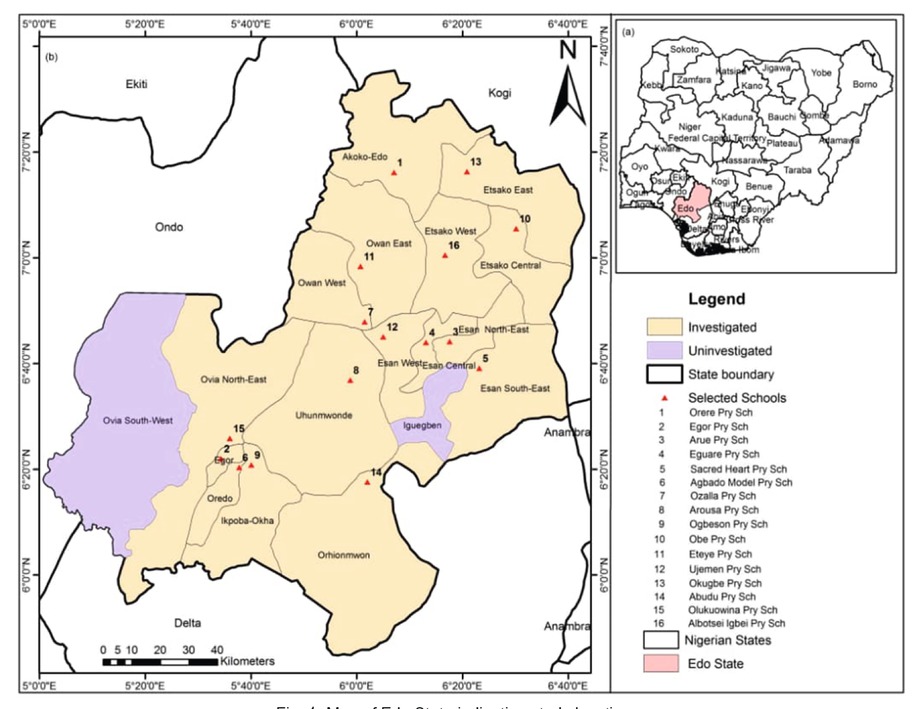
Fig. 1
Map of Edo State indicating study locations.
Table 1
Description of sampled primary schools.
| Local Government Area | Primary School | Location | Population size | State of perimeter fencing | Water facility | Toilet facility |
|---|---|---|---|---|---|---|
| Oredo | Agbado pry sch | Urban | 1240 | Fenced | Borehole | Present |
| Orhionmwon | Abudu pry sch | Rural | 918 | Not fenced | Absent | Present |
| Ovia-North-East | Olukuowina pry sch | Semi-urban | 877 | Not fenced | Absent | Present |
| Owan East | Eteye pry sch | Semi-urban | 950 | Not fenced | Absent | Present |
| Owan West | Ozalla pry sch | Rural | 1294 | Not fenced | Absent | Absent |
| Uhunwonde | Arousa pry sch | Rural | 968 | Fenced | Present | Present |
| Etsako West | Albotse Igbei pry sch | Semi-urban | 690 | Not fenced | Absent | Absent |
| Ikpobaokha | Ogbeson pry sch | Urban | 1099 | Fenced | Borehole | Present |
| Esan North-East | Arue pry sch | Semi-urban | 755 | Partial fencing | Well | Present |
| Esan Central | Eguare pry sch | Semi-urban | 940 | Fenced | Well | Present |
| Esan South-East | Sacred heart pry sch | Rural | 885 | Not fenced | Absent | Present |
| Esan West | Ujemen pry sch | Rural | 939 | Not fenced | Absent | Present |
| Etsako Central | Obe pry sch | Semi-urban | 978 | Fenced | Well | Present |
| Etsako East | Oghe-Okugbe pry sch | Rural | 720 | Fenced | Absent | Present |
| Akoko Edo | Orere pry sch | Urban | 1000 | Not fenced | Absent | Present |
| Egor | Egor pry sch | Urban | 844 | Fenced | Absent | Present |
Sample collection and processing
In this study, purposive sampling (Jarosz et al., 2010) was adopted in selecting areas for soil collection; and as such before any decision on points of soil collection within school premises, we closely inspected these schools at periods when there were breaks from classroom activities which provides for pupils to play around. So, for each school, three locations in which children frequents either to play or carry out other activities were considered for soil collections. Soil samples were collected at three points within each primary school premises twice a month (first and last week of the month) for a six-month period in both dry (January, February and March) and wet (May, June and July) seasons in 2018 and early 2019. We ensured that all-through the period of collection, 100 – 200 g of samples were obtained on same spots within a 5 m radius at 2 – 3 cm depth and preserved at room temperature until needed for parasitological investigation. Soil samples were dried, filtered and weighed to obtain 2 g. Different techniques were used: modified Baermann’s (soil samples were suspended in distilled water for 24hrs before examination) and flotation (sucrose solution) methods to obtain eggs and larvae. For the sucrose solution method, faecal samples were first mixed with distilled water, and sieved into tubes to remove large particulates before they were concentrated by centrifugation and decanted. Thereafter, tubes containing the concentrates were refilled with sucrose solution and cover slips placed on the surface of the tubes. Floated eggs/ larvae sticks to the surface of the cover slips and these slips are then placed on slides and examined under the microscope (Foreyt, 2001). Using appropriate keys, recovered parasites were identified and also quantified (number of parasites per 2 g of soil) (Horiuchi & Uga, 2013).
Statistical analysis
ANOVA was applied to test differences in monthly variation, while student t-test compared variations between seasons for prevalence and parasite density data. Post hoc analysis using New-man-Keuls multiple comparison test was applied to the data on monthly Strongyloides density for the dry season. Differences in mean values were significant at p<0.05. All analysis was done using GraphPad Prism version 5.01.
Ethics approval and/or Informed Consent
Not applicable.
Results
A total of 576 soil samples were collected in both dry and wet seasons. Four soil parasites were recovered with the following prevalence: Ascaris 127(22 %); Strongyloides 111(19.27 %); hookworm 50(8.68 %) and Trichuris 5(0.86 %). In the dry season, mean values of positive samples was lowest in January (1.87 ± 0.38) and highest in February (3.75 ± 051) as difference in mean values was significant (F=3.65; p<0.05). In contrast, mean values for the wet season months was not significant (F=0.73; p>0.05). The frequency of positive samples in the dry (2.95 ± 0.3) season was higher than in the wet (3.66 ± 0.29) but mean difference not significant (t=1.61; p>0.05). Of note is the highest number of positive samples recorded in Esan Central and lowest in Owan East. More than 50 % of the total numbers of soil samples were parasite-positive. The least number of positive soil samples were recorded in the month of January, while July samples had the highest number of positives (Table 2).
A total of six parasites were recovered from soil sampled in both seasons, with Ascaris being most preponderant in the dry followed by Strongyloides and hookworm (Table 3). Meanwhile, in the wet season, Strongyloides was the most frequently seen followed by Ascaris and hookworm (Table 4). The frequency of occurrence of hookworm in the wet season was higher than in the dry. Trichuris parasites were relatively scanty in both seasons.
Nine schools had higher Ascaris load in the dry than wet, while seven schools were higher in the wet. Specifically, Ascaris density was highest in Etsako Central (0.5 parasite/2 g soil), while in the dry, Etsako West was highest (0.44 parasite/2 g soil) (Fig. 2). The overall mean difference in the Ascaris ova density between dry (0.166 ± 0.027/2 g soil) and wet (0.14 ± 0.037/2 g soil) was marginal (95 % CI: -0.078 to 0.11; t=0.36; p>0.05). For Strongyloides, twelve of the sites had higher load in the wet than dry season. So far, no positive sample was recorded in one of the primary schools in the wet, while in one study location, the parasite load was same. Only two study locations recorded higher load in the dry than wet (Fig. 3). During the wet season, parasite larvae load was highest in Orhionmwon (0.55 parasite/2 g soil), while in the dry, it was highest in Esan South-East (0.44 parasite/2g soil) (Fig. 2). In the dry season, parasite load was significantly reduced in the month of January; and by post hoc analysis, significant difference was between January and February (q=3.69). The overall mean difference between dry (0.1 ± 0.027/2g soil) and wet (0.26 ± 0.44/2g soil) was significant (95 %CI: -0.27 to -0.059; t=3.19; p<005). For hookworm, of the sixteen (16) sites sampled, only five (5) were positive in the wet season, while twelve (12) sites were positive in the dry. Hookworm ova density in the wet season was highest in Esan West (0.27parasite/2g soil), while in the dry, it was highest in Esan North-East (0.22 parasite/2g soil) (Fig. 4). Meanwhile, overall mean difference between dry (0.076 ± 0.016/2g soil) and wet (0.04 ± 0018/2g soil) was not significant (95 %CI=-0.015 to 0.087; t=1.44; p>005).
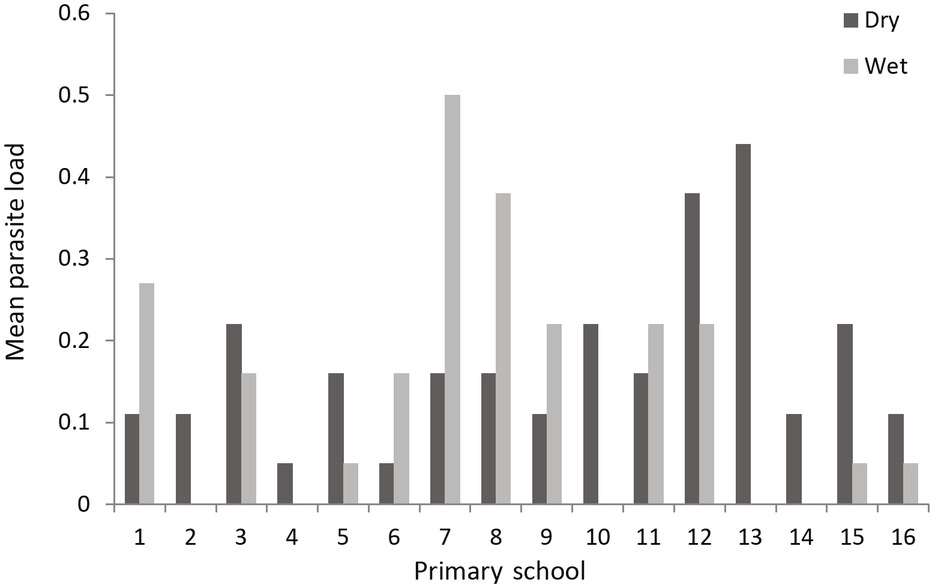
Fig. 2
Seasonal variations with Ascaris density.
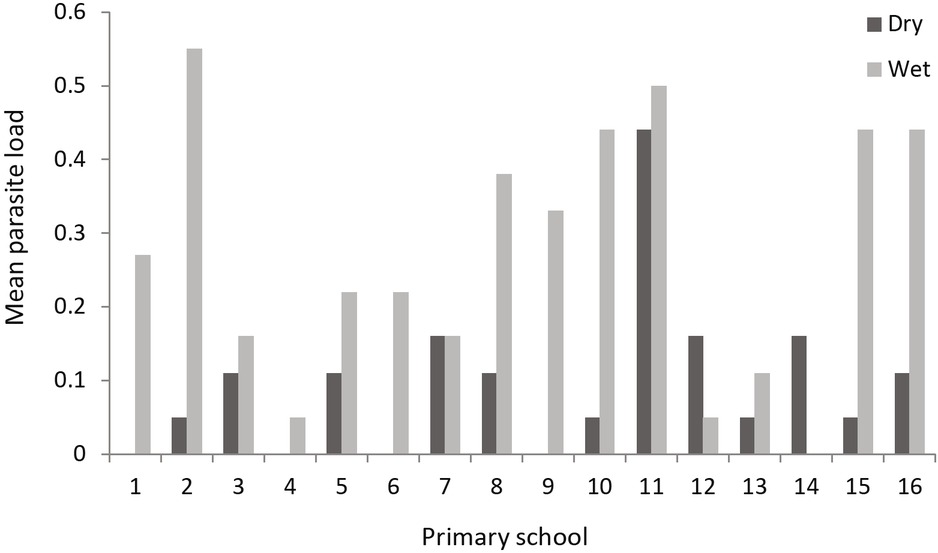
Fig. 3
Seasonal variations with Strongyloides density.
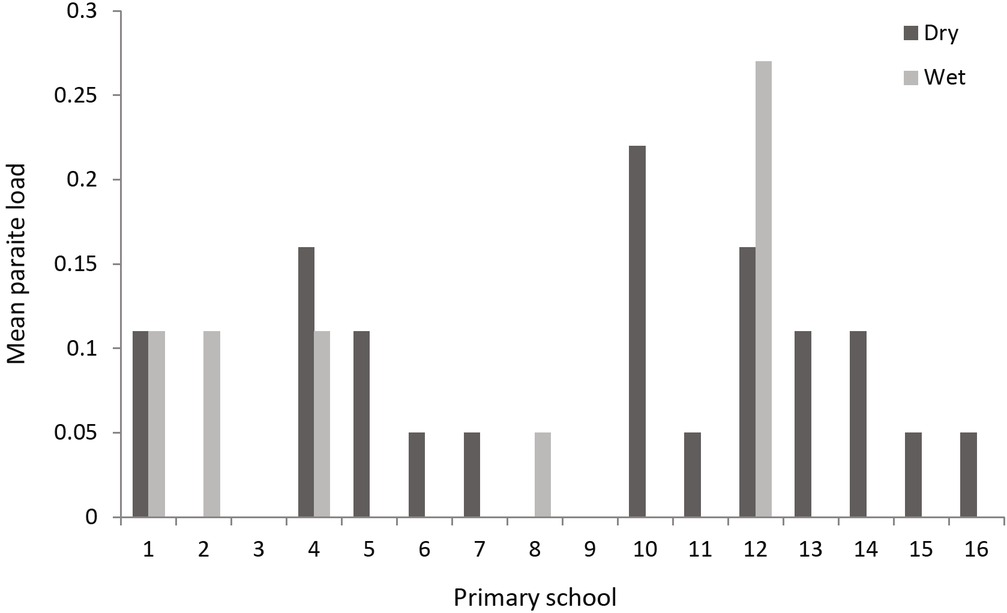
Fig. 4
Seasonal variations with hookworm density.
Discussion
Most of the efforts by WHO to break the cycles of STH transmission is primarily focused on mass drug administration but has posited that this goal is not achievable without deploying environmental measures to interrupt acquisition of new infections (Anderson et al., 2014; Truscott et al., 2014). Identification and estimating soil parasites burden could be in part the first step towards achieving this goal as information on the profile of dominant soil parasites in any locality could be useful in a complementary manner in planning an effective and sustainable preventive and control programme. More than half of the samples collected were positive of
Table 2
Frequency of occurrence of parasite-positive soil samples across primary school playground during the dry and wet seasons.
| Local Government Area | Primary school | Positive soil sample (dry season) | Total | Positive soil sample (wet season) | Total | Grand total | ||||
| January | February | March | n(%) | May | June | July | n(%) | N(%) | ||
| Oredo | Agbado pry sch | 2 | 0 | 6 | 8(44.44) | 6 | 4 | 6 | 16(88.88) | 24(66.66) |
| Orhionmwon | Abudu pry sch | 0 | 6 | 2 | 8(44.44) | 6 | 6 | 2 | 14(66.66) | 22(61.11) |
| Ovia-North East | Olukuowina pry sch | 2 | 6 | 0 | 8(44.44) | 2 | 4 | 6 | 12(66.66) | 20(55.55) |
| Owan East | Eteye pry sch | 2 | 4 | 0 | 6(33.33) | 4 | 0 | 2 | 6(33.33) | 12(33.33) |
| Owan West | Ozalla pry sch | 4 | 6 | 2 | 12(66.66) | 4 | 0 | 6 | 10(55.55) | 22(61.11) |
| Uhunwonde | Arousa pry sch | 0 | 0 | 2 | 2(11.11) | 2 | 6 | 2 | 10(55.55) | 12(33.33) |
| Etsako West | Albotse Igbei pry sch | 2 | 4 | 4 | 10(55.55) | 4 | 4 | 4 | 12(66.66) | 22(61.11) |
| Ikpobaokha | Ogbeson pry sch | 0 | 4 | 6 | 10(55.55) | 4 | 2 | 6 | 12(66.66) | 22(61.11) |
| Esan North- East | Arue pry sch | 2 | 4 | 0 | 6(33.33) | 6 | 2 | 6 | 14(77.77) | 20(55.55) |
| Esan Central | Eguare pry sch | 4 | 4 | 6 | 14(77.77) | 6 | 4 | 4 | 14(77.77) | 28(77.77) |
| Esan South-East | Sacred heart pry sch | 2 | 6 | 2 | 10(55.55) | 2 | 4 | 6 | 12(66.66) | 22(61.11) |
| Esan West | Ujemen pry sch | 4 | 4 | 2 | 10(55.55) | 2 | 4 | 6 | 12(66.66) | 22(61.11) |
| Etsako Central | Obe pry sch | 4 | 4 | 6 | 14(77.77) | 0 | 4 | 2 | 6(33.33) | 20(55.55) |
| Etsako East | Oghe-Okugbe pry sch | 0 | 4 | 6 | 10(55.55) | 0 | 0 | 0 | 0 | 0 |
| Akoko Edo | Orere pry sch | 2 | 0 | 2 | 4(22.22) | 6 | 6 | 4 | 16(88.88) | 20(55.55) |
| Egor | Egor pry sch | 0 | 4 | 6 | 10(55.55) | 4 | 2 | 4 | 10(55.55) | 20(55.55) |
| Total | 30(31.25) | 60(62.5) | 52(54.16) | 142(49.3) | 58(60.41) | 52(54.16) | 66(68.75) | 176(61..11) | 318(55.2) | |
[i] [n(%); n= number of positive samples by season; %= percentage of positive samples against total number of collected samples by season]; [N(%); N=total number of positive samples for both wet and dry seasons; %=percentage of positive samples against total number of collected samples in both dry and wet seasons]
Table 3
Prevalence of soil parasites in the dry season.
| Positive soil sample | Parasites | ||||||||
| Local Government Area | Primary school | January | February | March | Ascaris (ova) n(%) | Strongyloides (larvae) | Hookworm (ova) n(%) | Trichuris (ova) n(%) | |
| 1 | - | - | Hookworm | ||||||
| Oredo | Agbado pry sch | 2 | - | - | Ascaris | 2(11.11) | - | 4(22.22) | - |
| 3 | - | - | Hookworm; Ascaris | ||||||
| 1 | - | Ascaris | - | ||||||
| Orhionmwon | Abudu pry sch | 2 | - | - | Ascaris | 3(16.66) | 3(16.66) | - | - |
| 3 | - | Strongyloides | - | ||||||
| 1 | - | Strongyloides | - | ||||||
| Ovia North-East | Oluku Owina pry sch | 2 | - | Strongyloides; Ascaris | - | 4(22.22) | 4(22.22) | - | - |
| 3 | Ascaris | Ascaris | - | ||||||
| 1 | Hookworm | Hookworm | - | ||||||
| Owan East | Eteye pry sch | 2 | - | - | - | 2(11.11) | - | 4(22.22) | - |
| 3 | - | Ascaris; Hookworm | - | ||||||
| 1 | - | Strongyloides; Hookworm | - | ||||||
| Owan West | Ozalla pry sch | 2 | Ascaris | Hookworm | - | 5(27.77) | 3(16.66) | 2(11.11) | - |
| 3 | Ascaris | Ascaris; Strongyloides | Ascaris | ||||||
| - | |||||||||
| 1 | - | - | - | ||||||
| Uhunwonde | Arousa pry sch | 2 | - | - | - | 1(5.55) | - | 1(5.55) | - |
| 3 | - | - | Ascaris; Hookworm | ||||||
| 1 | - | - | - | ||||||
| Etsako West | Aibotse Igbei pry sch | 2 | - | Ascaris | Strongyloides; Hookworm | 4(22.22) | 4(22.22) | 2(11.11) | - |
| 3 | Ascaris | Ascaris | Strongyloides | ||||||
| 1 | - | Ascaris | Strongyloides | ||||||
| Ikpobaokha | Obeson pry sch | 2 | - | Ascaris | Ascaris | 7(38.88) | 3(16.66) | - | - |
| 3 | - | - | Ascaris | ||||||
| 1 | - | Trichuris | - | ||||||
| Esan North- East | Arue pry sch | 2 | - | Ascaris | - | 4(22.22) | - | - | 2(11.11) |
| 3 | Ascaris | - | - | ||||||
| 1 | Hookworm | Hookworm | Strongyloides | ||||||
| Esan Central | Eguare pry sch | 2 | - | Hookworm | Ascaris | 7(38.88) | 3(16.66) | 4(22.22) | - |
| 3 | Ascaris | - | Ascaris | ||||||
| 1 | Hookworm | Strongyloides | - | ||||||
| Esan South-East | Sacred heart pry sch | 2 | - | Strongloides | - | 4(22.22) | 4(22.22) | 2(11.11) | - |
| 3 | - | Ascaris | Ascaris | ||||||
| 1 | Ascaris; Strogyloides | - | - | ||||||
| Esan West | Ujemen pry sch | 2 | - | Strongyloides | - | 4(22.22) | 3(16.66) | 3(16.66) | - |
| 3 | Ascaris | Hookworm | Hookworm; Ascaris | ||||||
| 1 | - | Hookworm | Strongyloides | ||||||
| Etsako Central | Obe pry sch | 2 | Ascaris | Ascaris | Ascaris | 10(55.55) | 2(11.11) | 2(11.11) | - |
| 3 | Ascaris | - | Ascaris | ||||||
| 1 | - | Hookworm | Strongyloides | ||||||
| Etsako East | Oghe-Okgbe pry sch | 2 | - | - | Strongyloides | 2(11.11) | 5(27.77) | 3(16.66) | - |
| 1 | - | Ascaris; Hookworm - - | Strongyloides - | ||||||
| Akoko-Edo | Orere pry sch | 2 | Hookworm; Ascaris | - | Strongyloides | 1(5.55) | 2(11.11) | 1(5.55) | |
| 3 | - | - | - | - | |||||
| 1 | - | Strongyloides | Ascaris | ||||||
| Egor | Egor pry sch | 2 | - | Strongyloides | Hookworm | 3(16.66) | 5(27.77) | 2(11.11) | - |
| 3 | - | - | Ascaris; Strongyloides | ||||||
| Total N(%) | 70(24.3) | 41(14.26) | 30(1.04) | 1(0.34) | |||||
[i] [n(%); n=number of samples positive for respective parasite in each primary school; %=percentage of samples positive for respective parasites in each primary school against total number of collected samples in the surveyed primary school); [N(%); N=total number of samples positive for respective parasite across the sixteen primary schools; %= percentage of samples positive for respective parasite across the sixteen primary schools against the total number of collected soil samples in the sixteen primary schools]
Table 4
Prevalence of soil parasites in the wet season.
| Local Government Area | Primary school | Positive soil sample | Parasites | |||||||
| May | June | July | Ascaris (ova) n(%) | Strongyloides (larvae) | Hookworm (ova) n(%) | Trichuris (ova) n(%) | ||||
| 1 | Ascaris; Strongyloides | Ascaris | Strongyloides | |||||||
| Oredo | Agbado pry sch | 2 | Hookorm | Strongyloides | Hookworm | 3(16.66) | 7(38.88) | 6(33.33) | - | |
| 3 | Hookworm | - | Strongloides; Ascaris | |||||||
| 1 | Strongyloides; Hookworm | Strongyloides | ||||||||
| Orhionmwon | Abudu pry sch | 2 | Strongyloides | Hookworm | Strongyloides | - | 10(55.55) | 2(11.11) | - | |
| 3 | Strongloides | Strongyloides | - | |||||||
| 1 | - | - | Strongyloides; Ascaris | |||||||
| Ovia North-East | Oluku Owina pry sch | 2 | Ascaris | Ascaris | - | 5(27.77) | 2(11.11) | 2(11.11) | - | |
| 3 | - | - | Hookworm | |||||||
| 1 | - | - | - | |||||||
| Owan East | Eteye pry sch | 2 | Hookworm | - | _ | _ | 2(11.11) | 1(5.55) | _ | |
| 3 | Strongyloides | - | - | |||||||
| 1 | Ascaris | - | Strongyloides | |||||||
| Owan West | Ozalla pry sch | 2 | Strongyloides | - | Strongyloides | 3(16.66) | 5(27.77) | - | - | |
| 3 | - | - | - | |||||||
| 1 | - | Ascaris | - | |||||||
| Uhunwonde | Arousa pry sch | 2 | - | Ascaris | - | 4(22.22) | 4(22.22) | - | - | |
| 3 | - | Strongyloides | Strongyloides | |||||||
| 1 | - | Strongyloides | Ascaris | |||||||
| Etsako West | Aibotse Igbei pry sch | 2 | Ascaris | - | Ascaris | 5(27.77) | 3(16.66) | - | - | |
| 3 | Ascaris | Strongyloides | - | |||||||
| 1 | Ascaris | - | Ascaris; Strongyloides | |||||||
| Ikpobaokha | Obeson pry sch | 2 | Ascaris | Ascaris | Strongyloides; Hookworm | 7(38.88) | 4(22.22) | 1(5.55) | - | |
| 3 | - | Ascaris | - | |||||||
| 1 | Strongyloides; Ascaris | - | Strongyloides; Ascaris | |||||||
| Esan North- East | Arue pry sch | 2 | Ascaris | Trichuris; Strongyloides | Strongyloides; Ascaris | 7(38.88) | 6(33.33) | - | 1(5.55) | |
| 3 | Ascaris | - | Strongyloides | |||||||
| 1 | Strongyloides | Strongyloides | - | |||||||
| Esan Central | Eguare pry sch | 2 | Strongyloides; Hookworm | - | Strongyloides | 2(11.11) | 7(38.88) | 2(11.11) | 3(16.66) | |
| 3 | Trichuris; Ascaris | Trichuris | Strongyloides | |||||||
| 1 | - | - | Strongyloides | |||||||
| Esan South-East | Sacred heart pry sch | 2 | Ascaris | Ascaris | Strongyloides | 6(33.33) | 4(22.22) | 2(11.11) | - | |
| 3 | - | Ascaris | Strongyloides | |||||||
| 1 | - | Strongyloides | Ascaris; Hookworm | |||||||
| Esan West | Ujemen pry sch | 2 | - | - | Ascaris | 5(27.77) | 3(16.66) | 4(22.22) | - | |
| 3 | Hookworm | Hookworm | Ascaris | |||||||
| 1 | - | - | - | |||||||
| Etsako Central | Obe pry sch | 2 | - | Strongyloides | - | 2(11.11) | 3(16.66) | - | - | |
| 3 | - | Ascaris | - | |||||||
| 1 | - | - | - | |||||||
| Etsako East | Oghe-Okgbe pry sch | 2 | - | - | - | - | - | - | - | |
| 3 | - | - | - | |||||||
| 1 | Ascaris | Ascaris | - | |||||||
| Akoko-Edo | Orere pry sch | 2 | - | Strongyloides | Strongyloides | 6(33.33) | 8(44.44) | - | - | |
| 3 | Strongyloides | Strongyloides | Strongyloides | |||||||
| 1 | - | - | - | |||||||
| Egor | Egor pry sch | 2 | - | - | - | 2(11.11) | 2(11.11) | - | - | |
| 3 | Ascaris | - | Strongyloides | |||||||
| Total N(%) | 57(19.79) | 70(24.3) | 20(6.94) | 4(1.38) | ||||||
[i] [n(%); n=number of samples positive for respective parasite in each primary school; %=percentage of samples positive for respective parasites in each primary school against total number of collected samples in the surveyed primary school); [N(%); N=total number of samples positive for respective parasite across the sixteen primary schools; %= percentage of samples positive for respective parasite across the sixteen primary schools against the total number of collected soil samples in the sixteen primary schools]
one or more parasites as this could be an indication of the level of soil contamination. In January, positive samples were at the lowest but increased in subsequent months. In the state, usually in the month preceding January (December), there are no rains, while in February and March, the state experiences both its first and in some areas, the second rainfall for the year. Meanwhile, by May, the rainy season fully commences and peaks in July. Rainfall comes with high humidity and lower temperatures (23 and 30°C) and these conditions favour the presence and development of soil parasites (Brooker et al., 2006), while temperatures from 35°C and above which is often the case in December and January could potentially disintegrate parasites (Rocha et al., 2011; Steinbaum et al., 2016). Further, in these areas, improper disposal of human and animal faeces is common practice because a majority of these communities where these schools are located lack proper drainage and waste disposal systems. Therefore, when it rains and get flooded, most of these playgrounds could receive faecal-contaminated water from the surrounding environment, partly influencing the rise in the prevalence of STH eggs and larvae on playgrounds (Echazu et al., 2015).
The predominant parasites in these areas were Ascaris, Strongyloides and hookworm, while the occurrence of Trichuris was relatively scanty. So we believe that one of the sources of soil contamination with STHs in these playgrounds may have been through open defecation from pupils and inhabitants of respective host communities living close to the school premises. Pit-toilet type was seen in all the schools and shared by pupils. Many pupils have apathy towards the use of a common toilet facility due to it often unhygienic state as they are poorly managed. A report has shown that shared latrines are likely to be dysfunctional, less clean and have flies and faeces littered; and that people who shared latrines were more likely to practice open defecation (Heijnen et al., 2015). Another source of contamination could be as a result of lack/partial perimeter fencing, whereby animals could freely move into and out of the school premises and defecate. Coprophagia of human faeces by dogs increases the possibility of transporting STH eggs into the playground as sticky-coated Ascaris egg might adhere to the dog’s coat for relatively longer period (Nonaka et al., 2011; Traub et al., 2002). Aside being reservoir hosts, the role of dogs in the transmission cycle of Ascaris has been suggested (Shalaby et al., 2010). However, it is difficult to differentiate S. steroralis larvae, hookworm eggs and larvae as well as T. vulpis eggs from the human-infecting STH species deposited possibly by dogs on the playgrounds. Whichever the case, any of these parasites can potentially cause human infection. Meanwhile, a survey of the intestinal parasites of sheep, goat, cattle and dogs across the states possibly indicate high incidence of zoonotic parasites and these could be of public health importance to these children (unpublished data) as reported elsewhere (Shalaby et al., 2010; Areekul et al., 2010; Steinbaum et al., 2019; Pipikova et al., 2017). The prevalence and load of Ascaris and hookworm between the dry and wet seasons were similar; while for Strongyloides, positive samples were higher in the wet than dry. So seasonal variation in parasite’s prevalence and burden demonstrates period of higher or lower risk of infections as well as changes that may have occurred to the source(s) of contamination over time (Wong & Bundy, 1990). The optimal conditions for S. stercoralis to thrive in an environment include soil temperatures between 20 to 28ºC and high moisture; which is likely the case during the wet seasons in most parts of southern Nigeria as larvae dies rapidly under unfavourable conditions. However, evidence has shown that geographical and climatic conditions are not the primary factors determining the disease presence but rather the level of infrastructural facility, sanitation and socioeconomic status; and as such, strongyloidiasis is recently referred to as: ‘’a disease of disadvantage and poor sanitation’’ (Beknazarova et al., 2016). The overall sanitary conditions as well as the state of the infrastructural facilities in most of the schools are poor; but specifically, these primary schools (Abudu and Sacred heart) with relatively high load of Strongyloides lacked perimeter fencing.
Detection of STHs in children playground suggests that children exposure to the soil poses substantial health risk. Geophagy is widespread among school children and not limited to toddlers, infants and pregnant women; and this habit has been associated with STH infections (Wong et al., 1991; Geissler et al., 1998; Saathoff et al., 2002; Nchito et al., 2004). In a study, 46 % of geophagus school children carried out this activity at break hours in school (Geissler et al., 1998). Regardless of the season, by the mean parasite load for Ascaris and Strongyloides, children who practise geophagy are likely to ingest STH eggs/larvae; but infection may not be as frequent as when a higher parasite load is recorded (Steinbaum et al., 2016). In addition, some children that are not habitually geophagous, are equally at risk of infection because often time after play they were seen eating their snacks or other food items without strictly observing hand hygiene (personal observation). Further, in all the schools during break period, many of the boys often play in the open field (mainly football) without footwear so as to ease movement. Therefore, this risk behaviour further exposes these children to hookworm and Strongyloides infections.
The soil parasites recovered from designated points in the study locations may not be a complete reflection of the reported parasite profile as soil texture could affect egg recovery efficiency (Steinbaum et al., 2017). The flotation technique (sugar solution) used in this study is known to distort STH eggs and make microscopic identification difficult (Ayres & Mara, 1996). Also, identifying eggs in soil samples is challenging as soil contain different life stages of STH eggs. Worthy of note is that the rhabditiform larvae of S. stercoralis are morphologically similar to those of some free-living nematodes and it is possible that in some cases misidentification may have occurred. In future, molecular techniques should be used so that parasites are identified at species level as this could determine the extent to which these playgrounds are contaminated with human or zoonotic parasites.
Of the four soil parasites isolated (Ascaris, Strongyloides, hookworm and Trichuris), Ascaris was most dominant in the dry season while Strongyloides in the wet. The intensity of Strongyloides was higher in the wet than dry but not significant for other parasites. Clearly, schoolchildren in all the sampled areas across the state are substantially at risk of acquiring soil parasites; and we believe that the profile of parasites in Edo State public primary schools may be similar to other states in southern Nigeria as they have similar climatic conditions and possibly similar sanitary status. If sanitary conditions and the state of infrastructure remain unchanged, interrupting the cycle of infection would be daunting. To our knowledge, intervention programmes like preventive chemotherapy (WHO, 2006) within the context of mass drug administration has not been organised or implemented for Edo State and effectively in many parts of southern Nigeria. We cannot evidently provide reasons why such schemes have not been stepped down to heavily endemic regions like Edo State; but we sense a lack of political-will to push for this kind of programme. In any case, by this communication, we strongly advocate that relevant authorities and agencies should make efforts to implement this laudable project within the state and indeed in southern Nigeria as there are huge benefits (Bleakley, 2009). We also recommend that there should be significant improvement in the sanitary/water facilities in public primary schools including engaging in continuous education/enlightenment programme that strongly emphasise strict compliance to personal and environmental hygiene.
Acknowledgements
We thank the schools’ management for granting permission to collect soil samples. We acknowledge the work of Mr B.E. Daukere of the Department of Geography and Environmental Management, Ahmadu Bello University, Zaria, Nigeria for helping with the design of the map.