Introduction
Long-duration exposure to microgravity during spaceflight results in pronounced skeletal deconditioning, characterized by reductions in bone mineral density, altered trabecular architecture, and increased fracture risk (Lang et al., 2006; Vico and Hargens, 2018). These changes arise primarily from an uncoupling of bone remodeling, in which osteoclast-mediated resorption exceeds osteoblast-mediated formation (Smith et al., 2012). Although resistive exercise and nutritional countermeasures mitigate some aspects of skeletal loss, they do not fully prevent it, particularly during extended missions, motivating continued exploration of complementary biological strategies.
Plants are integral components of bioregenerative life-support systems for human space exploration, providing food, oxygen regeneration, carbon dioxide removal, and psychological benefits (Wheeler, 2010). Beyond their role as nutritional crops, plants synthesize diverse secondary metabolites whose production and partitioning are sensitive to environmental conditions, including altered gravity (Paul et al., 2013; Zabel et al., 2016). Many of these compounds, particularly phenolics and phytoestrogens, exhibit biological activity in mammalian systems and have been shown to influence bone cell function in vitro and in vivo (Setchell and Lydeking-Olsen, 2003; Weaver et al., 2005).
Recent multi-omic analyses in rodents and humans indicate that spaceflight alters estrogen signaling pathways, underscoring endocrine regulation as a medically relevant component of spaceflight physiology; notably, estrogen-related receptor signaling (e.g., ESRRA) can be responsive to phytoestrogens such as genistein, supporting continued interest in diet-derived estrogenic compounds as candidate countermeasure targets (Mathyk et al., 2024).
A growing body of spaceflight and ground-based analog studies demonstrate that altered gravity environments reliably modify plant growth and morphology, typically reducing biomass accumulation and altering root system architecture, while leaving core developmental programs intact (Kiss et al., 2019; Wuest et al., 2015). Increasingly, attention has shifted from growth responses alone toward understanding how altered gravity affects plant metabolic regulation. Transcriptomic and biochemical analyses indicate that spaceflight and simulated microgravity activate stress-responsive signaling pathways, including redox regulation and phytohormone signaling, which in turn influence secondary metabolism (Jiao et al., 2004; Paul et al., 2013). Importantly, these responses are often interpreted as reflecting metabolic reprogramming rather than generalized suppression, with specific compound classes being redistributed or differentially conjugated.
Consistent with gravity-sensitive secondary metabolism, simulated microgravity has also been reported to increase isoflavone concentrations in legume sprouts (including ~2-fold increases under some conditions) and to modulate extract bioactivity in human cell models, reinforcing the finding that that altered-gravity growth histories can influence biologically relevant plant chemical outputs (Grudzińska et al., 2024).
Legumes are of particular interest in this context due to their capacity to synthesize isoflavonoids and related phenylpropanoid compounds with established bioactivity in mammalian bone metabolism. Spaceflight experiments with soybeans have demonstrated gravity-dependent, tissue-specific redistribution of isoflavone glycosides and malonylated derivatives, rather than uniform changes in whole-plant concentrations (Levine et al., 2001). Ground-based clinostat and random positioning machine studies reproduce key aspects of these responses, supporting their utility as analog systems for probing gravity-regulated secondary metabolism despite known physical limitations (Herranz et al., 2013).
The relevance of such metabolic shifts extends beyond plant physiology to potential countermeasures for skeletal unloading. In terrestrial hindlimb-unloading models, dietary soybean isoflavones attenuate bone loss and modulate markers of osteoclast and osteoblast activity, indicating functional relevance under conditions of mechanical disuse analogous to microgravity (Sugiyama et al., 2006; Tousen et al., 2020). These findings raise the possibility that plants grown under altered gravity conditions may retain biologically relevant secondary metabolite activity even when growth is suppressed.
Medicago truncatula is a well-established model legume with a sequenced genome, extensive genetic resources, and a characterized repertoire of phenolic and isoflavonoid metabolites. Previous studies demonstrate that simulated microgravity alters plant morphology, hormone signaling, and stress responses in legumes, yet the functional consequences of these changes for plant-derived bioactivity remain poorly resolved, particularly in the context of bone-relevant mammalian cell models.
The present study aims to evaluate the effects of clinostat-modeled microgravity on M. truncatula growth and to determine whether gravity history influences the bioactivity of plant extracts on mammalian bone cell models. By integrating quantitative plant growth measurements with in vitro assays of osteoclast precursor and osteoblast-like cell responses, this work adopts a functional, outcome-focused approach to assess whether simulated microgravity alters integrated plant metabolic output in a biologically meaningful manner. Rather than quantifying individual metabolites, this study seeks to establish whether altered gravity conditions modify the net bioactivity of plant extracts relevant to skeletal remodeling under unloading conditions associated with spaceflight.
Materials and Methods
Environmental growth conditions
All experiments were conducted in controlled environment chambers under standardized conditions following procedures described by Hayes et al. (2014). Plants were grown in a controlled environment chamber (Environmental Growth Chambers (EGC), Chagrin Falls, OH, USA) maintained at 22 °C with relative humidity set to 50% and ambient CO2 concentrations. A 16 h light / 8 h dark photoperiod was used, with photosynthetically active radiation (PAR) maintained at 200 μmol m−2 s−1 at the canopy level resulting in a daily light integral (DLI) of 11.5 mol d−1. Illumination was provided by GE F96T8/SPX41/HO fluorescent lamps. Growth conditions were held constant throughout the experimental period to minimize environmental variability across treatments.
Sterilized, scarified M. truncatula (10 per plate) were aseptically transferred onto 20 ml of sterile Murashige Skoog (MS) media in 60 mm x 15 mm Petri dishes sealed with Parafilm, which was punctured with a sterile needle to allow gas exchange. Seedlings were grown either under stationary 1g (static) or simulated microgravity (clinostat) using a 2-D clinostat-based rotation system designed to minimize the directional gravity vector (Figure 1).
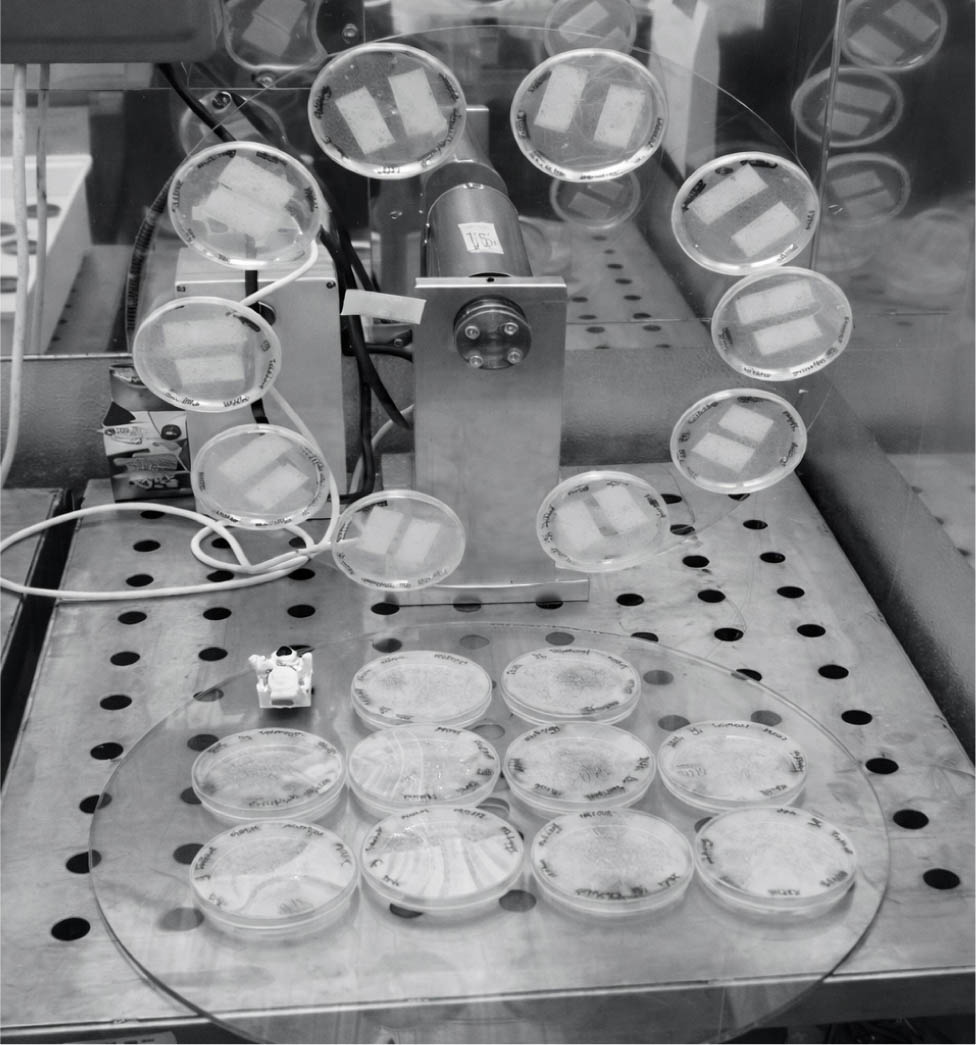
Figure 1.
Two-dimensional clinostat system positioned with a controlled environment chamber (EGC M-48, Environmental Growth Chamber, Chagrin Falls, OH, USA). M. truncatula seeds were placed at the center of each petri dish containing Murashge and Skoog (MS) medium and mounted on the rotating clinostat plate to simulate microgravity conditions, while identical controls were maintained within the same chamber (foreground) under identical environmental conditions.
2-D Clinostat simulated microgravity treatments
The clinostat was operated at 1 rpm using the same mounting geometry and plate-holding hardware previously employed in related experiments (Hayes et al., 2014; Stutte and Roberts, 2026). At this rotational speed, residual loading results from centripetal acceleration rather than static gravity and was estimated for sample positions 0.10–0.14 m from the rotation axis to be approximately 1.1–1.5 × 10⁻³ m s−2 (≈1.1–1.6 × 10⁻⁴ g), corresponding to nanonewton-scale forces at the seedling level. Petri plates were secured to prevent lateral movement during rotation, but no compressive force was applied to the growth medium or biological material. Although clinorotation does not reproduce true microgravity, the magnitude of rotation-associated mechanical loading was minimal, quantifiable, and uniform across treatments.
Biometric analysis
After 14 days of growth, seedlings were harvested and evaluated for root length, shoot length, lateral root number, and fresh mass. Root and shoot lengths were measured manually using calibrated rulers, lateral roots were counted under 4X magnification (Optika Model XDS-2, Ponteranica (BG), Italy), and fresh mass was determined using an analytical balance (Model ER-120A, A&D Company, Ltd., Tokyo, Japan) immediately following harvest and stored at −20° C.
Tissue extraction
Harvested plants were flash frozen and lyophilized (Heto Power Dry 200, Thermo Electron Corp., Waltham, MA, USA), homogenized and extracted in 80% ethanol to extract secondary metabolites, centrifuged (Biofuge Statos, Thermo Electron Corp., Waltham, MA, USA) and sterile-filtered prior to use in cell-based assays. To facilitate accurate dosing and solvent control, a 10% ethanol intermediate stock was prepared from the original extract stock using sterile phosphate buffer saline solution (PBS) for storage.
Intermediate stocks were further diluted into complete culture medium to achieve final ethanol concentrations within an experimentally established tolerance range (0.04–0.12% v/v). Vehicle control wells were prepared to match the ethanol concentration of each corresponding extract dilution.
Total flavonoid content assay
Total flavonoid content was determined using a colorimetric aluminum chloride assay adapted from Zhishen et al. (1999), with modifications to accommodate sample volume and detection limits. All assays were conducted using UV–visible spectrophotometry.
Reagents were prepared as follows: a 5% (w/v) sodium nitrite (NaNO2) solution was prepared by dissolving 5 g NaNO 2 in deionized (DI) water and bringing the volume to 100 mL. A 10% (w/v) aluminum chloride (AlCl3) solution was prepared by slowly dissolving 10 g AlCl3 in DI water under a fume hood and adjusting the final volume to 100 mL. A 1 M sodium hydroxide (NaOH) solution was prepared by dissolving 40 g NaOH in 1 L of DI water. A quercetin standard stock solution (500 ppm) was prepared by dissolving 50 mg quercetin in 100 mL DI water.
Plant extracts and standards were diluted tenfold prior to analysis. For each assay, 100 μL of sample extract or quercetin standard was added to 400 μL of DI water in a 1.5 mL microcentrifuge tube. At time 0, 30 μL of 5% NaNO2 was added to each tube. After 5 min, 30 μL of 10% AlCl3 was added. At 6 min, 200 μL of 1 M NaOH was added, followed by 240 μL of DI water to bring the final reaction volume to 1.0 mL. The contents of the tubes was mixed thoroughly after each addition.
Absorbance was measured at 415 nm using a UV-visible spectrophotometer (GENESYS 10S, Thermo Fisher Scientific, Waltham, MA, USA). All samples, standards, and blanks were analyzed three times. Total flavonoid content was calculated from the quercetin standard curve and expressed as quercetin equivalents.
Total isoflavonoid content assay
Total isoflavonoid content was determined using a UV-visible spectrophotometric method modified from Downey et al. (2013). Genistein was used as the calibration standard.
A genistein stock solution (200 ppm) was prepared by dissolving 5 mg genistein (from Glycine max) in 25 mL of 80% (v/v) ethanol. Working standards ranging from 1 to 5 ppm were prepared by serial dilution of the stock solution. Absorbance of standards was measured in duplicate to generate a standard curve.
Plant extracts were diluted threefold directly in cuvettes using the same solvent system. Absorbance was measured at 260 nm using a UV-visible spectrophotometer. Isoflavonoid concentrations were calculated from the linear regression of the genistein standard curve and expressed as genistein equivalents per mg of fresh weight.
Cell lines and culture conditions
MC3T3-E1 mouse pre-osteoblast cells and RAW264.7 mouse macrophage cells (commonly used as an osteoclast precursor model) (Sudo et al., 1983) were maintained under standard mammalian cell culture conditions at 37 °C in a humidified incubator with 5% CO2.
MC3T3-E1 cells were cultured in phenol red-free α-minimum essential medium (α-MEM) supplemented with 10% fetal bovine serum (FBS), 1% penicillin-streptomycin, and 1% L-glutamine. RAW264.7 cells were cultured in Dulbecco’s modified Eagle medium (DMEM) supplemented with 10% FBS, 1% penicillin-streptomycin, and 1% L-glutamine.
Cells were routinely passaged at 70–80% confluence using trypsin-EDTA for MC3T3-E1 cells and reseeded at densities optimized for each assay as described below. Cell counts and viability were determined using trypan blue exclusion and a hemocytometer prior to seeding.
Cell proliferation and viability assays
Cell viability/proliferation was quantified using a resazurin-based colorimetric assay (PrestoBlue™). MC3T3-E1 cells were seeded at 3.0 × 10³ cells per well in 96-well plates and allowed to adhere overnight prior to treatment. RAW264.7 cells were seeded in 96-well plates under comparable short-term assay conditions and allowed to adhere overnight. Cells were exposed to plant extract dilutions, coumestrol reference treatments, or ethanol-matched vehicle controls. PrestoBlue™ (Thermo Fisher Scientific, Waltham, MA, USA) reagent was added directly to wells and incubated for 3 h at 37 °C prior to measurement of absorbance at 570 nm using a microplate reader (Thermo Fisher Scientific, Waltham, MA, USA). Signal was normalized to ethanol vehicle controls and expressed as percent control.
Osteoblast differentiation and alkaline phosphatase activity
Osteoblast differentiation was assessed in MC3T3-E1 cells using alkaline phosphatase (ALP) activity as an early differentiation marker. Cells were seeded into 24-well plates at 2.0 × 10⁴ cells per well and allowed to adhere for 24 h. Growth medium was then replaced with osteogenic differentiation medium consisting of basal culture medium supplemented with dexamethasone, ascorbic acid, and β-glycerophosphate. Differentiation medium was refreshed every third day.
ALP activity was quantified using a colorimetric p-nitrophenyl phosphate (pNPP) assay. Cells were washed with assay buffer and lysed using a Triton X-100–containing lysis buffer, and clarified lysates were collected. Fifty microliters of each lysate or ALP standard were combined with pNPP substrate solution and incubated for 30 min at 37 °C. Absorbance was measured at 405 nm using a microplate reader.
Osteogenic differentiation medium served as a positive control for ALP induction. Data are expressed as the mean of three independent experiments.
RAW264.7 cell proliferation assay
RAW264.7 mouse macrophage cells, commonly used as an osteoclast precursor model (Takayanagi et al., 2002), were used to assess the effects of plant extracts and reference compounds on cell proliferation. Cells were maintained in DMEM supplemented with 10% fetal bovine serum, 1% penicillin-streptomycin, and 1% L-glutamine at 37 °C in a humidified atmosphere containing 5% CO2.
For proliferation assays, RAW264.7 cells were seeded into 96-well plates at a density appropriate for short-term viability assessment and allowed to adhere overnight. Cells were then exposed to serial dilutions of plant extracts, coumestrol reference treatments, or ethanol-matched vehicle controls prepared as described above. Final ethanol concentrations were maintained within the previously established tolerance range to avoid solvent-induced cytotoxicity.
Cell proliferation and viability were quantified using a resazurin-based colorimetric assay (PrestoBlue™). Following treatment, PrestoBlue™ reagent was added directly to each well and incubated for 3 h at 37 °C. Absorbance was measured at 570 nm using a microplate reader.
RAW264.7 cells were not induced toward terminal osteoclast differentiation in these experiments; therefore, observed responses reflect effects on precursor cell proliferation rather than mature osteoclast activity.
Statistical analysis
All data are reported as mean ± standard deviation. Statistical analyses were performed using one-way analysis of variance (ANOVA), with significance defined as P < 0.05. All treatment groups were compared against ethanol-matched vehicle controls.
Results
Effects of Simulated Microgravity on Medicago truncatula Growth
Growth of M. truncatula seedlings was significantly reduced under clinostat-modeled microgravity relative to stationary 1g controls. After 14 days of growth, seedlings exposed to simulated microgravity exhibited decreased shoot fresh mass, reduced shoot length, shorter primary roots, and fewer lateral roots compared with 1g-grown plants (Figure 2). These effects were consistent across three independent experiments, and all measured growth parameters differed significantly between gravity treatments (p ≤ 0.001).
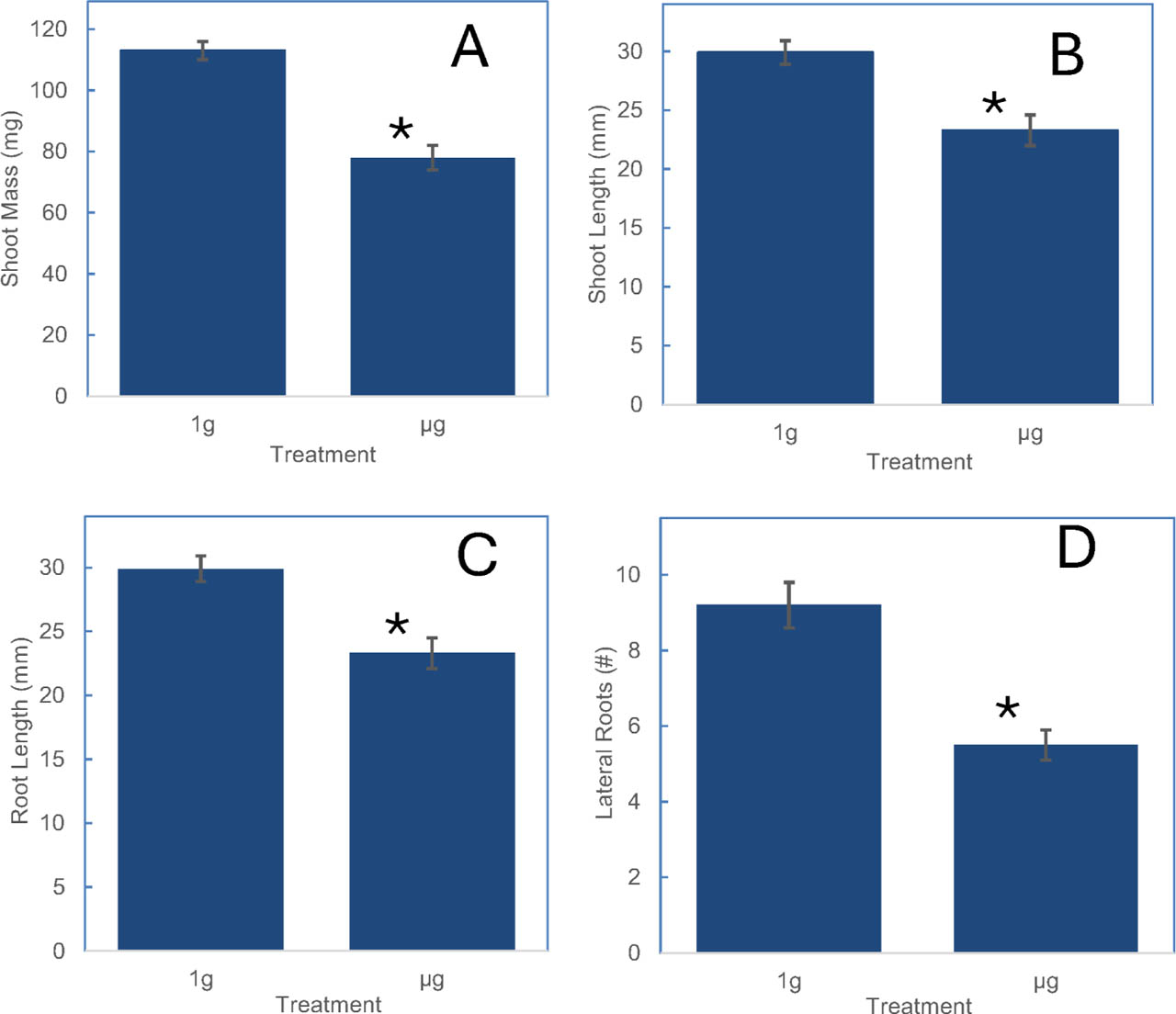
Figure 2.
Effects of simulated microgravity on growth of M. truncatula growth parameters after 14 days. The data represent (A) shoot fresh mass, (B) shoot length, (C) primary root length, and (D) number of lateral roots under stationary 1g or clinorotation (simulated μg) conditions. Data represent the mean of three independent experiments (10 seedlings per experiment). Error bars indicate standard deviation. Asterisks denote statistically significant differences (p ≤ 0.001) between 1g and simulated μg treatments.
Representative images illustrating overall seedling morphology under static and clinostat conditions are provided in Supplementary Figure S1.
Table 1.
RAW264.7 metabolic activity expressed as percentage of 0.1% ethanol control following exposure to Medicago truncatula extracts under static and clinostat conditions.
| Static | Clinostat | ||||
|---|---|---|---|---|---|
| Ethanol controls | |||||
| Dose (%) | % Control | SD | Dose (%) | % Control | SD |
| 0.1 | 100 | 3.7 | 0.1 | 100 | 3.8 |
| M. truncatula extracts | |||||
| Static | Clinostat | ||||
| Dose (ng)* | % Control | SD | Dose (ng) | % Control | SD |
| 4.9 | 58 | 1.4 | 5.4 | 56.6 | 1.2 |
| 9.8 | 53.2 | 3.5 | 10.7 | 54.3 | 2.6 |
| 14.7 | 52.3 | 2.6 | 16.5 | 51.8 | 7.2 |
| 19 | 51.8 | 4.4 | 21.4 | 40.2 | 1.6 |
Effects of simulated microgravity on flavonoid and isoflavonoid concentration
The flavonoid concentration (as quercetin equivalent) of clinostat-modeled microgravity M. truncatula was 45% higher than that of the stationary 1g control treatments on a fresh mass basis (Figure 3A).
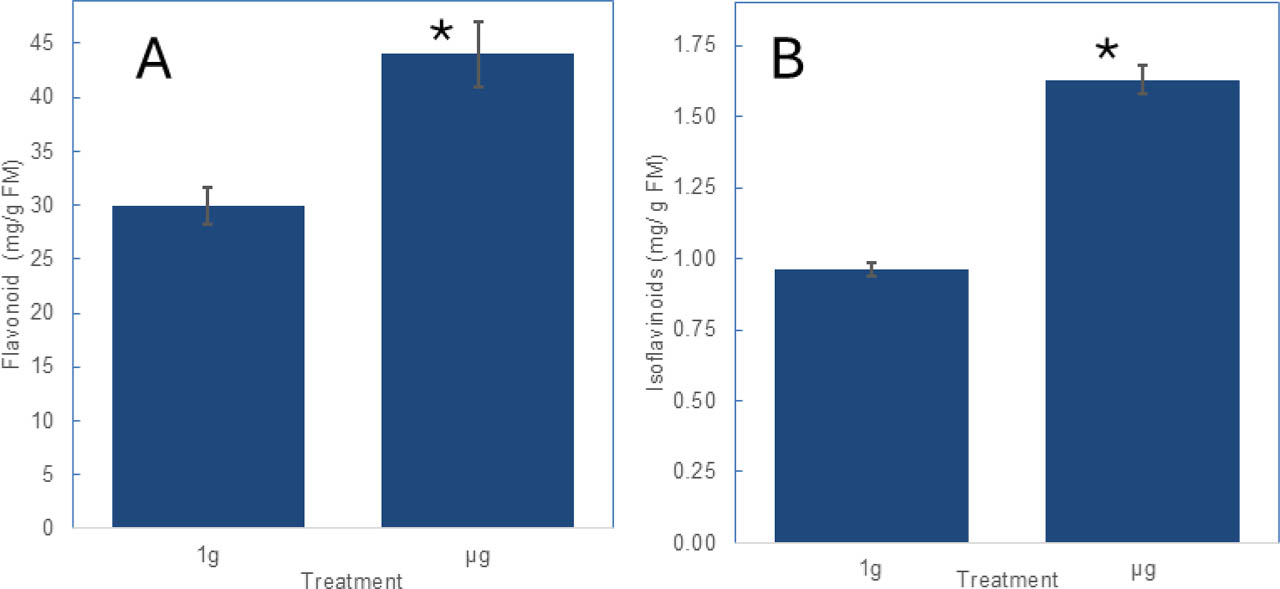
Figure 3.
Effects of simulated microgravity on M. truncatula secondary metabolite concentrations after 14 days. The data represents (A) total flavonoid concentration (mg g−1 fresh mass) as quercetin equivalents and (B) total isoflavonoid concentration (mg g−1 fresh mass) as genistein equivalents. Data represent the mean of three independent experiments (10 seedlings per experiment). Error bars indicate standard deviation. Asterisks denote statistically significant differences (p ≤ 0.05) between 1g and simulated μg treatments.
The isoflavonoid concentration (as genistein equivalents) was 64% higher in the clinostat-simulated microgravity treatment than it was when subject to the stationary 1g controls (Figure 3B). These results are consistent with prior work indicating an inverse relationship between g and secondary metabolite production (Levine et al., 2001; Downey et al., 2013; Musgrave et al., 2005).
Effects of Medicago truncatula extracts on osteoblast-like cells
Exposure of MC3T3-E1 osteoblast-like cells to ethanolic extracts derived from M. truncatula seedlings produced no detectable effects on cell proliferation under either gravity condition. Across the tested concentration range, relative cell number remained within approximately 85–100% of ethanol vehicle controls, with no consistent dose-dependent or gravity-dependent trends observed (Supplementary Table S1). Similarly, ALP activity in MC3T3-E1 cells was not significantly altered by extract exposure. Normalized alkaline phosphatase activity values remained within ~95–100% of ethanol controls for extracts derived from both static and clinostat-grown plants, and no gravity-specific or concentration-dependent effects were detected (Supplementary Table S2).
Effects of Medicago truncatula extracts on osteoclast precursor cells
RAW264.7 macrophage-lineage cells reacted differently than osteoblast-like cells to exposure to M. truncatula extracts; results showed a marked reduction in relative cell number. Extract treatment reduced RAW264.7 cell proliferation to approximately 40–60% of ethanol control values across the tested concentration range (Table 2). This inhibitory effect was observed for extracts derived from both static and clinostat-grown plants.
Table 2.
Summary of metabolic effects of Medicago truncatula ethanol extracts on bone-relevant cell models.
| Cell Line | Cell type/function | End point assessed | Observed effectx |
|---|---|---|---|
| MC3T3-E1 | osteoblast-like | Cell Proliferation (cell counts) | No detectable effect |
| MC3T3-E1 | osteoblast-like | Alkaline phosphatase activity | No detectable effect |
| RAW264.7 | osteoclast precursory | Cell Proliferation (cell counts) | ↓40–60 % relative to EtOH control |
No statistically significant differences were detected between extracts derived from different gravity histories at any concentration tested. Thus, while extract exposure consistently reduced RAW264.7 cell proliferation, the magnitude of this effect was independent of whether plants were grown under simulated microgravity or 1g conditions.
When the normalized reductions in RAW264.7 proliferation were plotted against concentration, there was a concentration dependent response for both the static and clinostat-simulated microgravity treatments (Figure 4). RAW264.7 cell proliferation decreased with increasing coumestrol equivalents of M. truncatula ethanol extracts derived from both static- and clinostat-grown seedlings (Figure 4). Absorbance at 570 nm declined modestly across the tested concentration range, from approximately 0.18 at the lowest concentration to ~0.13–0.14 at the highest concentrations. While a concentration-dependent relationship was observed for both treatments, the magnitude of the response was small over much of the range and became more apparent only at the highest coumestrol equivalents tested. Regression analysis indicated strong model fits for both treatments (R2 = 0.978 for clinostat; R2 = 0.976 for static), despite increased variability at higher concentrations.
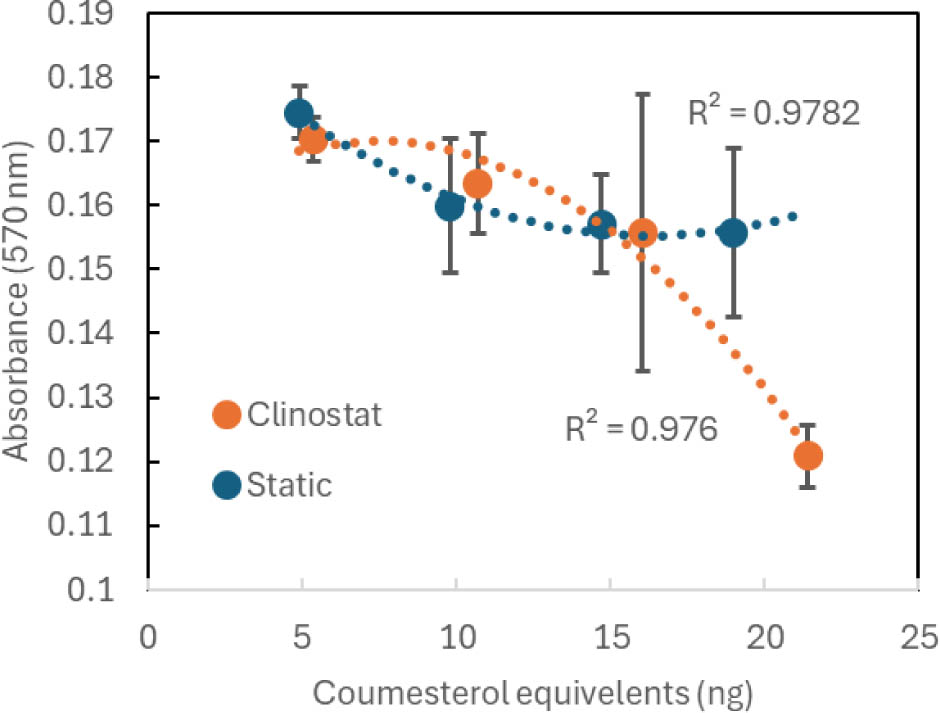
Figure 4.
RAW264.7 activity in response to the 0.1% ethanol extracts from 14-day-old M. truncatula seedlings that have been grown under static or 2-D clinostat conditions.
Summary of cell-type–specific responses
Medicago truncatula extracts exhibited cell-type selectivity, with no detectable effects on osteoblast-like cell proliferation or alkaline phosphatase activity, and a pronounced inhibitory effect on proliferation of RAW264.7 cells used as an osteoclast precursor model (Table 2). All responses were normalized to ethanol vehicle controls, and RAW264.7 cells were not induced to terminal osteoclast differentiation in these assays. When normalized to the 0.1% ethanol vehicle control, M. truncatula extracts produced no consistent or concentration-dependent change in MC3T3-E1 metabolic activity under either static or clinostat conditions, with values remaining within approximately 85–100% of control levels (Table 2).
Discussion
Simulated microgravity produced a consistent and significant suppression of M. truncatula seedling growth, including reductions in shoot length, root length, lateral root number, and fresh biomass. These responses agree with previous spaceflight and ground-based analog studies demonstrating that altered gravity reliably modifies plant growth and morphology, particularly during early development, without causing gross developmental failure. In this context, the observed growth suppression primarily serves to confirm the physiological sensitivity of M. truncatula to gravity-vector perturbation and the effective operation of the clinostat system, rather than constituting a novel biological finding.
While the present study was not designed to resolve the cellular basis of these responses, the observed phenotype is consistent with disruption of processes governing directional growth, cell expansion, and developmental patterning, (Kiss et al., 2019; Morita, 2010; Su et al., 2017; Vandenbrink et al., 2014). The reduction in seedling size may reflect changes in cell expansion, cell number, or both, and this distinction directly affects interpretation of secondary metabolite concentrations expressed on a fresh-mass basis.
Clinostat-modeled microgravity was associated with significant increases in secondary metabolite classes relevant to bone biology, with total flavonoid concentration (quercetin equivalents) increasing by approximately 45% and total isoflavonoid concentration (genistein equivalents) increasing by approximately 64% on a fresh mass basis relative to stationary 1g controls.
A simple scaling model provides a framework for interpreting these results relative to cell volume or cell number. Assuming total metabolite production per seedling remains constant, increases in measured concentration will scale inversely with biomass. The approximately 31% reduction in shoot fresh mass observed under simulated microgravity predicts a 45% increase on a fresh mass basis, which closely matches the observed increase in total flavonoids. This correspondence suggests that the elevated values can largely be explained by concentration effect associated with reduced biomass and/or cell expansion.
In contrast, the observed ~64% increase in total isoflavonoid concentration exceeds that predicted from biomass-scaling by about 19 percentage points, or approximately 13% relative to the predicted value. This discrepancy suggests that factors beyond simple concentration due to reduced biomass may contribute to the isoflavonoid response. These may include altered metabolic allocation, tissue distribution, or pathway-level regulation of isoflavonoid metabolism under simulated microgravity.
Because the present study does not include cellular or tissue-level measurements, it is not possible to distinguish among contributions from changes in cell expansion, cell number, or metabolite production. Accordingly, the scaling model provides a boundary condition for interpretation: flavonoid accumulation is consistent with biomass scaling, whereas isoflavonoid enrichment indicates an additional biological contribution beyond simple concentration effects.
This gravity-associated enrichment occurred despite an overall reduction in plant growth and is consistent with prior spaceflight and ground-based studies reporting an inverse relationship between gravitational loading and accumulation of phenylpropanoid-derived secondary metabolites (Levine et al., 2001; Musgrave et al., 2005; Downey et al., 2013).
At the pathway level, these responses align with the known responsiveness of the phenylpropanoid pathway to environmental stress. Spaceflight and simulated microgravity studies in model systems, particularly A. thaliana, demonstrate coordinated changes in gene expression across stress-response and secondary metabolic pathways, including phenylpropanoid and flavonoid biosynthesis (Paul et al., 2013; Barker et al., 2023; Zupanska et al., 2017). In parallel, studies in M. truncatula identify a stress-responsive phenylpropanoid framework, including key enzymes such as phenylalanine ammonia-lyase (PAL), chalcone synthase (CHS), and chalcone isomerase (CHI), which regulate flux into flavonoid and isoflavonoid production under abiotic stress conditions (Liu and Murray, 2016; Dixon and Pasinetti, 2010).
The present study does not include pathway-level metabolomic or gene expression analyses and cannot directly attribute the observed bioactivity to specific compounds or regulatory mechanisms. Future studies integrating targeted metabolomics, compound fractionation, and transcriptomic analysis of key phenylpropanoid pathway genes will be required to define the mechanistic basis of these responses and to determine how altered gravitational environments influence the production of bioactive compounds in plant tissue relevant to bone health.
Despite pronounced growth and metabolic changes, ethanolic extracts derived from M. truncatula exhibited a selective and reproducible bioactivity profile in bone-relevant mammalian cell models that was independent of gravity history. GeneLab-based multi-omic analyses demonstrate that spaceflight induces cell-type–specific metabolic and regulatory reprogramming, particularly within macrophage-lineage and bone-associated pathways (Beheshti et al., 2018; Globus et al., 2016), providing context for the selective inhibition of RAW264.7 osteoclast precursor proliferation observed in these experiments. Extract exposure reduced proliferation of RAW264.7 macrophage-lineage cells used as an osteoclast precursor model, while no detectable effects were observed on MC3T3-E1 osteoblast-like cells, indicating pathway selectivity rather than nonspecific cytotoxicity. Flavonoids and isoflavonoids are known to modulate osteoclast and osteoblast activity through antioxidant, signaling, and estrogenic mechanisms, providing a plausible link between altered plant metabolism and the observed responses (Sharma et al., 2023).
This absence of gravity-specific effects indicates that, under the conditions tested, clinostat-modeled microgravity did not measurably alter the net bioactivity of whole-plant extracts when normalized to compound-equivalent concentrations.
This outcome is consistent with prior legume studies (Levine et al., 2001) suggesting that altered gravity may result in tissue-specific redistribution, temporal shifts, or changes in conjugation state of metabolite pools rather than uniform changes in total extractable content. Whole-seedling extraction, as employed here, may therefore dilute localized metabolic differences that would otherwise be detectable with tissue-resolved or compound-specific analyses.
From a spaceflight perspective, it is important to recognize that microgravity represents only one component of a complex environmental stress regime. Ionizing radiation, in particular, is known to induce phenylpropanoid and flavonoid pathways associated with oxidative stress protection (Arena et al., 2014; Kim et al., 2007; Zaka et al., 2002). The present study therefore provides a controlled baseline for evaluating gravity-specific effects, and future studies integrating microgravity analog systems with radiation exposure and targeted metabolomic analysis will be required to define these interactions.
The selective inhibition of osteoclast precursor proliferation observed here parallels findings from terrestrial hindlimb unloading models, in which legume-derived isoflavones attenuate bone loss under conditions of mechanical disuse (Sugiyama et al., 2006; Devareddy et al., 2006; Tousen et al., 2020). Although direct extrapolation from in vitro cell assays to in vivo skeletal remodeling is not warranted, these parallels support the relevance of functional bioactivity as a screening endpoint for plant-derived compounds in spaceflight-relevant contexts.
Several limitations of the present study warrant explicit acknowledgment. Clinostat-based systems approximate, but do not replicate, true microgravity, and differences in fluid dynamics and mechanical cues may influence plant responses. The use of crude whole-plant extracts precludes identification of specific compounds responsible for the observed bioactivity and may mask gravity-dependent differences occurring at the tissue or metabolite level. In addition, RAW264.7 cells were not induced to terminal osteoclast differentiation, limiting interpretation to effects on precursor proliferation rather than mature osteoclast function. Finally, cellular parameters such as cell size and number were not measured, constraining interpretation of structural versus metabolic contributions. Within these constraints, the results demonstrate a decoupling of plant growth and functional metabolic output. Under simulated microgravity, reduced growth of M. truncatula did not reduce bioactivity that selectively affects osteoclast precursor proliferation, indicating that plant systems may retain functional value under growth-limiting conditions. From a spaceflight perspective, these findings suggest that reduced plant biomass under microgravity conditions does not necessarily imply diminished functional capacity, particularly when bioactivity rather than yield is the endpoint of interest.
Conclusions
Simulated microgravity produced a consistent suppression of M. truncatula seedling growth, confirming the sensitivity of early plant development to gravity-vector perturbation under clinostat conditions. Despite these growth effects, ethanolic extracts derived from M. truncatula exhibited preserved biological activity in bone-relevant mammalian cell models.
Extract exposure resulted in a pronounced reduction in proliferation of RAW264.7 macrophage-lineage cells used as an osteoclast precursor model, while no detectable effects were observed on MC3T3-E1 osteoblast-like cell proliferation or alkaline phosphatase activity. These responses were independent of plant gravity history, indicating that clinostat-modeled microgravity did not measurably alter the net bioactivity of whole-plant extracts under the conditions tested. Together, these findings demonstrate a decoupling of plant growth and functional metabolic output under simulated microgravity, with selective preservation of bioactivity relevant to osteoclast-associated pathways. From a spaceflight perspective, the results suggest that reduced plant biomass under altered gravity conditions does not necessarily imply diminished functional value, particularly when biological activity rather than yield is the endpoint of interest. Future studies integrating tissue-specific sampling, targeted metabolomic analyses, and extended biological assays will be required to resolve gravity-dependent metabolic regulation in greater mechanistic detail and to assess its relevance for long-duration exploration missions.
Acknowledgments
Authors wish to thank Dr. Helen McMahon (Munster Technological University, Tralee, Ireland) for the donation of the MC3t3-EI and RAWS 264.7 cell lines. The authors also gratefully acknowledge Dr. Michelle McKeon-Bennett and Controlled Environment Laboratory for Life Sciences (CELSS) of Limerick Institute of Technology (now a part of the Technological University of the Shannon(TUS)) for their technical support and for providing access to the controlled environment chambers used in this work. Portions of this research were derived from co-author Adam Shinners’s M.Sc. thesis, Microgravity Induced Phytohormones (2016).
Notes
Notes
Supplementary Material
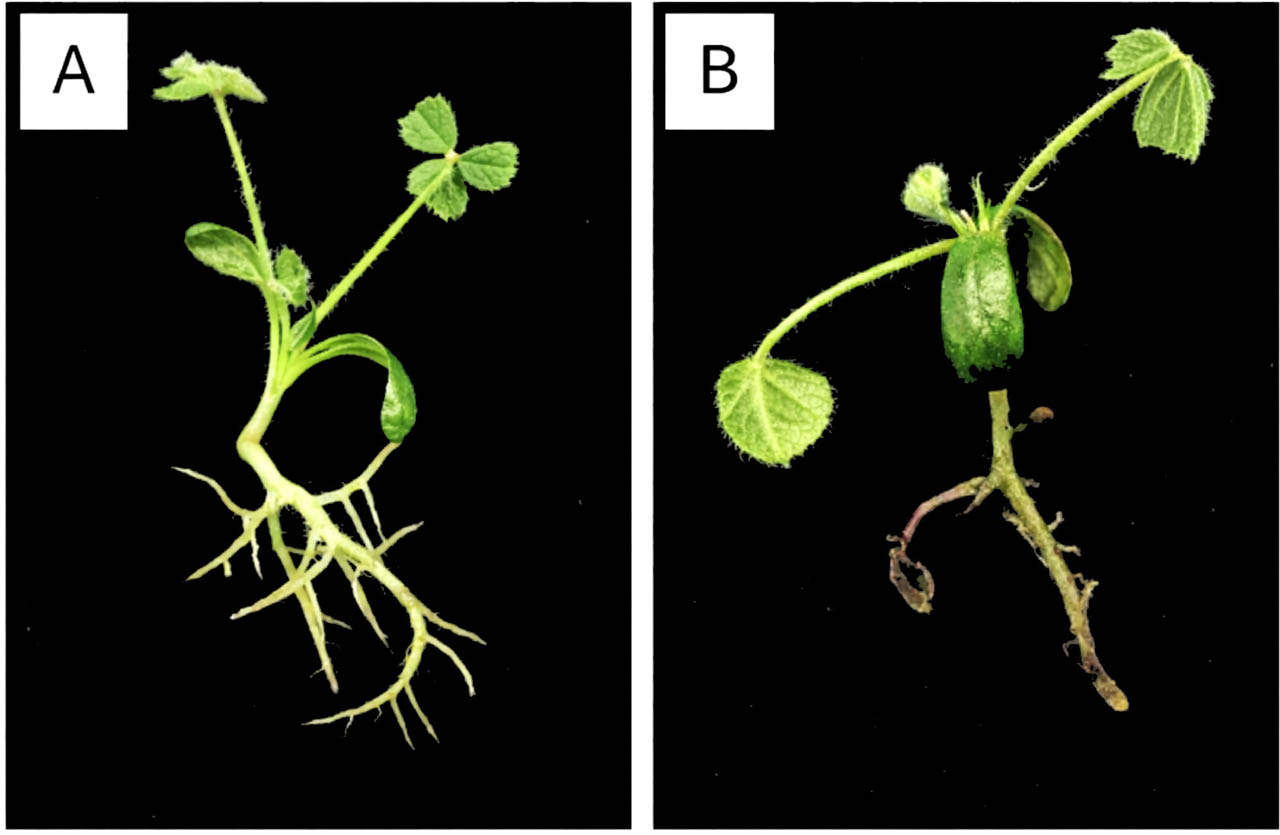
Figure S1.
Representative morphology of M. truncatula seedlings grown for 14 days under (A) stationary 1g conditions and (B) 2-D clinostat-modeled simulated microgravity. Seedlings grown under microgravity exhibited reduced shoot length, primary root length, lateral root development and overall biomass reduction relative to 1g controls.
Table S1.
MC3T3-E1 metabolic activity expressed as percent of 0.1% ethanol control following exposure to Medicago truncatula extracts under static and clinostat conditions.
| Treatment | |||||
|---|---|---|---|---|---|
| Static | Clinostat | ||||
| Ethanol controls | |||||
| Dose (%) | % Control | SD | Dose (%) | % Control | SD |
| 0.1 | 100 | 7.8 | 0.1 | 100 | 8.3 |
| M. truncatula extracts | |||||
| Static | Clinostat | ||||
| Dose (ng)* | % Control | SD | Dose (ng) | % Control | SD |
| 4.9 | 86.1 | 4.2 | 5.4 | 97.8 | 2.5 |
| 9.8 | 94.4 | 8.3 | 10.7 | 97.2 | 2.8 |
| 14.7 | 97.2 | 6.9 | 16.5 | 96.7 | 8.9 |
| 19 | 95.8 | 8.3 | 21.4 | 95.8 | 8.3 |
Table S2.
Alkaline phosphatase (ALP) metabolic activity expressed as percent of 0.1% ethanol control following exposure to Medicago truncatula extracts under static and clinostat conditions.
| Treatment | |||||
|---|---|---|---|---|---|
| Static | Clinostat | ||||
| Ethanol controls | |||||
| Dose (%) | % Control | SD | Dose (%) | % Control | SD |
| 0.1 | 100 | 7.2 | 0.1 | 100 | 7.3 |
| M. truncatula extracts | |||||
| Static | Clinostat | ||||
| Dose (ng)* | % Control | SD | Dose (ng) | % Control | SD |
| 4.9 | 96.4 | 7.5 | 5.4 | 96.8 | 7.6 |
| 9.8 | 98.2 | 7.4 | 10.7 | 96.8 | 7.4 |
| 14.7 | 96.8 | 7.5 | 16.5 | 98.2 | 7.5 |
| 19 | 97.3 | 7.4 | 21.4 | 95.5 | 7.3 |