Introduction
The first popcorn was popped in space during the Blue Origin New Shepard NS-29 sub-orbital spaceflight on February 4, 2024, in a small K-12 STEM demonstration experiment. NS-29 was the first lunar-gravity mission for New Shepard, so the popcorn kernel was popped in lunar gravity, not in weightlessness, while the capsule was in space. The experiment was designed, built, ground tested, and delivered for flight by the “Zero-gravity Flight Experiment” undergraduate class in the School of Aeronautics and Astronautics at Purdue University. Popping a kernel of popcorn in lunar gravity on a sub-orbital space mission can be viewed as a novelty, but the engineering design process to create this capability within tight constraints on size, mass, and power is a valuable and memorable educational experience for the engineering students.
Payload weight and power requirements create several challenges that were overcome by the Purdue students in the design and implementation phases. Specifically, a maximum mass of 0.5 kg and maximum electrical current of 0.9 A at 5 VDC require care to satisfy both simultaneously. The primary issue is that rapid electrical heating of the popcorn requires more power than the flight provider can offer, yet supplementing that power with batteries results in an overweight design. Described below is the careful use of the mission timing to enable a lightweight payload to deliver sufficient thermal energy by the proper moment in the mission to pop one kernel of popcorn during the approximately three minutes of spaceflight.
The size of the payload is specified by the flight provider to be the 2U cubesat format, shown in Fig. 1. That is, a 10 cm square face with a 20 cm length. A payload box developed previously which has been distributed free of charge internationally to schools and known as the “Purdue School Launchbox” [1] is used for this experiment. This box is the proper size, is lightweight, has a USB socket in the correct location, and is tested to withstand the necessary g-loads of the mission at the maximum mass allowed by the flight provider. The Purdue School Launchbox design first flew in 2017 [2] and since then has been used by others to fly numerous K-12 and collegiate experiments. This experiment program began as a collaboration with three high schools in Indiana.
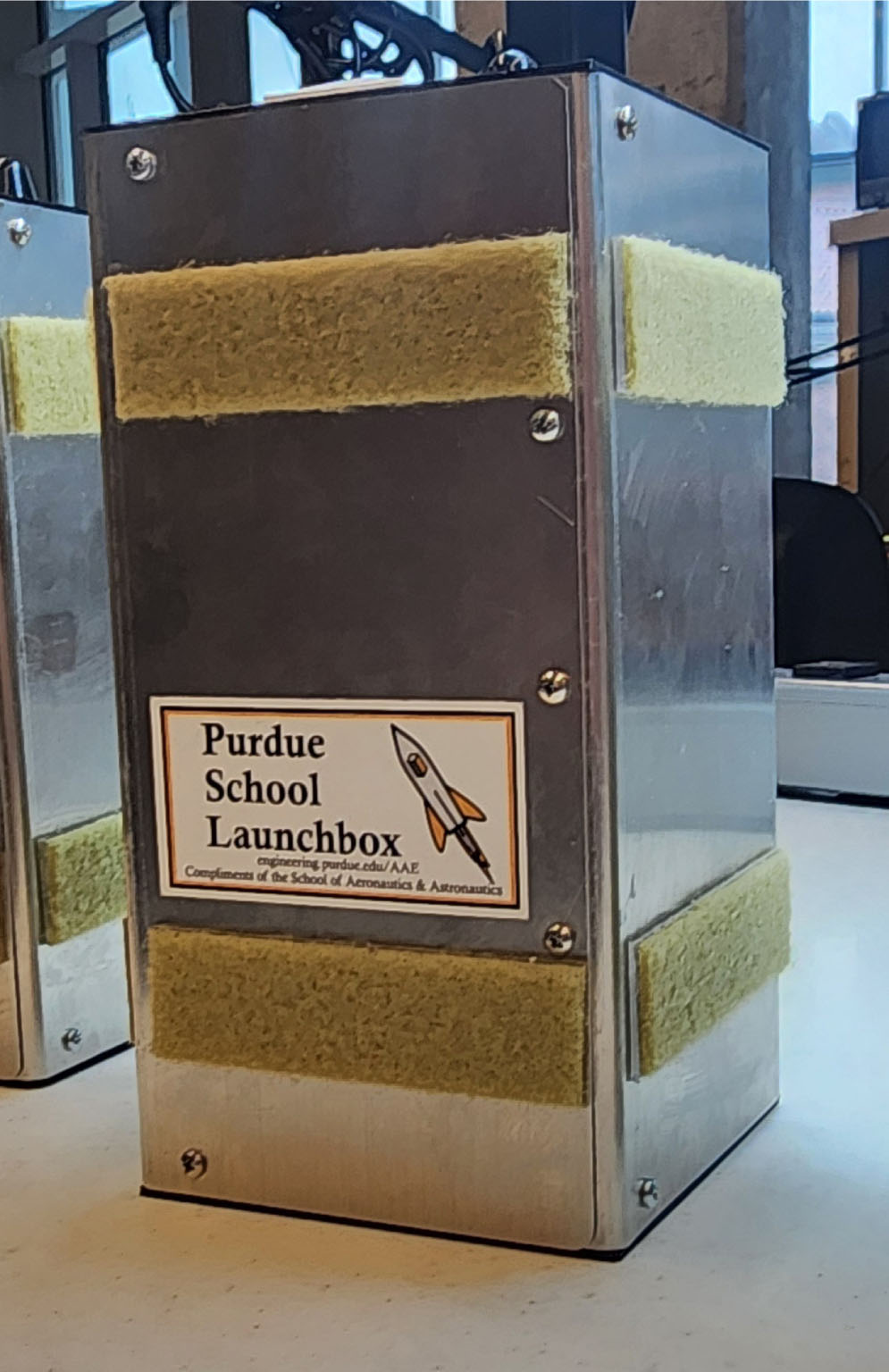
Figure 1.
The Purdue School Launch box that housed the experiment. The dimensions for the box are standard 2U CubeSat (10cm × 10cm × 20cm)
Popping popcorn in spaceflight was chosen as the experiment topic because popcorn is a popular snack, Indiana is a major popcorn producer, and the popping process provides good high school STEM lessons in electrical and thermal energy, power, boiling, pressure, and more. For example, Table 1 presents concepts from a consideration of energy, backtracking from the actual popping event. Additionally, how fast or slow the processes occur yields lessons about power and how power and energy are related. Popping a kernel in classrooms using just a DC power supply and Ni-Chrome wire can provide repeated eye-witness experiences to all of the steps in the process for the students.
Table 1.
Lesson opportunities in an energy-based view of the popping of a kernel of popcorn.
| Event | Cause | Description |
|---|---|---|
| Popping | A kernel pops when it bursts from high pressure inside. | This introduces concepts of gas pressure, material strength, and sudden energy release, and is easily extended to safety with pres- surized vessels in the lab and the kitchen. |
| High pressure | The high pressure is created by steam, confined by the ap- proximately rigid hull of the kernel. | Gas processes are introduced. |
| Steam | Boiling of moisture in the kernel. | Introduction to states of matter and latent heat of vaporization. |
| Energy to boil | The effect of power supplied over a duration of time. | How energy and power are related and visible in everyday life |
| Thermal control | Radiation and convection work against popping in this system. | The effect of lunar-g on convective losses can be discussed. |
| Heating | The Ni-Chrome wire transforms electrical current into heat, which increases the temperature of the kernel. | Resistive heating, electrical current and voltage; Ohm’s Law. |
| A source of energy | Batteries. | The energy to drive current through the wire is supplied by Blue Origin’s batteries. |
| Batteries | Energy is stored in chemical bonds. | Energy in different forms, primary versus rechargeable batteries. |
Unfortunately, a series of launch delays and high school teacher turnover during these delays caused the collaboration to falter. The Purdue aerospace engineering undergraduate students in Purdue’s “AAE418 Zero-gravity Flight Experiment” class, which was mentored by the authors, then completed the experiment.
Method
The goal of the experiment began as popping popcorn in space and quickly narrowed to popping a single kernel in space due to power limitations in this experimental format. Blue Origin supplies up to 0.9 A at 5 V for a 2U payload, which is a power limit of 4.5 W. The payload required a micro-controller, camera, white-light LED, and the apparatus to heat the kernel. The kernel-heating wrap, made of Ni-Chrome wire (Fig. 2), was developed to operate within the power and time constraints of the mission and to survive shipping to launch and the boost loads and vibrations. The power consumption of the Raspberry Pi Zero micro-controller [3] was measured to be 1.5 W with the camera on idle, peaking to 2.2 W when the camera is recording with the LED operating, thus leaving only 2.3 W of power for heating the kernel.
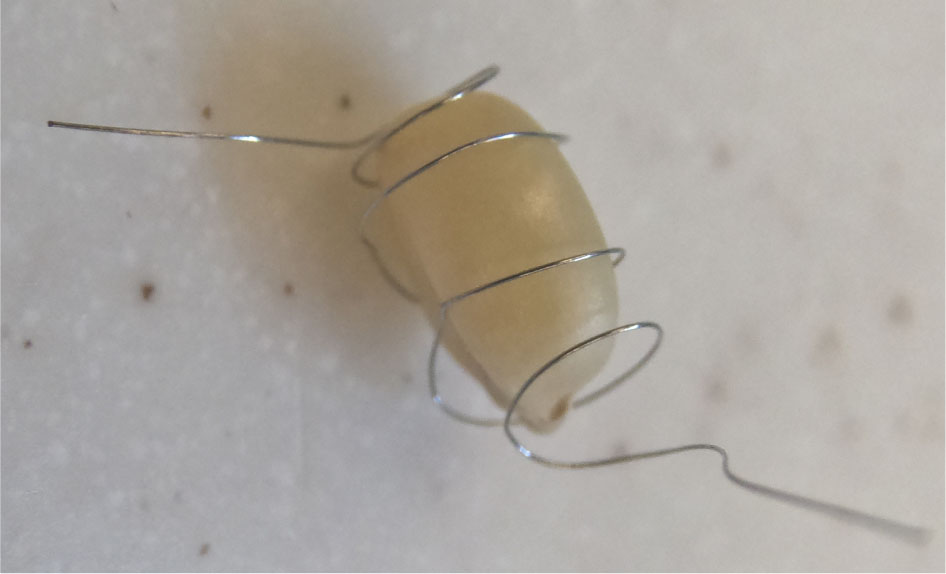
Figure 2.
Example of a single popcorn kernel wrapped in Ni-Chrome wire as used in this experiment. The Ni-Chrome wire is 36-gauge in diameter, and the kernel is approximately 0.8cm long and 0.4cm in diameter.
The amount of heat required to pop a kernel is highly dependent on its size, moisture content, and shape [4]. For the kernel to pop, temperatures around 180◦C are required for the steam pressure to overcome the pericarp (the “shell” or “hull” of the kernel) strength [5]. Preliminary calculations indicated that the total best-case heat required for a typical popcorn kernel (mass around 0.4 g) is approximately 180 J. It is found that up to 12 cm of wire can be wrapped around a kernel. Best performance was found to be with 10 cm of wrapping, and thus with a 1 cm allowance for connections on each side, 12 cm of 36-gauge Ni-Chrome wire is used. Ground testing showed that with this wrapped wire, the kernel requires approximately 2 W of power, or a current of 0.4 A at 5 V, to pop within a desirable time. This popping power is within the 2.3 W available. This measurement, repeated on numerous kernels, served as the start of the flight experiment design. Ground testing was found necessary to identify how exposure to the environment, additional resistance, kernel diversity, the added resistance of packing the kernel between acrylic tubing, variations in wire wrapping, positioning, and tautness, kernel size, and kernel shape affect the energy and power needed for successful popping.
Because of the significant variability in the kernel size, ground testing was used to identify a practical heating schedule for the flight experiment. The length and diameter of Ni-Chrome wire wrapped around the kernel were varied in ground testing, and the resulting time required to pop the kernel was recorded. Based on ground testing, the wire length wrapped around a kernel was set to 10 cm to achieve a time to pop of approximately 250 seconds. Kernels were selected from a large batch to ensure the kernel mass was always close to 0.4 g.
The time to pop a kernel with this heating averaged approximately 250 seconds. The Blue Origin Payload User Guide [6] states a nominal coast time after separation from the Propulsion Module (booster) of 180 seconds. For NS-29, the Crew Capsule was spun up to produce centripetal acceleration equal in magnitude to lunar gravity. We were told to expect a lunar gravity testing time of about 120 seconds. Thus, preheating the kernel before lunar-g begins is necessary to be able to pop while in space. Because the start time for the lunar-g operations is about 177 seconds of mission elapsed time (0 seconds = liftoff), the ideal time to start heating the kernel is at about 24 seconds of mission elapsed time, which is during boost. This guaranteed that the minimum (∼ 160 seconds) and the maximum (∼ 300 seconds) times found necessary, during ground testing, to pop a kernel would each result in popping within the lunar gravity period of the flight.
One observation for the kernel wrapped in Ni-Chrome wire is that it is challenging to keep it secured, and that the kernel can fall out of the wire very easily. The kernel needs to be secured tightly in the wire and the experiment apparatus to avoid external disturbances. The kernel is secured by clamping the wires between an acrylic tube and the base to keep the wire secured. Aggressive jostling of this setup assured that the kernel was held in place during the vibrations and shocks of shipping and flight.
The Raspberry Pi Zero (model 2W) [3] is the micro-controller used for this experiment. It provides General Purpose Input Output (GPIO) ports, which are configured in this experiment to control Ni-Chrome wire heating times and the power to the white-light light emitting diode (LED). The Raspberry Pi also has a native camera module, and most importantly, the measured power consumption is within the limits required by the experiment (∼ 2.2W). A GPIO port is used to actuate a solid-state relay (SSR) to control when the Ni-Chrome wire and kernel receive power. Once the Raspberry PI receives a signal that a particular time in the mission has been reached, it turns on current to the kernel. The circuit diagram can be seen in Fig. 3.
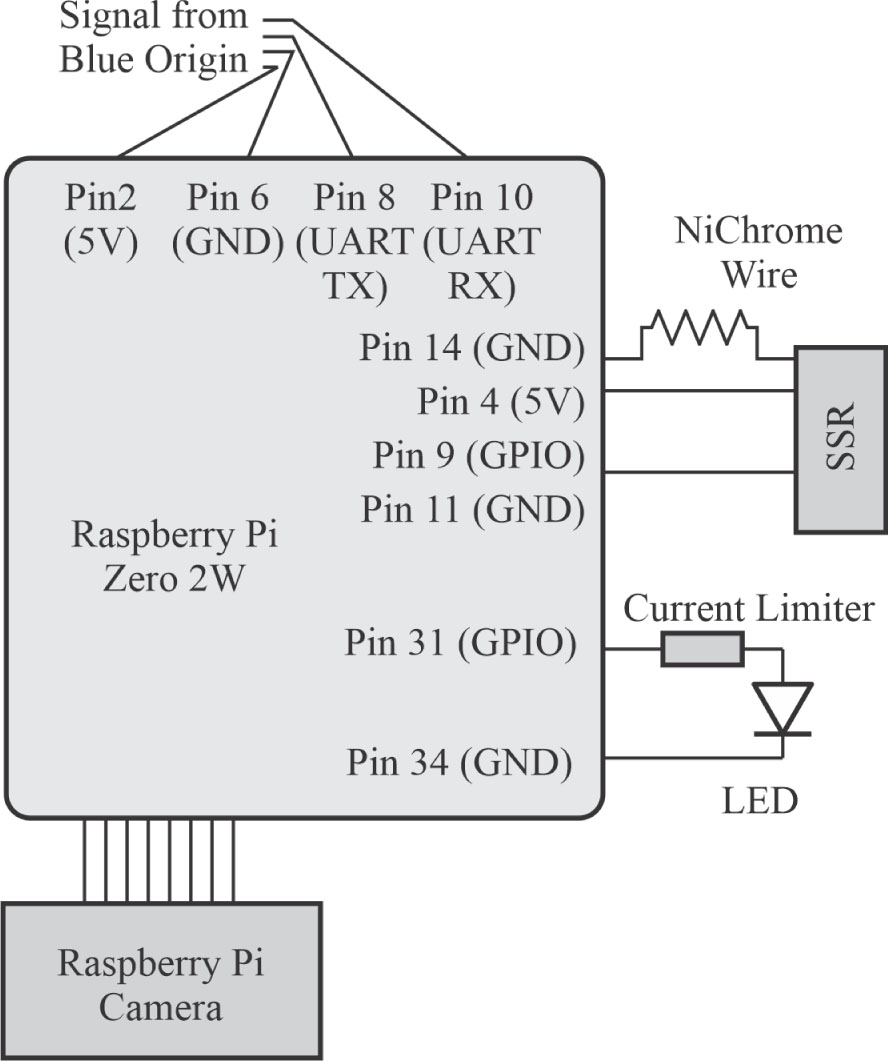
Figure 3.
Control circuit for the popcorn experiment.
An attempt was made to record the kernel pop during the spaceflight experiment via a video camera. The Raspberry Pi camera module 2[7] was chosen for its native compatibility with the Raspberry Pi Zero. The video file recovered after flight showed that the camera did not stay in the necessary location and orientation but had detached from the hook and loop fastener even before the mission started. Vibrations and shocks during shipping to the launch site are the likely cause of this failure.
Mission
Blue Origin required the payload to arrive at the launch site approximately two weeks before the launch. No access to the payload was permitted for the researchers after shipping (note that the larger, more expensive experiment options generally have permitted launch site access by the customer). Thus, the payload had to be shipped from the authors’ labs fully assembled in a launch-ready state. Blue Origin’s NS-29 sub-orbital mission on February 4, 2024, was a novel flight because it was the first New Shepard mission to spin the Crew Capsule to create centripetal acceleration nominally equal to the lunar surface. Either lunar or zero-g would have been acceptable to this experiment and the choice was made to fly it at the earliest possible time, thus the inclusion on the NS-29 manifest. The flight provided approximately three minutes of spaceflight as the Crew Capsule traveled up to apogee and down after it separated from the booster following the powered ascent.
The final timeline for the experiment is defined using the Payload User’s Guide [6]. Once the payload receives power, which is 300 seconds before liftoff, the micro-controller starts to run a script, which controls each of the devices. The script is set to start the kernel heating after 324 seconds after the micro-controller boots up. This time delay ends during boost at 24 seconds after liftoff. The camera and LED are then provided power and run until power is stopped, while the Ni-Chrome wire is powered for only 320 seconds. Ground testing showed that 320 seconds of heating caused no hazards with or without successful popping. The timeline for the experiment is illustrated in Fig. 5.
The experiment was returned to the authors in Indiana promptly after the flight by Blue Origin. When it arrived back at Purdue it was opened (Fig. 4), and the popped kernel was observed (Fig. 6). This is also when the camera mounting failure was found, and that video from the flight showed that the camera mount failure happened before the flight.
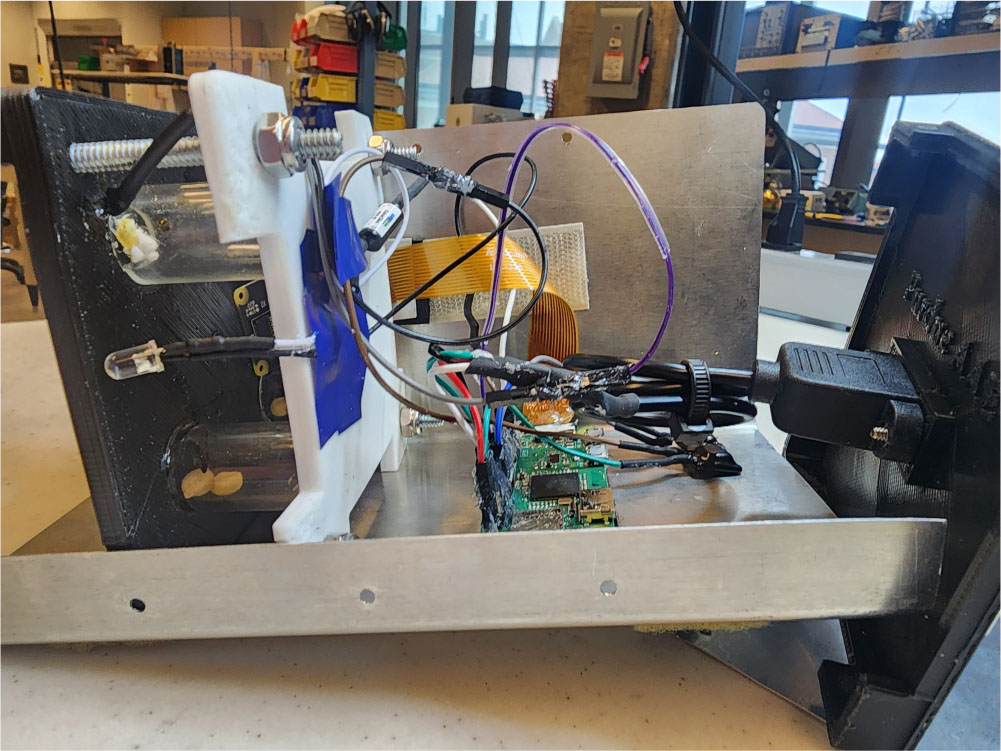
Figure 4.
View of the internal hardware of the experiment. The dimensions for the box are standard 2U CubeSat (10cm × 10cm × 20cm).
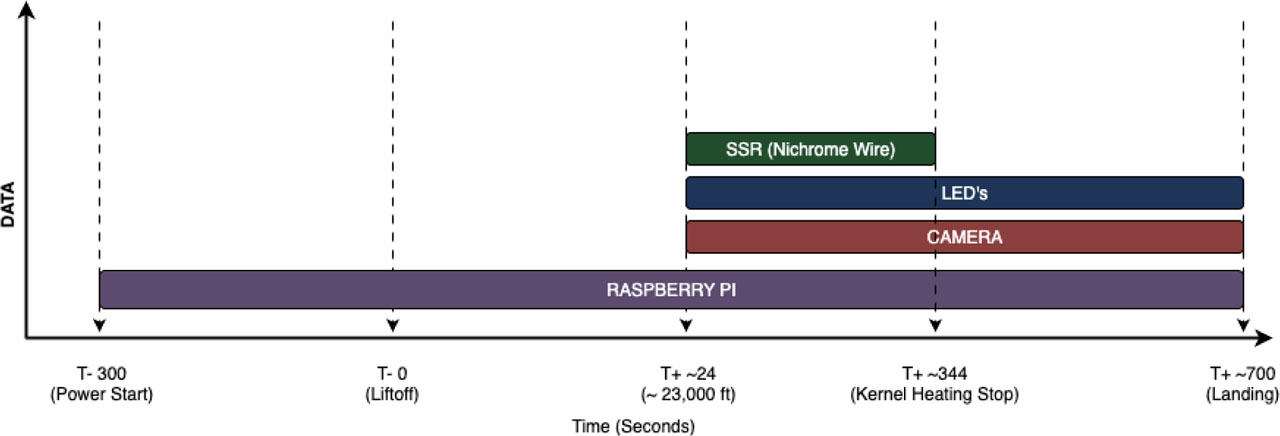
Figure 5.
Timeline of events for the popcorn experiment.
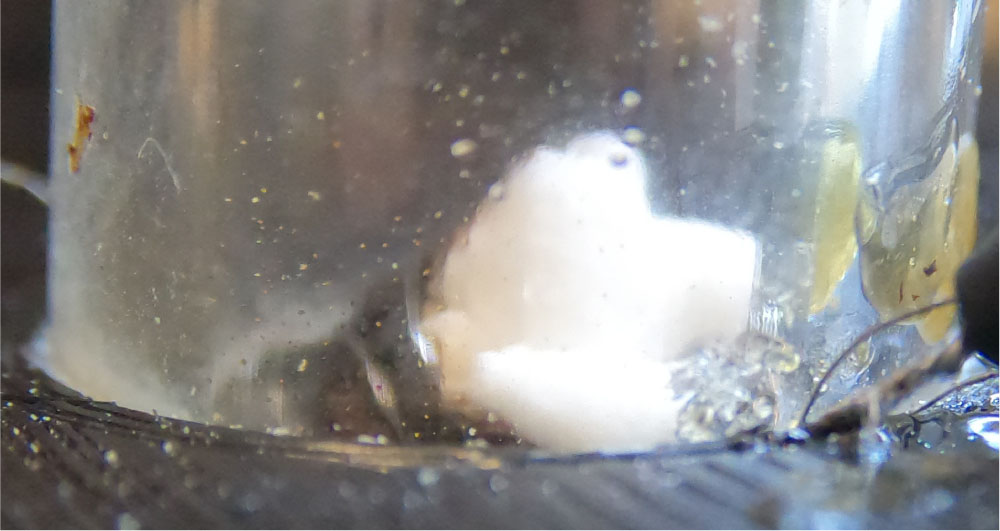
Figure 6.
One popped kernel of popcorn after the mission. The acrylic tube visible here served to constrain the Ni-Chrome wire and kernel during the mission. The tube dimensions are: inner diameter 1.27 cm, outer diameter 1.9 cm, height 2.54 cm.
Conclusion
A single kernel of popcorn was successfully popped during the spaceflight. No observations or quantitative conclusions regarding differences between 1-g and lunar-g popping are made because popcorn naturally varies substantially from kernel to kernel and only one kernel was popped. A bowlful of popcorn popped in lunar-g might provide useful comparisons but not this single kernel.
The video recording operated but the camera broke loose from its mount, likely during shipping to the launch site, and so no video of the popping event was acquired. Note too that no experimenter access was permitted at the launch site on this small experiment, but for larger, more expensive payload formats, such access is common.
Regardless of the video and K-12 collaboration failures, the experiment achieved the desired goal of popping what may be the first kernel of popcorn popped in spaceflight. The design-build-test process for small payloads in the commercial reusable sub-orbital rocket industry in the USA, with or without K-12 STEM collaborations, is a unique opportunity for collegiate engineering workforce development. The era of “New Space” offers new opportunities for education, workforce development, and research.
Acknowledgments
Inclusion of this experiment on the Blue Origin NS-29 mission was funded as a small K-12 STEM outreach option on NASA Flight Opportunities Program grant number 80NSSC21K0502. The Arete-STEM Foundation provided contracting expertise. The support of the Flight Opportunities Program for the primary payload and this payload is acknowledged warmly. The authors thank numerous undergraduate aerospace engineering students through several semesters in Purdue’s AAE418 “Zero-gravity Flight Experiment” class who made the popping succeed. Blue Origin payload engineer Mr. Laki Vlachos was most helpful throughout the payload safety and integration processes.