Introduction
Antibiotic resistance has existed for at least tens of thousands of years (D’Costa et al., 2011; Perron et al., 2015; Perry et al., 2016), and potentially millions of years or more (Barlow and Hall, 2002; Bhullar et al., 2012; Torres et al., 2025), and has emerged as a major health risk over the past century. Following the discovery of penicillin in 1928, antibiotics were rapidly and widely harnessed for human and veterinary medicine, livestock, agriculture, and biotechnology. This has revolutionized modern medicine and fundamentally impacted livelihood on Earth, but has also driven the extensive proliferation of antibiotic resistance. Today, antimicrobial resistance, which includes antibiotic resistance, is identified by the World Health Organization, Centers for Disease Control and Prevention, and the World Medical Association as one of the most prevalent contemporary public health issues (CDC, 2024; WHO, 2019, 2023; WMA, 2022).
Antibiotic-resistant microbes are widespread across outdoor and built environments (Bengtsson-Palme et al., 2017; Larsson and Flach, 2022; Mahnert et al., 2019), and areas that are enclosed and frequently cleaned can have higher resistance prevalence (Mora et al., 2016). Culture-based methods are commonplace in medicine, agriculture, livestock, and wastewater monitoring, enabling rapid, high-throughput screening for antibiotic-resistant microbes (Caruso, 2018; Haulisah et al., 2021; Kuper et al., 2009; Lemonnier et al., 2023; Manaia et al., 2018; McLain et al., 2016; Reinthaler et al., 2003; Smaill, 2000; Tomida et al., 2013).
Although agar plates containing antibiotics can be used for such methods, little data exist on the long-term stability of antibiotics in agar (over weeks, months, or years). Lyophilized antibiotics are generally stable for months to years, but degrade quickly once reconstituted in water. This is generally not an issue for laboratory settings, as media can be prepared and inoculated with antibiotics as needed. However, certain situations (i.e., remote medicine, spaceflight) require longer-term storage of antibiotics in agar plates if real-time preparation of plates is not feasible, and specific data on the stability of various antibiotics is critical for planning culture-based screening in remote environments.
Over the past few decades of crewed space exploration, the effects of spaceflight conditions on microbes and their potential implications for crew health have become increasingly apparent. In space, microbes can demonstrate increased growth, virulence, pathogenicity, and biofilm formation, as well as changes in metabolism (Huang et al., 2018; Kacena et al., 1999; Kim et al., 2013; Landry et al., 2020; Ott et al., 2020; Rosenzweig et al., 2010; Sharma and Curtis, 2022; Vaishampayan and Grohmann, 2019; Wilson et al., 2007). The unique conditions of spaceflight can likewise exacerbate antibiotic resistance in microbes. This has been characterized in simulated-microgravity experiments on the ground and in culture-based experiments in space (Aunins et al., 2018; Moatti et al., 1986; Tirumalai et al., 2019; Tixador et al., 1985; Urbaniak et al., 2022)
Spaceflight can suppress astronaut immune systems (Sonnenfeld, 1998; Stratis et al., 2023), which increases the risks imposed by these microbial responses to spaceflight. Microbial monitoring is routinely conducted to survey the genomic and functional composition of crewed spacecraft (Yamaguchi et al., 2014). Such monitoring aboard the International Space Station (ISS) has indicated that antibiotic-resistant microbes are present on surfaces proximal to crew members, and may pose risks to astronaut health (Bryan et al., 2021; Urbaniak et al., 2022). Bryan et al. specifically investigated Enterococcus faecalis isolates recovered from the ISS, showing that antibiotic-resistant E. faecalis exists on-station with potential pathogenicity, and indicating the need to further assess the abundance of antibiotic-resistant microbes on-station.
Genomic Enumeration of Antibiotic Resistance in Space (GEARS) is a NASA-funded spaceflight mission aimed at characterizing the frequency and genomic identity of antibiotic-resistant microbes on the ISS. This study focuses on enterococci due to their status as the second-leading cause of hospital-acquired bacteremia (Dubin and Pamer, 2017; Hidron et al., 2008; Wisplinghoff et al., 2004) and their presence aboard the ISS (Bryan et al., 2021). This project will use contact slides filled with antibiotic-spiked agar to screen for antibiotic-resistant microbes on internal surfaces of the ISS and will leverage in-space nanopore sequencing instrumentation to identify microbes on orbit. The GEARS study is one of three complementary investigations aimed at better understanding the adaptation and antibiotic resistance of enterococci in the spaceflight environment. The other two investigations, Enterococcus Growth Advantage Investigation via Tn-seq (EnteroGAIT) and Adaptation and Evolution of Resilient Enterococcus in Space (AERES), are concurrently underway.
To prepare for the GEARS study, it was necessary to first determine which antibiotics would be most useful to generally screen for Enterococcus, as the main genus of interest for this project, as well as Staphylococcus, another genus with high propensity for antibiotic resistance and human pathogenicity. Next, it was necessary to determine the “shelf life” of these antibiotics once reconstituted in agar. For GEARS, it was important to determine how long antibiotic stability could be maintained to plan mission logistics and prevent significant variability due to loss of antibiotic potency. This manuscript describes the process of antibiotic selection and the validation of antibiotic stability and reports results on the stability of gentamicin and streptomycin over a 6.5-month period.
Materials and Methods
Antibiotic Selection
A literature review was conducted to identify antibiotics for further study, focusing on two main mechanisms of antibiotic impact related to cell wall biosynthesis (beta-lactams, carbapenems, penicillin-like antibiotics) and ribosome synthesis (aminoglycosides, lincomycin, macrolides, tetracyclines) and associated resistance mechanisms observed in E. faecalis (Arias and Murray, 2012). Data on intrinsic and acquired resistance in Enterococcus and Staphylococcus, and on long-term (several weeks) stability in solution and on agar plates at 4 °C, were aggregated from peer-reviewed literature, vendor information, and medical documentation. Antibiotic recommendations for use in the experimental portion of this study were made based on the presence of intrinsic resistance in Enterococcus and Staphylococcus and long-term antibiotic viability following reconstitution.
Contact Slide Preparation
Three concentrations (high, low, zero) for two antibiotic types (streptomycin, gentamicin) were used in this study. Antibiotic concentrations were determined via preliminary testing on how a model antibiotic-resistant strain, Enterococcus faecalis OG1RF (ATCC 47077), grew at various antibiotic concentrations. The “high” concentration was the minimum tested concentration needed to prevent any visible growth of E. faecalis OG1RF colonies, while the “low” concentration was the minimum tested concentration needed for E. faecalis OG1RF colonies to be visibly smaller than those growing on no-antibiotic TSA. The tested concentrations were 250 μg/mL (high) and 150 μg/mL (low) for gentamicin and 400 μg/mL (high) and 250 μg/mL (low) for streptomycin.
Tryptic soy agar (TSA) (Thermo Scientific R455002) powder was reconstituted in 18 MΩ water according to the manufacturer’s instructions, then autoclaved at 121 °C for 15 minutes. To ensure that antibiotics were added to agar at a consistent temperature, agar bottles were kept in a water bath at 50 °C after autoclaving, for at least 30 minutes and until time of use. Gentamicin (MP Biomedicals 02194530) and streptomycin (MP Biomedicals 0219454125) were reconstituted according to the manufacturer’s instructions and then filtered through a 0.2 μm filter. Antibiotic solutions were prepared fresh daily and stored at 4 °C until immediately before use. Aliquots of antibiotics were added to agar, then agar bottles were swirled gently to mix. Each HYCON contact slide (Millipore 144024) was filled with 12 mL of agar, then left to cool and solidify in the biological safety cabinet for 30 minutes before being closed and transferred to the refrigerator. Contact slides were sealed using the provided film and stored at 4 °C in airtight and light-shielded conditions for the duration of the stability testing period of 6.5 months.
Antibiotic Stability Assay
Approximately once per month, a group of contact slides (high, low, and no antibiotic) was removed from storage, and their stability was assessed by inoculating with E. faecalis OG1RF. Fresh cultures were prepared and applied to the group of contact slides each month using the following workflow:
A wire loop was flamed and allowed to cool, then dipped into E. faecalis OG1RF stocks stored at −80 °C and streaked on three standard TSA plates. Plates were incubated for 24 hours at 37 °C. One isolated colony from each plate was used to inoculate a 100 mL flask of tryptic soy broth (TSB). The three flasks were then incubated for 24 hours at 37 °C while shaking at 200 rotations per minute (rpm).
Previous work determined an optimal dilution of 10−6 to yield an appropriate number of countable colonies for this organism and set of growth conditions. Accordingly, liquid cultures were diluted to 10−6, then 50 μL aliquots were plated on contact slides. For each time point, plating was done in triplicate for each group of high/low/zero antibiotic concentration slides (i.e., 3 plates at 250 μg/mL gentamicin, 3 plates at 150 μg/mL gentamicin, 3 plates at 400 μg/mL streptomycin, 3 plates at 250 μg/mL streptomycin, and 3 plates at zero antibiotic). Contact slides were incubated for 48 hours at 37 °C.
After 48 hours of incubation, contact slides were removed, colony-forming units (CFUs) were counted, and images of the contact slides were taken from a standardized distance at a resolution of 26.3 pixels/mm (0.038 mm/pixel). Following imaging, the group of contact slides for that sampling interval was discarded. Images were loaded into ImageJ (Schneider et al., 2012) and the scale was set using the middle line on each contact slide as a reference length, then the ImageJ ROI Manager Tool was used to measure colony diameter.
Statistical testing was performed to determine whether differences in colony counts within each sampling interval were significant. Single-factor ANOVA was performed on CFU counts from contact slides containing no antibiotic and low concentrations of gentamicin and streptomycin. No statistically significant differences were found, so no multiple-comparison tests were performed.
Statistical testing was also performed to determine whether colony diameters were significantly different between antibiotic types over the course of the experiment and within time points. A linear mixed-effects model was applied to the dataset using MATLAB’s fitlme function. Timepoint, antibiotic type, and their interaction were set as fixed effects; replicate number was set as a random effect; and colony diameter was set as the response variable. Post-hoc comparisons were performed for diameters from each antibiotic contact slide type against the no-antibiotic contact slide diameters. P-values were adjusted using a Holm-Bonferroni multiple testing correction (alpha = 0.05).
Results
Target Antibiotic Selection
The literature review focused on 13 antibiotics from 7 classes (FIG.1.). These antibiotics were selected based on their impacts on cell wall biosynthesis (beta-lactams, carbapenems, penicillin-like antibiotics) and ribosome synthesis (aminoglycosides, lincomycin, macrolides, tetracyclines), which links them to key antibiotic resistance mechanisms in enterococci (Arias and Murray, 2012). Data on long-term stability in solution and in agar and prevalence of intrinsic and acquired resistance in Enterococcus and Staphylococcus were collected. These results are shown in Table 1.
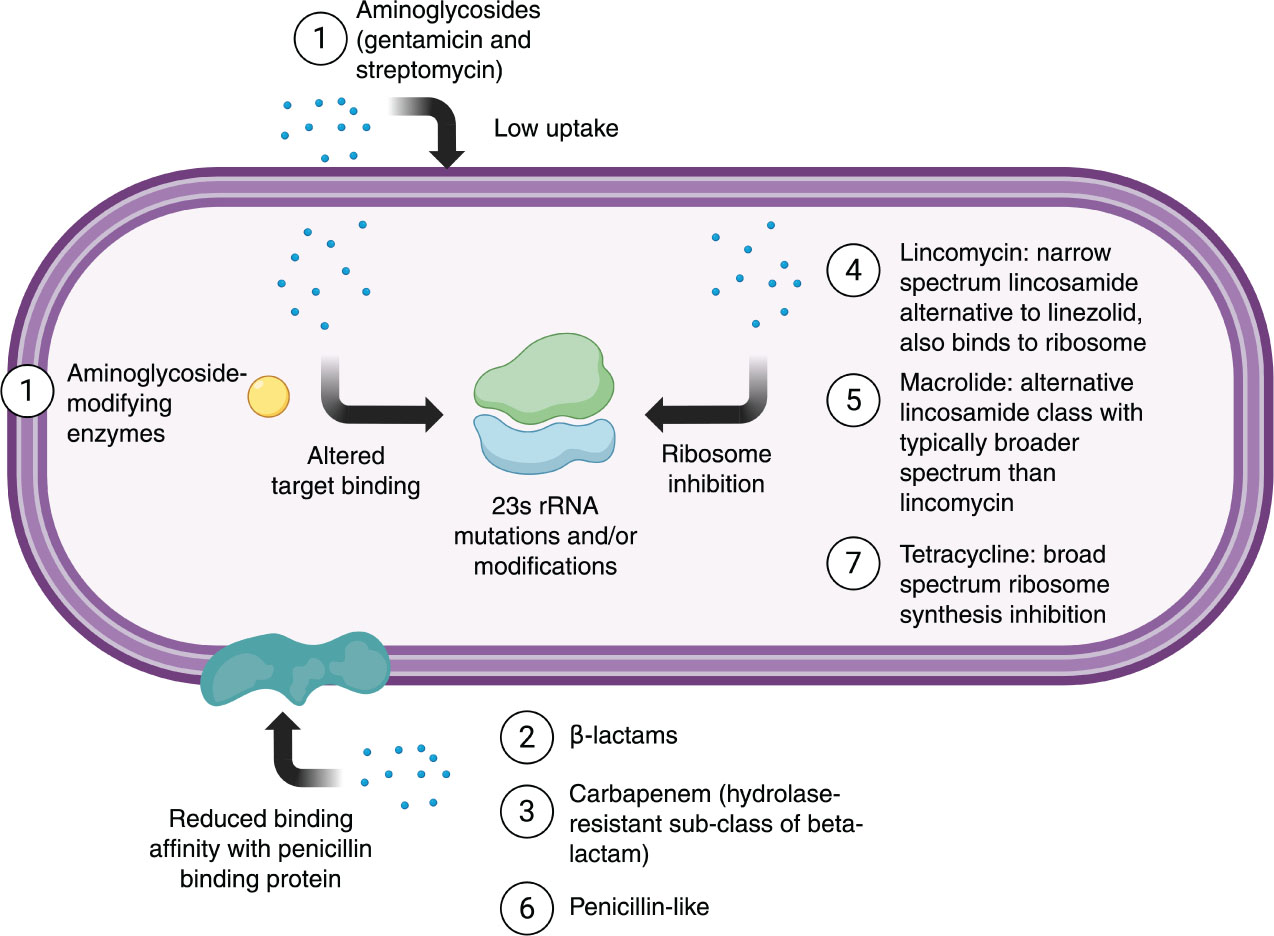
Figure 1.
Mechanisms of resistance for antibiotics included in literature review. Antibiotics are numbered based on order in table.1. Adapted from Arias & Murray 2012.
Table 1.
Antibiotic literature review results. Antibiotics are organized alphabetically within their respective classes. Stability in solution and in agar at 4 °C is given, then resistance in Enterococcus and Staphylococcus is briefly described.
Following this review, gentamicin and streptomycin were selected for further analysis. These antibiotics were among the higher-ranking options for stability in solution, and previous work had indicated that streptomycin is stable in agar for at least 30 days (Ryan et al., 1970). Furthermore, these specific antibiotics are relevant to the GEARS study – both Enterococcus and Staphylococcus, the main targets of this project, often display resistance to these antibiotics. Enterococci possess low-level intrinsic resistance to aminoglycosides overall (a category that includes both gentamicin and streptomycin), and can further acquire high-level resistance (Chow, 2000; Hollenbeck and Rice, 2012; Miller et al., 2014). Furthermore, staphylococci can develop resistance to both antibiotics (Cattoir, 2016; Domínguez et al., 2002; Jensen and Lyon, 2009; Vestergaard et al., 2016).
Antibiotic Stability Over 6.5-month Test Period
During each testing interval, colony-forming units (CFUs) were counted on each set of contact slides (high/low gentamicin and streptomycin, no antibiotic). No CFUs grew on the high-concentration contact slides for either antibiotic type throughout the testing period. Single-factor ANOVA was performed on CFU counts for contact slides containing no antibiotic and low concentrations of gentamicin and streptomycin. These tests found no statistically significant differences in colony counts among the no-antibiotic, low-gentamicin, and low-streptomycin plates at each time point. Since no statistically significant differences were found, no multiple correction testing was performed. FIG.2. displays these CFU counts over 6.5 months.
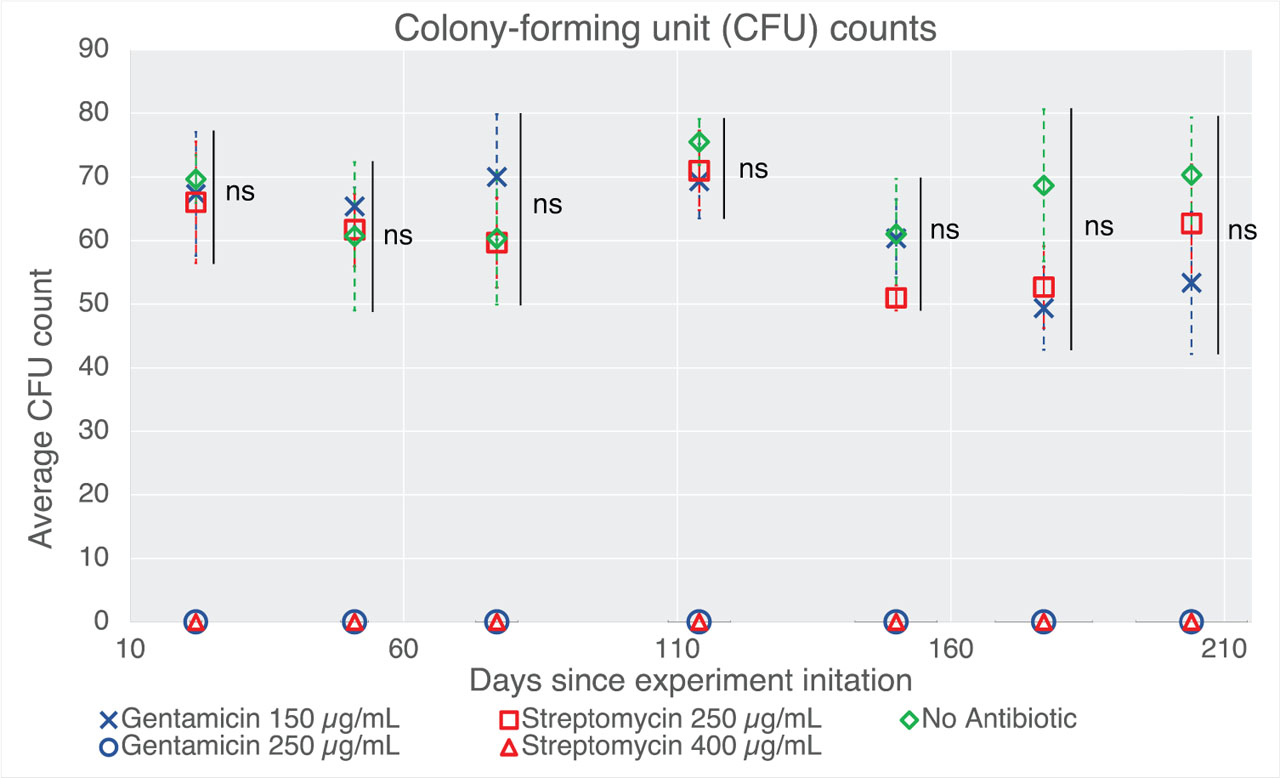
Figure 2.
Average colony-forming unit (CFU) counts for contact slides containing no antibiotic, low-concentration and high-concentration gentamicin, and low-concentration and high-concentration streptomycin over 6.5 months. Colored bars indicate standard deviation. Asterisks denote level of statistical significancy from single-factor ANOVA tests performed on CFU counts for the contact slides containing no antibiotic and low-concentration gentamicin and streptomycin (no significance: ns; p < 0.05: *; p < 0.01: **; p < 0.001: ***; p < 0.0001: ****).
During preliminary testing, it was observed that colony diameter decreased with increasing antibiotic concentration. While a direct relationship between colony diameter and antibiotic concentration was not quantified, this observation suggests that colony diameter could also serve as an indicator of functional antibiotic concentration, suggesting its stability. Colony diameter was tracked throughout the study as an additional exploration of a potentially useful but currently unvalidated method to further inform antibiotic selection (see Discussion for further details). A linear mixed-effects model was applied to investigate the effects of timepoint, antibiotic type, and their interaction on colony diameter, while accounting for variability between replicates. All fixed effects were highly significant (p << 0.05). The model estimated the colony diameter on plates containing no antibiotic at hypothetical day 0 to be 2.77 mm (95% CI 2.72 to 2.82). Meanwhile, the estimated colony diameter at hypothetical day 0 was significantly smaller on plates containing gentamicin (−0.68 mm, 95% CI −0.75 to −0.60) and streptomycin (−0.77 mm, 95% CI −0.84 to −0.70). Throughout the experiment, colony size on plates with no antibiotics decreased with time (−0.0011 mm/day; 95% CI −0.0015 to −0.00068), which suggests an aging effect of agar plates. Meanwhile, colony diameters gradually increased on plates containing gentamicin (0.0032 mm/day, 95% CI 0.0025 to 0.0038) and streptomycin (0.0020 mm/day, 95% CI 0.0014 to 0.0026), which is consistent with antibiotic degradation over time. The standard deviation for replicates was zero, indicating no significant plate-to-plate differences and suggesting consistent growth conditions. Post-hoc testing (FIG.3) revealed that at all timepoints, both antibiotic conditions had colony diameters that were significantly different than no antibiotic, with one exception: at the day 204 timepoint, the G150 condition had no significant difference in colony diameter. This suggests some degradation of the antibiotic by this timepoint, although longer-duration experimentation would have been necessary to further resolve this potential trend of decreased antibiotic efficacy.
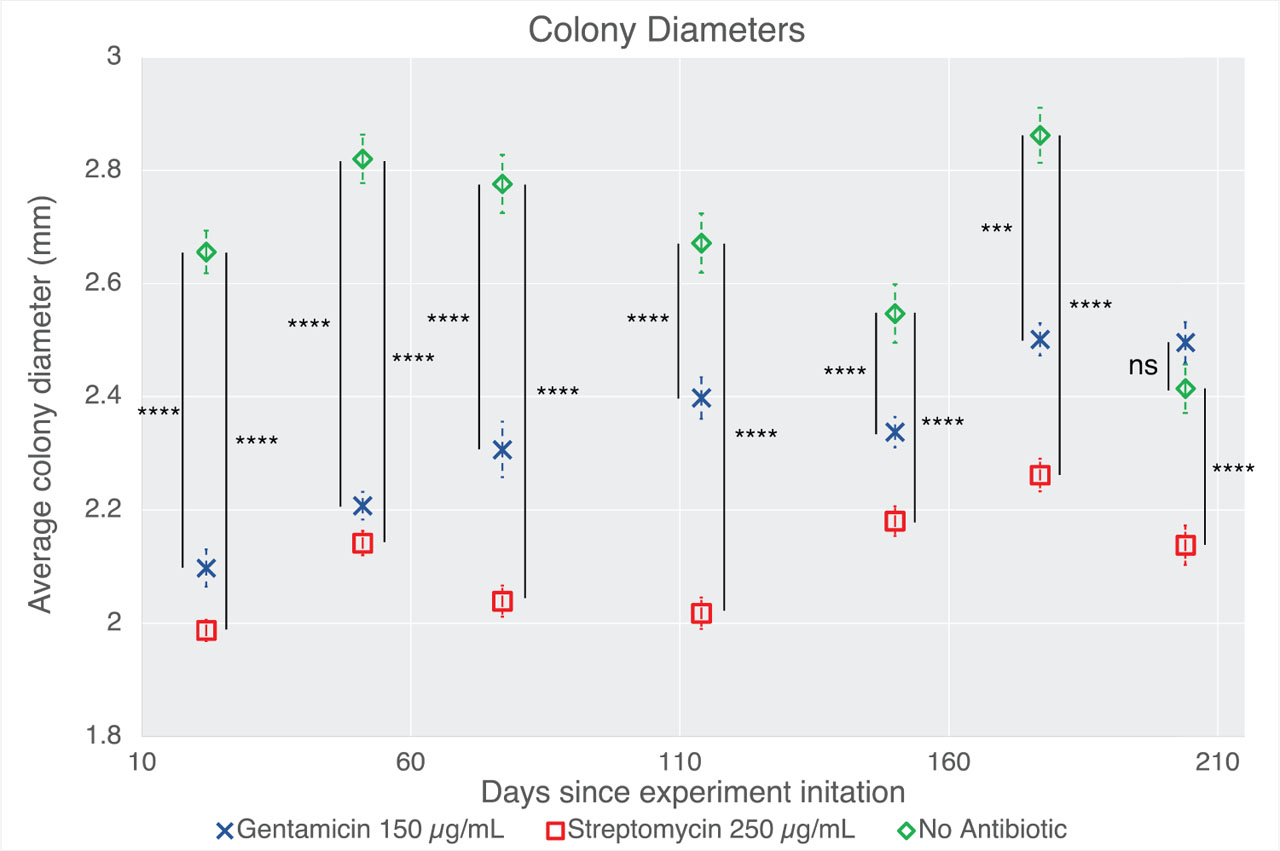
Figure 3.
Average colony diameter on contact slides containing no antibiotic, low-concentration gentamicin, and low-concentration streptomycin over 6.5 months. Colored bars indicate standard error of the mean. Asterisks denote adjusted level of statistical significance from post-hoc comparisons (no significance: ns; p < 0.05: *; p < 0.01: **; p < 0.001: ***; p < 0.0001: ****).
Discussion
In this study, we present data on the long-term stability of gentamicin and streptomycin in tryptic soy agar, which was used to inform antibiotic selection and planning for the GEARS spaceflight mission. We discuss the criteria for selecting test antibiotics, show that both tested antibiotics remain stable over the 6.5-month test period, and present a novel method for using colony diameter to gain additional insight into antibiotic stability.
Based on the literature review, gentamicin and streptomycin were selected for further validation in the GEARS study due to their viability in solution and on agar plates and the prevalence of resistance to these drugs in Enterococcus and Staphylococcus. Enterococcus possess low-level intrinsic resistance to aminoglycosides (a class that includes both gentamicin and streptomycin), based on poor drug uptake and drug inactivation by Enterococcus-produced enzymes (Miller et al., 2014). Staphylococcus similarly exhibits low-level intrinsic resistance to gentamicin (Cattoir, 2016; Vestergaard et al., 2016) and exhibits widespread emergent low-level resistance to streptomycin (Jensen and Lyon, 2009). Additionally, streptomycin has been shown to be viable in agar plates for at least 30 days (Ryan et al., 1970), and gentamicin and streptomycin are viable in solution for 4 weeks (Bastani et al., 2005) and 2 weeks (Millipore Sigma, 2021), respectively. We evaluated whether antibiotics remained stable on agar plates under cold storage conditions for up to 6.5 months. This timeframe was selected to support a GEARS mission lasting up to 4 months, with margins for time between slide preparation and launch, as well as potential delays on the ground or on-orbit. The “shelf life” would limit the time between preparation and usage, and since GEARS plates are being returned to Earth, would imply limits on the time between launch and landing to avoid overgrowth of plates. These two antibiotics underwent additional stability testing to inform GEARS flight planning.
Perhaps the most prominent general finding from the literature review was the deep lack of data on the stability of antibiotics in agar. This is not surprising: conventional laboratory operations allow for rapid preparation of antibiotics for use in agar or solution, and general best practices for antibiotic resistance research dictate using freshly-prepared antibiotics. However, it is useful to have information on the long-term stability of antibiotics in agar for applications where the tools of a standard microbiology lab may not be accessible (e.g., spaceflight, remote medicine, livestock monitoring). By validating the long-term stability of our antibiotics of interest for the GEARS study, we collected data that may be useful in other situations where antibiotic resistance monitoring is needed but the continuous production of antibiotic-containing consumables is not feasible. Culture-based microbial monitoring is critical to medical, agricultural, livestock, and wastewater systems. Data on antibiotic stability after reconstitution in agar plates can extend the shelf life of plates needed for these applications and enable microbial monitoring in remote or resource-limited settings. Furthermore, this data can inform the longevity of antibiotics polluting environmental systems, which is a major driver of the rapid proliferation of antibiotic resistance seen today (Larsson and Flach, 2022). In addition, these findings may have implications for the natural use of antibiotics by microbes; extended stability of antibiotics could support ecological functions such as niche maintenance, defense, intercellular signaling, or inter-species interactions (Davies, 2006; Martínez, 2008; Sengupta et al., 2013).
Throughout the 6.5-month testing period, there were no significant differences between CFU counts on low-antibiotic and no-antibiotic contact slides, although the colonies on the low-antibiotic contact slides were visibly smaller than those of the no-antibiotic contact slides. Additionally, no colonies ever grew on the high-antibiotic contact slides. This indicates that the chosen test concentrations were well-suited for growing the test model organism on antibiotic concentrations that partially and fully attenuated growth, and that antibiotics remained stable enough to have these effects throughout the test period.
Antibiotic decay was estimated to be no greater than 40% for gentamicin and 37.5% for streptomycin as described below. No colonies were observed on the high-concentration antibiotic contact slides (250 μg/mL for gentamicin and 400 μg/mL for streptomycin) throughout 6.5 months of storage, while colonies were observed on the low-concentration antibiotic contact slides (150 μg/mL for gentamicin and 250 μg/mL for streptomycin) at the initiation of the experiment, when the contact slides were freshly made. This implies that the high-concentration antibiotic contact slides did not decay down to an equivalent functional concentration of the low-concentration antibiotic contact slides during the testing period. Thus, the remaining functional antibiotic doses must be greater than 150 μg/mL / 250 μg/mL or 60% of the original for gentamicin (<40% decay), and 250 μg/mL / 400 μg/mL or 62.5% for streptomycin (<37.5% decay).
Based on these findings, it was determined that either antibiotic option would be suitable for the GEARS study when targeting 30–45 day duration Commercial Resupply Services (CRS) missions. Ultimately, gentamicin was selected due to satisfactory stability and anecdotal observations of streptomycin interfering with downstream DNA extraction and sequencing, although at tested doses higher than considered for culturing.
In this experiment, we used colony diameter as an additional proxy metric for antibiotic efficacy. This was based on an observation in preliminary testing that colony diameter decreased with increasing antibiotic concentration. This observation can be extended to suggest that, as an antibiotic decays, its reduced functional concentration will be reflected in larger colony diameters than on a plate with fresh antibiotics. Thus, we decided to record colony diameter to explore how it changed as antibiotics decayed over the test period. It is important to note that this is not a validated method for directly measuring antibiotic efficacy and is intended as a potentially useful metric that enriches our conclusions and may merit further exploration. Further testing would be necessary to determine whether there is a quantifiable relationship between antibiotic concentration/efficacy and colony diameter, and to explore how this relationship may translate into clinical applications. These results imply that for longer duration CRS missions, up to six months, some degradation may be present, but does not exceed 40%, and could be lower.
The GEARS study is currently underway, with the first launch and operations occurring in March and April 2024, the second in December 2024, and the third in June 2026. This mission may reveal additional information about the utility of antibiotics under the unique conditions of spaceflight (e.g., launch, radiation, and microgravity). As space missions increase in duration, distance from Earth, and crew size, it will be critical to continually update our understanding of the microbes that coexist with the crew, which can have drastic implications for astronaut health.
Acknowledgements
The authors would like to thank the GEARS team, including Project Scientist Gwo-Shing Sun, Co-PI Sarah L. Castro-Wallace, Sarah Stahl-Rommel, Christian Mena, Hang N. Nguyen, Christian Castro, G. Marie Sharp, Noelle C. Bryan, Ralf Moeller, Elisabeth Grohmann, and Co-PI Aaron S. Burton. Figure 1 was created using BioRender.com. This material is based upon work supported by the National Aeronautics and Space Administration under Grant No. 80NSSC21K0234 to C.E.C.