Introduction
Simulating lunar regolith using Earth’s minerals is an effective strategy for exploring potential off-world applications of the abundant in situ (on-site) surface material. Work with these simulants has confirmed several potential limitations to regolith usage (Fackrell et al., 2024), especially as a resource for biology applications Misra et al. (2021) and others have suggested that the In-Situ Resource Utilization (ISRU) capacity of lunar regolith could be enhanced by the inclusion of microorganisms capable of promoting plant growth and assisting plants in the removal of a variety of stress-inducing abiotic factors through mechanisms such as phytoaccumulation, phytodegradation, and rhizodegradation. Collectively, our labs have begun to explore approaches to including such bacteria into regolith simulant work in our labs. In this study, we utilized four genera (Azospirillum, Herbaspirillum, Bradyrhizobium, and Cupriavidus) that have previously been detected on the International Space Station (ISS), suggesting that they are able to persist under spaceflight-associated conditions (Khodadad et al., 2020; Hummerick et al., 2021).
However, the low yield of DNA isolated from the regolith simulant microbiota poses a significant challenge to efforts to understand the dynamics of the microbial community. These protocols were derived from soil-based isolation methods in which the substrate is generally available in abundance. This is in sharp contrast to regolith simulant studies in which the substrate is often seriously limited in the quantities available given their costs. Moreover, these metal and salt-rich substrates disrupt DNA isolation and are the primary issue in effective characterization of the regolith microbiome. Here, we present a method which optimizes the use of commercially available kits without having to perform multiple extractions on the same sample, based on the suspension of bacteria and subsequent extraction. This improved technique fills an important methodological gap in sequencing of the microbiome of regolith simulants, a critical need for continued regolith-based ISRU applications involving microorganisms.
Materials and Methods
Inoculation of bacterial consortia in lunar regolith
The four bacterial strains used were: Azospirillum brasilense - BR 11001, Herbaspirillum frisingense - BR 11790, Bradyrhizobium japonicum - BR 114, and Cupriavidus taiwanensis - BR 3471, acquired from Embrapa (Brazilian Agricultural Research Corporation, Brazil) under the biological material transfer agreement (ATM07/2024). At the Molecular Biology Laboratory of Plants and Fungi at Federal University of the State of Rio de Janeiro (UNIRIO, Brazil), each strain was cultured in Nutrient Agar and subsequently introduced into a proprietary biodegradable microbial delivery platform, hereafter referred to as the Microbial Cube, forming a bacterial consortium (BC) according to Figure 1. This cube, created by the Winston-Salem State University Astrobotany Lab with NASA Kennedy Space Center partners, is designed to maintain microbial viability, provide strain separation across its lateral faces, and enable controlled release into the surrounding substrate while fully degrading without residue. Each lateral face of the cube was inoculated with a different bacterial strain, resulting in a stable four-species consortium.
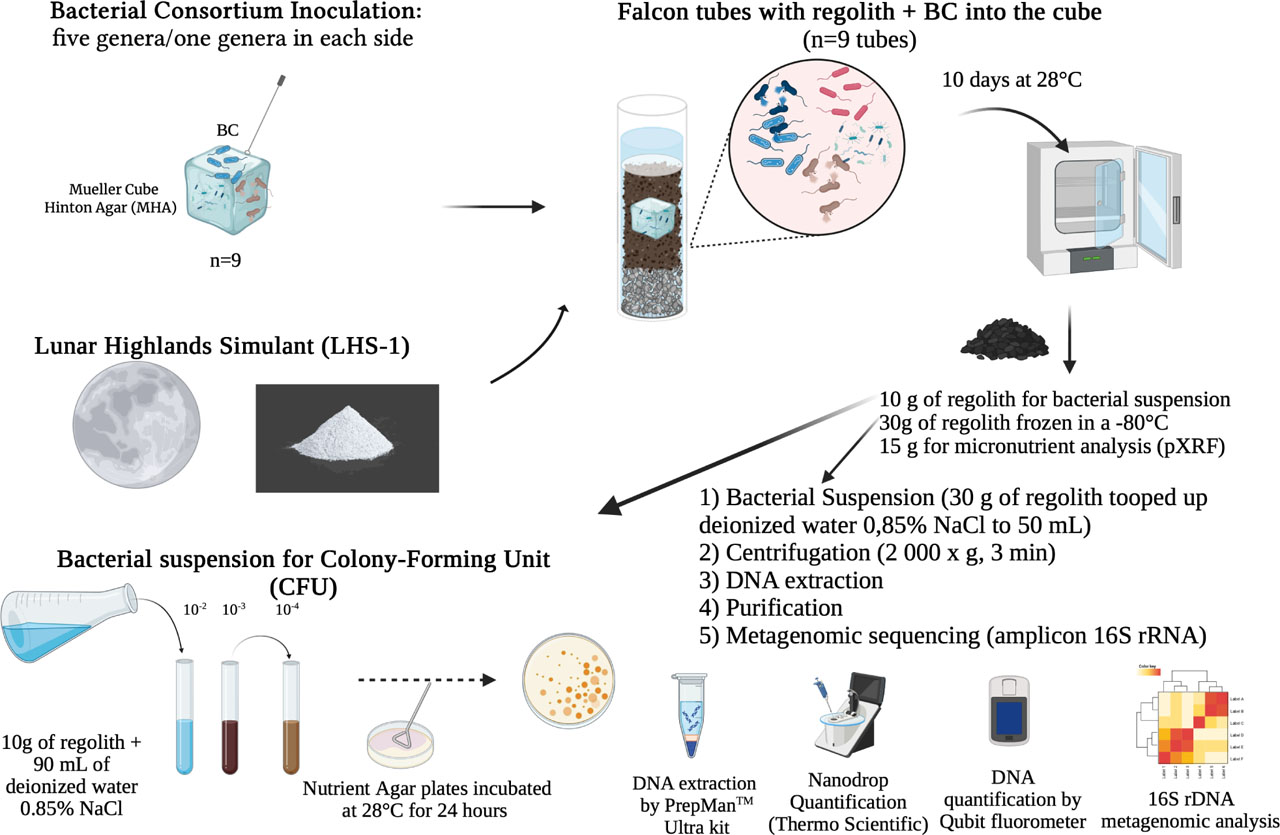
Figure 1.
Schematic drawings showing the steps to DNA Extraction from bacteria consortia inoculated in Lunar Regolith Simulant (LHS-1). Created with BioRender.com.
The detailed formulation, composition, and fabrication methods of the cube are not disclosed here, as they are the subject of a pending patent application. Still, its functionality for microbial delivery under experimental conditions has been fully validated.
The substrate used in the experiment was the Lunar Highlands Simulant (LHS-1) provided by Space Resource Technologies at the University of Central Florida. Before use, 900 g of regolith was autoclaved (Prismatec 50L Analog Vertical Autoclave) at 121 °C for 30 min for sterilization. Nine 50 mL conical tubes were prepared, containing 10 g of regolith; a cube of BC was inserted into each tube and completed with another 10 g of regolith, totaling 20 g of substrate per tube. Control tubes were prepared with only distilled water and uninoculated cubes. After that, hydration was done by adding 10 mL of autoclaved distilled water. The tubes were sealed with PVC film and stored in a Biochemical Oxygen Demand incubator (BOD) (Eletrolab) at 28 °C for 10 days. To maintain relative humidity and prevent substrate dehydration, the tubes were stored in sealed plastic boxes containing a beaker with 250 mL of distilled water.
After the incubation period of the samples, 3 biological pools were prepared containing the substrate from 3 tubes each, homogenized, and 10 g was taken for analysis of bacterial colony counts, 15 g for analysis of micronutrients by X-ray fluorescence, and 30 g was stored at −80 °C for later DNA extraction.
Estimating the number of viable microbial cells
The number of viable microbial cells were estimated by diluting a series of bacterial suspensions from a simulant regolith. In this process, 10 g of the simulant regolith was diluted in 90 mL of 0.85% saline solution in deionized water and mixed for 30 min at 25 °C. Afterwards, it was left to settle for 10 min, and then serial dilution was performed, using 1 mL of the suspension in 9 mL of saline solution up to 10−4. The plates containing Nutrient Agar (K25-1060-500g Bottle - KASVI) were kept in the dark for 24 h, 28 °C, and the number of cells was counted at a dilution of 10−4 for CFU calculation.
DNA isolation from bacterial suspension
Initially, we used 2 g of simulant regolith to prepare a bacterial suspension for DNA isolation. However, low DNA yield (~120 ng) was insufficient for amplicon sequencing using our library preparation protocol, which recommends DNA concentrations of at least 5 ng per microliter (µL) in 40 µL (200 ng in total). It is important to note that some sequencing methods can operate with sub-nanogram DNA inputs; therefore, this threshold reflects the requirement of the protocol used in this study rather than a general limitation of amplicon- or metagenomics-based approaches. For this reason, we scaled up to 30 g of simulant. The steps were:
(1) Regolith samples stored at −80 °C, were thawed to room temperature. 30 g was then placed in a 50 mL conical tube and topped up with 0.85% saline solution (w/v) to a final volume of 50 mL.
(2) Tubes were subjected to vigorous agitation for 30 min and then allowed to rest for 10 min for sedimentation of the substrate.
(3) The supernatant was transferred to a new conical tube and centrifuged at 2000 g for 3 min.
(4) The new supernatant was discarded, and the precipitate resuspended directly in 100 µL of PrepMan™ Ultra Sample Preparation Reagent (Thermo Fisher Scientific, Waltham, MA, USA) by vortexing for 30 s.
(5) The suspended bacterial cells were transferred to a 1 mL microcentrifuge tube.
(6) The following steps were according to the kit manufacturer: Incubation at 95 °C for 10 min; room temperature for 2 min; microcentrifugation at 14.000 rpm for 2 min.
(7) The final supernatant containing DNA was recovered for downstream analyses.
Purification and conventional PCR
Purified DNA samples were processed using the ZR-96 DNA Clean-Up Kit™ (Zymo Research). We resuspended the samples in 40 μL of the elution buffer, expecting to obtain at least 5 ng/μL and thus reach the 200 ng needed for taxonomic analysis. DNA quantification was done using ND™ 1000 UV–vis spectrophotometer (NanoDrop Technologies) and Qubit® 3.0 Fluorometer (Thermo Fisher Scientific). The conventional PCR using the 16S rRNA primers 27F and 1432R, as described in Callahan et al. (2016), was performed as follows: PCR reaction mixture (20 μL) included Phusion Mix (2X), 10 μM of each primer and 1 μL of the template. The amplification cycle was done in a T100™ Thermal Cycler (Bio-Rad) with the following parameters: 98 °C for 30 s, followed by 40 cycles at 98 °C for 10 s; at 55 °C for 30 s; at 72 °C for 90 s, and a final extension at 72 °C for 10 min.
Amplicon sequencing and analysis
The samples were sequenced on Illumina® 16s rRNA amplicon sequencing platform (16SV3-V4/) to generate paired-end raw reads (Raw PE) and then merged and pre-treated to obtain clean tags. Sequencing was performed on an Illumina® MiSeq™ Sequencing System (Illumina, San Diego, CA, USA) according to the company’s protocol (Novogene Corporation Inc., Sacramento, CA, USA). All PCR reactions were carried out with 15 µL of Phusion High-Fidelity PCR Master Mix; 0.2 µM of forward and reverse primers, and about 10 ng template DNA. Thermal cycling consisted of initial denaturation at 98°C for 1 min, followed by 30 cycles of denaturation at 98°C for 10 s, annealing at 50°C for 30 s, and elongation at 72°C for 30 s and 72°C for 5 min. The PCR products were purified using magnetic bead purification. Paired-end reads were assigned to samples based on their unique barcodes and truncated by cutting off the barcodes and primer sequences. The whole process was performed through Python® (V3.6.13), and adaptors were removed through Cutadapt (V3.3). Paired-end reads were merged using FLASH (V1.2.11, http://ccb.jhu.edu/software/FLASH/) (Magoc et al., 2011). Quality filtering on the raw tags was performed using the fastp (Version 0.23.1) software to obtain high-quality clean tags (Bokulich et al., 2012). The tags were compared with the reference database [Silva database (16S/18S), https://www.arb-silva.de/] to detect chimera sequences. Effective tags were obtained by removing the chimera sequences with the VSEARCH® package (V2.16.0, https://github.com/torognes/vsearch) (Edgar et al., 2011).
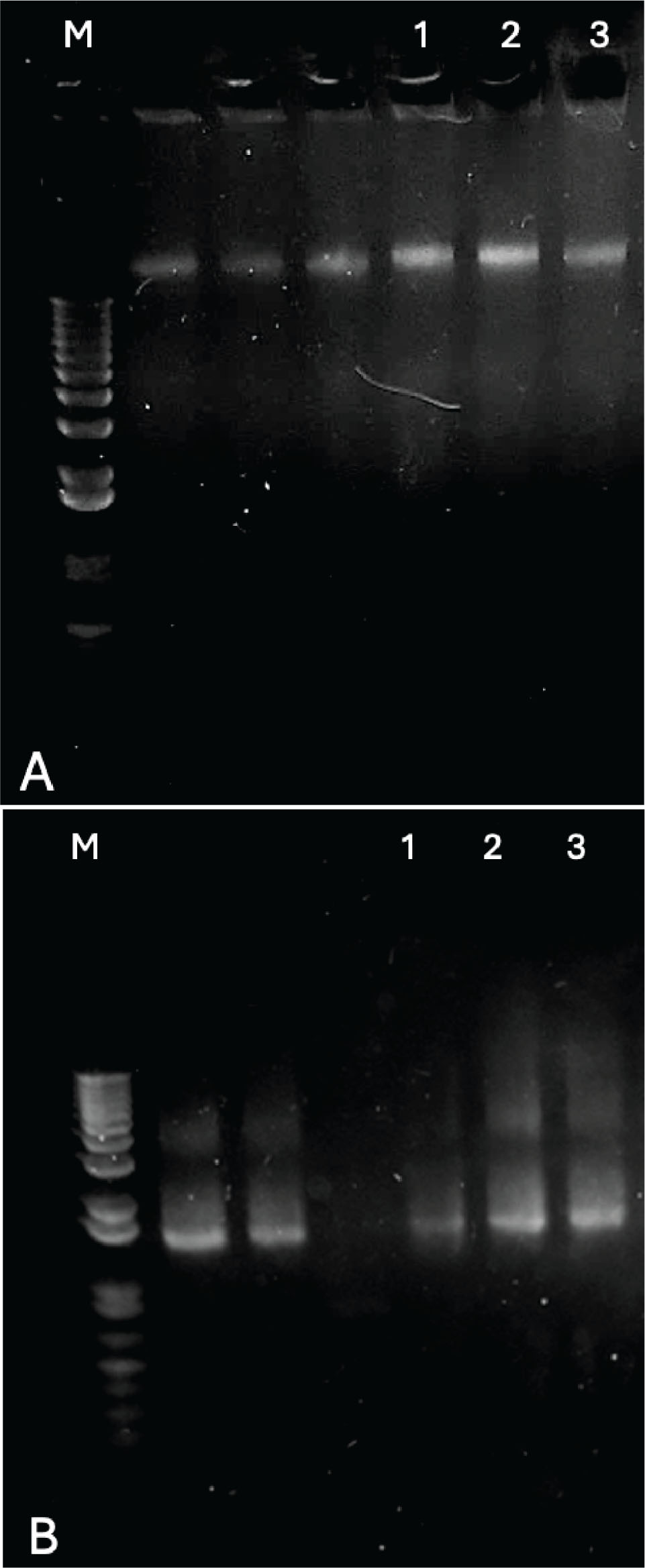
Figure 2.
Agarose gels 1% showing: A. The DNA isolated from bacterial suspension of regolith. B. The PCR amplicons obtained using the universal 16S rRNA primers (27F and 1432R). Legend: M: 1KB ladder marker; the numbers 1, 2 and 3 are the replicates of Bacterial Consortium described.
Results
The number of viable microbial cells estimated by diluting a series of bacterial suspension from simulant LHS-1 was 1.16 × 10⁷ (±3.6 × 10⁶) CFU/mL representing the total viable cell count of the four-species consortium. Converting to regolith mass, this corresponds to approximately 1.0 × 10⁸ cells per gram of regolith. DNA extraction from 30 g of simulated lunar regolith resulted in 26.5, 29.6, and 15.6 ng/g for BC1, BC2, and BC3, respectively. This information is summarized in Table 1. The yield of DNA extraction from each sample pool and the quality analysis measured before and after purification are in Table 2. The total yield, after purification, measured in Qubit® was 796, 888, and 468 ng for samples BC1, BC2, and BC3, respectively. All samples showed sufficient quality to be amplified using 16S universal primers according to Figure 2.
Table 1.
Estimates of microbial biomass and DNA yield per gram of regolith derived from the bacterial suspension approach.
| Metric | Value | Notes |
|---|---|---|
| CFU per mL | 1.16 × 10⁷ | bacterial suspension approach |
| Total suspension volume (mL) | 90 | 10 g regolith |
| Regolith mass used for CFU estimation (g) | 10 | initial mass |
| Cells per gram of regolith (cells/g) | 1.04 × 10⁸ | CFU/mL × volume ÷ mass |
| Regolith mass used for DNA extraction (g) | 30 | per sample |
| DNA yield BC1 (ng/g) | 26.5 | 796 ng / 30 g |
| DNA yield BC2 (ng/g) | 29.6 | 888 ng / 30 g |
| DNA yield BC3 (ng/g | 15.6 | 468 ng / 30 g |
| Mean ± SD DNA (ng/g) | 23.9 ± 7.4 | n=3 |
Table 2.
Comparisons between the quantifications of DNA from the bacterial consortium in lunar regolith after suspension, before and after purification, measured in Nanodrop photometer and in Qubit fluorometer.
| Sample | Nanophotometer Analysis | Qubit Fluorometer | ||||||
|---|---|---|---|---|---|---|---|---|
| Before purification | After purification | Before purification | After purification | |||||
| Purity | Concentration | Purity | Concentration | Concentration | Concentration | |||
| A260/280 | A260/230 | ng/uL | A260/280 | A260/230 | ng/uL | ng/uL | ng/uL | |
| BC1 | 2.6 | 0.47 | 97.6 | 2.27 | 1.44 | 23.8 | 10.1 | 19.9 |
| BC2 | 2.6 | 0.5 | 100.2 | 2.26 | 1.6 | 24.3 | 15.2 | 22.2 |
| BC3 | 2.58 | 0.5 | 76.2 | 2.66 | 1.39 | 8 | 6.82 | 11.7 |
| Average | 2.6 | 0.5 | 91.3 | 2.4 | 1.5 | 18.7 | 10.7 | 17.9 |
After performing quality trimming, approximately 600,000 16S rRNA sequences were obtained. The summarizations from taxonomic analysis obtained in each step of data processing are shown in Table 3.
Table 3.
Results of metagenomic amplicon sequencing 16S rDNA of samples of Bacterial Consortium in lunar regolith obtained after the protocol described.
| Sample | RawPE | Combined | Qualified | Nochime | Base(nt) | Avglen(nt) | GC | Q20 | Q30 |
|---|---|---|---|---|---|---|---|---|---|
| BC1 | 206539 | 204860 | 199906 | 192558 | 80258689 | 416.80 | 55.52% | 98.86% | 95.82% |
| BC2 | 204822 | 203775 | 199144 | 195115 | 80416946 | 412.15 | 56.13% | 98.95% | 96.22% |
| BC3 | 214590 | 213248 | 207797 | 204108 | 84221902 | 412.63 | 56.04% | 98.83% | 95.69% |
Discussion
The advantage of using microbial cubes in cultivation, is that they supply nutrients to the bacteria and keep them together within the same environment. NASA’s Planetary Protection approach emphasizes the importance of containing these microorganisms and preventing them from floating freely, even when they are non-pathogenic, as recommended by the National Academies of Sciences, Engineering, and Medicine (2023). When co-inoculated with plants, the cubes provide nutrients to bacteria before root development begins and promotes exudate production, which can lead to improved nutrient cycling and enhanced plant support. The strong adsorption of DNA to minerals, particularly clays, typically results in low yields during extraction. Commercial kits accelerate and standardize sample processing; however, appropriate kit selection depends on soil sample characteristics (Dineen et al., 2010), and no kit has been specifically designed for regolith simulants. Wang et al. (2024) evaluated different protocols for extracting microbial DNA from the Mars Global Simulant (MGS-1) after incubation with living soil for five weeks, obtaining an average yield of 9 ng/µL under the best conditions. Direito et al. (2012) had previously demonstrated nucleic acid recovery from a range of minerals relevant to Earth and Mars, identifying the most effective buffer as P/EtOH (1 M phosphate buffer, 15% ethanol, pH 8.0). However, their work examined individual minerals, whereas natural sediments contain complex mixtures, making it difficult to predict how DNA extraction efficiency and community profiling are affected by mineral interactions. Therefore, optimizing DNA extraction protocols is essential to improve nucleic acid recovery from regolith samples, considering the complexity of mineral–matrix interactions.
Conclusions
Among the approaches tested, the suspension of bacterial consortia followed by DNA extraction with PrepMan™ Ultra and purification with the Zymo® kit proved efficient, producing up to 888 ng of DNA of sufficient quality for PCR amplification and 16S rRNA sequencing. Furthermore, the microbial cubes method maintained high bacterial viability, isolated DNA in sufficient quantities (up to ~888 ng), and generated approximately 200,000 16S rRNA reads in each sample suitable for taxonomic analysis. This study focused primarily on optimizing DNA extraction from lunar regolith simulant (LHS-1). Detailed characterization of the community will be addressed in future work.
Acknowledgments
Coordination for the Improvement of Higher Education Personnel (CAPES) to J.C.O; Fundação Carlos Chagas Filho de Amparo à Pesquisa do Estado do Rio de Janeiro (FAPERJ [grant number Ref. Proc. E-26/210.152/2025 to C.M.P]; FAPERJ SEI-260003/001725/2025 - APQ1 Federal University of the State of Rio de Janeiro (UNIRIO). The authors would lik to thank NASA (National Aeronautics and Space Administration) for providing the operational support as part of the Space Act Agreement with Winston-Salem State University (KCA-4754).