
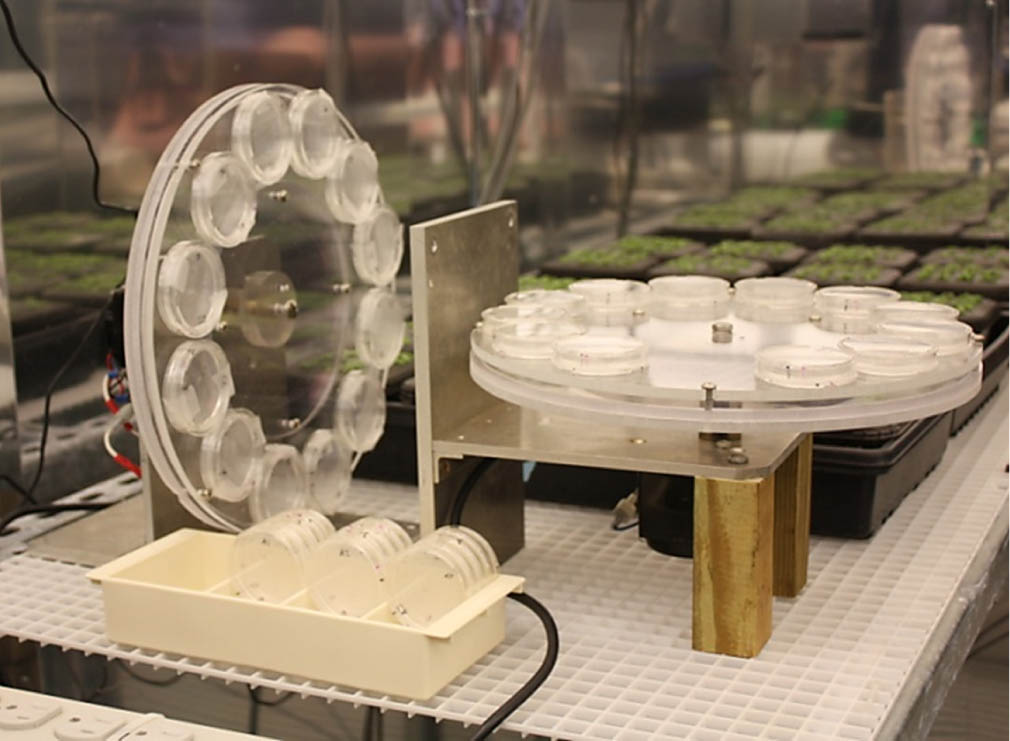
Figure 1.
Configuration of custom horizontal and vertical 2-D clinostats used to model microgravity during the A. thaliana and P. indica co-culture experiments. Clinostats were maintained in controlled environment chambers with regulated CO2, temperature, relative humidity, light intensity, and photoperiod.
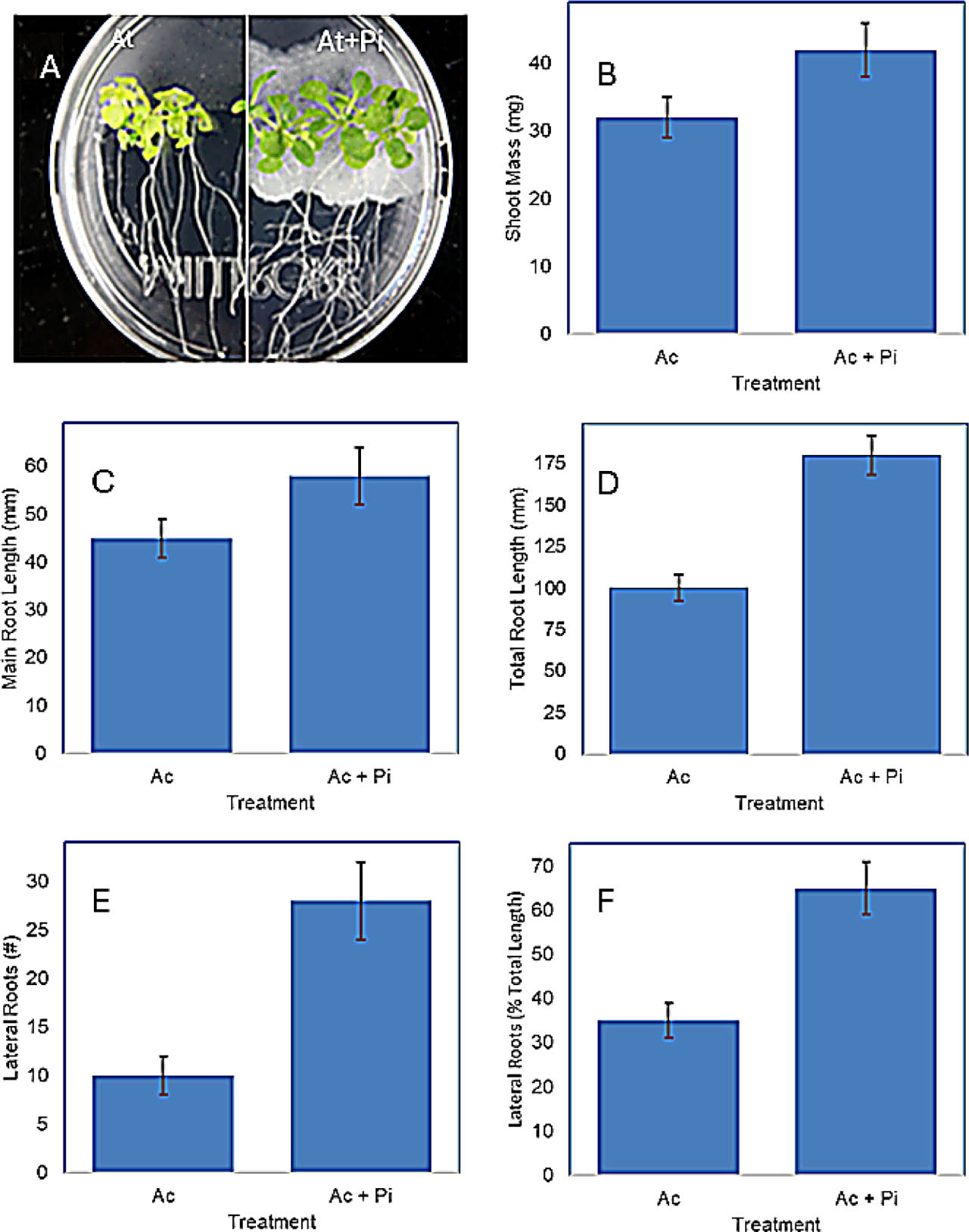
Figure 2.
Biometric assessment of A. thaliana (At) control treatments and A. thaliana inoculated with P. indica (Pi) at the time of seeding. Panel A shows a bright-field micrograph of root and shoot morphology in uninoculated and inoculated seedlings. Panels B–F present quantitative measurements of shoot fresh mass (B), main root length (C), total root length (D), number of lateral roots (E), and the percentage of total root length contributed by lateral roots (F). Bars represent mean values ± standard deviation (n = 6 plates per treatment).
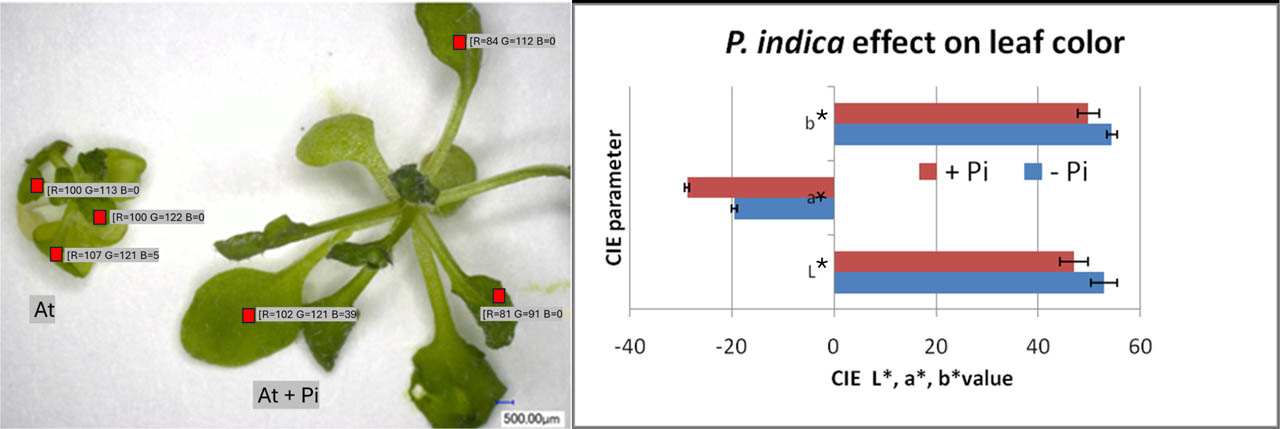
Figure 3.
Visual and quantitative assessment of leaf pigmentation in Arabidopsis thaliana (At) control seedlings and seedlings inoculated with Piriformospora indica (At+Pi). Panel A shows representative brightfield images of uninoculated and inoculated seedlings after 14 days of growth, with rectangular regions of interest (ROIs) indicating areas selected for color analysis. Panel B presents CIELAB color parameters, including lightness (L*), green–red axis (a*), and blue–yellow axis (b*), derived from RGB values extracted from the ROIs and converted to CIELAB color space. Lower a* values and reduced L* values indicate increased green pigmentation and are commonly used as nondestructive optical proxies for relative chlorophyll content in leaf tissues (Richardson et al., 2002). Bars represent mean values ± standard deviation (n = 6 plates per treatment).
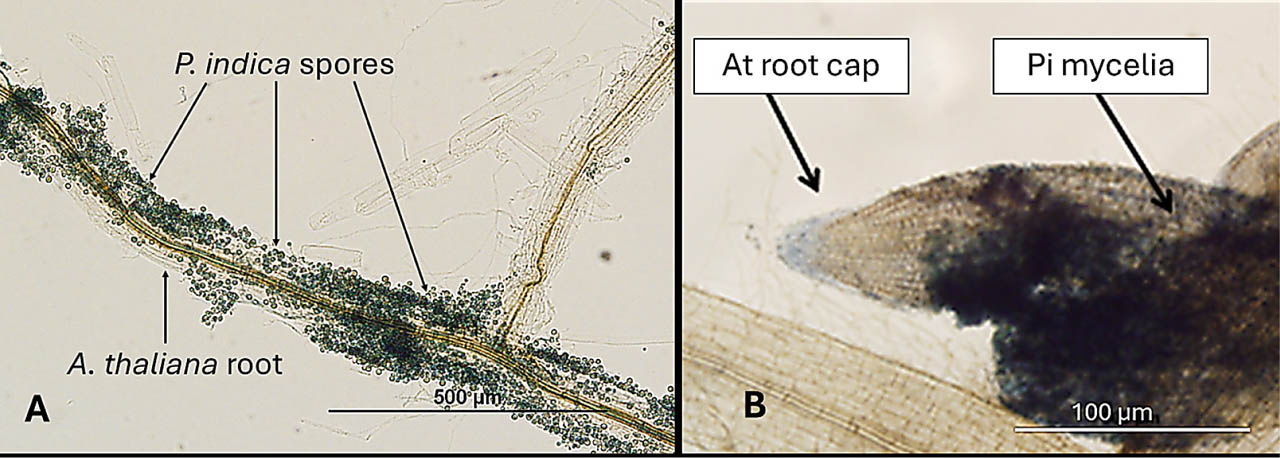
Figure 4.
Photomicrograph of Arabidopsis thaliana roots colonized by Piriformospora indica. Panel A shows extensive P. indica association along the root surface, including dense mycelial networks and abundant spherical spores distributed along the rhizodermis. Panel B presents a higher-magnification view of the root cap region, highlighting localized mycelial accumulation at the root apex. Fungal structures are closely associated with epidermal tissues without visible disruption of root surface continuity. Images were acquired using ink–vinegar staining and brightfield microscopy. Scale bars = 500 μm (A) and 100 μm (B).