Introduction
Plant-microbe mutualistic interactions, such as those between arbuscular mycorrhizal fungi (AMF) and terrestrial plants, have played an essential role in the evolution of land plants. These associations facilitate enhanced nutrient uptake, stress resilience, and plant vigor, with AMF relationships documented in approximately 80% of vascular plant species (Smith and Read, 2008). In space environments, beneficial microbial symbioses face novel microgravity-related challenges that individually and collectively lead to physiological stress, including altered fluid dynamics (Hatch et al., 2022), disrupted root exudation (Liu et al., 2018), and impaired microbial chemotaxis (Acres et al., 2021). In the unique controlled-growth environment of plant cultivation systems in low Earth orbit, persistent microgravity, increased radiation, altered gaseous composition (e.g., elevated CO2), and reduced convective mixing yield profound novel changes in the physical environment that contribute to physiological and biological alterations at the molecular and gene expression level that directly alter host and symbiont physiology as well as the ecological stability and performance of these mutualisms (Ferl et al., 2002; Kiss et al., 2019).
Animal and plant model systems converge on a common principle in space biology: microgravity perturbs the molecular ‘handshake’ between hosts and their microbiomes, shifting the balance along the mutualism–parasitism continuum. In the Euprymna scolopes–Vibrio fischeri symbiosis, modeled microgravity delays innate immune cell trafficking, accelerates bacteria-induced apoptosis, and amplifies microbe-associated molecular pattern (MAMP) signaling via increased lipopolysaccharide (LPS) and outer-membrane vesicle (OMV) release. At the transcriptome level, microgravity dysregulates host NF-κB pathway components and elicits stress-responsive programs during colonization (Foster et al., 2013; Casaburi et al., 2017; Vroom et al., 2021; Duscher et al., 2018; Duscher et al., 2024). These studies establish that gravitational unloading can retime and rescale reciprocal signaling, even for beneficial partners. In plants, ecological network analyses also show that the abiotic context reconfigures interspecies interactions, with hub taxa and stress exposure determining whether outcomes manifest as mutualism, commensalism, competition, or disease (Agler et al., 2016). Together, these data motivate using binary models to dissect how spaceflight-relevant physics modulates MAMP pathways and host development.
Previous studies of microbial interactions in space have predominantly focused on pathogenicity and stress responses using human pathogens, such as Salmonella enterica and Pseudomonas aeruginosa, which exhibit markers of increased virulence (Nickerson et al., 2000; Crabbé et al., 2013). In contrast, beneficial microbial partnerships—like rhizobia-legume nitrogen fixation or mycorrhizal fungi—remain largely unexplored under microgravity. This represents a significant gap in our understanding of plant resilience in extraterrestrial environments.
Recent work has demonstrated that microgravity can intensify microbial virulence (Nickerson et al., 2000) and modulate host immune responses (Crabbé et al., 2013), yet few studies have systematically investigated its impact on beneficial plant-microbe interactions. The use of Piriformospora indica, a cultivable root endophyte of the Sebacinaceae family, circumvents limitations posed by AMF's obligate symbiosis and inability to grow axenically. P. indica can promote growth, enhance stress tolerance, and increase nutrient uptake in a broad range of plant hosts, including a model plant species, A. thaliana, which makes it a valuable model for studying mutualism under altered gravity conditions (Varma et al., 1999; Deshmukh et al., 2006).
Given that Arabidopsis has a sequenced genome, well-characterized developmental patterns, and an extensive history of use in microgravity research, it has been recommended by the National Research Council as a model species for space biology (NRC, 1998). Here, we describe the ground-based, modeled microgravity results from the MuRGE (Mutualism in a Reduced Gravity Experiment) experiment, which builds on this foundation by testing the hypothesis that microgravity alters the establishment and stability of beneficial mutualisms between P. indica and A. thaliana. This model system offers an ideal platform for dissecting the cellular, biochemical, and morphological changes involved in plant-fungal mutualism under altered mechanical constraints imposed by spaceflight.
Materials and Methods
Culture Conditions and Media Preparation: Murashige and Skoog (MS) medium (PhytoTechnology Laboratories, M519) was prepared using 2.2 g/L MS salts, 0.5 g/L MES buffer (Sigma-Aldrich, M3671), 2.5 g/L sucrose (Sigma-Aldrich, S7903), and 1 mL/L Gamborg B5 vitamin mix (Sigma-Aldrich, G1019), solidified with 0.8% (w/v) Phytagel (Sigma-Aldrich, P8169). The pH was adjusted to 5.75 using 1 N KOH prior to autoclaving.
Seed Sterilization and Planting: Arabidopsis thaliana (ecotype Col-0) seeds were surface-sterilized with 70% ethanol (1 min), then with 50% bleach (Clorox) + 0.1% Tween-20 (Sigma-Aldrich, P9416) for 10 min and rinsed 10 times with sterile deionized water. Seeds were placed on 60 mm sterile Petri dishes (VWR) containing 5 mL of prepared MS medium. Seeds were pipetted in 5 μL droplets at densities of 6, 12, or 18 seeds per plate.
Fungal Culture and Spore Preparation: Piriformospora indica (DSMZ strain DSM 11827) was successfully cultured on both MS and Potato Dextrose Agar (PDA; Difco) at 30°C. Spore suspensions used in the inoculations were prepared by flooding cultures grown on MS medium plates with sterile DI water and scraping hyphal mats with a polypropylene spreader. The spore suspension was filtered through a 40 μm cell strainer (Corning) and centrifuged at 5,000 rpm. The pellet was resuspended and counted using a hemocytometer (Hausser Scientific, Horsham, Pennsylvania, USA).
Inoculation and Incubation: A. thaliana seeds were inoculated at planting with 2 μL of a 1 × 10⁵ spores/mL suspension of P. indica. Plates were wrapped in foil and incubated vertically at 22°C, 50% RH, 1200 μmol mol−1 CO2.
Modeled Microgravity: Plates were mounted on a horizontal 2-D clinostat rotating at 1 rpm to simulate microgravity. While this analog reproduces some gravitational unloading effects, it does not fully replicate the biophysical forces or fluid shear patterns of orbital flight and introduces mechanical stress on organisms due to centrifugal forces (Mansour et al., 2023). The residual mechanical loading on the seedlings was estimated, assuming the seedlings were positioned from 0.10 to 0.14 m from the axis of rotation, to have experienced centripetal accelerations of 1.1–1.5 x 10⁻³ms−2, equivalent to 1.1–1.6 x 10⁻⁴ g, resulting in effective centrifugal forces of approximately 7–12 nN per seedling.
These values confirm that the mechanical forces generated by the clinostat are small, relative to 1 g, but are not zero. Nevertheless, the clinostat remains a widely accepted terrestrial analog for pre-flight validation of gravitational response pathways and is useful for demonstrating physical effects on biological systems exposed to free-fall and rotational environments in which the gravity vector is variable.
Treatments: Four custom-built slow-rotation clinostats (1 rpm) were used to evaluate the responses of Arabidopsis thaliana and Piriformospora indica to altered gravity vectors.
Each clinostat was configured to accommodate twelve 60-mm Petri plates, arranged into four sets of three plates each. The following treatments were assigned per clinostat:
– Treatment A: Arabidopsis thaliana only (At)
– Treatment B: A. thaliana with P. indica spores (At + Pi spores)
Each treatment was replicated across three Petri plates. Petri plates contained 18 A. thaliana seeds each for the relevant treatments. The experimental setup is shown in Figure 1.
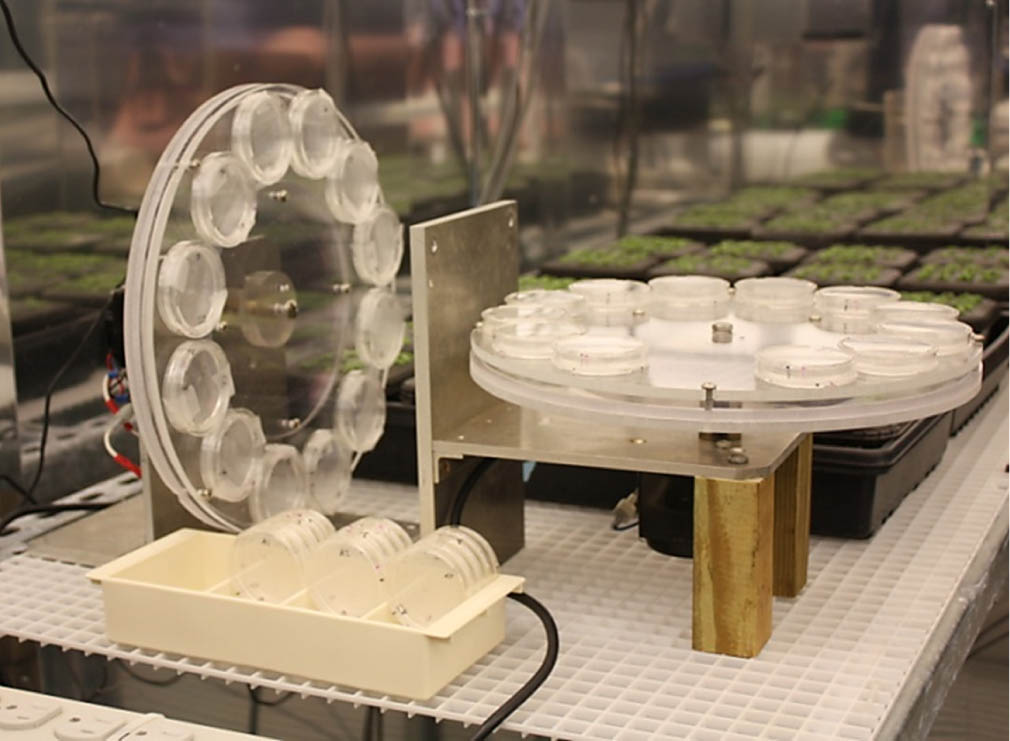
Figure 1.
Configuration of custom horizontal and vertical 2-D clinostats used to model microgravity during the A. thaliana and P. indica co-culture experiments. Clinostats were maintained in controlled environment chambers with regulated CO2, temperature, relative humidity, light intensity, and photoperiod.
All samples were incubated in a controlled-environment chamber (EGC M-36; Environmental Growth Chambers, Chagrin Falls, OH) to ensure consistent light quality, light intensity, and environmental conditions across all treatments. The photoperiod was set to 18:6 hour light: dark cycles at 300 μmol−2 s−1 photosynthetically active radiation (PAR) being provided with T8 triphosphor fluorescent (TPF) lamps (Sylvania FP541/841/HO; Osram Sylvania, Westfield, IN) The CO2, temperature and relative humidity (RH) were maintained at 1200 ppm CO2, 22°C, and 50% RH respectively to simulate a relevant spacecraft environment. Photoperiod and environmental conditions were maintained using an integrated control, monitoring, and data management system.
Ink and Vinegar Staining Protocol: To visualize Piriformospora indica hyphae and spore colonization in Arabidopsis thaliana root tissues, a modified ink-vinegar staining method adapted from Pitet et al. (2009) was used. This protocol was selected for its superior contrast compared with traditional Acid Fuchsin/Lactic Acid stains, which are prone to interference from tissue autofluorescence.
Root samples were first cleared of phenolics and pigmented compounds by incubating in 10% potassium hydroxide (KOH) at 100°C for 5 minutes. Following clearing, roots were rinsed thoroughly with sterile distilled water. Tissues were then fixed in 5% acetic acid for 5 minutes and rinsed repeatedly with distilled water. Staining was conducted overnight in a solution composed of 5% (v/v) black ink (Schaeffer) in 5% acetic acid. After staining, samples were destained using an acidified glycerol solution (50% glycerol containing 5% acetic acid) to remove excess background coloration. Processed roots were mounted on slides and analyzed by brightfield microscopy for the presence of hyphae and chlamydospores.
Morphological and Digital Analysis: Shoots were excised at 14 DAP, and fresh mass was determined using an analytical balance (Mettler Toledo, Columbus, Ohio, USA). The excised shoots were imaged and digitized with a Keyence VHX-1000E digital microscope (Keyence Corp., Itasca, IL, USA) equipped with a 12V, 100W halogen lamp. All samples were imaged under standardized bright-field illumination to maintain uniform contrast and exposure across treatments.
Because the plant was small, direct measurements of leaf pigmentation were not possible, and analysis of digital images was used as a proxy for chlorophyll content. The “greenness” of the leaves was determined by extracting the Red, Blue, and Green (RGB) of multiple points from fully expanded leaves from the digital images using the Keyence VHX software. The RGB values (in the NSTC RGB color model) were converted to CIE 1967 Standard CIELAB equivalents (L*a*b*), which are closer approximations to human vision, using the CIE Color Calculator (www.brucelindbloom.com).
The remaining roots were carefully transferred from the growth media onto glass microscope slides and imaged with a Fluorchem 8900 imager (Alpha Innotech, San Leandro, CA) equipped with a cooled 1.92-megapixel CCD camera. Auto-exposure mode was used to optimize image acquisition. The main root length, number of laterals, and total root length were determined with ImagePro Plus 7.0 (Media Cybernetics, Rockville, MD).
Statistical Analysis: All quantitative data are presented as mean ± standard deviation. Statistical significance between treatments was assessed using a two-tailed Student's t-test assuming unequal variances. A threshold of p < 0.05 was considered significant for all comparisons. Statistical analyses were conducted using Microsoft Excel (Redmond, WA) and validated with GraphPad Prism ver. 9 (La Jolla, CA).
Results
There were no significant main effects or interactions attributable to the modelled gravity treatment (stationary vs. clinostat) for any biometric parameter. In accordance with established statistical practice, these treatments were pooled to increase statistical power and reduce residual variance (Quinn and Keough, 2022).
Germination rates ranged from 86.3% to 100% across all treatments, with no significant differences observed between inoculated and uninoculated seeds. Under 2-D clinostat rotation, both root and shoot growth of inoculated seedlings remained comparable to static controls. Visual observation confirmed that P. indica maintained viability and root-colonization morphology under a 2-D clinostat simulation of microgravity, including hyphal extension and sporulation.
Aboveground biomass was significantly increased in P. indica-treated seedlings. Figure 2A shows a representative sample of A. thaliana control and inoculated treatments. Shoot fresh mass increased with P. indica inoculation of the roots. Fresh mass of aerial tissues rose from approximately 30 mg in controls to 42 mg in inoculated plants (Figure 2b). Root system architecture was also substantially altered by P. indica inoculation. Main root length increased from a mean of 44 mm in controls to 60 mm in inoculated seedlings (Figure 2c). Total root length increased 83% from 98 mm to 180 mm (Figure 2d) and the number of lateral roots tripled, going from an average of 10 in control plants to 30 in inoculated plants (Figure 2e), and the proportion of root length contributed by lateral roots increased 81%, rising from 37% to 67% of total root length (Figure 2f).
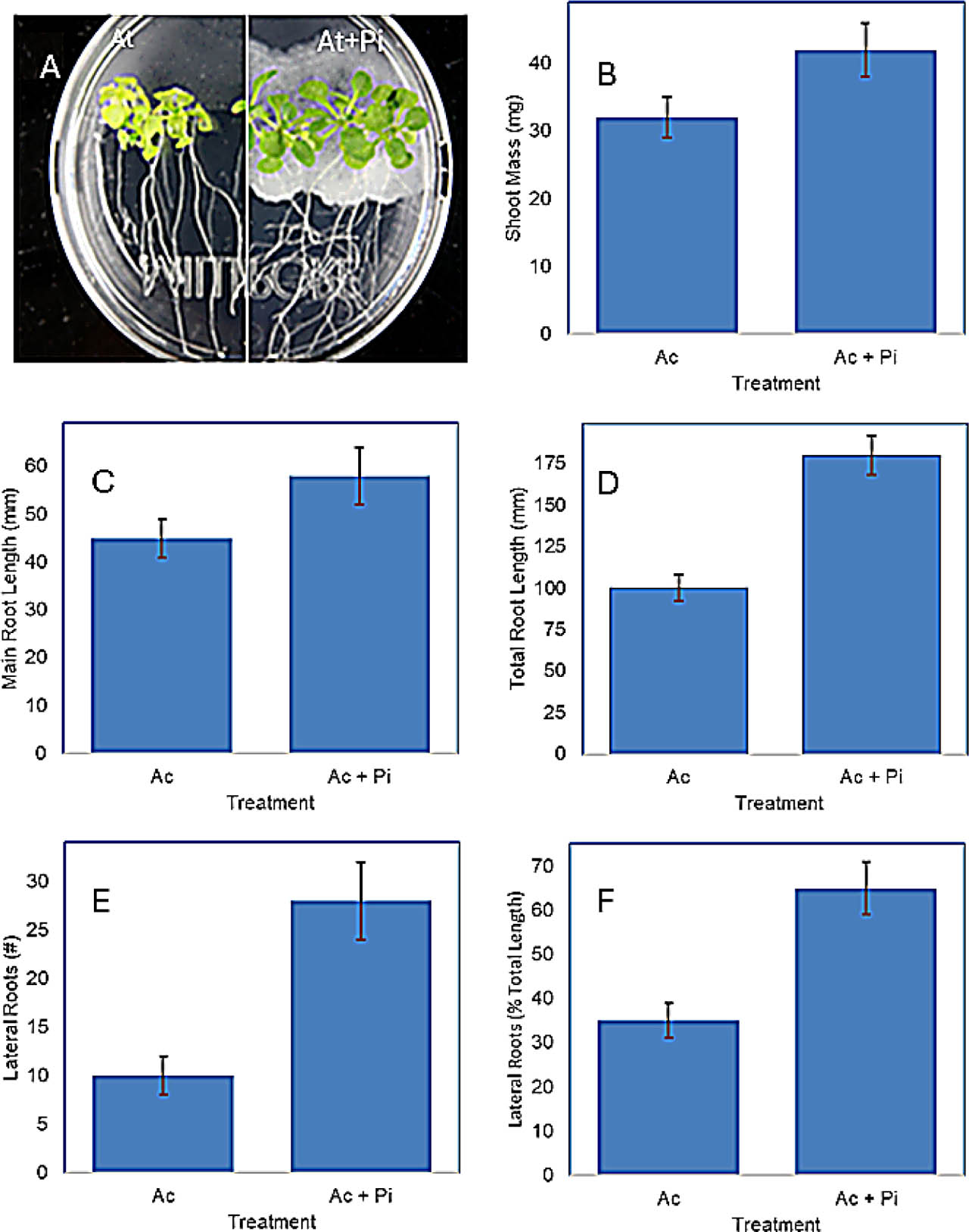
Figure 2.
Biometric assessment of A. thaliana (At) control treatments and A. thaliana inoculated with P. indica (Pi) at the time of seeding. Panel A shows a bright-field micrograph of root and shoot morphology in uninoculated and inoculated seedlings. Panels B–F present quantitative measurements of shoot fresh mass (B), main root length (C), total root length (D), number of lateral roots (E), and the percentage of total root length contributed by lateral roots (F). Bars represent mean values ± standard deviation (n = 6 plates per treatment).
Digital color metrics derived from the CIELAB color space, particularly the a* (green-red) and L* (lightness) parameters, have been widely used as non-destructive optical proxies for relative chlorophyll content in plants (Richardson et al., 2002). Leaf pigmentation was quantified by extracting RGB values from standardized brightfield images and converting them to the device-independent CIELAB color space, as described in the Materials and Methods (Figure 3). This approach minimizes the influence of illumination and imaging-system variability while enabling quantitative comparison of color differences along a visual axis. Using this analysis, P. indicainoculated seedlings exhibited a shift in leaf color parameters relative to the uninoculated controls, characterized by a more negative a* value and reduction in L* (Figure 3 B), which is consistent with increased green pigmentation. This aligns with the observed increase in seedling biomass and suggests enhanced chlorophyll accumulation in the leaves.
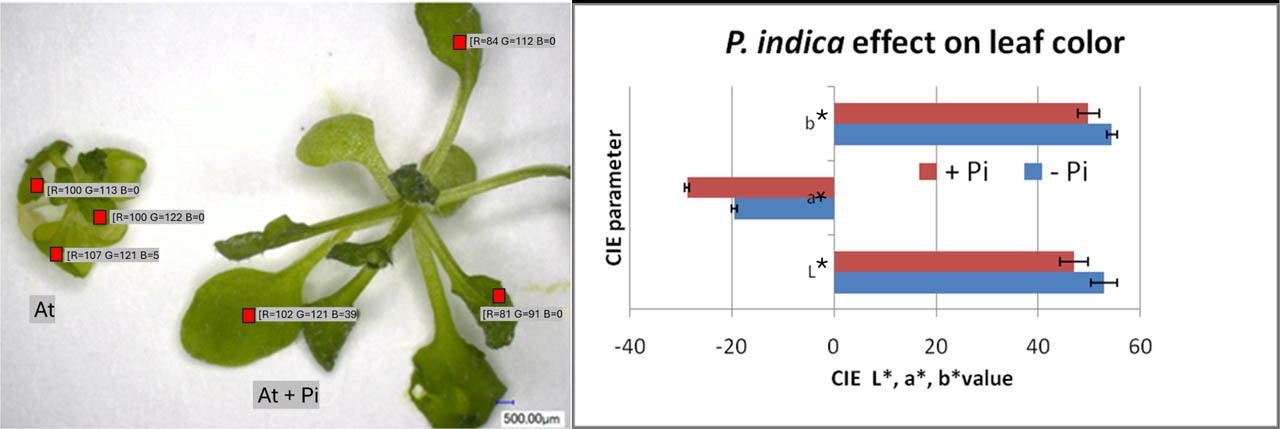
Figure 3.
Visual and quantitative assessment of leaf pigmentation in Arabidopsis thaliana (At) control seedlings and seedlings inoculated with Piriformospora indica (At+Pi). Panel A shows representative brightfield images of uninoculated and inoculated seedlings after 14 days of growth, with rectangular regions of interest (ROIs) indicating areas selected for color analysis. Panel B presents CIELAB color parameters, including lightness (L*), green–red axis (a*), and blue–yellow axis (b*), derived from RGB values extracted from the ROIs and converted to CIELAB color space. Lower a* values and reduced L* values indicate increased green pigmentation and are commonly used as nondestructive optical proxies for relative chlorophyll content in leaf tissues (Richardson et al., 2002). Bars represent mean values ± standard deviation (n = 6 plates per treatment).
Microscopic imaging revealed extensive Piriformospora indica association with Arabidopsis thaliana roots, characterized by dense hyphal networks along the root surface and abundant spherical spores associated with epidermal and cortical regions (Figure 4 A,B). At higher magnification, localized fungal accumulation was evident near the root cap and along the rhizodermis, consistent with active colonization. The presence of spores under these conditions indicates that fungal growth and sporulation were maintained under the modeled microgravity environment, demonstrating that these developmental processes occur in the absence of normal gravitational cues.
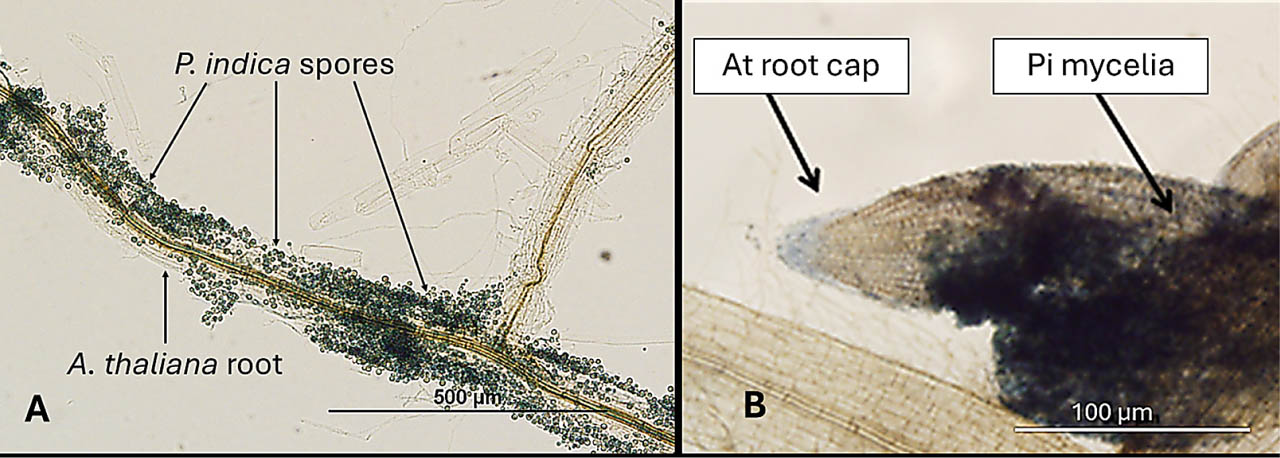
Figure 4.
Photomicrograph of Arabidopsis thaliana roots colonized by Piriformospora indica. Panel A shows extensive P. indica association along the root surface, including dense mycelial networks and abundant spherical spores distributed along the rhizodermis. Panel B presents a higher-magnification view of the root cap region, highlighting localized mycelial accumulation at the root apex. Fungal structures are closely associated with epidermal tissues without visible disruption of root surface continuity. Images were acquired using ink–vinegar staining and brightfield microscopy. Scale bars = 500 μm (A) and 100 μm (B).
Discussion
Because no statistically significant differences were detected between stationary and clinorotated seedlings, the following interpretation focuses on the P. indica-dependent phenotypes that persist despite randomization of the gravitational vector. This indicates that initial stages of mutualistic signaling and developmental modification are gravity robust within the sensitivity of our testing. These findings are consistent with terrestrial reports demonstrating P. indica's ability to promote plant biomass, lateral root development, and stress resilience (Deshmukh et al., 2006; Varma et al., 1999). Here, we extend those observations into a space-relevant context.
Inoculated plants demonstrated a 162% increase in total root length and a threefold increase in the number of lateral roots compared to uninoculated controls (Figure 2). These quantitative increases (Fig. 2d-f) show that morphological reprogramming proceeds normally even when the gravity vector is continuously randomized, suggesting that developmental pathways influenced by P. indica, such as lateral root initiation and main root elongation, do not require a stable sedimentation signal. These architectural changes were supported by quantitative image analysis and highlight P. indica's influence on root system morphology. The increase in lateral roots likely contributes to improved nutrient acquisition and overall plant stability. This is an important morphological modification in microgravity environments, where soil-root contact dynamics are altered.
Beyond root morphology, inoculated plants showed increased shoot biomass and greater green leaf pigmentation, as inferred from CIELAB color analysis. Enhanced greenness (lower a* values) indicates a possible upregulation of chlorophyll biosynthesis, which could be mediated by fungal signals or nutrient reallocation prompted by fungal colonization. The concurrent ~40% increase in shoot biomass (Fig. 2b) strengthens this interpretation, as deeper pigmentation and increased leaf mass typically co-occur when resource allocation favors photosynthetic expansion (Evans, J. R., 1989). This phenotype is consistent with known P. indica-mediated shifts in carbon allocation and chloroplast development under terrestrial conditions (Sherameti et al., 2005).
Microscopic imaging revealed robust fungal colonization. One notable image (Figure 4) displays intense P. indica hyphal colonization across the root surface, with visible hyphae forming networks at the root cortex. The presence of intracellular chlamydospores under both clinorotation conditions confirms that the key life stages, including reproductive differentiation, proceed normally during gravity-vector randomization. Increased magnification (Figure 4B) clearly shows intracellular chlamydospore formation in A. thaliana cortical cells, stained using ink-vinegar protocols. These chlamydospores appear dark and globular, providing direct empirical evidence that sporulation occurs even in the absence of gravitational cues (e.g., sedimentation), which is essential for the viability of fungal mutualism in space environments.
Our results show that P. indica maintains colonization and growth promotion in A. thaliana under clinorotation while remodeling root architecture and leaf pigmentation, which serve as clear indicators of strong host–microbe signaling in a space-relevant environment. All measured outcomes, including increased total biomass, enhanced pigmentation, and extensive lateral root formation, are characteristic of a stable mutualistic state rather than a transition towards parasitism. This supports the hypothesis that the P. indica-A. thanliana symbiosis is achieved under disrupted gravity conditions.
Thus, the P. indica-A. thaliana model system illustrates how microgravity can modulate mutualistic signaling with consequences for developmental and physiological outcomes in ways relevant to spaceflight bioregenerative systems. Extending this principle beyond plants, comparable gravity-sensitive disruptions are observed in animal hosts where immune surveillance and microbial signals are integrated. The Euprymna scolopes-Vibrio fisheri model provides a complementary case for dissecting these host-microbe dynamics in animals.
As in the squid–Vibrio system, the plant model offers precise leverage over both sides of the interaction (axenic P. indica; genetically tractable Arabidopsis), enabling hypothesis-driven tests of how microgravity alters perception and response to fungal MAMPs (e.g., chitin/β-glucan) and to fungal extracellular vesicles, the plant analog of bacterial OMVs. Although molecular signaling was not directly assayed in our study, the preservation of morphological and pigmentation phenotypes under clinorotation suggests that early perception of fungal MAMPs and downstream developmental signaling were not disrupted. Because microgravity can heighten microbial virulence and perturb host immunity, a binary plant system that can be toggled across the mutualism–parasitism boundary (e.g., P. indica's context-dependent requirement for host cell death in cereals) becomes a powerful ecological model for predicting when stress will flip beneficial interactions toward disease.
Concretely, P. indica–A. thaliana allows quantification of gravity-sensitive traits (e.g., exudate flow, MAMP signaling kinetics, defense hormone crosstalk) while offering versatile and scalable experimental designs for spaceflight investigations in multiple hardware. This directly complements the animal literature and extends it into plant bioregenerative life support, where maintaining cooperative microbiomes is mission-critical.
These morphological and pigmentation changes may be mediated by known fungal influences on plant signaling pathways. Prior terrestrial studies suggest that P. indica can alter auxin gradients to stimulate lateral root formation and may modulate jasmonic acid (JA) and salicylic acid (SA) pathways to balance growth and defense. Under modeled microgravity, such modulation could be amplified if fluid dynamics change root exudation patterns or MAMP perception kinetics. Moreover, fungal extracellular vesicles could serve as gravity-sensitive carriers of signaling molecules, linking structural phenotypes to underlying biochemical cues. The morphological results observed, particularly the tripling of lateral roots and the 83% increase in total root length, are consistent with auxin redistribution documented in terrestrial P. indica studies (Sirrenberg et al., 2007). Similarly, the increase in shoot biomass and pigmentation is consistent with JA/SA modulation when resources are reallocated from defense to growth (Jacobs et al., 2011).
Confirmation that P. indica can complete its life cycle in culture without a plant host and maintain infectivity under clinostat conditions further supports its utility for future flight experiments. Unlike obligate AMF, P. indica can be mass cultured and cryopreserved, enabling integration into payload designs where space, mass, and biosecurity constraints are critical.
Taken together, these findings validate the MuRGE model as a tractable and informative system for investigating host-microbe interactions under spaceflight conditions. Because no gravity-dependent differences were detected, the clinostat specifically demonstrates that P. indica-mediated programming and colonization are stable under gravitational vector randomization. This suggests a robust phenotypic baseline for evaluation in future spaceflight experiments. They also suggest that P. indica could serve as a biostimulant in bioregenerative life support systems, where promoting root robustness and plant productivity are essential goals. Future studies could incorporate transcriptomic profiling and proteomic analysis to further elucidate the molecular mechanisms underlying mutualistic signaling and adaptation in space.
Conclusion
This study establishes Arabidopsis thaliana–Piriformospora indica mutualism as a viable and responsive model system for evaluating plant-microbe interactions under simulated microgravity and spaceflight conditions. Using a combination of clinostat-based analogs, rigorous imaging protocols, and quantitative morphological assessment, we demonstrated that P. indica retains its ability to colonize host roots, induce lateral root formation, increase total root and shoot biomass, and enhance leaf pigmentation in a spaceflight-relevant environment.
The ability of P. indica to sporulate independently of a plant host and maintain infectivity after exposure to modeled microgravity strengthens its potential as a deployable bioinoculant for future bioregenerative life support systems. These findings provide a foundational step toward incorporating microbial symbiosis into controlled ecological life support strategies for long-duration missions, including those to the Moon or Mars. Although clinostats effectively randomize the gravity vector, they cannot replicate the absence of sedimentation, altered fluid shear, or gas–liquid phase separation observed in orbit. As such, clinostat data should be interpreted as pre-flight validation of gravitational response pathways rather than direct surrogates for spaceflight results. Future work integrating clinostat data with transcriptomic and metabolomic profiling in actual flight will be critical to confirm whether the observed phenotypes extend to orbital conditions.
Beyond spaceflight applications, this research informs terrestrial practices in low-input and climate-challenged agriculture, particularly in vertical and soilless systems where synthetic inputs must be minimized. The compatibility of this model with sterile, modular culture systems aligns well with current innovations in plant production technologies.
Overall, the MuRGE experiment demonstrates the practicality, adaptability, and scientific value of using a non-obligate endophyte to explore the dynamics of plant mutualism in non-terrestrial environments.
Acknowledgements
This research was supported by NASA Grant NNX10AG93G. We acknowledge support from the CSS, Inc. (Consolidated Safety Services, formerly CSS-Dynamac Corporation), Space Florida's Space Life Sciences Lab, and the NASA John F. Kennedy Space Center during the performance of this research. We thank DSMZ for providing the P. indica cultures and Dr. Christina M. Johnson for editorial review.