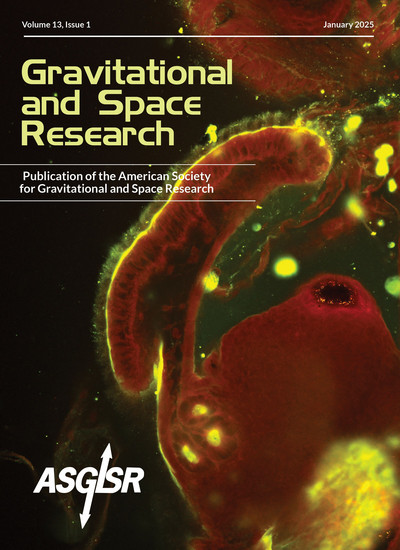
Impact of Simulated Microgravity Environment on Bioprinted Tissue Constructs
Abstract
Microgravity significantly impacts cellular functions and physiological systems, leading to oxidative stress and cellular dysfunction. This study investigated the effects of simulated microgravity on bioprinted vascular tissue constructs made with human skin fibroblast cells encapsulated in GelMA-based bioink. The bioprinting parameters were optimized to obtain tissue constructs with high structural integrity and cellular viability. Cellular viability remained high despite some cell death, likely caused by shear stress during bioprinting or limited nutrient availability while maintaining the samples in a bioreactor. The samples were stained with DHE solution to characterize the oxidative stress and imaged using a confocal microscope. The study revealed that oxidative stress, quantified by reactive oxygen species (ROS) levels, increased significantly after 48 h of simulated microgravity exposure. The ROS levels rose from 24 h to 48 h and then there was a subsequent decrease at 72 h, which reflects typical cellular responses to stress from microgravity such as cell adaptation and possible recovery mechanisms. These findings highlight the need for targeted strategies, such as incorporating antioxidants or mitochondria supporting compounds into the bioinks and dynamic culture systems to mitigate the effects of microgravity-induced oxidative stress.
© 2025 Sampada Koirala, Bela Perdomo, Brian Billings, Dylan Welch, Roshan Vijayakumar, Meghana Nelli, Caroline Moore, Caleb Phillips, Isscca Hall Burns, Kunal Mitra, published by American Society for Gravitational and Space Research
This work is licensed under the Creative Commons Attribution-NonCommercial-NoDerivatives 3.0 License.