
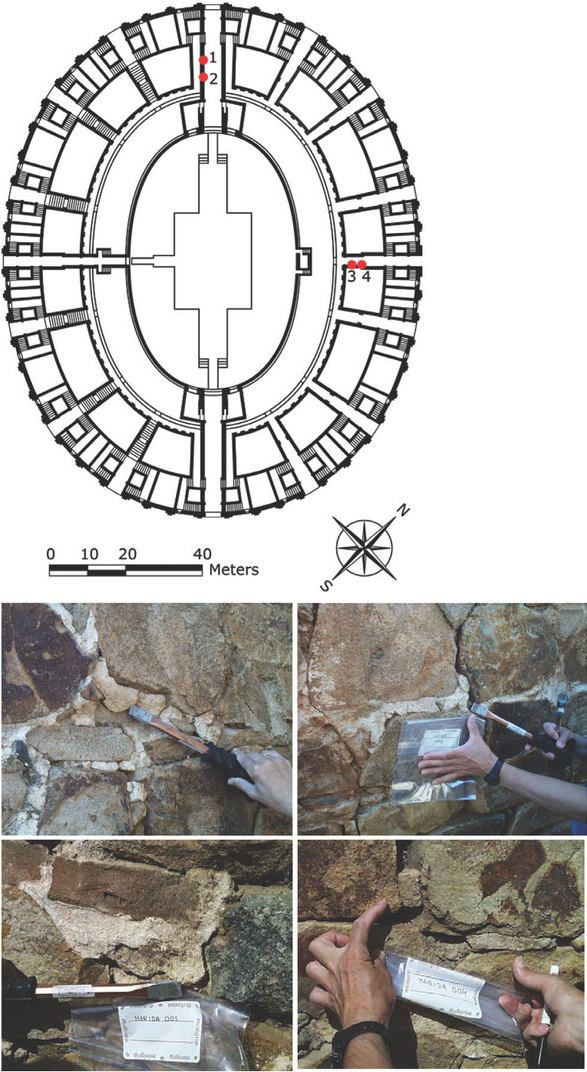
Fig 1
Sample positions 1-4 in the amphitheatre. Sampling: Upper left, Mérida 001; Upper right, Mérida 002; Lower left, Mérida 003; Lower right, Mérida 004. See details in the text.
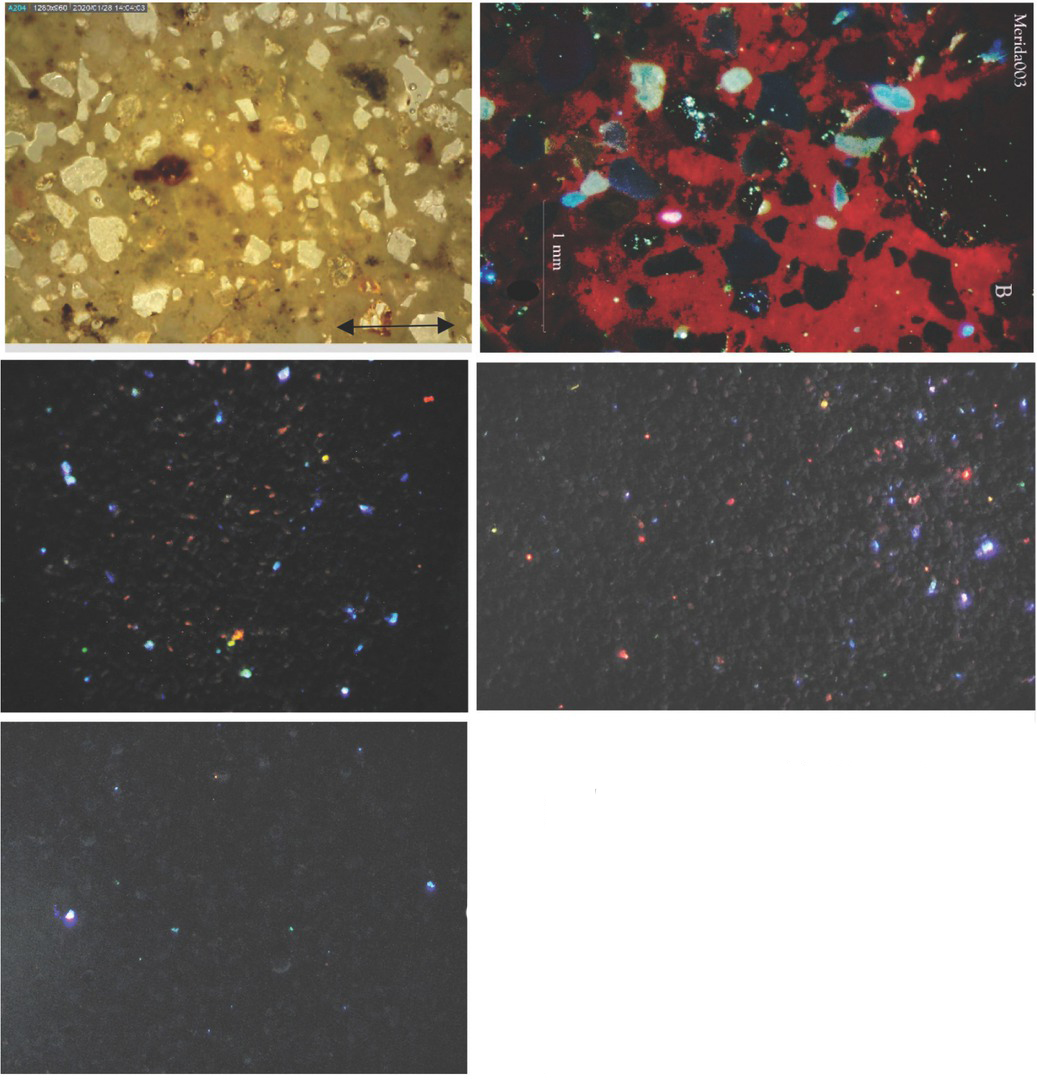
Fig 2
Thin section images. Upper left: 100μm section of sample Mérida 001 in transmitted light. Transparent minerals are mostly quartz. CL images: Upper right, cut and polished surface of a piece from sample Mérida 003 showing distribution between calcite (red) and other binder minerals (black). Mid left, the dated 46-75μm grainsize fraction of sample Mérida 001; Mid right, Mérida 003 ditto. Lower left, Mérida 004 ditto. Images from sample Mérida 002 are omitted because it turned out to be younger and less relevant. Red minerals are calcite and dark red ones have a dolomitic component while more orange ones are purer. Blue and turquoise are quartz and dull green are feldspar. The green dust-like powder in the slice is secondary aragonite from grinding. There is also a void filled with an extremely luminescent mineral in lilac, which we have not tried to identify.
Table 1
ICP-OES analyses of the soluble phase of the samples when dissolved for 1h in 1M HCl at room T. For comparison, 3 samples from the Medieval Bishop Masonas Hospital (Mérida 005, 006 and 007) and 3 samples from the Colosseum are included. Major elements are converted to oxides.
| Sample ID | Al2O3 | Ba | CaO | FeO | K2O | MgO | Mn | Na2O | SiO2 | Sr | Hydraulic |
|---|---|---|---|---|---|---|---|---|---|---|---|
| % | mg/kg | % | % | % | % | mg/kg | % | % | mg/kg | index | |
| Mérida 001 | 0.08 | 70.8 | 30.2 | 0.21 | <0.05 | 3.12 | 253 | 0.09 | 0.51 | 578 | 0,02 |
| Mérida 002 | 0.08 | 61.9 | 27.3 | 0.21 | <0.05 | 4.22 | 295 | 0.58 | 0.68 | 552 | 0,03 |
| Mérida 003 | 0.11 | 60.7 | 17.9 | 0.13 | <0.05 | 2.59 | 133 | 0.04 | 0.34 | 376 | 0,03 |
| Merida 005 | 0.14 | 56.9 | 19.0 | 0.19 | 0.02 | 1.18 | 225 | 0.05 | 0.25 | 378 | 0,03 |
| Mérida 006 | 1.69 | 169 | 15.3 | 0.25 | 0.09 | 0.71 | 73.3 | 0.02 | 0.36 | 51 | 0,17 |
| Mérida 007 | 1.54 | 184 | 15.6 | 0.21 | 0.12 | 0.82 | 61.2 | 0.01 | 1.79 | 85 | 0.13 |
| Colosseum001 | 5.61 | 519 | 15.8 | 0.54 | 2.04 | 0.28 | 312 | 1.49 | 2.65 | 490 | 0,55 |
| Colosseum002 | 5.29 | 621 | 20.7 | 0.55 | 1.85 | 0.35 | 165 | 1.26 | 3.17 | 588 | 0,43 |
| Colosseum003 | 8.01 | 1660 | 6.66 | 0.76 | 1.87 | 0.93 | 355 | 1.28 | 3.83 | 690 | 1,66 |
Table 2
Numerical TGA data and the CO2 yield in H3PO4 hydrolysis for aliquots of the same sample material. For TGA about 10mg of the 46-75μm was heated and in the hydrolysis about 50mg was reacted with 85% H3PO4. The acid was taken from an ice bath but it reached room T before the reaction ceased after about 1h.
| Sample | LOI 550 | LOI 850 | CO2 yield | Residue | LOI(850˚/550˚) |
|---|---|---|---|---|---|
| ID | (%) | (%) | H3PO4 (%) | (%) | ratio |
| Mérida 001 | 3.6 | 26 | 26 | 69 | 7.2 hydraulic |
| Mérida 002 | 4.3 | 27 | 16 | 66 | 6.3 hydraulic |
| Mérida 003 | 4.0 | 19 | 16 | 74 | 4.8 hydraulic |
| Mérida 004 | 4.8 | 22 | 25 | 71 | 4.6 hydraulic |
| Colosseum 003 | 2.7 | 7.6 | 3.7 | 81 | 2.8 hydraulic |
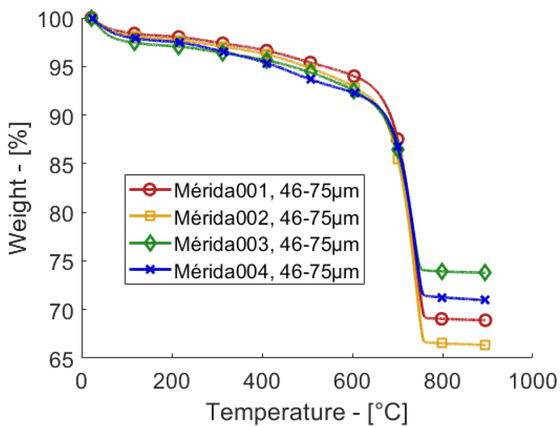
Fig 3
TGA profiles of the four samples from Mérida. The profiles are similar, but the most hydraulic samples Mérida 003 and 004 have lower CO2 yields and consequently more residue.
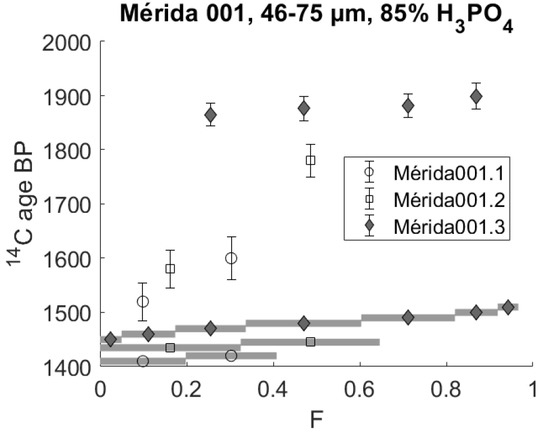
Fig 4
14C profiles from three different sample preparations of sample Mérida 001: Open circles are from the first dating attempt in 2001. Open boxes are from supplementary measurements later the same year and black diamonds from re-dating 2018. The grey bars along the abscissa denote the size of each CO2 fraction relative to the total CO2 yield. In all the following 14C profile plots the size of the CO2 fractions will be presented the same way without specific mention.
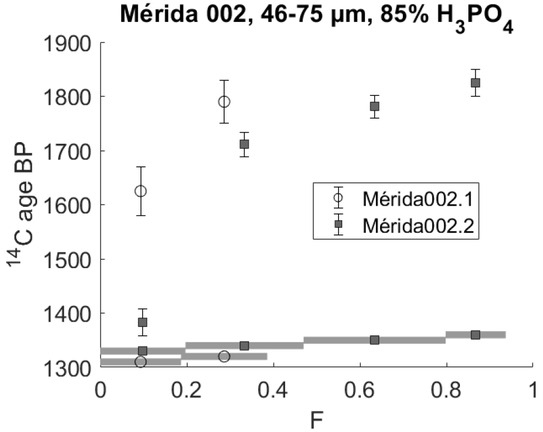
Fig 5
14C profiles of sample Mérida 002. Open circles present dating in 2001 and black boxes dating in 2018.
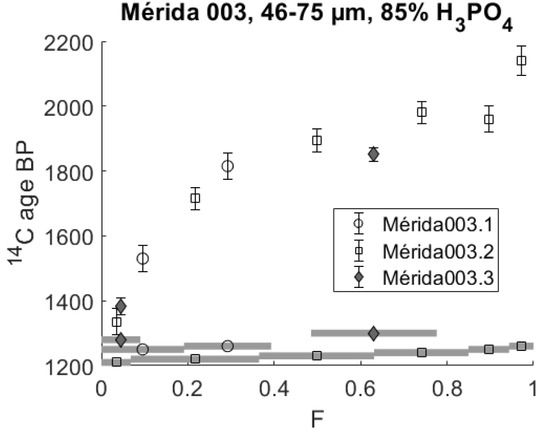
Fig 6
14C profiles of sample Mérida 003. Open circles denote dating in 2001 and open boxes a profile in six CO2 fractions dated later the same year. Black diamonds represent re-dating in 2018. For this sample we used the same powder that had been in a non-airtight container for 17 years. The data point with low F value representing initially effervesced CO2 was measured to ensure that the sample powder had not captured modern CO2 and grown new calcite on the grains.
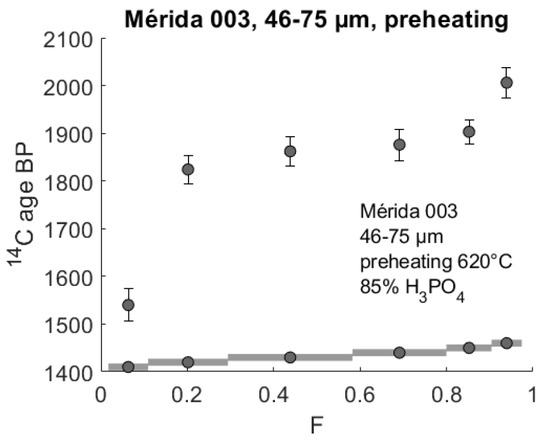
Fig 7
14C profile from sample Mérida 003 after heating the sample to 620˚C. Some of the young carbonates have been lost and the profile now increases more rapidly in the beginning compared with the profile from the non-heated original sample powder (Fig. 6).
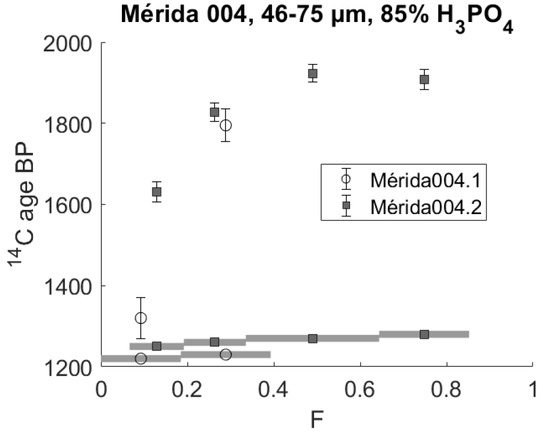
Fig 8
14C profiles from sample Mérida 004. Open circles, dating 2001. Black boxes, dating 2018.
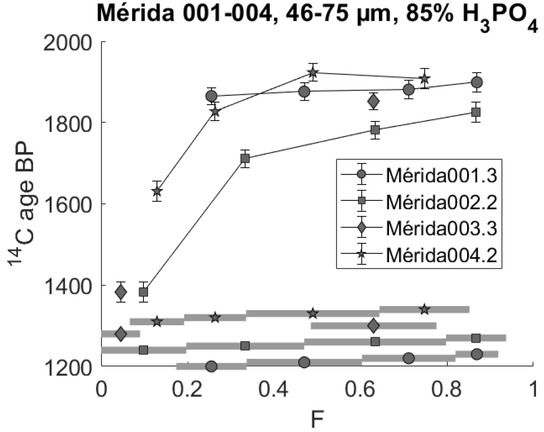
Fig 9
14C data from 2018. Data points for each sample are connected with lines for clarity. Samples Mérida 001, 003 and 004 yield similar 14C ages after about 20% dissolution (F>0.2) whereas sample Mérida 002 appears younger in all fractions.
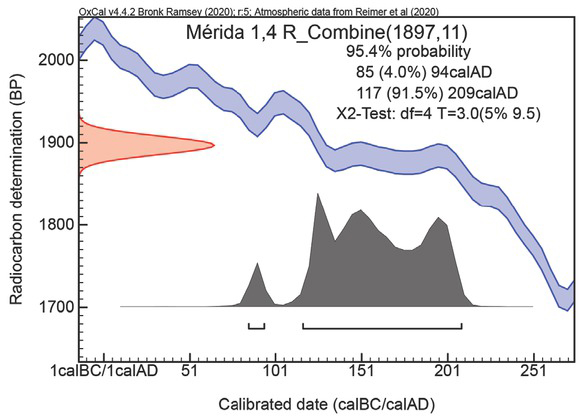
Fig 10
Combined calibration of 5 CO2 fractions with similar ages. The calibration includes the 3 last fractions from sample Mérida 001 and the two last ones from Merida 004 in Fig 9.
| Site | Sample nr | Reaction | Carbon | Fraction | 14C | ± | δ13C | Laboratory |
|---|---|---|---|---|---|---|---|---|
| location | run nr | time | yield | size | Age | ‰ | ||
| CO2 fraction nr | (s) from t0 | (tot %) | (relative 1) | (BP) | VPDB | nr | ||
| Merida amphiteater | Merida 001.1.1 | 67 | 7.4 | 0-0.198 | 1520 | 35 | -13.0 | AAR-6721.1 |
| Main entance | Merida 001.1.2 | 727 | 0.198-0.408 | 1600 | 40 | -8.96 | AAR-6721.2 | |
| Merida 001.2.1 | 600 | 6.9 | 0-0.325 | 1580 | 35 | -10.1 | AAR-6721.2.1 | |
| Merida 001.2.2 | 2820 | 0.325-0.646 | 1780 | 30 | -8.40 | AAR-6721.2.2 | ||
| Merida 001.3.3 | 20-115 | 7.2 | 0.174-0.337 | 1865 | 21 | -8.3 | ETH-87848 | |
| Merida 001.3.4 | 540 | 0.337-0.604 | 1876 | 22 | -10.2 | ETH-87849 | ||
| Merida 001.3.5 | 1380 | 0.604-0.820 | 1881 | 22 | -10.9 | ETH-87850 | ||
| Merida 001.3.6 | 1980 | 0.820-0.919 | 1899 | 24 | -9.3 | ETH-89323 | ||
| Main entrance | Merida 002.1.1 | 43 | 8.0 | 0-0.187 | 1626 | 45 | -13.7 | AAR-6722.1 |
| Merida 002.1.2 | 523 | 0.187-0.386 | 1790 | 40 | -7.10 | AAR-6722.2 | ||
| Merida 002.2.2 | 30-120 | 4.4 | 0.273-0.470 | 1711 | 22 | -7.0 | ETH-87851 | |
| Merida 002.2.3 | 600 | 0.470-0.798 | 1781 | 21 | -7.5 | ETH-87852 | ||
| Merida 002.2.4 | 1180 | 0.798-0.937 | 1825 | 25 | -5.3 | ETH-87863 | ||
| Passage towards NE | Merida 003.1.1 | 104 | 5.6 | 0-0.191 | 1530 | 40 | -12.5 | AAR-6723.1 |
| Merida 003.1.2 | 884 | 0.191-0.394 | 1815 | 40 | -9.9 | AAR-6723.2 | ||
| Merida 003.2.1 | 30 | 3.2 | 0-0.068 | 1335 | 40 | -18.4 | AAR-6723.2.1 | |
| Merida 003.2.2 | 510 | 0.068-0.365 | 1715 | 35 | -9.82 | AAR-6723.2.2 | ||
| Merida 003.2.3 | 2490 | 0.365-0.631 | 1895 | 35 | -9.66 | AAR-6723.2.3 | ||
| Merida 003.2.4 | 8790 | 0.631-0.850 | 1980 | 35 | -10.4 | AAR-6723.2.4 | ||
| Merida 003.2.5 | 15990 | 0.850-0.943 | 1960 | 40 | -11.8 | AAR-6723.2.5 | ||
| Merida 003.2.6 | 63000 | 0.943-1.00 | 2140 | 45 | -10.2 | AAR-6723.2.6 | ||
| Merida 003.3.1 | 30 | 4.4 | 0-0.093 | 1383 | 25 | -15.7 | ETH-87864 | |
| Merida 003.2.8 | 530-1950 | 0.487-0.777 | 1852 | 21 | -12.2 | ETH-87853 | ||
| “Roasting” | Merida 003 Roa1.1 | 8 | 2.4 | 0-0.0174 | ||||
| hydrolysis after | Merida 003 Roa1.2 | 25 | 0.0174-0.109 | 1539 | 34 | -13 | AAR-30431 | |
| heating to 620˚C | Merida 003 Roa1.3 | 100 | 0.109-0.294 | 1821 | 29 | -6 | ||
| Merida 003 Roa1.4 | 580 | 0.294-0.582 | 1859 | 30 | -8 | |||
| Merida 003 Roa1.5 | 1320 | 0.582-0.800 | 1873 | 33 | -10 | |||
| Passage towards NE | Merida 004.1.1 | 14 | 6.3 | 0-0.185 | 1320 | 50 | 17.7 | AAR-6724.1 |
| Merida 004.1.2 | 194 | 0.185-0.393 | 1795 | 40 | -7.10 | AAR-6724.2 | ||
| Merida 004.2.2 | 6-19 | 6.8 | 0.068-0.128 | 1631 | 25 | -14.1 | ETH-87854 | |
| Merida 004.2.3 | 105 | 0.128-0.343 | 1827 | 23 | -7.8 | ETH-87855 | ||
| Merida 004.2.4 | 580 | 0.343-0.658 | 1923 | 22 | -11.6 | ETH-87856 | ||
| Merida 004.2.5 | 1440 | 0.658-0.870 | 1908 | 25 | -10.6 | ETH-89324 | ||