
Table 1
Physical and functional properties of selected fabrics for the compression base layer system.
| Characteristics | Fabric A (base zone) | Fabric B (support zone) | Fabric C (ventilation zone) |
|---|---|---|---|
| Fiber composition | Polyester 90%, Polyurethane 10% | Polyester 94%, Polyurethane 6% | Nylon 85%, Polyurethane 15% |
| Thickness (mm) | 0.65 | 0.61 | 0.28 |
| Density (stitches/cm2) | 499.5 | 442.8 | 1304.6 |
| Tensile strength (N) | Wale: 390, Course: 350 | Wale: 550, Course: 430 | Wale: 240, Course: 180 |
| Elongation (%) | Wale 18.0, Course 20.0 | Wale 11.7, Course 14.2 | Wale 14.4, Course 43.0 |
| Water vapor permeability (g/m2 24 h) | 8,447 | 8,512 | 9,530 |
| Absorption rate (s) | 10 | 60 | 30 |
| Drying rate (min) | 223 | 193 | 97 |
Notes. Properties tested according to KS K 0210(2018), KS K 5084(1996), KS K 0512(2017), KS K 0520(2021), ASTM D2594, KS K 0594(2021), and KS K 0642(2022). Pressure targets are summarized in Table 3.
Source: Author’s contribution.
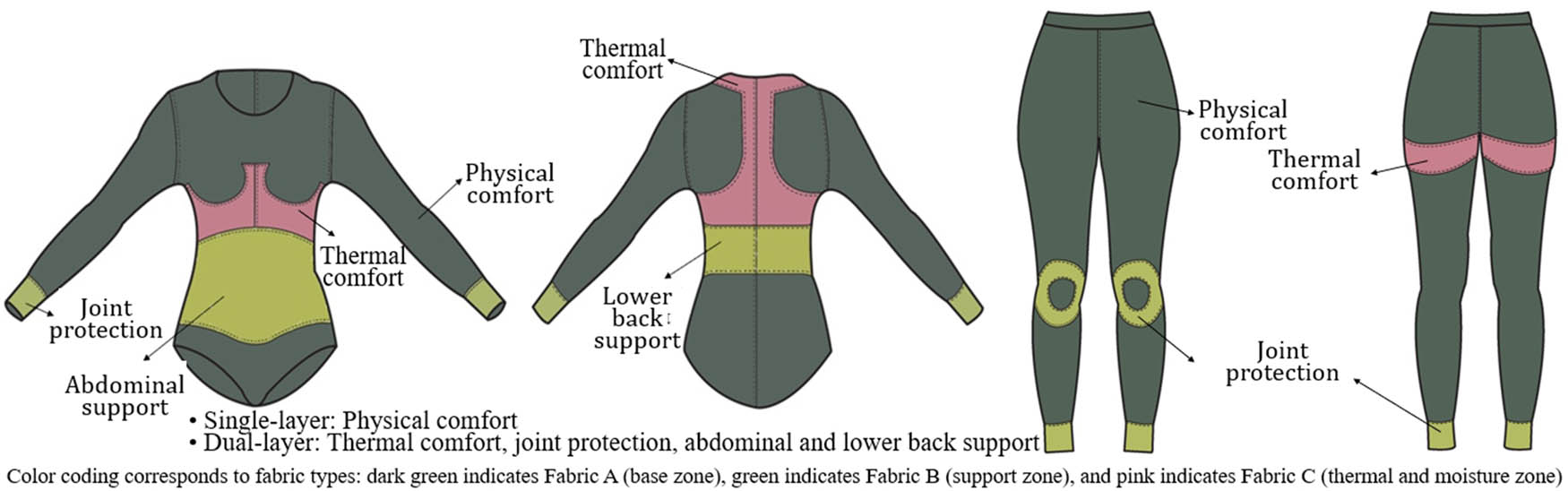
Figure 1
Functional inner panel configuration of the compression base layer for both top and bottom garments. Single-layer zones (green) provide physical comfort and flexibility, whereas dual-layer zones (yellow) provide joint protection and localized support, and breathable zones (pink) enhance thermal comfort. Fabric types are indicated by color coding: dark green = Fabric A (base zone), green = Fabric B (support zone), and pink = Fabric C (thermal and moisture zone).
Source: Author’s contribution.
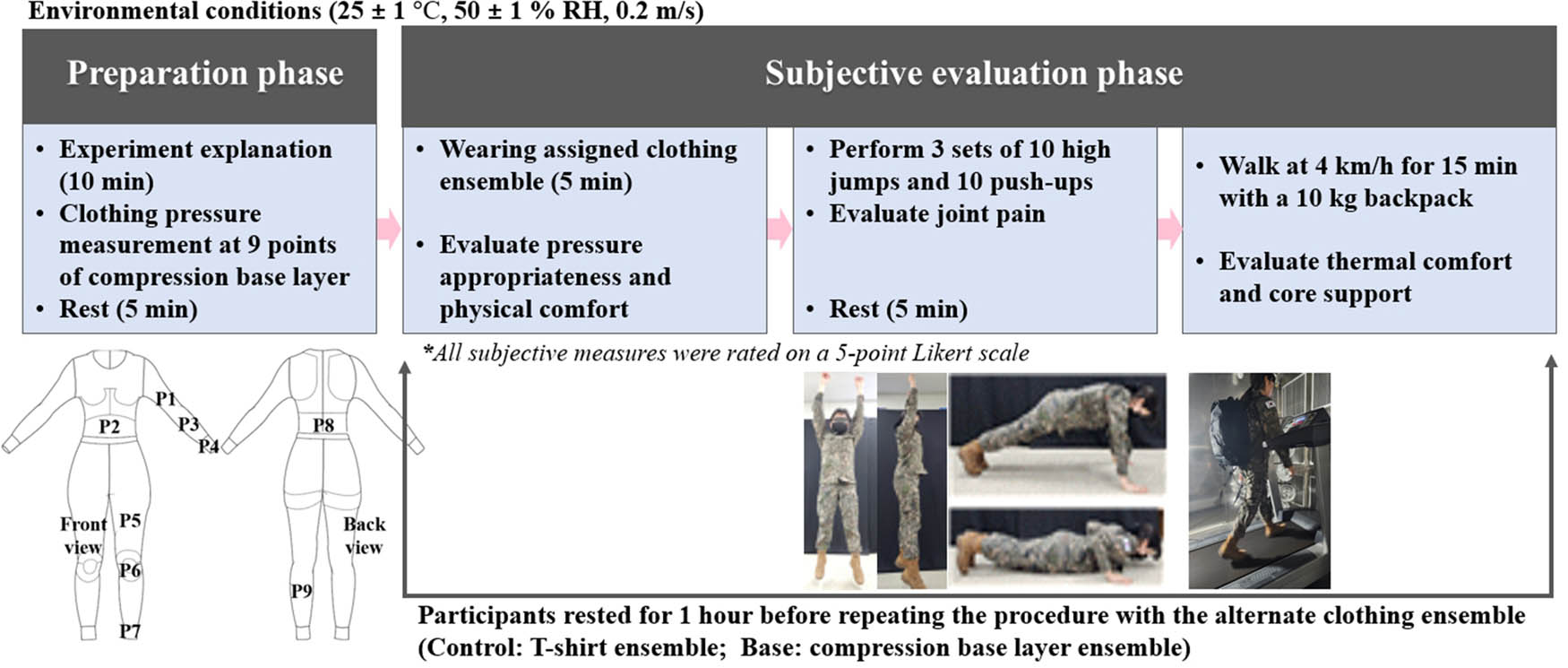
Figure 2
Experimental protocol and subjective evaluation procedure. All trials were conducted under controlled environmental conditions (25 ± 1°C, 50 ± 1% RH, 0.2 m/s air velocity). The protocol comprised a preparation phase (instruction, interface pressure measurement at nine anatomical sites, and rest) followed by a subjective evaluation phase including static fit assessment, combat-relevant maneuvers (high jumps and push-ups), and a treadmill walk at 4 km/h with a 10-kg backpack. Participants completed both conditions in a randomized crossover design with a 1-h washout period (Control: T-shirt ensemble; Base: compression base-layer ensemble).
Source: Author’s contribution.
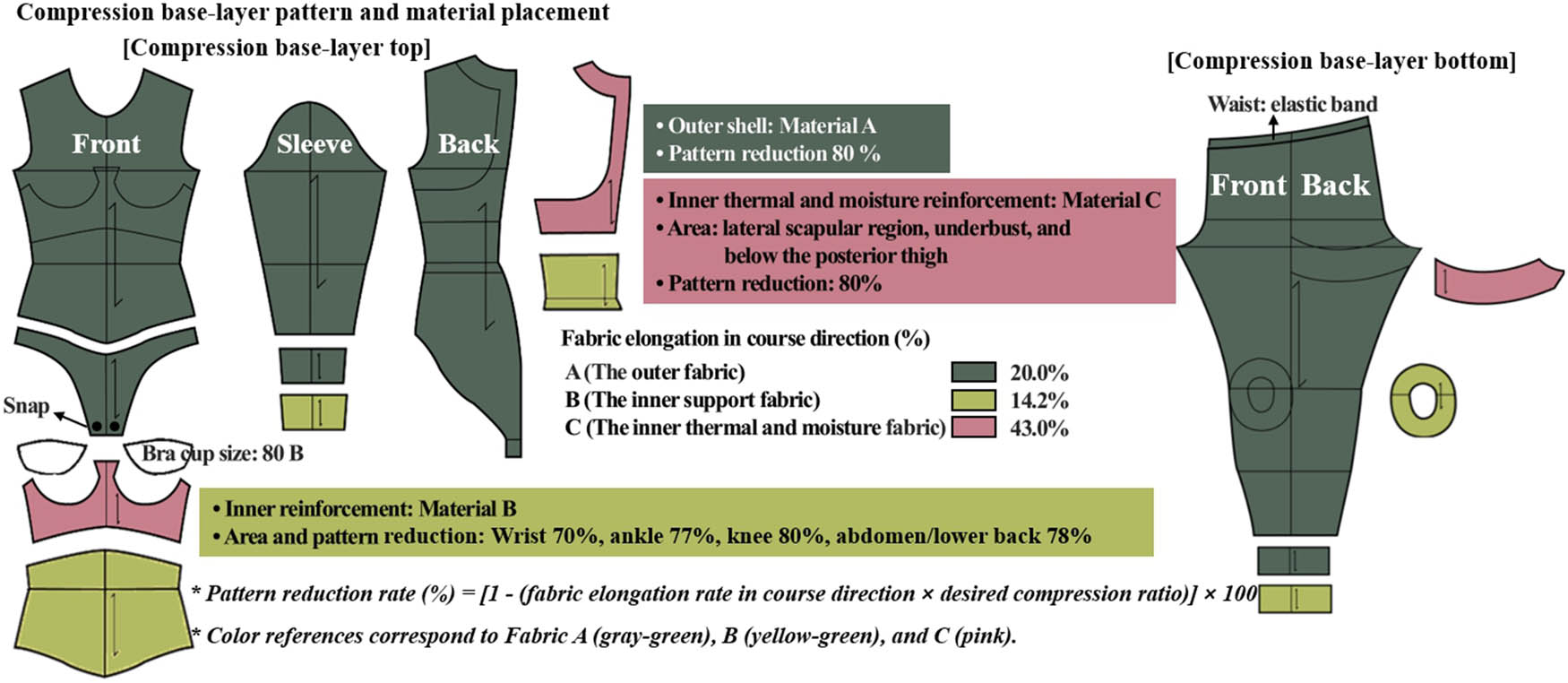
Figure 3
Compression base-layer pattern and material placement. Fabric A (outer shell; pattern reduction: 80%) provided the baseline elasticity of the garment. Fabric B (inner reinforcement; pattern reduction 70–80%) was applied at the wrist (70%), ankle (77%), knee (80%), and abdomen/lower back (78%) to provide localized support. Fabric C (inner thermal and moisture reinforcement; pattern reduction: 80%) was positioned at the lateral scapular region, underbust, and below the posterior thigh to facilitate thermal regulation and moisture management.
Source: Author’s contribution.
Table 2
Virtual and actual fitting of the women-specific compression base layer.
| 3D Virtual fitting | Actual fitting | ||||
|---|---|---|---|---|---|
| Outer side | Inner side | ||||
| Front | Back | Front | Back | Front | Back |

|

|

| |||
Notes. Comparison of 3D virtual and actual fittings of user-centered compression base layers. Reinforcement panels (Material B) were placed at the wrists, ankles, knees, abdomen, and lower back for joint and core support. Ventilation panels (Material C) were positioned at the lateral scapulae, underbust, posterior thighs, nape, and interscapular regions to enhance moisture management. Virtual fitting was conducted using CLO 3D (CLO Virtual Fashion Inc., Korea), and actual fitting was performed on participants with body dimensions comparable to the average values in the Size Korea database.
Source: Author’s contribution.
Table 3
Target and measured base-layer pressures by body region (mean ± SD; n = 10).
| Region | Measured (kPa) | Target range (kPa) |
|---|---|---|
| P1: Upper arm | 0.5 ± 0.2 | 0.5–1.5 |
| P2: Abdomen | 0.6 ± 0.3 | 1.0–2.4 |
| P3: Forearm | 0.8 ± 0.4 | 0.5–1.5 |
| P4: Wrist | 2.1 ± 0.5 | 1.0–2.4 |
| P5: Thigh | 0.9 ± 0.3 | 0.5–1.5 |
| P6: Knee | 1.8 ± 0.6 | 1.0–2.4 |
| P7: Ankle | 2.4 ± 0.5 | 1.0–2.4 |
| P8: Lower back | 1.1 ± 0.4 | 1.0–2.4 |
| P9: Calf | 0.6 ± 0.2 | 0.5–1.5 |
Notes. Pressures were measured using a pneumatic sensor system (AMI 3037-2; AMI Co., Japan). Measurements were taken on the right side, except for P2 and P8. For each 1-min recording, the central 40-s segment was analyzed after discarding the initial and final 10s. Negative instantaneous values were set to 0 before averaging.
Source: Author’s contribution.
Table 4
Subjective evaluation of compression base layer (mean ± SD, n = 10).
| Variable | Regions | Control set | Underlayer set | p-value |
|---|---|---|---|---|
| Compression appropriateness | Wrist | 1.30 ± 0.68 | 3.90 ± 0.78 | 0.006** |
| Knee | 1.70 ± 0.81 | 3.50 ± 0.91 | 0.008** | |
| Ankle | 1.20 ± 0.77 | 4.00 ± 0.79 | 0.005** | |
| Abdomen | 2.00 ± 0.90 | 3.50 ± 1.10 | 0.025* | |
| Lower back | 1.70 ± 0.82 | 3.60 ± 0.65 | 0.007** | |
| Arm | 2.00 ± 1.10 | 3.50 ± 1.01 | 0.013* | |
| Thigh | 2.10 ± 1.00 | 3.80 ± 1.00 | 0.007** | |
| Calf | 2.00 ± 0.96 | 3.70 ± 1.10 | 0.008** | |
| Physical comfort | Chest | 3.00 ± 0.82 | 4.00 ± 1.05 | 0.084 |
| Arm | 3.60 ± 0.88 | 4.60 ± 1.00 | 0.086 | |
| Thigh | 3.00 ± 0.82 | 4.30 ± 0.95 | 0.035* | |
| Calf | 3.10 ± 0.88 | 4.40 ± 0.84 | 0.037* | |
| Overall | 3.00 ± 0.82 | 4.40 ± 0.84 | 0.029* | |
| Joint pain (↓ better) | Wrist | 3.80 ± 0.63 | 2.00 ± 0.82 | 0.004** |
| Ankle | 3.20 ± 0.79 | 1.90 ± 0.74 | 0.006** | |
| Knee | 3.30 ± 0.82 | 1.80 ± 0.92 | 0.006** | |
| Thermal comfort (↓ better) | Underbust | 4.00 ± 0.94 | 3.30 ± 1.16 | 0.008** |
| Nape | 3.70 ± 0.48 | 2.70 ± 0.68 | 0.015* | |
| Spine | 4.10 ± 0.88 | 3.80 ± 0.63 | 0.317 | |
| Hip | 3.70 ± 1.06 | 3.30 ± 0.82 | 0.102 | |
| Muscle support | Abdomen | 1.50 ± 0.71 | 4.70 ± 0.48 | 0.004** |
| Lower back | 1.60 ± 0.70 | 4.80 ± 0.42 | 0.004** | |
| Spine | 1.50 ± 0.71 | 4.70 ± 0.68 | 0.004** | |
| Overall | 1.60 ± 0.70 | 4.70 ± 0.48 | 0.005** |
Notes. Values are expressed as mean ± SD. p-Values were obtained using two-sided Wilcoxon signed-rank tests (α = 0.05). *p < 0.05; **p < 0.01. Higher scores indicate improvement in compression appropriateness, comfort, and support, whereas lower scores indicate improvement in pain and heat-related symptoms.
Source: Author’s contribution.
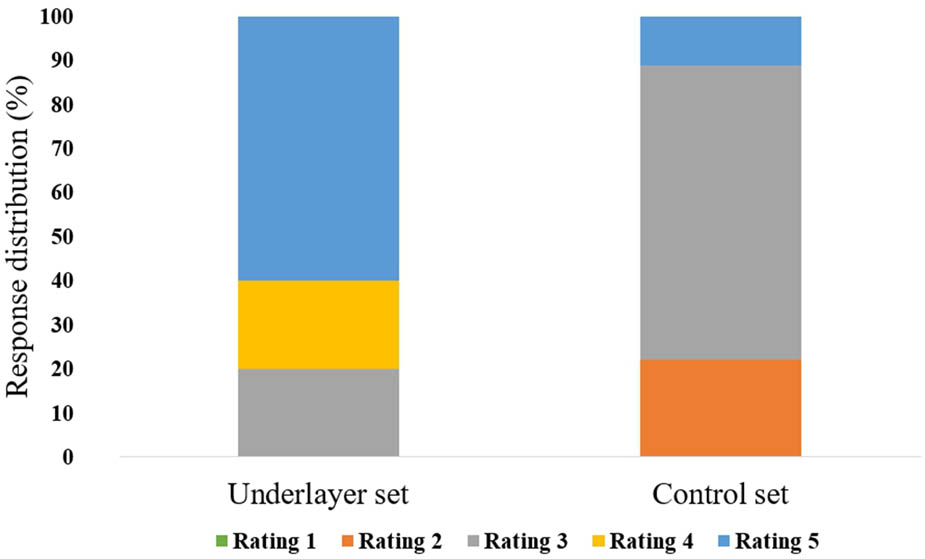
Figure 4
Percentage distribution of subjective physical comfort ratings. Ratings were assessed using a 5-point Likert scale (1 = very uncomfortable, 5 = very comfortable). Stacked bars represent the percentage distribution of responses across participants (n = 10) for the compression base-layer and control conditions.
Source: Author’s contribution.