
1. Introduction
Workers in high-load occupations – particularly those involving sustained load carriage – are exposed to simultaneous musculoskeletal loading and thermophysiological stress. Conventional base layers and protective equipment often inadequately accommodate women-specific anthropometry and joint support requirements and may exacerbate heat strain by restricting moisture and heat transfer. From an industrial ergonomics perspective, wearable systems integrating localized pressure engineering with thermophysiological comfort are needed to link garment design directly to task performance, discomfort, and safety outcomes [1]. From a textile-engineering standpoint, this requires the structured integration of fabrics with differentiated elasticity, modulus, and breathability into garment panels capable of delivering targeted compression while maintaining effective thermal regulation.
Compression base layers represent a low-disruption preventive strategy because they can be incorporated within existing uniform systems. Prior research suggests that compression may enhance proprioception, attenuate soft-tissue vibration, and support venous return – mechanisms relevant to load carriage, repetitive impact, and prolonged static postures [2,3,4]. However, most available evidence derives from athletic or rehabilitation settings and short-duration exercise trials, frequently involving mixed-sex or male-dominant cohorts. These contexts differ substantially from standardized occupational tasks performed under integrated uniform systems, where prolonged load carriage and thermal accumulation coexist. Consequently, the applicability of prior findings to active-duty women operating in high-load military environments remains limited.
Furthermore, most compression garment studies have focused primarily on generalized performance outcomes in sports contexts rather than garment-engineering strategies applicable to occupational clothing systems. Sex-specific anthropometric characteristics, joint alignment patterns, and injury risk profiles may influence both fit and functional response, particularly in load-bearing tasks requiring sustained joint stabilization. Yet much of the literature relies on mixed-sex samples without stratified analysis or emphasizes generalized performance metrics rather than female-specific ergonomic demands. Moreover, relatively few studies have systematically integrated panel-based textile engineering strategies – such as pressure zoning and localized ventilation – within a structured design-to-validation framework tailored to women in high-load occupational contexts. Accordingly, studies examining compression garment systems specifically designed for female users and evaluated within realistic military operational and training environments remain limited.
In military environments, women demonstrate elevated musculoskeletal injury incidence relative to men [5,6,7,8,9], and South Korean training conditions involve repetitive impact exposure, standardized load carriage, prolonged static posture, and seasonal heat stress [10]. Load carriage itself represents a major source of physiological and biomechanical stress in military operations and is strongly associated with musculoskeletal injury risk and performance limitations [11,12]. As female participation in physically demanding roles increases [13], garment-based textile interventions targeting fit, pressure distribution, and microclimate regulation represent a feasible and scalable preventive approach alongside broader structural reforms [14,15]. Supporting this perspective, studies on knitted fabric heat and mass transfer demonstrate that yarn and fabric parameters strongly influence air and water-vapor permeability and thermal conductivity – critical determinants of base-layer microclimate performance [16,17,18]. These findings underscore the importance of design-level textile variables in mediating both biomechanical and thermophysiological responses. Against this background, the present study investigates a women-specific compression base layer developed through a user-centered workflow incorporating targeted pressure mapping at key joints (wrists, knees, ankles, abdomen, and lower back). Unlike most previous compression garment studies conducted primarily in sports or rehabilitation contexts, the present study evaluates a women-specific compression base layer within an integrated military uniform system under standardized military training conditions. Using a randomized crossover design under standardized load-carriage conditions, we compared the compression system with a control ensemble in terms of perceived joint support, musculoskeletal symptoms, thermal sensations, and acceptability. We hypothesized that panel-integrated pressure engineering would improve perceived joint stability and region-specific symptoms without increasing thermal burden.
Importantly, this study operationalizes panel configuration, fabric modulus, and localized permeability as controllable textile-engineering variables and evaluates their translation into task-anchored perceptual outcomes. Rather than treating compression garments as finished products, the design is conceptualized as a parameter-driven textile system linking structural configuration to ergonomic and thermal performance.
This study advances textile science and functional garment engineering in three principal ways. First, it translates pressure-engineering decisions at key joints into measurable ergonomic outcomes, including perceived joint support, regional discomfort, and thermal comfort. Second, it centers female anthropometry and joint-support requirements within a low-disruption intervention compatible with existing uniform systems. Third, it specifies textile parameters – fabric modulus, panel placement, and thermal/moisture transport properties – as replicable design variables relevant for scalable implementation across high-load occupational applications. This framework shifts compression garment research from product-level evaluation toward a design-parameter-driven textile engineering approach.
2. Materials, Design, and Methods
2.1. Participants and Experimental Design
A randomized, two-condition crossover pilot study was conducted with ten active-duty Korean female soldiers to evaluate the physiological and perceptual effects of compression base layers during load-bearing tasks [19]. All participants were free from musculoskeletal injury or medical conditions that could affect physical performance during the study. Each participant completed two sessions – one wearing the standard-issue control ensemble and one wearing the experimental compression base layer ensemble – in a counterbalanced order. A 1-h washout period between sessions was provided to minimize potential carryover effects. All trials were performed in a controlled environmental chamber maintained at 25 ± 1°C, 50 ± 1% relative humidity, and 0.2 m/s air velocity. Although interface pressure measurements were conducted outside the climatic chamber, the same environmental conditions were maintained to ensure consistency of the experimental procedures. Participants were instructed to refrain from strenuous physical activity, alcohol consumption, and smoking, and to maintain their habitual sleep and diet patterns for 24 h prior to each session. Eligibility criteria were designed to ensure anthropometric representativeness of Korean women in their 20s–30s. The mean (±SD) body dimensions of the sample were height of 163.9 ± 3.7 cm, weight of 56.7 ± 5.8 kg, chest 86.5 ± 4.7 cm, waist 72.1 ± 5.4 cm, and hip 95.7 ± 7.2 cm, consistent with Size Korea (2021) reference data. Anthropometric measurements were taken following the Size Korea protocol for landmark definitions. At least three participants regularly engaged in advanced combat training (e.g., ranger drills, individual combat exercises). The sample size (n = 10) was determined based on operational feasibility and prior pilot research in military clothing ergonomics, which typically employed 8–12 participants for crossover physiological assessments. Recruitment aimed to capture a range of body types and combat experience levels to reflect the variability encountered in field populations.
The study protocol was approved by the Institutional Review Board (IRB) of Chungnam National University (Approval No. 202203-SB-027-01). All participants provided written informed consent prior to participation.
2.2. Compression Base Layers: Material Selection
The compression base layer system comprised a leotard-style top with integrated cups and ankle-length leggings, designed to deliver region-specific pressures through differential pattern reductions and strategically placed functional fabric panels. Support zones were positioned at the wrists, knees, ankles, abdomen, and lower back, while breathable panels were incorporated under the bust, at the posterior thigh, the nape, and the interscapular region to facilitate localized ventilation. Sizing and pattern development were based on the 8th Korean Human Body Size Survey for women in their 20s–30s [20]. A two-dimensional pattern was generated using the established reduction method [21,22], defined as Pattern reduction ratio (%) = [1 – (fabric elongation rate × desired application rate)] × 100. An initial close-fit prototype (with zero ease) was developed, and region-specific reductions were applied following established compression garment engineering principles. Target compression levels were defined according to published ranges for muscle and joint support [23]: comfort zones were adjusted to approximately 0.5–1.5 kPa, while support zones were tuned to 1.0–2.4 kPa, remaining below the threshold for excessive pressure (>2.67 kPa). Material selection was guided by a market scan of leading commercial compression brands [24] and refined through preliminary user testing. Three functional fabrics were adopted with complementary properties (Table 1). Fabric A, a 90% polyester/10% polyurethane knit, provided baseline elasticity and general comfort. Fabric B, positioned at the wrists, knees, ankles, abdomen, and lumbar region, exhibited the highest tensile modulus and contributed to joint and core stability. Fabric C, applied to the lateral scapula, underbust, and posterior thigh areas, was lightweight (≈0.28 mm), quick-drying (≈97 min), and highly permeable to water vapor, enhancing thermal and moisture regulation in heat-sensitive regions. The garments were constructed as single-layer bases with dual-layer reinforcements at support zones, balancing targeted pressure delivery with thermophysiological comfort (Figure 1). The compression base layer was specifically designed and manufactured for research purposes using conventional cut-and-sew techniques and is not commercially available.
Table 1
Physical and functional properties of selected fabrics for the compression base layer system.
| Characteristics | Fabric A (base zone) | Fabric B (support zone) | Fabric C (ventilation zone) |
|---|---|---|---|
| Fiber composition | Polyester 90%, Polyurethane 10% | Polyester 94%, Polyurethane 6% | Nylon 85%, Polyurethane 15% |
| Thickness (mm) | 0.65 | 0.61 | 0.28 |
| Density (stitches/cm2) | 499.5 | 442.8 | 1304.6 |
| Tensile strength (N) | Wale: 390, Course: 350 | Wale: 550, Course: 430 | Wale: 240, Course: 180 |
| Elongation (%) | Wale 18.0, Course 20.0 | Wale 11.7, Course 14.2 | Wale 14.4, Course 43.0 |
| Water vapor permeability (g/m2 24 h) | 8,447 | 8,512 | 9,530 |
| Absorption rate (s) | 10 | 60 | 30 |
| Drying rate (min) | 223 | 193 | 97 |
Notes. Properties tested according to KS K 0210(2018), KS K 5084(1996), KS K 0512(2017), KS K 0520(2021), ASTM D2594, KS K 0594(2021), and KS K 0642(2022). Pressure targets are summarized in Table 3.
Source: Author’s contribution.
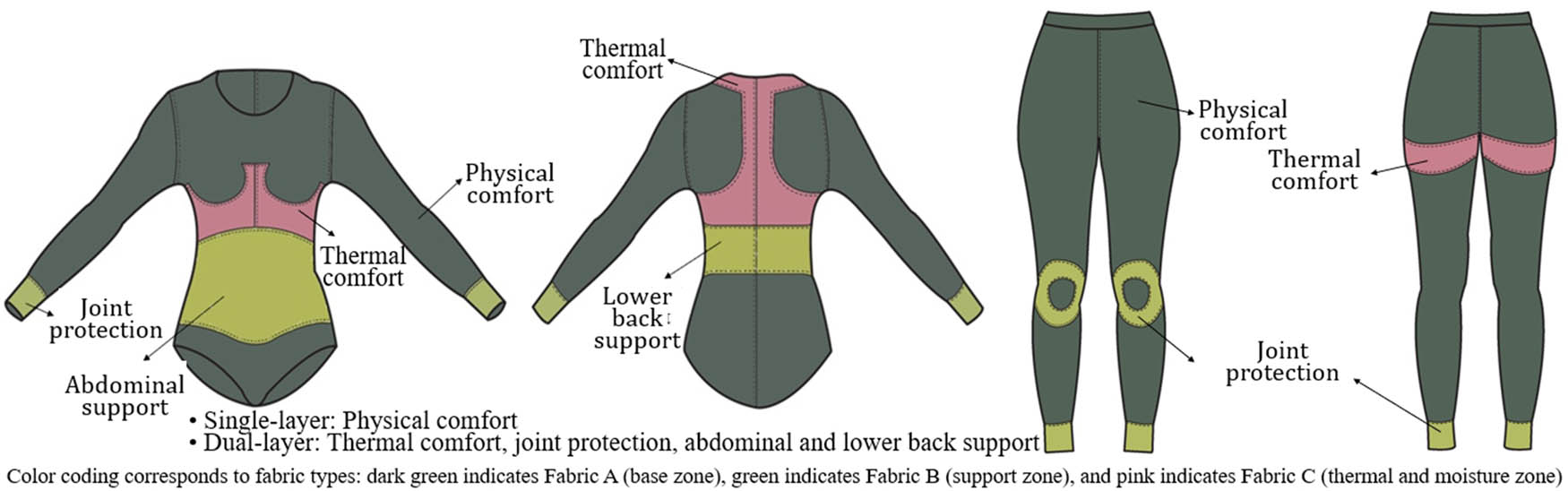
Figure 1
Functional inner panel configuration of the compression base layer for both top and bottom garments. Single-layer zones (green) provide physical comfort and flexibility, whereas dual-layer zones (yellow) provide joint protection and localized support, and breathable zones (pink) enhance thermal comfort. Fabric types are indicated by color coding: dark green = Fabric A (base zone), green = Fabric B (support zone), and pink = Fabric C (thermal and moisture zone).
Source: Author’s contribution.
2.3. Procedures and Outcome Measures
Participants were randomly assigned to begin with either the control ensemble – comprising a brassiere, underwear, T-shirt, combat uniform, socks, and military boots – or the compression ensemble, in which the T-shirt was replaced with the compression base layer worn beneath the combat uniform. The control T-shirt was composed of 100% cotton and constructed as a single-layer knit. It did not contain elastane or other stretch fibers capable of generating engineered compression, nor did it incorporate differential pattern reduction or functional ventilation panels. All other uniform components were identical across conditions. The experimental sequence (Figure 2) was designed in consultation with military training specialists to ensure ecological validity.
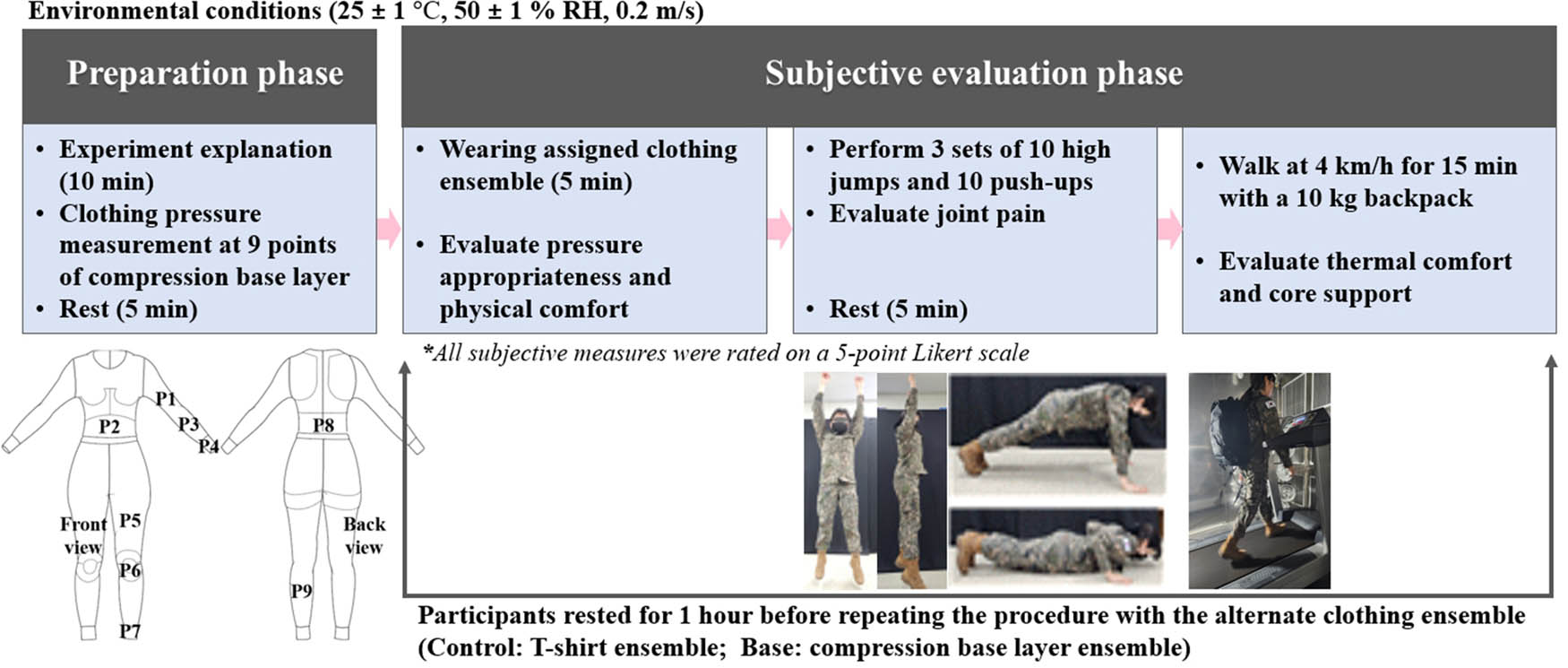
Figure 2
Experimental protocol and subjective evaluation procedure. All trials were conducted under controlled environmental conditions (25 ± 1°C, 50 ± 1% RH, 0.2 m/s air velocity). The protocol comprised a preparation phase (instruction, interface pressure measurement at nine anatomical sites, and rest) followed by a subjective evaluation phase including static fit assessment, combat-relevant maneuvers (high jumps and push-ups), and a treadmill walk at 4 km/h with a 10-kg backpack. Participants completed both conditions in a randomized crossover design with a 1-h washout period (Control: T-shirt ensemble; Base: compression base-layer ensemble).
Source: Author’s contribution.
Compression was evaluated using two complementary approaches: objective interface pressure measurements using a pneumatic pressure sensor system (AMI 3037-2, AMI Co., Japan) and subjective assessments of perceived compression collected via participant questionnaires. Interface pressure was measured at nine anatomical sites – P1: upper arm, P2: abdomen (midline), P3: forearm, P4: wrist, P5: thigh, P6: knee, P7: ankle, P8: lower back (midline), and P9: calf [24]. Except for P2 and P8, measurements were taken on the right side only to ensure procedural consistency and minimize instrumentation time during repeated testing. Because the compression garment was constructed symmetrically with identical pattern reduction and panel placement on both sides, right-side measurements were considered representative of bilateral interface pressure distribution.
Pressure was recorded for 1 min at each site while participants maintained a standardized standing posture. To minimize transient effects caused by garment adjustment and sensor stabilization, the first and last 10s were excluded, and the central 40-s segment was used for analysis. Each site was recorded three times. Anatomical landmarks were identified according to the Size Korea protocol to ensure positional consistency across participants.
Subjective evaluations were conducted at three stages. After donning the garment and completing pressure measurements, participants rated perceived pressure and general physical comfort. Following combat-relevant maneuvers – three sets of ten high jumps and push-ups – they evaluated joint protection, stability, and pain at the wrists, knees, and ankles. Finally, after a 15-min treadmill walk at 4 km/h while carrying a standardized 10-kg backpack, participants rated thermal comfort, heat-related symptoms, and perceived core support.
Primary outcomes included perceived joint stability, joint pain, and musculoskeletal discomfort. Secondary outcomes comprised thermal sensation, heat-related symptoms, and overall comfort ratings. Safety monitoring addressed potential skin irritation, excessive constriction, and activity-limiting discomfort. Acceptability was assessed at the end of each session through overall satisfaction and intention to re-wear the base layer. All subjective ratings were collected using a 5-point Likert scale and are reported as mean ± standard deviation.
Following completion of the first condition, participants changed into casual clothing and rested for approximately 1 h to allow physiological recovery before repeating the protocol in the alternate ensemble under identical environmental conditions. All sessions were supervised by trained researchers to ensure protocol adherence and participant safety.
2.4. Statistical Analysis
Data were analyzed using non-parametric statistics due to the small sample size (n = 10). Statistical analyses were performed using SPSS (Version 27, IBM Corp., Armonk, NY, USA). Wilcoxon signed-rank tests were used to compare paired outcomes between the control and compression ensembles. All statistical tests were conducted as two-sided tests, and statistical significance was set at p < 0.05. Effect sizes were calculated and reported to facilitate the interpretation of the practical magnitude of differences between garment conditions. Effect sizes were calculated as r = |Z|/√N, where N represents the number of non-zero pairs. Descriptive statistics are reported as mean ± standard deviation (SD). Given the pilot nature of this study, the analyses were considered exploratory and aimed at identifying potential trends rather than confirming definitive effects. Therefore, unadjusted p-values and effect sizes are reported. From a textile-engineering perspective, these analyses examine whether the designed panel placements and pressure zoning of the compression base layer are associated with measurable ergonomic and thermophysiological improvements.
3. Results
3.1. Validation of Material-based Compression Base-layer Design
Region-specific pressures in the compression base-layer ensemble were consistent with the a priori textile-engineering targets. Reinforcement zones incorporating Fabric B produced support-level pressures at the wrist (2.1 ± 0.5 kPa), knee (1.8 ± 0.6 kPa), and ankle (2.4 ± 0.5 kPa) – all within the recommended support range of approximately 0.8–3.1 kPa and below the undue-compression threshold (>2.67 kPa) [21]. Core zones exhibited light-to-moderate compression (abdomen 0.6 ± 0.3 kPa; lower back 1.1 ± 0.4 kPa), whereas comfort-oriented regions (forearm, upper arm, thigh, and calf) remained below 1.0 kPa as designed. These data indicate that panel-specific pattern reductions achieved the intended localized pressure delivery. Figure 3 shows the finalized two-dimensional patterns and the placements of the reinforcement panels. Fabric A was used as the outer shell with an approximate 80% reduction rate. Among the inner reinforcement materials, Fabric B was applied with pattern-reduction rates of approximately 70% (wrist), 77% (ankle), 80% (knee), 78% (abdomen), and 78% (lower back). Ventilation panels composed of Fabric C were positioned at the lateral scapulae, underbust, and posterior thigh regions with about an 80% reduction to maintain light skin contact while enhancing moisture and heat transport. Table 2 summarizes both virtual (CLO-3D simulation) and physical fittings, confirming close alignment between predicted and measured pressures. Table 3 compares the engineering design targets with empirical values, demonstrating strong correspondence across all regions. Collectively, these results support that the material selection and differential-reduction strategy produced the desired ergonomic compression profile.
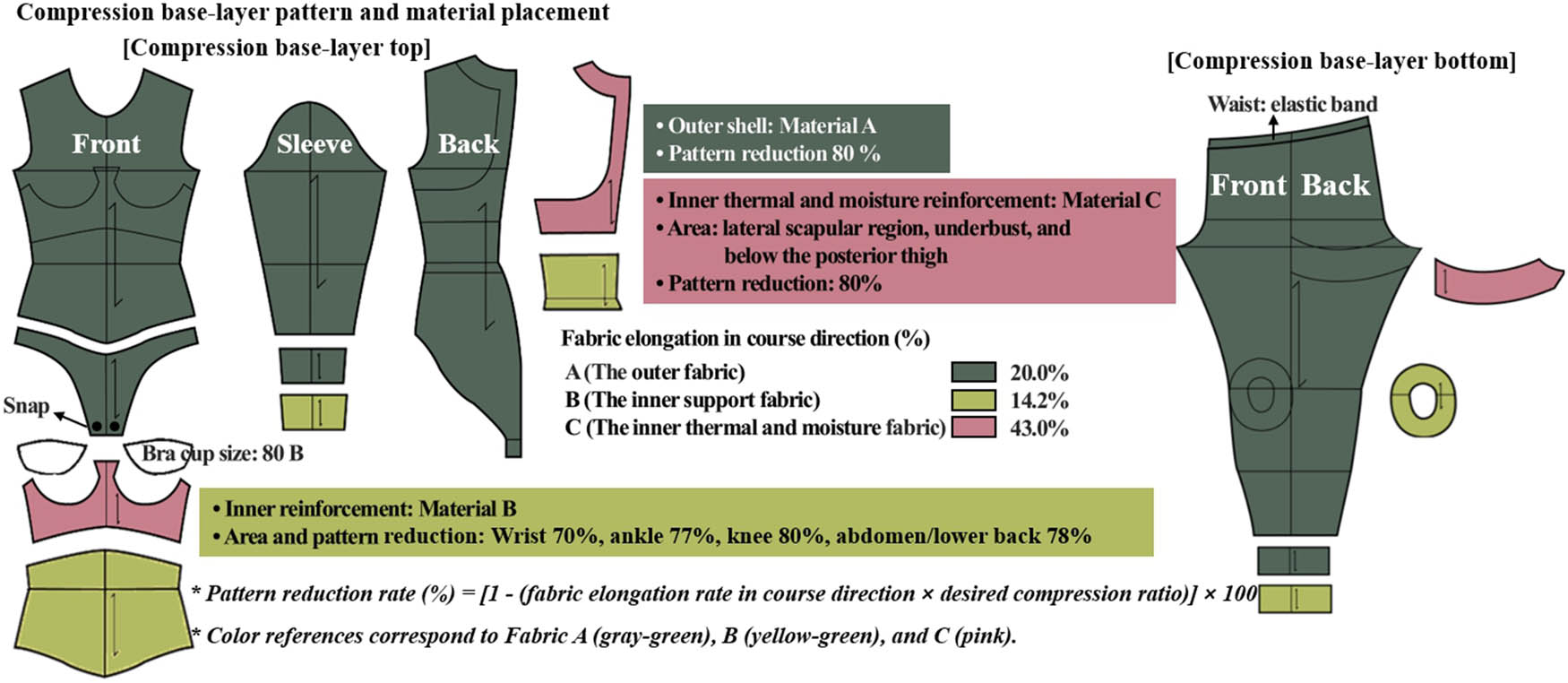
Figure 3
Compression base-layer pattern and material placement. Fabric A (outer shell; pattern reduction: 80%) provided the baseline elasticity of the garment. Fabric B (inner reinforcement; pattern reduction 70–80%) was applied at the wrist (70%), ankle (77%), knee (80%), and abdomen/lower back (78%) to provide localized support. Fabric C (inner thermal and moisture reinforcement; pattern reduction: 80%) was positioned at the lateral scapular region, underbust, and below the posterior thigh to facilitate thermal regulation and moisture management.
Source: Author’s contribution.
Table 2
Virtual and actual fitting of the women-specific compression base layer.
| 3D Virtual fitting | Actual fitting | ||||
|---|---|---|---|---|---|
| Outer side | Inner side | ||||
| Front | Back | Front | Back | Front | Back |

|

|

| |||
Notes. Comparison of 3D virtual and actual fittings of user-centered compression base layers. Reinforcement panels (Material B) were placed at the wrists, ankles, knees, abdomen, and lower back for joint and core support. Ventilation panels (Material C) were positioned at the lateral scapulae, underbust, posterior thighs, nape, and interscapular regions to enhance moisture management. Virtual fitting was conducted using CLO 3D (CLO Virtual Fashion Inc., Korea), and actual fitting was performed on participants with body dimensions comparable to the average values in the Size Korea database.
Source: Author’s contribution.
Table 3
Target and measured base-layer pressures by body region (mean ± SD; n = 10).
| Region | Measured (kPa) | Target range (kPa) |
|---|---|---|
| P1: Upper arm | 0.5 ± 0.2 | 0.5–1.5 |
| P2: Abdomen | 0.6 ± 0.3 | 1.0–2.4 |
| P3: Forearm | 0.8 ± 0.4 | 0.5–1.5 |
| P4: Wrist | 2.1 ± 0.5 | 1.0–2.4 |
| P5: Thigh | 0.9 ± 0.3 | 0.5–1.5 |
| P6: Knee | 1.8 ± 0.6 | 1.0–2.4 |
| P7: Ankle | 2.4 ± 0.5 | 1.0–2.4 |
| P8: Lower back | 1.1 ± 0.4 | 1.0–2.4 |
| P9: Calf | 0.6 ± 0.2 | 0.5–1.5 |
Notes. Pressures were measured using a pneumatic sensor system (AMI 3037-2; AMI Co., Japan). Measurements were taken on the right side, except for P2 and P8. For each 1-min recording, the central 40-s segment was analyzed after discarding the initial and final 10s. Negative instantaneous values were set to 0 before averaging.
Source: Author’s contribution.
3.2. Thermal and Moisture Regulation
The placement of quick-drying, permeable panels (Fabric C) was associated with reductions in heat-related sensations, particularly at the underbust and nape. Improvements at the spine and posterior thigh did not reach statistical significance, which may reflect anatomical curvature and limited panel coverage. Consistent with the subjective ratings summarized in Table 4, thermal discomfort scores decreased notably at the underbust and nape regions (p < 0.05). Under the compression condition, ratings were predominantly clustered in the mid-range (scores 3–4), whereas the control condition demonstrated a broader distribution toward higher discomfort scores. This pattern indicates that optimizing panel dimensions and continuity could further enhance localized moisture and heat dissipation.
Table 4
Subjective evaluation of compression base layer (mean ± SD, n = 10).
| Variable | Regions | Control set | Underlayer set | p-value |
|---|---|---|---|---|
| Compression appropriateness | Wrist | 1.30 ± 0.68 | 3.90 ± 0.78 | 0.006** |
| Knee | 1.70 ± 0.81 | 3.50 ± 0.91 | 0.008** | |
| Ankle | 1.20 ± 0.77 | 4.00 ± 0.79 | 0.005** | |
| Abdomen | 2.00 ± 0.90 | 3.50 ± 1.10 | 0.025* | |
| Lower back | 1.70 ± 0.82 | 3.60 ± 0.65 | 0.007** | |
| Arm | 2.00 ± 1.10 | 3.50 ± 1.01 | 0.013* | |
| Thigh | 2.10 ± 1.00 | 3.80 ± 1.00 | 0.007** | |
| Calf | 2.00 ± 0.96 | 3.70 ± 1.10 | 0.008** | |
| Physical comfort | Chest | 3.00 ± 0.82 | 4.00 ± 1.05 | 0.084 |
| Arm | 3.60 ± 0.88 | 4.60 ± 1.00 | 0.086 | |
| Thigh | 3.00 ± 0.82 | 4.30 ± 0.95 | 0.035* | |
| Calf | 3.10 ± 0.88 | 4.40 ± 0.84 | 0.037* | |
| Overall | 3.00 ± 0.82 | 4.40 ± 0.84 | 0.029* | |
| Joint pain (↓ better) | Wrist | 3.80 ± 0.63 | 2.00 ± 0.82 | 0.004** |
| Ankle | 3.20 ± 0.79 | 1.90 ± 0.74 | 0.006** | |
| Knee | 3.30 ± 0.82 | 1.80 ± 0.92 | 0.006** | |
| Thermal comfort (↓ better) | Underbust | 4.00 ± 0.94 | 3.30 ± 1.16 | 0.008** |
| Nape | 3.70 ± 0.48 | 2.70 ± 0.68 | 0.015* | |
| Spine | 4.10 ± 0.88 | 3.80 ± 0.63 | 0.317 | |
| Hip | 3.70 ± 1.06 | 3.30 ± 0.82 | 0.102 | |
| Muscle support | Abdomen | 1.50 ± 0.71 | 4.70 ± 0.48 | 0.004** |
| Lower back | 1.60 ± 0.70 | 4.80 ± 0.42 | 0.004** | |
| Spine | 1.50 ± 0.71 | 4.70 ± 0.68 | 0.004** | |
| Overall | 1.60 ± 0.70 | 4.70 ± 0.48 | 0.005** |
Notes. Values are expressed as mean ± SD. p-Values were obtained using two-sided Wilcoxon signed-rank tests (α = 0.05). *p < 0.05; **p < 0.01. Higher scores indicate improvement in compression appropriateness, comfort, and support, whereas lower scores indicate improvement in pain and heat-related symptoms.
Source: Author’s contribution.
3.3. Comfort, Safety, and Acceptability
Perceived appropriateness of compression improved across all targeted regions when wearing the compression base-layer ensemble. Despite slightly lower-than-target pressures at the abdomen, participants rated abdominal support as sufficient, suggesting that the subjective sense of support reflects an interaction between the applied textile pressure and individual soft-tissue compliance. Overall physical comfort ratings increased relative to the control ensemble (from 3.0 ± 0.82 to 4.4 ± 0.84). Comfort and support ratings were assessed using a 5-point Likert scale (1 = very uncomfortable/insufficient; 5 = very comfortable/sufficient). Under the compression condition, ratings were concentrated in the higher categories (4–5), whereas the control ensemble was largely centered on mid-level scores (primarily 3) with some responses in lower categories.
Figure 4 illustrates the distribution of physical comfort ratings, showing a clear shift toward higher response categories for the compression base-layer ensemble compared with the control condition.
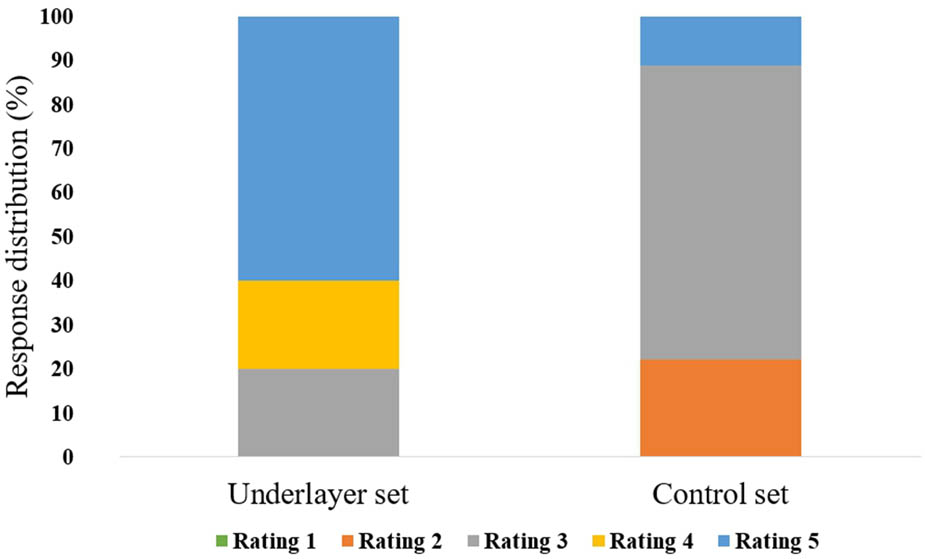
Figure 4
Percentage distribution of subjective physical comfort ratings. Ratings were assessed using a 5-point Likert scale (1 = very uncomfortable, 5 = very comfortable). Stacked bars represent the percentage distribution of responses across participants (n = 10) for the compression base-layer and control conditions.
Source: Author’s contribution.
Physical comfort was selected as a representative subjective outcome, as it integrates multiple perceptual dimensions of wear experience and provides an intuitive summary of overall acceptability across conditions. No device-related adverse events were reported, and no cases of skin irritation, circulation restriction, or activity-limiting discomfort were observed. Acceptability was high: most participants indicated a willingness to re-wear the base layer under operational or training conditions. Detailed regional evaluations of compression appropriateness and physical comfort are summarized in Table 4, demonstrating significant improvements across most body sites when wearing the compression base layer.
3.4. Functional Outcomes During Standardized Tasks
Performance during combat-relevant maneuvers suggested potential functional benefits of textile reinforcement. Knee and ankle pain ratings during high jumps decreased from 3.3 to 1.8 and from 3.2 to 1.9, respectively, while wrist pain during push-ups declined from 3.8 to 2.0. As shown in Table 4, joint pain scores at the wrist, knee, and ankle decreased significantly (p < 0.01), indicating localized perceived benefits of textile reinforcement. During a 15-min treadmill walk at 4 km/h with a 10-kg backpack, heat sensations decreased at multiple body sites, with significant reductions at the underbust and nape. Core support ratings were consistently high (>4.5), with significant improvements at the abdomen (4.7 ± 0.48), lower back (4.8 ± 0.42), and spine (4.7 ± 0.68). Enhanced perceived muscle support at the abdomen, lower back, and spine (all p < 0.01; Table 4) suggests potential ergonomic benefits of the compression base layer. These findings indicate that the compression base layer was associated with improved perceived joint stabilization and thermophysiological comfort during representative load-bearing tasks, supporting its potential relevance to operational contexts.
4. Discussion
4.1. Validation of Pressure Targets and Material Design
The region-specific compression values achieved by the prototype closely met the intended engineering specifications, suggesting that fabric modulus and differential reduction methods may translate design intent into measurable outcomes. Support zones (wrists, knees, and ankles) remained within the recommended pressure range (≈0.8–3.1 kPa) [25], while comfort-focused regions remained below 1.0 kPa, supporting wearability.
Although abdominal pressure was slightly below target, participants perceived it as appropriate, indicating that subjective assessment reflects not only absolute pressure but also soft-tissue compliance and fabric–body interaction. The strong concordance between virtual predictions and bench measurements (Tables 2 and 3) further suggests that panel placement and reduction rules may function as controllable design parameters for delivering region-specific pressures within defined tolerance bands.
These findings suggest that fabric modulus and reduction rules may function as quantifiable textile-engineering control variables rather than merely descriptive garment attributes.
4.2. Thermal and Moisture Regulation via Functional Panels
Quick-drying, permeable panels placed at high-sweat regions were associated with reported improvements in thermal comfort. Participants noted reductions in heat-related sensations at the underbust and nape, suggesting that localized material placement may support moisture transfer. Smaller effects observed at the spine and posterior thigh may reflect anatomical curvature and limited panel coverage, indicating opportunities for further pattern refinement.
These findings align with prior research demonstrating that yarn and fabric parameters influence air and water-vapor permeability, thereby affecting microclimate regulation. Accordingly, modest increases in panel area or curvature-conforming shaping could further improve moisture transport without compromising structural support. Collectively, these results suggest that panel-based textile engineering may contribute to improved microclimate regulation during load-carriage tasks [16,17,18].
Rather than evaluating a finished compression product alone, the present findings highlight how panel-based textile engineering strategies can be systematically designed to influence thermophysiological responses under standardized occupational conditions.
4.3. Implications for Textile Engineering and Functional Garment Design
The present study demonstrates how pressure zoning and fabric placement can be operationalized into functional compression base-layer prototypes. By integrating high-tensile fabrics at joint regions with permeable fabrics at heat-sensitive areas, the system achieved a balance between localized support and thermophysiological comfort. At the textile-engineering level, panel configuration and fabric modulus were treated as controllable structural parameters and evaluated against predefined ergonomic and thermal criteria under load-carriage conditions.
By operationalizing panel configuration, fabric modulus, and localized permeability as task-linked textile design variables, this work advances compression garment research toward a structured, parameter-driven textile engineering framework for women-specific high-load systems.
Compared with prior compression garment research conducted primarily in athletic populations, the present study extends the evidence to women performing standardized load-carriage tasks within uniform-based operational conditions. Whereas earlier studies demonstrated improvements in proprioception, muscle vibration attenuation, and post-exercise recovery [2,3,4], most were conducted in short-duration exercise trials and mixed or male-dominant samples. Relatively few investigations have centered on female anthropometry, joint-support demands, and microclimate management within occupational environments. Moreover, existing literature frequently evaluates compression garments as finished products rather than as systems defined by controllable textile-engineering variables.
In addition, the present study explicitly incorporated female anthropometric characteristics and joint-support requirements into the compression garment design process. This approach addresses an important gap in existing literature, where many compression garment studies have relied on mixed-sex samples without fully considering women-specific ergonomic and fit-related requirements.
From a development and production perspective, the proposed panel-integrated compression system is compatible with conventional cut-and-sew manufacturing processes and utilizes commercially available elastic and breathable fabrics, facilitating integration into existing uniform production systems. The specification of target pressure ranges alongside defined fabric property windows provides a scalable framework adaptable across size ranges and standardized manufacturing environments, supporting broader implementation across uniform programs and related high-load occupational domains [16,17,18].
Future investigations incorporating objective physiological endpoints – such as electromyography, skin and core temperature, and motion analysis – will be necessary to verify whether these textile interventions translate into measurable reductions in musculoskeletal or thermal strain under operational conditions. Collectively, these findings highlight how compression garments can be conceptualized not merely as finished products but as parameter-driven textile systems linking structural design variables to ergonomic and thermophysiological performance in occupational contexts.
5. Limitations and Future Work
This study was a single-site pilot with a small sample, short exposure duration, and predominantly subjective outcomes, which may limit generalizability. The constrained sample size reduced statistical power; therefore, findings should be interpreted as exploratory rather than confirmatory. Pressure measurements were obtained under static resting conditions and may not fully capture dynamic interface pressure fluctuations during load-carriage and task-related movements. In addition, durability after repeated laundering – an important performance criterion for military textile systems – was not evaluated. Although a randomized two-period crossover design with a 1-h washout was implemented, residual period or sequence effects cannot be entirely excluded. The washout interval may have been insufficient to fully mitigate potential carryover effects, particularly for perceptual responses. Multiple region-specific comparisons were conducted without formal adjustment for multiplicity; accordingly, reported p-values should be interpreted cautiously as exploratory signals rather than confirmatory evidence. Future investigations should incorporate dynamic pressure monitoring using wearable sensors, extended wear durations, and standardized laundering protocols. Larger and more diverse samples, together with objective physiological and biomechanical endpoints, will be necessary to strengthen external validity. Refinements extending permeable panel coverage and improving curvature conformity at the spine and posterior thigh may further enhance microclimate control and comfort.
6. Conclusion
This study supports the feasibility of compression base layers engineered with region-specific textile panels to achieve targeted pressure delivery and perceived thermal comfort. The integration of functional fabrics through differential patterning may provide a scalable approach for developing women-specific compression garments. From a practical perspective, the panel-integrated design framework may facilitate integration into existing uniform systems and conventional manufacturing processes, thereby enhancing its applicability in high-load occupational contexts. While confirmatory trials incorporating objective measures are warranted, the present findings suggest that material placement and fabric selection may contribute to perceived ergonomic and thermophysiological benefits. These results support a structured textile-engineering framework linking panel configuration, fabric modulus, and localized permeability to task-related ergonomic outcomes in women-specific high-load systems.
Funding Information
This research was supported by the National Research Foundation of Korea (NRF) grant funded by the Korean government (Ministry of Science and ICT) (No. RS-2022-NR072432). This research was also supported by the Global – Learning & Academic Research Institution for Master’s, PhD students, and Postdocs (G-LAMP) Program of the National Research Foundation of Korea (NRF) funded by the Ministry of Education (No. RS-2025-25442707).
Author Contributions
O. L. contributed to conceptualization, methodology, investigation, data analysis, and writing – original draft, while Y. L. contributed to supervision, validation, and writing – review & editing. All authors have read and approved the final manuscript.
Conflict of Interest Statement
Authors state no conflict of interest.
Data Availability Statement
A Data Availability Statement has been included in the revised manuscript. The data supporting the findings of this study are available from the corresponding author upon reasonable request.