
Table 1
Production schemes of the first group clothing samples.
| Sample name | Fabric material | Color | Weaving method |
|---|---|---|---|
| SP1-WF | Woven fabric | White | Weaving |
| SP2-EF | Embroidered thread | White | Embroidering |
| SP3-SF | Coated fabric | White-blue | Coating |
| SP4-WC F | Coated fabric | White | Coating |
Source: Author’s contribution.
Table 2
Production schemes of the second group clothing samples.
| Sample name | Fabric material | Color | Weaving method |
|---|---|---|---|
| SP4-WCF | White-coated fabric | White | Coating |
| SP5-PCF | Pink-coated fabric | Pink | Coating |
| SP6-BCF | Blue-coated fabric | Blue | Coating |
| SP7-YCF | Yellow-coated fabric | Yellow | Coating |
Source: Author’s contribution.
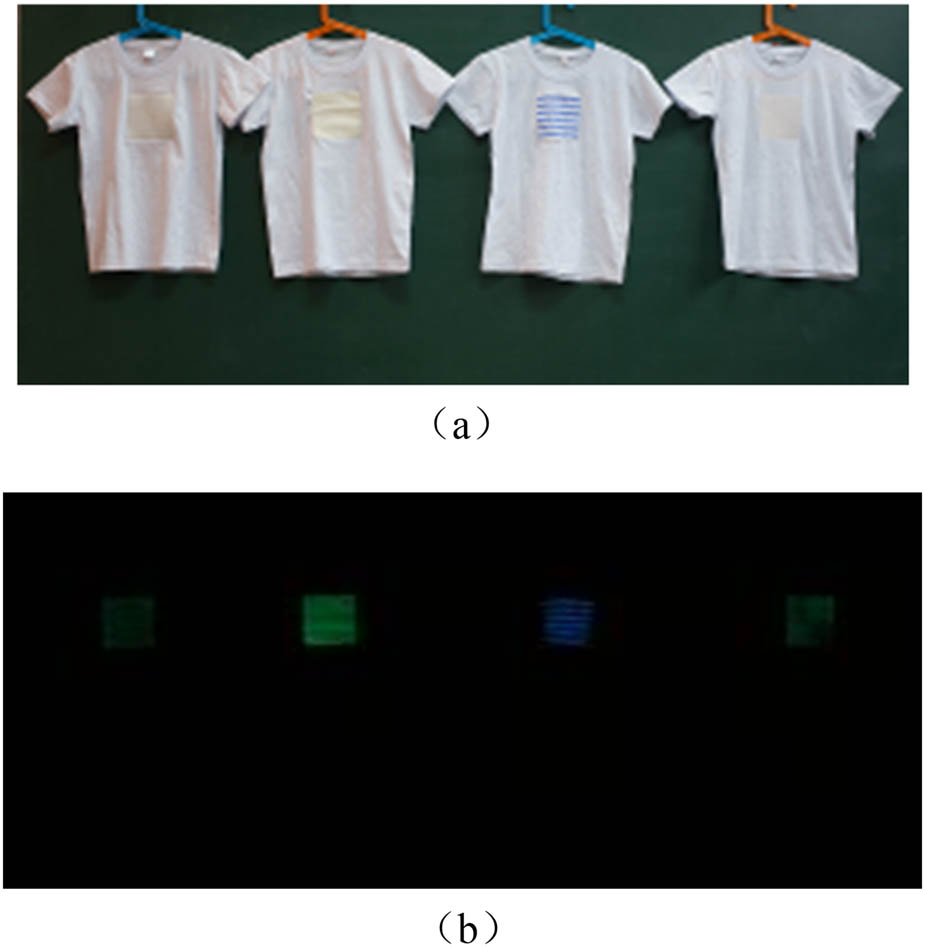
Figure 1
The first group clothing samples. (a) With light. (b) Without light.
Source: Author’s contribution.
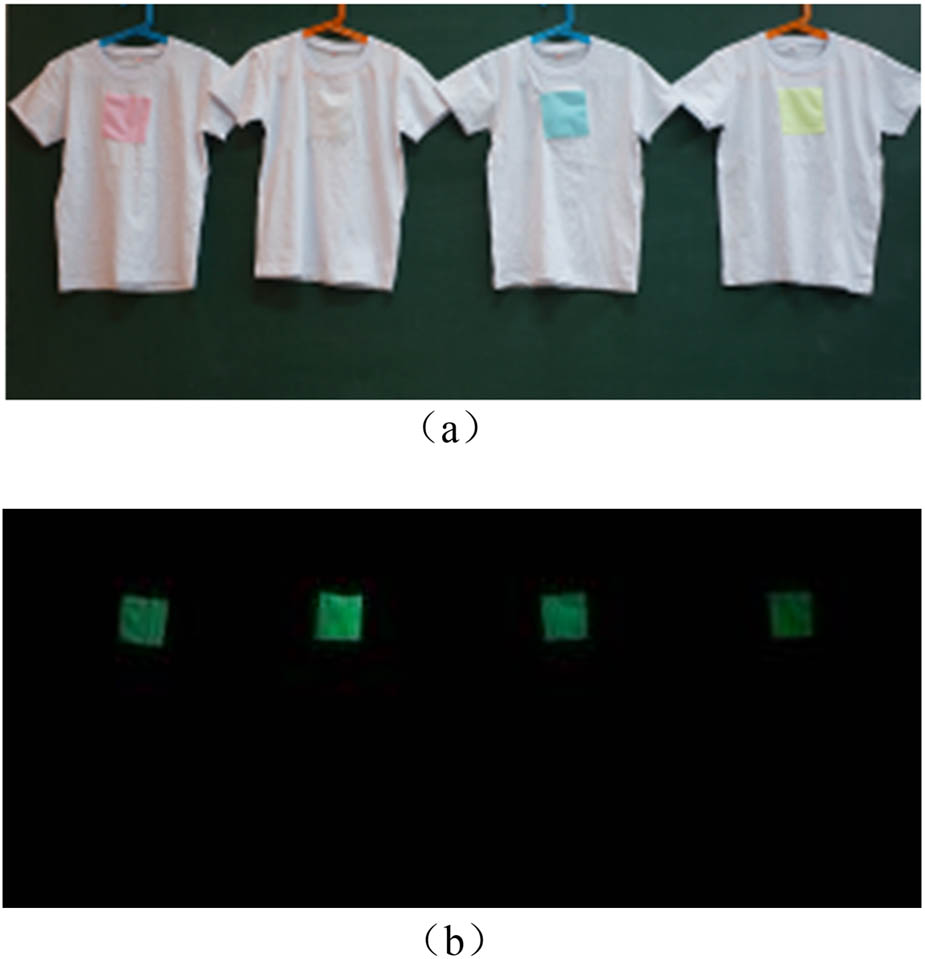
Figure 2
The second group clothing samples. (a) With light. (b) Without light.
Source: Author’s contribution.
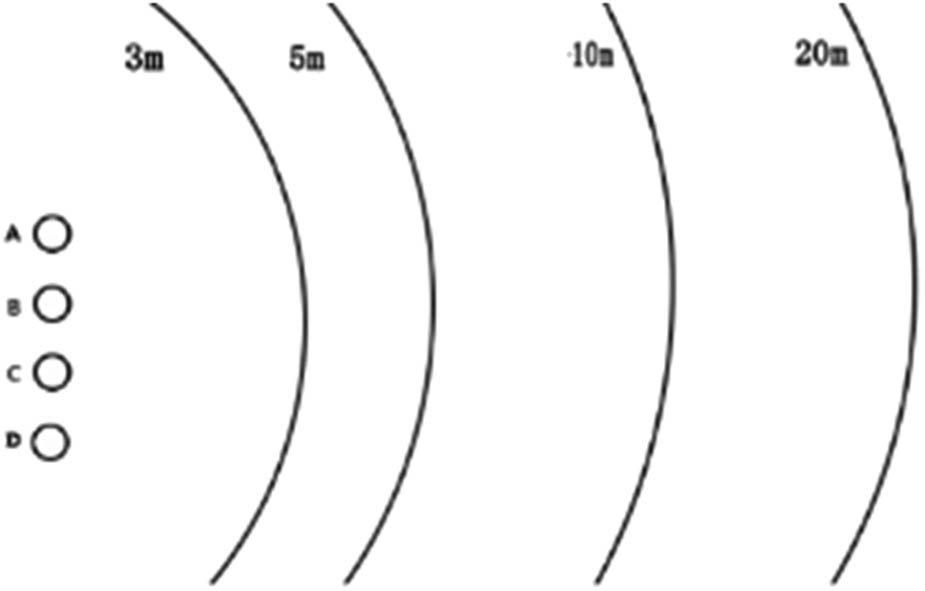
Figure 3
The design of the experimental environment.
Source: Author’s contribution.
Table 3
Evaluation criteria.
| Value | Identifiability of the clothing samples |
|---|---|
| 5 | Excellent, can be recognized exactly |
| 4 | Good, can be recognized easily |
| 3 | Average, can be recognized normally |
| 2 | Fair, can be recognized partly |
| 1 | Poor, can be recognized slightly |
Source: Author’s contribution.
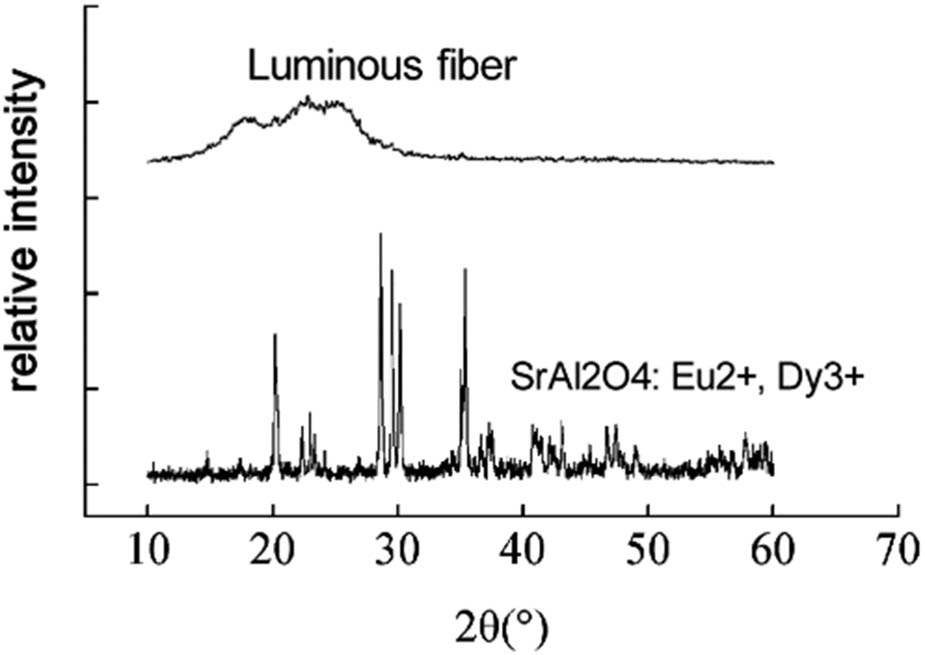
Figure 4
The XRD patterns of the luminous material and the luminous fiber.
Source: Author’s contribution.
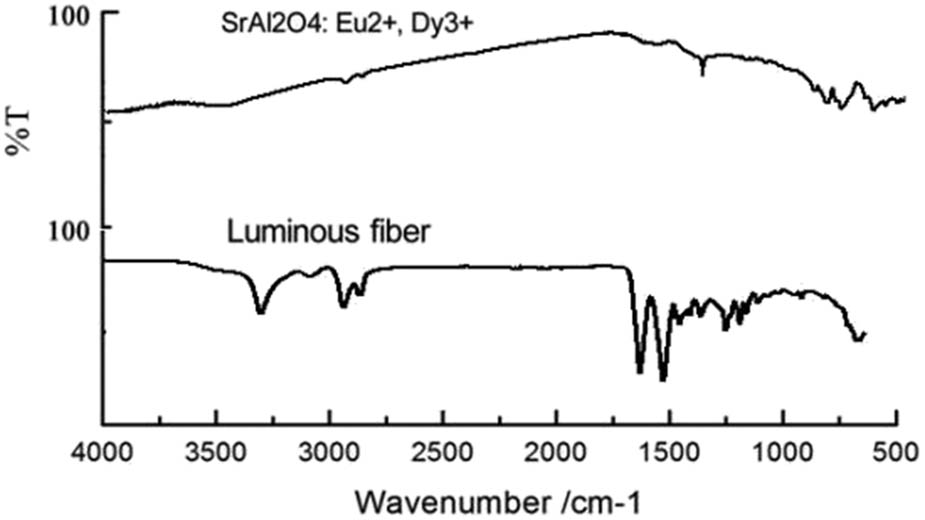
Figure 5
The FTIR spectra of the luminous material and the luminous fiber.
Source: Author’s contribution.
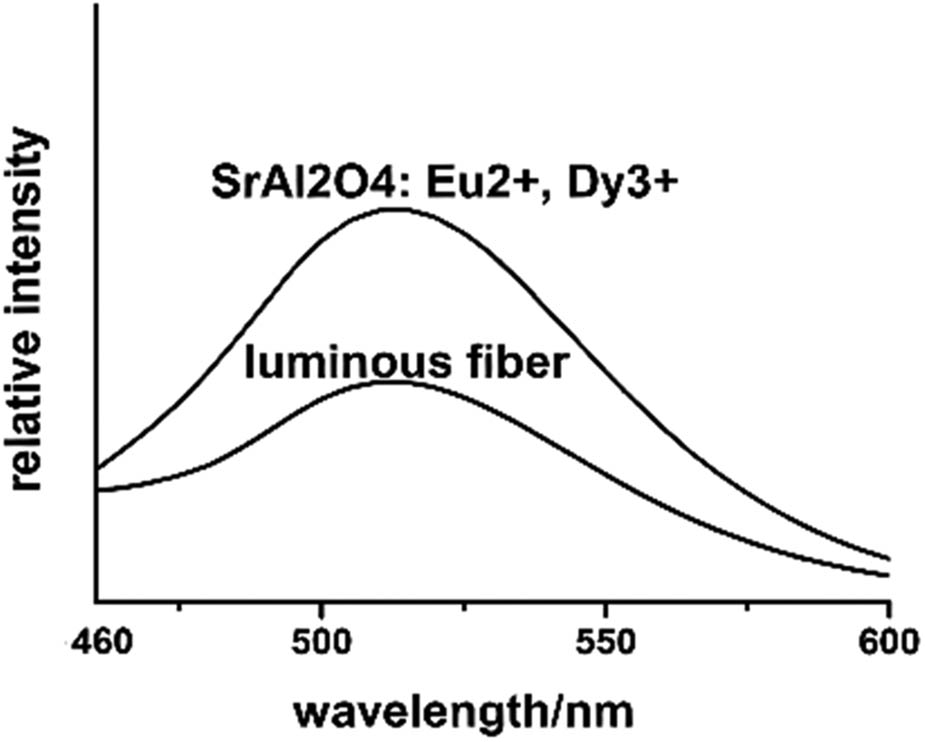
Figure 6
The Emission spectra of the luminous material and the luminous fiber.
Source: Author’s contribution.
Table 4
Colorimetric parameters.
| Sample | Chromaticity coordinates | Dominant wavelength | Purity | |
|---|---|---|---|---|
| X | Y | |||
| SrAl2O4:Eu2+, Dy3+ | 0.2640 | 0.4605 | 530 | 0.3880 |
| Luminous fiber | 0.2025 | 0.5360 | 515 | 0.656 |
Source: Author’s contribution.
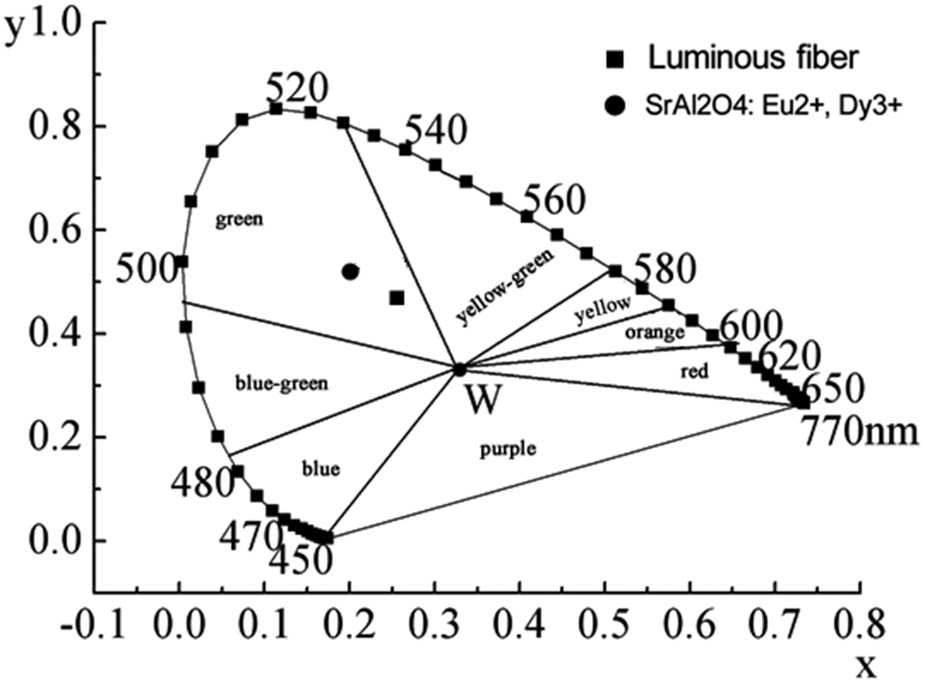
Figure 7
The CIE chromaticity diagram of the luminous material and the luminous fiber.
Source: Author’s contribution.
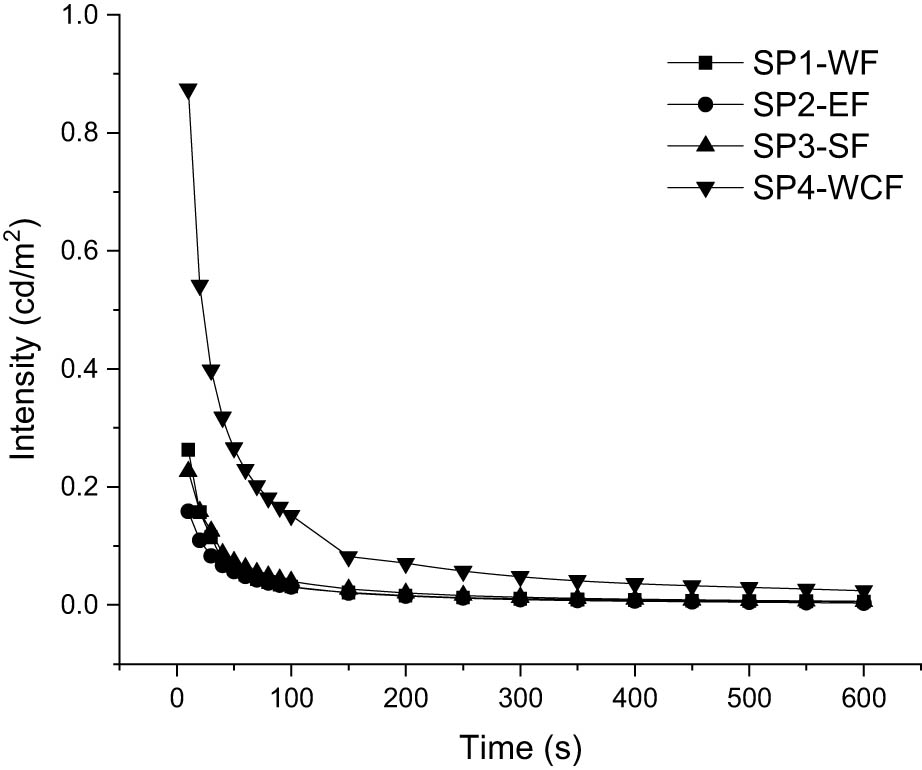
Figure 8
The afterglow spectrum of the first group clothing samples.
Source: Author’s contribution.
Table 5
Initial brightness and the plateau brightness of the first group clothing samples (cd/m2).
| Samples | Initial brightness | Plateau brightness |
|---|---|---|
| SP4-WCF | 0.8742 | 0.0477 |
| SP5-PCF | 0.6087 | 0.0361 |
| SP6-BCF | 0.3870 | 0.0386 |
| SP7-YCF | 0.4191 | 0.0238 |
Source: Author’s contribution.
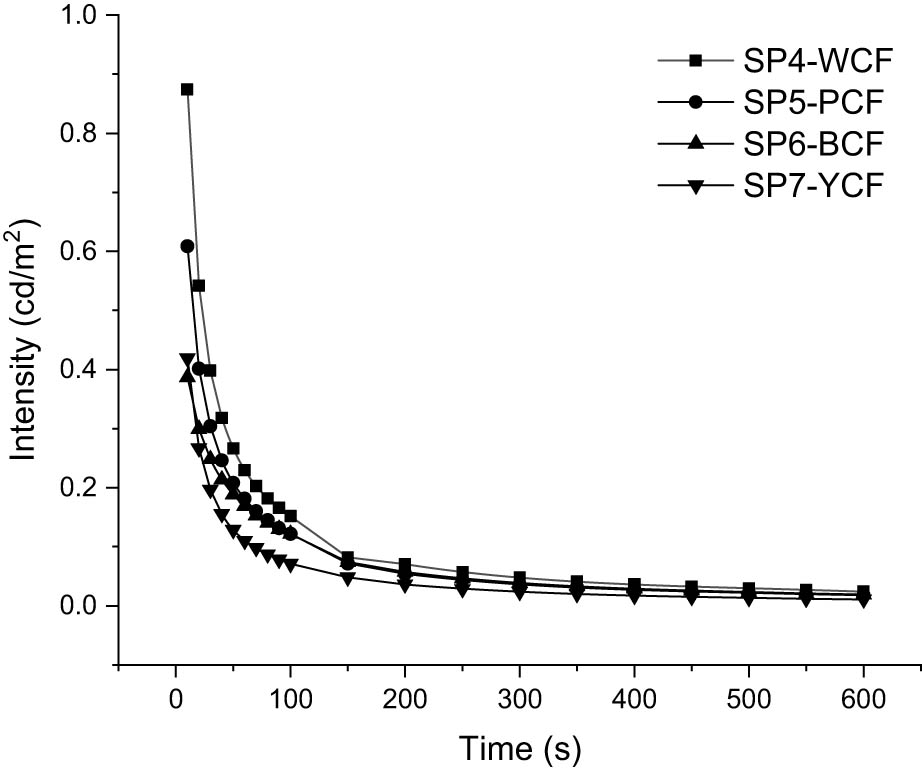
Figure 9
The afterglow spectrum of the second group clothing samples.
Source: Author’s contribution.
Table 6
Initial brightness and plateau brightness of the second group clothing samples (cd/m2).
| Samples | Initial brightness | Plateau brightness |
|---|---|---|
| SP1-WF | 0.2628 | 0.0104 |
| SP2-EF | 0.1584 | 0.0093 |
| SP3-SF | 0.2265 | 0.0131 |
| SP4-WCF | 0.8742 | 0.0477 |
Source: Author’s contribution.
Table 7
Visibility values of the first group clothing samples.
| Distance (m) | Time (min) | Sample | |||
|---|---|---|---|---|---|
| SP1-WF | SP2-EF | SP3-SF | SP4-WCF | ||
| 3 | 0 | 3.4 | 2.2 | 2.8 | 4.8 |
| 5 | 3.2 | 1.8 | 2.8 | 4.8 | |
| 10 | 2.4 | 1.4 | 2.6 | 4.4 | |
| 20 | 2.8 | 1.4 | 2.4 | 3.8 | |
| 5 | 0 | 3.6 | 3 | 2.4 | 4.8 |
| 5 | 3.2 | 2 | 2.4 | 4.8 | |
| 10 | 2.6 | 1.6 | 1.8 | 3.8 | |
| 20 | 2.2 | 1.4 | 1.6 | 3.2 | |
| 10 | 0 | 3.4 | 2.2 | 1.8 | 4.6 |
| 5 | 2.4 | 1.2 | 1.2 | 3.8 | |
| 10 | 1.8 | 1.4 | 1.4 | 2.8 | |
| 20 | 1.4 | 1.2 | 1.2 | 2.4 | |
| 20 | 0 | 3 | 2 | 1.2 | 4.4 |
| 5 | 2.2 | 1 | 1 | 3.2 | |
| 10 | 1 | 1 | 1 | 2 | |
| 20 | 1 | 1 | 1 | 1.2 | |
Source: Author’s contribution.
Table 8
Data regression analysis of the first group clothing samples.
| Sample | Regression equation | R2 | F |
|---|---|---|---|
| SP1-WF | y = 3.799942 − 0.07052 x 1 − 0.074857 x 2 | 0.535249 | 44.34004 |
| SP2-EF | y = 2.369090 − 0.035694 x 1 − 0.047714 x 2 | 0.29331 | 15.97933 |
| SP3-SF | y = 2.808598 − 0.085116 x 1 − 0.024286 x 2 | 0.465534 | 33.53452 |
| SP4-WCF | y = 5.533728 − 0.101445 x 1 − 0.102286 x 2 | 0.729539 | 103.8496 |
Source: Author’s contribution.
Table 9
Visibility values of the second group clothing samples.
| Distance (m) | Time (min) | Samples | |||
|---|---|---|---|---|---|
| SP4-WCF | SP5-PCF | SP6-BCF | SP7-YCF | ||
| 3 | 0 | 4.8 | 4.4 | 4.6 | 4.2 |
| 5 | 4.6 | 3.8 | 4.2 | 3.6 | |
| 10 | 4.2 | 3.2 | 3.4 | 2.4 | |
| 20 | 3.6 | 1.8 | 2.4 | 1.6 | |
| 5 | 0 | 5 | 4.2 | 4.4 | 4.2 |
| 5 | 5 | 3.8 | 4 | 3.4 | |
| 10 | 3.6 | 2.4 | 2.6 | 2.4 | |
| 20 | 2.6 | 1.8 | 1.6 | 1.6 | |
| 10 | 0 | 5 | 4.6 | 4.4 | 4.6 |
| 5 | 4.8 | 3.8 | 3.8 | 3 | |
| 10 | 3 | 2.4 | 2.2 | 1.8 | |
| 20 | 2.2 | 1.4 | 1.4 | 1.4 | |
| 20 | 0 | 4.8 | 3.4 | 3.8 | 3.4 |
| 5 | 3.6 | 2.2 | 2.4 | 2.2 | |
| 10 | 2 | 1 | 1 | 1 | |
| 20 | 1.6 | 1 | 1 | 1 | |
Source: Author’s contribution.
Table 10
Data regression analysis of the second group clothing samples.
| Sample | The regression equation | R2 | F |
|---|---|---|---|
| SP4-WCF | y = 5.582890 − 0.073988 x 1 − 0.126286 x 2 | 0.715723 | 96.93141 |
| SP5-PCF | y = 4.724855 − 0.076301 x 1 − 0.134286 x 2 | 0.620722 | 63.00868 |
| SP6-BCF | y = 4.964480 − 0.084682 x 1 − 0.138286 x 2 | 0.65425 | 72.85224 |
| SP6-YCF | y = 4.366199 − 0.061705 x 1 − 0.133429 x 2 | 0.580065 | 53.1809 |
Source: Author’s contribution.
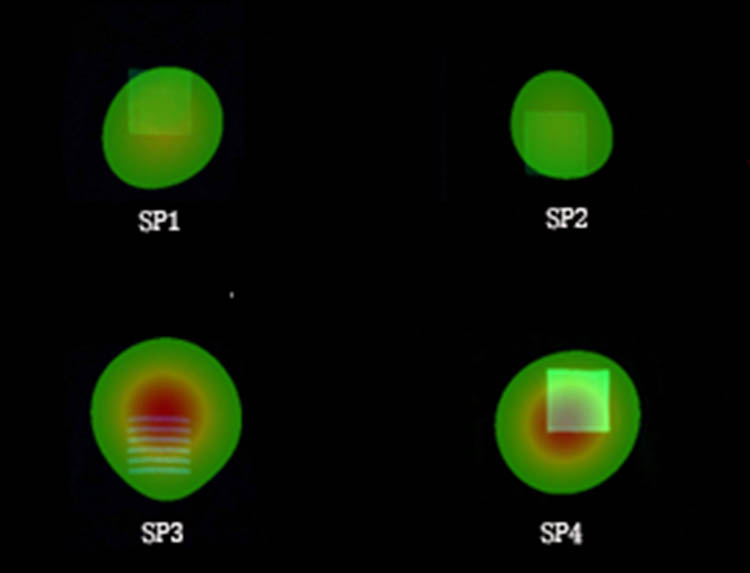
Figure 10
Eye tracking thermal map of the first group clothing samples.
Source: Author’s contribution.
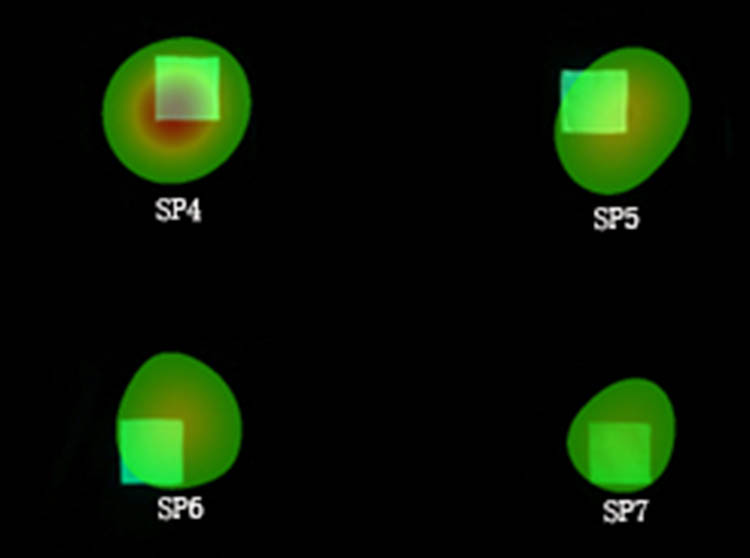
Figure 11
Eye tracking thermal map of the second group clothing samples.
Source: Author’s contribution.