
1. Introduction
The ecological concern of nations is globally increasing the application of natural dyes in the dyeing of textiles with green and sustainable production methods. Therefore, strict environmental standards imposed by many associations increase the revival and use of natural dyes in different areas of life [1, 2]. Compared to certain synthetic dyes, colorants derived from naturally occurring sources have less of a negative impact on the environment and wastewater problem. That is why these colors, which are renewable, biodegradable, sustainable, and non-toxic, are acceleratingly popularized around the world [3,4,5]. Also, natural dyes are currently employed on an industrial scale to color textiles [6, 7]. Although some properties of dyestuffs of animal origin are superior to those of vegetable dyes, in recent years their use has not been preferred. This is due to the importance of clean technology and the environment. Plant-derived natural dyes contain overmuch chemical or biochemical pathways in the plant structure [8, 9].
Anthocyanins are a group of phenolic compounds that color flowers, fruits, and vegetables. The colors, from red to purple and blue, are due to the pigments of anthocyanins. Anthocyanins have antioxidant, antimutagenic, anticancer, and anti-obesity properties. It has positive effects on human health such that it reduces the risk of coronary heart disease [10, 11]. Since anthocyanins are water soluble, they are widely used as a colorant in the cosmetics, food, and textile industries [12, 13]. The world’s most prevalent root vegetable, the black carrot has a very high anthocyanin concentration. The black carrot’s anthocyanin quantity was given as 1750 mg/kg of fresh weight. Turkey, Afghanistan, Egypt, Pakistan, and India are among the countries that mostly grow black carrots [14, 15]. Anthocyanins have been used as a natural dye for wool, silk, linen, and cotton in previous studies. Vivid hues like purple, blue, and green are obtainable by anthocyanins, which also give textiles antibacterial and UV protection qualities [16].
Dyeing is explained as the process of adding color to textile fiber, yarn, or fabric to give stability and uniform quality. Natural dyes require a mordanting process to fix the color of the fiber; for this reason, a pretreatment for dyeing textile fibers with natural dyestuffs is necessary with mordant substances [17, 18]. Mordants come in two categories: metallic mordants and bio-mordants (organic mordants). In the historical process, due to their intensive use, the most important metallic mordants are iron, aluminum, and chromium hydroxides. The same dyestuff in the dyebath gives very different colors with different mordants, for example madder (Alizarin) produces a red color on aluminum mordant, a garnet color on chrome mordant, and a purple color on iron mordant [19, 20]. Bio mordants generally contain different tannins and also fatty mordants. In the dyeing process of cellulose-based vegetable fiber, tannin mordant, commonly found in many plants, is preferred in principle. The dyeing properties of many bio mordants have been also studied in the literature, such as pomegranate peel, mango peel, tea leaves, tamarind, aloe vera, acacia bark ash, orange peel, pomegranate peel, amla powder, mustard powder, sodium alginate, lemon peel and pine cones [21,22,23,24].
In this study, the color properties of black carrot with natural mordants on cellulosic-based flax and cotton fabric were investigated. Two natural mordants including sodium alginate and gall oak were used as bio-mordant to improve the color characteristics. The colorimetric characteristics (CIE Lab and K/S values) and washing, rub, and light fastness properties of the dyed cellulosic-based materials were specified. The objective of this work was to assess the dyeability of cellulosic-based fibers using an extract of black carrot (Daucus carota L.) in the presence of bio-mordants.
2. Materials and methods
2.1. Materials
Two different fabrics were used. The first fabric, 100% natural cotton single jersey knitted fabric, ready for cotton dyeing, was used (Cotton yarn - Ne 30 and gsm:100 g/m2). The second fabric used was flax/cotton (weft-100% flax yarn, warp - 100% cotton yarn) union of plain weave (weft flax yarn - Ne 20 and warp cotton yarn count – Ne 30 and gsm:120 g/m2). Black carrots were obtained from the Emine Nacak farm in the village of Akcakavak in Beypazarı (Ankara-Turkiye). Sodium alginate and gall oak were purchased (İstanbul, Türkiye) and used as bio-mordant. Alum (KAl(SO4)2·12H2O) was obtained from Merck (Darmstadt, Germany) (Figure 1).
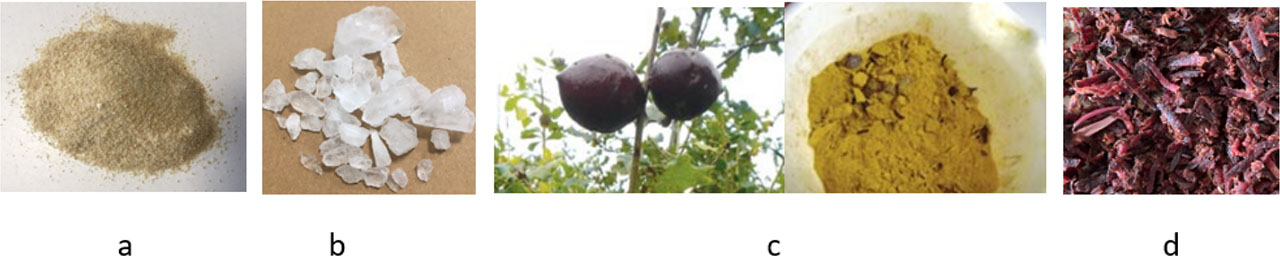
Fig. 1.
a) sodium alginate, b) alum, c) gall oak, d) black carrot
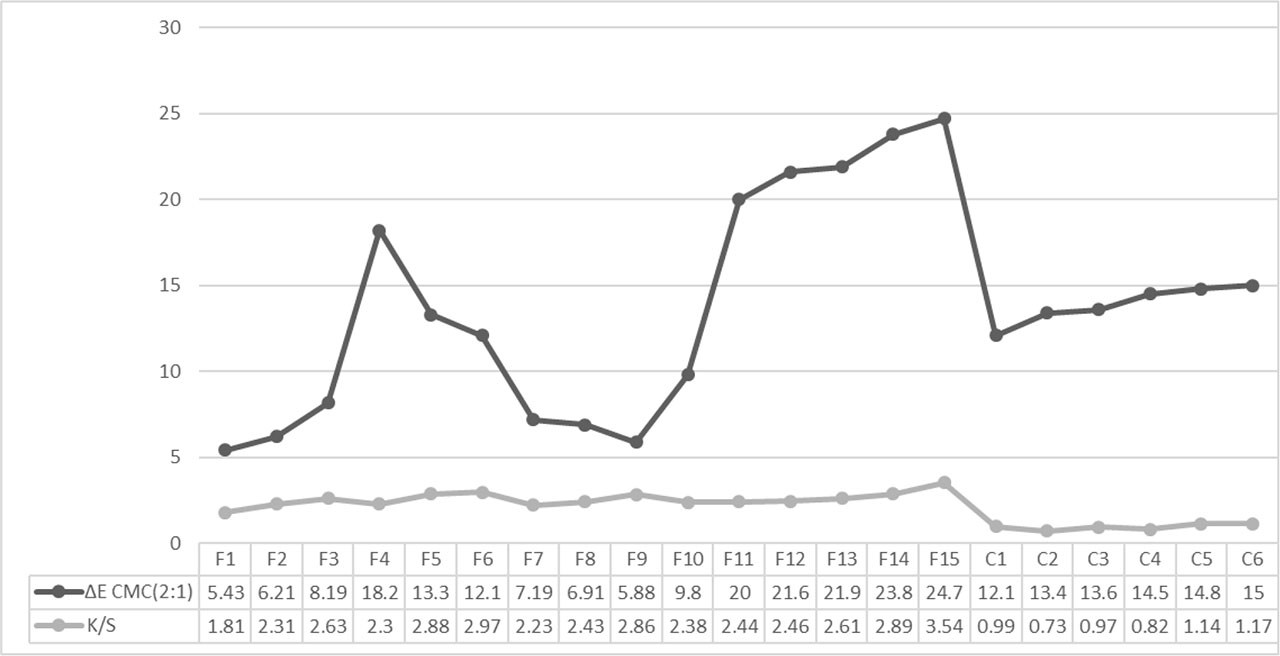
Fig. 2.
K/S and ΔECMC(2:1) values of the dyed fabrics
2.2. Mordanting and dyeing procedure
Black carrot dyeing was carried out using different mordant ratios on sixteen flax/cotton union fabrics (16 pieces; 20×20 cm) and six natural cotton single jersey knitted fabrics (6 pieces; 20×20 cm). The meta-mordanting procedure was used to investigate the impact of bio-mordants (sodium alginate and gall oak) on the color fastness properties (black carrot) of the cellulose-based fiber. The procedure of dyeing and mordanting is shown in Table 1.
Table 1.
Dyeing procedure of fabrics
| Code | Mordant (%) | Daucus carota (%) | L:R | Temp (°C) | L* | a* | b* | C* | h° | ΔECMC(2:1) | K/S | Shade | |||
|---|---|---|---|---|---|---|---|---|---|---|---|---|---|---|---|
| Alg. | Gall. | Alum | Micro. | Real | |||||||||||
| F0 | 0 | 0 | 0 | - | - | - | 95.5 | 2.97 | −10.4 | 10.88 | 285.8 | - | - |  |  |
| F1 | 1 | 0 | 0 | 50 | 1:50 | 80 | 85.1 | 3.27 | −1.21 | 3.49 | 339.6 | 5.43 | 1.81 |  |  |
| F2 | 2 | 0 | 0 | 89.2 | 3.35 | −4.35 | 5.48 | 307.6 | 6.21 | 2.31 |  |  | |||
| F3 | 5 | 0 | 0 | 89.8 | 3.44 | −5.17 | 6.21 | 303.6 | 8.19 | 2.63 |  |  | |||
| F4 | 1 | 1 | 0 | 79.7 | 5.56 | 2.82 | 6.24 | 26.85 | 18.2 | 2.30 |  |  | |||
| F5 | 2 | 1 | 0 | 82.1 | 5.18 | −0.31 | 5.19 | 356.5 | 13.3 | 2.88 |  |  | |||
| F6 | 5 | 1 | 0 | 82.8 | 6.52 | −2.16 | 6.87 | 341.6 | 12.1 | 2.97 |  |  | |||
| F7 | 1 | 1 | 1 | 81.9 | 2.04 | −3.98 | 4.47 | 297.1 | 7.19 | 2.23 |  |  | |||
| F8 | 2 | 1 | 2 | 83.5 | 2.64 | −4.17 | 4.94 | 302.3 | 6.91 | 2.43 |  |  | |||
| F9 | 5 | 1 | 3 | 84.3 | 3.34 | −7.26 | 7.99 | 294.7 | 5.88 | 2.86 |  |  | |||
| F10 | 5 | 2 | 0 | 82.3 | 7.71 | −0.02 | 7.71 | 359.8 | 9.80 | 2.38 |  |  | |||
| F11 | 5 | 5 | 0 | 79.6 | 10.38 | 1.93 | 10.56 | 10.54 | 20.0 | 2.44 |  |  | |||
| F12 | 5 | 7.5 | 0 | 77.2 | 10.28 | 3.16 | 10.75 | 17.08 | 21.6 | 2.46 |  |  | |||
| F13 | 5 | 10 | 0 | 77.0 | 11.33 | 2.79 | 11.67 | 13.83 | 21.9 | 2.61 |  |  | |||
| F14 | 5 | 12.5 | 0 | 75.7 | 11.55 | 4.30 | 12.33 | 20.43 | 23.8 | 2.89 |  |  | |||
| F15 | 5 | 15 | 0 | 74.2 | 9.73 | 5.85 | 11.36 | 30.98 | 24.7 | 3.54 |  |  | |||
| C0 | 0 | 0 | 0 | - | - | - | 96.0 | 0.11 | 2.08 | 2.08 | 86.98 | - | - |  |  |
| C1 | 5 | 2 | 0 | 50 | 1:50 | 80 | 83.8 | 4.81 | 11.7 | 12.66 | 67.68 | 12.1 | 0.99 |  |  |
| C2 | 5 | 5 | 0 | 85.4 | 3.46 | 10.3 | 10.91 | 71.51 | 13.4 | 0.73 |  |  | |||
| C3 | 5 | 7.5 | 0 | 82.5 | 5.08 | 10.5 | 11.70 | 64.23 | 13.6 | 0.97 |  |  | |||
| C4 | 5 | 10 | 0 | 83.2 | 4.88 | 10.5 | 11.61 | 65.16 | 14.5 | 0.82 |  |  | |||
| C5 | 5 | 12.5 | 0 | 80.0 | 5.04 | 11.4 | 12.46 | 66.16 | 14.8 | 1.14 |  |  | |||
| C6 | 5 | 15 | 0 | 80.1 | 5.99 | 11.0 | 12.55 | 61.52 | 15.0 | 1.17 |  |  | |||
2.3. Color measurement
Color characteristics of the dyed fabrics with black carrot were measured using a colorimeter instrument (Datacolor International, USA). From the reflectance values (R) in the visible spectrum (400–700 nm) at the maximum absorption wavelength (λmax) for each dye, the corresponding color strength (K/S) values of the samples were calculated by using the Kubelka–Munk (equation 1).
where, K is the absorption coefficient of the substrate, S the scattering coefficient of the substrate, and R is the reflectance of the dyed samples at λmax.The untreated fabric was taken as standard and the color differences of the dyed materials were compared according to the CMC (l:c) equation, ΔECMC(2:1) is computed by Equation 2:
2.4. Color fastness
The fastness of the dyed materials to light (ISO105-B02), washing [ISO105: C06 (A1S)], and rubbing (ISO105-X12) were tested using ISO standard methods [25, 26]. The results of light, rubbing, and washing fastness tests of the dyed fabrics are given in Table 2.
Table 2.
Results of light, rubbing and washing fastness tests of dyed fabrics
| Dying code | Mordant % | Daucus carota % | Light fastness | Rubbing fastness | Washing fastness - Staining | ||||||||
|---|---|---|---|---|---|---|---|---|---|---|---|---|---|
| Alg | Gall oak | Alum | Dry | Wet | Acetate | Cotton | Nylon 6.6 | Polyester | Acrylic | Wool | |||
| F0 | 0 | 0 | 0 | - | - | - | - | - | - | - | - | - | - |
| F1 | 1 | 0 | 0 | 50 | 2–3 | 4 | 3–4 | 4 | 4–5 | 4–5 | 4–5 | 4 | 4–5 |
| F2 | 2 | 0 | 0 | 2–3 | 4 | 3–4 | 4 | 4–5 | 4–5 | 4–5 | 4 | 4–5 | |
| F3 | 5 | 0 | 0 | 2–3 | 4 | 3–4 | 4 | 4–5 | 4–5 | 4–5 | 4 | 4–5 | |
| F4 | 1 | 1 | 0 | 2–3 | 4 | 3–4 | 4 | 4–5 | 4–5 | 4–5 | 4 | 4–5 | |
| F5 | 2 | 1 | 0 | 2–3 | 4 | 3–4 | 4 | 4–5 | 4–5 | 4–5 | 4 | 4–5 | |
| F6 | 5 | 1 | 0 | 2–3 | 4 | 3–4 | 4 | 4–5 | 4–5 | 4–5 | 4 | 4–5 | |
| F7 | 1 | 1 | 1 | 2–3 | 4 | 3–4 | 4 | 4–5 | 4–5 | 4–5 | 4 | 4–5 | |
| F8 | 2 | 1 | 2 | 2–3 | 4 | 3–4 | 4 | 4–5 | 4–5 | 4–5 | 4 | 4–5 | |
| F9 | 5 | 1 | 3 | 2–3 | 4 | 4 | 4 | 4–5 | 4–5 | 4–5 | 4 | 4–5 | |
| F10 | 5 | 2 | 0 | 2–3 | 4 | 4–5 | 4 | 4–5 | 4–5 | 4–5 | 4 | 4–5 | |
| F11 | 5 | 5 | 0 | 3 | 4–5 | 4–5 | 4 | 4–5 | 4–5 | 4–5 | 4 | 4–5 | |
| F12 | 5 | 7,5 | 0 | 3 | 4–5 | 4–5 | 4 | 4–5 | 4–5 | 4–5 | 4 | 4–5 | |
| F13 | 5 | 10 | 0 | 3 | 4–5 | 4–5 | 4 | 4–5 | 4–5 | 4–5 | 4 | 4–5 | |
| F14 | 5 | 12.5 | 0 | 3–4 | 4–5 | 4–5 | 4 | 4–5 | 4–5 | 4–5 | 4 | 4–5 | |
| F15 | 5 | 15 | 0 | 3–4 | 4–5 | 4–5 | 4 | 4–5 | 4–5 | 4–5 | 4 | 4–5 | |
| C0 | 0 | 0 | 0 | - | - | - | - | - | - | - | - | - | - |
| C1 | 5 | 2 | 0 | 50 | 2–3 | 4–5 | 4–5 | 4 | 4–5 | 4–5 | 4–5 | 4 | 4–5 |
| C2 | 5 | 5 | 0 | 2–3 | 4–5 | 4–5 | 4 | 4–5 | 4–5 | 4–5 | 4 | 4–5 | |
| C3 | 5 | 7,5 | 0 | 2–3 | 4–5 | 4–5 | 4 | 4–5 | 4–5 | 4–5 | 4–5 | 4–5 | |
| C4 | 5 | 10 | 0 | 3 | 5 | 4–5 | 4 | 4–5 | 4–5 | 4–5 | 4–5 | 4–5 | |
| C5 | 5 | 12.5 | 0 | 3–4 | 5 | 5 | 4 | 4–5 | 4–5 | 4–5 | 4–5 | 4–5 | |
| C6 | 5 | 15 | 0 | 3–4 | 5 | 5 | 4 | 4–5 | 4–5 | 4–5 | 4–5 | 4–5 | |
2.5. FTIR analysis
A PerkinElmer Spectrum 100 s. (USA) spectrometer was used to record the FT-IR spectra, which ranged between 4000 and 650 cm−1. The analysis results carried out by FTIR are given in Figure 3.
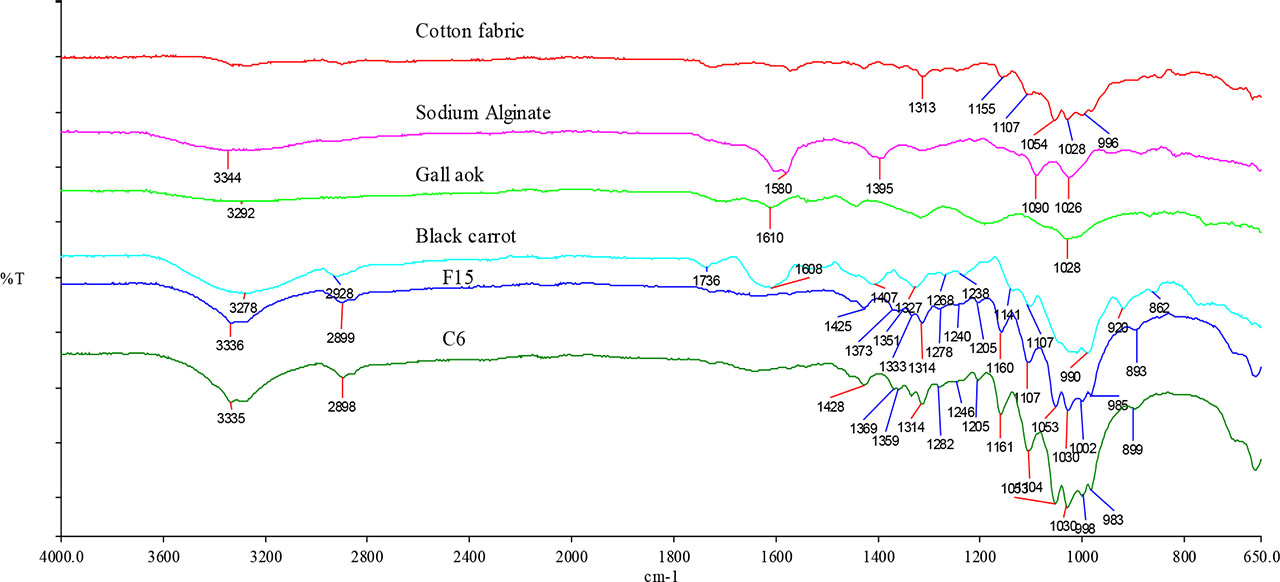
Fig. 3.
Analysis of results carried out by FTIR
2.6. HPLC-DAD analysis
An Agilent 1200 series system (Agilent Technologies, Hewlett-Packard, Germany) including a G1329A ALS autosampler and G1315A diode-array detector were used for chromatographic experiments [27, 28]. The chromatogram and spectra of the dyed sample are given in Figure 4.
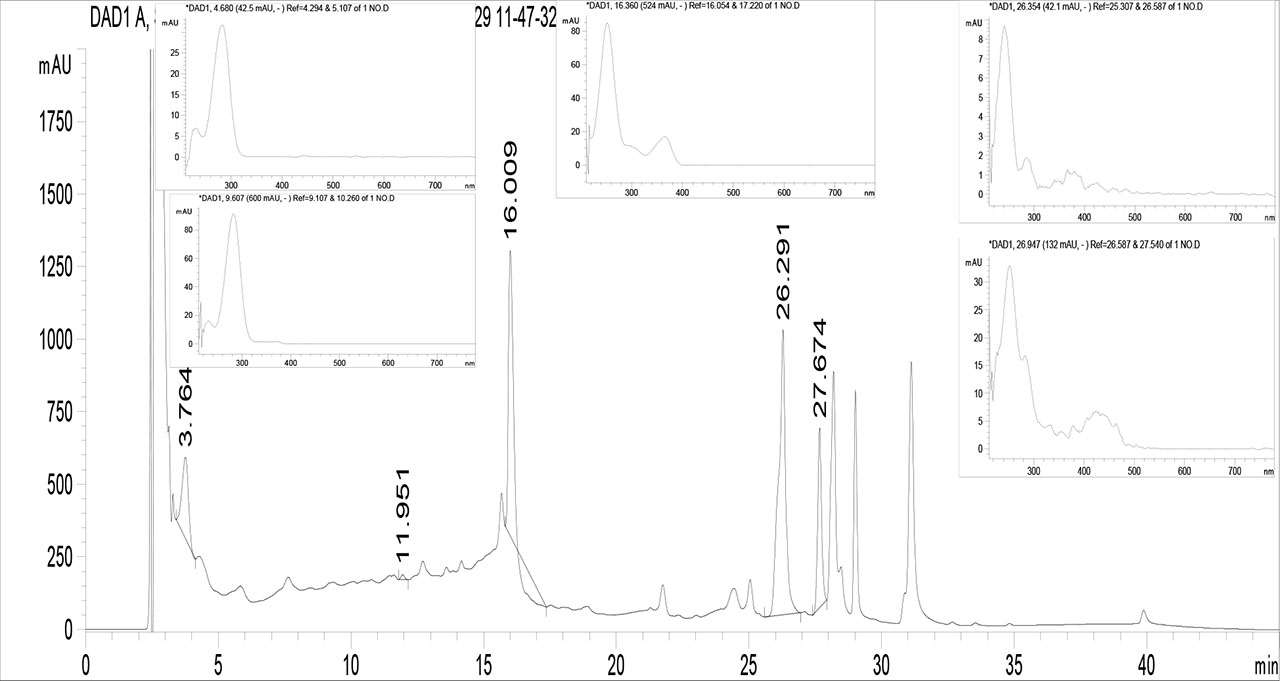
Fig. 4.
Chromatogram and spectra of the dyed samples
3. Results and discussions
3.1. Method of natural dyeing
Ready-to-dye organic cotton single jersey knitted fabrics (coded C1–C6) and plain weave flax/cotton union fabrics (weft:flax yarn, warp:cotton yarn) were utilized in the present study (coded F1–F15). To determine the best dyeing parameters using a minimum quantity of resources, the color characteristics of flax and cotton yarns were compared, and the impact of biomordant and dye concentration in cotton and flax fabric was investigated. The dyeing process also adhered to NODS [29]. In natural dyeing, extraction is the primary step, and the color component was extracted directly from the black carrot (Daucus carota L.) in a conventional aqueous process. This extraction is the simplest and most common technique, used all over the world since ancient times. Mordants, in the form of bio (natural based) and metal salt, bind dyes to the textile fiber by forming a chemical bridge between them. Mordanting is pre-processing called for to color textile fabric using natural dyes. The mordanting method depends on the plant dye used, being one of the following three techniques, namely pre, meta, and, post. To reduce expenses and save energy, the meta-mordanting method was used in the study. In this process, the plant that contains dyestuff and mordant material are added to the dye bath at the same time. Natural dyeing of fabrics was carried out in a neutral bath (pH 5-7), at 80°C, for 60 minutes and at an L:R of 1:50, depending on the chemical nature of the fiber and the dye with the application of different mordants. The gall oak ratio was increased from 1% to 15% and the sodium alginate ratio from 1% to 5%, given that it was used as a bio-mordant. Thus, various quantities of these natural mordants were used to identify the best dyeing parameters as compared to a metal mordant (alum). The procedure of dyeing and mordanting is shown in Table 1.
3.2. Colorfastness of dyed fabrics
The light fastness of all fabrics, particularly union fabrics, were found poor, but this is typical of natural coloring in cellulosic-based materials [30]. All of the dyed cotton fabrics displayed fastness to rubbing levels of 4–5 when dry and the lowest of 3–4 when wet. In conclusion, all fabric samples displayed good performance in the rubbing fastness test when dry. The findings of the washing fastness tests likewise exhibited modest and similar results. The rubbing, washing, and light fastnesses are given in Table 2.
3.3. Color strength and color coordinates
The cotton and flax fabrics dyed using black carrot with sodium alginate and gall oak displayed a color varying from light yellow to pinkish. The alum metal salt, which we examined as a metallic mordant, did not influence the color. The colors of six cotton fabrics (dying code C1–C6) displayed a yellowish color and union (flax-cotton) fabrics (dying code F1–F15) a pinkish color. The results showed that the high concentration of sodium alginate and gall oak in the dye bath which was utilized as a bio-mordant was significant for the enhanced coloristic properties of the colored fabrics. Union (flax-cotton) fabrics’ dyeability generally improved with the usage of gall oak as a bio-mordant. In conformity with the results of color measurements with flax yarn, fabric F1, mordanted with only 1% sodium alginate, had the lightest color (L*=85.12). Additionally, fabric F15 (L*=74.28) was identified as the colored sample with the darkest color. The color differences of the dyed fabrics were compared according to the CMC (l:c) equation, ΔECMC(2:1), and dyed “F-coded” samples showed color differences (ΔECMC(2:1)) ranging from 5.84 to 24.7 when the sample “F0” was used as a standard (the highest color difference value was found to be 24.7 for sample F15 and the lowest was 5.84 for the sample F1). The type of biomordant utilized determined the color difference values, ΔECMC(2:1) values were directly related to the concentration of gall oak used as a biomordant. The F15-coded sample had the highest color yield (K/S = 3.54) among all the dyed fabrics at the maximum absorption wavelength. Using 5% sodium alginate and 15% gall oak resulted in the highest color yield. K/S and ΔECMC(2:1) values obtained for the dyed fabrics are given in Figure 2.
3.4. FTIR and HPLC-DAD results
Raw fabric and selected dyed fabric samples with sodium alginate, gall oak (Quercus infectoria Olivier), and black carrot (Daucus carota L.) used as bio mordants were analyzed by FTIR-ATR. The spectra of undyed fabrics and dyed fabrics when compared confirmed the binding of fiber to the bio-mordant and dyes. An analysis of results from the FTIR are given in Figure 3. To perform dye extractions for HPLC analysis, published methods were applied [31,32,33]. According to the analysis result, cyanidin, a major anthocyanin of black carrot, and derivatives of cyanidin were identified in the dyed fabric. A peak at approximately 26.09 and 26.29 min was determined in the black carrot. Besides, gallic acid and ellagic acid were identified in the gall oak in the selected dyed fabric with bio-mordant. In the gall oak, peaks at approximately 3.76 and 11.95 minutes were found. For ellagic acids, a peak was found at about 16.09 minutes of retention durations, respectively. A chromatogram and spectra of the dyed sample are given in Figure 4.
4. Conclusions
For thousands of years, the textile industry has depended on natural resources, such as cellulosic-based fibers like cotton and flax. The history of natural dyes, used in industry since ancient times, is almost as old as the history of textiles. Natural dyes are becoming more significant due to their qualities as antioxidants, antibacterials, antimicrobials, etc., and the adverse impacts of some synthetic colorants on human health. In this study, various concentrations of gall oak and sodium alginate were used as bio-mordants, and black carrot (Daucus carota L.) was used as a natural dye. Natural colors are better for the environment and supply special benefits. The dyeing process also adhered to the Natural Organic Dye Standard (NODS). Hazardous compounds, heavy metals, pesticides, harmful and carcinogenic hues, and artificial dyes are all excluded by the NODS. Companies and the textile sector can do more by manufacturing materials that comply with the NODS while also encouraging sustainability and environmentally responsible dyeing. In an identical vein, utilizing biomordants reduces the harmful and damaging consequences of synthetic mordants. The overall result revealed that gall oak as a bio-mordant is a better choice for cellulosic-based fabrics at a concentration of 15% since it has a good color efficiency (K/S = 3.54) and color fastness to washing (4–5), light (3–4), and rubbing (4–5). Also, anthocyanin, a natural colorant extracted from black carrot, was found to be ecological for dyeing cotton and linen fabric, making it more sustainable, environmentally friendly, and non-toxic, thus requiring less work and energy.