
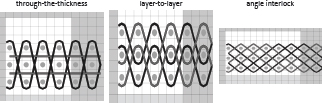
Fig. 1-1.
Three basic multilayer weaves (cut along the warp direction: weft dot, warp line)
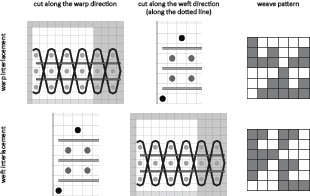
Fig. 1-2.
Through-the-thickness weave structure and pattern in warp and weft direction
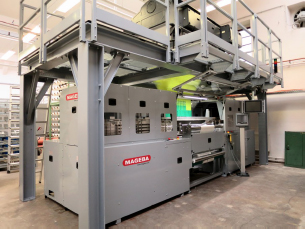
Fig. 2-1.
MAGEBA shuttle rapier loom SL RTEC 1200/1
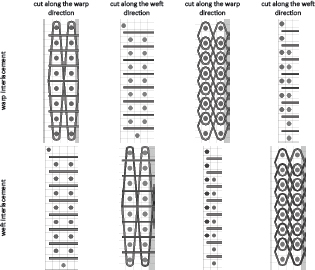
Fig. 2-2.
Weave structure for the produced samples in warp and weft direction
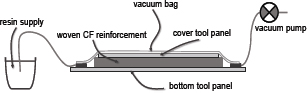
Fig. 2-3.
Setup for sample infiltration
Table 2-1.
Four weave patterns with warp (WaD) and weft densities (WeD) in threads per cm
| through-the-thickness weft interlacement | through-the-thickness warp interlacement | layer-to-layer weft interlacement | layer-to-layer warp interlacement | |
|---|---|---|---|---|
 |  |  |  | |
| WeD | 16 | 16 | 14 | 16 |
| WaD | 16 | 16 | 16 | 14 |
| Sample batch | 1 | 2 | 3 | 4 |
Table 3-1.
Fiber volume content, determined according to EN ISO 1172
| Sample batch | Weave | Interlacement type | Fiber volume content (FVC) | Sample thickness |
|---|---|---|---|---|
| 01 | Through-the-thickness | Weft interlacement | 43.5 % | 3.4 mm |
| 02 | Through-the-thickness | Warp interlacement | 39.4 % | 3.4 mm |
| 03 | Layer-to-layer | Weft interlacement | 50.2 % | 2.8 mm |
| 04 | Layer-to-layer | Warp interlacement | 52.0 % | 2.8 mm |
Table 3-2.
Results of the flexural bending test
| Sample batch | Test direction | Modulus of elasticity in flexure | Flexural strength | Strain at flexural strength | ||
|---|---|---|---|---|---|---|
| Test result | Normalized1) | Test result | Normalized1) | |||
| Ef in 103 N/mm² | Ef,norm in 103 N/mm² | σf in N/mm² | σf,norm in N/mm² | EfM in % | ||
| 01 | Warp | 31.4 ± 4.32) | 36.1 ± 4.9 | 407 ± 68 | 468 ± 78 | 1.9 % |
| Weft | 29.5 ± 1.1 | 33.9 ± 1.3 | 473 ± 16 | 544 ± 18 | 1.9 % | |
| 02 | Warp | 33.8 ± 2.0 | 38.9 ± 2.3 | 522 ± 25 | 600 ± 29 | 1.6 % |
| Weft | 36.6 ± 0.4 | 42.1 ± 0.5 | 490 ± 18 | 563 ± 21 | 1.8 % | |
| 03 | Warp | 57.4 ± 5.7 | 57.2 ± 5.7 | 578 ± 43 | 576 ± 43 | 1.1 % |
| Weft | 36.1 ± 1.8 | 36.0 ± 1.8 | 483 ± 30 | 481 ± 30 | 1.5 % | |
| 04 | Warp | 36.9 ± 3.8 | 35.5 ± 3.7 | 494 ± 30 | 475 ± 29 | 1.5 % |
| Weft | 48.7 ± 0.2 | 46.8 ± 0.2 | 601 ± 34 | 578 ± 33 | 1.2 % | |
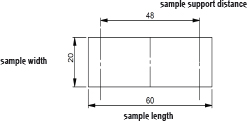
Fig. 2-4.
Sample geometry
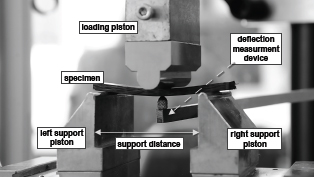
Fig. 2-5.
Flexural test setup
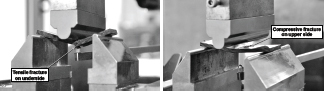
Fig. 3-1.
Fracture behavior during the bending tests (left: tensile fracture, right: compressvie fracture)
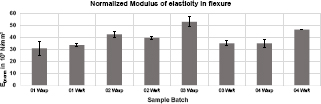
Fig. 3-2.
Normalized modulus of elasticity in flexure
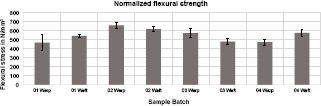
Fig. 3-3.
Normalized flexural strength
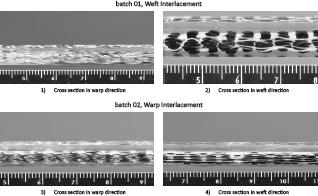
Fig. 3-4.
Cross section of the through-the-thickness samples
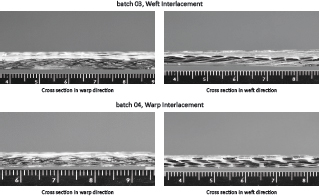
Fig. 3-5.
Cross section of the layer-to-layer samples