
1. Introduction
Day by day, fashion is changing, and, nowadays, consumers like to wear skinny dress, for which proper fit and good appearance of clothing play a vital role for acceptance. Fabric elasticity is the most significant factor when it comes to comfort, fit, and body movement. For example, denim jeans need 10-35% elasticity for better comfort at the time of body movement [1]. In recent years elastic fabric and garments usage has increased a lot, and to fulfill the demand, the usage of elastic materials has increased also. Consumers choose elastic garments over conventional ones due to their comfortability, stretch, recovery capability, and performance [2]. An elastic structure is required to improve the elasticity and recovery of the fabrics, and the elastic core-spun yarn is used to accomplish this purpose [3] as fabric properties mainly depend on its elements like fiber and yarn properties.
Core-spun yarn has at least two components, a sheath fiber, and core fiber. The core fiber is an elastomeric filament which is surrounded by the sheath fiber. Here sheath fiber is a staple fiber and has less elasticity than core fiber. With this arrangement, the yarn has all the sheath fiber properties and stretchability [3–7]. As core-spun yarn has some challenges like lack of recovery, dimensional change, and stability, a new generation yarn named dual core-spun yarn has been developed [8, 9]. Dual core-spun yarn is made of three components, and along with sheath fiber in the core, there are filaments and elastane [1, 10–12]. Here, elastane as a high elastic component helps to enhance the high elasticity, whereas semi-elastic filament helps to enhance high recovery, stability, and low shrinkage properties [8]. Figure 1 illustrates the cross-section view of core and dual core-spun yarns.
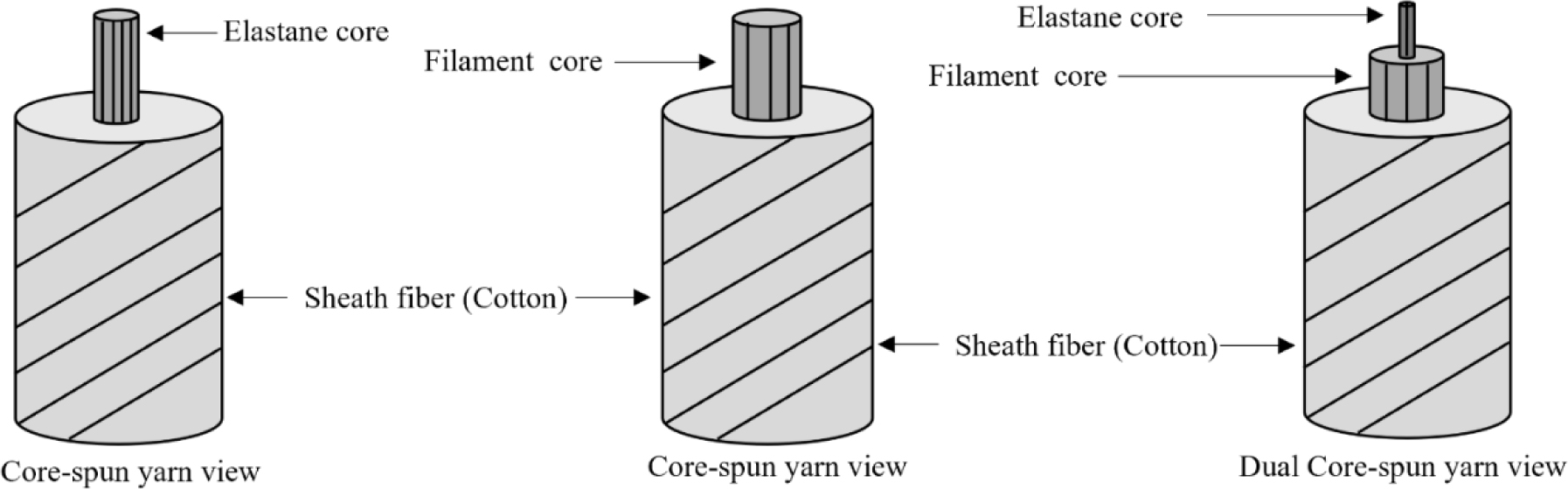
Fig. 1.
Illustration of core-spun and dual core-spun yarns view (Picture is drawn by the author)
For the filament, PET/PTT (polyethylene terephthalate/polytrimethylene terephthalate), PET (polyester), PBT (polybutylene terephthalate), PTT (polytrimethylene terephthalate), etc., are used as a core component, and PET-based core yarn is used for attaining higher strength [13]. Elastane filament is used as a soft component and has a high elongation range of 400 to 800 %, with polyurethane segmenting the polymeric chains at 85 %. After removing the force on elastane, it can quickly return to its original form, whereas PET/PTT (T400®) has higher stretch and recovery properties than textured yarn as well as dimensional stability and chlorine resistance along with easy care [14]. PBT is a type of textured polyester filament, and after finishing the process, PBT shows permanent elastic properties [15]. Moreover, dual core-spun yarns have more advantages in terms of yarn stress decay, hairiness, CVm (coefficient of variation of mass), elongation, strength, and durability than core-spun yarns [2, 16]. In addition, compared with conventional ring-spun yarns, dual core-spun yarns show better results in terms of yarn irregularity, hairiness, yarn friction coefficient, yarn tenacity, and elongation [9]. Though filament-based core-spun yarns have higher tenacity than dual core-spun yarn, and elastane draft is proportionally related to the elongation of dual core-spun yarns [17, 18].
Core-spun yarn can be produced using a variety of spinning processes, but ring-spinning systems are mostly used [19]. It is found that the production method and feeding system have a statistically significant effect on the yarn properties of the core-spun and dual core-spun yarns [9]. Besides that, core positioning directly affects the core-spun yarn’s structure, properties, and performance [20, 21]. Furthermore, it is possible to manufacture finer elastomeric yarn with a more uniform structure and better cover effect [21] and a better cover factor influenced by a higher feed-in angle[22]. These new structured yarns increase not only fabric comfort but also the spinning and weaving process. [1]. Due to having aesthetic properties, these new yarns can be used as a component of the technical textiles field [23] and in smart textiles relying on elasticity [24].
Most of the studies in this area have investigated core-spun yarn properties and its fabrics, while limited work is found on dual core-spun yarn [11, 21, 22, 25]. The limited work found that finer dual core-spun yarns have more unevenness and imperfections but less hairiness and lower tensile properties than coarser ones. Filament linear density showed a significant result on yarn properties [16]. In dual core-spun yarn, tenacity increases with finer core filament, while coarser filament has higher breaking elongation [8]. Regarding fabric width and post-wash change, using dual core-spun yarn shows that fabric construction has more influence than elastic ratio, and adjusting the dual core-spun yarn density on the fabric can produce color variations. Despite having the same elasticity, dual core-spun weft threads had a higher permanent elongation value than regular elastane core-spun weft threads [11]. The dual core-spun yarn count influences the fabric pilling property and the type of yarn used in the dual core-spun yarn [26]. Dual core-spun yarn with elastane shows good elongation and recovery percentage. Increasing the elastane ratio shows a positive relationship with fabric air permeability and extensibility but a negative relationship with fabric tensile strength, dimensional stability, and growth of woven fabrics though weft density has a greater impact on fabric width than the elastane ratio [27]. Elastane filament has extensibility between 300 to 700 %, and 2 to 8 % elastane filament is used in fabrics or yarn [5]. Yarns, having elastane change the fabric properties such as abrasion, strength, extension, and elongation [28]. There is no comparative study using different linear densities and ratios of elastane on different filaments of dual core-spun yarn, as various types of filaments are available in the market. For two different linear densities of yarns, multiple linear densities and ratios of elastane, as well as several types of filaments, such as PTT, PET, and PET/PTT for dual core-spun yarns, were utilized in this study. Yarn properties and fabric properties of those yarns used at the weft direction were analyzed.
2. Materials and methods
For this study, 369.06 dtex (Ne16/1) and 328.06 dtex (Ne18/1) dual core-spun yarns were produced by the modified ring spinning method. Both the filament and elastane were used in the center of the feeding system. Figure 2 represents this study’s modified ring-spinning method for producing dual core-spun yarn [16, 29]. 100% Cotton was used as a sheath fiber, and three types of filaments, polyethylene terephthalate/polytrimethylene terephthalate (PET/PTT T400®), polytrimethylene terephthalate (PTT Solotex®) and polyester (PET), were used with two different linear densities for two types of yarns. Here, Lycra® was used as the elastane with three different linear densities such as 44 dtex, 78 dtex, and 117 dtex, along with different amount of ratios to investigate the effect of elastane on the yarn properties as well as denim fabric. Changing the elastane ratio along with the linear density and maintaining the same amount of filament ratio and linear density for 369.06 dtex and 328.06 dtex yarns, a total of eighteen samples of yarn properties were investigated to find out the elastane effects on the dual core-spun yarn with different filaments. From these yarns, 3/1 Z twill weave denim fabrics were also produced where these sample yarns were used as weft yarn, and 421.43 dtex (Ne14/1) indigo dyed 100% cotton yarns were used as the warp yarn with the same linear density of weft yarns. The composition of the weft yarns investigated is shown in Table 1 in detail. For producing these dual core-spun yarns, cotton fiber properties, along with roving properties after cotton fiber processing and filament properties, are shown in Table 2.
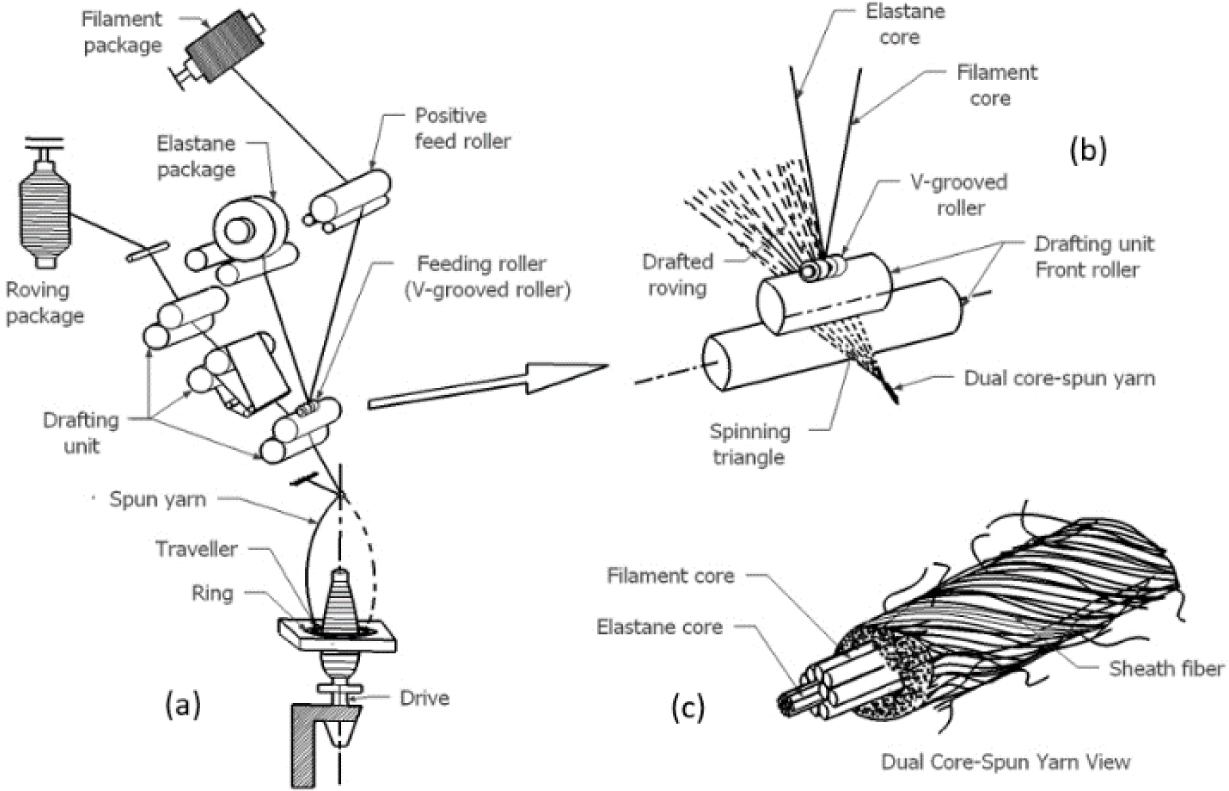
Fig. 2.
Schematic illustration of modified ring spinning method for dual core-spun yarn; (a) modified ring spinning arrangement, (b) combination of materials, (c) cross-sectional view of dual core-spun yarn. [16, 29]
Table 1.
Structure of composite/hybrid yarns used in this study
| Sample | Sheath | Core | Composition | Linear density |
|---|---|---|---|---|
| DT1 | Cotton | 55 dtex PET/PTT 44 dtex Elastane | 80.45% CO + 15.52% T400® + 4.03% Elastane | 328.06 dtex (Ne 18/1) |
| DS1 | Cotton | 56 dtex PTT 44 dtex Elastane | 80.17% CO + 15.80% Solotex® + 4.03% Elastane | 328.06 dtex (Ne 18/1) |
| DP1 | Cotton | 55 dtex PET 44 dtex Elastane | 80.29% CO + 15.68% PET + 4.03% Elastane | 328.06 dtex (Ne 18/1) |
| CT1 | Cotton | 83 dtex PET/PTT 44 dtex Elastane | 75.60% CO + 20.82% T400® + 3.58% Elastane | 369.06 dtex (Ne 16/1) |
| CS1 | Cotton | 84 dtex PTT 44 dtex Elastane | 75.35% CO + 21.07% Solotex® + 3.58% Elastane | 369.06 dtex (Ne 16/1) |
| CP1 | Cotton | 83 dtex PET 44 dtex Elastane | 75.51% CO + 20.91%PET + 3.58% Elastane | 369.06 dtex (Ne 16/1) |
| DT2 | Cotton | 55 dtex PET/PTT 78 dtex Elastane | 77.91% CO + 15.52% T400® + 6.57% Elastane | 328.06 dtex (Ne 18/1) |
| DS2 | Cotton | 56 dtex PTT 78 dtex Elastane | 77.63% CO + 15.80% Solotex® + 6.57% Elastane | 328.06 dtex (Ne 18/1) |
| DP2 | Cotton | 55 dtex PET 78 dtex Elastane | 77.75% CO + 15.68% PET + 6.57% Elastane | 328.06 dtex (Ne 18/1) |
| CT2 | Cotton | 83 dtex PET/PTT 78 dtex Elastane | 73.34% CO + 20.82% T400® + 5.84% Elastane | 369.06 dtex (Ne 16/1) |
| CS2 | Cotton | 84 dtex PTT 78 dtex Elastane | 73.09% CO + 21.07% Solotex® + 5.84% Elastane | 369.06 dtex (Ne 16/1) |
| CP2 | Cotton | 83 dtex PET 78 dtex Elastane | 73.25% CO + 20.91% PET + 5.84% Elastane | 369.06 dtex (Ne 16/1) |
| DT3 | Cotton | 55 dtex PET/PTT 117 dtex Elastane | 74.63% CO + 15.52% T400® + 9.85% Elastane | 328.06 dtex (Ne 18/1) |
| DS3 | Cotton | 56 dtex PTT 117 dtex Elastane | 74.35% CO + 15.80% Solotex® + 9.85% Elastane | 328.06 dtex (Ne 18/1) |
| DP3 | Cotton | 55 dtex PET 117 dtex Elastane | 74.47% CO + 15.68% PET + 9.85% Elastane | 328.06 dtex (Ne 18/1) |
| CT3 | Cotton | 83 dtex PET/PTT 117 dtex Elastane | 70.43% CO + 20.82% T400® + 8.75% Elastane | 369.06 dtex (Ne 16/1) |
| CS3 | Cotton | 84 dtex PTT 117 dtex Elastane | 70.18% CO + 21.07% Solotex® + 8.75% Elastane | 369.06 dtex (Ne 16/1) |
| CP3 | Cotton | 83 dtex PET 117 dtex Elastane | 70.34% CO + 20.91% PET + 8.75% Elastane | 369.06 dtex (Ne 16/1) |
Table 2.
Properties of cotton fiber, roving, and filaments used in this study
| Cotton fiber HVI | Roving properties | Filament | Strength, cN/Tex | Elongation% | ||
|---|---|---|---|---|---|---|
| SCI | 140.3 | Count Ne | 0.7 | PET/PTT 55 dtex | 35.42 | 28.54 |
| Mic. | 4.98 | U% | 3.98 | PTT 56 dtex | 37.75 | 27.85 |
| UHML (mm) | 30.5 | CVm% | 5.01 | PET 55 dtex | 44.52 | 23.50 |
| SFI | 6.13 | CVm 1m% | 1.65 | PET/PTT 83 dtex | 42.53 | 26.66 |
| Strength (g/tex) | 33.37 | CVm 3m% | 1.25 | PTT 84 dtex | 35.36 | 25.02 |
| Elongation (%) | 8.4 | CVm 5m% | 1.14 | PET 83 dtex | 40.39 | 23.73 |
According to the standard method, every yarn sample’s strength, unevenness, hairiness, and elongation were measured. For each measurement, five tests were done, and a calculated mean value was used to compare and investigate. The ring machine setting was almost the same for each sample to get a better comparison to produce the dual core-spun yarn with different filaments and elastane linear density. For denim fabric, the weight of the fabric, elasticity, fabric growth, tensile strength, tearing strength, and shrinkage were measured according to the standard method after home washing and conditioning. Table 3 shows the test methods used to measure the yarn and fabric properties. Multiple linear regression analysis was also carried out to find the interaction and develop a quadratic mathematical model between the study’s independent and dependent variables using SPSS 25.0. Sometimes, the independent variable is denoted as the predictor variable or regressor and the dependent variable as the response. Here, yarn count, elastane, and filament were considered as independent variables and obtained yarn and denim fabric properties were considered as dependent variables. From the output of the analysis, multiple correlation coefficient R explains the level of prediction, coefficient of determination R2 indicates how much the independent variables reduced the variability of dependent variables or assesses the model’s suitability, and adjusted R2 is a variant of R2 that considers the number of predictors in the model. An R2 value of more than 50% indicates that the mathematical equations obtained from the independent variables have a high predictability of the measured properties. The ANOVA table can explain the significance of the independent variables to predict the dependent variables. A general mathematical equation can be formed from the coefficient table to predict the dependent variables from independent variables [30, 31].
Table 3.
Test method standard used in this study for yarn and fabric
| Yarn Test | Standard | Fabric test | Standard |
|---|---|---|---|
| Yarn count (dtex) | TS 244 EN ISO 2060 | Weight (gsm) | ASTM D3776 |
| Uster unevenness (%) | TS 2394 | Tear strength (grf) | ASTM D1424 |
| Yarn hairiness (%) | TS12863 | Tensile strength (kgf) | ASTM D5034 |
| Yarn breaking tenacity (%) | TS 245 EN ISO 2062 | Shrinkage (%) | AATCC 135 |
| Yarn and fabric sample acceptance and conditioning | ASTM D 1776 | Stiffness (kgf) | ASTM D4032 |
| Elasticity & growth (%) | ASTM D3107 |
3. Results and discussion
3.1. Yarn properties
3.1.1. Strength
Figure 3 illustrates the strength of different dual core-spun yarns. With 44 dtex elastane, 328.06 dtex (finer) yarn with PTT filament shows slightly higher strength, but 369.06 dtex (coarser) yarn shows the lowest strength, while yarn with PET filament shows the opposite scenario. Yarn with PTT filament having 78 dtex elastane indicates higher strength than others for both yarn linear density. Considering 117 dtex elastane, yarn with PET and PET/PTT filament represents better strength compared to other yarns for finer and coarser yarn, respectively. Overall, coarser dual core-spun yarn samples have more strength than finer yarn samples for all types of filaments and elastane linear density due to their linear density. Within the same linear density of the yarn, having coarser elastane in the core decreases the yarn strength as the amount of sheath fiber is decreased in the yarn’s cross-section. It is because the amount of sheath fiber in dual core-spun yarn determines its strength. Similar results were also found in other studies [8, 16]. Moreover, because of the possibility of reduced packing densities for fiber spread out in yarn cross-section, yarn strength decreases as elastane quantity increases. Among all filaments, yarn with PTT filament shows a slighter decrease of strength in terms of increasing elastane coarseness from 44 dtex to 78 dtex. When the elastane linear density is increased from 78 to 117 dtex, it is revealed that yarn with PET/PTT filament has less strength loss, while overall yarn with PET filament and PTT filament has less strength loss for finer and coarser yarns, respectively. The strength loss of the yarn for different filaments can be affected by the filament’s surface features in dual core-spun yarns, as well as the packing density of the yarn.
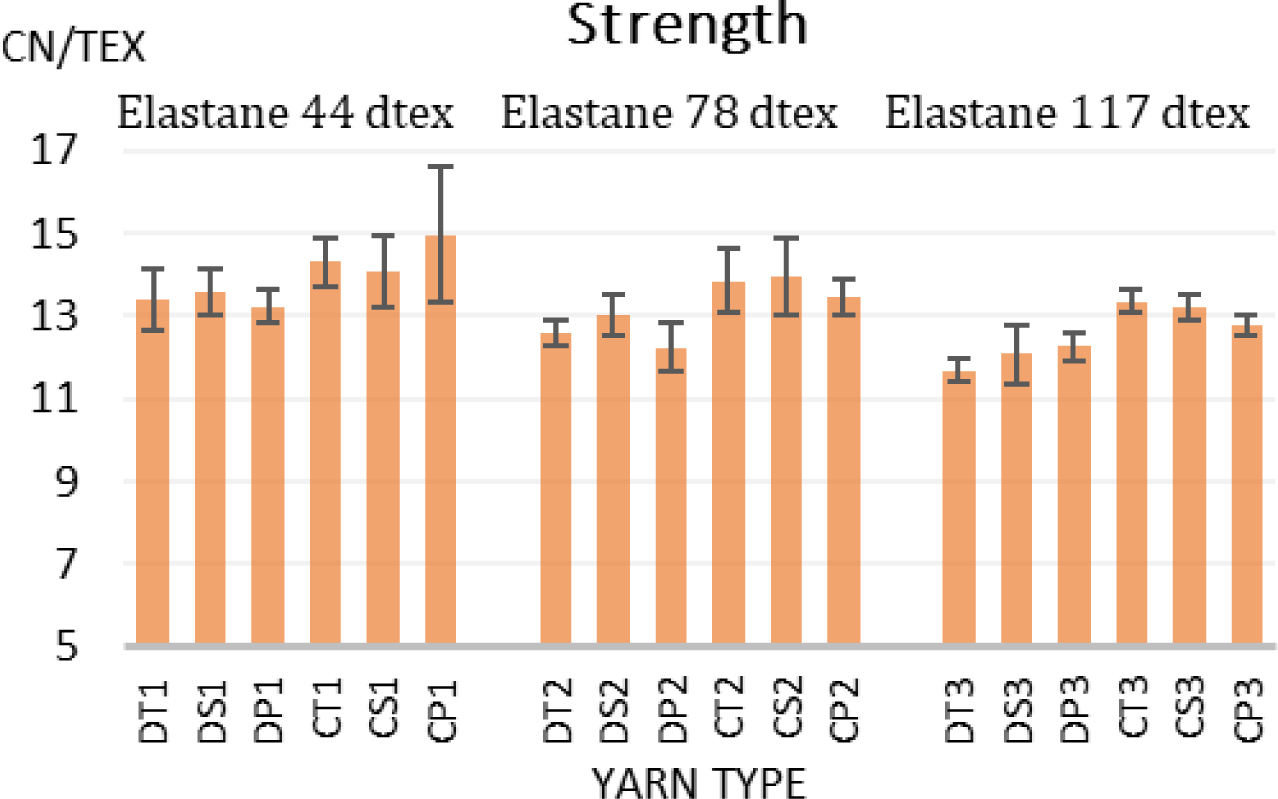
Fig. 3.
Strength of dual core-spun yarns
A multiple regression analysis was run to predict the yarn strength from yarn count, elastane, and filament-independent variables. From Table 4, the model summary of the analysis shows a value of R=0.764, which indicates a good prediction level. Here, R2= 0.584 shows that independent variables can explain 58.4% of the variability of the yarn strength. Table 4 also shows that F (3,86) = 40.287 and P<0.05, which illustrates that independent variables are statistically significantly useful in predicting yarn strength. From the coefficient Table 5, a regression equation (1) is obtained for yarn strength.
Table 4.
Regression model and ANOVA table for yarn properties
| Model Summary | ANOVA | ||||||
|---|---|---|---|---|---|---|---|
| Dependent Variables | R | R Square | Adjusted R Square | Std. error of the Estimate | Dependent variables | F | Sig. |
| Strength | 0.764 | 0.584 | 0.570 | 0.67503 | Yarn Strength | 40.287 | 0.000 |
| Elongation | 0.770 | 0.593 | 0.579 | 0.88906 | Yarn elongation | 41.836 | 0.000 |
| Unevenness | 0.649 | 0.421 | 0.401 | 0.43800 | Yarn Unevenness | 20.846 | 0.000 |
| Hairiness | 0.605 | 0.366 | 0.344 | 0.56914 | Yarn Hairiness | 16.526 | 0.000 |
Table 5.
Regression coefficients for yarn properties response variables using values of the independent variables
| Coefficient | ||||||||
|---|---|---|---|---|---|---|---|---|
| Strength | Elongation | Unevenness | Hairiness | |||||
| Terms | Coefficient | Sig. | Coefficient | Sig. | Coefficient | Sig. | Coefficient | Sig. |
| Constant | 24.098 | 0.000 | 9.357 | 0.000 | 6.204 | 0.000 | 15.286 | 0.000 |
| Yarn count | −0.549 | 0.000 | 0.020 | 0.828 | 0.303 | 0.000 | −0.348 | 0.000 |
| Elastane fineness | −0.019 | 0.000 | 0.030 | 0.000 | −0.006 | 0.000 | −0.007 | 0.001 |
| Filament type | −0.025 | 0.776 | −0.679 | 0.000 | 0.116 | 0.044 | −0.127 | 0.087 |
From the significance column in Table 5, it is found that yarn count and elastane have a statistically significant effect, p < 0.05, while the change in the filament type is not statistically significant on yarn strength.
3.1.2. Elongation
Figure 4 illustrates the elongation of different dual core-spun yarns. The elastane 44 dtex, yarns with PET filament have less elongation for both linear densities than other yarns. Yarn with PTT filament shows high elongation for the finer sample, but coarser sample yarn with PET/PTT filament shows high elongation compared to others. Containing 78 dtex and 117 dtex elastane in the core shows that yarns with PET filament have less elongation than others. A content of PTT filament in the core of the yarns shows higher elongation. The whole picture shows that yarns with PTT filament have high elongation while those with PET filament exhibits lower elongation, where the finer yarn has less elongation than the coarser yarn of that filament. Moreover, increasing the elastane coarseness of the dual core-spun yarns increases elongation in the case of a higher amount of elastane in the core, as the ratio or amount of elastane affects yarn elongation [8]. Therefore, yarn linear density, filament type, and elastane ratio are the parameters for determining dual core-spun yarn’s elongation.
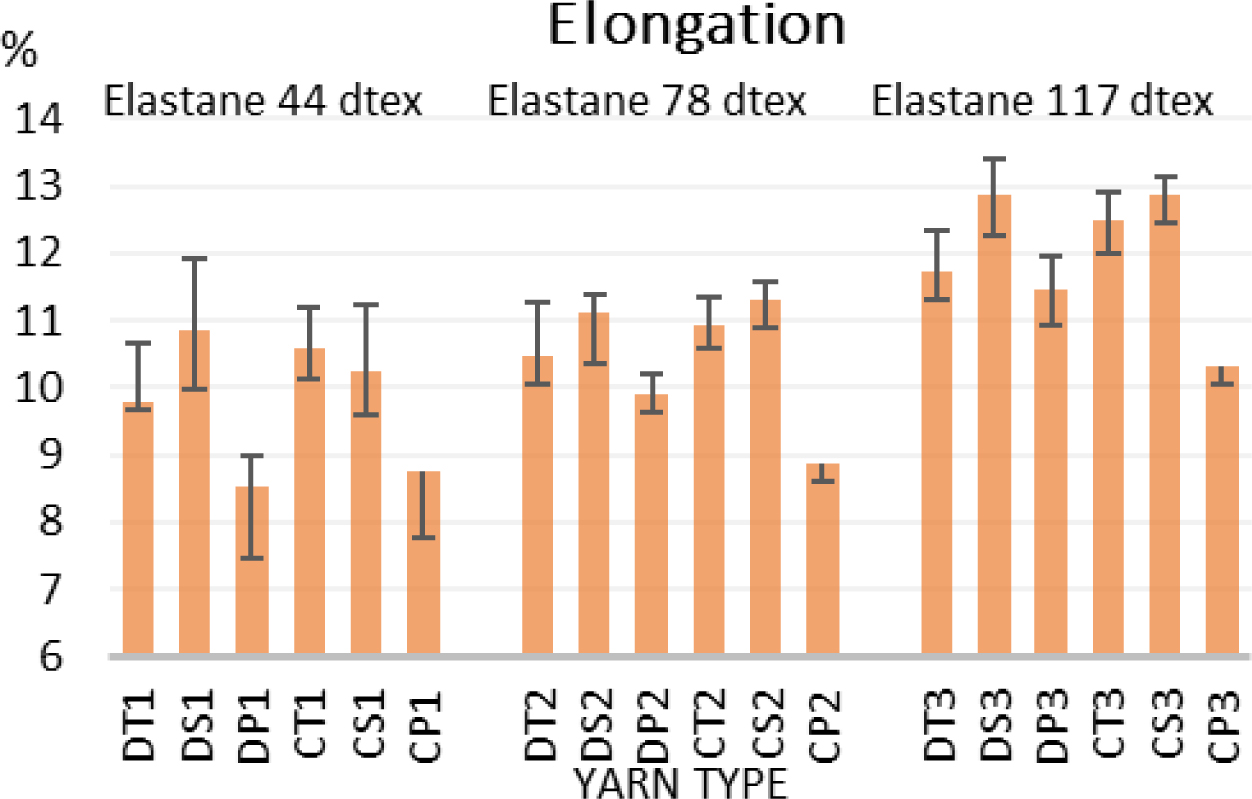
Fig. 4.
Elongation% of dual core-spun yarns
From Table 4 presenting a multiple regression model summary for yarn elongation, it is found that R2 = 0.593, which means a 59.3% change in the yarn elongation can be explained by the dependent variables. From ANOVA Table 4, for yarn elongation, F (3,86) = 41.836, and P < 0.05, which illustrates that independent variables are statistically significantly useful for predicting yarn elongation. The regression coefficient in Table 5 shows that elastane and filament type change is statistically significant, while the other variable, yarn count, is not. The regression equation (2) obtained for yarn elongation is given below.
3.1.3. Unevenness
Figure 5 shows that finer dual core-spun yarn samples have more unevenness% than the coarser yarn samples as the amount of sheath fiber determines the yarn unevenness [16]. Here, for 44 dtex elastane, yarn with PTT filament shows higher unevenness comparing to others. Increasing elastane linear density to 78 dtex, it is found that PET filament with coarser yarn sample shows less irregularity but higher with the finer yarn and for 117 dtex elastane, the figure indicates that for both yarn linear density samples, PET shows the highest unevenness% than others where yarn with PET/PTT filaments have the lowest. Overall, it shows that yarns with elastane 44 dtex have a high unevenness% and yarns with 117 dtex elastane have a low unevenness% as the amount of sheath fiber is reduced though there is no regular change for elastane increasing. The filament yarn’s bulkiness features are most likely responsible for this scenario [32]. The presence of a dual core in the cross-section also impacts yarn irregularity due to the uneven spread of sheath fiber. Unevenness is significantly changed along with yarn linear density for PET filament, where PET/PTT filament shows minor change. Having the same linear density, yarn with PET filament shows a slighter decrease of unevenness% for the coarser sample, where unevenness% is increased for the finer sample.
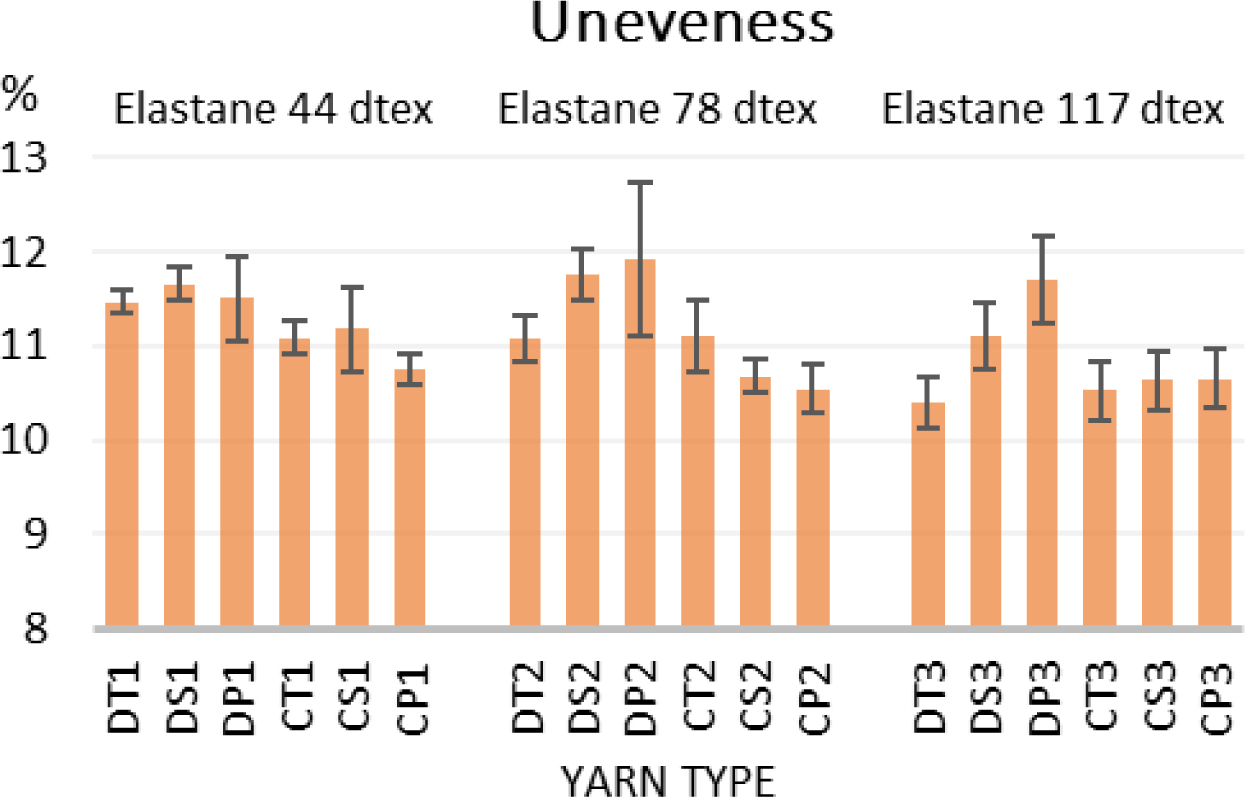
Fig. 5.
Unevenness% of dual core-spun yarns
From the regression model summary in Table 4, the R2 = 0.421 means that 42.1% change in the unevenness can be explained by the independent variables. From the ANOVA Table 4, for yarn unevenness, it is found that F (3,86) = 20.846 and P <0.05, which illustrates that the group of independent variables is statistically significant and can be used to predict yarn unevenness reliably. From the regression coefficient in Table 5, it can be said that the change in yarn count and elastane are statistically significant, while the other variable, such as filament type, is not statistically significant for yarn unevenness. A regression equation (3) obtained for yarn unevenness is given below,
3.1.4. Hairiness
The hairiness of yarn samples with different elastane linear densities is shown in Figure 6, indicating no regular change in terms of yarn linear density. Having 44 dtex elastane shows that coarser yarns have almost the same and higher amount of hairiness than finer yarn samples. Yarn with PTT filament shows less hairiness with finer yarn but a high amount of hairiness with coarser yarn samples, which is increased by about 30%. For 78 dtex elastane, yarn with PTT filament shows more hairiness on its surface for finer samples but less hairiness for coarser yarn samples, whereas yarn with PET/PTT filament shows opposite results. Coarser yarns with 44 dtex and 117 dtex elastane have higher hairiness than finer yarns for all filaments, except for yarn with 78 dtex elastane. Thus, there is no regular relation between yarn type and hairiness in terms of elastane change. Almost every sample shows a lower amount of hairiness with 117 dtex elastane than samples with 44 dtex elastane except yarn with PTT filament, where hairiness is increased. As the number of short-staple sheath fibers decreases to have a higher amount of elastane, the amount of protruding fiber decreases, and therefore hairiness decreases. Also, the surface characteristics of the different filaments and their interaction with other components have an effect on yarn hairiness.
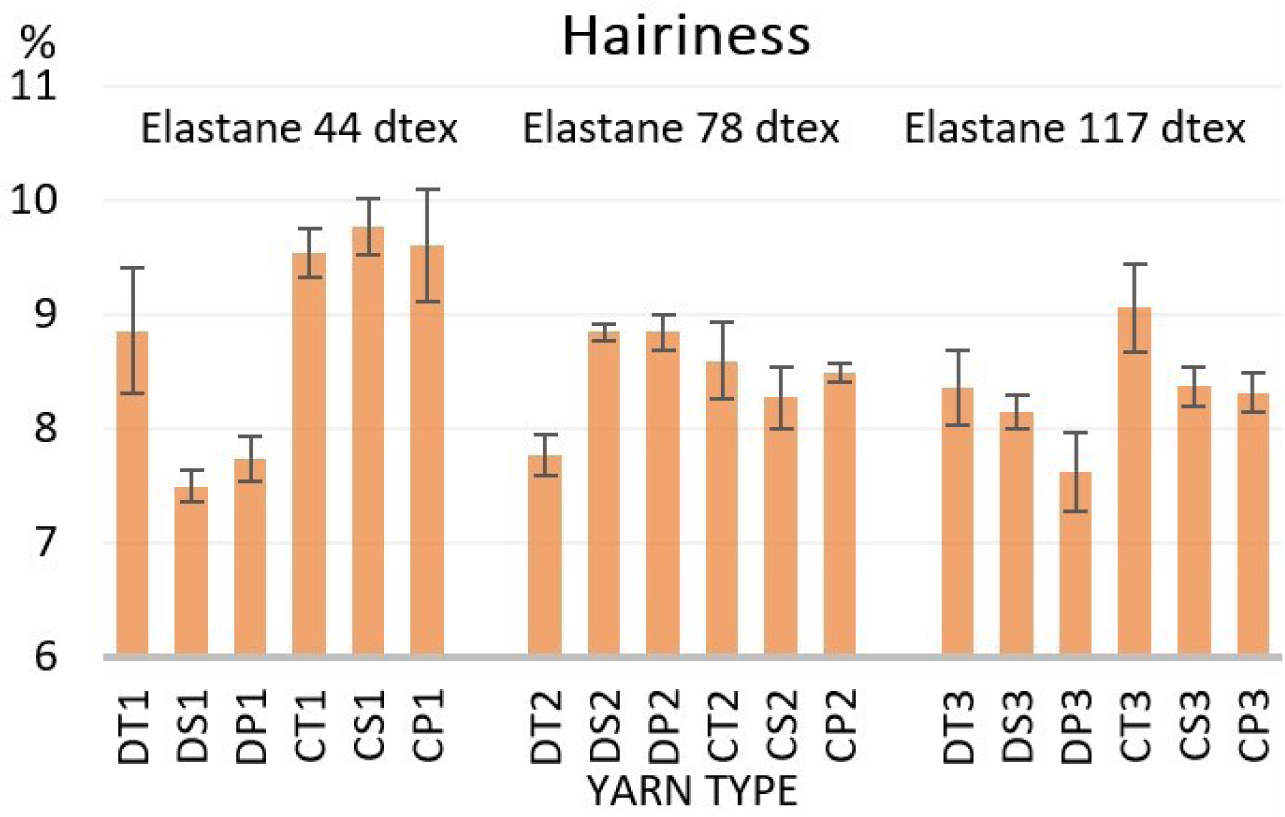
Fig. 6.
Hairiness% of dual core-spun yarns
From the multiple regression analysis (Table 4) for yarn hairiness, it is found that R2 =0.366, which indicates that only 36.6% variance in the yarn hairiness can be predicted from the independent variable though the ANOVA (Table 4) shows F (3,86) = 16.526, and p < 0.000, which means that independent variables can be used to predict the yarn hairiness reliably, from Table 4. A regression equation (4) for yarn hairiness can be developed from the obtained coefficient value of Table 5, and from the significance column, it is found that the change in yarn count and elastane is statistically significant, while the change in filament type is not statistically significant.
4. Fabric properties
4.1. Dry and washed weight of fabrics
Figure 7 shows that increasing the elastane coarseness increases the fabric’s dry and washed gsm (gram per square meter) though having the same yarn linear density. It also indicates that the change of fabric gsm from dry to washed increases with elastane coarseness. Fabrics with finer elastane have a reduced amount of changes in gsm percentage after washing. For elastane 44 dtex, except the CP1 sample, other samples have more than 25% increase of gsm, and for elastane 78 dtex, all the samples have more than 28% increase of gsm, whereas DP2 and DS2 samples show a slightly higher than 38% increase. Most of the time, fabric with PTT weft yarn shows a higher increase in gsm percentage after washing than fabric with PET and PET/PTT filament yarns with an elastane change. Fabric with 117 dtex elastane shows more than 30% gsm increase for both yarns counts from dry to washed. As the amount of elastane percentage and linear density increases, the compactness of the fabric also increases due to its elastic properties. For this reason, the number of weft and warp yarns in a square meter is also increased, which denotes shrinkage or dimensional changes in the fabric. Therefore, after washing, the shrinkage or dimensional changes of the fabric help to increase its gsm. Within the same filament, after washing, the change of gsm percentage is increased while increasing the elastane dtex for the coarser weft yarn specimen, but no such scenario is found for the finer weft yarn specimen.
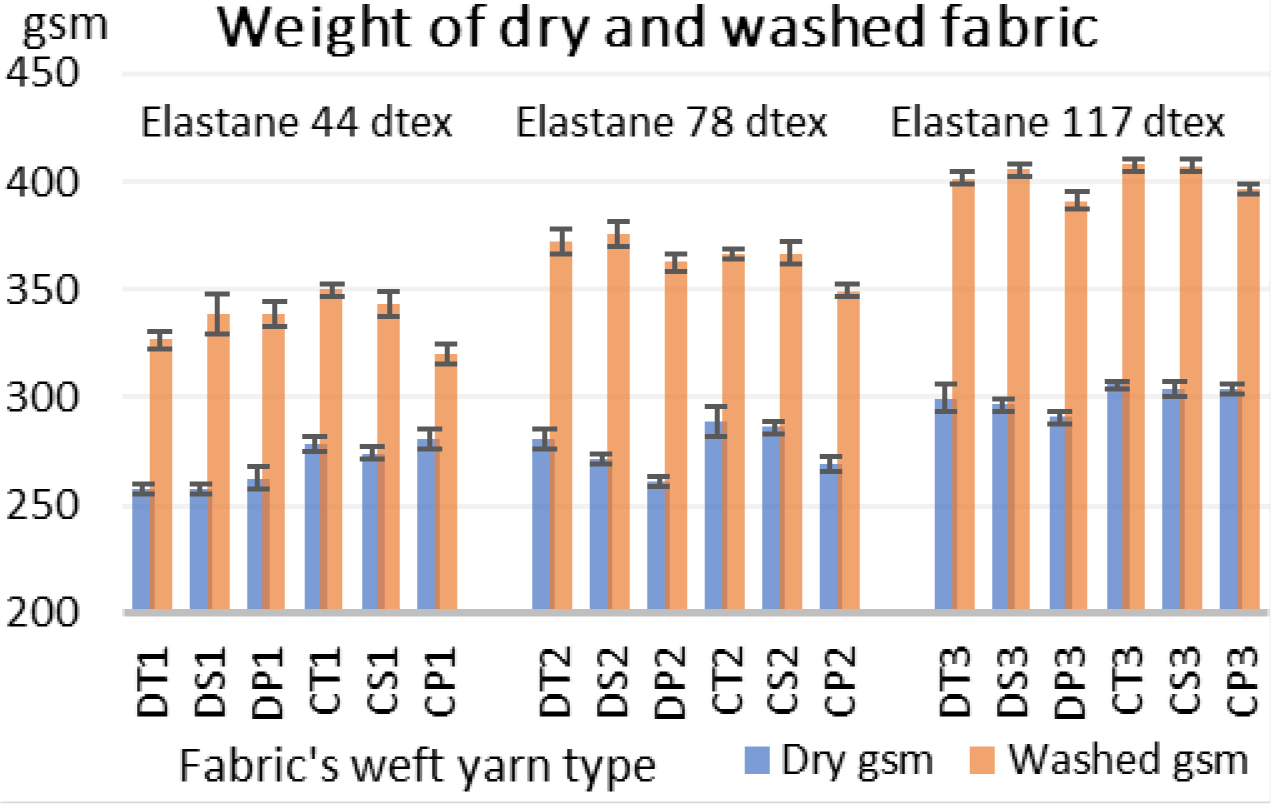
Fig. 7.
Weight of dry and washed fabrics
The model summary of fabric properties multiple regression in Table 6 shows that the value of R2 for fabric dry and washed weight is 0.825 and 0.921, respectively. Here, the independent variables can explain 82.5% and 92.1% of fabric dry and washed weight variability, respectively. Independent variables are also statistically significant in predicting the fabric weight, as found in the ANOVA in Table 7. From the coefficient in Table 8, it is found that all the independent factors are statistically significant for fabric dry and washed weight except yarn count for the washed weight of the fabric. The regression equations (5 and 6) obtained for fabric dry and washed weight are given below,
Table 6.
Regression analysis model summary for fabric properties
| Model Summary | ||||
|---|---|---|---|---|
| Dependent Variables | R | R Square | Adjusted R Square | Std. Error |
| Fabric dry weight | 0.908 | 0.825 | 0.818 | 6.97576 |
| Fabric washed weight | 0.959 | 0.921 | 0.918 | 8.17244 |
| Fabric elasticity | 0.968 | 0.938 | 0.935 | 2.16641 |
| Fabric growth% 30 sec | 0.617 | 0.381 | 0.359 | 0.59702 |
| Fabric growth% 2hr | 0.552 | 0.305 | 0.280 | 0.72006 |
| Warp tensile strength | 0.892 | 0.797 | 0.789 | 2.53191 |
| Weft tensile strength | 0.956 | 0.914 | 0.911 | 1.29636 |
| Warp tearing strength | 0.856 | 0.733 | 0.724 | 49.19050 |
| Weft tearing strength | 0.891 | 0.795 | 0.788 | 182.10435 |
| Warp shrinkage | 0.444 | 0.197 | 0.169 | 1.72689 |
| Weft shrinkage | 0.845 | 0.714 | 0.704 | 2.07561 |
| Stiffness | 0.919 | 0.844 | 0.839 | 0.06412 |
Table 7.
ANOVA table for fabric properties of regression analysis
| ANOVA | |||||
|---|---|---|---|---|---|
| Dependent variables | F | Sig. | Dependent variables | F | Sig. |
| Fabric dry weight | 134.749 | 0.000 | Warp tensile strength | 112.240 | 0.000 |
| Fabric washed weight | 332.405 | 0.000 | Weft tensile strength | 303.867 | 0.000 |
| Fabric elasticity | 431.107 | 0.000 | Warp tearing strength | 78.768 | 0.000 |
| Fabric growth% 30s | 17.643 | 0.000 | Weft tearing strength | 110.975 | 0.000 |
| Fabric growth% 2 hr | 12.552 | 0.000 | Warp shrinkage | 7.052 | 0.000 |
| Stiffness | 155.364 | 0.000 | Weft shrinkage | 71.492 | 0.000 |
Table 8.
Regression coefficients for fabric properties response variables using values of the independent variables
| Dependent variable | constant | yarn count | elastane | filament | |
|---|---|---|---|---|---|
| Fabric dry weight | coefficient | 360.750 | −6.289 | 0.438 | −3.517 |
| significance | 0.000 | 0.000 | 0.000 | 0.000 | |
| Fabric washed weight | coefficient | 302.034 | 0.311 | 0.899 | −5.550 |
| significance | 0.000 | 0.719 | 0.000 | 0.000 | |
| Fabric elasticity | coefficient | −33.990 | 3.639 | 0.247 | −0.342 |
| significance | 0.000 | 0.000 | 0.000 | 0.225 | |
| Fabric growth% 30s | coefficient | −0.633 | 0.444 | 0.003 | 0.067 |
| significance | 0.565 | 0.000 | 0.133 | 0.389 | |
| Fabric growth% 2 hr | coefficient | −2.415 | 0.422 | 0.006 | −0.117 |
| significance | 0.071 | 0.000 | 0.026 | 0.213 | |
| Warp tensile strength | coefficient | 71.330 | 0.100 | 0.160 | −1.383 |
| significance | 0.000 | 0.709 | 0.000 | 0.000 | |
| Weft tensile strength | coefficient | 104.200 | −4.111 | 0.002 | 0.417 |
| significance | 0.000 | 0.000 | 0.606 | 0.015 | |
| Warp tearing strength | coefficient | 4324.973 | 26.783 | 2.500 | 10.800 |
| significance | 0.000 | 0.000 | 0.000 | 0.093 | |
| Weft tearing strength | coefficient | 9024.065 | −331.289 | 0.049 | 139.200 |
| significance | 0.000 | 0.000 | 0.940 | 0.000 | |
| Warp shrinkage | coefficient | −10.849 | 0.489 | −0.023 | 0.083 |
| significance | 0.001 | 0.009 | 0.000 | 0.709 | |
| Weft shrinkage | coefficient | 23.793 | −2.456 | −0.066 | 0.700 |
| significance | 0.000 | 0.000 | 0.000 | 0.011 | |
| Stiffness | coefficient | 0.306 | 0.006 | 0.005 | −0.033 |
| significance | 0.011 | 0.413 | 0.000 | 0.000 |
4.2. Elasticity and growth properties
Figure 8 illustrates the elasticity% of different fabric samples and indicates that elastane linear density impacts the elasticity of the fabric. Having high elastane dtex in the dual core-spun yarns increases the fabric elasticity, and fabrics from finer yarn samples have more elasticity than fabrics from coarser yarn samples as a finer yarn has less sheath fiber than the coarser ones. While increasing the amount of elastane along with coarseness, yarn samples containing PET filament show more changes of elasticity% than others though that yarn has less amount of elongation. For different elastanes and different linear densities, filaments show no regularity of elasticity%. The elastic properties of the elastane influence the fabric’s elastic properties and almost all filaments have more or less the same amount of elongation individually; that is why fiber and filament arrangement in the weft yarn gives a variable elasticity of the fabrics.
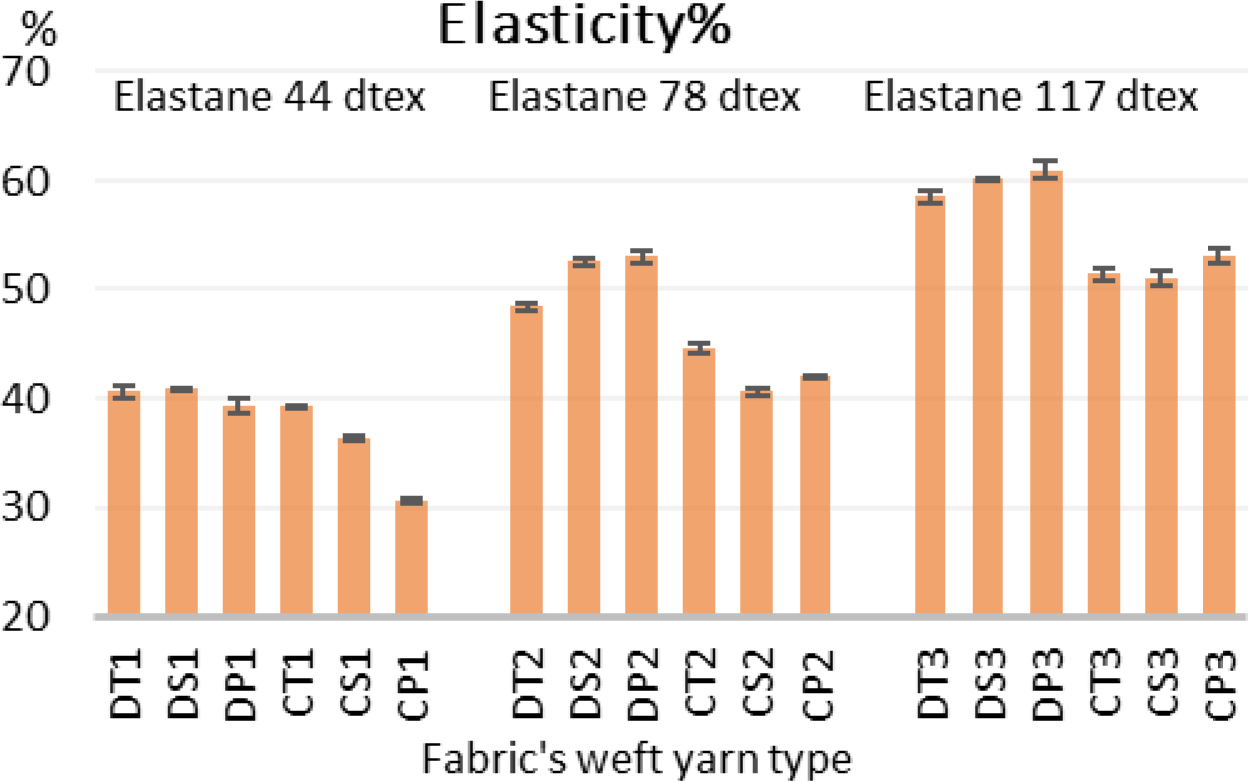
Fig. 8.
Elasticity% of the fabrics
The growth% of fabric samples are given in Figure 9. Fabric with finer yarn has more growth than a coarser yarn with specific filaments. Fabrics having 44 dtex elastane and PET/PTT filament in their weft yarn have higher growth % both in 30 seconds and 2 hours. At 2 hours, with 117 dtex elastane, fabric with PET filament shows the highest growth%, and almost every sample has more than 5% growth except the sample with 369.06 dtex weft yarn with PET/PTT filament. Whereas yarn samples with 44 dtex elastane have less than 5% fabric growth. Overall, there is no regular trend found to give a conclusion due to changes in elastane amount and linear density, but for 117 dtex elastane, there is a stable picture found for growth%. Using different filaments with different ratios of elastane in the weft yarns influences the growth% of the fabrics, and their combination with the arrangement in the yarn also affects the result.
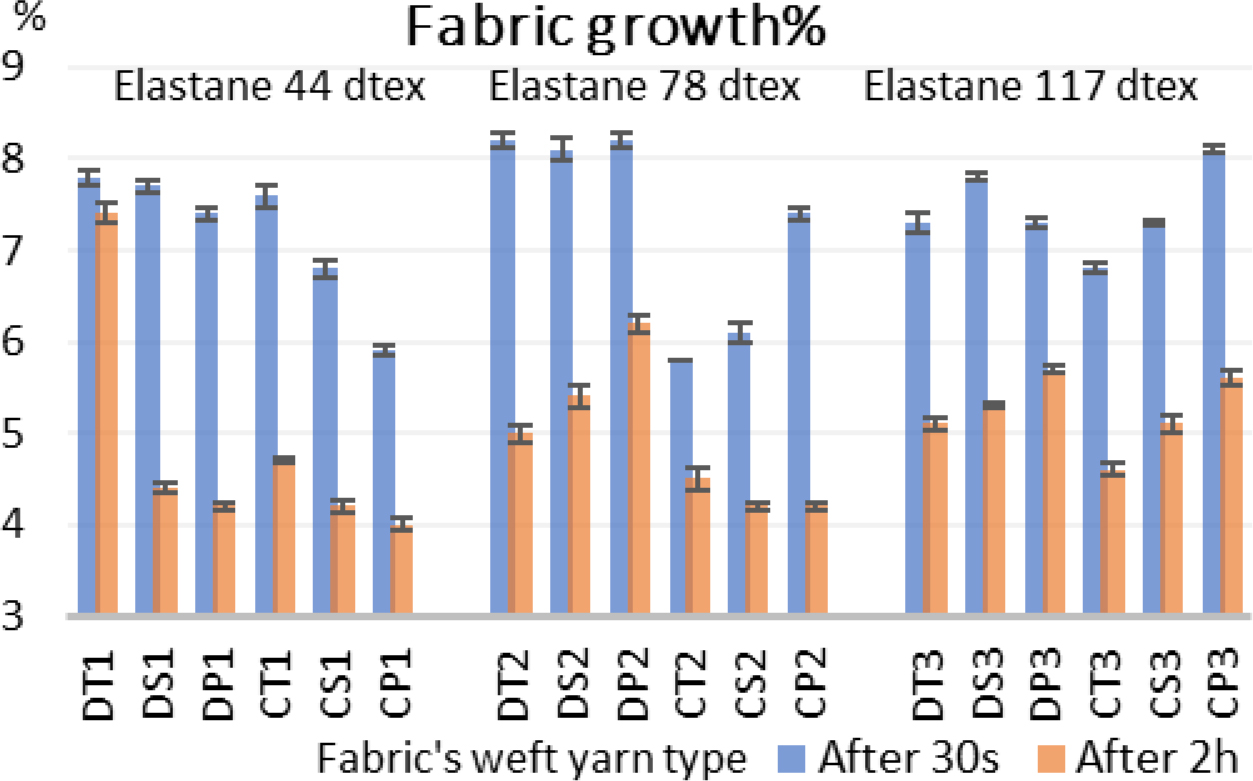
Fig. 9.
Growth% of the fabric
From the multiple regression model summary in Table 6, the R2 value of elasticity and growth properties of the fabric at 30 seconds and 2 hours is 0.938, 0.381, and 0.305, respectively, which denotes that independent variables can explain 93.8%, 38.1%, and 30.5% variability of the fabric elasticity, fabric growth properties at 30 seconds and 2 hours, respectively. From the ANOVA in Table 7 of regression analysis, it is found that independent variables are statistically significant for predicting fabric elasticity and growth properties. From the coefficient Table 8, it is found that change of filament type has no significance for fabric elasticity and growth properties while all other independent variables have significance except elastane for fabric growth at 30 seconds. The regression equations (7-9) for elasticity and growth properties are given below.
4.3. Fabric strength
In this study fabric’s tensile and tearing strength were evaluated for both directions of the fabric. Figure 10 shows fabric tensile strength for different yarn samples in warp and weft directions. As dual core-spun yarns are used in the weft direction, the fabric’s weft tensile strength is only considered. It is found that fabrics with coarser yarn samples have more tensile strength than finer ones. For the PET/PTT sample, increasing the elastane dtex first decreases the fabric tensile strength and then increases it, while for the PTT sample’s tensile strength first increases and then decreases for both yarn linear density and for the PET sample, no predictability could be shown. Overall, it is indicated that there is no regular change of tensile strength in the weft direction for the specific filament of both finer and coarser yarn samples in terms of changing elastane linear density. For finer yarn samples, fabric with PTT filament shows the highest tensile strength, and for coarser yarn samples, fabric with PET shows the highest tensile strength at any of elastane’s linear density. No clear trend was also found for the tensile properties of the fabric regarding yarn count and core filament linear density [8].
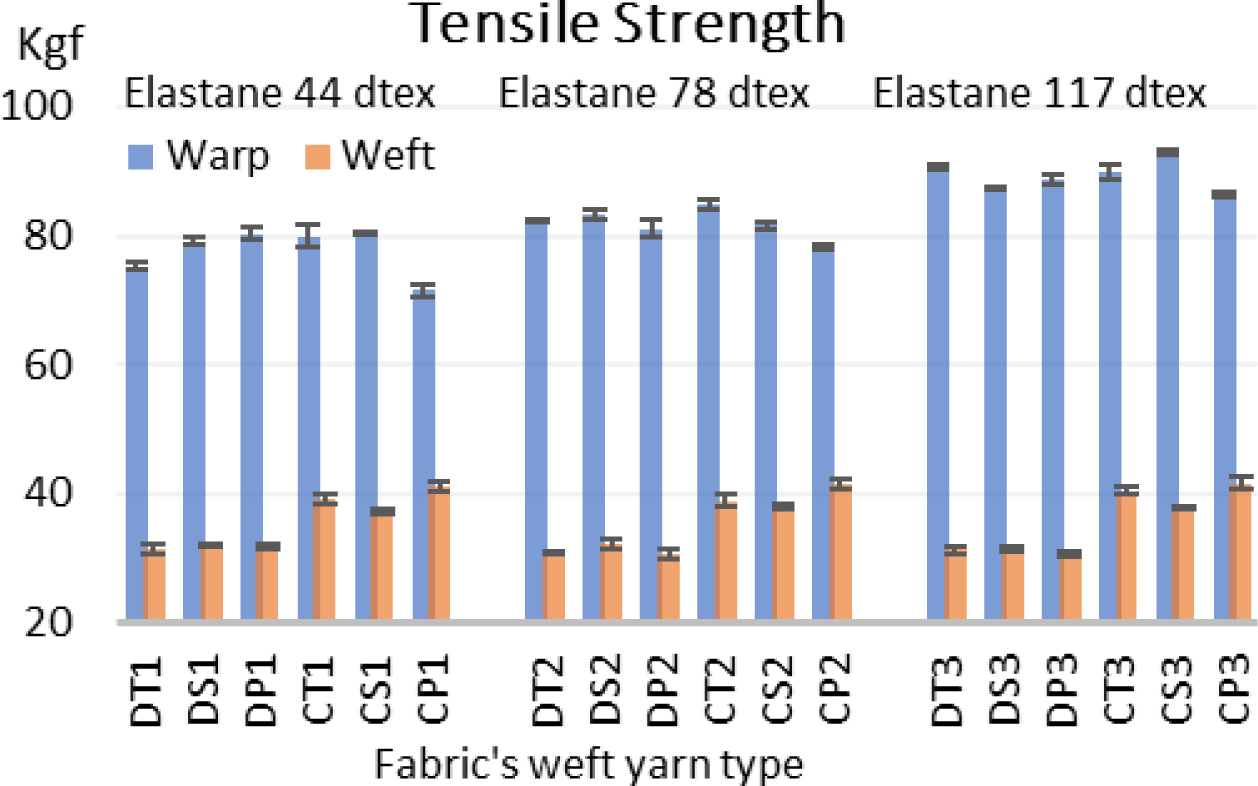
Fig. 10.
Warp and weft tensile strength (kgf) of the fabrics
As sample yarns are used here only in the weft direction of the fabric, the tearing strength in the weft direction is considered to evaluate the fabric samples. Figure 11 shows that coarser yarn fabrics have higher tearing strength in the weft direction than finer yarn fabric. Although finer yarn samples do not show any regularity on elastane change, the coarser yarn sample’s tearing strength is first increased and then decreased with the increase of elastane dtex for each sample. For coarser yarn fabric, the PET sample has higher, and the PTT sample has lower tearing strength, respectively, while finer yarn samples do not have such an indication. However, no trend was found in the strength of the filament regarding different dtex values that affect the strength level of the yarns and fabrics. Core filaments surface coating, interaction with sheath fiber, and elastane may change the arrangement of the core filament, which possible displacement may cause the irregularity of yarn and fabric strength level.
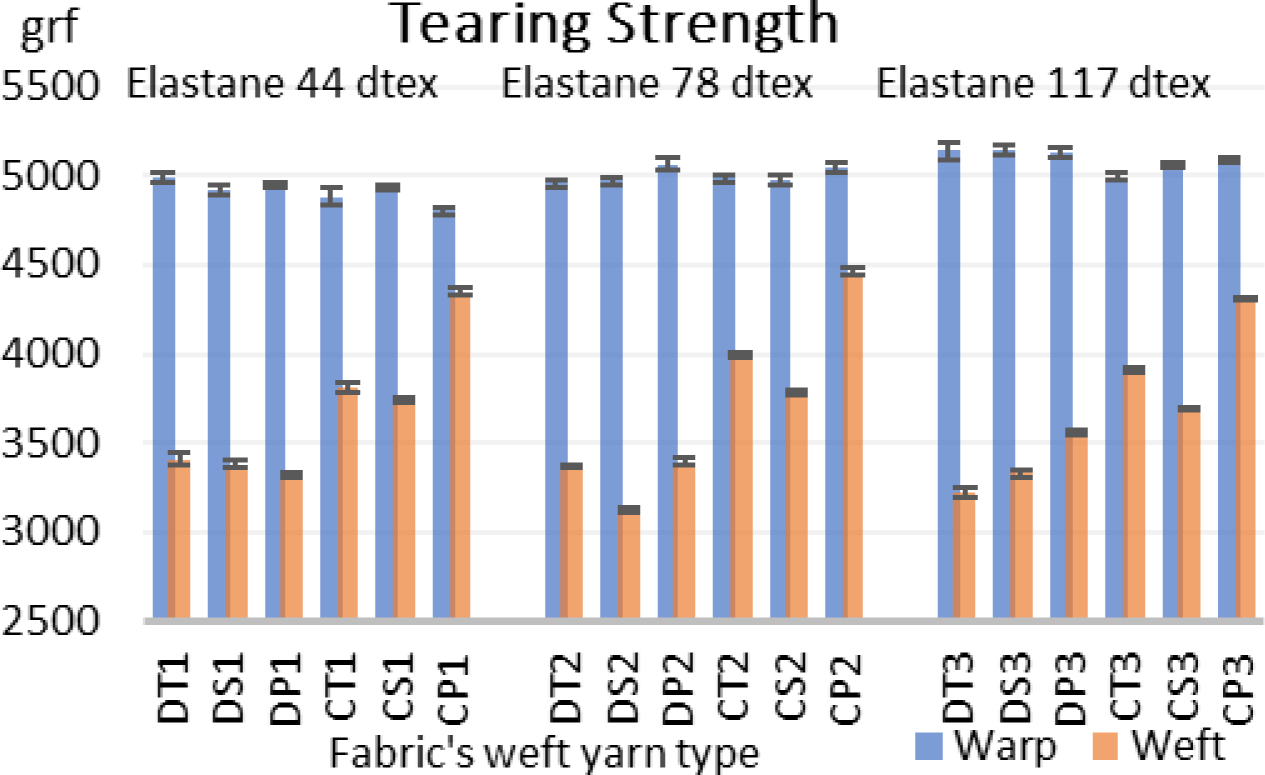
Fig. 11.
Warp and weft tearing strength (grf) of the fabrics
From the multiple regression model summary in Table 6, it is found that the value of R2 for warp and weft tensile strength and for warp and weft tearing strength are 0.797, 0.914, 0.733, and 0.795, respectively, which denotes that independent variables can explain 79.7%, 91.4%, 73.3% and 79.5% variability of warp and weft tensile strength and warp and weft tearing strength respectively. Table 7 also shows that the independent variables can be used to predict the fabric tensile and tearing strength reliably. The regression coefficient Table 8 represents that warp tensile strength, weft tensile strength, warp tearing strength, and weft tearing strength is not statistically significant for the yarn count, elastane, filament type, and elastane, respectively, while others have significance. Obtained regression equations (10-13) are given below for fabric strength.
4.4. Fabric shrinkage
Figure 12 represents the fabric shrinkage percentage in the warp and weft direction. As yarn samples are used in the weft direction of the fabrics here, only weft shrinkage is considered. It is found that finer yarn fabrics samples show higher shrinkage than coarser yarn samples, and with the increase of elastane dtex, fabric shrinkage is increased. The elastic properties of elastane are the reason behind it. Increasing the linear density of elastane from 44 dtex to 78 dtex, it is found that PET samples show the highest increase in shrinkage percentage but cannot maintain it further, and there is no regularity for specific filament. For 44 dtex elastane, the PTT and PET/PTT samples have higher shrinkage for finer and coarser yarn fabric. Fabrics containing 78 dtex elastane and PET filament yarn in their weft direction have higher shrinkage than others for both yarn linear densities. However, for 117 dtex elastane, yarn with PTT filament has a higher shrinkage percentage. Figure 12 shows that warp side shrinkage increases gradually with high elastane dtex in the weft yarn. From the model summary of regression analysis in Table 6, it is found that the value of R2 for warp and weft shrinkage of the fabric is 0.197 and 0.714, respectively, which shows that the independent variables can explain 19.7% and 71.4% shrinkage change of warp and weft direction. Table 7 represents those independent variables that are statistically significantly useful to predict fabric shrinkage in both directions. The only change of filament type has no significant effect on warp shrinkage of the fabric, while others have significance in both directions, as found in Table 8. The regression equations (14, 15) obtained for shrinkage are given below.
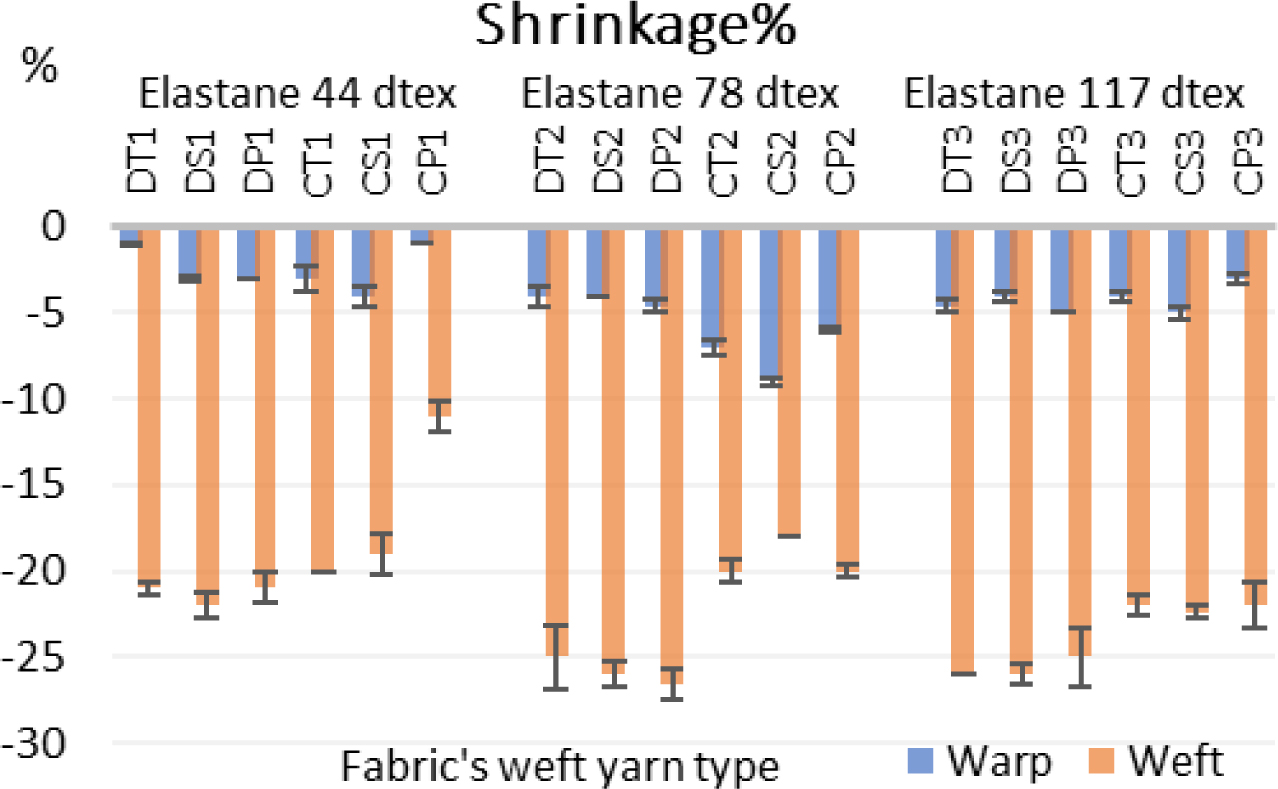
Fig. 12.
Warp and weft shrinkage% of the fabrics
4.5. Stiffness
Figure 13 shows that by increasing the elastane amount and coarseness in the dual core-spun yarn, fabric stiffness% is increased with the same filament and yarn linear density. Generally, fabrics with coarser yarns have more stiffness than finer ones. Due to high elastane content, there is an increase in dimensional changes, resulting in more compact fabric and making it stiffer. Fabric having 44 dtex elastane and PTT filament shows higher stiffness for finer yarn samples and lesser for coarser yarn samples, whereas fabric with PET filament shows the opposite trend. For 78 dtex and 117 dtex elastane, fabrics having PET filament in its weft direction have less stiffness than others, whereas, among the three filaments, fabric with yarn having PTT filament shows almost high stiffness as the yarn with PTT filament has higher elongation% which helps to make the fabric more compact, resulting higher stiffness than others.
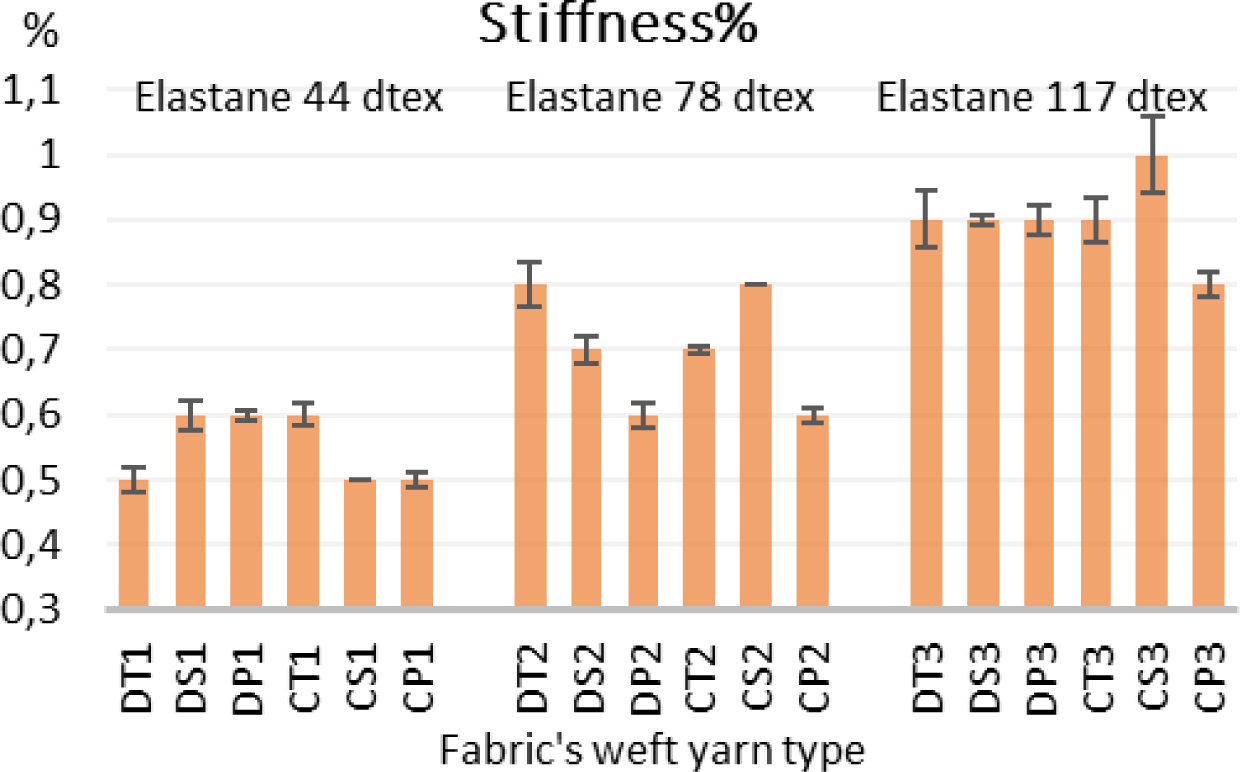
Fig. 13.
Stiffness of the fabrics
From Table 6, it is shown that the value of R2 is 0.844, which means independent variables can explain the 84.4% variability of the fabric stiffness. From Table 7, it can be said that all the independent variables affect fabric stiffness. Table 8 shows that yarn count has no statistical significance for stiffness, while other variables have significance. The regression equation (16) for stiffness is given below.
5. Conclusion
The main focus of this study was finding the effect of elastane linear density on different filament types of dual core-spun yarn and fabric made of it. Mathematical equations were developed from the regression analysis, and the effect of independent variables was examined. It was found that independent variables were statistically significant in predicting the dependent variables.
The study’s findings are that using different elastane linear densities in the dual core-spun yarn has a common effect on yarn strength and elongation. While increasing the elastane linear density, yarn strength increases, while the elongation of yarn decreases. Moreover, for yarn samples with 44 dtex elastane and 117 dtex elastane, unevenness is high, and hairiness is low, respectively. However, having coarser elastane in the dual core-spun yarns means high stiffness, elasticity, and shrinkage for fabric. Furthermore, with the same yarn linear density, the coarser elastane affects the dry and washed weight of the fabric.
It is also found that dual core-spun yarn with PET/PTT filament has more hairiness and minor change in unevenness, and PTT filament has higher elongation and a slighter decrease of strength with elastane change. Finer yarn with PET filament has higher but less unevenness and elongation with coarser yarn. The PET sample showed a significant change in unevenness with respect to yarn linear density. From the observation of fabric properties, it was concluded that fabric with PTT filament in its weft yarn has a high weight change after washing. Moreover, the fabric sample with PTT filament shows high stiffness, whereas the fabric sample with PET has low stiffness. A coarser PET sample has a higher tearing and tensile strength.
Acknowledgments
The authors would like to acknowledge the ÇALIK DENİM Tekstil AŞ, R&D Department, for their support and cooperation.
Notes
[2] Conflicts of interest Declaration of conflicting interests
The authors declared no potential conflicts of interest concerning the research, authorship, and/or publication of this article