
Table 1
Compositions of mixtures for the production of thermal insulation
| Mixture No. | Weight percentage of input components, % | ||
|---|---|---|---|
| Waste from woollen yarn production | PLA | Waste from defibered woollen yarn | |
| 1 | 100 | - | - |
| 2 | 87 | 13 | - |
| 3 | 74 | 11 | 15 |
Table 2
Composition of woollen yarn waste
| Amount, mass % | ||
|---|---|---|
| Long fibres (>30 mm) | Average fibres (10÷30 mm) | Short fibres and dusts (< 10 mm) |
| 47.7 | 26.3 | 26.0 |
Table 3
Quantity of non-fibrous matter in long and medium length fibres
| No. of specimen | Non-fibrous matter, mass % | |
|---|---|---|
| Quantity of oils, fats, and waxes | Salts and etc. | |
| 1 | 1.1 | 2.7 |
| 2 | 1.0 | 2.8 |
| Mean value | 1.1 | 2.8 |
Table 4
Quantity of fibrous matter in long and medium length fibres
| No. of specimen | Fibres, mass % | ||||
|---|---|---|---|---|---|
| Sheep wool fibres | Polyamide | Wood resins and fibres polyester | Cellulose fibres (grass, wood pieces and etc.) | ||
| 1 | 94.7 | 0.5 | 0.1 | 0.9 | |
| 2 | 95.3 | 0.4 | 0.1 | 0.4 | |
| Mean value | 95.0 | 0.4 | 0.1 | 0.6 | |
Table 5
Quantity of fibrous matter in short length fibres
| No. of specimen | Fibre content, mass % | ||
|---|---|---|---|
| Sheep wool fibres | Wood resins, polyester fibres, and polyamide fibres | Cellulose fibres (grass, wood pieces and etc.) | |
| 1 | 91.2 | 1.4 | 7.4 |
| 2 | 91.6 | 1.2 | 7.2 |
| 3 | 93.0 | 0.6 | 6.4 |
| Mean value | 91.9 | 1.1 | 7.0 |
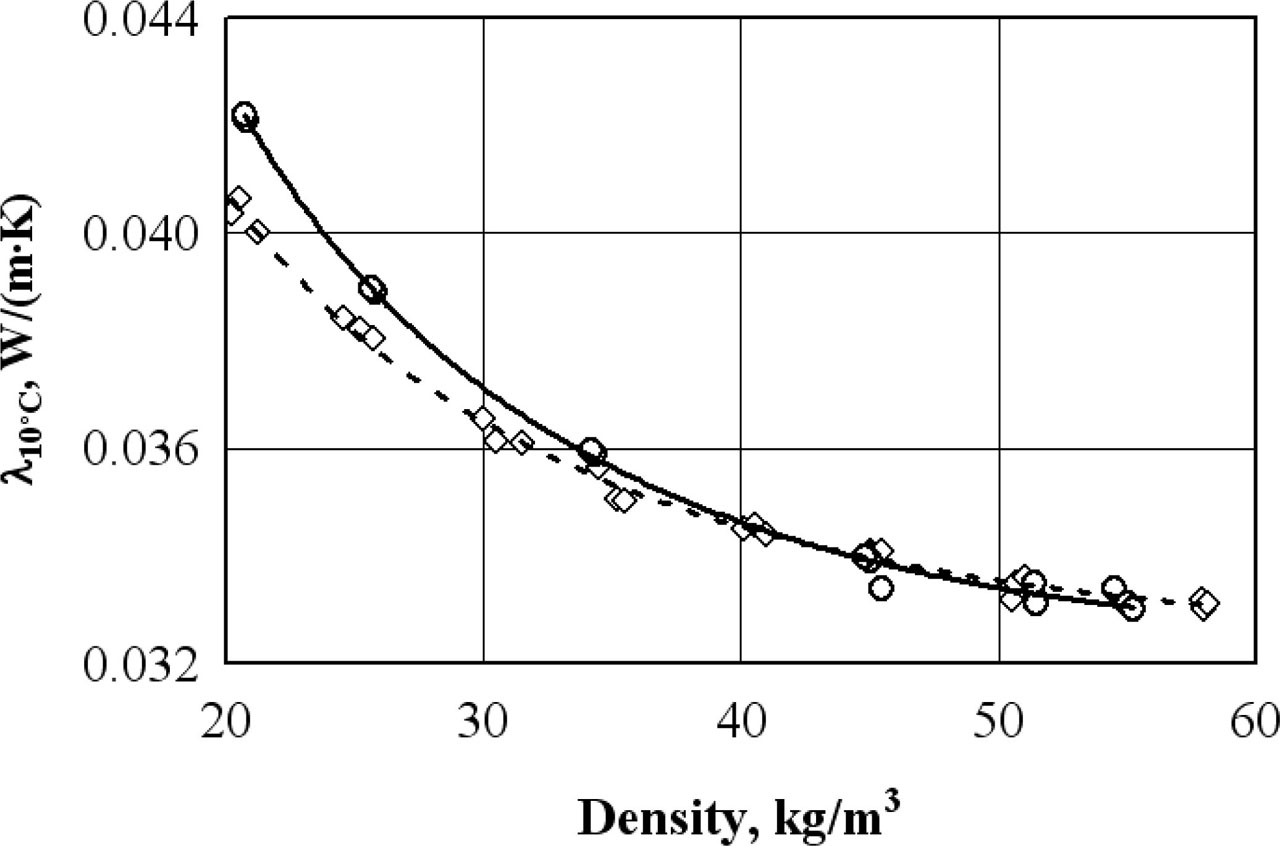
Fig. 1
Dependence of thermal conductivity on the density of specimens of 100% polylactide fibres (PLA): ○ – experimental data; (──) – regression line (equation (3)); and woollen yarn waste (Table 1, mixture No 1): ◊ – experimental data; (─ ─ ─) – regression line (equation (4))
Table 6
Results of the statistical processing of the thermal conductivity of PLA fibres and woollen yarn waste
| Number of regression equation | Number of tests (estimations) | Values of constant coefficients | Sr, W/(m·K) | R2λ10·φ | ||
|---|---|---|---|---|---|---|
| b0 | b1 | b2 | ||||
| 3 | 18 | 0.0223 | 0.000069 | 0.3813 | 0.000168 | 0.998 |
| 4 | 24 | 0.0258 | 0.000041 | 0.2818 | 0.000170 | 0.995 |
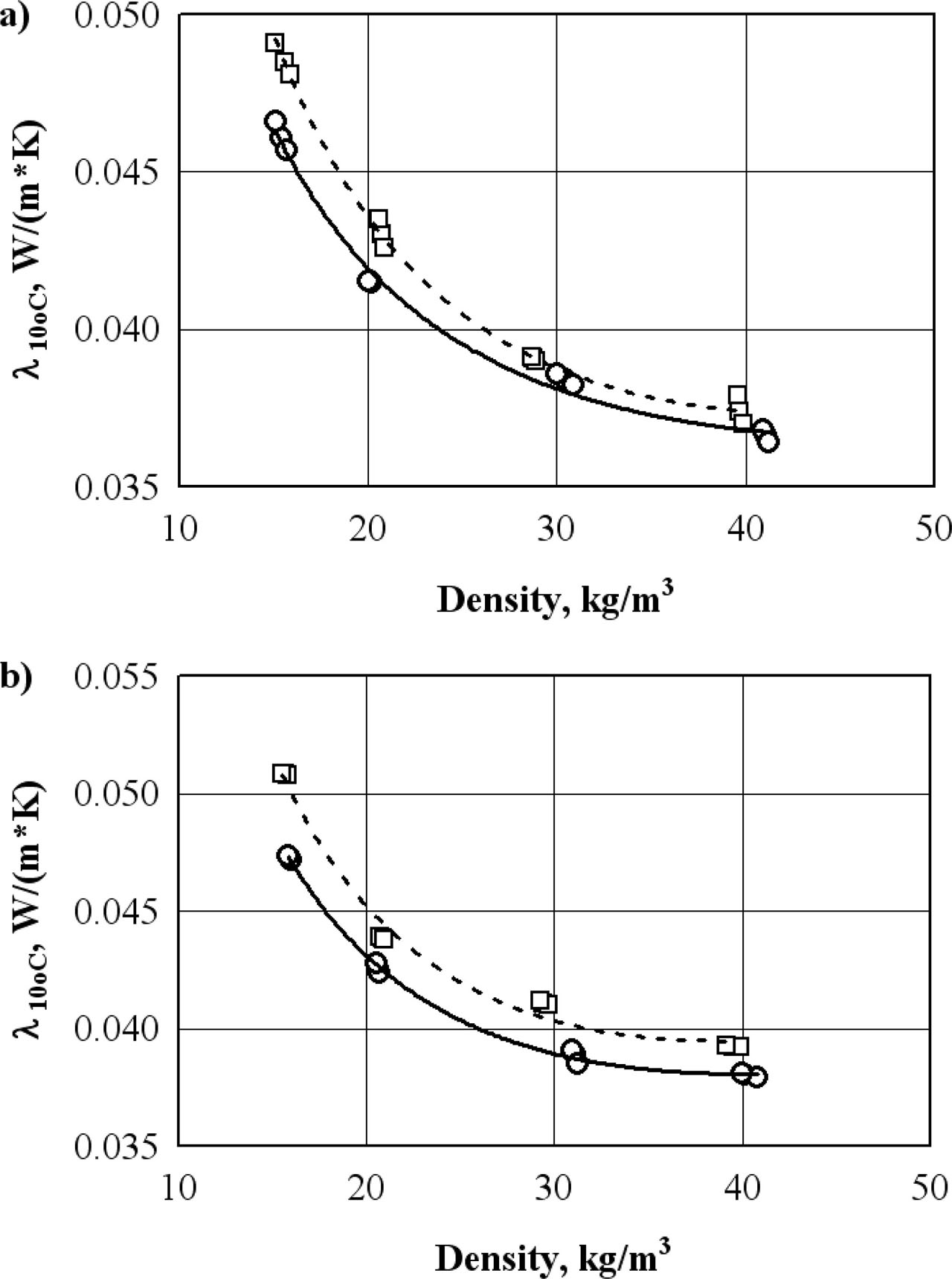
Fig. 2
Relationship between thermal conductivity and density: a) composite without added yarns (Table 1, mixture No 2); ○, □ – experimental data; (──) – thermally untreated specimen (regression line according to equation (5)); (- - -) – thermally treated specimen (regression line according to equation (6)); b) composite with added yarns (Table 1, mixture No 3); ○, □ – experimental data; (──) – thermally untreated specimen (regression line according to equation (7)); (- - -) – thermally treated specimen (regression line according to equation (8))
Table 7
Results of the statistical processing of the thermal conductivity of composites
| Number of regression equation | Number of tests (estimations) | Values of constant coefficients | Sr, W/(m·K) | R2λ10 ·φ | ||
|---|---|---|---|---|---|---|
| b0 | b1 | b2 | ||||
| 5 | 12 | 0.0242 | 0.000124 | 0.305 | 0.000354 | 0.993 |
| 6 | 12 | 0.0189 | 0.000206 | 0.412 | 0.000276 | 0.997 |
| 7 | 12 | 0.0183 | 0.000240 | 0.398 | 0.000173 | 0.998 |
| 8 | 12 | 0.0145 | 0.000320 | 0.486 | 0.000566 | 0.988 |
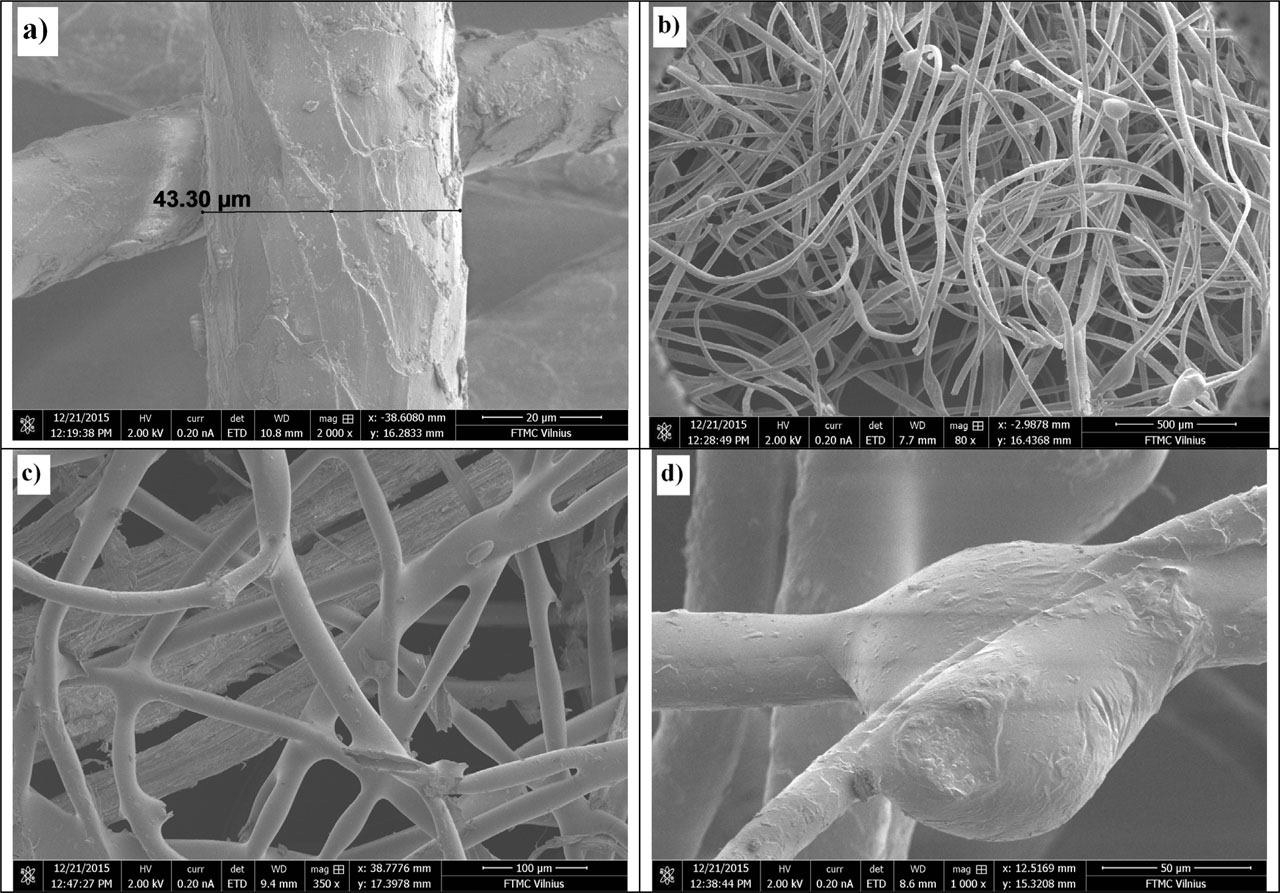
Fig. 3
Structure of fibres and contact zones of thermally treated composite (Table 1, mixture No 2): a – sheep wool fibres; b – general view of interconnected fibres of composite; c – network of interconnected polylactide fibres; d – network of interconnected sheep wool and polylactide fibres