

Fig. 1
Cross-sections of self-crimp filaments: (a) side-by-side, (b) eccentric sheath-core
Table 1
Specifications of H-PET/L-PET SBSBFs
| Component | H- PET/L- PET | ||||
|---|---|---|---|---|---|
| Specification | 110 dtex/34f | ||||
| Volume Ratio | 70:30 | 60:40 | 50:50 | 40:60 | 30:70 |
Table 2
Spinning and drawing conditions
| Items | Parameter | |
|---|---|---|
| Temperature of extruder(°C) | H-PET | 292/325/325 |
| L-PET | 272/277/276 | |
| Spinning manifold | Temperature (°C) | 305 |
| GR1 (Godet roller 1) | Temperature (°C) | 85 |
| Speed (m/min) | 2310 | |
| GR2 (Godet roller 2) | Temperature (°C) | 125 |
| Speed (m/min) | 4310 | |
| WR (Winding roller) | Speed (m/min) | 4200 |
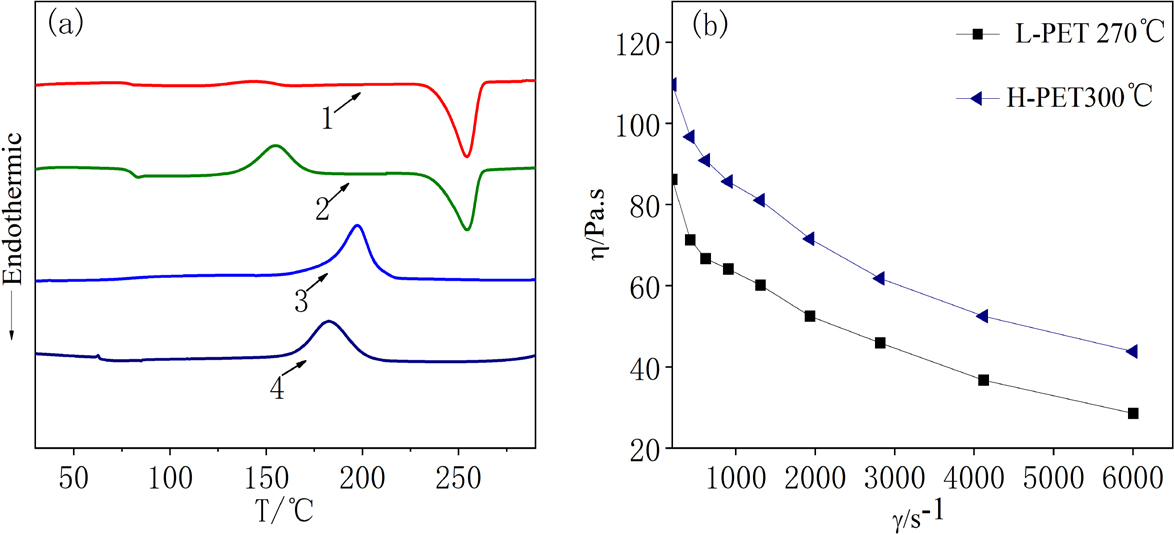
Fig. 2
Characteristics of H-PET and L-PET. (a) DSC curves (heating process of 1. L-PET and 2. H-PET, cooling process of 3. L-PET and 4. H-PET), (b) viscosity vs. shear rate curves
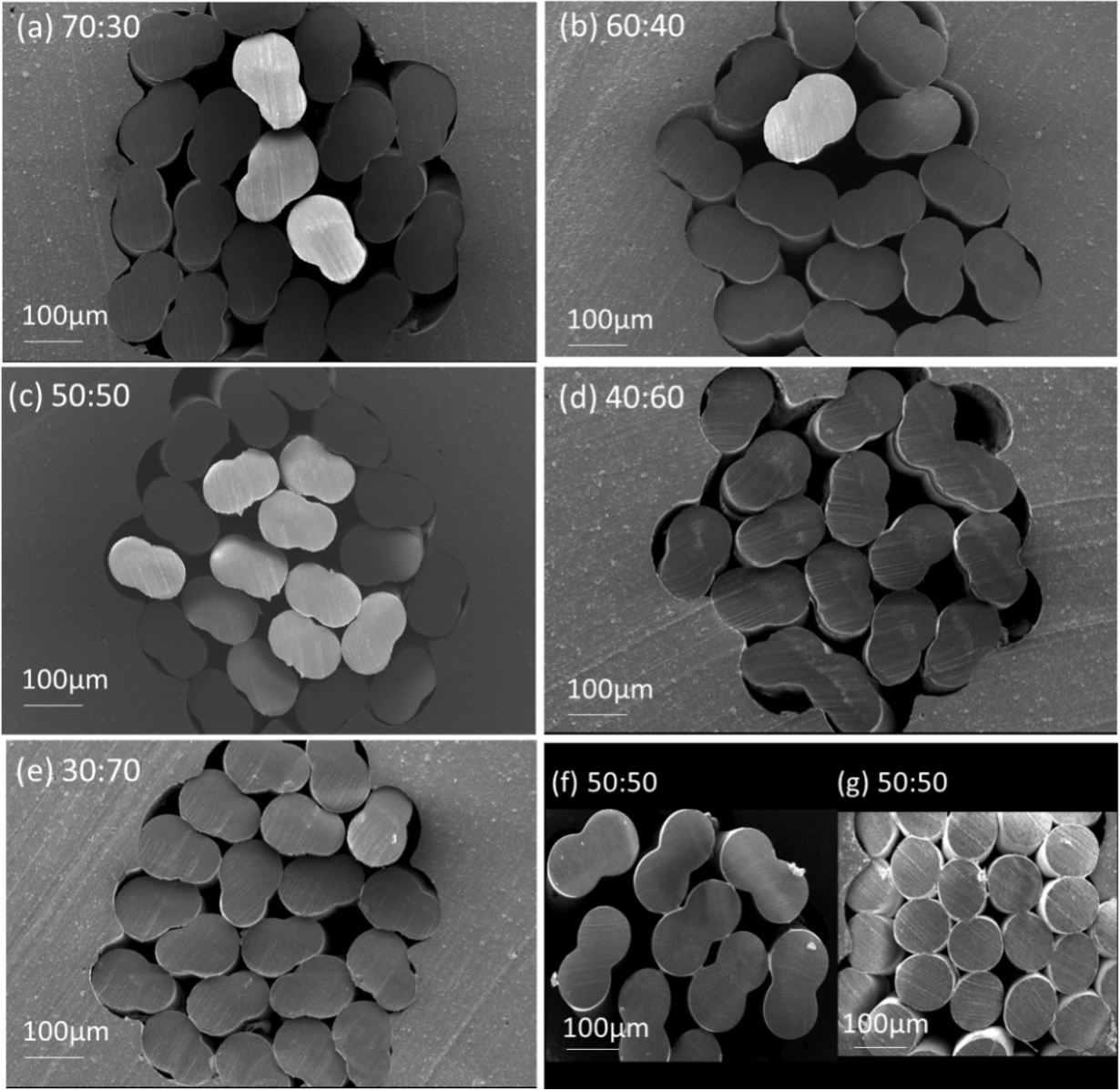
Fig. 3
Cross-section SEM images of bicomponent filaments with various H-PET:L-PET ratios. (a) 70:30, (b) 60:40, (c) 50:50, (d) 40:60, (e) 30:70, (f) H-PET: H-PET 50:50, (g) L-PET: L-PET 50:50).
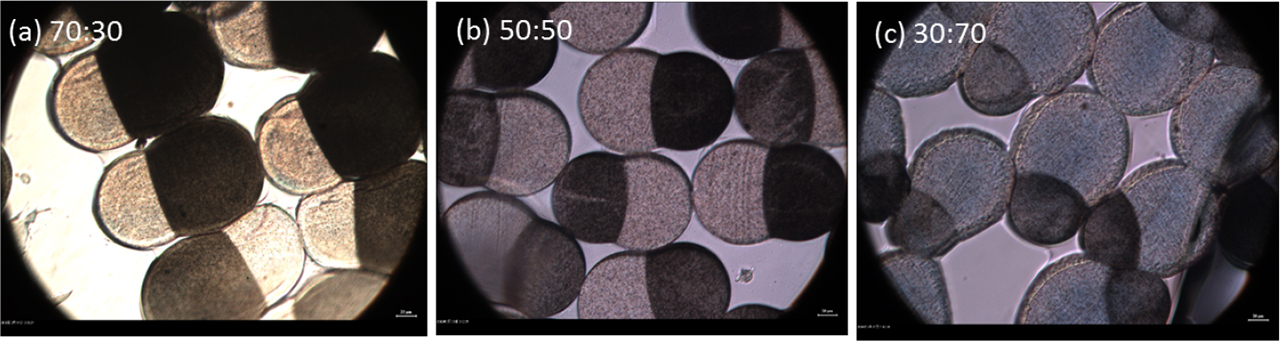
Fig. 4
OM images of cross-sections (500×) of coloured H-PET/L-PET SBSBFs with various H-PET:L-PET ratios, where the black component is the high-viscosity component. (a) 70:30, (b) 50:50, (c) 30:70)

Fig. 5
Characteristics of H-PET/L-PET SBSBFs. (a) sonic orientation factor, (b) wide angle X-ray diffraction patterns, (c) DSC first heating curves, (d) mechanical properties
Table 3
Melt temperatures of H-PET/L-PET SBSBFs
| H-PET/L-PET | Neck melting peak/°C | Main melting peak/°C |
|---|---|---|
| 70:30 | 252 | 259 |
| 60:40 | 253 | 358 |
| 50:50 | 256 | 258 |
| 40:60 | 255 | 258 |
| 30:70 | 257 | 257 |

Fig. 6
Boiling water shrinkage of H- PET/L-PET SBSBFs
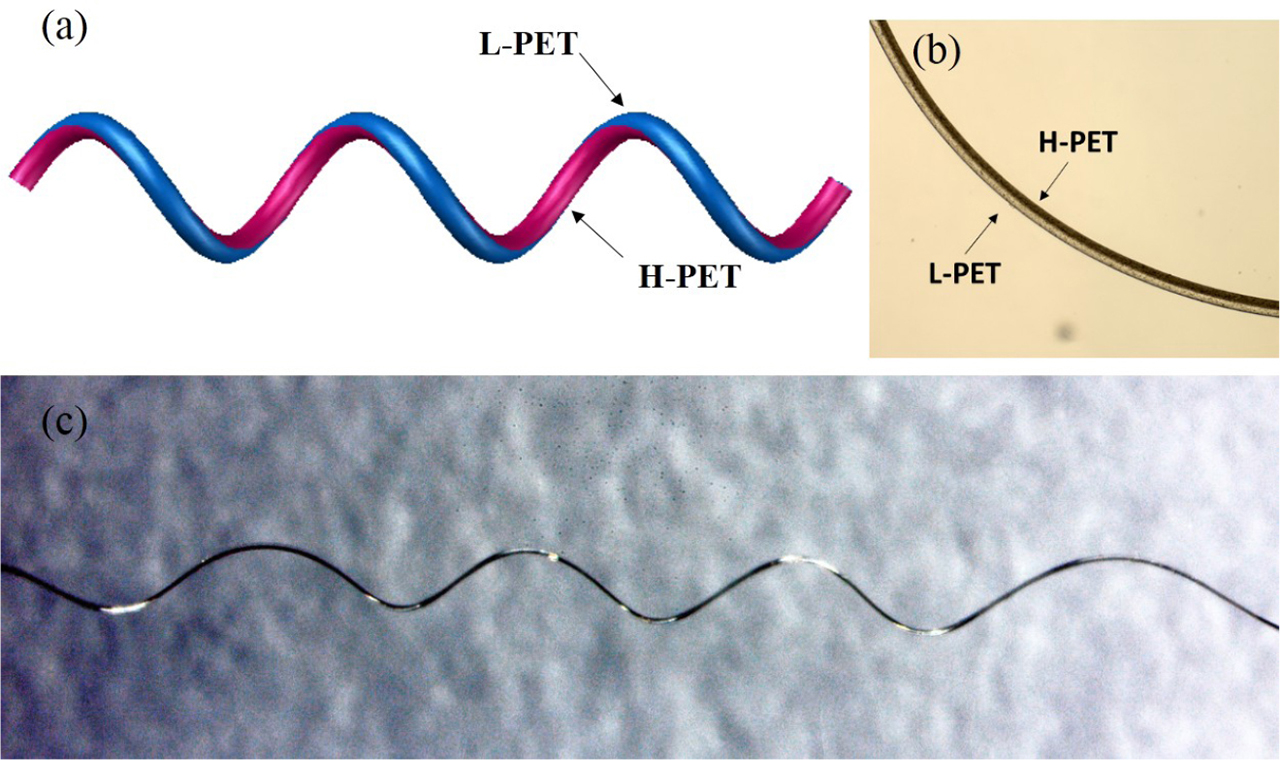
Fig. 7
Morphology of crimps of H-PET/L-PET SBSBFs. (a) model image, (b) OM image (500×), (c) physical image (25×)
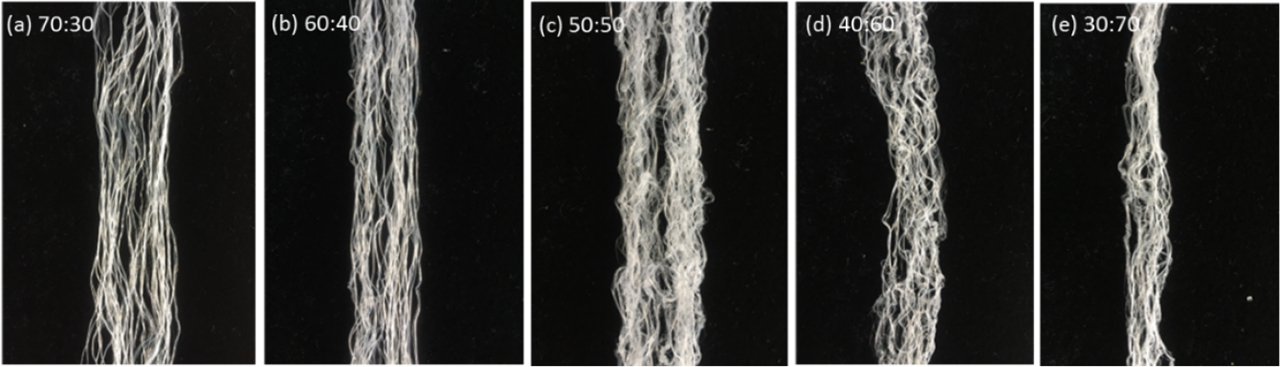
Fig. 8
Images of curved H-PET/L-PET SBSBFs after being treated in boiling water with various H-PET:L-PET ratios. (a) 70:30, (b) 60:40, (c) 50:50, (d) 40:60, (e) 30:70)
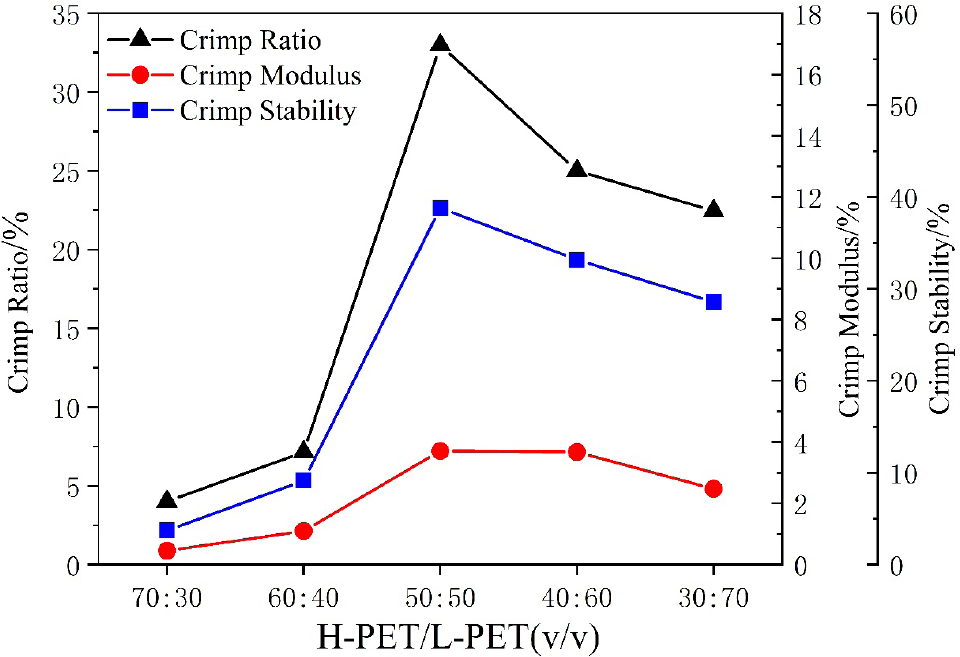
Fig. 9
Crimp ratio, crimp moduli and crimp stability of H-PET/L-PET SBSBFs