
1. Introduction
With highly competitive markets, characterised by a demand for personalised products of good quality, delivered in minimum deadlines and at the lowest cost, today’s companies realise that effective management of their local and international purchases can be a substantial competitive advantage. Thus, the selection of suppliers becomes a strategic decision that has a crucial impact on any company’s overall performance. In the literature, numerous studies are concerned with this topic in several fields, particularly in the textile and apparel field [1,2,3]. One of them focused on supplier selection and evaluation using a multi-objective programming method to select the optimal suppliers and determine the optimal order quantity [4]. Chen used a structured methodology for supplier evaluation and selection in the Taiwanese textile industry using the data envelopment analysis (DEA) technique for the order of preference by similarity to the ideal solution (TOPSIS) to filter and evaluate suppliers. As a result, the implemented model can help enterprises to select and evaluate suppliers throughout the supply chain [5].
Ozkok and Tiryaki used a multi-objective linear model for supplier evaluation and to solve selection problems with multiple items to choose a sustainable supplier in a Turkish textile firm. In their research, they applied Werner fuzzy and land operators to determine the best supplier [6]. Other researchers combined the analytic hierarchy process (AHP) with several methods, such as ELECTRE-TRI, preemptive goal programming (PGP), and TOPSIS approaches in the textile industry. The weights of criteria were determined with the AHP method, and the other methods were used to rank suppliers [7,8,9,10,11]. Amindoust and Saghafinia developed a modular fuzzy inference system in the textile industries. In their research, they used three decision-makers and five suppliers as candidates. They found that their model can rank suppliers based on their performance ratings and assigned the important degree of criteria in the ranking process [12]. Lahdhiri et al. applied the AHP method and the fuzzy method in their study to choose the best subcontractor in an apparel supply chain. In this research, the AHP method was more efficient than the fuzzy logic method for selecting the optimal subcontractors [13].
Wang et al. used a multi-criteria decision-making model to identify the textile and garment industry’s optimal suppliers. The criteria were defined according to the supply chain operations’ reference model. The Fuzzy-AHP determined the weights of suppliers, and the preference ranking organisation method for the enrichment of evaluations (PROMOTHEE II) was used to rank suppliers. As a result, they found that this model’s use is feasible in a textile and garment industry with large criteria. It can be used in other fields such as financial assessment and measuring the risk level in construction engineering [14]. Nakiboglu and Bulgurcu used intuitionistic fuzzy TOPSIS to choose the best raw material supplier for a textile company. They confirmed this method is efficient and could be used in the supplier selection of different businesses and sectors by taking appropriate criteria and their weights into consideration [15]. Besides, other scientific works dealing with these problems in manufacturing are numerous; in this section we present some of them to highlight the wide variety of applications. Safa et al. used the TOPSIS method in a construction project to evaluate and select suppliers [16]. In the electronic field, Gencer and Gurpinar applied the analytic network process to choose the best supplier, and other researchers applied a hybrid method based on an artificial neural network (ANN), the analytic network process (ANP), and DEA methods to evaluate suppliers [17, 18]. Some studies used the TOPSIS approach combined with the ANP and AHP methods in dairy companies and cable manufacturing companies. With ANP and AHP methods, the weights of selected criteria were calculated, and then the rank of suppliers was determined with the TOPSIS method [19, 20]. Nazari Shirkouhi et al. used a fuzzy multi-objective linear programming model for supplier selection and evaluation problems with multiple price levels and multiple products [21]. Arabsheybani et al. applied the fuzzy-MOORA approach to evaluate suppliers of the appliance industry. In their research, they implemented the failure mode and conducted an effects analysis to evaluate suppliers’ risk, and used fuzzy-MOORA to determine the suitable supplier. As a result, the approach proposed determined a sustainable supplier and can be applied in electrical, automotive, and chemical manufacturing [22]. Demir et al. conducted research according to the VIKORSORT approach to evaluate the supplier’s environmental performance in an electrical device manufacturer [23]. Barla et al. used a multi-attribute selection model to solve the supplier selection problem in a glass-producing firm [24]. Ha, and Krishnan used a hybrid approach based on AHP for criteria weights calculation, and the DEA and ANN methods to determine suppliers’ rank in a firm producing auto components. Also, in the automotive industry, Alizadeh and Handfield used a multi-objective mixed-integer linear programming model to evaluate suppliers and allocate order quantities [25, 26]. Other researchers applied the fuzzy AHP approach to choose the best supplier in an electronic company and a firm operating in beverage bottling [27, 28]. After thorough literature searching, several applications of the MCDM methods for supplier evaluation and selection were found; however, research studies in the clothing industry are still limited. For this reason, in this work, the AHP-TOPSIS, AHP-WSM, and AHP-WPM methods were applied for the ranking and selection of suitable suppliers in an apparel supply chain. This paper consists of five sections. The literature review on supplier selection in the textile sector and other fields is presented in the introduction section. In section 2, our research methodology and proposed methods used for the selection of suppliers are explained. In sections 3 and 4, a case study is given to illustrate the MDCM models, and the results are discussed. Finally, conclusions and future suggestions are stated in section 5.
2. Methods
2.1. Research methodology
This study aims to present hybrid multi-criteria decision-making methods, including the analytic hierarchy process (AHP), the technique for the order of preference by similarity to the ideal solution (TOPSIS), the weighted sum method (WSM), and the weighted product method (WPM) for selecting the best supplier in the apparel industry and fill the gap in the literature. This study consists of several steps. In the first, the literature was reviewed in order to determine the criteria set for evaluating and selecting the best supplier in the manufacturing sector. A questionnaire was then designed, and an investigation was conducted with 10 purchasing experts to evaluate the suppliers. Next, the weights of criteria and the decision matrix were established using the AHP method. In another step, hybrid MCDM models (AHP-TOPSIS, AHP-WSM, and AHP-WPM) were used to select the best supplier. Finally, in the last step, the hybrid models were compared. The methodology of our research is summarized in Figure 1.
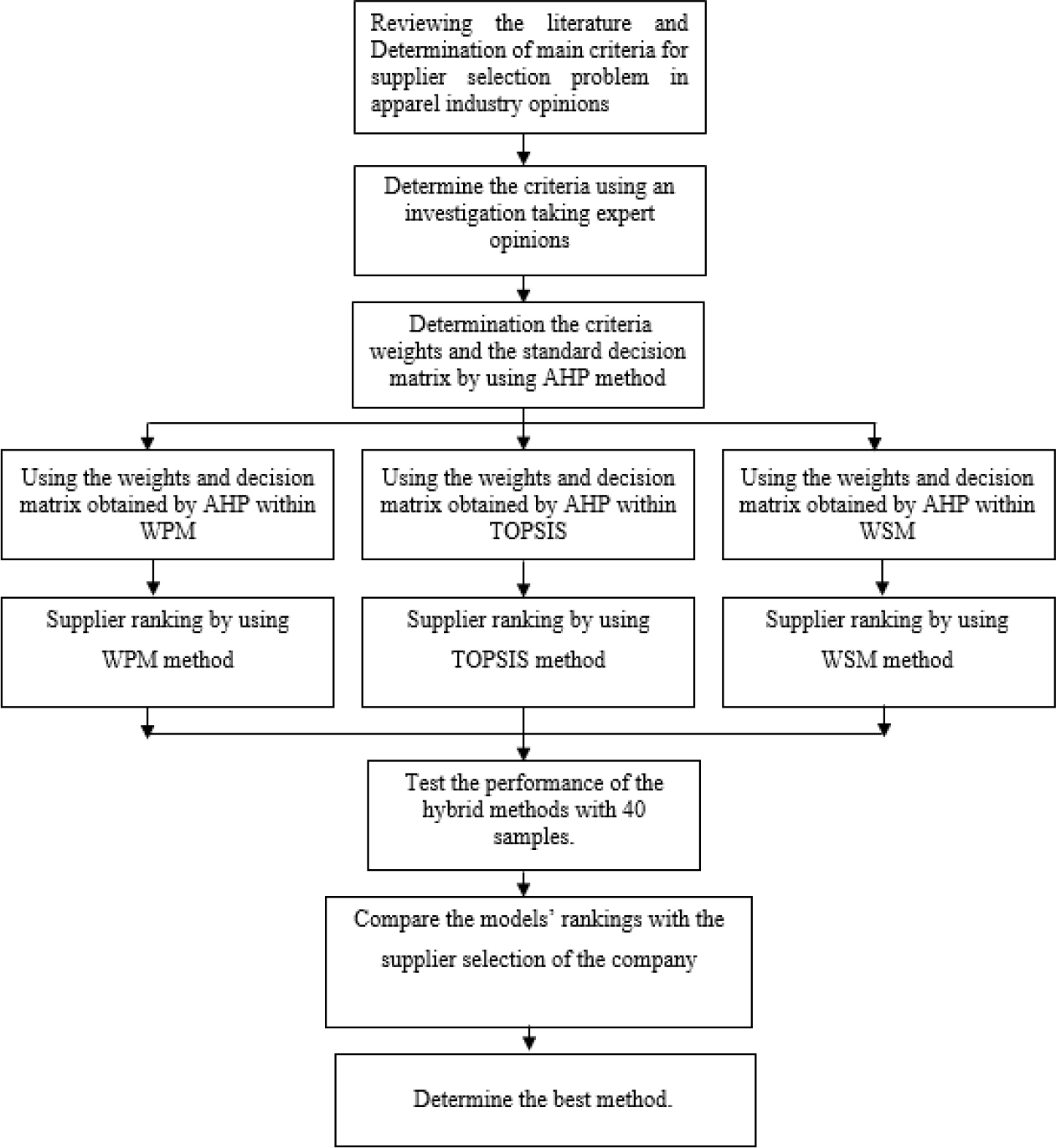
Fig. 1
Methodology of the study
As for the MCDM methods used in this paper, they are explained in the following section.
2.2. AHP-TOPSIS
The AHP developed by Saaty is one of the MCDM methods frequently used. It is a structured technique for organising, analysing, and solving complex decisions [29]. The AHP process begins by defining problems, criteria, and alternatives and then establishing a pair-wise comparison between criteria and alternatives. The process ends by determining the rank of alternatives. The TOPSIS method is a multi-criteria decision method proposed by Ching-Lai Hwang and Yoon [30,31,32], based on the positive ideal solution and negative ideal solution. AHP-TOPSIS is a combination of the AHP and TOPSIS methods. The use of AHP is to calculate the weight of the criteria and, as in the TOPSIS method, rank alternatives. The following steps can be described for using AHP-TOPSIS:
Step 1. Construct the decision matrix: as mentioned in Table 1.
Step 2. Construct the normalised decision matrix: as shown in Equation 1:
Step 3. Calculate the weight of the criteria: using the AHP method
– Construct a pair-wise comparison matrix (n*n) for criteria concerning objectives as shown in Table 3. The criteria’ weights should be calculated using a pair-wise comparison between criteria by applying Saaty’s l–9 scale [33]. Saaty’s scale is mentioned in Table 2.
– Normalise the resulting matrix as mentioned in Table 4.
– Calculate the row averages “W” of the normalised pair-wise matrix; a weights vector is obtained:
Table 2
Saaty’s 1–9 scale for pair-wise comparisons
| Numerical rate | Verbal judgment of preference |
|---|---|
| 1 | Equal importance |
| 3 | Weak importance of one over another |
| 5 | Essential or strong importance |
| 7 | Demonstrated importance |
| 9 | Absolute importance |
| 2, 4, 6, 8 | Intermediate values between the two adjacent judgments |
Table 3
Pair-wise comparison matrix of criterion
| Criteria | C1 | C2 | C3 | …. | Cn |
|---|---|---|---|---|---|
| C1 | 1 | W1/W2 | W1/W3 | …. | W1/Wn |
| C2 | W2/W1 | 1 | W2/W3 | …. | W2/Wn |
| C3 | W3/W1 | W3/W2 | 1 | …. | W3/Wn |
| .. | … | …. | … | 1 | … |
| Cn | Wn/W1 | Wn/W2 | Wn/W3 | Wn/W.. | 1 |
Table 4
Normalisation Matrix
| Criteria | C1 | C2 | C3 | …. | Cn |
|---|---|---|---|---|---|
| C1 | X11 | X12 | X13 | … | X1n |
| C2 | X11 | X22 | X23 | … | X2n |
| C3 | X31 | X32 | X33 | … | X3n |
| .. | … | … | … | … | … |
| Cn | Xn1 | Xn2 | Xn3 | … | Xnn |
Step 4. Calculate the weighted normalised decision matrix.
Calculate the weighted normalised value. Vij is presented in Equation 2:
Step 5. Determine the positive ideal and negative ideal solutions
Positive ideal solution A+ has the form presented in Equation 3:
Negative ideal solution A− has the form presented in Equation 4: I is associated with benefit criteria and J with the worst criteria, i=1, …, m; j=1, …, nStep 6. Calculate the separation measures from the positive ideal solution and negative ideal solution.
In the TOPSIS method, the separation coefficient of each alternative from the positive ideal solution Si+ is given by the following Equation (5):
The separation coefficient of each alternative from the negative ideal solution Si− is given by the following Equation 6:Step 7. Calculate the relative closeness coefficient to the positive ideal solution Ri: as shown in Equation 7:
Step 8. Rank the alternatives.
Rank the alternatives according to Ri; i=1,2,3,..,n
2.3. AHP-WSM
The Weighted Sum Method (WSM) is a multi-criterion decision-making method [34]. There will be multiple alternatives, and we have to determine the most suitable one based on several criteria. The AHP-WSM method is a combination of the AHP method and WSM method. The use of the AHP method is to calculate the weight of the criteria and that of the WSM method to rank alternatives.
2.3.1. AHP-WSM process
Step 1. Construct the decision matrix X: identical to AHP-TOPSIS
Step 2. Construct the normalised decision matrix Z: as shown in Table 5.
Table 5
Normalised matrix
| C1 | C2 | C3 | …. | Cm | |
|---|---|---|---|---|---|
| A1 | Y11 | Y12 | Y13 | … | Y1m |
| A2 | Y11 | Y22 | Y23 | … | Y2m |
| A3 | Y31 | Y32 | Y33 | … | Y3m |
| .. | … | … | … | … | … |
| An | Yn1 | Yn2 | Yn3 | … | Ynm |
A beneficial attribute or alternative, Yij, is obtained by Equation 8:
A non-beneficial attribute or alternative, Yij, is obtained by Equation 9:Step 3. Calculate the weight of the criteria: using the AHP method: identical to AHP-TOPSIS
Step 4. Construct the weighted normalised decision matrix Z.’
Multiply the weighted vector W of criteria with the normalised matrix. The weighted normalised decision matrix is mentioned in Table 6.
Table 6
Weighted normalised decision matrix
| C1 | C2 | C3 | …. | Cm | |
|---|---|---|---|---|---|
| A1 | Y11 *W1 | Y12*W2 | Y13*W3 | … | Y1m*Wm |
| A2 | Y11*W1 | Y22*W2 | Y23*W3 | … | Y2m*Wm |
| A3 | Y31*W1 | Y32*W2 | Y33*W3 | … | Y3m*Wm |
| .. | … | … | … | … | … |
| An | Yn1*W1 | Yn2*W2 | Yn3*W3 | … | Ynm*Wm |
Step 5. Calculate the score S for AHP-WSM: as presented in Equation 10
2.4. AHP-WPM
The Weighted Product Method (WPM) is a multi-criterion decision-making method. There will be multiple alternatives, and one has to determine the most suitable based on several criteria. WPM is very similar to WSM. The main difference consists in using multiplication instead of the sum in the last step of computing the model outputs. The AHP-WPM method is an integrated approach allowing to calculate as a first step the criteria weights on the basis of the AHP method, and then the WSM method will be used to rank alternatives.
2.4.1. AHP-WPM process
Step 1. Construct the decision matrix X: identical to AHP-WSM
Step 2. Construct the normalised decision matrix Z: identical to AHP-WSM
Step 3. Calculate the weight of the criteria: using the AHP method: identical to AHP-WSM
Step 4. Construct the weighted normalised decision matrix Z.’
Multiply the weighted vector W of the criteria with the normalised matrix. The weighted normalised decision matrix is mentioned in table 7.
Table 7
Weighted normalised decision matrix
| C1 | C2 | C3 | …. | Cm | |
|---|---|---|---|---|---|
| A1 | Y11 ^W1 | Y12^W2 | Y13^W3 | … | Y1m^Wm |
| A2 | Y11^W1 | Y22^W2 | Y23^W3 | … | Y2m^Wm |
| A3 | Y31^W1 | Y32^W2 | Y33^W3 | … | Y3m^Wm |
| .. | … | … | … | … | … |
| An | Yn1^W1 | Yn2^W2 | Yn3^W3 | … | Ynm^Wm |
Step 5. Calculate the score Si for AHP-WPM: as shown in Equation 11:
3. Case study in a denim garment company
3.1. Data set used
This work was carried out in a company specialised in manufacturing denim products, employing 400 persons, with an annual production of 900,000 pieces, and operating as an ordering party for various subcontractors as well as a manufacturer of several items (pants, jackets, skirts) in small and medium orders for different international brands, requiring high-quality, right and short-time delivery. There are several types of purchases in this company, such as textile accessories, fabric, and other items. As for the fabric purchase, the customers ordering impose their suitable suppliers on the company. Consequently, in this work, we dealt essentially with textile purchasing accessories; in fact, it represents the most important part in terms of variety and cost. Besides, this company has an important database for these items, but there is no objective method for supplier selection; the purchasing operations have been based only on the supply chain manager’s experience. In this case study, to apply the models proposed, we have sorted and retained successful purchasing actions and considered them as a database in the current supplier’s selection study. As a result, the sorted database is composed of 40 various textile accessories, 40 purchase orders, and 120 suppliers.
3.2. Criteria selection
To define the main criteria for the supplier selection decision, an investigation was conducted with 10 experts having a professional career in textile purchasing ranging from 6 to 18 years. The list of criteria used for the investigation was determined on the basis of the literature review and mentioned in Table 8 [35,36,37,38,39].
Table 8
List of criteria
| N° | Criteria | N° | Criteria |
|---|---|---|---|
| 1 | Cost | 11 | Ease of production |
| 2 | Quality | 12 | Environment |
| 3 | Compliance to quantity | 13 | Free sampling |
| 4 | Compliance to deadlines | 14 | Minimum production capacity |
| 5 | Social relationship | 15 | Technical capacity |
| 6 | Guarantee | 16 | Purchase volume in the past |
| 7 | Financial situation | 17 | Process conformity |
| 8 | Development | 18 | Certification |
| 9 | Geographical location | 19 | Control of operations |
| 10 | Management and organisation | 20 | Training and support |
The steps of the investigation were as follows:
– Order the criteria according to their importance
– Determine the weights of the first four criteria using the AHP method.
– Determine the four most important criteria for the10 experts according to the ABC diagram.
The results of the investigation are mentioned in Table 9 and Figure 2.
Table 9
Investigation results for the 10 experts
| Investigation | First 4 criteria | Weight | Investigation | First 4 criteria | Weight |
|---|---|---|---|---|---|
| Expert 1 | Quality | 0.06 | Expert 6 | Compliance to deadlines | 0.06 |
| Cost | 0.10 | Cost | 0.11 | ||
| Compliance to deadlines | 0.32 | Quality | 0.29 | ||
| Compliance to quantity | 0.53 | Compliance to quantity | 0.54 | ||
| Expert 2 | Cost | 0.50 | Expert 7 | Ease of production | 0.07 |
| Guarantee | 0.17 | Social relationship | 0.12 | ||
| Ease of production | 0.05 | Quantity | 0.26 | ||
| Compliance to deadlines | 0.27 | Management and organisation | 0.56 | ||
| Expert 3 | Compliance to quantity | 0.07 | Expert 8 | Ease of production | 0.06 |
| Quality | 0.15 | Financial situation | 0.10 | ||
| Cost | 0.29 | Compliance to quantity | 0.32 | ||
| Compliance to deadlines | 0.49 | Quality | 0.53 | ||
| Expert 4 | Development | 0.55 | Expert 9 | Quality | 0.55 |
| Geographical location | 0.26 | Compliance to quantity | 0.26 | ||
| Cost | 0.14 | Compliance to deadlines | 0.14 | ||
| Quality | 0.05 | Guarantee | 0.05 | ||
| Expert 5 | Guarantee | 0.06 | Expert 10 | Environment | 0.06 |
| Financial situation | 0.10 | Financial situation | 0.10 | ||
| Cost | 0.32 | Compliance to quantity | 0.32 | ||
| Quality | 0.53 | Compliance to de+adlines | 0.53 |
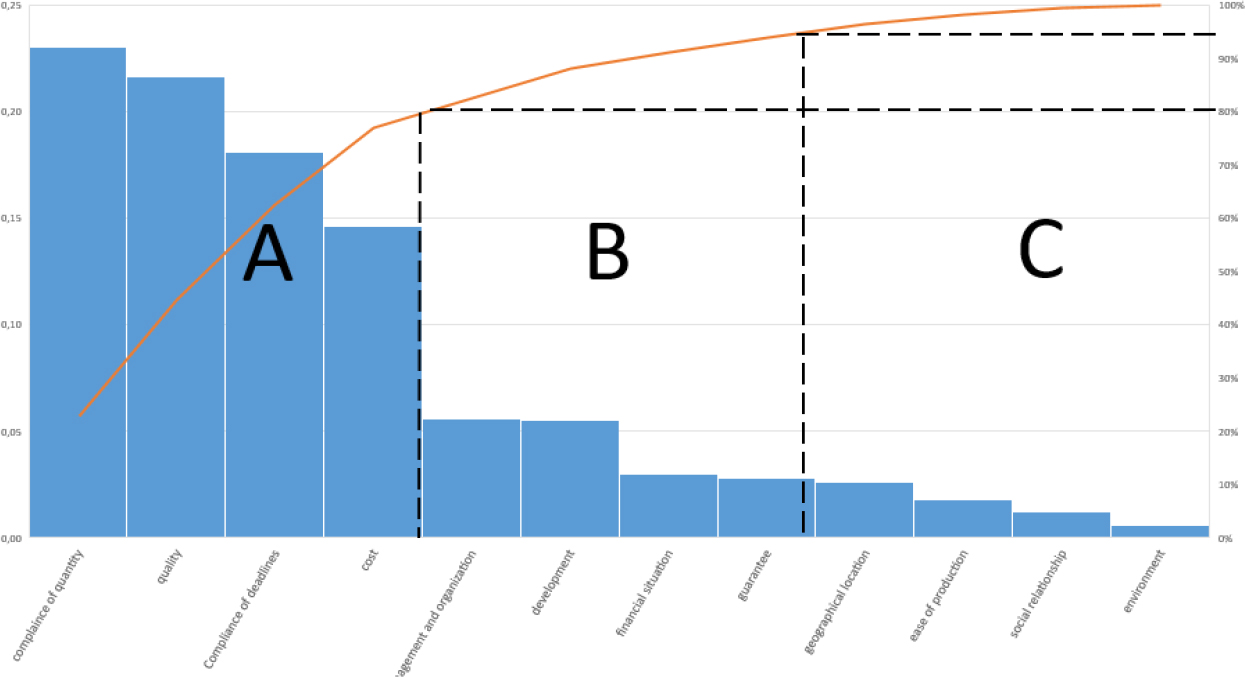
Fig. 2
Classification of criteria
After determining the criteria mentioned in the literature, the choice and weights of each expert’s criteria are obtained, shown in Table 9.
After the investigation, an ABC chart was plotted to determine the final criteria choice and classify the most important ones, presented in Figure 2.
From the ABC chart, the most important criteria (Zone A) are cost, quality, compliance to quantity, and compliance to deadlines.
3.3. Supplier selection using hybrid models
In this section, we applied AHP-TOPSIS, AHP-WSM, and AHP-WPM models to choose the best suppliers from three suppliers (S1, S2, and S3) for purchasing textile supplies and accessories. The problem’s overall objective in this example is the purchase of a button with reference 001.
3.2.1. AHP-TOPSIS MODEL
Step 1. Construct the decision matrix and determine the weight of the criteria: as shown in Table 10
Table 10
Decision matrix
| Cost | Quality | Compliance to quantity | Compliance to deadlines | |
|---|---|---|---|---|
| S1 | 0.197 | 3 | 1 | 0.96 |
| S2 | 0.6 | 3 | 1 | 0.96 |
| S3 | 0.125 | 2 | 1 | 0,94 |
Step 2. Construct the normalized decision matrix: as shown in Table 11
Table 11
Normalisation matrix
| Cost | Quality | Compliance to quantity | Compliance to deadlines | |
|---|---|---|---|---|
| S1 | 0.31 | 0.64 | 0.58 | 0.58 |
| S2 | 0.93 | 0.64 | 0.58 | 0.58 |
| S3 | 0.19 | 0.43 | 0.58 | 0.57 |
Step 3. Calculate the weight of each criterion:
– Construct a pair-wise comparison matrix for the criteria: as shown in Table 12
– Normalize the resulting matrix: as shown in Table 13
Table 12
Pair-wise comparison matrix
| Criteria | Cost piece | Quality | Compliance to quantity | Compliance to deadlines |
|---|---|---|---|---|
| Cost/piece | 1 | 0.33 | 0.2 | 0.14 |
| Quality | 3 | 1 | 0.5 | 0.33 |
| Compliance to quantity | 5 | 2 | 1 | 0.2 |
| Compliance to deadlines | 7 | 3 | 5 | 1 |
Table 13
Normalization Matrix
| Criteria | Cost / piece | Quality | Compliance to quantity | Compliance to deadlines | Average vector: W |
|---|---|---|---|---|---|
| Cost/piece | 0.06 | 0.05 | 0.03 | 0.09 | 0.07 |
| Quality | 0.19 | 0.16 | 0.07 | 0.20 | 0.15 |
| Compliance to quantity | 0.31 | 0.32 | 0.15 | 0.12 | 0.22 |
| Compliance to deadlines | 0.44 | 0.47 | 0.75 | 0.60 | 0.56 |
Step 4. Calculate the weighted normalised decision matrix: as shown in Table 14
Table 14
Weighted normalised matrix
| Cost | Quality | Compliance to quantity | Compliance to deadlines | |
|---|---|---|---|---|
| S1 | 0.02 | 0.10 | 0.13 | 0.33 |
| S2 | 0.07 | 0.10 | 0.13 | 0.33 |
| S3 | 0.01 | 0.06 | 0.13 | 0.32 |
Step 5. Determine the positive ideal and negative ideal solutions: as shown in Table 15
Table 15
Positive ideal and negative ideal solution
| Cost | Quality | Compliance to quantity | Compliance to deadlines | |
|---|---|---|---|---|
| S1 | 0.02 | 0.10 | 0.13 | 0.33 |
| S2 | 0.07 | 0.10 | 0.13 | 0.33 |
| S3 | 0.01 | 0.06 | 0.13 | 0.32 |
| V+ | 0.01 | 0.10 | 0.13 | 0.33 |
| V− | 0.07 | 0.06 | 0.13 | 0.32 |
Step 6. Calculate the separation measures from the positive ideal solution and negative ideal solution: as shown in Table 16
Table 16
Separation measures
| Cost | Quality | Compliance to quantity | Compliance to deadlines | Si+ | Si− | |
|---|---|---|---|---|---|---|
| S1 | 0.02 | 0.10 | 0.13 | 0.33 | 0.01 | 0.05 |
| S2 | 0.07 | 0.10 | 0.13 | 0.33 | 0.05 | 0.03 |
| S3 | 0.01 | 0.06 | 0.13 | 0.32 | 0.03 | 0.05 |
Step 7. Calculate the relative closeness coefficient to the positive ideal solution and rank the alternative according to Ri: as shown in Table 17
3.2.2. AHP-WSM MODEL
Step 1. Construct the decision matrix X: identical to AHP-TOPSIS
Step 2. Construct the normalised decision matrix Z: as shown in Table 18
Table 18
AHP-WSM Normalised matrix
| Cost | Quality | Compliance to quantity | Compliance to deadlines | |
|---|---|---|---|---|
| S1 | 0.63 | 1.00 | 1 | 1.00 |
| S2 | 0.21 | 1.00 | 1 | 1.00 |
| S3 | 1.00 | 0.67 | 1 | 0.98 |
Step 3. Calculate the weight of each criterion: identical to AHP-TOPSIS
Step 4. Construct the weighted normalised decision matrix: as shown in Table 19
Table 19
AHP-WSM Weighted normalised matrix
| Cost | Quality | Compliance to quantity | Compliance to deadlines | |
|---|---|---|---|---|
| S1 | 0.63 | 1.00 | 1 | 1.00 |
| S2 | 0.21 | 1.00 | 1 | 1.00 |
| S3 | 1.00 | 0.67 | 1 | 0.98 |
Step 5. Calculate the score for AHP-WSM: as shown in Table 20
3.2.3. AHP-WPM MODEL
The results from step 1 until step 3 for the AHP-WPM method are similar to those of the AHP-WSM method, as mentioned in the definition of AHP-WPM
Step 4. Construct the weighted normalised decision matrix: as shown in Table 21
Table 21
AHP-WPM weighted normalised matrix
| Cost | Quality | Compliance to quantity | Compliance to deadlines | |
|---|---|---|---|---|
| S1 | 0.63 | 1.00 | 1 | 1.00 |
| S2 | 0.21 | 1.00 | 1 | 1,00 |
| S3 | 1.00 | 0.67 | 1 | 0.98 |
Step 5. Calculate the score for AHP-WPM: as shown in table 22
For button 001 purchasing, the three models lead to S1 as being the best supplier, but with different scores. For AHP-TOPSIS, S1 has a score equal to 0.87, which was ranked as the best choice, with a score equal to 0.97 for AHP-WSM and AHP-WPM methods.
4. Results and discussion
4.1. Test evaluation
To evaluate the performance of the AHP-TOPSIS, AHP-WSM, and AHP-WPM models in predicting the best choice of supplier, a dataset composed of 40 samples was used. Then, these data were tested in a real case. It should be noted that these purchase orders, which are given to well-defined suppliers, were selected from those which had already been conducted successfully in the supplier selection and purchase process. The purchase orders chosen were of good quality, reasonable price, convenient delivery time, and the desired quantity. Table 23 presents the rank of the suppliers adopted by the company in the list of suppliers determined by the AHP-TOPSIS, AHP-WSM, and AHP-WPM models.
Table 23
Test evaluation (part 1)
| Purchase order number | Item | Supplier selected by company | Supplier selected by AHP-TOPSIS | Rank of supplier | Supplier selected by AHP-WSM | Rank of supplier | Supplier selected by AHP-WPM | Rank of supplier |
|---|---|---|---|---|---|---|---|---|
| 1 | Stopper | FX | FX | 1 | FY | 2 | FY | 2 |
| 2 | Label kontakt | AY | AY | 1 | AB | 4 | AB | 4 |
| 3 | Label brice | FS | FS | 1 | FR | 3 | FR | 2 |
| 4 | Fringe | XA | XA | 1 | XR | 2 | XA | 1 |
| 5 | Yarn 100% cotton | ZD | ZA | 2 | ZD | 1 | ZA | 2 |
| 6 | Elastic | CA | CA | 1 | CX | 2 | CA | 1 |
| 7 | Zipper L18 cm | DZ | DR | 1 | DR | 1 | DR | 1 |
| 8 | Button 2 HOLE 25 | IL | IJ | 2 | IL | 1 | IJ | 2 |
| 9 | Ribbon | WK | WK | 1 | WK | 1 | WK | 1 |
| 10 | Buckle | HI | HX | 3 | HX | 2 | HX | 2 |
| 11 | Hangtag –vms | X1 | X1 | 1 | X1 | 1 | X1 | 1 |
| 12 | Rivet 84061 | B1 | B1 | 1 | B2 | 2 | B2 | 2 |
| 13 | Rivet 84425 | C1 | C1 | 1 | C1 | 1 | C1 | 1 |
| 14 | Button 11631 | CF | CF | 1 | CR | 2 | CF | 1 |
| 15 | Scotch | Y1 | Y1 | 1 | Y1 | 1 | Y1 | 1 |
| 16 | Button 4 Hole 28″ | A1 | A1 | 1 | A1 | 1 | A1 | 1 |
| 17 | Zip 14.5cm | G1 | G1 | 1 | G1 | 1 | G1 | 1 |
| 18 | Buckle 1cm | G1 | G1 | 1 | G1 | 1 | G1 | 1 |
| 19 | Confection sticker - | H1 | H1 | 1 | H1 | 1 | H1 | 1 |
| 20 | Bias Tape 100 % | W1 | W1 | 1 | W1 | 1 | W1 | 1 |
| 21 | Leather10895 | U1 | U1 | 1 | U1 | 1 | U1 | 1 |
| 22 | Zip L16.5cm | G1 | G1 | 1 | G1 | 1 | G1 | 1 |
| 23 | Yarn Tex 60 Dual Duty 5000mts-fil | T1 | T1 | 1 | T1 | 1 | T1 | 1 |
| 24 | Sangle nastro spinato 30/2 PXT mm.60 | R1 | R1 | 1 | O1 | 2 | R1 | 1 |
| 25 | Sticker dim 100*150 | BR | BR | 1 | BR | 1 | BR | 1 |
| 26 | Plastic cover | FR | FR | 1 | V | 1 | FR | 1 |
| 27 | Hang Tag Retro | BG | BG | 1 | BG | 1 | BG | 1 |
| 28 | Ribbon polyamide | FH | FH | 1 | FH | 1 | FH | 1 |
| 29 | Button tack metal | FT | FT | 1 | FT | 1 | FT | 1 |
| 30 | Button jeans 20mm | XS | XS | 1 | XS | 1 | XS | 1 |
| 31 | Rivet laiton de 2 cm | XS | XS | 1 | XS | 1 | V | 1 |
| 32 | Leather belt | GH | GH | 1 | GH | 1 | GH | 1 |
| 33 | Yarn col 439 Super Twist N°20 20gr/fil | XR | XR | 1 | XR | 1 | XR | 1 |
| 34 | Strap ecru | XY | XY | 1 | XY | 1 | XY | 1 |
| 35 | Buckle overalls | BJ | BJ | 1 | BJ | 1 | BJ | 1 |
| 36 | Zip L43cm RGKB | BN | BN | 1 | BN | 1 | BN | 1 |
| 37 | Confection sticker-Care Label | VH | VH | 1 | VH | 1 | VH | 1 |
| 38 | Finishing sticker -VMS | VY | VY | 1 | VY | 1 | VY | 1 |
| 39 | Finishing sticker women | SML | SML | 1 | SML | 1 | SML | 1 |
| 40 | Metal overalls buckle accessory Internal diameter 3.8 cm White | SF | SF | 1 | SF | 1 | SF | 1 |
4.2. Results analysis
On the basis of these results, a statistical study was carried out on the two methods, in which we took the results of the 1st rank for each method, and variance analysis was conducted to determine if the differences between group means are statistically significant or not. The results are mentioned in Table 24 and Table 25.
Table 24
Statistical study of each method pair
| Method pair | σ xy | σ x | σ y | R xy | standard deviation |
|---|---|---|---|---|---|
| AHP-TOPSIS and AHP-WSM | 0.0015 | 0.11 | 0.05 | 0.29 | 0.089 |
| AHP-TOPSIS and AHP-WPM | 0.00094 | 0.1 | 0.018 | 0.47 | 0.08 |
| AHP-WSM and AHP-WPM | 0.00014 | 0.048 | 0..018 | 0.16 | 0.03 |
Table 25
ANOVA for the three MCDM methods
| Source of variation | SS | Df | MS | F | P-value | F crit |
|---|---|---|---|---|---|---|
| Between groups | 0.143 | 2 | 0.071 | 15.131 | 1.431E-06 | 3.073 |
| Within groups | 0.555 | 117 | 0.004 | |||
| Total | 0.699 | 119 |
In Table 24, we calculated the correlation coefficient to determine the dependence between AHP-TOPSIS /AHP-WSM, AHP-TOPSIS/AHP-WPM, and AHP-WSM/AHP-WPM supplier rankings. As a result, a non-significant correlation between the various MCDM couples was observed, where the correlation coefficient values Rxy do not exceed 0,47.
From table 25, the p-value is less than the significance level, thus we rejected the null hypothesis and concluded that not all of the population means are equal. We can conclude that the differences between group means are statistically significant.
Besides this, from Table 23 we determined the ratio of coincidence of supplier rankings between the AHP-TOPSIS, AHP-WSM, and AHP-WPM models and the supply manager’s choice for all the successful purchase operations in the database. The results obtained are displayed in Figure 3.
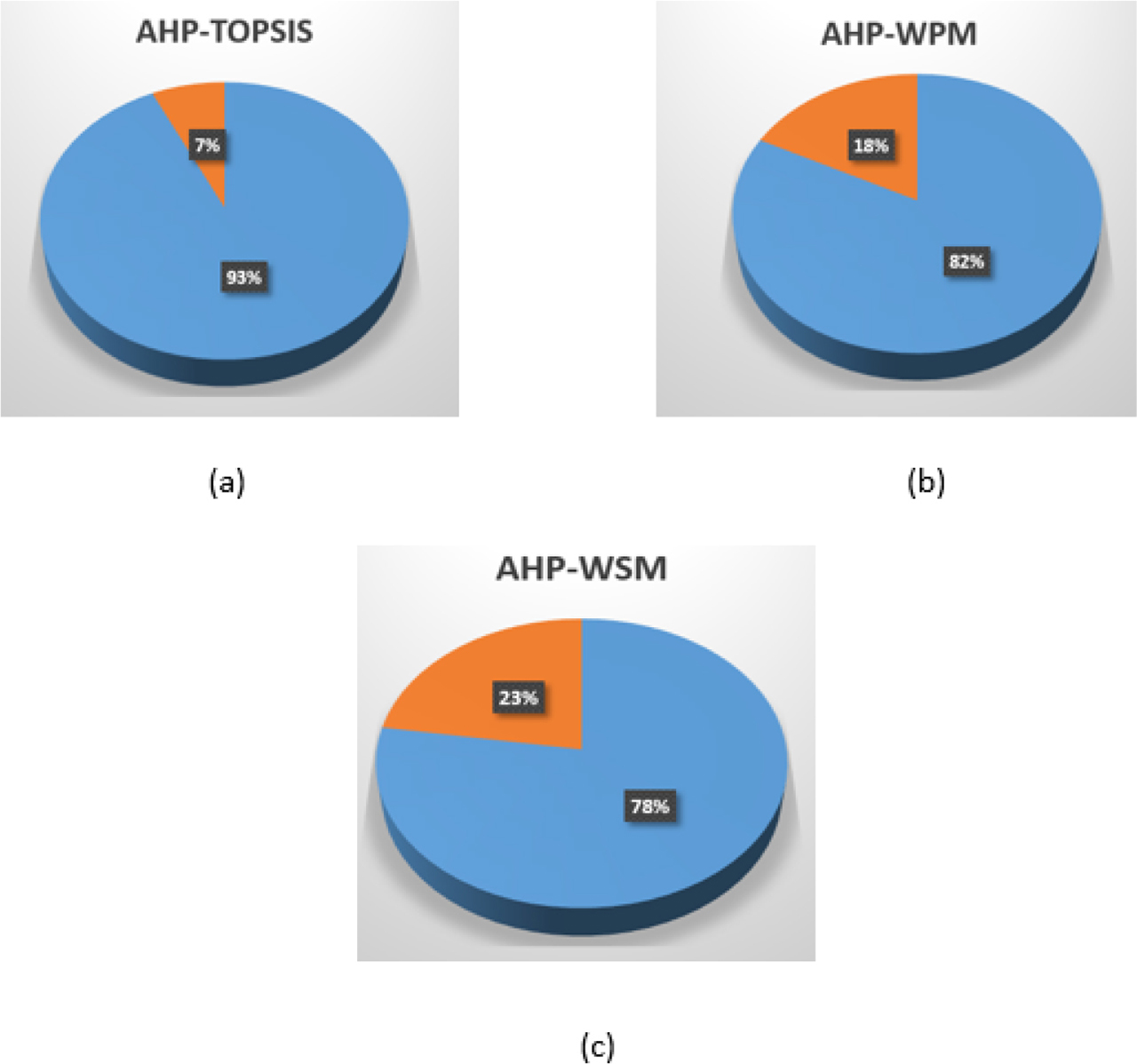
Fig. 3
Ratio of coincidence of supplier rankings between the AHP-TOPSIS, AHP-WSM, and AHP-WPM models and the choice of supply chain manager
According to Figure 3, it is clearly shown that the three integrated models have led to satisfactory results. Indeed, the percentage of coincidence of supplier rankings between the AHP-TOPSIS, AHP-WPM, and AHP-WSM models and the choice of supply chain manager are equal to 93%, 82%, and 78%, respectively. In our case study, the results obtained highlight the greatest performance of the AHP-TOPSIS model in selecting the best supplier, the model results do not fit the choice of the company only in 7% of the cases tested in comparison with the others. It can be considered as an excellent outcome in the industrial framework. This model is expected to be adopted in the supply chain department to avoid subjective selection methodology.
4.3. Industrial application
In this step, further developments were carried out to allow model implementation into a smart MCDM application so that supplier evaluation and selection decisions will be made rapidly and efficiently using a digital process.
For the development of this application, visual basic .NET version 2015 was used as a programming language and Microsoft access version 2016 as a database.
Figure 4 presents a screenshot of the MCDM application developed. Which was exploited by the supply chain manager to optimise the supplier selection decisions in garment company.
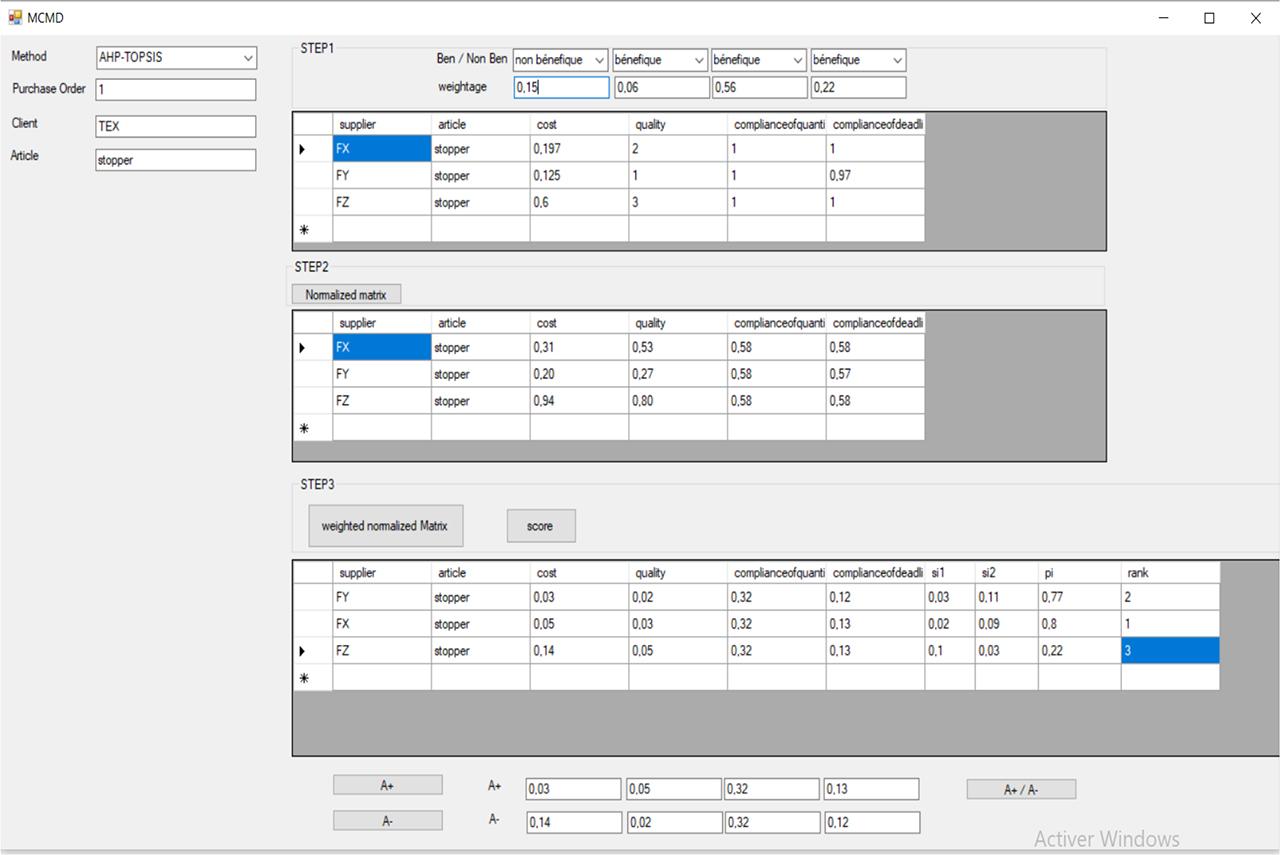
Fig. 4
MCDM application interface for supplier selection
This digital decision-aided application was performed in the clothing industry using the same database of section 4.1 and compared to the choice of company. The results obtained are displayed in Figure 5.

Fig. 5
Decision-aided application performance
According to Figure 5, the percentage of coincidence of supplier rankings between our application outcomes and the choice of supply chain manager was equal to 93%. This ratio is considered very satisfactory. In a further study, the database will be more and more extended to include all the real cases in the company and to enhance the decision-aided application performance.
5. Conclusions
In this work, three multi-criteria decision models were applied for the selection of suppliers in a denim-manufacturing company. These tools are essential to decide or evaluate several options in situations where no possibility is perfect. According to a wide literature search, numerous criteria in supplier selection problems were considered and a questionnaire design realised to conclude about the main criteria on the basis of purchase expert answers.
In the second step of our case study, we established three integrated models by combining the AHP approach with the TOPSIS, WSM, and WPM methods, and then we applied these models in the case of a clothing firm. As a result, it was proved that the AHP-TOPSIS model is more efficient than the AHP-WSM and the AHP-WPM methods for the selection of the best supplier. The results showed that the three models did not produce the same ranking; In fact, the coincidence percentage between the solutions obtained using the models developed and those corresponding to the company’s best choice is high. In the case of AHP-TOPSIS supplier selection compared to the others, in 93% of the purchase orders treated, the company’s best choice fitted perfectly with the model’s decision. It can be concluded that the AHP-TOPSIS model is feasible for predicting and selecting the best suppliers in the supply chain process of a clothing company. Besides, this approach is also expected to be applied in other industrial frameworks, taking into account the specific conditions and criteria of the purchase process.
Acknowledgment
This project was carried out under the MOBIDOC scheme, funded by the EU through the EMORI program, and managed by the ANPR.
We would like to express our gratitude to the company’s team for their help, collaboration, and encouragement throughout this research study.
Notes
[1] Conflicts of interest Conflicts of Interest
The authors declare no conflict of interest.