
Introduction
Forests are invaluable ecosystems that support biodiversity, regulate climate, and provide essential services for human well-being. Protecting and sustainably managing forests is crucial for the health of our planet and future generations (Mishra & Agarwal, 2024). Tropical forests are widely recognized as one of the most biodiverse ecosystems on the planet, renowned for their unparalleled richness in species diversity (Pratap, 2013). But they are under many threats, including deforestation, habitat fragmentation, climate change, and unsustainable logging practices. These threats have significant implications for biodiversity, ecosystem services, and the livelihoods of local communities (Kumar et al., 2022; Patra et al., 2022). Benin Republic, despite its relatively small geographical area, faces similar pressures. The altered environmental conditions due to global change can have profound effects on the country’s forests and biodiversity. Benin Republic’s forests are crucial for maintaining ecological balance and supporting various species. Its natural forests are renowned for their exceptional biodiversity, encompassing a wide array of plant and animal species within their rich ecosystems (Houessou et al., 2019). These forests serve as vital habitats for numerous endemic and endangered species, contributing significantly to the overall biodiversity of the region (Adjovi et al., 2017; Assogba et al., 2022). Furthermore, these forests represent a valuable resource for timber and non-timber forest products, including various types of wood used for construction, furniture, and crafts (Assogbadjo et al., 2017; World Bank, 2020). Their floral diversity is shaped by various environmental factors such as sunlight intensity, temperature, humidity, geology, climate, and topography. These factors collectively contribute to the heterogeneous distribution of plant species across different ecosystems within the country. Studies by Adjovi et al. (2017) and Houessou et al. (2019) have highlighted the significant influence of local-scale factors on terrestrial plant diversity in Benin. Factors such as elevation, slope, soil conditions, and human activities play crucial roles in shaping the composition and structure of plant communities across different regions of the country. For instance, areas with higher elevations or steep slopes may harbor distinct microclimates and soil types, leading to the establishment of specialized plant species adapted to these conditions. Moreover, human activities such as deforestation, land conversion, and agricultural practices have profound impacts on plant diversity patterns in Benin’s landscapes. Assogbadjo et al. (2017) have documented the effects of land-use changes on plant communities, emphasizing the need for sustainable land management practices to conserve biodiversity. According to Kimengsi et al. (2022), constraints to sustainable forest management in Sub-Saharan Africa include limited knowledge of the state of forests, their conditions and functions in terms of structure, composition, regeneration and quantitative assessment of the tangible and intangible benefits that can be derived from them. In the realm of ecosystem conservation and management, understanding the richness and diversity of natural ecosystems is paramount. However, it is equally crucial to delve deeper into the specific components that comprise these ecosystems, particularly their wood resources. While it may be widely acknowledged that ecosystems are rich and diverse, comprehensive information regarding the wood resources they harbor is vital for formulating effective conservation and management plans. Wood resources play a pivotal role in ecosystem functioning, providing habitats for numerous species, contributing to carbon storage, and serving as valuable economic assets for local communities (Ghazoul & Sheil, 2010; Pan et al., 2011). Therefore, a nuanced understanding of wood resources within ecosystems is essential for promoting sustainable practices that balance biodiversity conservation with socio-economic development (Siry et al., 2005).
The primary objective of this project is to conduct a comprehensive assessment of wood resources within three key natural ecosystems of southern Benin (Niaouli, Bonou and Pobè forests). Each forest possesses its own distinct characteristics, ranging from vegetation composition and structure to ecological functions and conservation significance. A study based on a phytosociological and phytogeographical approach to plant formations in Benin (Adomou, 2005) has identified 10 major floristically homogeneous regions known as phytodistricts. Microhabitats and ecological disturbances play important roles in shaping plant diversity dynamics in Benin. Nagel et al. (2004) have highlighted the significance of microhabitats, such as forest edges, riparian zones, and disturbed areas, in supporting unique plant communities. Ecological disturbances, such as fire events and invasive species encroachment, can also alter plant diversity patterns over time, as noted by Nagel et al. (2004) and Ahononga et al. (2020). Comparing the ecological attributes and biodiversity patterns of the three forests offers a unique opportunity to explore the diverse array of ecosystems within southern Benin. Understanding the diversity and typology of wood species within these forests is essential for sustainable management practices that balance conservation efforts with economic development (Lescuyer et al., 2016; Assogbadjo et al., 2017).
Material and Methods
Study area
This research was conducted across three dense semi-deciduous forests in Benin, highlighting unique ecosystems, extensive biodiversity, and crucial conservation values (Figure 1). The dense semi-deciduous Niaouli Forest, located in the arrondissement of Atogon, commune of Allada, 75 km from Cotonou, precisely at 6°44'N and 2°08'E, covers around 220 hectares. It lies in the plateau phytodistrict, characterized by concretion-free ferralitic soils, an annual rainfall of between 900 and 1100 mm, and a bimodal rainfall regime (2 rainy seasons). It comprises two distinct ecosystems – the lowland forest, located in the northern depression of the station’s northern boundary and fed by the Ava stream, a branch of the Couffo river, home to hygrophilous dryland species such as Pentaclethra macrophylla Benth., Cola gigantea A.Chev., Pycnanthus angolensis (Welw.) Warb., as well as hydromorphic soil species such as Cleistopholis patens (Benth.) Engl. & Diels and Macaranga heudelotii Baill., and the plateau forest, located on the crest of the plateau with a 35-metre difference in height from the lowland forest, characterized by a dense semi-deciduous formation including species such as Triplochiton scleroxylon K.Schum., Sterculia tragacantha Lindl., Ceiba pentandra (L.) Gaertn., Antiaris toxicaria (J.F.Gmel.) Lesch. and Celtis mildbraedii Engl.
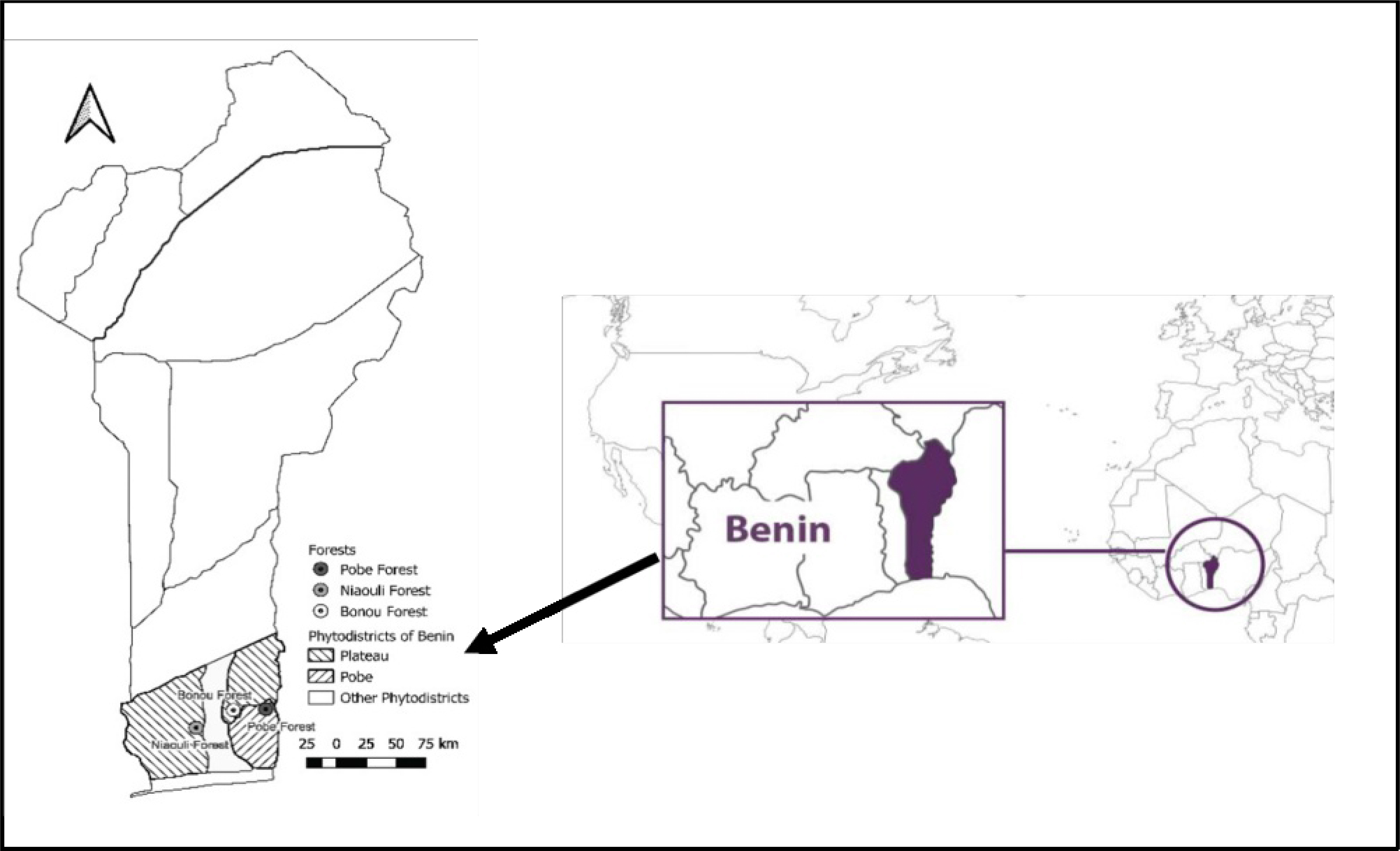
Figure 1.
Location of the forests in South Benin.
Found in the same phytogeographic zone as the Niaouli Forest, the Bonou classified forest is located in the eastern part of the Bonou commune, between latitudes 6°40' and 7°N and longitudes 2°25' and 2°40'E, in the Ouémé department, southeast of Benin. It covers an area of 197 hectares. Classified since February 2, 1946, the Bonou Forest was initially considered a botanical reserve of semi-deciduous rainforest. Today, only the gallery forest is impacted by human activity to a little extent, although some natural formations remain, with species such as Antiaris toxicaria, Ceiba pentandra, Cola millenii K.Schum., and Afzelia Africana Sm. ex Pers., preserved among the teak plantation plots. The gallery forest is characterized by species such as Cleistopholis patens, Crudia senegalensis Planch. ex Benth., Strombosia pustulata Oliv., Piptadeniastrum africanum (Hook.f.) Brenan, Dialium guineense Willd., Triplochiton scleroxylon, and Terminalia superba Engl. & Diels.
The Pobè Forest, located in the center of the town of Pobè in the Guinean-Congolese zone of the Pobè phytodistrict, is characterized by a rainfall regime of 1200–1300 mm, ferralitic soils without concretions, and a bimodal rainfall regime. Covering around 115 hectares, it extends between latitudes 6°57'20'' and 6°58'04'' to the north, and longitudes 2°39'46'' and 2°40'45'' to the east. This dense semi-deciduous rainforest, 700 to 1050 metres wide and 1500 metres long from east to west, is crossed in its southern third by the small Itché stream, which flows constantly throughout the year. The natural forest of Pobè has a complex structure, ranging from herbaceous strata to dominant arborescent strata, favoring the presence of numerous species. Among the main species are Triplochiton scleroxylon, Terminalia superba, Antiaris toxicaria, Albizzia spp., Ceiba pentandra, Ficus spp., Cleistopholis patens, Cola spp., Celtis spp., Milicia excelsa (Welw.) C.C. Berg and Holoptelea grandis (Hutch.) Mildbr.
Methods
This study focused exclusively on woody species; herbaceous species were not included in the analysis. A systematic sampling design was employed across the three forests – Bonou, Pobè, and Niaouli – by establishing 90 uniformly distributed plots of 50 × 50 metres (0.25 ha each). In each forest, 30 plots were laid out at 100-meter intervals along pre-defined inventory transects, ensuring consistent spatial coverage and representative data collection (Kangas & Maltamo, 2006). Within each plot, dendrometric data were collected for all woody individuals with a DBH (diameter at breast height, measured at 1.30 m above ground) ≥ 10 cm using a diameter tape. Tree heights were visually estimated using a Suunto clinometer. Species diversity was assessed using the Shannon (H') and Pielou’s Evenness (Eq) indices, based on the relative abundance of woody species (trees and shrubs with DBH ≥ 10 cm) recorded per plot.
Plant identification was conducted using the Benin National Herbarium reference catalog and cross-verified with the African Plant Database (APD, version 4.0). Species nomenclature followed the Angiosperm Phylogeny Group IV (APG IV) system. Dendrometric parameters (density, basal area, height, diameter) were calculated separately for each identified woody species, and then aggregated to obtain community-level metrics per forest.
Unique species richness was calculated by counting species exclusive to each forest, highlighting floristic originality as described by Vanpeene-Bruhier et al. (1998). In parallel, the common species pool, representing species shared across all three forests, was determined to understand the extent of biodiversity overlap. This approach allowed for the identification of both unique and shared biodiversity components, essential for targeted conservation strategies. Data were analyzed using density and basal area calculations, along with Shannon and Pielou’s indices to assess species diversity and distribution. Nonparametric statistical tests evaluated interforest dendrometric differences.
To evaluate the regeneration potential of each forest, all woody individuals with a diameter at breast height (DBH) below 10 cm were classified into three regeneration classes: seedlings (DBH < 10 mm), juveniles (10 mm ≤ DBH < 50 mm), and small poles (50 mm ≤ DBH < 100 mm). These classes reflect key stages in natural forest regeneration and are widely used in tropical forest ecology (Condit et al., 1998; Finegan, 1996). Within each 50 m × 50 m plot, individuals in these categories were counted regardless of species. The counts were converted to stems per hectare and averaged across plots within each forest to estimate regeneration density. This method enables the evaluation of structural continuity and recruitment processes within forest stands (Chazdon, 2003; Ashton et al., 2001).
Statistical analyses were performed using R software (version 4.3.0). Non-parametric Kruskal-Wallis tests were used to compare dendrometric parameters and regeneration classes across forests, due to non-normal data distributions. Pairwise comparisons were conducted using the Dunn test with Bonferroni correction.
Results
Dendrometric parameters
Table 1 presents the key dendrometric parameters across the three natural forests. Bonou Forest exhibited the highest stem density (348.73 stems ha−1), followed by Niaouli (283.47 stems ha−1) and Pobè (237.73 stems ha−1). The basal area was also the largest in Bonou (24.40 m2 ha−1), slightly greater than in Pobè (22.08 m2 ha−1) and significantly larger than in Niaouli (17.96 m2 ha−1). The average tree diameter was the largest in Pobè Forest (28.47 cm), while Bonou and Niaouli showed smaller but statistically similar mean diameters. Tree height followed a similar trend, with Pobè having the tallest trees (22.97 m), Bonou moderately tall trees (21.42 m), and Niaouli significantly shorter trees (18.63 m). These differences suggest variation in forest structure, successional stage, and potential disturbance levels.
Table 1.
Dendrometric parameters of the natural forests.
| Parameters | Bonou Forest | Pobè Forest | Niaouli Forest | Prob. | |||
|---|---|---|---|---|---|---|---|
| M | CV (%) | M | CV (%) | M | CV (%) | ||
| Density (N, stems ha−1) | 348.73a | 27.55 | 237.73b | 33.64 | 283.47b | 52.72 | 0.010 |
| Basal area (G, m2 ha−1) | 24.40a | 45.90 | 22.08a | 33.67 | 17.96b | 36.18 | 0.036 |
| Diameter (Dg, cm) | 24.93a | 29.93 | 28.47a | 8.44 | 25.81a | 21.90 | 0.168 |
| Height (Hl, m) | 21.42a | 20.43 | 22.97a | 17.59 | 18.63b | 13.53 | 0.000 |
Diameter structure
The diameter distribution of tree stems (Figure 2) followed an inverted J-shaped curve in all forests, characterized by a high proportion of individuals in smaller diameter classes (10–30 cm), especially in Bonou Forest. This pattern is typical of natural, uneven-aged forests with ongoing recruitment. The scarcity of large-diameter trees (> 130 cm) in all forests may indicate previous disturbances or low representation of long-lived, emergent species.
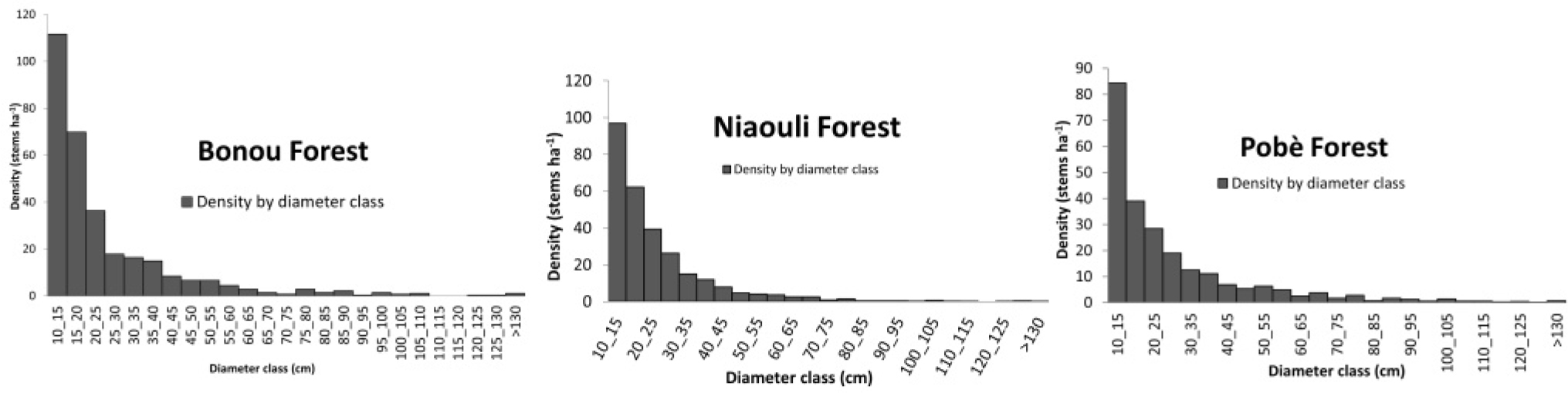
Figure 2.
Diameter structure of the natural forests.
Floristic diversity of forests
The characterization of the forests studied on the basis of diversity indices is recorded in Table 2. Floristic analysis showed that Pobè Forest had the highest species richness with 56 woody species, followed by Niaouli (40) and Bonou (38). However, Bonou recorded the highest Shannon Diversity Index (H' = 4.6) and Pielou’s Evenness (Eq = 0.9), indicating a more balanced distribution of individuals across species. In contrast, Pobè, despite its higher richness, had a lower evenness index (Eq = 0.42), suggesting dominance by a few species. Niaouli had moderate values for both indices. These metrics highlight differing community structures, with Bonou being the most floristically balanced and Pobè the most species-rich.
Regeneration density of the forests
Table 3 summarizes regeneration densities. Bonou and Pobè forests demonstrated high regeneration densities across all classes, especially for seedlings (1233 and 1393 stems ha−1, respectively), reflecting favorable regeneration dynamics. Niaouli showed considerably lower densities (e.g. 85 seedlings ha−1), pointing to constraints in seedling establishment or higher environmental stress. Juvenile densities were comparable across forests, while small poles were particularly abundant in Pobè (346 stems ha−1), indicating advanced regeneration.
Table 3.
Average regeneration densities of Bonou, Pobè and Niaouli forests.
| Regeneration classes | Regeneration densities | Prob. | ||
|---|---|---|---|---|
| Forest of Bonou | Forest of Pobè | Forest of Niaouli | ||
| Seedlings (đbh < 10 mm) | 1233a | 1393a | 85b | 0.000 |
| Juveniles (10 mm < dbh < 50 mm) | 655a | 351a | 503a | 0.132 |
| Small poles (50 mm < dbh < 100 mm) | 118a | 346b | 190a | 0.000 |
| Overall average density (stems ha−1) | 2006a | 2090a | 779b | 0.000 |
The floristic originality of each forest
Floristic originality analysis (Figure 3) revealed that 48% of the woody species in Pobè were unique to that forest, compared to 22% in Bonou. This underlines the conservation value of Pobè as a reservoir of unique biodiversity. Sørensen similarity indices ranged between 0.40 and 0.45, indicating a moderate species overlap among the three forests and emphasizing their ecological complementarity.
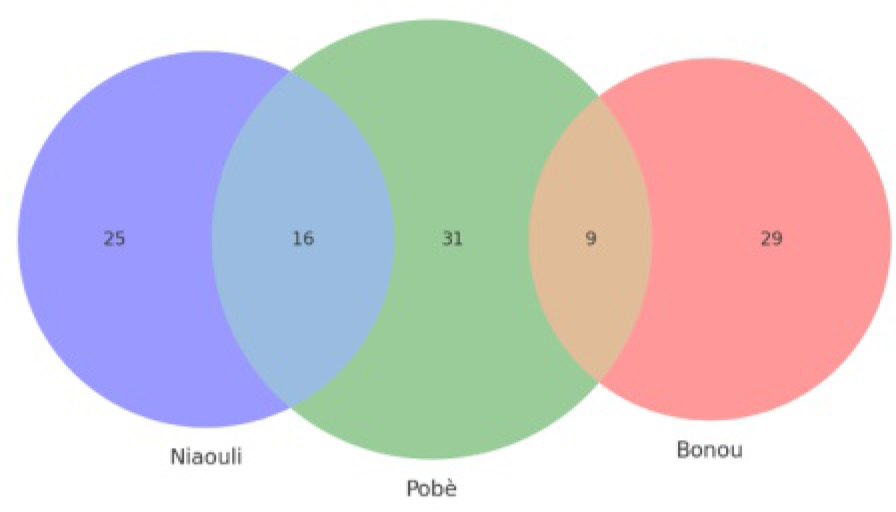
Figure 3.
Venn diagram of woody species richness across forests.
Sørensen similarity index
The Sørensen similarity index provides valuable insights into the species composition relationships among the studied forests. Table 4 presents a Sørensen similarity matrix, which quantifies the similarity in species composition between pairs of forests. The values range from 0 to 1, with 0 indicating no similarity and 1 indicating complete similarity.
Table 4.
Value of Sørensen’s similarity index for the forests studied.
| Forest of Niaouli | Forest of Pobè | Forest of Bonou | |
|---|---|---|---|
| Forest of Bonou | 0.41 | 0.45 | 1 |
| Forest of Pobè | 0.40 | 1 | - |
| Forest of Niaouli | 1 | - | - |
Table 4 shows that Sørensen index is relatively homogeneous between the three forests. The Forest of Bonou and Forest of Pobè exhibit a moderate similarity in species composition, as indicated by a Sørensen similarity index of 0.45. This value suggests that approximately 45% of the species are shared between these two forests, highlighting a significant overlap in their biodiversity while also reflecting distinct ecological characteristics unique to each forest. Similarly, the Forest of Bonou and the Forest of Niaouli demonstrate a moderate similarity in species composition, with a Sørensen similarity index of 0.41. Approximately 41% of the species in Bonou Forest are shared with Niaouli Forest. These results reflect also the fact that there is a 40% chance of finding the same species in Pobè and Niaouli Forest.
Discussion
Dendrometric parameters
The dendrometric parameters observed in Bonou, Pobè, and Niaouli forests provide important insights into forest structure and health. Forest density, basal area, tree diameter, and height are all indicators of forest stand dynamics, successional stages, and habitat quality.
Tree density is a fundamental parameter often used to infer forest stand density and species competition. In this study, Bonou Forest exhibited the highest tree density (348.73 trees ha−1), which may indicate a younger or more regenerating forest, as high densities are often associated with dense regeneration (Chazdon, 2008; Laurance et al., 2014). Pobè Forest, with lower density (237.73 trees ha−1), could reflect either lower regeneration or more mature stands where tree competition has reduced stem numbers over time, a pattern observed in mature tropical forests with higher basal areas and larger tree diameters (Ghazoul & Sheil, 2010).
Basal area is crucial for understanding canopy cover and biomass. Bonou Forest, with the highest basal area (24.40 m2 ha−1), suggests a well-developed canopy that may support more biodiversity and carbon storage capacity (Pan et al., 2011). This is in line with studies that correlate higher basal areas with diverse, stable ecosystems capable of supporting complex ecological interactions (Siry et al., 2005).
The larger diameters in Pobè suggest older or more mature trees, consistent with findings that mature tropical forests tend to have larger diameter trees, which contribute to habitat complexity and carbon storage (Laurance et al., 2014). This aligns with studies suggesting that older forests often exhibit a range of diameter classes, indicative of diverse successional stages within the forest (Chazdon, 2008).
Tree height is often used to infer forest age and structure. Pobè Forest, with the tallest trees (22.97 m), may have a more stable, mature forest structure compared to Bonou and Niaouli forests, which had shorter average heights of 21.42 m and 18.63 m, respectively. Taller trees are often indicative of less disturbed environments, allowing trees to grow without frequent cutting or canopy gaps (Chazdon, 2008; Assogbadjo et al., 2017). Niaouli’s lower height could be attributed to higher disturbance rates or a predominance of younger or smaller tree species, which may limit overall canopy height (Akoègninou et al., 2006).
These differences in dendrometric parameters highlight variations in forest stand structure and successional stages, which have important implications for conservation. Denser forests with higher basal areas, such as Bonou, are likely to provide higher biodiversity benefits and ecosystem services, while forests like Niaouli with lower basal areas and shorter heights may require focused management to prevent degradation and enhance their ecological functions (Nagel et al., 2004; Siry et al., 2005). Conservation strategies that support natural regeneration, protect larger, mature trees, and limit disturbances could enhance ecosystem resilience across these forest types (Laurance et al., 2014; Pan et al., 2011).
Diameter structure analysis
Analyzing diameter structure is a well-established method to assess forest health, stand dynamics, and disturbance impacts (Hitimana et al., 2004). By examining each diameter class, we gain insights into regeneration and recruitment rates, crucial indicators of forest vitality (Legilisho-Kiyiapi, 1998; Botkin, 1993), and to compare recruitment between different forests (Kigomo et al., 1990). In this study, the diameter structures of Bonou, Pobè, and Niaouli forests display an inverted J shape, commonly associated with non-degraded, multi-species stands (Kigomo et al., 1990). This distribution, which reflects a high density of smaller-diameter trees, suggests robust regeneration processes and resilience across these forests.
The dominance of trees in the 10 cm to 30 cm diameter range, particularly in Bonou Forest (110 trees ha−1 in the 10–15 cm class), indicates successful recruitment and active regeneration. This distribution is critical for forest stability, as a steady supply of young individuals is essential for sustaining canopy dynamics and biodiversity over time (Eyog Matig et al., 2002). The abundance of smalldiameter trees also aligns with observations of healthy, regenerating forests that support biodiversity by maintaining a dynamic age structure (Condit et al., 1998; Deal, 2022). According to Condit et al. (1998), this type of a stable population structure suggests effective regeneration, which bolsters ecosystem resilience and the forest’s ability to recover from natural or anthropogenic disturbances (Feeley et al., 2007). Though trees with diameters exceeding 100 cm are present, those above 130 cm are scarce, which may indicate limitations in the growth and survival of mature trees. These large trees are vital for the ecosystem, providing structural complexity, carbon storage, and unique habitats for various species (Laurance et al., 2014). The limited number of large-diameter trees could stem from multiple factors, including selective logging, competition, and environmental stressors (Hitimana et al., 2004). This scarcity calls for closer examination of growth dynamics, mortality rates, and potential environmental pressures, such as soil quality and climatic changes, which might restrict the full development of certain tree species (Feeley et al., 2007). The observed diameter distribution highlights the forests’ overall health and stability, yet the scarcity of very large trees signals potential gaps in the forest’s age structure that could impact ecosystem functionality.
Further investigation into natural mortality rates, and environmental stressors is warranted to better understand the dynamics shaping the diameter structure. Adaptive management and continuous monitoring of these diameter classes will be essential for ensuring long-term ecosystem integrity stability and biodiversity conservation. Proactive conservation strategies that protect mature trees, support natural regeneration, and control selective logging could help balance recruitment with canopy complexity, ultimately fostering ecosystem resilience and sustainable use of forest resources (Siry et al., 2005).
Floristic diversity analysis
The floristic diversity of Bonou, Pobè, and Niaouli forests reveals unique ecological structures and provides insights into their conservation needs. The diversity indices calculated include species richness, the Shannon Diversity Index, and Pielou’s Evenness, which collectively describe the composition and balance of species in each forest.
Species richness is an essential measure of biodiversity that indicates the variety of species within an ecosystem (Magurran, 2003). Pobè Forest exhibits the highest species richness (56 species) compared to Bonou (38 species) and Niaouli (40 species), suggesting that it might contain more ecological niches and microhabitats. However, higher species richness alone does not necessarily equate to a balanced ecosystem, as evenness plays a critical role in ensuring ecosystem structure (Gaston, 2000). The Shannon Index (H') provides insight into both richness and evenness, reflecting overall diversity (Shannon & Weaver, 1949). Bonou Forest has the highest Shannon Index (H' = 4.6), suggesting a well-distributed population across species, followed closely by Pobè (H' = 4.56) and Niaouli (H' = 4.27). Higher Shannon values are associated with stable ecosystems, where species interact in balanced ecological processes (Magurran, 2013). Pielou’s Evenness (Eq) indicates how uniformly individuals are spread among species (Pielou, 1966). Bonou Forest shows the highest evenness (Eq = 0.9), reflecting a more equal distribution of individuals per species, implying reduced competition among species for resources. In contrast, Pobè Forest has a lower evenness (Eq = 0.42), highlighting a dominance of certain species that may lead to ecological imbalance if unchecked. Niaouli Forest presents a balanced structure with moderate evenness (Eq = 0.8), suggesting a relatively stable forest ecosystem (Lindenmayer & Franklin, 2002).
With high evenness and Shannon diversity, Bonou Forest exemplifies resilience and stability, attributes critical for ecosystem sustainability. Conservation strategies for Bonou should focus on maintaining current practices to preserve this ecological equilibrium (Chazdon, 2008). Although Pobè has the highest species richness, its lower evenness indicates potential dominance issues that could threaten biodiversity. Management interventions should focus on promoting evenness, possibly by regulating dominant species and fostering conditions that support underrepresented species (Laurance et al., 2014). Representing moderate values in all indices, Niaouli Forest demonstrates balanced biodiversity, making it an ideal candidate for sustained conservation efforts aimed at preserving its stable structure (Laurance et al., 2014).
Regeneration density of the forests
Seedling density is a critical indicator of successful regeneration and plays a significant role in forest succession. Bonou and Pobè forests display notably high seedling densities (1233 and 1393 stems per hectare, respectively) compared to Niaouli, where seedling density is markedly lower (85 stems per hectare). This difference could reflect environmental conditions favorable to seed germination and survival in Bonou and Pobè. The availability of adequate canopy cover, for instance, has been shown to influence seedling development by regulating light and temperature conditions (Whitmore, 1996). Additionally, competition among species can impact seedling density, as seedlings rely heavily on specific microsite conditions to thrive (Connell & Green, 2000). Juvenile density, which reflects young trees advancing towards maturity, provides insights into forest sustainability. Here, the juvenile density does not significantly differ across the forests, indicating similar intermediate growth conditions. Juvenile trees are critical for the future canopy, and stable densities across all three forests suggest a consistent capacity for regeneration. Research shows that consistent juvenile density across multiple forest sites may indicate relatively stable conditions, although minor variations may arise due to species-specific ecological requirements (Ashton et al., 2001). Small poles represent advanced regeneration stages, marking a critical point in forest succession. Pobè Forest has the highest density of small poles (346 stems per hectare), suggesting active regeneration and a capacity for canopy replacement over time. Bonou and Niaouli show lower small pole densities, which might be indicative of ecological pressures, such as competition and human impact (Chazdon, 2003). The presence of more advanced regeneration stages, as seen in Pobè, is often associated with forests undergoing successional recovery processes following disturbances (Finegan, 1996).
The overall regeneration density across all classes is highest in Bonou and Pobè, reflecting robust regeneration dynamics. This trend suggests favorable ecological conditions, such as soil fertility, microclimate, and possibly lower anthropogenic pressures, supporting regeneration (Connell & Green, 2000; Laurance et al., 2001). In contrast, Niaouli Forest’s lower density, particularly in the seedling class, may indicate challenges in regeneration conditions. This reduced regeneration can reflect factors such as increased competition from herbaceous species, nutrient limitations, or environmental stress (Lugo, 1992).
Each forest’s regeneration profile has implications for conservation strategies. Bonou and Pobè’s robust regeneration densities indicate healthy, resilient ecosystems, suggesting that management should focus on maintaining these favorable conditions. In contrast, the lower regeneration density in Niaouli calls for targeted conservation measures. Ensuring that young trees progress through all regeneration classes is essential to maintaining forest structure, resilience, and biodiversity (Lamb, 2014).
Floristic originality and Sørensen similarity index analysis
The Sørensen similarity index provides an effective way to assess the species composition overlap between forest ecosystems. For the forests of Bonou, Pobè, and Niaouli, this index reveals moderate similarity levels, suggesting both shared and unique ecological characteristics among them. The Sørensen similarity index between Bonou and Pobè forests is 0.45, indicating that they share approximately 45% of their species. This level of overlap suggests that while they host several common species, each forest also maintains a unique set of flora. This moderate similarity may be due to similar environmental conditions or shared forest management practices, which could encourage species common to both ecosystems.
The index for Bonou and Niaouli stands at 0.41, showing that about 41% of the species in Bonou are shared with Niaouli. This suggests an intermediate level of similarity, meaning Bonou and Niaouli, like Bonou and Pobè, share a considerable proportion of species while maintaining distinct floral communities. The similarity index between Pobè and Niaouli forests is 0.40, indicating that these two forests share 40% of their species. This slightly lower similarity could be due to varying environmental factors, historical land use differences, or distinct soil compositions, which can influence species diversity and distribution (Magurran, 2003; Socolar et al., 2016).
The moderate levels of similarity across these forests highlight the presence of both common and unique species, underscoring the importance of diverse management strategies. Conservation efforts should recognize these similarities to streamline cross-forest management practices, especially for species that benefit from shared protection. However, each forest’s unique species composition also suggests a need for tailored strategies that protect its distinct flora.
Each forest’s distinct flora suggests that conservation strategies should be tailored to address the specific ecological needs of each area. Remarkably, the woody species richness in Pobè, Bonou and Niaouli forests surpasses that documented in the Lama dense forest, where a study recorded only 31 woody species (Bonou et al., 2009). This comparison underscores the exceptional biodiversity of these southern Benin forests, highlighting them as critical biodiversity hotspots in the region. Preserving these unique ecosystems could prevent biodiversity loss and maintain ecological resilience.
Biodiversity contributes to ecosystem stability and resilience (Tilman et al., 2006). The shared species across these forests could contribute to ecological stability across the region, while the unique species in each forest could enhance their adaptability to environmental stressors. This composition highlights how maintaining inter-forest biodiversity supports ecosystem services such as pollination and pest regulation, which are crucial for forest health and resilience. The Sørensen similarity analysis of Bonou, Pobè, and Niaouli forests illustrates the ecological interplay of shared and unique species across each forest. This reinforces the importance of an integrated yet adaptive approach in biodiversity management, focusing on both the shared species that stabilize the ecosystem and the unique species that contribute to each forest’s ecological value.
The unique characteristics of each forest underscore the need for customized conservation strategies. Continuous monitoring is recommended to adaptively manage these forests, ensuring their stability and biodiversity in the long term (Gaston, 2000; Magurran, 2003).
Conclusion
This study provides a comparative ecological assessment of three natural forests in southern Benin – Bonou, Pobè, and Niaouli – focusing on their woody species diversity, structural characteristics, and regeneration potential. The findings reveal distinct ecological profiles for each forest: Bonou stands out for its structural balance and floristic evenness, Pobè exhibits exceptional species richness and originality, while Niaouli demonstrates lower regeneration densities and structural development, pointing to potential conservation concerns.
These differences underline the importance of tailored conservation strategies. Pobè’s high proportion of unique species calls for enhanced protection to safeguard its floristic originality. Bonou’s resilience and structural equilibrium support the continuation of current management practices, whereas Niaouli may benefit from targeted interventions to boost regeneration and reduce ecological stress.
Beyond individual forest profiles, the moderate species similarity across sites reinforces the value of preserving all three forests to maintain regional biodiversity. Conservation efforts should be ecosystemspecific but also integrated within a broader landscape approach to ensure ecological connectivity and resilience.
Future research should incorporate longterm monitoring of regeneration trends, threats from anthropogenic disturbance, and environmental variables such as soil quality and canopy dynamics. These insights will strengthen adaptive forest management and contribute to the sustainable conservation of Benin’s natural forest ecosystems.
Notes
[3] Data availability
Data will be provided upon request.
Acknowledgements
We thank the field personnel from each forest and the staff of the Forest Sciences Laboratory at the University of Abomey-Calavi (Benin), including its director, for their support with methodology, data collection, and analysis. We also extend our gratitude to The Rufford Foundation for funding our project on natural forest and threatened trees species conservation in Benin.