
Introduction
Optical (300 to 2500 nm) electromagnetic-spectrum observations of the Earth’s surface from spacecraft are influenced by the absorption of atmospheric gases, by Rayleigh scattering from gas molecules, and by scattering and absorption processes involving the various small particles that constitute aerosols (Turner & Spencer, 1972). To correct for the atmospheric influence, it is necessary to know at least the amounts of atmospheric ozone and water vapour and the optical depth of aerosols (the visibility). A simple method for atmospheric correction assumes that for a dark target exhibiting some known very small reflectance, most of the recorded signal is related to the atmosphere (Chavez, 1988). Clear water absorbs solar radiation intensely and therefore can serve as a dark target. Finding sufficiently well characterizable dark targets for land observations, on the other hand, is problematic.
Kaufman et al. (1997) proposed taking dense vegetation as a dark target. Upon analysing Landsat-5 Thematic Mapper images and Airborne Visible/lnfrared Imaging Spectrometer (AVIRIS) measurements taken on clear days, they found that reflectance in the red spectral region (0.6 μm) can be predicted by a simple and strong correlation from nearinfrared (2.2 μm) reflectance. The estimated ratio ρ2.2/ρ0.6 = 2 was proposed for the Terra MODIS operational algorithm (Kaufman et al., 1997) and was later suggested for Landsat data (Liang et al., 1997), with implementation improvements added by Ouaidrari & Vermote (1999).
Subsequent studies by Remer et al. (2001) and Gatebe et al. (2001) found that in general the assumption ρ2.2/ρ0.6 = 2 holds reasonably well. However, they also reported dependence of ρ2.2/ρ0.6 on measurement and illumination geometry, on vegetation type, and on growth season. Remer et al. (2001) found that the forest ρ2.2/ρ0.6 value can double when tree growth reaches its summer maximum. Kaufman et al. (2002) carried out a series of model simulation experiments and explained in a comprehensive way the principal factors influencing ρ2.2/ρ0.6, as identified in empirical studies: canopy cover, soil brightness, leaf area index, and measurement geometry. They concluded that the assumption ρ2.2/ρ0.6 = 2 is robust enough to be used in operational algorithms for satellitedata atmospheric correction.
Levy et al. (2007) implicitly added into the MODIS algorithm modifications of the ρ2.2/ρ0.6 = 2 assumption based on the scattering angle and canopy vegetation index. The same modifications were adopted for the Landsat-8/9 OLI algorithm LaSRC by Vermote et al. (2016). Remer et al. (2020) conclude in their review, based on collected datasets, that although the assumption ρ2.2/ρ0.6 = 2 represents a global average sufficiently well, there is substantial scatter around the assumed constant relationship. This scatter may be more pronounced in regions where vegetation exhibits strong seasonal phenology. In many places, the (automatically) selected dark dense vegetation is most likely forest. Boreal and hemiboreal forests cover large territories and exhibit significant phenology in their reflectances (Suviste et al., 2007; Nilson et al., 2008, 2012; Rautiainen et al., 2018).
The atmospheric correction algorithm for Sentinel-2 MSI data for its part again assumes ρ2.2/ρ0.6 = 2.
Landsat and Sentinel data are employed in national forest inventories for change detection and the estimation of forest structure variables. Since atmospheric correction results depend on predicted reflectance for the dark reference, deviations from the assumed constant ρ2.2/ρ0.6 value introduce uncertainties into forest spectral reflectance predictions. In response to this difficulty, our study focuses on the time series of Sentinel-2 MSI and Landsat-8/9 OLI images. We analyse the seasonal dependence of ρ2.2/ρ0.6, examining 92,230 forest stands in Estonia. We propose models for predicting the (nonconstant) ratio to be used in improved atmospheric correction algorithms.
Material and Methods
Study site
The target area, in south and south-east Estonia, lies between longitudes 24.5° E and 28.3° E and between latitudes 57.5° N and 59.6° N. The ground-surface topography is flat, with ground elevation rising only to 318 m above mean sea level (Arold, 2005). The landscape in this part of Estonia is characterised by hills with a local relative height exceeding tens of metres (Arold, 2005).
The forests in the test area are predominantly composed of evergreen coniferous Norway spruce (Picea abies (L.) H. Karst.) and Scots pine (Pinus sylvestris L.), and of broadleaf deciduous European aspen (Populus tremula L.), silver birch (Betula pendula Roth), downy birch (Betula pubescens Ehrh.), grey alder (Alnus incana (L.) Moench), and black alder (Alnus glutinosa (L.) Gaertn.) (Valgepea et al., 2023). Within the test area, diverse forest site types and plant species compositions are developed over various mineral soils (Leptosols, Cambisols, Luvisols, Albeluvisols, and Podzols), and additionally over Histosols (Kõlli et al., 2004). According to Valgepea et al. (2023), the Estonian National Forest Inventory estimates a forest cover of 53.5% for Estonia as a whole.
Forest stand height in the test area generally remains below 35 m (Tappo, 1982). Multi-layer forests are common, with Norway spruce and other shade-tolerant species growing below the upper canopy. The average stand size is 1.24 ha. Within the test area larger stands occur more frequently in state forests (Valgepea et al., 2023). After stand-replacing disturbances, tree regeneration develops dense canopy covers, usually during the first 10 years. In the case of managed forests within the test area, canopy cover may be modified with thinnings and maintenance fellings.
The test area exhibits a diverse range of landscapes, shaped by legal restrictions on clear-cut sizes – ranging from 2 to 7 ha depending on forest type (Forest Act, 2023) – and by a long-standing tradition of retention forest management (Gustafsson et al., 2012) that promotes rapid regeneration on forest land. Within Estonia as a whole, forest management is limited or entirely prohibited over a remarkable 30.3% of forest land (Raudsaar et al., 2023).
Phenology of dominant tree species
The four seasons characteristic of the study area drive its vegetation growth (Jaagus & Ahas, 2000). While observable signs of springtime greening occur in the forest understorey vegetation by mid-April, the active development of new leaves on trees starts by mid-May. The summertime season peak is attained by the end of June, after which growth continues until some point in the first 10 days of September, when the first occurrences of leaf yellowing become evident. By the end of October, the deciduous trees have shed most of their leaves. The timing of the phenophases is spatially variable in Estonia, over a range of about 10 days (Jaagus & Ahas, 2000). The phenophases of forest trees are influenced by tree genotype, and even more by year-to-year differences in air temperature (Possen et al., 2014), which in this region correlate with the North Atlantic oscillation (NAO) and Arctic oscillation (AO) indices (Aasa et al., 2004).
Scots pine in Estonia starts to develop current-year shoots around DOY 132 (EE, 2025). Scots pine has an intensive needle-shedding period in the middle of September, after which only needles from the last two years remain over the winter (Kollist, 1967).
Norway spruce exhibits two well-known phenological forms in Estonia (Sellin et al., 2024), with the average DOYs for budburst on branches cited as 142 and 153 for the early- and late-flushing trees, respectively, and budburst of top shoot few days later. Some phenological observations, however, indicate a somewhat earlier time, with DOY = 138 (EE, 2025). The average DOYs of top-shoot growth cessation are 185 and 190 in the early- and the late-flushing spruces, respectively, whereas the respective DOYs for growth cessation of branches are 175 and 185. In contrast with Scots pine, Norway spruce needles undergo no massive, visually detectable, autumnal yellowing.
European aspen likewise exhibits early- and late-flushing phenological forms in Estonia. Foliation starts around DOY 132, can in some years be delayed by a week or two, and lasts for about 14 days (Tamm, 2000). Autumn colouring appears in the first leaves in September, becoming fully evident by DOY 266 (EE, 2025). Dormancy is reached on DOY 289 (EE, 2025).
Two birch species, silver birch and downy birch, are included in our forest inventory data without being distinguished. Downy birch dominates on poor soils, whereas silver birch occupies most of the fertile soils. On average, birch leaf formation starts on DOY 126 (Jaagus & Ahas, 2000), or according to the phenology calendar (EE, 2025) a few days later, on DOY 130. Our own observations indicate that leaf unfolding is delayed by about a week on wet and poor soils, since these warm more slowly, hindering the start of active growth. Autumn colouring starts in the first leaves by the end of August, becoming fully evident by DOY 262. Dormancy is reached on DOY 295 (EE, 2025).
Grey alder is described in the phenology calendar (EE, 2025) as follows: bud swelling starts on DOY 109, autumn leaf colouring is fully observable on DOY 271, and dormancy is reached on DOY 262. Our own observations indicate that autumn colouring of grey alder foliage yields brownish tones, in contrast with the yellow of silver birch and the yellow-red mixture of European aspen.
Forest register and inventory data
The Estonian Environment Agency (Keskkonnaagentuur) maintains the Estonian forest register (Eesti metsaregister). The database contains forest management inventory data in tabular form, accompanied by 1:10,000 stand border maps. We used state forest records taken from the database in the version of 08 February 2023 to select stands that are sufficiently large in relation to 30 m pixels in satellite images. Our database query conditions were as follows: stand age greater than 15 years; stand area between 1 and 10 ha; and relative stocking density (this correlates strongly with canopy cover) greater than 80%, including both the upper and second tree layer.
We made the selection from the list of stands dominated by Norway spruce, Scots pine, European aspen, birch species, and grey alder. Black alder stands were not included, because preliminary experiments with the satellite-image atmospheric correction algorithm revealed black alder stands to be not selected as dense dark vegetation.
Tree species groups
For the analysis of seasonal changes in ρ2.2/ρ0.6, the selected forest stands were assigned tree species group labels, the various groups being defined by soil fertility and dominant tree species (Table 1). The final selection of stands was made only after queries from raster layers in the satellite images, to ensure that only those stands were included that had more than 70% of their area covered by pixels with centroids inside the stand polygons. This exclusion rule eliminated stands of irregular shape and minimised the influence of mixed pixels located at stand borders. Table 2 gives sample sizes and mean values of forest inventory variables. Norway spruce contributes notably to species composition in the deciduous broadleaved group (9%) and in the pine stands growing on fertile soils (7%), because Norway spruce is shade-tolerant, frequently growing as a second layer below the light-demanding deciduous broadleaved species, and also frequently growing on fertile soils below stands of Scots pine. The mean normalised difference vegetation index (NDVI) in our selected forest areas is 0.79, with standard deviation of 0.09 (Table A3.1), when calculated for the active growth season (140 < day < 260).
Table 1.
Construction rules for tree-species groups. The fertility classes correspond to Orlov’s bonity categories, where 0 indicates the greatest and 6 the lowest fertility. The bonity class 3 is excluded from soil fertility-dependent subsets. Forest inventory data do not distinguish between silver birch and downy birch. However, it is known that downy birch dominates on poor soils.
| Group | Species | Share(%) | Fertility classes |
|---|---|---|---|
| All stands | All | All | all |
| Evergreen needleleaved | Norway spruce, Scots pine | >85 | all |
| Deciduous broadleaved | Norway spruce excluded, Scots pine excluded | ≥85 | all |
| Pine | Scots pine | ≥80 | all |
| Pine (fertile soil] | Scots pine | ≥ 80 | 0,1,2 |
| Pine (poor soil) | Scots pine | ≥80 | 4,5,6 |
| Birch spp. | Silver birch, downy birch | ≥80 | all |
| Birch (fertile soil) | Silver birch | ≥80 | 0,1,2 |
| Birch (poor soil) | (Silver birch), downy birch | ≥80 | 4,5,6 |
| Spruce | Norway spruce | ≥80 | all |
| Aspen | European aspen | ≥75 | all |
| Alder | Grey alder | ≥75 | all |
Table 2.
Detailed descriptions of the tree species groups introduced in Table 1. KU signifies Norway spruce, MA Scots pine, HB European aspen, KS both silver birch and downy birch (these two species are not distinguished in the forest inventory of the Estonian Environment Agency), LV grey alder, and KX species compositions not matching any of the other codes. Stands in the evergreen needleleaf group Everg. N. consist predominantly of Norway spruce and Scots pine, while stands in the group Dec. Br. are dominated by deciduous broadleaved species. In the Bon (bonity) column, code A signifies all fertility classes, P poor soils, and F fertile soils. For each tree species group, an entry in the N column gives the number of stands in that group, S its aggregate area, A the mean value of its various stand ages, H100 the mean value of the 100-year heights predicted for its various stands (this is a measure of site productivity), T its relative density, and G its basal area.
| Group | Stands | Stand structure | Tree species composition (%) | ||||||||||
|---|---|---|---|---|---|---|---|---|---|---|---|---|---|
| Species | Bon | N | S (ha) | A | H100 (m) | T (%) | G (m2ha−1) | HB | KS | KU | LV | MA | KX |
| All | A | 92,230 | 231,687 | 77 | 26.6 | 94 | 28.4 | 6 | 29 | 26 | 3 | 33 | 3 |
| Everg. N. | A | 34,073 | 83,321 | 92 | 25.4 | 92 | 30.4 | 0 | 4 | 28 | 0 | 68 | 0 |
| Dec. Br. | A | 22,659 | 60,990 | 61 | 27.1 | 95 | 25.4 | 13 | 60 | 9 | 8 | 1 | 9 |
| MA | A | 1,5898 | 39,765 | 94 | 23.4 | 90 | 29.7 | 0 | 3 | 5 | 0 | 92 | 0 |
| MA | F | 8,675 | 20,553 | 85 | 27.2 | 91 | 31.1 | 0 | 3 | 7 | 0 | 90 | 0 |
| MA | P | 3,388 | 9,575 | 107 | 15.8 | 89 | 26.6 | 0 | 3 | 2 | 0 | 95 | 0 |
| KU | A | 5,092 | 11,627 | 51 | 31.3 | 93 | 27.7 | 1 | 6 | 90 | 1 | 1 | 1 |
| KS | A | 6,471 | 17,024 | 56 | 24.8 | 93 | 21.7 | 1 | 90 | 4 | 1 | 2 | 2 |
| KS | F | 4,013 | 10,130 | 50 | 27.3 | 93 | 22.6 | 1 | 90 | 5 | 1 | 1 | 2 |
| KS | P | 6,66 | 1,978 | 69 | 17.6 | 94 | 18.5 | 0 | 91 | 2 | 0 | 4 | 3 |
| HB | A | 441 | 951 | 65 | 31.7 | 95 | 31.7 | 83 | 8 | 6 | 1 | 0 | 2 |
| LV | A | 960 | 2,222 | 45 | 27.0 | 96 | 25.8 | 2 | 5 | 3 | 88 | 0 | 2 |
Satellite images
Landsat-8/9 OLI (Zanter, 2016; Sayler & Glynn, 2022) collection 002 images that were processed to level L1 (at-sensor radiance) and L2 (surface reflectance) were downloaded from the USGS GLOVIS data server. The Sentinel-2A/B MSI images of the latest available baseline processing with versions starting from 04.00 (https://sentiwiki.copernicus.eu/web/s2-processing) were downloaded from the Estonian Land Board (Maaja Ruumiamet) data hub. The Sentinel-2 MSI data corresponded to at-sensor reflectance at the processing level L1C.
An inspection revealed that the USGS Landsat-8/9 OLI surface reflectance dataset was influenced by a production error that expressed itself as a noise pattern deriving from the aerosol estimation quality map in the red spectral region and even in the nearinfrared. For this reason, USGS Landsat-8/9 OLI surface reflectance data (L2) were not used for forest stand-level analysis, but only for determining the ρ2.2/ρ0.6 mean value across each image. The image-wide dark dense-vegetation mean reflectance values were used only to estimate the initial parameters for our ρ2.2/ρ0.6 phenology model: USGS applies a phenology-dependent algorithm (Vermote et al., 2016) for atmospheric correction, in contrast with the Sen2Cor3 algorithm (Pignatale et al., 2025) employed in this study to process both Landsat-8/9 OLI L1 and Sentinel-2 MSI L1C data.
In the case of Landsat-8/9 OLI, this study used images from WRS-2 system paths and rows 185–019, 185–020, 186–019, 186–020, 187–018, 187–019, and 187–020. In the case of Sentinel-2 MSI, this study used image granules from the locations of MGRS-2 system tiles T35VME and T35VNE. Our decision in both cases was driven by the availability of stationary AERONET (https://aeronet.gsfc.nasa.gov) and SkySpec (Kuusk & Kuusk, 2018) radiometers that provided data for the preliminary assessment of atmospheric correction of satellite images, in work parallelling Doxani et al. (2023). However, when our study progressed beyond this preliminary assessment, we did not find it necessary to analyse the statistical correlations between the radiometer data and aerosol optical depth estimates from the satellite images.
In selecting a satellite image for the study, we required that the usable area, net of obscuration by clouds, be greater than about 25% of the image area. The sampling period started each year in March, with the consequent inclusion of images that may on a local scale have exhibited some remaining small traces of snow in shaded pixels at forest edges. Each year, the sampling period ended on the last day of October. In the process of image selection, the entire time series, starting in 2013 and ending in 2024, was checked visually. The number of days when the overpass of at least one satellite yielded usable image data was 268. This total, however, includes days when both satellites made overpasses of the study area: in the entire sequence of selected images, there were 122 Landsat-8/9 overpasses and 146 Sentinel-2 overpasses.
All satellite images were used in their original map projection. Forest stand boundaries were reprojected for each individual image to avoid errors from the resampling of raster data. High-quality cloud and cloud-shadow masks were constructed for the Sentinel-2 MSI images with KappaMask (Domnich et al., 2021). Our assessment supplied additional confirmation that this algorithm has substantially greater precision than other algorithms. In the case of Landsat-8/9 OLI, the cloud masks bundled with the spectral data were later additionally used in the Sen2Cor3 runs, as the masks were superior to the native Sen2Cor3 algorithm in detecting faint clouds and faint cloud shadows.
The atmospheric correction program Sen2Cor3
The Sen2Cor3 (Pignatale et al., 2025) tool is a version of the official atmospheric correction program Sen2Cor distributed by the European Space Agency and maintained by its partners. Sen2Cor is deployed worldwide in data hubs and by Sentinel-2 MSI data users for predicting ground surface reflectance from top-of-atmosphere (TOA) reflectance measurements (ESA, 2021). Sen2Cor3 is developed within the Sen2Like project (Saunier et al., 2022) and includes an option to process also Landsat-8/9 TOA data and calculate surface reflectance.
We downloaded the latest Sen2Cor3 version 3.01.00, available in August 2024, according to the instructions given in GitHub (https://github.com/senbox-org/sen2like/blob/master/sen2cor3/README.md), installing it on a Linux workstation. This software, written in Python, is provided as open-source code, apart from the module for calculating topographic shadows.
Initial test runs indicated the possibility of improving the preprocessing phase, run by Sen2Cor3 as a preliminary to its atmospheric correction. In this preprocessing, Sen2Cor3, proceeding on the basis both of reflectance ρ2.2,ref in the near-infrared (2.2 μm) band and of other filters, selects pixels that are assumed to represent dense dark vegetation (DDV). First, we replaced the three-step adjustment of threshold imposed on a preliminary estimate of ρ2.2,ref by Sen2Cor3 in its DDV-pixel selection phase with a small-step incremental search for the threshold value. Our search used the same three configurable decision thresholds as are provided with the program configuration files described in the Sen2Cor3 manual. In place of the commonly used value ρ2.2,ref = 0.05, however, we set the first threshold to the lower value of 0.035.
Second, we added a binary morphologybased filter to remove small putative DDV-pixel groups that were found upon visual inspection of the DDV maps to consist mostly of noise. We constructed our filter by combining SciPy library procedures that do binary erosion, setting the parametric window structure size to 2 × 2 pixels, and a binary propagation operation. We found that our filter effectively removed salt-and-pepper noise from the DDV map without generating the geometric distortions typical in the case of moving window-based median filters.
This pair of enhancements yielded a large improvement in the consistent detection of DDV pixels, as the target optimum of 2% out of the total number of pixels of interest: the DDV set was now more efficiently targeted, without the occasional large incremental steps in the DDV-pixel set size generated by the original algorithm.
However, test runs under our two enhancements now revealed that DDV pixels were frequently selected from areas of cloud shadow not identified by the Sen2Cor algorithm. This problem was in turn addressed with a third modification, by importing data for clouds and cloud shadows from KappaMask, as applied on the one hand to the Sentinel images, on the other hand to the Landsat L1 pixel-quality metadata layer bundled with images in the Landsat product. Our selection of DDV pixels was allowed only for terrain lying outside the buffers of 600 m for Sentinel-2 MSI and 1500 m for Landsat-8/9OLI.
Our three enhancements jointly added about 10 seconds of processing time per image tile to the total of 15 to 25 minutes originally required.
As a filter throughout its processing, Sen3Cor uses surface-elevation maps (for the calculation of vertical visibility in the atmosphere) and water-body maps. In place of the coarse-scale datasets included within the Sen2Cor3 installation package, we used the ground-surface digital elevation model, at fine-scale (25 m) spatial resolution, with a 1:10,000 water body map (showing lakes and rivers) provided by the Estonian Land Board. To avoid the selection of mixed-landcover pixels as dark dense vegetation, the water body map was rasterised, and a buffer was added around water bodies.
The atmospheric correction procedure requires data for ozone and water vapour content. In the case of Sentinel-2 MSI, the ozone data is bundled with the image, and a water-vapour map is predicted with an internal algorithm of Sen2cor3. In the case of Landsat OLI, the Copernicus Atmosphere Monitoring System (CAMS) data (https://atmosphere.copernicus.eu/) could be used. Although this functionality was not yet fully included in the Sen2Cor3 version 3.01.00, the Telespazio team kindly provided us with code from the development version of the next Sen2Cor3 release. This Sen2Cor3 upgrade allowed us to read ozone and water vapour data from daily CAMS data, instead of setting some values manually for each individual image.
Finally, we added functionality for setting the target region of interest (ROI) for DDV-pixel selection, through a vector polygon file. We constructed this ROI by adding a 30 km positive buffer around the Estonian state border, thereby excluding from the images localities contaminated by haze outside our study area. Because hazy atmospheres exhibit trends in their optical properties, the imaging of such contaminated localities would bias otherwise usable pixels. Specifically, bias would be introduced by the fact that Sen2Cor uses mean aerosol optical depth per granule instead of the map (for reasons yet unknown to us: the algorithm duly constructs the map in its internal operations, while leaving it unused).
The processing of the entire image time series took on the order of 12 or 13 hours on a Linux workstation running the OpenSUSE 15.5 operating system, with 16 CPU cores, 128 GB of RAM, and a NVIDIA GeForce 630 graphics card fitted with its own 2 GB of RAM. System tools were used to run from 12 to 14 Sen2Cor3 instances in parallel, with each instance processing a single image granule.
The image processing and band ratio phenology analysis
With the enhanced Sen2Cor3 all images were first processed under standard settings, except that the initial threshold for ρ2.2,ref was specified as 0.035 in place of the standard value 0.05. The ρ2.2/ρ0.6 ratio was kept at the constant value 2, corresponding to the value 0.5 given in the program input-configuration file. This first run produced DDV-pixel maps.
The DDV maps were then used to sample pixels from the USGS version of the Landsat-8/9 OLI surface-reflectance data. This sampling step was appropriate because the LaSRC algorithm (Vermote et al., 2016) uses coarse-resolution reflectance data time series collected from a selection of MODIS and MISR images (with pixel size of about 5 km × 2.5 km at our study area) to determine band ratios for particular regions and seasons: consequently, the USGS Landsat-8/9 OLI level L2 dataset, for which LaSRC considers the seasonality of ground-surface spectral reflectance, should in theory outperform Sen2Cor in capturing the seasonal changes in plant canopy reflectance. The mean ρ2.2/ρ0.6 ratio was calculated for each Landsat-8/9 OLI granule, and to this data the following modified double logistic model (Eklundh & Jönsson, 2012) was fitted:
where ε is the model residual error (RSE); t is the day number in the year; a, b, c, and d are free parameters; kpk is the springtime inflection point; kk is the springtime growth rate; kps is the autumn inflection point; and ks is the autumn growth rate. The values of kpk, kk, kps, and ks were first found by expert guess, after which a, b, c, and d were estimated with the nls procedure in R (R Core Team, 2022; Baty et al., 2015), version 4.2.2. The obtained model estimates, with 100 degrees of freedom and the residual standard error 0.087, were as follows: a = 1.81, b = 6.51, c = 0.379, d = 0.785, kpk = 140, kk = 5, kps = 260, and ks = 25.Next, the model was fitted to the surfacereflectance data that had been obtained from the first run of Sen2Cor3 (described above), with its assumption of constant ρ2.2/ρ0.6 = 2. The empirical dataset for this fitting step consisted of DDV pixels aggregated (binned) for each image by unique ρ2.2 values, to decrease the data size. The group mean ρ0.6 was calculated for each bin, with the number of pixels in the bin used as a weight in model parameter estimation. The parameters kpk, kk, kps, and ks were fixed to the values found for the USGS Landsat L2 dataset. The free parameters a, b, c, and d were again estimated with the nls procedure in R. After this revision, the model estimates, with 168,484 degrees of freedom and the residual standard error 9.4, were as follows: a = 2.08, b = 6.85, c = 0.40, d = 1.1, kpk = 140, kk = 5, kps, = 260, and ks = 25. The notable large residual error arose because here the DDV pixel groups were the observations.
With the model (1) predictions checked against data scatter plots, the model was found suitable. The model was then used with the adopted parameter estimates to make predictions of ρ2.2/ρ0.6 for all the images in our dataset. Atmospheric correction of top-of-atmosphere radiance data was done again with Sen2Cor3, but now dropping the assumption of the constant channel ratio and using instead the DOY-dependent ρ2.2/ρ0.6.
Finally, the atmospherically corrected images served to sample forest spectral reflectance, using forest stands as delineated in the forest inventory map. The empirical dataset for studying ρ2.2/ρ0.6 seasonal variability was constructed by selecting the stands that had (as previously described) more than 70% of their area covered by reflectance data pixels with centroids inside the stand polygons. An additional filter was now imposed, excluding those areas in each image that were less than 1 km away from clouds and cloud shadows.
At this stage the model (1) was fitted for each tree species group (Table 1, Table 2), so that single observation corresponded to the ρ2.2/ρ0.6 of an individual forest stand calculated from a particular image granule. The search ranges for the model parameters kpk, kk, kps, and ks were allowed to vary reasonably widely around the previous estimates. The search ranges for a, b, and d had to be limited for some species groups. The parameter c was throughout this fitting fixed to the constant c = 1. The coefficient of determination R2 was calculated as
where yi is the ρ2.2/ρ0.6 value for a single stand on an image granule, ŷi is the predicted value, and ȳ is the species-group sample mean. The model (1) was incapable of following some changes characteristic of autumn. Empirical values were consequently also approximated by splines, using the smooth splines procedure in R, and adjusting the degrees of freedom to make the fitted spline follow the main trend through the composite year without picking up too much variability within short time ranges.Results
General seasonal models
In all our twelve species groups, the starting value of ρ2.2/ρ0.6 after the melting of snow in March and during the first week of April is found to remain between 2.2 ≤ a ≤ 2.4 (Table 3). This is greater than the commonly assumed constant ρ2.2/ρ0.6 = 2. During the first ten days of April, the landscape-level ρ2.2/ρ0.6 value starts to increase (Figure 1), rapidly reaching an inflection point kpk around day 140 (Table 3). The maximum values of ρ2.2/ρ0.6 occur in the vicinity of the summer solstice, around day 180. This is followed until the end of July by a slightly decreasing near-plateau. In August, an accelerated decrease of ρ2.2/ρ0.6 starts. This process continues until the middle of September, by which the ρ2.2/ρ0.6 band ratio has decreased almost to 1.8. After this minimum is reached, an increase resumes, continuing until the end of October (the last month in our dataset). The season-ending value is about the same as the starting value.
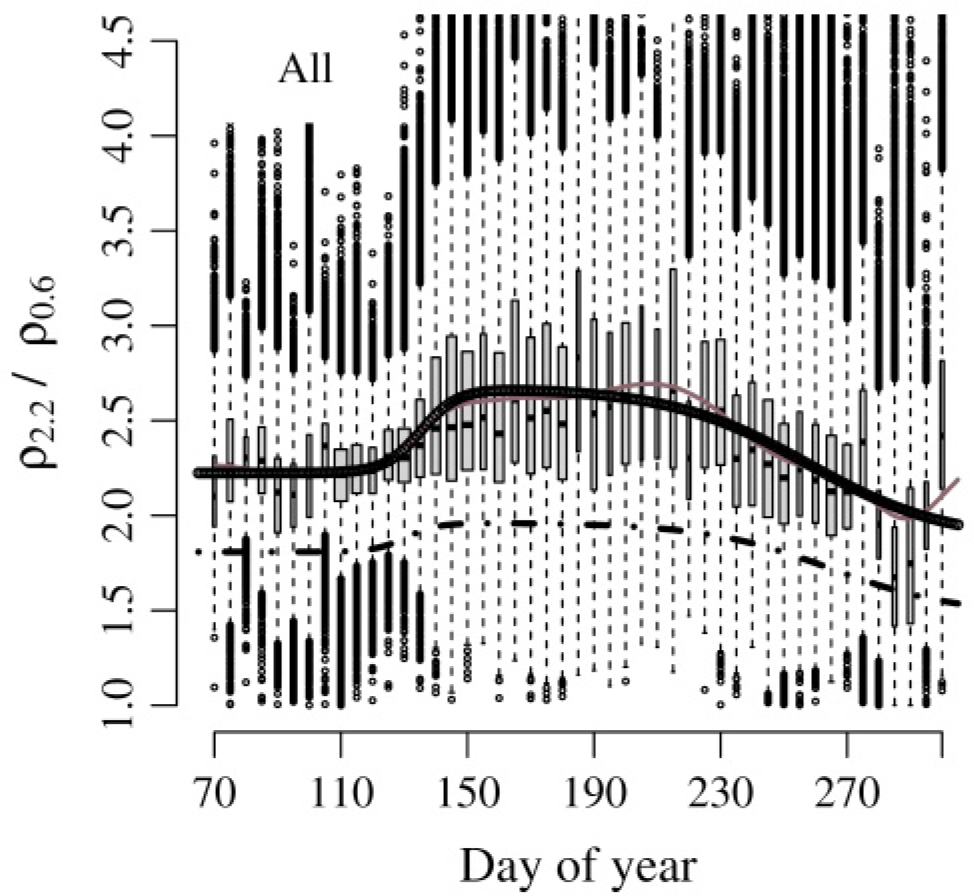
Figure 1.
The average seasonal course of the red ρ0.6 and near-infrared ρ2.2 reflectance ratio, summarised as a boxplot using 5-day bins. The dashed line corresponds to the preliminary model estimated from USGS Landsat-8/9 OLI L2 surface reflectance data. The wide line corresponds to model (1); the narrower line to our spline-based refinement.
Table 3.
Estimated parameters for the model (1). An observation is one stand on an image granule. RSE is the model residual error. R2 is the determination coefficient as defined by equation (2). Parameter values in the shaded cells were not significant. The parameter c has been fixed to the constant c = 1.
| Model for group | N. obs | R2 | RSE | Parameter estimates | ||||||
|---|---|---|---|---|---|---|---|---|---|---|
| a | b | d | kpk | kk | kps | ks | ||||
| All | 5.6 × 10⁶ | 0.15 | 0.69 | 2.22 | 2.22 | 1.24 | 140.0 | 5.84 | 262.4 | 22.0 |
| Evergreen needleleaf | 2.2 × 10⁶ | 0.02 | 0.47 | 2.21 | 39.2 | 6.52 | 140.0 | 5.03 | 270.9 | 22.0 |
| Deciduous broadleaf | 1.4 × 10⁶ | 0.45 | 0.68 | 2.34 | 1.22 | 0.95 | 138.0 | 4.50 | 255.0 | 25.0 |
| Scots pine (MA) | 1.0 × 10⁶ | 0.05 | 0.43 | 2.20 | 160.0 | 5.61 | 136.9 | 4.00 | 262.3 | 21.0 |
| MA (fertile soil) | 6.3 × 10⁵ | 0.05 | 0.43 | 2.21 | 160.0 | 5.41 | 141.0 | 4.45 | 264.7 | 23.0 |
| MA (poor soil) | 6.3 × 10s | 0.04 | 0.44 | 2.17 | 99.9 | 6.83 | 140.0 | 4.61 | 261.8 | 22.0 |
| Norway spruce (KU) | 6.3 × 10⁵ | 0.02 | 0.56 | 2.19 | 5.55 | 6.13 | 150.0 | 8.00 | 280.0 | 22.0 |
| Birch spp. (KS) | 6.3 × 10⁵ | 0.46 | 0.63 | 2.29 | 1.23 | 0.90 | 135.0 | 4.00 | 255.0 | 25.0 |
| KS (fertile soil) | 6.3 × 10⁵ | 0.46 | 0.64 | 2.31 | 1.25 | 0.90 | 135.0 | 4.00 | 255.0 | 25.0 |
| KS (poor soil) | 6.3 × 10⁴ | 0.45 | 0.66 | 2.24 | 1.19 | 0.90 | 137.4 | 4.00 | 255.0 | 25.0 |
| European aspen (HB) | 3.5 × 10⁴ | 0.47 | 0.67 | 2.35 | 1.09 | 0.90 | 138.0 | 4.20 | 250.0 | 22.0 |
| Grey alder (LV) | 4.3 × 10⁴ | 0.49 | 0.61 | 2.36 | 0.82 | 0.90 | 131.0 | 9.27 | 257.5 | 18.9 |
However, the seasonal ρ2.2/ρ0.6 value for evergreen needleleaf forests is found not to depend so strongly on the time during the season. Although the 5-day averaged values indicate small fluctuations, variability around the mean values in each 5-day bin hides most of the possible seasonal changes, and the double logistic phenology model (1) predicts only a marginal increase for the mid-summer (Figure 2). This independence of the evergreen needleleaf ρ2.2/ρ0.6 value from the day of the year is indicated also by the almost zero value of the determination coefficient (Table 3). In contrast to the evergreen needleleaf tree species group, the deciduous broadleaved species group is found to exhibit substantial dependence on the date during the growth season (Figure 3). While there is not much difference in the springtime inflection point kpk, the autumn inflection point kps, of the phenology model occurs 7 to 10 days earlier, in comparison both to the landscape average and to the evergreen needleleaf stands (Table 3). The autumn ρ2.2/ρ0.6 minimum is much more pronounced than in the landscape-level average (Figure 3). However, the model (1) is not flexible enough to capture such small fluctuations. On the other hand, the splinebased smoothed model (Table A2.1) follows the phenomena rather well. We find that during the autumn minimum the median values of ρ2.2/ρ0.6 can decrease even to about 1.5 for about 10 days.
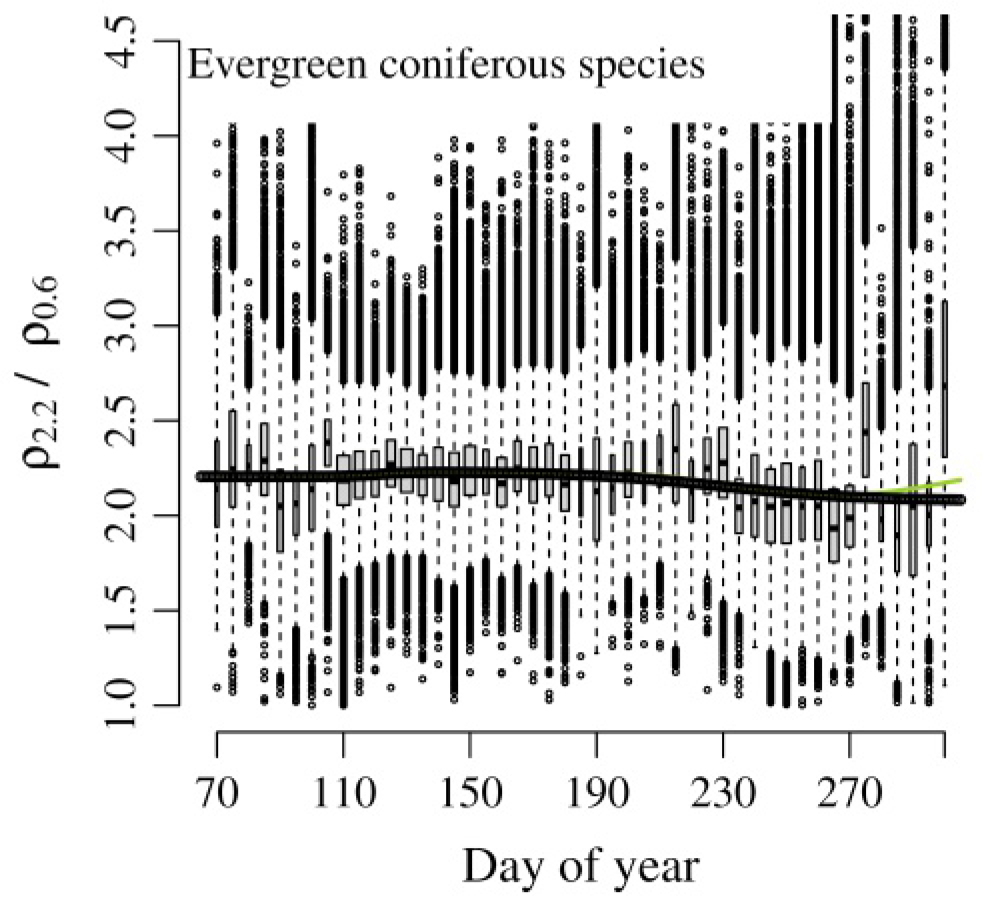
Figure 2.
Evergreen needleleaf tree species group. Figure details are as in Figure 1.
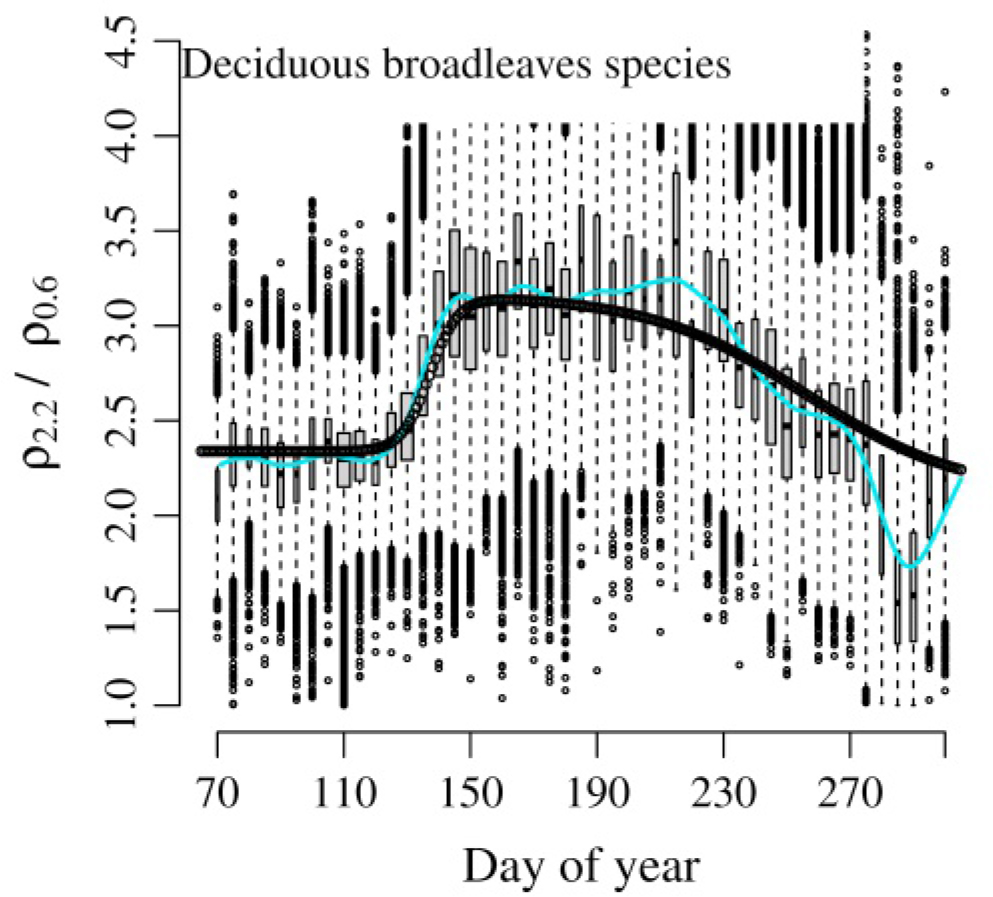
Figure 3.
Deciduous broadleaved tree species group. Figure details are as in Figure 1.
Detailed models by tree species and soil fertility
The fitted parameters for particular tree species and soil fertility groups in model (1) follow the characteristics of the general groups that were defined in terms of pooled leaf type and pooled tree-shoot morphology. The run of seasonal ρ2.2/ρ0.6 values for Scots pine stands and Norway spruce stands is found to resemble the seasonal ρ2.2/ρ0.6 run for pooled evergreen forest (Figures A1.1 to A1.4). Similarly, the European aspen stands, birch stands, and grey alder stands are found to follow the seasonal ρ2.2/ρ0.6 run of the pooled deciduous broadleaved species group (Figures A1.5 to A1.9).
The tree species subsets do, however, exhibit some possible small, interesting time periods during which the empirical values of ρ2.2/ρ0.6 do not follow the phenology model (1).
(A) In the autumn, the three Scots pine stand groups and the Norway spruce stand group are found to exhibit a small decrease in ρ2.2/ρ0.6, similar to the ρ2.2/ρ0.6 decrease in the various deciduous broadleaved species groups. In the first Scots pine stand group (Scots pine overall, without differentiation by soil fertility) the decrease starts possibly already from day 230, with ρ2.2/ρ0.6 reaching its minimum value around day 270. In the Scots pine stands growing on poor soils this feature is more pronounced (Figure A1.3). In the Norway spruce stands group, the autumn minimum at the end of September is still more strongly pronounced (Figure A1.4). Each of the latter two groups includes a small proportion of deciduous broadleaved trees (Table 2), the share being about 10% in the case of the Norway spruce stands. This heterogeneity in stand composition partly explains the similarity with the broadleaved deciduous groups. Additionally, however, in the Estonian autumn about 25% of Scots pine needles turn yellow and are shed. This can cause seasonal reflectance changes similar to those exhibited by many broadleaved deciduous species.
(B) In the birch stand groups the seasonal changes in ρ2.2/ρ0.6 are found to follow those of the pooled deciduous broadleaved group. The autumn minimum is, however, more pronounced in the stands growing on fertile soils (as can be seen by comparing Figure A1.6 against Figures A1.5 and A1.7). The ρ2.2/ρ0.6 value increases remarkably during the growth season, attaining values around 3 for several months. In the European aspen stands the ρ2.2/ρ0.6 value increases even more, with 5-day bin medians yielding ρ2.2/ρ0.6 ≥ 3.25 (Figure A1.8, Table A2.1). Otherwise, however, European aspen stands and birch stands exhibit similar seasonal values. The grey alder stands reach the greatest values of ρ2.2/ρ0.6 among all groups, with 5-day bin medians rising even as high as 3.5, and they differ somewhat in their seasonal courses from birch and European aspen stands (Figure A1.9, Table A2.1). There is in their case no rapid increase phase in the spring, with the ρ2.2/ρ0.6 seasonal course instead almost symmetrical around the summer solstice. Nevertheless, the springtime plateau before budburst is detectable, as in the other deciduous broadleaved species groups. An interesting pattern can be found during the late summer period, from day 250 until day 280, when the decrease in ρ2.2/ρ0.6 is replaced by a temporary increase before the final decrease sets in.
Discussion and Conclusion
Our study shows that the band ratio for dense dark vegetation represented by some common tree species found in the boreal and temperate climate regions is at almost all points in the snowless period greater than the commonly used value ρ2.2/ρ0.6 = 2. Smaller values are found only during a short period in the autumn, when the yellowing of tree foliage marks the end of the growing season, and consequently substantially alters the canopy spectral reflectance signature. Evergreen needleleaf tree species have rather stable seasonal ρ2.2/ρ0.6 values. This stability contrasts with the substantial variation on the part of deciduous broadleaved tree species, for which the seasonal course of ρ2.2/ρ0.6 exhibits a variation dependent on the leaf area. During the most active growth period, the median values of ρ2.2/ρ0.6 increase up to 3.5 in deciduous broadleaved stands. Soil fertility has some, but rather small influence on the seasonal course of ρ2.2/ρ0.6.
Our findings agree well with published measurements of forested test sites where the regular normalised difference vegetation index (NDVI) reaches over 0.7, as NDVI does in our empirical dataset. For example, in the case of forests, Remer et al. (2001) report values of ρ2.2/ρ0.6 as high as about 4. The forest and dense-vegetation observations in the dataset of Kaufman et al. (1997) exhibit the range 1.7 ≤ ρ2.2/ρ0.6 ≤ 3.4, and de Almeida Castanho et al. (2007) find that ρ2.2/ρ0.6 for dark vegetation can increase even beyond 5. Admittedly, at the other end of the scale Karnieli et al. (2001), analysing aircraft measurements of various vegetated surfaces in Israel, find the ρ2.2/ρ0.6 close to 2. However, most of their samples have an NDVI of less than 0.7, which is less than the mean-value-subtracted-one standard deviation in our dataset (Table A3.1).
Despite this generally high value of ρ2.2/ρ0.6 in regions with NDVI > 0.7, evident both from our present study and from the above-cited literature, global environment optical data from Terra/Aqua MODIS and its successor constellation Suomi NPP VIIRS (Franch et al., 2016) are routinely processed with the unrealistic ρ2.2/ρ0.6 = 2 model – admittedly with some modifications that account for the scattering angle, and additionally account for foliage abundance on the basis of the vegetation index NDVISWIR (Levy et al., 2007). With these modifications, the model of Levy et al. (2007) yields a limited range of 1.5 < ρ2.2/ρ0.6 < 2.1 if calculated with the correct dependence on NDVISWIR (Levy et al., 2013) for the measurement geometry of Landsat-8/9 OLI and Sentinel-2 MSI, using vegetation index values that correspond to the forest canopies of our test area during the growth season. The discrepancy with the results of our present study stems from the spatial resolution of the data, i.e. from the pixel size. The MODIS-like environmental monitoring satellite scanners have a 250 to 500 m pixel size in the nadir view direction, in contrast with the 10 to 30 m pixels of Sentinel-2 MSI and Landsat-8/9 OLI. Such large pixels cover, as an example, more than ten forest stands, or several land cover classes, in the Estonian landscape. The inclusion of sparsely vegetated areas, bare soil, or buildings within the imaging depresses ρ2.2/ρ0.6 values, as shown in the case of urban areas by an empirical study of de Almeida Castanho et al. (2007), and by the model simulation experiments of Kaufman et al. (2002). Another influential factor is the prevalence of undetected small clouds, which likewise systematically depress ρ2.2/ρ0.6 values on such large pixels.
While the LaSRC algorithm used by USGS for the atmospheric correction of Landsat data already includes some accounting for seasonal and regional dependence of ρ2.2/ρ0.6, Sen2Cor still relies on the assumption of the constant ρ2.2/ρ0.6 = 2. The inclusion of ρ2.2/ρ0.6 seasonal dependence into Sen2Cor would be technically simple. One option is to proceed as in LaSRC. Another option is to proceed from tree species maps. In the first implementations, these should distinguish between evergreen forests and deciduous broadleaved forests, providing variables that support the prediction of seasonally correct ρ2.2/ρ0.6 values in 10–30 m pixels. Such maps, with suitable spatial resolution for Landsat-8/9 OLI and Sentinel-2 MSI data, do not at present exist globally, but nevertheless do exist at various national and regional levels, e.g. for Estonia (Lang et al., 2018), Belgium (Bolyn et al., 2022), Germany (Blickensdörfer et al., 2024), Europe (Langanke et al., 2018; Dostálová et al., 2021), Argentina (Silveira et al., 2023), and Canada (Hermosilla et al., 2024).
Our present study leads us to conclude that so far as 10 to 30 m multispectral satellite imaging is concerned, the solution proposed by Kaufman et al. (1997) for atmospheric correction of at-sensor radiance is capable of substantial improvement. In our view, the integration of already collected satellite image time series with predictions of land surface reflectances yields the most promising approach to improving the accuracy of current atmospheric correction algorithms.
Acknowledgements
This study was supported by the Estonian Research Council grant PRG2214. Satellite images are distributed by USGS and ESA. We are grateful to Dr. Jérôme Louis from the Telespazio team for help with updating some features of Sen2Cor3. The authors thank Dr. Toomas Karmo for the linguistic and copy-edit review of the article manuscript. They also thank anonymous referees for reviewing their manuscript. Ground-surface elevation models and basemap data were provided by the Estonian Land Board.
Appendices
Appendix 1.
Detailed models for tree species and soil fertility groups
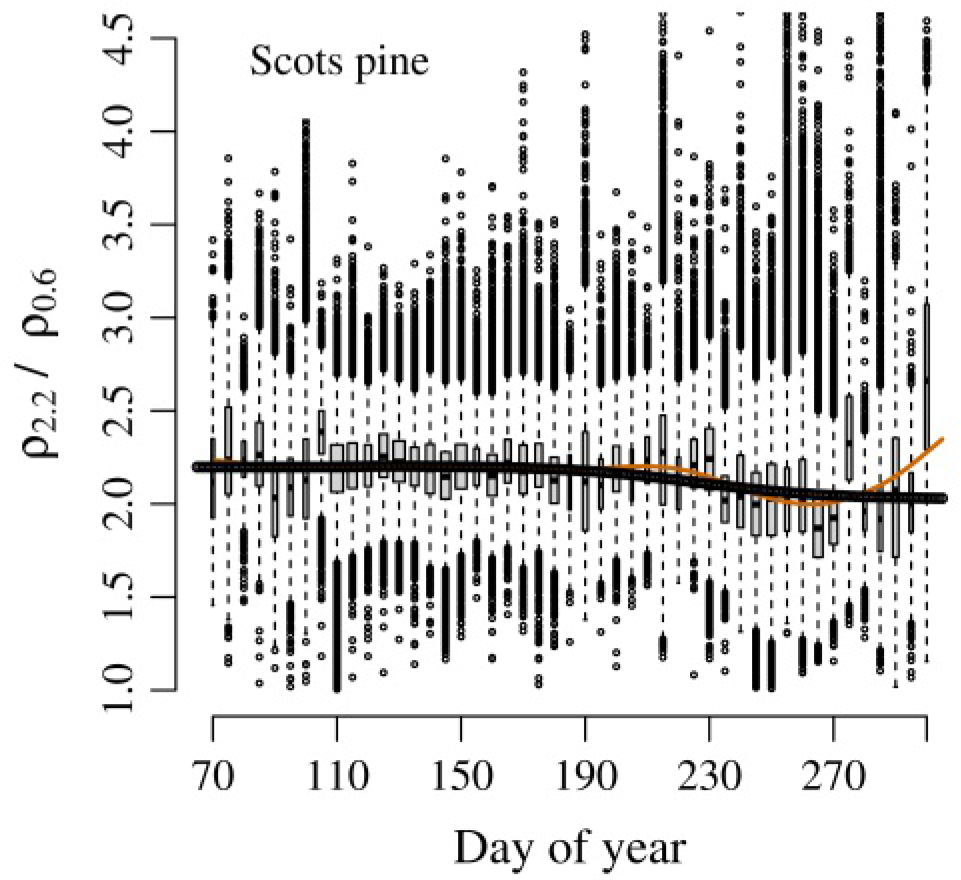
Figure A1.1.
Scots pine stands.
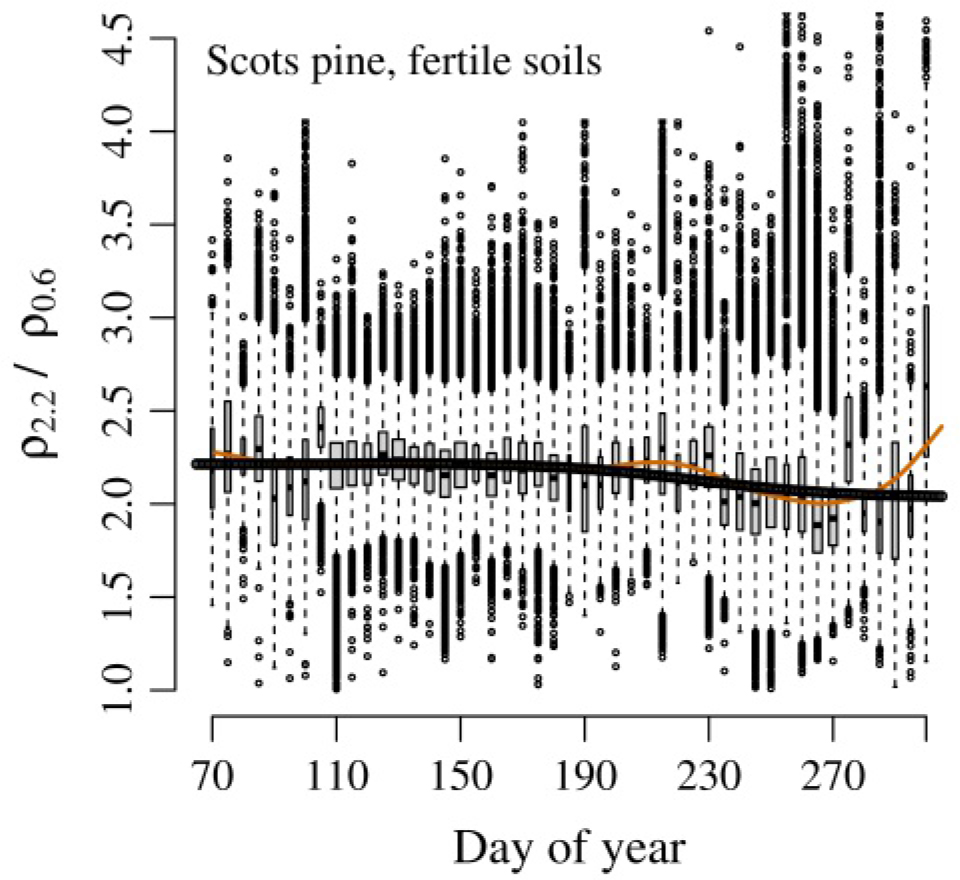
Figure A1.2.
Scots pine stands on fertile soils.
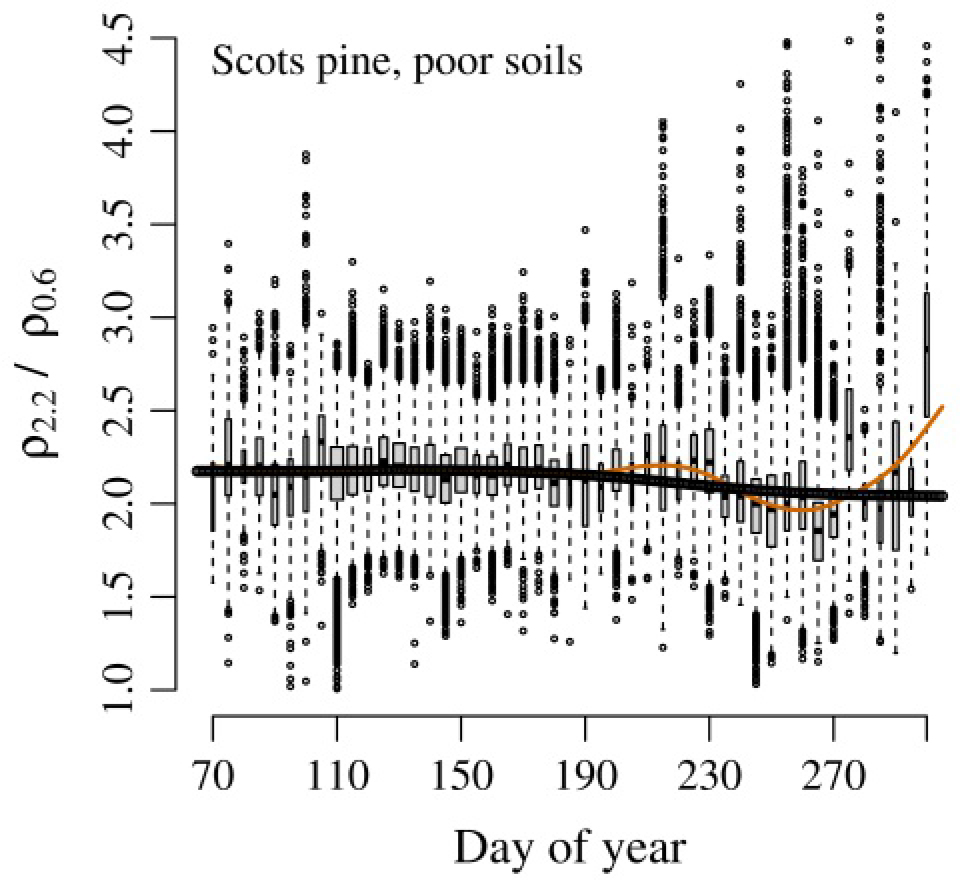
Figure A1.3.
Scots pine stands on poor soils.
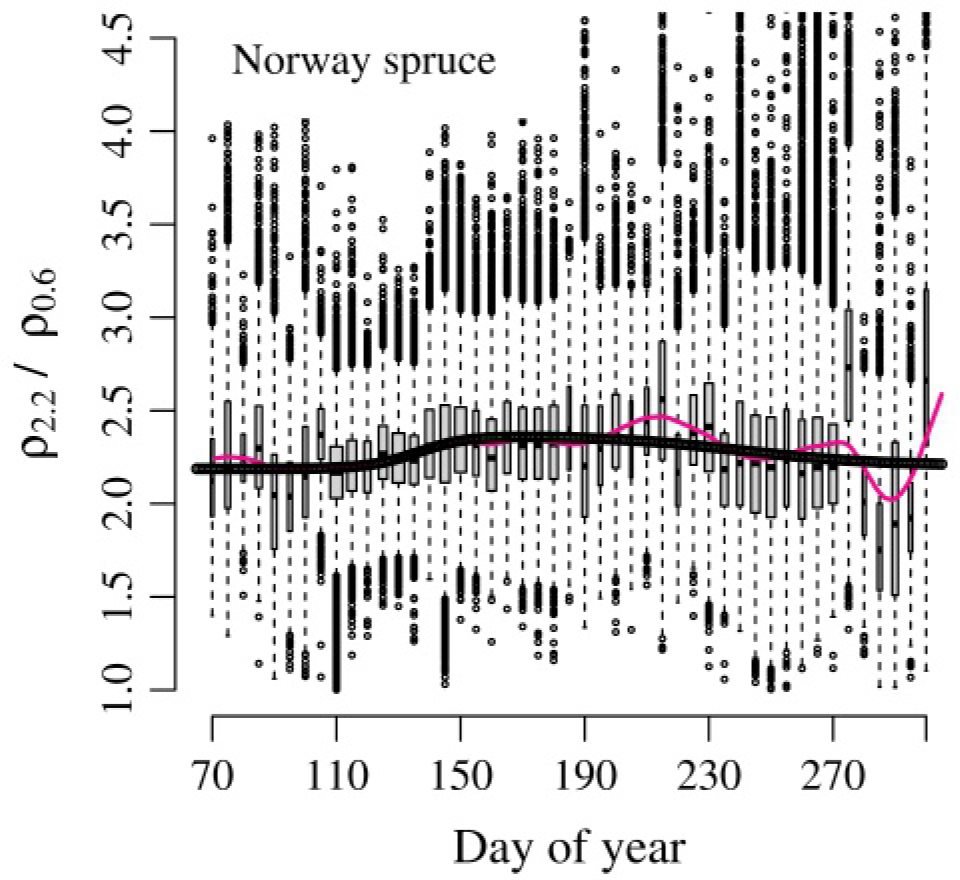
Figure A1.4.
Norway spruce stands.
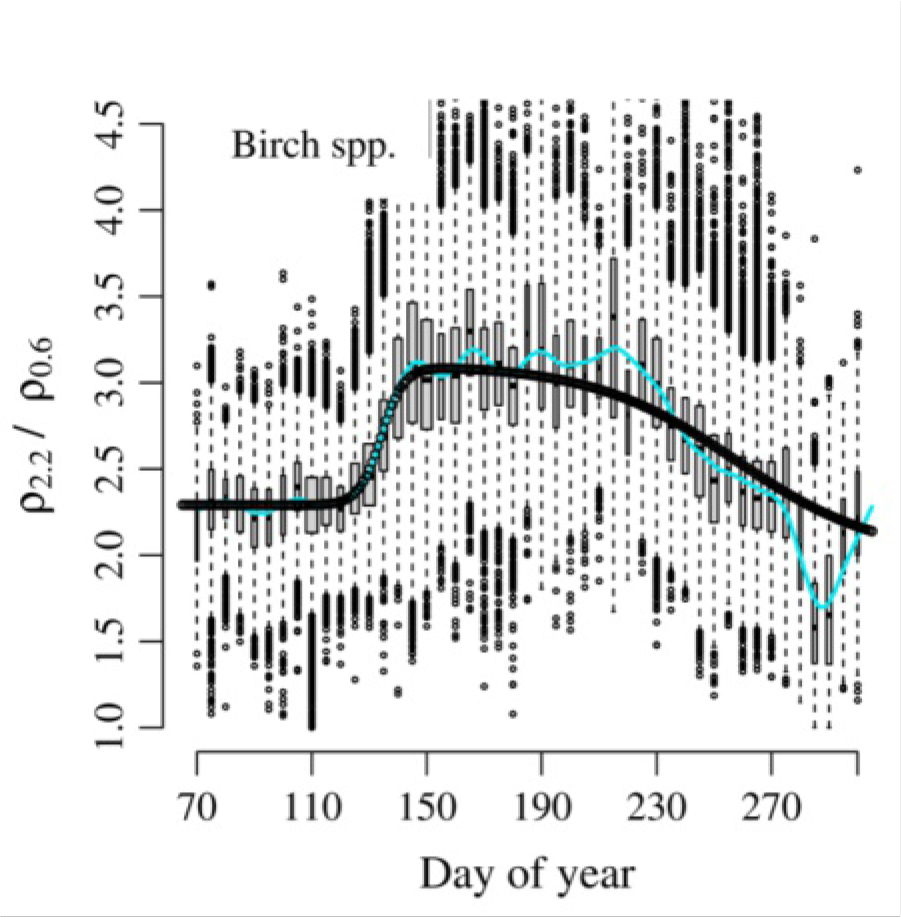
Figure A1.5.
Birch stands.
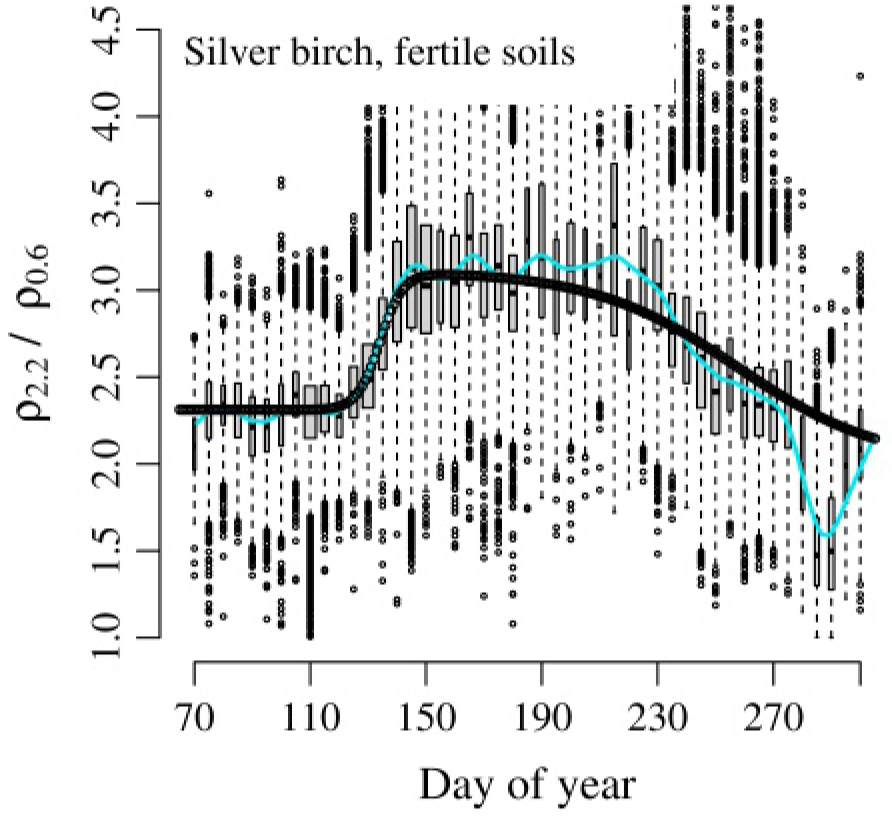
Figure A1.6.
Birch stands on fertile soils.
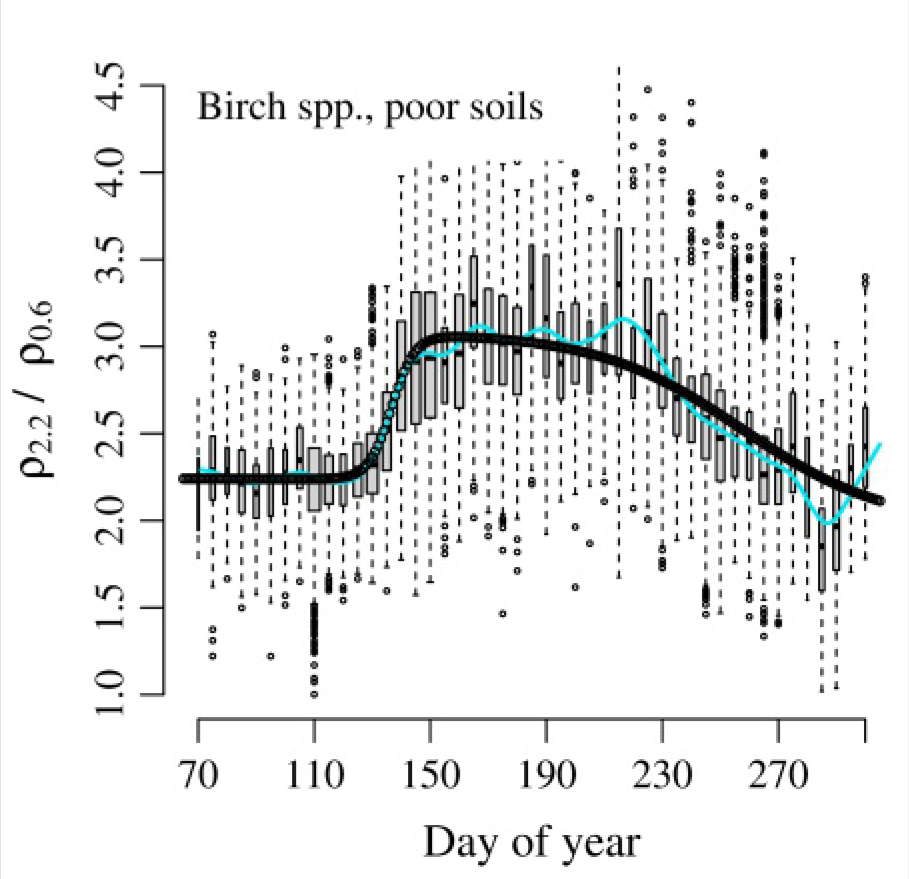
Figure A1.7.
Birch stands on poor soils.
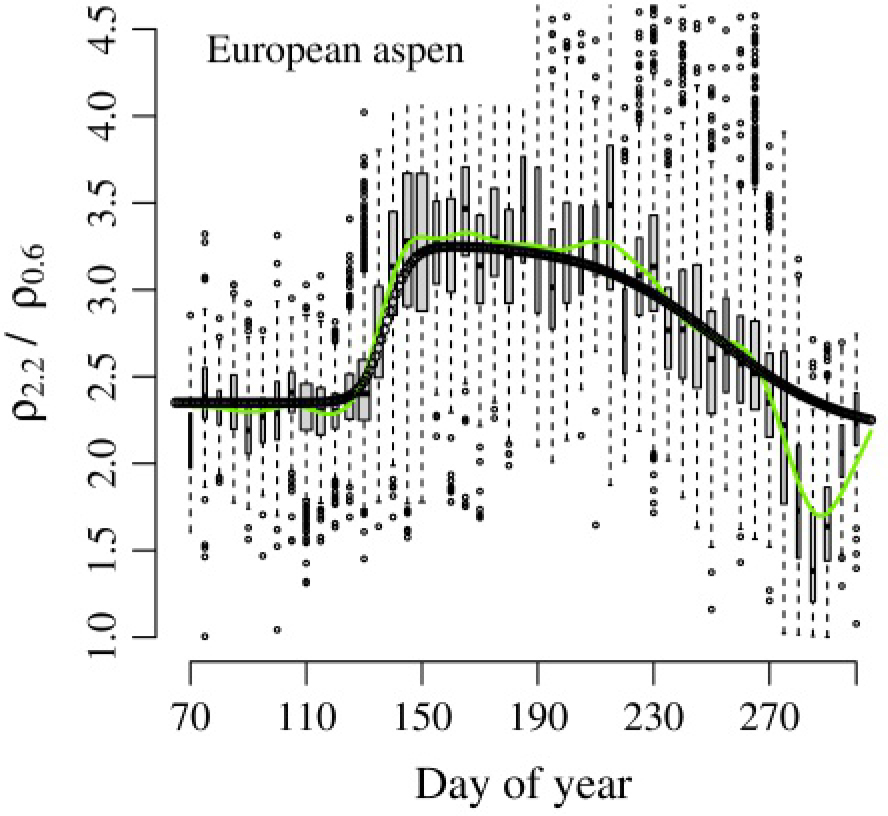
Figure A1.8.
European aspen stands.
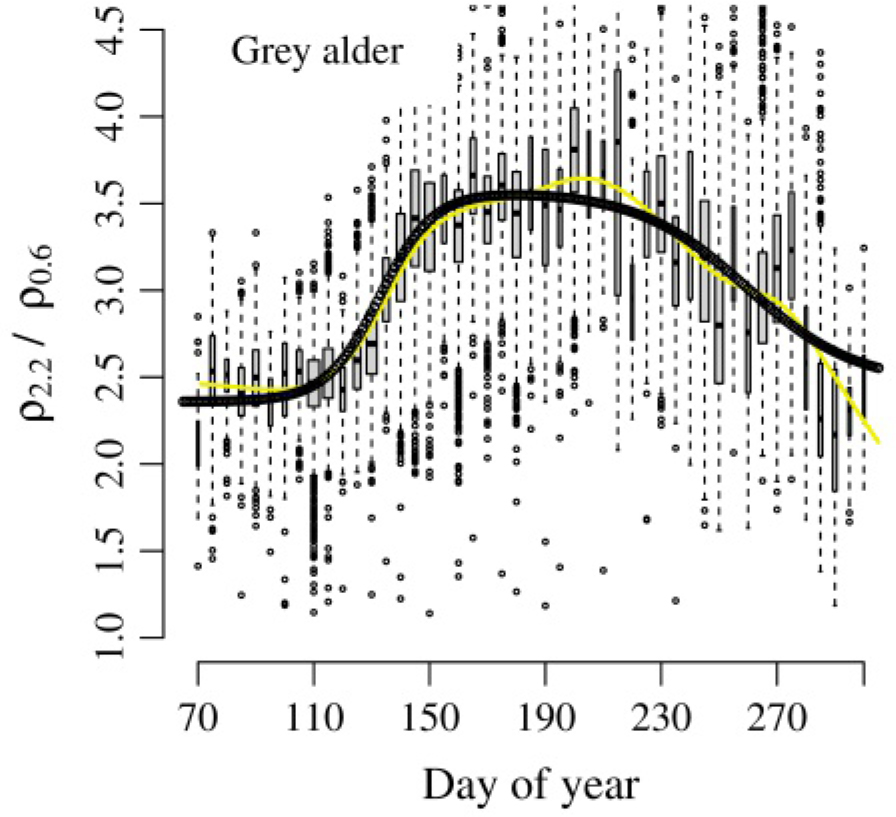
Figure A1.9.
Grey alder stands.
Appendix 2.
Smoothed course of the near-infrared/red reflectance ratio ρ2.2/ρ0.6
Table A2.1.
Smoothed course of the near-infrared/red reflectance ratio ρ2.2/ρ0.6. Values are scaled by 100. Group descriptions are given in Tables 1 and 2.
| Day | Tree species groups | |||||||||||
|---|---|---|---|---|---|---|---|---|---|---|---|---|
| All | Everg. N. | Dec. Br. | MA-A | MA-F | MA-P | KU-A | KS-A | KS-F | KS-P | HB-A | LV-A | |
| 70 | 226 | 223 | 226 | 224 | 228 | 220 | 224 | 225 | 222 | 229 | 233 | 246 |
| 73 | 226 | 223 | 228 | 223 | 227 | 220 | 225 | 229 | 227 | 229 | 233 | 246 |
| 76 | 226 | 222 | 230 | 222 | 226 | 219 | 225 | 231 | 231 | 228 | 233 | 245 |
| 79 | 225 | 222 | 231 | 222 | 225 | 218 | 225 | 232 | 232 | 226 | 232 | 245 |
| 82 | 224 | 222 | 230 | 221 | 224 | 218 | 224 | 231 | 232 | 224 | 231 | 245 |
| 85 | 223 | 222 | 229 | 221 | 223 | 217 | 222 | 229 | 229 | 223 | 231 | 244 |
| 88 | 222 | 222 | 227 | 220 | 222 | 216 | 220 | 226 | 226 | 221 | 230 | 244 |
| 91 | 222 | 222 | 226 | 220 | 222 | 216 | 219 | 224 | 224 | 221 | 230 | 243 |
| 94 | 221 | 222 | 227 | 220 | 221 | 216 | 218 | 224 | 224 | 223 | 230 | 243 |
| 97 | 221 | 222 | 228 | 220 | 221 | 216 | 219 | 226 | 226 | 224 | 231 | 243 |
| 100 | 221 | 222 | 230 | 220 | 221 | 217 | 220 | 229 | 229 | 226 | 232 | 243 |
| 103 | 222 | 222 | 232 | 220 | 221 | 217 | 220 | 232 | 232 | 227 | 233 | 244 |
| 106 | 222 | 222 | 232 | 220 | 221 | 217 | 220 | 233 | 233 | 227 | 233 | 245 |
| 109 | 222 | 222 | 231 | 220 | 221 | 217 | 219 | 231 | 231 | 226 | 232 | 246 |
| 112 | 223 | 222 | 230 | 220 | 222 | 218 | 219 | 230 | 230 | 224 | 231 | 248 |
| 115 | 223 | 222 | 229 | 221 | 222 | 218 | 219 | 229 | 229 | 222 | 229 | 251 |
| 118 | 225 | 222 | 229 | 221 | 222 | 219 | 220 | 228 | 229 | 222 | 228 | 254 |
| 121 | 227 | 222 | 231 | 221 | 223 | 219 | 222 | 230 | 231 | 222 | 229 | 259 |
| 124 | 229 | 222 | 234 | 221 | 223 | 219 | 224 | 234 | 236 | 224 | 233 | 265 |
| 127 | 232 | 222 | 240 | 221 | 223 | 220 | 225 | 239 | 242 | 228 | 239 | 272 |
| 130 | 236 | 222 | 250 | 221 | 223 | 219 | 226 | 248 | 252 | 235 | 250 | 280 |
| 133 | 241 | 222 | 265 | 221 | 222 | 219 | 227 | 262 | 267 | 246 | 266 | 289 |
| 136 | 245 | 222 | 281 | 221 | 222 | 219 | 229 | 278 | 283 | 261 | 285 | 298 |
| 139 | 250 | 223 | 296 | 220 | 221 | 218 | 231 | 293 | 297 | 275 | 302 | 308 |
| 142 | 253 | 223 | 307 | 220 | 220 | 217 | 232 | 304 | 307 | 287 | 316 | 316 |
| 145 | 256 | 223 | 314 | 219 | 220 | 217 | 233 | 311 | 313 | 293 | 326 | 324 |
| 148 | 258 | 223 | 316 | 219 | 220 | 217 | 234 | 312 | 314 | 296 | 330 | 330 |
| 151 | 260 | 223 | 314 | 219 | 220 | 217 | 234 | 308 | 310 | 296 | 330 | 336 |
| 154 | 260 | 223 | 312 | 219 | 220 | 217 | 233 | 304 | 307 | 295 | 329 | 340 |
| 157 | 261 | 223 | 312 | 219 | 220 | 217 | 232 | 304 | 306 | 297 | 330 | 343 |
| 160 | 261 | 223 | 314 | 219 | 220 | 217 | 232 | 309 | 310 | 302 | 331 | 345 |
| 163 | 262 | 223 | 318 | 219 | 220 | 217 | 233 | 315 | 316 | 308 | 332 | 347 |
| 166 | 262 | 223 | 321 | 219 | 220 | 217 | 234 | 319 | 320 | 312 | 333 | 349 |
| 169 | 262 | 223 | 320 | 219 | 220 | 217 | 234 | 317 | 318 | 311 | 332 | 350 |
| 172 | 262 | 223 | 318 | 218 | 219 | 217 | 234 | 312 | 312 | 308 | 330 | 351 |
| 175 | 262 | 223 | 315 | 218 | 219 | 216 | 234 | 307 | 308 | 304 | 328 | 352 |
| 178 | 262 | 223 | 313 | 218 | 219 | 216 | 233 | 304 | 305 | 303 | 327 | 353 |
| 181 | 262 | 223 | 313 | 218 | 218 | 215 | 233 | 306 | 307 | 304 | 326 | 354 |
| 184 | 263 | 223 | 315 | 218 | 218 | 215 | 232 | 312 | 313 | 307 | 326 | 356 |
| 187 | 264 | 223 | 317 | 218 | 218 | 215 | 232 | 317 | 318 | 310 | 326 | 357 |
| 190 | 264 | 223 | 318 | 219 | 219 | 216 | 232 | 318 | 320 | 310 | 325 | 359 |
| 193 | 266 | 222 | 318 | 219 | 219 | 216 | 234 | 315 | 318 | 307 | 324 | 361 |
| 196 | 267 | 222 | 318 | 219 | 220 | 217 | 236 | 311 | 314 | 304 | 323 | 363 |
| 199 | 268 | 222 | 319 | 220 | 220 | 218 | 238 | 310 | 312 | 302 | 323 | 364 |
| 202 | 269 | 222 | 320 | 220 | 221 | 219 | 241 | 311 | 313 | 302 | 324 | 365 |
| 205 | 269 | 222 | 322 | 220 | 222 | 219 | 243 | 312 | 314 | 304 | 326 | 364 |
| 208 | 269 | 221 | 323 | 220 | 222 | 220 | 245 | 314 | 315 | 307 | 328 | 363 |
| 211 | 269 | 221 | 324 | 220 | 222 | 220 | 247 | 317 | 317 | 311 | 328 | 362 |
| 214 | 268 | 220 | 325 | 220 | 222 | 221 | 247 | 320 | 319 | 315 | 328 | 360 |
| 217 | 267 | 220 | 323 | 219 | 222 | 221 | 246 | 320 | 319 | 316 | 325 | 357 |
| 220 | 265 | 219 | 320 | 219 | 221 | 220 | 244 | 316 | 315 | 313 | 321 | 353 |
| 223 | 262 | 218 | 315 | 218 | 220 | 219 | 242 | 311 | 311 | 309 | 317 | 349 |
| 226 | 259 | 218 | 311 | 216 | 219 | 218 | 240 | 305 | 306 | 302 | 312 | 345 |
| 229 | 255 | 217 | 306 | 215 | 217 | 216 | 237 | 300 | 302 | 294 | 307 | 341 |
| 232 | 251 | 216 | 299 | 213 | 215 | 214 | 234 | 293 | 296 | 285 | 301 | 336 |
| 235 | 247 | 215 | 291 | 211 | 213 | 211 | 231 | 283 | 286 | 276 | 294 | 331 |
| 238 | 242 | 214 | 282 | 209 | 211 | 208 | 228 | 274 | 276 | 269 | 287 | 326 |
| 241 | 239 | 214 | 275 | 208 | 209 | 206 | 226 | 266 | 267 | 263 | 282 | 321 |
| 244 | 235 | 213 | 269 | 206 | 207 | 203 | 224 | 261 | 261 | 258 | 278 | 316 |
| 247 | 232 | 212 | 264 | 204 | 206 | 201 | 224 | 257 | 256 | 255 | 275 | 312 |
| 250 | 230 | 212 | 259 | 203 | 205 | 199 | 224 | 252 | 251 | 252 | 273 | 308 |
| 253 | 228 | 211 | 256 | 202 | 204 | 198 | 225 | 249 | 249 | 249 | 271 | 305 |
| 256 | 226 | 211 | 254 | 201 | 203 | 197 | 227 | 247 | 247 | 246 | 270 | 303 |
| 259 | 224 | 211 | 253 | 200 | 202 | 197 | 229 | 244 | 245 | 243 | 268 | 301 |
| 262 | 223 | 211 | 252 | 200 | 201 | 197 | 230 | 242 | 242 | 239 | 265 | 300 |
| 265 | 221 | 211 | 250 | 200 | 200 | 197 | 231 | 239 | 239 | 236 | 258 | 298 |
| 268 | 219 | 211 | 246 | 200 | 200 | 199 | 232 | 236 | 237 | 233 | 248 | 296 |
| 271 | 216 | 211 | 240 | 201 | 201 | 201 | 233 | 234 | 233 | 231 | 235 | 292 |
| 274 | 213 | 211 | 230 | 203 | 202 | 203 | 232 | 228 | 227 | 227 | 220 | 288 |
| 277 | 209 | 212 | 217 | 204 | 203 | 206 | 228 | 216 | 213 | 221 | 204 | 282 |
| 280 | 205 | 212 | 201 | 206 | 205 | 209 | 219 | 199 | 193 | 212 | 189 | 276 |
| 283 | 202 | 213 | 186 | 208 | 206 | 212 | 210 | 182 | 174 | 204 | 177 | 268 |
| 286 | 199 | 213 | 176 | 211 | 209 | 215 | 204 | 171 | 161 | 199 | 171 | 260 |
| 289 | 198 | 214 | 173 | 214 | 212 | 219 | 202 | 170 | 159 | 200 | 170 | 253 |
| 292 | 200 | 215 | 177 | 217 | 216 | 224 | 206 | 179 | 166 | 206 | 175 | 245 |
| 295 | 202 | 216 | 184 | 221 | 221 | 230 | 213 | 192 | 178 | 215 | 183 | 237 |
| 298 | 207 | 217 | 194 | 225 | 227 | 236 | 225 | 204 | 190 | 224 | 193 | 230 |
| 301 | 212 | 218 | 205 | 229 | 233 | 243 | 239 | 215 | 202 | 233 | 204 | 222 |
| 304 | 217 | 218 | 216 | 233 | 239 | 250 | 254 | 225 | 212 | 241 | 215 | 215 |
| 307 | 223 | 219 | 227 | 238 | 246 | 257 | 269 | 235 | 223 | 249 | 226 | 208 |
| 310 | 228 | 220 | 238 | 242 | 252 | 263 | 284 | 245 | 234 | 257 | 237 | 200 |
Appendix 3.
The normalised difference vegetation index (NDVI) in tree species groups
Table A3.1.
The normalised difference vegetation index INDVI = (ρ0.85 – ρ0.6) / (ρ0.85 + ρ0.6) mean values and standard deviation for our species groups. Spectral reflectances are from the bands at 0.85 μm (ρ0.85) and 0.6 μm (ρ0.6). Group descriptions are given in Tables 1 and 2. The estimate is made for the period starting from day 141 and ending with day 259.
| Tree species group | NDVI | ||
|---|---|---|---|
| Species | Bonity | Mean | Standard deviation |
| All | A | 0.79 | 0.09 |
| Everg. N. | A | 0.78 | 0.06 |
| Dec. Br. | A | 0.78 | 0.13 |
| MA | A | 0.77 | 0.06 |
| MA | F | 0.78 | 0.06 |
| MA | P | 0.76 | 0.06 |
| KU | A | 0.82 | 0.07 |
| KS | A | 0.77 | 0.13 |
| KS | F | 0.78 | 0.13 |
| KS | P | 0.75 | 0.15 |
| HB | A | 0.78 | 0.15 |
| LV | A | 0.79 | 0.14 |