
Introduction
Forests constitute one of the indispensable resources for the survival of mankind for the services they provide such as maintaining environmental stability, providing food and raw materials, livelihood, and employment for millions of people in rural areas (FAO, 2010; Arce, 2019). Additionally, forest ecosystems eliminate CO2 from the atmosphere and store more C than any other land type per unit area. (Lorenz & Lal, 2010). Tropical forests have been identified as the richest biological communities of the earth (Baraloto et al., 2013). They contribute around 1/3rd of the global terrestrial primary productivity and display a broad spectrum of vegetative and reproductive phenology (Beer et al., 2010). Of these, the dry deciduous forests are seen to be the least protected and highly disturbed ecosystems (Murphy & Lugo, 1986), which are disappearing at alarming rates worldwide attributable to overexploitation of forest resources, agricultural land expansion, and livestock overgrazing (Anitha et al., 2010).
To prevent this ongoing forest deterioration, it is essential for foresters and ecologists to examine the current status of these forests by studying their species diversity and making forest inventories to carry out proper management activities. This will help to deliver a valued source for forest assessment and will also expand our knowledge of valuable plant species ecologically as well as economically. In this direction, the phytosociological analysis underpins the understanding of the forest ecology of any vegetated land (Mandal & Joshi, 2014; Dar & Sundarapandian, 2016). It includes the quantification of plant species, their distribution as well as abundance and structural analysis that is critical for acquiring sufficient knowledge on the species diversity and richness of forest ecosystems for management purposes and, also for a deeper knowledge of forest ecology and ecosystem functioning. (Siraj et al., 2017).
Diversity and structure are crucial in forest communities (Gadow et al., 2016). Plant species diversity controls a forest's stability, trophic structure, and productivity (Lillo et al., 2019). It also varies by biogeography, environment, and perturbation (Majumdar et al., 2012). Vegetation structure and species variety are essential for forest ecosystem protection and sustainability. Thus, quantitative data on a forest's floristic composition and vegetation structure is essential for strategizing and implementing conservation programs, which are presently scarce in the Morni forest, Panchkula, Haryana.
Physio-graphically, Haryana comes under the Indo-Gangetic plains while some of the areas also fall in Shiwalik Hills i.e. the foothills of the Himalayas. Morni forest belongs to the tertiary formations of the Shiwalik Hills that contain tropical dry deciduous forests filled with ample floristic as well as functional diversity (Dhiman et al., 2020; Himanshi et al., 2021). But due to increasing anthropic activities, it might be under ecological disturbance widening the forest gaps and the risk of shifts in community composition in the near future. Only a few studies including vegetation composition (Rout & Gupta, 1989), diversity of invasive plants (Dhiman et al., 2021) and floristic richness (Kumar et al., 2023) have been reported in the study area.
Thus, the present study was designed to quantify the floristic composition, diversity and population structure of Morni Hills forest lying in the foothills of Himalayas, with a small elevation change, thereby helping to comprehend the present conditions of these forests in a better way. Given that the distribution of mountain biota is shifting upward because of climate change (Steinbauer et al., 2018; Rumpf et al., 2018), this study would be helpful for understanding how plant species adapt to such altitudinal shifts on a warming planet.
Material and Methods
Study site
Haryana is a North Indian agricultural state with a forest cover of 1602.44 km2, or 3.62 percent of its total geographical area (FSI, 2019). Morni Hills of the Panchkula district lie in the north-eastern region of Haryana. They consist of tertiary formations of Shiwalik Hills and form a part of the active Sub-Himalayan belt that is mainly composed of sandy facies and an inter-bedded sequence of medium to coarse-grained sandstone as well as fine-grained shales. The current study was performed in lower altitudinal ranges of Morni Hills at an altitude of 400–800 m AMSL from 30′39″N to 30′45″ N and 77′2″E to 77′10″ E (Figure 1).
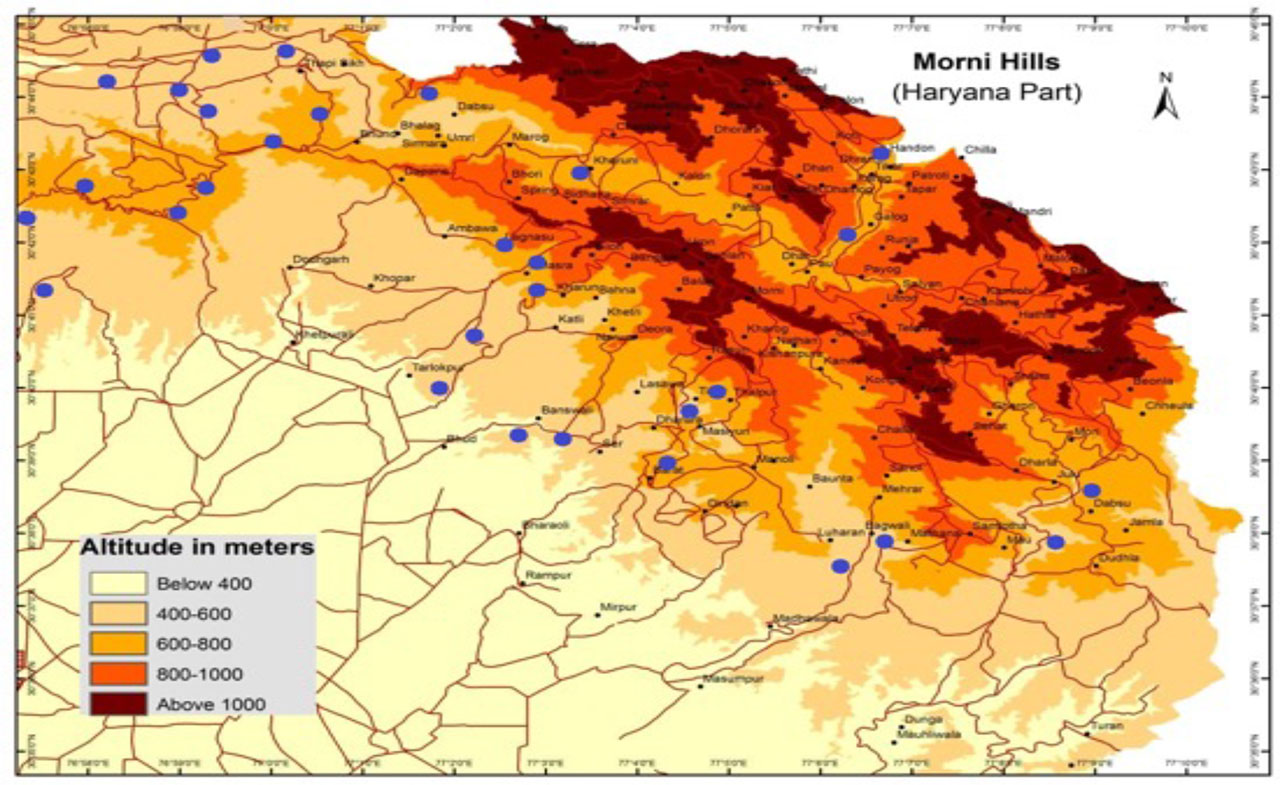
Figure 1.
Map of the study site showing the location of plots (blue dots) studied in the selected altitudinal ranges of Morni Hills forest.
Sampling of vegetation and data analysis
The data was collected from the year 2018 to 2021, by selecting a total of 30 plots of size 0.1ha (15 plots/range) randomly in the lower two altitudinal/elevational ranges of the selected area, i.e. 400–600 m (AR_1) and 600–800 m (AR_2) AMSL (above mean sea level), as shown in Figure 1. The current ecological analysis was performed using the quadrat method. In each plot, 5 quadrats (10 × 10 m) were randomly established for the calculation of different ecological parameters. Trees and climbers were sampled in these quadrats whilst for shrubs and herbs quadrats of 5 × 5 m and 1 × 1 m were placed within, respectively (Curtis & McIntosh, 1950; Phillips, 1959). For plant species whose scientific names were not immediately known in the field, local names were employed. The parts of unidentifiable plants, such as twigs, leaves, flowers, and fruits, were gathered, brought to the lab and referred to the flora.
The quantitative analysis of plant species including Frequency (F), Density (D), Abundance (A), and Basal Area (B.A.) was performed following Cottam & Curtis (1956). As per Phillips (1959), the important value index (IVI) was computed by adding the relative density, relative frequency, and relative dominance. Moreover, a frequency class distribution pattern was obtained for the plant species in two ranges following Raunkiaer (1934). To understand the distribution pattern of plants, the A/F ratio was also calculated following Cottam & Curtis (1956) viz. regular (less than 0.025), random (0.025–0.050), and contiguous (more than 0.050). Various diversity indices were also estimated, viz. Shannon-Wiener Index (Shannon & Weaver, 1963) for species diversity (H′), Simpson Index (Simpson, 1949) for the concentration of dominance (CD), Pielou Index (Pielou, 1966) for species evenness or equitability (E), and Margalef (1958) for species richness (d). Subsequently, the Similarity index was also deliberated following the Sørensen Index (Sørensen, 1948) for the two altitudinal ranges. By taking the girth of trees at 1.37 m from the ground, the population/stand structure was analysed using the NRSA (2008) manual by putting the individual trees in different girth classes. To understand the correlation between different parameters studied, the Pearson correlation was analyzed using R studio. The following formulae were used during the study for the calculation of analytical characters of the vegetation:
Where ‘r’ is the radius of the tree at breast height (1.37 m).
Where, pi is the proportion of individuals belonging to ith species, calculated as pi = ni/N.
Where, H′ = Value of Shannon Wiener Index and S = Total number of species.
Where, S = Total no. of species and N = Total density obtained for all the species encountered on an area.
Results
Floristic composition and diversity analysis
During the present investigation, a total of 143 species of plants (39 trees, 19 shrubs, 68 herbs & 17 climbers) representing 56 families were found in the selected altitudinal ranges of Morni Hills, Panchkula. Poaceae exhibited the maximum number of species i.e. 12 subsequently Asteraceae and Fabaceae (10 species each); Euphorbiaceae (8 species); Lamiaceae (7 species); Amaranthaceae and Mimosaceae (6 species each), followed by others.
In AR_1 (400–600 m AMSL), 106 plant species (26 trees, 14 shrubs, 54 herbs, and 12 climbers) while in AR_2 (600–800 m AMSL), 118 plant species (31 trees, 17 shrubs, 58 herbs, and 12 climbers) were found as shown in Table 1 to 4. The area was found to be covered with a large number of trees like Bauhinia purpurea, Cassia fistula, Falconeria insignis, Grewia optiva, Lannea coromandelica, Leucaena leucocephala, Mangifera indica, Prosopis cineraria, etc. Several of the plant species observed were invasive, like Ageratum conyzoides, A. haustonianum, Chromolaena odorata, Lantana camara, Parthenium hysterophorus, etc.
Table 1.
Phytosociological analysis of tree species in the two altitudinal ranges of Morni Hills, Panchkula.
| S.N. | Name of the plant | Family | AR_1 (400–600 m AMSL) | AR_2 (600–800 m AMSL) | ||||||
|---|---|---|---|---|---|---|---|---|---|---|
| D | A/F | B.A. | IVI | D | A/F | B.A. | IVI | |||
| 1 | Acacia nilotica (L.) willd. Ex Delile | Mimosaceae | 15 | 0.15 | 6.954 | 56.92 | 1.32 | 0.12 | 1.006 | 6.189 |
| 2 | Albizia lebbeck (L.) Benth. | Mimosaceae | 1.64 | 0.15 | 0.286 | 6.799 | 3.32 | 1.2 | 1.027 | 7.197 |
| 3 | Alstonia scholaris (L.) R. Br. | Apocynaceae | 1.32 | 0.12 | 0.225 | 6.06 | 3 | 0.06 | 2.072 | 12.93 |
| 4 | Azadirachta indica A. Juss. | Meliaceae | 0.64 | 0.06 | 0.671 | 6.322 | 1 | 0.09 | 1.053 | 5.94 |
| 5 | Bauhinia purpurea L. | Verbenaceae | 0.64 | 0.06 | 0.702 | 6.422 | 0.64 | 0.37 | 0.941 | 3.585 |
| 6 | Boehmeria rugulosa Wedd. | Urticaceae | - | - | - | - | 7.32 | 1.23 | 0.042 | 17.7 |
| 7 | Bombax ceiba L. | Bombacaceae | 0.64 | 0.24 | 3.519 | 13.82 | - | - | - | - |
| 8 | Butea monosperma (Lam.) Taub. | Fabaceae | 2.64 | 0.1 | 1.32 | 13.35 | 2 | 0.008 | 0.172 | 6.37 |
| 9 | Cassia fistula L. | Caesalpiniaceae | 6.64 | 0.15 | 3.122 | 27.42 | 13.64 | 0.07 | 4.32 | 25.19 |
| 10 | Cassia siamea Kurz | Caesalpiniaceae | - | - | - | - | 2.32 | 0.21 | 0.039 | 5.162 |
| 11 | Dalbergia sisso Roxb. Ex DC. | Fabaceae | 1.32 | 0.53 | 0.269 | 3.565 | - | - | - | - |
| 12 | Eucalyptus citriodora Hook. | Myrtaceae | 1 | 0.04 | 0.401 | 7.647 | - | - | - | - |
| 13 | Falconeria insignis Royle | Euphorbiaceae | - | - | - | - | 1 | 0.09 | 0.153 | 3.952 |
| 14 | Ficus bengalensis L. | Moraceae | - | - | - | - | 1 | 0.09 | 1.892 | 7.791 |
| 15 | Ficus racemosa L. | Moraceae | - | - | - | - | 1 | 0.09 | 0.887 | 5.572 |
| 16 | Ficus religiosa L. | Moraceae | 0.64 | 0.06 | 0.663 | 6.297 | - | - | - | - |
| 17 | Flacourtia indica (Burm.f.) Merr. | Salicaceae | 1.32 | 0.48 | 0.011 | 3.83 | 5 | 0.11 | 0.029 | 10.63 |
| 18 | Grevillea robusta A. Cunn. Ex R. Br. | Proteaceae | - | - | - | - | 1 | 0.09 | 0.586 | 4.909 |
| 19 | Grewia optiva J. R. Drumm. Ex Burret | Tiliaceae | 0.64 | 0.06 | 0.177 | 4.755 | 2.64 | 0.1 | 1.108 | 9.146 |
| 20 | Jacaranda mimosifolia D. Don. | Mimosaceae | - | - | - | - | 1 | 0.09 | 0.988 | 5.795 |
| 21 | Kydia calycina Roxb. | Malvaceae | 0.64 | 0.06 | 0.269 | 5.047 | 0.64 | 0.24 | 1.537 | 5.356 |
| 22 | Lannea coromandelica (Houtt.) Merr. | Anacardiaceae | 2 | 0.04 | 2.798 | 18.52 | - | - | - | - |
| 23 | Leucaena leucocephala (Lam.) de Wit | Mimosaceae | 4.33 | 0.04 | 0.977 | 19.81 | 3.32 | 0.13 | 1.65 | 11.1 |
| 24 | Mallotus philippensis (Lam.) Müll.Arg. | Euphorbiaceae | 1.32 | 0.48 | 0.181 | 4.369 | 4.64 | 0.18 | 2.746 | 14.98 |
| 25 | Mangifera indica L. | Anacardiaceae | 1.32 | 0.12 | 4.6 | 19.96 | 1.32 | 0.053 | 4.673 | 15.55 |
| 26 | Moringa oleifera Lam. | Moringaceae | - | - | - | - | 1 | 0.09 | 0.537 | 4.801 |
| 27 | Morus alba L. | Moraceae | 1 | 0.09 | 0.468 | 6.29 | - | - | - | - |
| 28 | Oroxylum indicum (L.) Kurz | Bignoniaceae | - | - | - | - | 6.32 | 0.03 | 2.798 | 23.23 |
| 29 | Phoenix dactylifera L. | Arecaceae | - | - | - | - | 0.64 | 0.24 | 0.388 | 2.818 |
| 30 | Pongamia pinnata (L.) Pierre | Fabaceae | 2 | 0.18 | 1.153 | 10.16 | 10.64 | 0.96 | 6.203 | 27.98 |
| 31 | Prosopis cineraria (L.) Druce | Mimosaceae | 3.32 | 0.3 | 0.353 | 9.864 | 1 | 0.09 | 0.404 | 4.506 |
| 32 | Prosopis juliflora (Swartz) de Candolle | Mimosaceae | 3.64 | 0.33 | 0.54 | 11 | - | - | - | - |
| 33 | Pterospermum acerifolium (L.) Willd. | Sterculaceae | - | - | - | - | 2 | 0.08 | 1.81 | 9.987 |
| 34 | Pyrus pashia Buch.-Ham. Ex D. Don | Rosaceae | - | - | - | - | 1 | 0.09 | 0.117 | 3.873 |
| 35 | Tectona grandis L.f. | Verbenaceae | 1.32 | 0.03 | 1.078 | 11.89 | 1.32 | 0.12 | 0.258 | 4.539 |
| 36 | Terminalia bellirica (Gaertn.) Roxb. | Combretaceae | 1.64 | 0.15 | 0.236 | 6.64 | 1.64 | 0.15 | 2.097 | 8.953 |
| 37 | Thevetia peruviana (Pers.) K.Schum. | Apocynaceae | 0.64 | 0.24 | 0.303 | 3.603 | - | - | - | - |
| 38 | Wendlandia heynei (Schult.) Santapau & Merchant | Rubiaceae | - | - | - | - | 6.32 | 0.14 | 3.689 | 20.13 |
| 39 | Zizyphus jujuba Mill. | Rhamnaceae | 1.64 | 0.03 | 0.195 | 9.632 | 1.32 | 0.12 | 0.08 | 4.145 |
| Total | 58.89 | 31.47 | 300 | 90.32 | 45.3 | 300 | ||||
Table 2.
Phytosociological analysis of shrub species in the two altitudinal ranges of Morni Hills, Panchkula.
| S.N. | Name of the plant | Family | AR_1 (400–600 m AMSL) | AR_2 (600–800 m AMSL) | ||||||
|---|---|---|---|---|---|---|---|---|---|---|
| D | A/F | B.A. | IVI | D | A/F | B.A. | IVI | |||
| Trees | ||||||||||
| 1 | Abutilon indicum (L.) Sweet | Malvaceae | 37.64 | 0.84 | 0.002 | 12.91 | - | - | - | - |
| 2 | Barleria cristata L. | Acanthaceae | 14.64 | 0.33 | 0.002 | 9.487 | 6.32 | 0.57 | 6E-04 | 3.404 |
| 3 | Calotropis procera (Aiton) Dryand. | Apocynaceae | 12.32 | 1.11 | 0.047 | 6.34 | - | - | - | - |
| 4 | Carissa spinarum L. | Apocynaceae | 8.64 | 0.78 | 0.014 | 5.179 | 19 | 0.27 | 0.035 | 9.367 |
| 5 | Colebrookea oppositifolia Sm. | Lamiaceae | 7.32 | 0.66 | 0.011 | 4.916 | 61.64 | 0.27 | 0.088 | 20.56 |
| 6 | Dodonea viscosa L. | Sapindaceae | - | - | - | - | 3.64 | 1.32 | 0.059 | 2.542 |
| 7 | Eranthemum pulchellum Hort. | Acanthaceae | - | - | - | - | 7 | 0.63 | 6E-04 | 3.487 |
| 8 | Ipomoea carnea Jacq. | Convolvulaceae | 13 | 0.57 | 0.016 | 5.86 | 9.32 | 0.84 | 0.011 | 3.916 |
| 9 | Lantana camara L. | Verbenaceae | 102.64 | 0.36 | 2.517 | 80.43 | 189.64 | 0.47 | 4.834 | 103.7 |
| 10 | Murraya koenigii (L) Spreng. | Rutaceae | 89.64 | 0.32 | 0.447 | 39.89 | 133.64 | 0.39 | 0.615 | 39.04 |
| 11 | Naringi crenulata (Roxb.) Nicolson | Rutaceae | - | - | - | - | 2.64 | 0.24 | 0.008 | 3.058 |
| 12 | Parthenium hysterophorus L. | Asteraceae | 366.32 | 1.09 | 0.699 | 87.59 | 312 | 0.92 | 0.06 | 53.37 |
| 13 | Ricinus communis L. | Euphorbiaceae | - | - | - | - | 1.64 | 0.15 | 2E-04 | 2.827 |
| 14 | Solanum incanum L. | Solanaceae | - | - | - | - | 11.64 | 0.46 | 0.002 | 5.399 |
| 15 | Spermadictyon suaveolens Roxb. | Rubiaceae | 4 | 1.44 | 0.091 | 4.098 | 20.32 | 7.34 | 0.196 | 6.422 |
| 16 | Toxicodendron parviflorum (Roxb.) Kuntze | Anacardiaceae | 7.32 | 0.66 | 0.166 | 7.812 | 15.32 | 1.38 | 0.357 | 9.278 |
| 17 | Urena lobata L. | Malvaceae | 2.32 | 0.84 | 4E-04 | 2.167 | 7.64 | 0.75 | 4E-04 | 3.562 |
| 18 | Woodfordia fructicosa (L.) Kurz | Lythraceae | 3.64 | 0.33 | 1.347 | 29.29 | 12 | 0.17 | 1.19 | 23.99 |
| 19 | Ziziphus nummularia Aubrev. | Rhamnaceae | 2.32 | 0.21 | 0.004 | 4.042 | 5.64 | 0.12 | 0.007 | 6.046 |
| Total | 671.76 | 5.361 | 300 | 819.04 | 7.464 | 300 | ||||
Table 3.
Phytosociological analysis of herb species in the two altitudinal ranges of Morni Hills, Panchkula.
| S.N. | Name of the plant | Family | AR_1 (400–600 m AMSL) | AR_2 (600–800 m AMSL) | ||||||
|---|---|---|---|---|---|---|---|---|---|---|
| D | A/F | B.A. | IVI | D | A/F | B.A. | IVI | |||
| 1 | Acanthospermum hispidum DC. | Asteraceae | 14.64 | 0.33 | 0.002 | 3.087 | - | - | - | - |
| 2 | Achyranthes aspera L. | Amaranthaceae | 99 | 0.55 | 0.016 | 10.67 | 23 | 0.52 | 0.005 | 3.841 |
| 3 | Aerva sanguinolenta (L.) Blume | Amaranthaceae | 66.32 | 0.37 | 0.004 | 7.837 | 69 | 0.3 | 0.004 | 8.75 |
| 4 | Ageratum conyzoides L. | Asteraceae | 32.32 | 0.72 | 0.004 | 4.116 | 84.32 | 0.47 | 0.01 | 9.791 |
| 5 | Ageratum houstonianum Mill. | Asteraceae | 18.32 | 1.65 | 0.015 | 3.547 | 76.32 | 0.56 | 0.007 | 8.432 |
| 6 | Ajuga parviflora Benth. | Lamiaceae | 4 | 1.44 | 3E-04 | 0.775 | 4 | 1.44 | 4E-05 | 0.741 |
| 7 | Alternanthera pungens Kunth | Amaranthaceae | - | - | - | - | 5.32 | 0.48 | 6E-05 | 1.345 |
| 8 | Alycicarpus vaginalis (L.) DC. | Fabaceae | 15.32 | 1.38 | 0.001 | 1.963 | - | - | - | - |
| 9 | Amaranthus virdis L. | Amaranthaceae | - | - | - | - | 16 | 1.44 | 3E-04 | 1.903 |
| 10 | Anisomeles indica (L.) Kuntze | Lamiaceae | 50.64 | 2.02 | 0.005 | 4.452 | 25.64 | 2.31 | 0.005 | 3.018 |
| 11 | Argemone mexicana L. | Papaveraceae | 4 | 1.44 | 5E-04 | 0.792 | - | - | - | - |
| 12 | Bidens pilosa L. | Asteraceae | - | - | - | - | 49 | 0.71 | 0.005 | 5.795 |
| 13 | Boerhavia diffusa L. | Nyctaginaceae | 11.32 | 0.45 | 2E-04 | 2.228 | - | - | - | - |
| 14 | Cannabis sativa L. | Cannabinaceae | - | - | - | - | 10.64 | 0.96 | 0.001 | 1.752 |
| 15 | Celosia argentea L. | Amaranthaceae | 2.64 | 0.96 | 2E-04 | 0.706 | 5.32 | 1.92 | 3E-04 | 0.836 |
| 16 | Commelina bengalensis L. | Commelinaceae | 22.64 | 0.51 | 9E-04 | 3.365 | 13.64 | 0.54 | 6E-04 | 2.364 |
| 17 | Coronopus didymus (L.) Sm. | Brassicaceae | 7.64 | 0.3 | 1E-04 | 2.053 | 17 | 1.53 | 2E-04 | 1.945 |
| 18 | Croton bonplandianus Baill. | Euphorbiaceae | 68.32 | 6.17 | 4E-04 | 4.158 | 10.64 | 0.96 | 3E-04 | 1.639 |
| 19 | Cymbopogon martini (Roxb.) Stapf. | Poaceae | 35.64 | 3.22 | 6E-04 | 2.753 | 146.32 | 3.29 | 0.002 | 9.653 |
| 20 | Cynodon dactylon (L.) Pers. | Poaceae | 285 | 2.85 | 0.002 | 16.1 | 251 | 2.51 | 0.002 | 15.97 |
| 21 | Cyperus cyperoides (L.) Kuntze | Cyperaceae | 5 | 0.45 | 6E-04 | 1.418 | 14 | 1.26 | 8E-04 | 1.869 |
| 22 | Dactyclotenium aegyptium (L.) Willd. | Poaceae | 31 | 1.24 | 2E-04 | 3.082 | 49.32 | 1.11 | 3E-04 | 4.639 |
| 23 | Dendrocalamus strictus (Roxb.) Nees | Poaceae | 1.32 | 0.48 | 0.053 | 6.405 | 3.32 | 0.3 | 0.161 | 21.34 |
| 24 | Dichanthium annulatum (Forssk.) Stapf. | Poaceae | 101.64 | 4.06 | 0.001 | 6.299 | 36.64 | 3.31 | 5E-04 | 2.963 |
| 25 | Digitaria ciliaris (Retz.) Koeler | Poaceae | 38.32 | 0.55 | 6E-04 | 4.582 | 34.32 | 3.1 | 3E-04 | 2.813 |
| 26 | Echinochloa colona (L.) Link | Poaceae | 12.32 | 0.49 | 2E-04 | 2.267 | - | - | - | - |
| 27 | Emilia sonchifolia (L.) DC. ex DC. | Asteraceae | 7 | 0.63 | 1E-04 | 1.451 | 4.32 | 0.39 | 5E-05 | 1.294 |
| 28 | Eragrostis cilianensis (All.) Janch. | Poaceae | 139.32 | 1.02 | 8E-04 | 10.16 | 121.32 | 1.75 | 5E-04 | 8.788 |
| 29 | Eschenbachia leucantha (D.Don) Brouillet | Asteraceae | - | - | - | - | 0.64 | 0.24 | 4E-05 | 0.573 |
| 30 | Euphorbia maculata L. | Euphorbiaceae | - | - | - | - | 2.08 | 3.01 | 3E-04 | 0.671 |
| 31 | Euphorbia heterophylla L. | Euphorbiaceae | 8.32 | 0.75 | 0.001 | 1.62 | 12 | 1.08 | 1E-03 | 1.794 |
| 32 | Euphorbia hirta L. | Euphorbiaceae | 68.32 | 0.38 | 5E-04 | 7.587 | 79.32 | 0.58 | 6E-04 | 7.788 |
| 33 | Geranium occelatum L. | Geraniaceae | 9 | 0.81 | 6E-05 | 1.534 | 21 | 0.47 | 2E-04 | 3.219 |
| 34 | Hexasepalum teres (Walter) J.H.Kirkbr. | Rubiaceae | - | - | - | - | 53.64 | 2.14 | 3E-04 | 4.319 |
| 35 | Indigofera linifolia (Lf) Retz. | Fabaceae | 39.32 | 3.55 | 5E-04 | 2.91 | 5.64 | 0.22 | 6E-05 | 1.904 |
| 36 | Justicia adhatoda L. | Acanthaceae | 63 | 0.46 | 0.048 | 11.97 | 43.64 | 0.43 | 0.012 | 6.961 |
| 37 | Justicia procumbens L. | Acanthaceae | 7.32 | 2.65 | 0.002 | 1.069 | 12 | 1.08 | 1E-04 | 1.688 |
| 38 | Launaea nudicaulis (L.) Hook. fil. | Asteraceae | - | - | - | - | 17.32 | 0.69 | 3E-04 | 2.509 |
| 39 | Leucas cephalotes (Roth) Spreng. | Lamiaceae | 13.32 | 1.2 | 0.001 | 1.855 | - | - | - | - |
| 40 | Leonotis nepetifolia (L.) R. Br. | Lamiaceae | - | - | - | - | 23 | 0.23 | 0.364 | 49.97 |
| 41 | Lindenbergia indica (L.) Vatke | Scrophulariaceae | - | - | - | - | 14.32 | 1.29 | 5E-04 | 1.846 |
| 42 | Lindernia crustacea (L.) F. Muell | Linderniaceae | 12.64 | 1.14 | 2E-04 | 1.705 | - | - | - | - |
| 43 | Malvastrum coromandelianum (L.) Garcke | Fabaceae | 128 | 0.72 | 0.003 | 10.47 | 60 | 0.86 | 0.003 | 6.002 |
| 44 | Martynia annua L. | Martyniaceae | 23.64 | 2.13 | 0.005 | 2.726 | - | - | - | - |
| 45 | Mazus pumilus (Burm. F.) Steenis | Scrophulariaceae | 59.32 | 2.37 | 6E-04 | 4.363 | 15 | 1.35 | 2E-04 | 1.841 |
| 46 | Mesosphaerum suaveolens (L.) Kuntze | Lamiaceae | 17 | 0.68 | 0.001 | 2.607 | - | - | - | - |
| 47 | Nepeta leucophylla Benth. | Lamiaceae | - | - | - | - | 40 | 3.61 | 0.002 | 3.283 |
| 48 | Oplismenus undulatifolius (Ard.) Roem. & Schult. | Poaceae | 15 | 1.35 | 1E-04 | 1.801 | 93 | 0.68 | 0.002 | 8.612 |
| 49 | Oxalis corniculata L. | Oxalidaceae | 31.32 | 1.25 | 2E-04 | 3.1 | 112.64 | 1.62 | 8E-04 | 8.401 |
| 50 | Paspalidium flavidum (Retz.) A.Camus | Poaceae | 12.64 | 0.5 | 2E-04 | 2.278 | 13.32 | 1.2 | 2E-04 | 1.759 |
| 51 | Pentanema indicum (L.) Ling | Asteraceae | - | - | - | - | 6.32 | 0.25 | 3E-04 | 1.962 |
| 52 | Peristrophe bicalyculata (Retz.) Nees | Acanthaceae | 34 | 1.36 | 0.004 | 3.62 | 6.64 | 0.6 | 1E-04 | 1.417 |
| 53 | Phyllanthus niruri L. | Phyllanthaceae | 16.32 | 1.47 | 1E-04 | 1.86 | 19.64 | 1.77 | 4E-04 | 2.102 |
| 54 | Physalis minima L. | Solanaceae | 6.64 | 0.6 | 0.002 | 1.638 | 0.64 | 0.24 | 2E-04 | 0.592 |
| 55 | Polygonum plebeium R.Br. | Polygonaceae | 22.4 | 2.04 | 4E-04 | 2.152 | 1.32 | 0.48 | 1E-05 | 0.603 |
| 56 | Pupalia lappacea (L.) Juss. | Amaranthaceae | 28.32 | 1.13 | 0.003 | 3.224 | 11 | 0.99 | 0.001 | 1.777 |
| 57 | Saccharum benghalense Retz. | Poaceae | 47.64 | 0.47 | 0.46 | 55.58 | 33.32 | 0.75 | 0.119 | 18.76 |
| 58 | Senna occidentalis (L.) Link | Caesalpiniaceae | 9 | 0.36 | 0.004 | 2.553 | 5.32 | 0.48 | 8E-04 | 1.433 |
| 59 | Senna tora (L.) Roxb. | Caesalpiniaceae | 151.32 | 1.11 | 0.256 | 38.48 | 48 | 0.48 | 0.079 | 15.48 |
| 60 | Setaria viridis (L.) P.Beauv. | Poaceae | 18.32 | 1.65 | 3E-04 | 1.97 | 7 | 0.63 | 4E-05 | 1.426 |
| 61 | Sida acuta Burm.f. | Malvaceae | 105 | 9.48 | 0.002 | 5.898 | 53 | 2.12 | 8E-04 | 4.348 |
| 62 | Sida cordifolia L. | Malvaceae | 49.32 | 1.11 | 0.001 | 4.547 | 23.64 | 0.94 | 1E-04 | 2.809 |
| 63 | Solanum nigrum L. | Solanaceae | - | - | - | - | 10 | 0.9 | 8E-04 | 1.666 |
| 64 | Torenia violacea (Azaola ex Blanco) Pennell | Linderniaceae | - | - | - | - | 24 | 2.16 | 0.001 | 2.453 |
| 65 | Trianthema portulacastrum L. | Aizoaceae | 7.32 | 0.66 | 9E-04 | 1.55 | - | - | - | - |
| 66 | Tridax procumbens L. | Asteraceae | 82 | 7.4 | 0.002 | 4.906 | 65.64 | 0.65 | 0.001 | 6.673 |
| 67 | Trifolium indicum L. | Fabaceae | 83.32 | 3.33 | 8E-04 | 5.43 | - | - | - | - |
| 68 | Xanthium strumarium L. | Asteraceae | 45.64 | 1.82 | 0.01 | 4.736 | 2.32 | 0.21 | 4E-04 | 1.233 |
| Total | 2288.4 | 0.918 | 300 | 2008.76 | 0.799 | 300 | ||||
Table 4.
Phytosociological analysis of climber species in the two altitudinal ranges of Morni Hills, Panchkula.
| S.N. | Name of the plant | Family | AR_1 (400–600 m AMSL) | AR_2 (600–800 m AMSL) | ||||||
|---|---|---|---|---|---|---|---|---|---|---|
| D | A/F | B.A. | IVI | D | A/F | B.A. | IVI | |||
| Trees | ||||||||||
| 1 | Abrus precatorius L. | Fabaceae | 2 | 0.18 | 0.03325 | 79.31 | 1 | 0.09 | 0.00041 | 14.84 |
| 2 | Aspidopterys wallichii Hook.f. | Malpighiaceae | - | - | - | - | 1 | 0.36 | 0.00021 | 7.995 |
| 3 | Asparagus racemosus Willd. | Asparagaceae | 1.64 | 0.15 | 0.00105 | 12.39 | - | - | - | - |
| 4 | Bauhinia vahlii Wight & Arn. | Caesalpiniaceae | 0.64 | 0.24 | 0.01108 | 27.56 | 26.4 | 0.24 | 0.00197 | 59.89 |
| 5 | Cissampelos pareira L. | Menispermaceae | - | - | - | - | 8.32 | 0.33 | 0.00013 | 20.39 |
| 6 | Coccinia grandis (L.) Voigt | Cucurbitaceae | 7.64 | 0.30 | 0.00045 | 26.13 | - | - | - | - |
| 7 | Convolvulus arvensis L. | Convolvulaceae | 4.64 | 0.42 | 0.00013 | 16.18 | - | - | - | - |
| 8 | Cryptolepis buchananii Roem. & Schult. | Euphorbiaceae | - | - | - | - | 3.64 | 0.33 | 0.00035 | 16.35 |
| 9 | Dioscorea bulbifera L. | Dioscoreaceae | 0.64 | 0.24 | 0.00005 | 4.88 | 16.32 | 0.052 | 0.00056 | 21.16 |
| 10 | Ichnocarpus frutescens (L.) R. Br. | Apocynaceae | 14 | 0.20 | 0.00058 | 45.57 | 9.32 | 0.053 | 0.00034 | 54.33 |
| 11 | Ipomoea cairica (L.) Sweet | Convolvulaceae | 6.64 | 0.26 | 0.00049 | 24.32 | - | - | - | - |
| 12 | Ipomoea muricata (L.) Jacq. | Convolvulaceae | 9.64 | 0.38 | 0.00076 | 30.57 | 2 | 0.18 | 0.00003 | 9.124 |
| 13 | Ipomoea quamoclit L. | Convolvulaceae | - | - | - | - | 6.32 | 0.12 | 0.00008 | 9.344 |
| 14 | Pueraria tuberosa (Willd.) DC. | Fabaceae | 3 | 0.27 | 0.00065 | 14.15 | 5.32 | 0.21 | 0.00136 | 39.13 |
| 15 | Pueraria montana (Lour.) Merr. | Fabaceae | - | - | - | - | 2 | 0.18 | 0.00009 | 10.18 |
| 16 | Stephania glabra (Roxb.) Miers | Menispermaceae | 1.32 | 0.12 | 0.00006 | 9.766 | 21.32 | 0.48 | 0.00015 | 37.25 |
| 17 | Trichosanthes dioica L. | Cucurbitaceae | 1 | 0.09 | 0.00005 | 9.127 | - | - | - | - |
| Total | 52.8 | 0.04861 | 300 | 102.96 | 0.00568 | 300 | ||||
In AR_1, the maximum frequency was observed for Acacia nilotica (50%) among trees, Parthenium hysterophorus (91.6%) among shrubs, Malvastrum coromandelianum (66.6%) among herbs, and Ichnocarpus frutescens (41.6%) among climbers. While, in AR_2, the maximum frequency was obtained for Cassia fistula (66.6%), Lantana camara (100%), Ageratum houstonianum (75%), and Ichnocarpus frutescens (66.6%) among trees, shrubs, herbs, and climbers, respectively.
During vegetation analysis, the highest density was observed for Acacia nilotica (15 ind./ha) in AR_1 and Cassia fistula (13.64 ind./ha) in AR_2 within the tree layer (Table 1). Conversely though, within the understory Lantana camara (AR_1- 102.64 ind./ha, AR_2- 189.64 ind./ha) and Cynodon dactylon ((AR_1- 285 ind./ha, AR_2-251 ind./ha) were found to have the maximum density in both the ranges among shrubs and herbs, respectively (Table 3).
Whilst among climbers, the highest density was observed for Ichnocarpus frutescens (14 ind./ha) in AR_1 and Bauhinia vahlii (26.4 ind./ha) in AR_2 (Table 4).
Among trees, the maximum value of the basal area was obtained for Acacia nilotica (6.95423 m2/ha) in AR_1 while for Pongamia pinnata (6.20303 m2/ha) in AR_2. Whereas among shrubs, the maximum was observed for L. camara in both ranges, i.e. AR_1 (2.51676 m2/ha) and AR_2 (4.8336 m2/ha). In herbs, the basal area was found to be the highest for Saccharum benghalense (0.46003 m2/ha) in AR_1 and Dendrocalamus strictus (0.1606 m2/ha) in AR_2. On the other hand, among climber species the maximum basal area was occupied by Abrus precatorius in AR_1 and by Bauhinia vahlii in AR_2. Other than this, the maximum IVI value of trees was found for Acacia nilotica (56.9184) followed by Cassia fistula (27.4220), Mangifera indica (19.9606), and Leucaena leucocephala (19.8086) in AR_1 while Pongamia pinnata (27.9808) followed Cassia fistula (25.1929), Oroxylum indicum (23.2338) and Wendlandia heynei (20.1264) in AR_2. Thus, the same species are represented as the dominant tree species of their respective altitudinal ranges.
Except for Eucalyptus citriodora, Leucanea leucocephala, Lannea coromandelica, and Zizyphus jujuba in AR_1 and Butea monosperma in AR_2 which showed the random distribution, all the other plant species were contiguously distributed. No plant species were found to display the regular type of distribution. The analysis of frequency class distribution from the present study site revealed that the two ranges do not follow Raunkiaer's frequency distribution law and represent a graph different from the normal frequency distribution curve reflecting the heterogenous nature of the forest community (Figure 2).
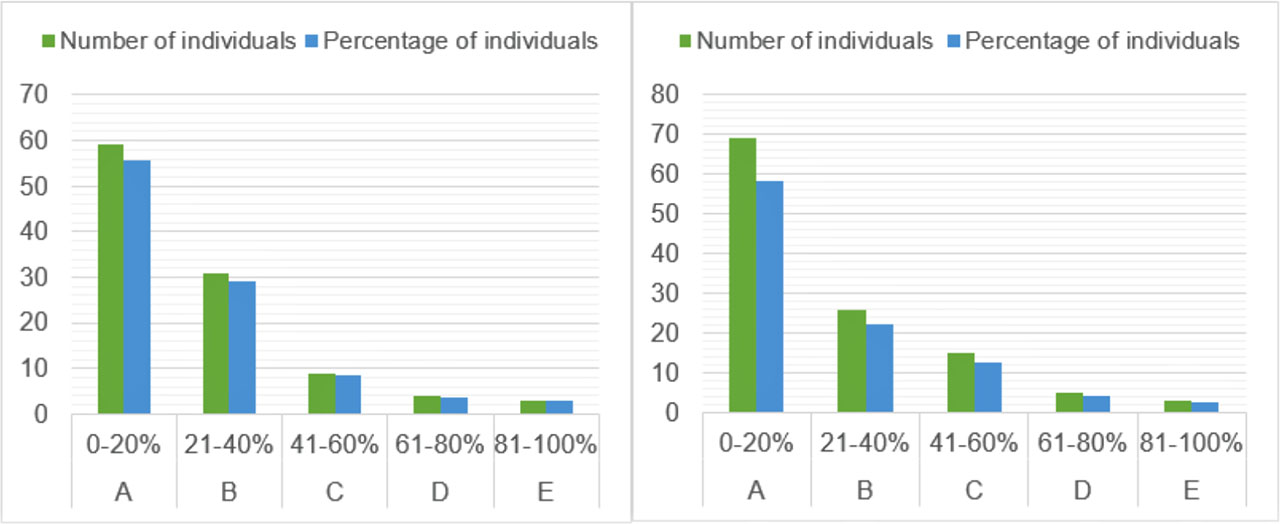
Figure 2.
Frequency class distribution (Raunkiaer, 1934) of the plant species encountered during the study in two altitudinal ranges, AR_1 (left) and AR_2 (right).
The analysis of diversity indices revealed that AR_2 is more diverse than AR_1 because the H’ value was obtained higher for AR_2 than AR_1 except for climbers, i.e. for trees, shrubs, and herbs, as shown in Table 5. While the value of CD was found to be just opposite of it, i.e. higher for AR_1 for trees, shrubs, and herbs but lower for climbers and vice versa for AR_2. On the other hand, the value of E was higher for trees and herbs for AR_2 while for shrubs and climbers for AR_1 (Table 5). Other than this, to understand the similarity in flora among the selected altitudinal ranges, Sørensen's Index of similarity was deliberated. A total of 81 species of plants remained common in both altitudinal ranges and the similarity index value was found to be 0.36, i.e. less than 0.5, indicating low similarity between them.
Table 5.
Diversity indices of the selected altitudinal ranges in the foothills of the Himalayas.
| S.N. | Habit | 400–600 m AMSL | 600–800 m AMSL | ||||||
|---|---|---|---|---|---|---|---|---|---|
| H′ | CD | E | d | H′ | CD | E | d | ||
| 1 | Trees | 2.958 | 0.0723 | 0.908 | 6.134 | 3.224 | 0.0479 | 0.9388 | 6.662 |
| 2 | Shrubs | 1.996 | 0.1897 | 0.7561 | 1.997 | 2.117 | 0.1832 | 0.7474 | 2.385 |
| 3 | Herbs | 3.370 | 0.0655 | 0.8449 | 7.371 | 3.467 | 0.0532 | 0.8538 | 7.383 |
| 4 | Climbers | 1.798 | 0.1959 | 0.9427 | 2.219 | 2.136 | 0.1556 | 0.8597 | 1.625 |
Population structure
On the selected study area, the population structure was also deliberated for tree species (Figure 3 and Figure 4), and it was found that in both the altitudinal ranges, girth class D had the maximum number of tree species (CBH=61–90 cm) followed by girth class C (CBH=31–60 cm), such as Acacia nilotica, Butea monosperma, Cassia fistula, Grewia optiva, Kydia calycina, Pongamia pinnata, Prosopis cinereria, etc. While only a few tree species were found to belong to A and B girth classes (CBH- <30 cm).
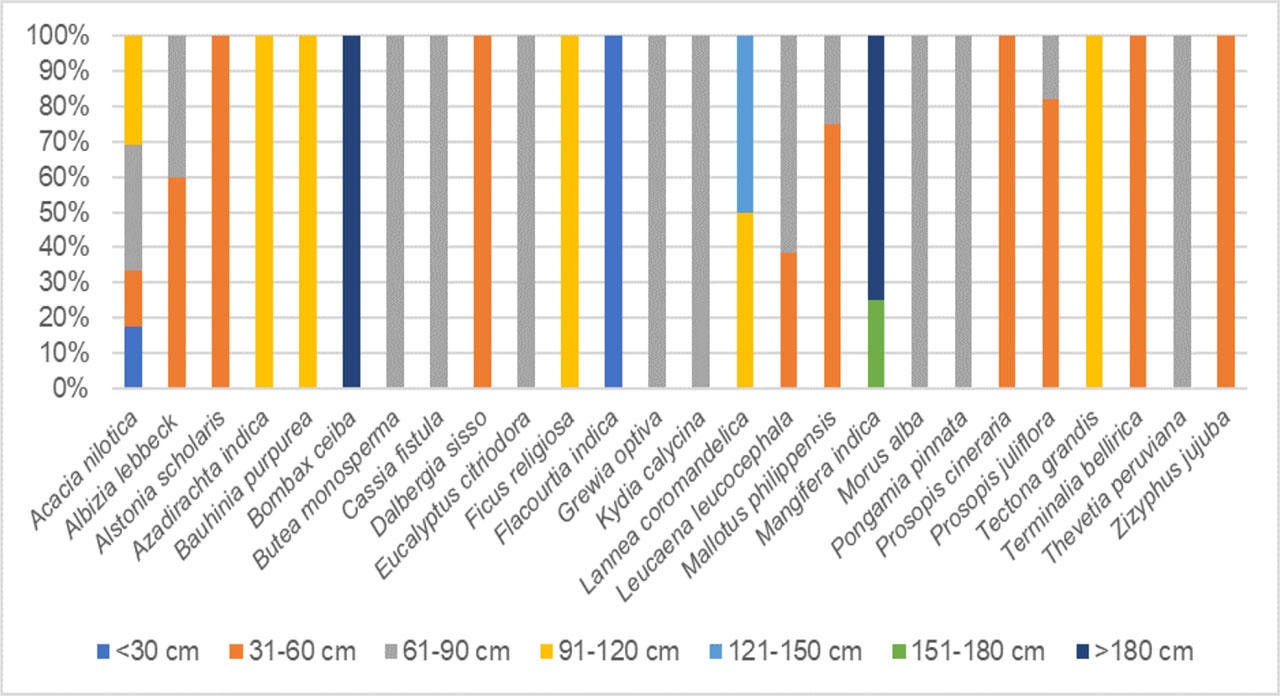
Figure 3.
Graph showing the tree species percentage of AR_1 belonging to girth classes; A=0–10.4 cm, B=10.5–30 cm, C=31–60 cm, D=61–90 cm, E=91–120 cm, F=121–150 cm, G=151–180 cm and H=181–210 cm.
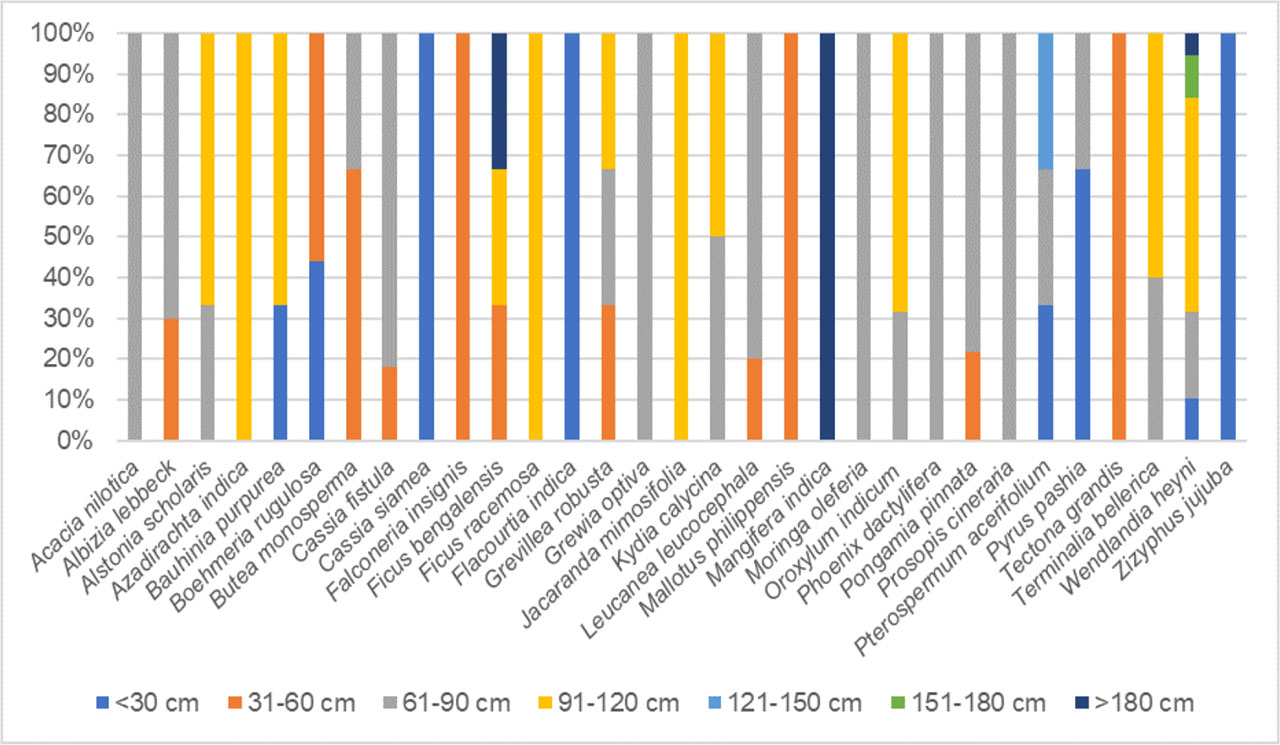
Figure 4.
Graph showing the tree species percentage of AR_2 belonging to girth classes; A=0–10.4 cm, B=10.5–30 cm, C=31–60 cm, D=61–90 cm, E=91–120 cm, F=121–150 cm, G=151–180 cm and H=181–210 cm.
Pearson correlation analysis
Pearson correlation revealed that D was strongly and positively correlated to A (r = 0.98) along with d (r = 0.53) and H′ (r = 0.57) but negatively correlated with B.A. (r = −0.46), CD (r = −0.43), and E (r = −0.36). Other than this, H′ showed a strong positive correlation with d (r = 0.98) as well as D (r = 0.57), A (r = 0.65), B.A. (r = 0.37), and E (r = 0.28) while correlated negatively to CD (r = −0.98) (Figure 5).
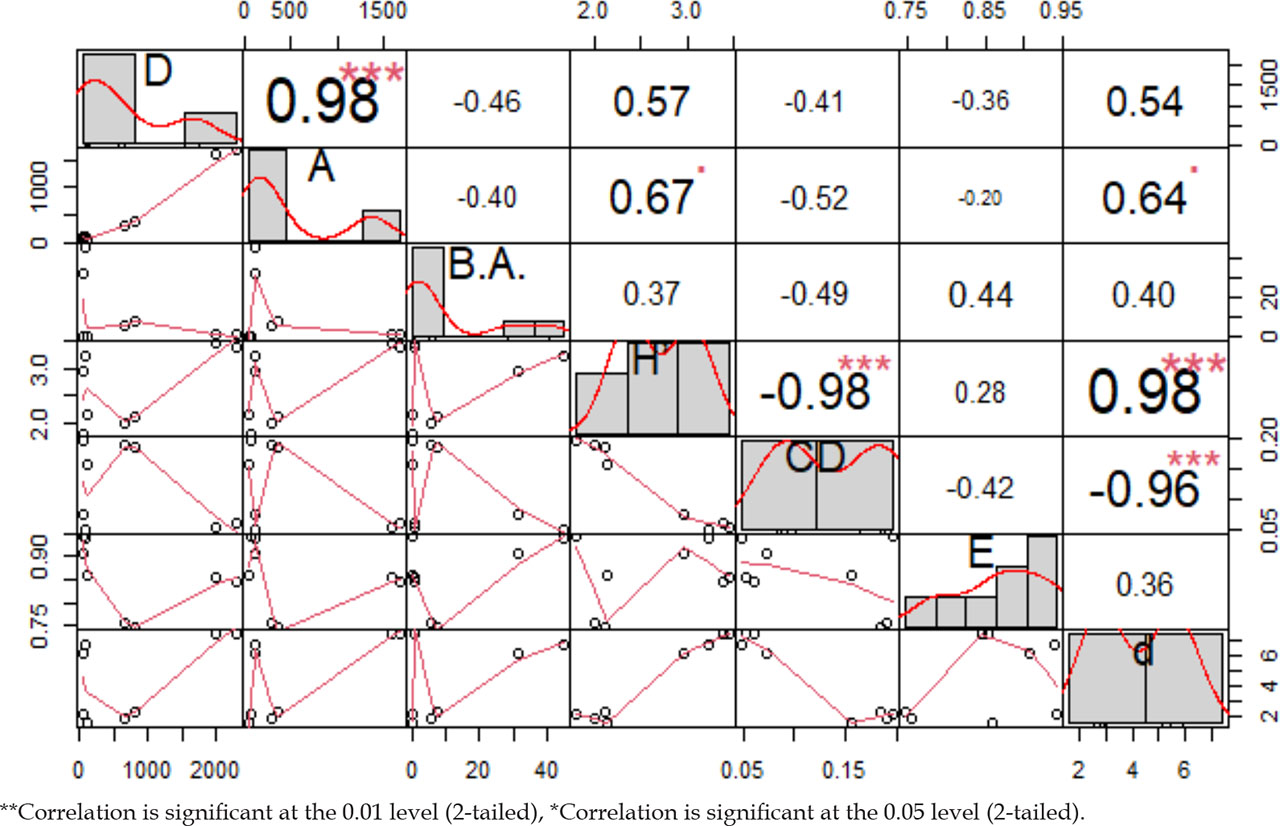
Figure 5.
Pearson correlation between different phytosociological parameters under study.
Discussion
Different forest ecosystems have their distinct floristic composition as the species occurring in them differ in their richness and abundance. In an ecosystem, the spatial and temporal patterns of vegetation are governed by different environmental variables such as climate, resource availability, herbivory, and level of human intervention (Poorter et al., 2024). The present investigation showed that the plant community in the selected area of lower Shiwaliks exhibited differences in floristic composition and diversity with even a small change in elevation. This spatial variation in floristic composition in hilly areas may arise due to factors like climate, altitude, aspect, slope, and edaphic factors (Lal & Lodhiyal, 2015).
A total of 39 trees, 19 shrubs, 68 herbs, and 17 climbers out of 143 species of plants representing 56 families in the lower altitudinal ranges of Morni Hills forests were identified with Poaceae being the dominating family. This can be compared to the results obtained by Devi & Yadava (2006) of 123 plant species (17 trees, 36 shrubs, and 70 herbs) representing 48 families, with Poaceae being the most species-rich. Similarly, Ao et al. (2021) found a total of 118 species with 43 families of plants in the sub-tropical forest of Mokokchung, Nagaland with Fabaceae as the most species-rich family. Kumar & Saikia (2020) found 137 plant species belonging to 51 families in the tropical moist-deciduous forests of Ranchi, Jharkhand. Dagne & Birhanu (2023) also found a total of 137 plant species (47 trees, 36 shrubs, 48 herbs and 11 climbers) with Fabaceae as the dominant species followed by Asteraceae.
The density of trees was calculated as 58.89 ind./ha and 90.32 ind./ha for AR_1 and AR_2, respectively. While Kumar et al. (2010) found tree densities ranging from 458 to 728 ind./ha, Singh et al. (2014) reported that the tree density varied from 7.5 to 175 ind./ha during their investigation. Additionally, Maiguru (2024) found the density of tree species varying from 56 to 136 ind./ha in the Kwesati Forest Reserve, Nigeria. Thus, the present study site has a significant stand density of trees which can be improved by taking care of tree felling as well as improving the growth of saplings. On the other hand, the B.A. of tree species was observed to be 31.47 m2/ha and 45.301 m2/ha for AR_1 and AR_2, respectively. This can be compared with the results of Sahoo et al. (2017), who found the B.A. of trees to be varying from 7.77 to 31.62 m2/ha. Whereas it is lower than the value observed by Kalita & Yumnam (2024), i.e. 71.74 m2/ha but higher than the value of Sherafu et al. (2024), i.e. 29.88 m2/ha.
The dominant plant species among trees, shrubs, herbs, and climbers of the area are Acacia nilotica, Parthenium hysterophorus, Saccharum benghalense, and Abrus precatorius in AR_1 while Cassia fistula, Lantana camara, Leonotis nepetifolia, and Bauhinia vahlii in AR_2, respectively as they possess the maximum value of IVI (Tables 1–4). Because the high value of IVI of a species contributes to its ecological success in a community reflecting adaptation to high disturbance pressure, different factors may be natural and environmental as well as the impact of local communities (Misra, 1968).
Raunkiaer's law states that a species might be rare or numerous in a group, generating two peaks of the distribution with intermediate occupancies for the rest. This is the J-shaped normal frequency distribution curve, and any departure demonstrates forest community heterogeneity. Figure 2 shows a frequency class distribution pattern that differs from the conventional J-shaped curve and may have been caused by biotic and abiotic disruptions, mostly by anthropic activities. Stephenne & Lambin (2004) noted that anthropic activities (e.g. disturbance regimes, such as tree felling) may affect species regeneration directly or indirectly, resulting in frequency decline. All plant species except a few have contiguous distribution. Kumar & Saikia (2020) and Punia et al. (2022) found the same in the forest stands studied.
In addition to this, the presence of widely held species of trees in intermediate girth classes indicates that Morni Hills forests are entering the transition phase since the tree species belonging to lower girth classes are growing to form the forest composition. This sort of stand structure also shows that the replacement of tree size classes by the saplings is disproportionate, thus advocates that if the ongoing seedling recruitment does not recover, the population might decline in the near future.
According to Odum (1983), the diversity of species is a function of the species number in a region, including the equitability with which the individuals are present amongst them. Kent & Coker (1992) stated that the value of H′ generally varies from 1.5 to 3.5 while hardly exceeds 4.5 indicating very high diversity. Thakur & Khare (2006) observed the value of H′ ranging from 2.22 to 3.66 during their study conducted in the forests around Sagar, Madhya Pradesh. Sherafu et al. (2024) reported the H′ value of 3.56 during their study. Thus, the value of H′ calculated during our study was found to follow the trend as it varied from 1.99 to 3.58 for trees, shrubs, herbs, and climbers in the two altitudinal ranges during the present study. It is also very high compared to the range observed by Kumar et al. (2010), i.e. 0.67–0.79. Hence, based on the high H′ value, it can be stated that Morni forest has a high species diversity.
During the present investigation, the CD value varied from 0.047 to 0.205 for trees, shrubs, herbs, and climbers in the two altitudinal ranges. This was found to be way lower than the value observed by Tiamiyu et al. (2023) i.e. 0.955, thus showing low dominance and high diversity. While the evenness or equitability index (E) for trees, shrubs, herbs and climbers ranged from 0.74 to 0.94 during the current study, which is more than the 0.02–0.05 range noted by Kumar et al. (2010) but is more or less comparable to the results of Iqbal et al. (2012), i.e. 0.95–1.11, Sarkar (2016), i.e. 0.73–0.85, Fnd et al. (2024), i.e. 0.71 and Sherafu et al. (2024), i.e. 0.87. Evenness is a chief element of diversity as it indicates the consistency of abundance among the species of a community. Thereby, high evenness ensues if the distribution and abundance of species are equivalent. Other than this, the value of the Margalef Index (d) varied from 1.625 to 7.383 for trees, shrubs, herbs, and climbers in the 4 altitudinal ranges. This is very high in comparison to Sharma et al. (2009) who reported the value of d to vary from 1.19 to 1.18 during their study but to be comparable to Tiamiyu et al. (2023), i.e. 7.862 and Fnd et al. (2024), i.e. 8.7.
Evaluating the difference or dissimilarities between communities has become essential in the field of community ecology. It is among the most readily identifiable attributes of natural forests (Jost et al., 2011) and may reflect distinct mechanisms that generate and preserve biodiversity, as well as habitat effects that outline the forest's structure and composition (Socolar et al., 2016). During the current investigation, the value of Sørensen's Index of similarity was obtained as 0.36 which is less than 0.5, thus indicating low similarity between the two altitudinal ranges. This indicates that the two ranges do not have a high similarity in floristic composition and are significant in terms of their floristic diversity.
The present study found a positive correlation between D, A, H′ and d, but a negative correlation between D, B.A., CD and E. Negi et al. (2022) also reported a positive correlation of D with H′, d and E whereas a negative correlation between CD, H′, B.A. and D. Other than this, H′ showed a strong negative correlation with CD, which is also supported by the results of Negi et al. (2022) and Nandy et al. (2024). If we compare the two altitudinal ranges, we see that AR_2 is more diverse and floristically rich than AR_2. According to Rahbek (1997) and Kessler (2000), productivity may peak at intermediate elevations sometimes. Consequently, activities like grazing, agriculture, development, and tourism were also observed on the current study site which leads to indiscriminate exploitation of vegetation. This could promote invasive species spread as well as the formation of vegetation patches in the forest land degrading the integrity of the forest and reduction in its diversity. And in the present scenario of turning these hills into a tourism hub of the state, they require even more protection and conservation to preserve the wonderful biodiversity they hold.
Conclusions
The biodiversity of the Himalayan ranges is distinct due to the high level of topo-graphic and climatic heterogeneity. The vegetation analysis of the foothills of the Himalayas in Haryana state revealed a substantial value in terms of diversity, basal area, and density. The two altitudinal ranges showed a significant difference in terms of floristic composition and vegetation structure. However, there may be a risk of biodiversity loss in the near future as a result of a variety of abiotic and biotic disturbances, including deforestation for developmental activities, tourism, and medicinal plant collection, as well as forest fires, landslides, and the invasion of alien plant species. Consequently, to maintain the biodiversity and maintain the natural state of these forests, it is imperative that appropriate management activities be implemented. Additionally, the rural residents of that region should be educated on the significance of biodiversity and encouraged to collaborate with the government and forest department in utilizing the benefits of forests in a sustainable manner.
Acknowledgements
The authors acknowledge the Council of Scientific and Industrial Research (CSIR), New Delhi, for funding this work by providing a Senior Research Fellowship (SRF) to Himanshi Dhiman. We also thank the Morni Hills Forest Department for their assistance during field trips conducted for this research.