
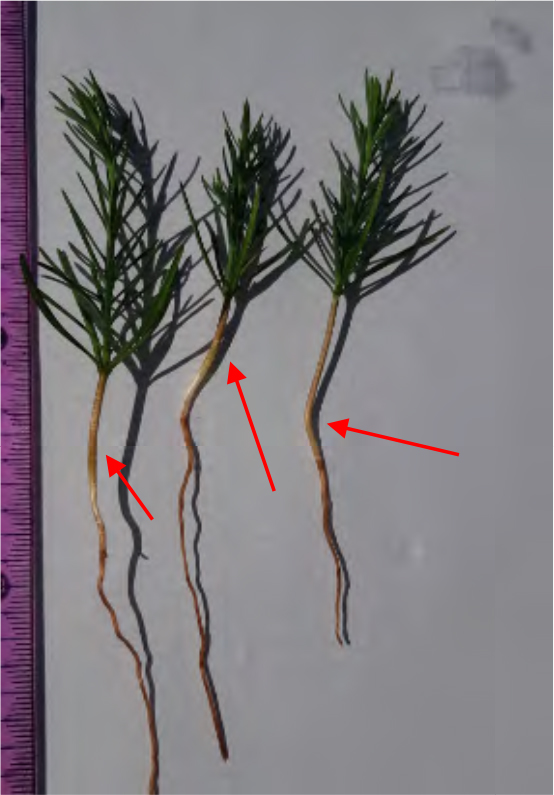
Figure 1
A small lesion associated with the constricted area on the stem (hypocotyl): Disease severity 1.
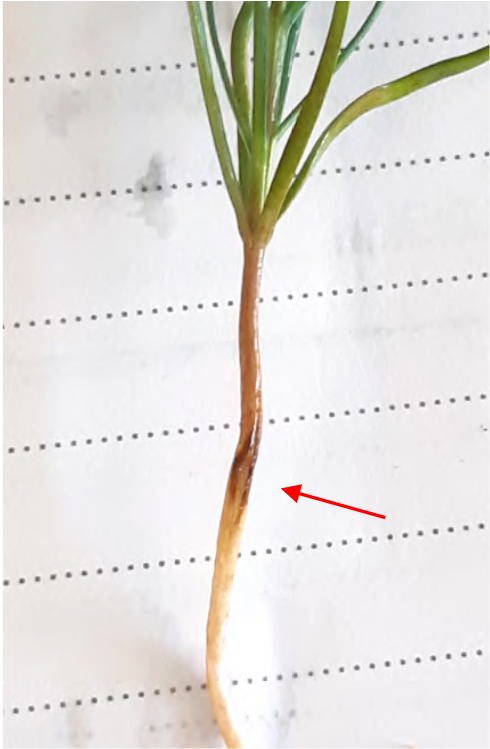
Figure 2
Brown lesion covering 25–50% of the hypocotyl length: Disease severity 2.
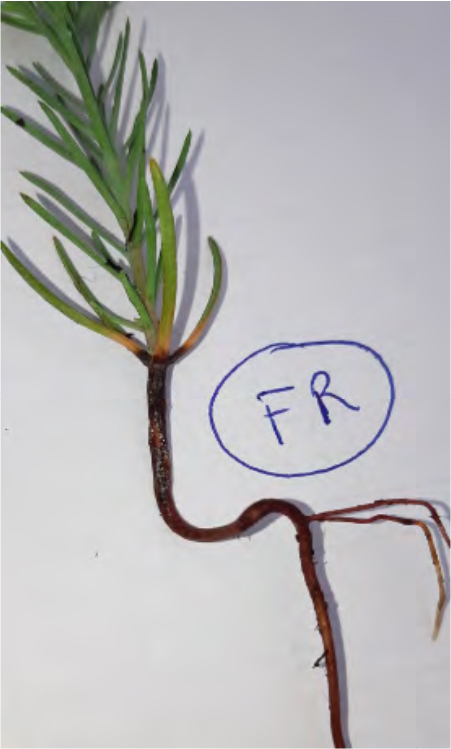
Figure 3
Necrosis affecting more than 50% of the hypocotyl length: Disease severity 3.
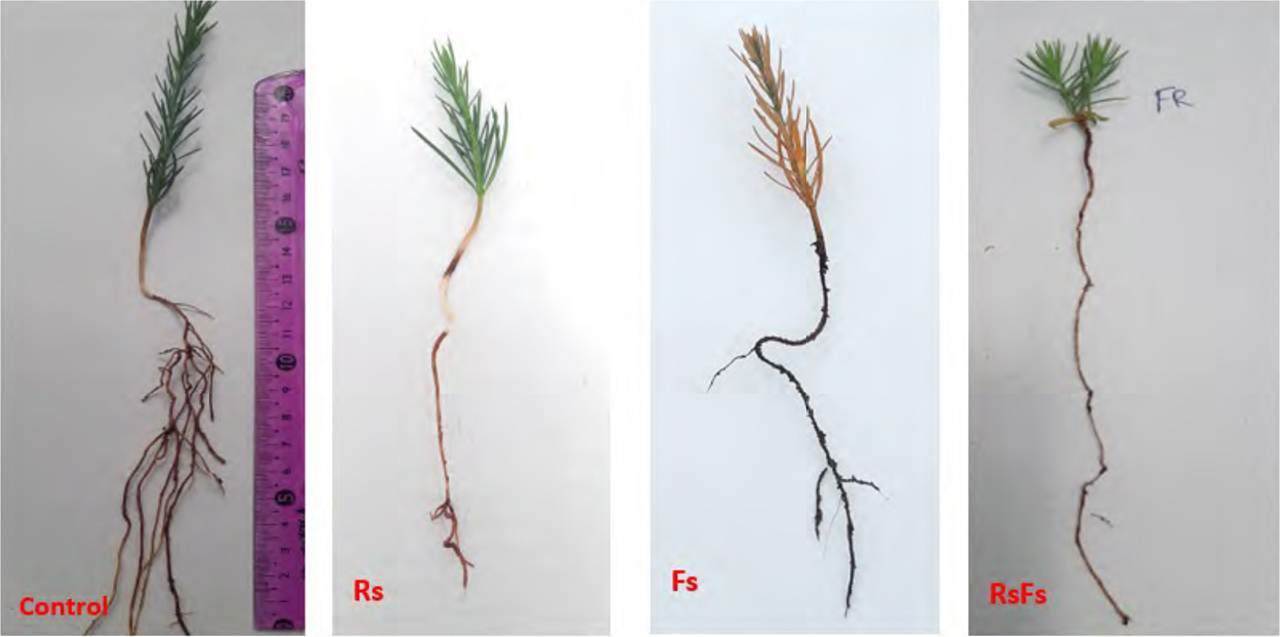
Figure 4
T. articulata seedlings taken from different treatments at 5 weeks. Note the difference between the control plant and inoculated plants: brown to black lesion with collar-constricted stem on the Rs sample; stem canker, general wilting and rotted root on the Fs sample, stunting and rotted roots on the RsFs sample. Contrary to the control plant, all inoculated seedlings showed a lack of fine roots.
Table 1
Effect of fungal pathogens alone and in combination on the pre-emergence and post-emergence of the damping-off disease and survival rate of T. articulata seedlings 62 days post-inoculation.
Table 2
Effect of fungal pathogens alone and in combination on different growth parameters of T. articulata seedlings 62 days post-inoculation; reduction in growth (%) in brackets.
| Treatment | Shoot height (cm)* | No. of leaves* | No. of lateral roots* | Lateral root length (cm) * | Primary root length (cm) * | Root system total length (cm) * |
|---|---|---|---|---|---|---|
| Control | 12.04 c | 57.65 c | 17.23 b | 3.6 c | 23.46 c | 86.32 b |
| Rs | 7.31 a (39.29%) | 49.85 b (13.53%) | 11.57 a (32.85%) | 3.14 b (12.78%) | 21.79 b (7.12%) | 51.02 a (40.89%) |
| Fs | 7.66 a (36.38%) | 33.74 a (41.47%) | 11.7 a (32.1%) | 2.89 ab (19.72%) | 19.48 a (16.97%) | 54.58 a (36.77%) |
| RsFs | 8.64 b (28.24%) | 44.34 b (23.09%) | 11.98 a (30.47%) | 2.56 a (28.89%) | 18.25 a (22.21%) | 48.98 a (43.26%) |
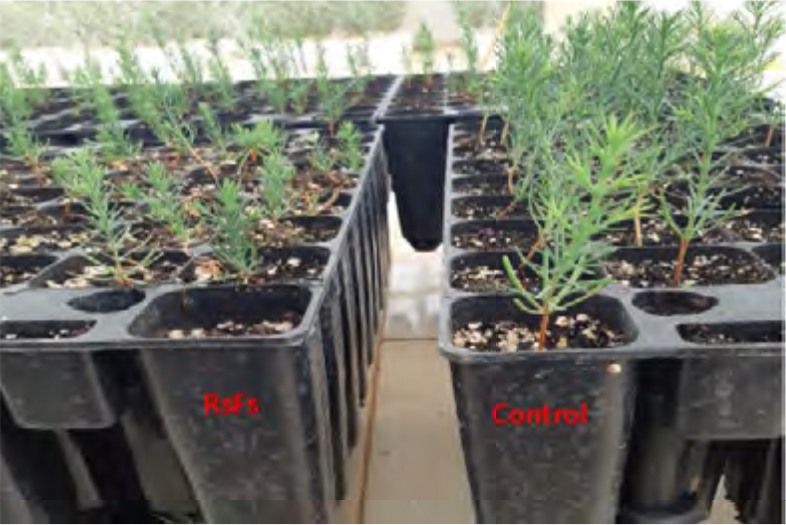
Figure 5
T. articulata seedlings under two treatments at 62 days: inoculated seedlings (RsFs treatment) and uninoculated seedlings (control).
Table 3
Effect of fungal pathogens alone and in combination on disease severity and disease-index (%) recorded on T. articulata seedlings 62 days post-inoculation.
Table 4
Fungal recovery (%) from epicotyl, hypocotyl, primary and lateral roots of T. articulata seedlings 62 days post-inoculation by R. solani and F. solani singly or in combination.
| Treatment | Isolation percentage Pi (%) | |||||||
|---|---|---|---|---|---|---|---|---|
| Epicotyl | Hypocotyl | Primary root | Lateral roots | |||||
| R. Solani | F. Solani | R. Solani | F. Solani | R. Solani | F. Solani | R. Solani | F. Solani | |
| Rs | 0 | – | 70 | – | 70 | – | 56 | – |
| Fs | – | 45 | – | 55 | – | 60 | – | 75 |
| RsFs | 0 | 28 | 17 | 43 | 13 | 42 | 25 | 33 |